


 |
市場調查報告書
商品編碼
2120498
印度玻璃包裝市場:市場佔有率分析、產業趨勢與統計及成長預測(2026-2031)India Glass Packaging - Market Share Analysis, Industry Trends & Statistics, Growth Forecasts (2026 - 2031) |
||||||

※ 本網頁內容可能與最新版本有所差異。詳細情況請與我們聯繫。
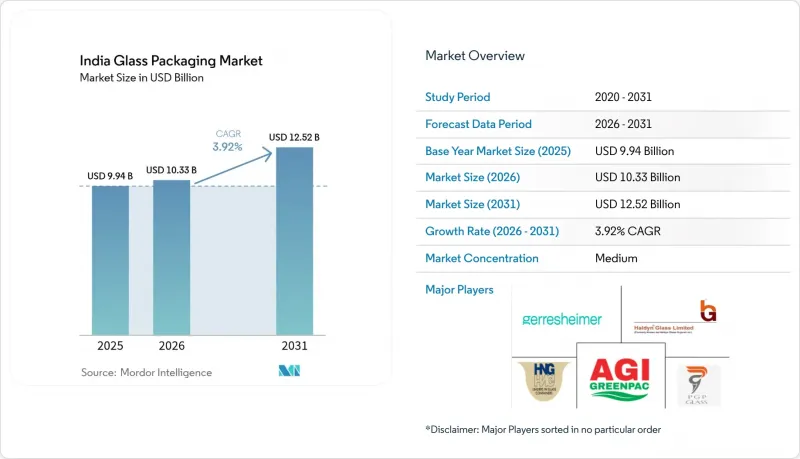
據 Mordor Intelligence 稱,2025 年印度玻璃包裝市場價值為 99.4 億美元,預計到 2031 年將達到 125.2 億美元,而 2026 年為 103.3 億美元,預測期(2026-2031 年)的複合年成長率為 3.92%。
本報告按產品類型(瓶罐、管瓶及其他)、玻璃類型(I型(硼矽酸玻璃)、II型(經處理的鈉鈣玻璃)、其他)、終端用戶行業(食品、軟性飲料、酒精飲料及其他)、容量範圍(小於30毫升、30-100毫升、100-5000000000毫升等。市場預測以美元計價。
印度玻璃包裝市場趨勢與洞察
從大規模生產的啤酒轉向精釀烈酒和即飲飲料,正在推動對優質燧石瓶的需求成長。
消費者偏好從普通啤酒轉向精釀烈酒和即飲雞尾酒,為印度玻璃包裝市場的客製化瓶裝產品創造了機會。預計2024會計年度印度酒精飲料出口額將達到3.7509億美元,有跡象表明,優質化正在蔓延至國內市場。馬哈拉斯特拉邦和卡納塔克邦的小型釀酒廠正在打造獨特的燧石和琥珀色模具,以強化品牌故事。雖然遵守印度標準局(BIS)的食品級標準仍然是強制性的,但簡化的邦級許可程序和以旅遊業為重點的政策正在推動這一趨勢。玻璃製造商柔軟性和實現複雜壓紋的能力,在價格上比大規模生產的競爭對手更具優勢。這使得他們擁有了多元化的收入來源,不易受到主流啤酒銷售波動的影響。
擴大疫苗出口和提高生技藥品生產能力將促進 I 型管瓶的使用。
印度玻璃包裝市場正直接受益於美國《生物安全法案》,該法案正將契約製造(CDMO)。 SGD Pharma與康寧公司在特倫甘納邦的合資企業已建立了符合全球生技藥品灌裝和包裝標準的Velocity管瓶生產線。硼矽酸玻璃價格高的原因在於其能承受複雜藥物所帶來的熱衝擊和化學反應。預計印度CDMO的銷售額將從2023年的156.3億美元成長到2028年的267.3億美元,確保下游市場的強勁需求。政府針對27個原料藥產業園推出的生產連結獎勵計畫(PLI)計畫正在降低投資門檻,而原料藥藥品運輸走廊的建設正在縮短出口前置作業時間。這些因素共同鞏固了對高純度管瓶的強勁需求。
在價格敏感型市場,與PET的競爭日益激烈。
政府規定,2025年4月,飲料瓶中再生PET(rPET)的含量必須達到30%,2029年達到60%。這些規定刺激了rPET產能的快速擴張,因此維持了PET的成本優勢。光是Ganesha Eco-PET一家公司就計畫到2026年每年回收4.2萬噸,約佔全國瓶子廢棄物的四分之一。大型飲料公司正在採用輕質PET和可結晶熱填充灌裝PET來取代玻璃瓶,用於盛裝食用油和碳酸飲料,因為運輸和破損成本是這些產品的重要負擔。除非玻璃製造商能夠建立一種經濟高效的可回收模式,否則PET預計將在大眾飲料市場繼續擴大其市場佔有率。
細分市場分析
瓶罐在主流食品飲料應用領域佔據主導地位,在印度玻璃包裝市場中佔最大佔有率,預計到2025年將達到67.25%。然而,隨著藥品出口轉向需要I型硼矽酸玻璃容器的生物製藥,管瓶的市佔率正以4.18%的複合年成長率快速成長。因此,隨著合約研發生產機構(CDMO)擴大產能,到2031年,管瓶在印度玻璃包裝市場的佔有率可能會顯著提升。雖然安瓿瓶和注射器提供了穩定的基礎需求,但高檔管瓶能為專業加工業者帶來更高的附加價值利潤。
這種轉變迫使大型玻璃容器製造商朝向較小規格的產品線多元化發展,否則它們將面臨過度專注於傳統飲料產品線的風險。領先企業正在採用模組化注塑機,實現從500毫升瓶到10毫升管瓶的快速切換,從而減少停機時間並擴大客戶群。藥品合規性審計促使企業投資於線上攝影機偵測和符合ISO 15378標準的無塵室環境,提高了新參與企業的進入門檻,同時也鞏固了綜合參與企業的收入。
預計到2025年,III型鈉鈣玻璃將佔總銷售額的57.80%,這主要得益於其在食用油和調味品領域的成本效益。同時,I型硼矽酸玻璃可望達到4.12%的複合年成長率,主要得益於嚴格的藥典標準和出口導向生物製藥需求。在印度玻璃包裝市場,隨著特倫甘納邦和古吉拉突邦用於低鹼配方的新型熔融罐運作,硼矽酸管瓶市場預計將穩定成長。
儘管鈉鈣玻璃的生產對於規模經濟仍然至關重要,但提高利潤率正日益依賴硼矽酸玻璃。採用氧氣燃燒器和間歇式預熱器的製造商正在降低能源消耗並縮小成本差距。經過處理的鈉鈣玻璃(II型)和具有紫外線阻隔性能的琥珀色玻璃分別繼續用於疫苗和精釀飲料的生產,從而支持了產品線的多樣化,並實現了收入來源的多元化。
其他福利
- Excel格式的市場預測(ME)表
- 3個月的分析師支持
目錄
第1章:引言
- 研究假設和市場定義
- 調查範圍
第2章:調查方法
第3章執行摘要
第4章 市場狀況
- 市場概覽
- 市場促進因素
- 從大規模生產的啤酒轉向精釀烈酒和即飲飲料,正在推動對優質燧石瓶的需求成長。
- 擴大疫苗出口和提高生技藥品生產能力將促進 I 型管瓶的使用。
- D2C化妝品品牌採用玻璃罐進行永續品牌推廣。
- 小規模啤酒廠和精釀酒廠偏愛訂製玻璃器皿
- 各州關於一次性塑膠製品的法規傾向於使用可回收的玻璃容器
- 在生產者激勵計畫 (PLI) 的支持下,新建的玻璃屑加工廠(例如馬哈拉斯特拉邦、特倫甘納邦等地)正在降低原料成本,並擴大對再生玻璃的需求。
- 市場限制因素
- 寶特瓶。
- 液化天然氣和電力價格的波動給貨櫃製造廠的利潤率帶來了壓力。
- 缺乏可回收玻璃容器的逆向物流基礎設施。
- 銀行對維修恢復期較長的反應爐持謹慎態度,減緩了產能擴張的速度。
- 產業價值鏈分析
- 監理情勢
- 波特五力分析
- 交易情境分析
第5章 市場規模與成長預測
- 依產品
- 瓶子和容器
- 管瓶
- 安瓿
- 注射器和藥筒
- 玻璃類型
- I型(硼矽酸玻璃)
- 第二類(處理過的鈉鈣玻璃)
- 第三類(鈉鈣玻璃)
- 按最終用戶行業分類
- 食物
- 軟性飲料
- 酒精飲料
- 化妝品和個人護理
- 製藥
- 按容量範圍
- 少於30毫升
- 30~100ml
- 100~500ml
- 500~1,000ml
- 按地區
- 印度北部
- 西印度群島
- 南印度
- 東印度
第6章 競爭情勢
- 市場集中度
- 策略趨勢
- 市佔率分析
- 公司簡介
- AGI Greenpac Limited
- Gerresheimer AG
- Ajanta Bottle Private Limited
- Canpack India Private Limited
- Hindustan National Glass and Industries Limited
- Borosil Glass Works Limited
- GM Overseas
- Pragati Glass Private Limited
- Piramal Glass Private Limited
- Haldyn Glass Limited
- SGD Pharma India Limited
- Vetropack India
- Schott Kaisha Private Limited
- Sunrise Glass Industries Private Limited
- Kascap Glass Private Limited
第7章 市場機會與未來展望
- 評估尚未開發的市場和未滿足的需求
According to Mordor Intelligence, the India glass packaging market size was valued at USD 9.94 billion in 2025 and estimated to grow from USD 10.33 billion in 2026 to reach USD 12.52 billion by 2031, at a CAGR of 3.92% during the forecast period (2026-2031).
This report is Segmented by Product (Bottles/Containers, Vials, and More), Glass Type (Type I Borosilicate, Type II Treated Soda-Lime, and More), End-User Vertical (Food, Soft-Drink Beverages, Alcoholic Beverages, and More), Capacity Range (<30 Ml, 30-100 Ml, 100-500 Ml and More), and Geography (North India, West India, and More). The Market Forecasts are Provided in Terms of Value (USD).
India Glass Packaging Market Trends and Insights
Craft Spirits Revolution Drives Premium Glass Demand
Consumer migration from standard beer to craft spirits and ready-to-drink cocktails widens opportunities for bespoke bottles in the India glass packaging market. Exports of alcoholic beverages rose to USD 375.09 million in FY 2024, signaling premiumization that spills into domestic shelves. Micro-breweries in Maharashtra and Karnataka commission proprietary molds in flint and amber variants that bolster brand storytelling. Streamlined state licensing and tourism-centric policies sustain this trajectory, although compliance with Bureau of Indian Standards food-grade norms remains compulsory. Glass makers able to deliver small-batch run flexibility and intricate embossing gain a pricing edge over mass-production peers. The result is a diversified revenue stream less exposed to volume swings in mainstream beer.
Pharmaceutical Export Ambitions Fuel Type I Vial Growth
The India glass packaging market benefits directly from the US Biosecure Act, which channels contract manufacturing away from Chinese suppliers toward Indian CDMOs. SGD Pharma's joint venture with Corning in Telangana establishes Velocity Vials capacity aligned with global biologic fill-finish standards. Borosilicate compositions withstand thermal shock and chemical reactivity posed by complex drugs, justifying premium selling prices. India's CDMO revenue is projected to climb from USD 15.63 billion in 2023 to USD 26.73 billion by 2028, ensuring sturdy downstream demand. Government PLI incentives covering 27 bulk-drug parks lower capex hurdles, while dedicated pharma freight corridors shorten export lead times. Collectively, these factors lock in a robust demand pipeline for high-purity vials.
PET Competition Intensifies in Price-Sensitive Segments
Government mandates for 30% recycled PET content in beverage bottles by April 2025, climbing to 60% by FY 2029, spur rapid scale-up of rPET capacity that sustains PET's cost advantage. Ganesha Ecopet alone plans to recycle 42,000 tonnes annually by 2026, capturing roughly one-quarter of national bottle waste. Beverage giants deploy lightweight PET and crystallizable hot-fill grades to replace glass in edible oils and carbonated drinks, where freight and breakage costs weigh heavily. Unless glass makers unlock cost-effective returnable models, PET will continue capturing incremental share in mass-market beverages.
Other drivers and restraints analyzed in the detailed report include:
- Sustainability Mandates Accelerate Glass Substitution
- PLI-Backed Cullet Processing Reduces Cost Base
- Energy Cost Volatility Pressures Manufacturing Economics
For complete list of drivers and restraints, kindly check the Table Of Contents.
Segment Analysis
Bottles and jars retained the largest 2025 share at 67.25% of the India glass packaging market size, anchored by mainstream food and beverage usage. However, vials are advancing at a 4.18% CAGR as pharmaceutical exports pivot toward biologics that require Type I borosilicate formats. The India glass packaging market share held by vials could therefore climb meaningfully by 2031 as CDMOs scale capacity. Ampoules and syringes deliver steady baseline demand, yet premium vial specifications capture value-added margins for specialized converters.
The shift compels container glass majors to diversify into smaller formats or risk over-concentration in legacy beverage lines. Early movers are installing modular forming machines capable of rapid changeovers from 500 ml bottles to 10 ml vials, reducing downtime and broadening customer reach. Pharmaceutical compliance audits drive investments in on-line camera inspection and ISO 15378 cleanroom environments, lifting barriers to entry for new firms but consolidating revenues for integrated players.
Type III soda-lime constituted 57.80% of 2025 revenue thanks to its cost-effectiveness in edible oils and sauces. Yet Type I borosilicate is on a 4.12% CAGR trajectory, propelled by stringent pharmacopeia norms and export-oriented biologics demand. The India glass packaging market size for borosilicate vials is forecast to expand steadily as Telangana and Gujarat commission new melting tanks with low-alkali formulations.
Soda-lime volumes remain essential for scale economics, but margin uplift increasingly hinges on borosilicate. Producers integrating oxy-fuel burners and batch pre-heaters curb energy intensity, narrowing cost gaps. Treated soda-lime (Type II) and UV-shielding amber variants continue to serve vaccines and craft beverages, respectively, underpinning a diversified product stack that insulates revenue streams.
Complete Report Scope:
- By Product
- Bottles / Containers
- Vials
- Ampoules
- Syringes / Cartridges
- By Glass Type
- Type I (Borosilicate)
- Type II (Treated Soda-lime)
- Type III (Soda-lime)
- By End-user Vertical
- Food
- Soft-drink Beverages
- Alcoholic Beverages
- Cosmetics and Personal Care
- Pharmaceutical
- By Capacity Range
- <30 ml
- 30 - 100 ml
- 100 - 500 ml
- 500 - 1 000 ml
- By Region
- North India
- West India
- South India
- East India
List of Companies Covered in this Report:
- AGI Greenpac Limited
- Gerresheimer AG
- Ajanta Bottle Private Limited
- Canpack India Private Limited
- Hindustan National Glass and Industries Limited
- Borosil Glass Works Limited
- G.M Overseas
- Pragati Glass Private Limited
- Piramal Glass Private Limited
- Haldyn Glass Limited
- SGD Pharma India Limited
- Vetropack India
- Schott Kaisha Private Limited
- Sunrise Glass Industries Private Limited
- Kascap Glass Private Limited
Additional Benefits:
- The market estimate (ME) sheet in Excel format
- 3 months of analyst support
TABLE OF CONTENTS
1 INTRODUCTION
- 1.1 Study Assumptions and Market Definition
- 1.2 Scope of the Study
2 RESEARCH METHODOLOGY
3 EXECUTIVE SUMMARY
4 MARKET LANDSCAPE
- 4.1 Market Overview
- 4.2 Market Drivers
- 4.2.1 Shift from mass beer to craft spirits and RTDs raises demand for premium flint bottles
- 4.2.2 Vaccine export push and biologics manufacturing capacity spur Type I vial uptake
- 4.2.3 D2C beauty brands adopt glass jars for sustainable branding
- 4.2.4 Micro-breweries and craft distilleries prefer bespoke glass formats
- 4.2.5 State bans on single-use plastics favour returnable glass containers
- 4.2.6 New PLI-backed cullet-processing plants (e.g., Maharashtra, Telangana) cut raw-material cost and boost demand for recycled glass
- 4.3 Market Restraints
- 4.3.1 Cost-competitive PET bottles erode share in edible oil and soft drinks
- 4.3.2 Volatile LNG and electricity prices squeeze margins for container plants
- 4.3.3 Reverse-logistics for returnable glass remains underdeveloped
- 4.3.4 Banks wary of long-payback furnace rebuilds slowing capacity addition
- 4.4 Industry Value Chain Analysis
- 4.5 Regulatory Landscape
- 4.6 Porter's Five Forces Analysis
- 4.6.1 Bargaining Power of Suppliers
- 4.6.2 Bargaining Power of Buyers
- 4.6.3 Threat of New Entrants
- 4.6.4 Threat of Substitutes
- 4.6.5 Intensity of Rivalry
- 4.7 Trade Scenario Analysis
5 MARKET SIZE AND GROWTH FORECASTS (VALUE)
- 5.1 By Product
- 5.1.1 Bottles / Containers
- 5.1.2 Vials
- 5.1.3 Ampoules
- 5.1.4 Syringes / Cartridges
- 5.2 By Glass Type
- 5.2.1 Type I (Borosilicate)
- 5.2.2 Type II (Treated Soda-lime)
- 5.2.3 Type III (Soda-lime)
- 5.3 By End-user Vertical
- 5.3.1 Food
- 5.3.2 Soft-drink Beverages
- 5.3.3 Alcoholic Beverages
- 5.3.4 Cosmetics and Personal Care
- 5.3.5 Pharmaceutical
- 5.4 By Capacity Range
- 5.4.1 <30 ml
- 5.4.2 30 - 100 ml
- 5.4.3 100 - 500 ml
- 5.4.4 500 - 1 000 ml
- 5.5 By Region
- 5.5.1 North India
- 5.5.2 West India
- 5.5.3 South India
- 5.5.4 East India
6 COMPETITIVE LANDSCAPE
- 6.1 Market Concentration
- 6.2 Strategic Moves
- 6.3 Market Share Analysis
- 6.4 Company Profiles (includes Global level Overview, Market level overview, Core Segments, Financials as available, Strategic Information, Market Rank/Share for key companies, Products and Services, and Recent Developments)
- 6.4.1 AGI Greenpac Limited
- 6.4.2 Gerresheimer AG
- 6.4.3 Ajanta Bottle Private Limited
- 6.4.4 Canpack India Private Limited
- 6.4.5 Hindustan National Glass and Industries Limited
- 6.4.6 Borosil Glass Works Limited
- 6.4.7 G.M Overseas
- 6.4.8 Pragati Glass Private Limited
- 6.4.9 Piramal Glass Private Limited
- 6.4.10 Haldyn Glass Limited
- 6.4.11 SGD Pharma India Limited
- 6.4.12 Vetropack India
- 6.4.13 Schott Kaisha Private Limited
- 6.4.14 Sunrise Glass Industries Private Limited
- 6.4.15 Kascap Glass Private Limited
7 MARKET OPPORTUNITIES ANDFUTURE OUTLOOK
- 7.1 White-space and Unmet-Need Assessment

 佛羅倫薩方形罐市場規模、佔有率和成長分析:按材質、容量、蓋子類型、應用、最終用戶和地區分類——2026-2033年行業預測
 玻璃包裝市場分析及預測(至2035年):依類型、產品、技術、組件、應用、材料類型、製程、最終用戶、功能及解決方案分類
 玻璃包裝:市場佔有率分析、產業趨勢與統計、成長預測(2026-2031)
 棕色玻璃包裝市場:全球市場預測(2026-2032 年)玻璃包裝市場:按包裝類型、玻璃類型、製造流程、產能、應用和分銷管道分類-全球市場預測(2026-2032 年)
 2026-2034年全球食品飲料玻璃包裝市場規模、佔有率、趨勢和成長分析報告
 復古相機市場:全球產業規模、市場佔有率、趨勢、機會和預測(按類型、狀況、分銷管道和地區分類)、競爭格局(2021-2031 年)
 食品飲料玻璃包裝市場規模、佔有率和趨勢分析報告:按產品類型、產能、最終用途、地區和細分市場預測(2026-2033 年)
 玻璃包裝市場報告:按產品、最終用戶和地區分類(2026-2034 年)
 玻璃包裝市場:按類型、終端用戶行業和地區分類