


 |
市場調查報告書
商品編碼
2120457
精準灌溉:市場佔有率分析、產業趨勢與統計、成長預測(2026-2031)Precision Irrigation - Market Share Analysis, Industry Trends & Statistics, Growth Forecasts (2026 - 2031) |
||||||

※ 本網頁內容可能與最新版本有所差異。詳細情況請與我們聯繫。
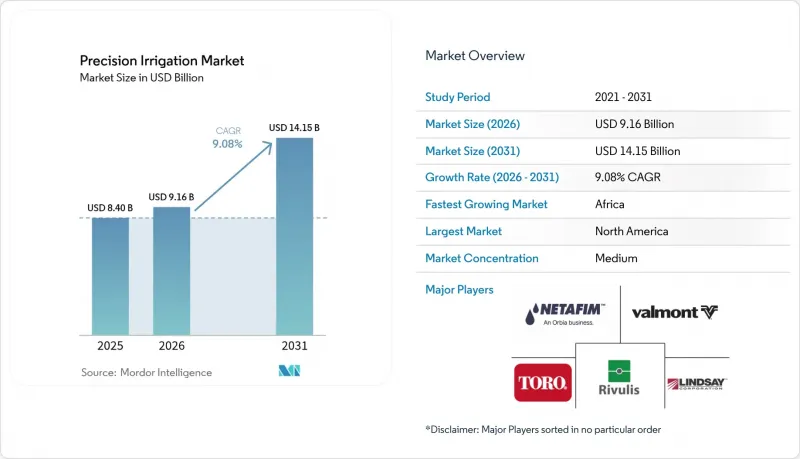
據 Mordor Intelligence 稱,2025 年精準灌溉市場價值 84 億美元,預計到 2031 年將達到 141.5 億美元,而 2026 年為 91.6 億美元,預測期(2026-2031 年)複合年成長率為 9.08%。
本報告按灌溉方式(噴灌、滴灌等)、組件(控制器和定時器、流量計和閥門等)、作物類型(田間作物、種植作物、果園和葡萄園等)以及地區(北美、歐洲、亞太地區等)進行分類。市場預測以美元計價。
全球精準灌溉市場趨勢及洞察
擴大節水農業的補貼
補貼計畫已將滴灌和中心支軸式噴灌升級的投資回收期從七年縮短至不到四年,從而促進了融資困難的農民採用這些技術。亞利桑那州和加州將於2024年向棉花、乳製品和特種作物生產商提供總計7,500萬美元的補貼,使其淨資本支出減少高達50%。澳洲已將其「農場緊急供水基礎設施補貼計畫」延長至2025年,補貼感測器和控制器一半的成本,以應對墨累-達令河流域的乾旱壓力。印度的「總理農民能源安全與發展舉措(PM-KUSUM)」已為18萬農民提供了一套結合太陽能水泵和滴灌套件的系統,有效地解決了能源和水資源方面的挑戰。許多此類計劃都整合了碳權額度,使生產者能夠將節水措施貨幣化,進一步提高了早期採用者的專案的經濟效益。
擴大園藝叢集中滴灌系統的應用
在高價值蔬果產區,從漫灌到滴灌的轉變速度超過了其他大田作物種植的整體趨勢。在加州中央谷地,到2024年,78%的杏仁種植面積將採用滴灌。這一成長與《永續地下水管理法》規定的地下水使用限制密切相關。在西班牙阿爾梅里亞的溫室中,幾乎全部採用循環滴灌系統,其用水效率超過90%,這項標準目前正在影響摩洛哥和土耳其。在印度納西克的葡萄園中,滴灌的採用率以每年22%的速度成長,補貼系統成本已降至每公頃800美元。智利的出口型藍莓種植者採用地下滴灌來減少鹽鹼脅迫,在節水35%的同時,產量提高了18%。
高初始成本與漫灌的比較
精準灌溉系統的成本仍比漫灌基礎設施高出200%以上,這給無法取得低利率貸款的生產者構成了一大障礙。在印度,補貼後安裝40公頃地下滴灌系統的成本為每公頃2500至3200美元,而漫灌管道的成本僅為每公頃800美元。因此,許多蔬菜生產者推遲設備升級,直到缺水情況嚴重到必須採取行動為止。在肯亞,一套滴灌設備的成本約為每公頃1,200美元,約佔農村家庭收入的60%,因此其推廣幾乎完全依賴捐助者的津貼。每年的過濾和發送器維護成本佔營運預算的15%至20%,鑑於目前能源價格低廉,節水效益並不那麼顯著。
細分市場分析
預計到2025年,滴灌將在精準灌溉領域佔據53.35%的市場佔有率,並在2031年之前以10.42%的複合年成長率成長,成為規模最大、成長最快的細分市場。地下滴灌在棉花和玉米等大田作物中越來越受歡迎,因為埋設的管道可以減少水分蒸發,並將養分直接輸送到根系區域,與噴灌相比,節水高達60%。地表滴灌仍是果園、葡萄園和高價值蔬菜作物的主要灌溉方式。加州杏仁種植者由於面臨該州地下水法的用水限制,到2024年,滴灌的採用率已提高到78%。一種名為「精準移動滴灌」的混合系統,透過將滴灌帶連接到可移動框架上,使單一系統能夠覆蓋多個田地。這種節約成本的方法目前正在以色列、肯亞和印度推廣。西班牙阿爾梅里亞佔地 31,000 公頃的溫室綜合體展示了尖端技術,採用幾乎完全循環的滴灌系統,利用了 90% 以上的供水量。
傳統噴灌系統、中心支軸式噴灌系統和側移式噴灌系統仍佔據精準灌溉市場的剩餘佔有率,但由於監管機構建議使用蒸發率較低的系統,它們的成長速度落後於滴灌。中心支軸式噴灌系統在大平原和巴西塞拉多地區仍然佔據主導地位,但許多業主正在採用變數轉換套件,使現有系統也能達到滴灌的精準度。側移式噴灌系統以直線而非旋轉的方式運行,預計到2024年將成長9%,因為它們可以覆蓋中心支軸式噴灌系統難以處理的矩形和不規則形狀地塊。在土地所有權分散的地區,傳統的固定式和手動噴灌仍在使用,但微噴灌和滴灌器正在填補幼苗需要輕柔澆水的細分市場。滴灌在肥料灌溉自動化方面也具有優勢。在堪薩斯州進行的試驗中,這使得養分利用效率提高了15%,即使在中心支軸式噴灌系統存在技術限制的坡地上也能發揮作用。
區域分析
預計到2025年,北美將引領精準灌溉市場,佔31.55%的銷售額,主要得益於其強大的中心支軸式噴灌基礎設施以及美國農業部一項津貼高達50%維修費用的項目。此外,加州和奧加拉拉含水層地區更嚴格的地下水法規也推動了對滴灌系統和可變流量中心支軸式噴灌機的需求。非洲預計將成為成長最快的市場,到2031年複合年成長率將達到10.05%,這主要得益於世界銀行和非洲開發銀行提供的旨在資助小規模農戶滴灌計畫的貸款。在肯亞、衣索比亞和摩洛哥等國,捐助者支持和政府補貼的增加正在加速從先導計畫向大規模商業農業的過渡。
在歐洲,農民受益於通用農業政策(CAP)的津貼,這些補貼涵蓋了精密農業升級改造一半的成本。同時,西班牙和義大利國家層級的地下水使用量限制使得滴灌成為主要蔬果產區的預設選擇。亞太地區的需求主要受印度「總理庫蘇姆」(PM-KUSUM)太陽能水泵計畫和中國針對新開墾農地的強制性精密農業標準的推動,目前全球規模最大的補貼安裝工程正在進行中。在中東,農民依靠沙烏地阿拉伯「2030願景」和阿拉伯聯合大公國「糧食安全計畫」提供的政府支持資金籌措,這些計畫強制要求在新農業計畫中安裝精準灌溉系統。南美洲的成長則主要得益於巴西的塞拉多草原和阿根廷的潘珀斯地區,在這些地區,中心支軸式噴灌系統正在擴大可種植面積,即使在降雨量不穩定的邊緣地區也是如此。
在北美,能源成本上漲和水資源緊張預計將推動傳統中心支軸式噴灌系統採用可變灌溉技術,從而縮短投資回收期。在歐洲,為遵守歐盟水足跡報告法規,感測器應用將加速普及,同時,對現有滴灌網路軟體訂閱的需求也將成長。在亞太地區,隨著政府補貼擴大到中型農場,以及本地製造商透過自主生產滴灌帶降低系統成本,預計市場將保持持續成長動能。非洲面臨的下一個挑戰是建立備件儲存設施和技術人員網路,以確保新安裝的系統運作,而具有前瞻性的供應商正在競相填補這一服務缺口。
其他好處:
- Excel格式的市場預測(ME)表
- 3個月的分析師支持
目錄
第1章:引言
- 研究假設和市場定義
- 調查範圍
第2章:調查方法
第3章執行摘要
第4章 市場狀況
- 市場概覽
- 市場促進因素
- 擴大節水農業的補貼
- 擴大園藝叢集中滴灌系統的應用
- 土壤濕度物聯網(IoT)感測器的整合
- 樞軸式改裝套件可降低中型農場的資本支出 (CAPEX)。
- 企業對淨零用水的承諾正在推動用水量關鍵績效指標的提升。
- 針對缺水地區的創業投資創投資金正在激增。
- 市場限制因素
- 高初始成本與漫灌的比較
- 新興經濟體土地所有權的碎片化
- 非洲售後服務網的缺失
- 網路連接式灌溉控制器的資料隱私問題
- 波特五力分析
第5章 市場規模與成長預測
- 透過灌溉法
- 噴水灌溉
- 傳統噴灌
- 中心樞軸式噴灌
- 橫向/直線移動式噴灌
- 滴灌
- 地表滴灌
- 地下滴灌
- 精準移動滴灌
- 其他類型
- 噴水灌溉
- 按組件
- 控制器和定時器
- 流量計和閥門
- 土壤濕度感測器
- 軟體服務
- 按作物類型
- 田間作物
- 種植作物
- 果園和葡萄園
- 草坪和觀賞植物
- 按地區
- 北美洲
- 美國
- 加拿大
- 墨西哥
- 其他北美國家
- 歐洲
- 德國
- 英國
- 法國
- 西班牙
- 義大利
- 俄羅斯
- 其他歐洲國家
- 亞太地區
- 中國
- 印度
- 日本
- 澳洲
- 韓國
- 其他亞太國家
- 南美洲
- 巴西
- 阿根廷
- 其他南美國家
- 中東
- 沙烏地阿拉伯
- 阿拉伯聯合大公國
- 土耳其
- 其他中東國家
- 非洲
- 南非
- 肯亞
- 其他非洲國家
- 北美洲
第6章 競爭情勢
- 市場集中度
- 策略趨勢
- 市佔率分析
- 公司簡介
- Netafim Ltd(Orbia Advance Corporation)
- Valmont Industries, Inc.
- Lindsay Corporation
- Rivulis Pte. Ltd.(Temasek Holdings Pte. Ltd.)
- The Toro Company
- Rain Bird Corporation
- Nelson Irrigation Corporation
- Deere & Company
- Mahindra EPC Irrigation Limited(Mahindra & Mahindra Limited)
- Sistema Azud SA
- Hunter Industries, Inc.
- Reinke Manufacturing Co., Inc.
- TL Irrigation Co.
- Metzerplas Cooperative Agricultural Organization Ltd.
- Irritec SpA
第7章 市場機會與未來展望
According to Mordor Intelligence, the precision irrigation market size was valued at USD 8.4 billion in 2025 and estimated to grow from USD 9.16 billion in 2026 to reach USD 14.15 billion by 2031, at a CAGR of 9.08% during the forecast period (2026-2031).
This report is Segmented by Irrigation Type (Sprinkler, Drip, and More), by Component (Controllers and Timers, Flow Meters and Valves, and More), by Crop Type (Field Crops, Plantation Crops, Orchards and Vineyards, and More), and by Geography (North America, Europe, Asia-Pacific, and More). The Market Forecasts are Provided in Terms of Value (USD).
Global Precision Irrigation Market Trends and Insights
Subsidy Expansions for Water-Efficient Farming
Rebate programs are cutting payback periods on drip and pivot upgrades from seven to fewer than four years, lifting adoption among cash-constrained growers. Arizona and California disbursed a combined USD 75 million in 2024 to cotton, dairy, and specialty-crop producers, reducing net capital outlays by up to 50% . Australia extended its On-Farm Emergency Water Infrastructure Rebate Scheme through 2025, covering half of sensor and controller costs to counter drought pressure in the Murray-Darling Basin. India's Pradhan Mantri Kisan Urja Suraksha Evam Utthan Mahabhiyan Yojana (PM-KUSUM) initiative paired solar pumps with drip kits for 180,000 farmers, effectively solving energy and water challenges in one bundle. Carbon-credit linkages embedded in many of these programs let growers monetize water savings, further improving project economics for early adopters.
Rising Adoption of Drip Systems in Horticulture Clusters
High-value fruit and vegetable belts are switching from flood to drip at rates surpassing broader row-crop trends. California's Central Valley reached 78% drip penetration in almond acreage during 2024, a surge tied to groundwater caps under the Sustainable Groundwater Management Act. Spain's Almeria greenhouses operate nearly exclusively on recirculating drip networks that exceed 90% water-use efficiency, a benchmark now influencing Morocco and Turkey. India's Nashik grape belt posted 22% annual growth in drip installations, cutting system costs to USD 800 per hectare after subsidies. Chile's export-oriented blueberry growers adopted subsurface drip to mitigate salt stress, lifting yields 18% while trimming water use by 35%.
High Initial Cost Versus Flood Irrigation
Precision systems still cost more than 200% above flood infrastructure, which deters growers without access to low-interest credit. A 40-hectare subsurface drip install in India ranges from USD 2,500 to USD 3,200 per hectare after subsidy, while flood canals need only USD 800, so many vegetable producers delay upgrades until water caps force action. In Kenya, drip kits priced near USD 1,200 per hectare equal roughly 60% of rural household income, leaving adoption almost entirely dependent on donor grants . Annual filtration and emitter maintenance add 15-20% to operating budgets, which weakens the water-savings argument when energy prices remain low.
Other drivers and restraints analyzed in the detailed report include:
- Integration of Soil-Moisture IoT (Internet of Things) Sensors
- Pivot-Retrofit Kits Lowering CAPEX for Mid-Size Farms
- Fragmented Landholding in Emerging Economies
For complete list of drivers and restraints, kindly check the Table Of Contents.
Segment Analysis
Drip irrigation held a 53.35% market share in the precision irrigation segment in 2025 and is projected to grow at a 10.42% CAGR through 2031, making it both the largest and fastest-growing segment. Subsurface drip irrigation is gaining popularity in row crops such as cotton and corn, as buried lines reduce evaporation and deliver nutrients directly to the root zone, resulting in water use reductions of up to 60% compared to sprinklers. Surface drip remains the workhorse in orchards, vineyards, and high-value vegetable crops; California almond growers, facing extraction caps under the state's groundwater law, increased drip penetration to 78% in 2024. A hybrid called precision mobile drip mounts tape on moveable frames so one system can serve several fields, a cost-saving approach now spreading through Israel, Kenya, and India. Spain's 31,000-hectare Almeria greenhouse hub showcases the cutting edge of technology, operating almost entirely on recirculating drip irrigation that utilizes more than 90% of the applied water.
Sprinkler formats, including traditional, center-pivot, and lateral-move units, comprise the remainder of the precision irrigation market size, yet their growth pace lags behind that of drip as regulators favor low-evaporation options. Center pivots still dominate the Great Plains and Brazil's Cerrado, but many owners are adding variable-rate retrofit kits that bring drip-like precision to existing hardware. Lateral-move systems, which run straight instead of pivoting, expanded 9% in 2024 because they cover rectangular edges and irregular parcels where pivots fall short. Traditional solid-set and hand-move sprinklers persist in areas with fragmented land tenure, while micro-sprinklers and bubblers fill nursery niches that need gentle delivery. Drip's edge also comes from fertigation automation, which raised nutrient efficiency 15% in Kansas trials and works on sloped terrain where pivots face engineering limits.
Complete Report Scope:
- By Irrigation Type
- Sprinkler Irrigation
- Traditional Sprinklers
- Center Pivot Sprinklers
- Lateral / Linear Move Sprinklers
- Drip Irrigation
- Surface Drip Irrigation
- Sub-surface Drip Irrigation
- Precision Mobile Drip Irrigation
- Other Types
- Sprinkler Irrigation
- By Component
- Controllers and Timers
- Flow Meters and Valves
- Soil-Moisture Sensors
- Software and Services
- By Crop Type
- Field Crops
- Plantation Crops
- Orchards and Vineyards
- Turf and Ornamentals
- By Geography
- North America
- United States
- Canada
- Mexico
- Rest of North America
- Europe
- Germany
- United Kingdom
- France
- Spain
- Italy
- Russia
- Rest of Europe
- Asia-Pacific
- China
- India
- Japan
- Australia
- South Korea
- Rest of Asia-Pacific
- South America
- Brazil
- Argentina
- Rest of South America
- Middle East
- Saudi Arabia
- United Arab Emirates
- Turkey
- Rest of Middle East
- Africa
- South Africa
- Kenya
- Rest of Africa
- North America
Geography Analysis
North America is projected to lead the precision irrigation market with a 31.55% revenue share in 2025, driven by a substantial center-pivot infrastructure and the United States Department of Agriculture (USDA) programs that subsidize up to 50% of retrofit costs. Additionally, stricter groundwater regulations in California and the Ogallala Aquifer region are increasing the demand for drip irrigation systems and variable-rate pivots. Africa is anticipated to be the fastest-growing market, with a CAGR of 10.05% through 2031, supported by World Bank and African Development Bank loans aimed at financing smallholder drip irrigation projects. Increased donor support and government subsidies in countries such as Kenya, Ethiopia, and Morocco are facilitating the transition of pilot projects into large-scale commercial farming operations.
Europe benefits from Common Agricultural Policy grants that cover half of precision upgrades, while national groundwater caps in Spain and Italy make drip the default choice for fruit and vegetable belts. Asia-Pacific demand is anchored by India's PM-KUSUM solar-pump bundles and China's mandatory precision standards on new farmland, creating the world's largest pipeline of subsidized installations. The Middle East relies on state-backed financing under Saudi Vision 2030 and the United Arab Emirates food-security plan, which require precision systems for new agricultural projects. South America's growth stems from Brazil's Cerrado and Argentina's Pampas, where pivots extend cropping into marginal zones subject to erratic rainfall.
North America is projected to add variable-rate technology to legacy pivots, shortening payback periods as energy costs rise and water allocations tighten. Europe will intensify sensor adoption to meet the European Union's water-footprint reporting rules, driving software subscriptions that layer onto existing drip networks. Asia-Pacific should see sustained momentum as state subsidies expand to mid-size farms and local manufacturers cut system costs with domestic drip-tape production. Africa's next challenge is building spare-parts depots and technician networks to keep newly installed systems running, a service gap that forward-looking vendors are racing to fill.
- Netafim Ltd (Orbia Advance Corporation)
- Valmont Industries, Inc.
- Lindsay Corporation
- Rivulis Pte. Ltd. (Temasek Holdings Pte. Ltd.)
- The Toro Company
- Rain Bird Corporation
- Nelson Irrigation Corporation
- Deere & Company
- Mahindra EPC Irrigation Limited (Mahindra & Mahindra Limited)
- Sistema Azud S.A.
- Hunter Industries, Inc.
- Reinke Manufacturing Co., Inc.
- T-L Irrigation Co.
- Metzerplas Cooperative Agricultural Organization Ltd.
- Irritec S.p.A.
Additional Benefits:
- The market estimate (ME) sheet in Excel format
- 3 months of analyst support
TABLE OF CONTENTS
1 Introduction
- 1.1 Study Assumptions and Market Definition
- 1.2 Scope of the Study
2 Research Methodology
3 Executive Summary
4 Market Landscape
- 4.1 Market Overview
- 4.2 Market Drivers
- 4.2.1 Subsidy Expansions for Water-Efficient Farming
- 4.2.2 Rising Adoption of Drip Systems in Horticulture Clusters
- 4.2.3 Integration of Soil-Moisture IoT (Internet of Things) Sensors
- 4.2.4 Pivot-Retrofit Kits Lowering CAPEX for Mid-Size Farms
- 4.2.5 Corporate Net-Zero Pledges Driving Water-Use KPIs
- 4.2.6 Surge in Agri-Venture Capitalist Funding for Water-Stress Regions
- 4.3 Market Restraints
- 4.3.1 High Initial Cost Versus Flood Irrigation
- 4.3.2 Fragmented Landholding in Emerging Economies
- 4.3.3 Limited After-Sales Service Networks in Africa
- 4.3.4 Data-Privacy Concerns Around Connected Irrigation Controllers
- 4.4 Porter's Five Forces Analysis
- 4.4.1 Bargaining Power of Suppliers
- 4.4.2 Bargaining Power of Buyers
- 4.4.3 Threat of New Entrants
- 4.4.4 Threat of Substitutes
- 4.4.5 Intensity of Competitive Rivalry
5 Market Size and Growth Forecasts (Value)
- 5.1 By Irrigation Type
- 5.1.1 Sprinkler Irrigation
- 5.1.1.1 Traditional Sprinklers
- 5.1.1.2 Center Pivot Sprinklers
- 5.1.1.3 Lateral / Linear Move Sprinklers
- 5.1.2 Drip Irrigation
- 5.1.2.1 Surface Drip Irrigation
- 5.1.2.2 Sub-surface Drip Irrigation
- 5.1.2.3 Precision Mobile Drip Irrigation
- 5.1.3 Other Types
- 5.1.1 Sprinkler Irrigation
- 5.2 By Component
- 5.2.1 Controllers and Timers
- 5.2.2 Flow Meters and Valves
- 5.2.3 Soil-Moisture Sensors
- 5.2.4 Software and Services
- 5.3 By Crop Type
- 5.3.1 Field Crops
- 5.3.2 Plantation Crops
- 5.3.3 Orchards and Vineyards
- 5.3.4 Turf and Ornamentals
- 5.4 By Geography
- 5.4.1 North America
- 5.4.1.1 United States
- 5.4.1.2 Canada
- 5.4.1.3 Mexico
- 5.4.1.4 Rest of North America
- 5.4.2 Europe
- 5.4.2.1 Germany
- 5.4.2.2 United Kingdom
- 5.4.2.3 France
- 5.4.2.4 Spain
- 5.4.2.5 Italy
- 5.4.2.6 Russia
- 5.4.2.7 Rest of Europe
- 5.4.3 Asia-Pacific
- 5.4.3.1 China
- 5.4.3.2 India
- 5.4.3.3 Japan
- 5.4.3.4 Australia
- 5.4.3.5 South Korea
- 5.4.3.6 Rest of Asia-Pacific
- 5.4.4 South America
- 5.4.4.1 Brazil
- 5.4.4.2 Argentina
- 5.4.4.3 Rest of South America
- 5.4.5 Middle East
- 5.4.5.1 Saudi Arabia
- 5.4.5.2 United Arab Emirates
- 5.4.5.3 Turkey
- 5.4.5.4 Rest of Middle East
- 5.4.6 Africa
- 5.4.6.1 South Africa
- 5.4.6.2 Kenya
- 5.4.6.3 Rest of Africa
- 5.4.1 North America
6 Competitive Landscape
- 6.1 Market Concentration
- 6.2 Strategic Moves
- 6.3 Market Share Analysis
- 6.4 Company Profiles (Includes Global Level Overview, Market Level Overview, Core Segments, Financials as Available, Strategic Information, Market Rank/Share, Products and Services, and Recent Developments)
- 6.4.1 Netafim Ltd (Orbia Advance Corporation)
- 6.4.2 Valmont Industries, Inc.
- 6.4.3 Lindsay Corporation
- 6.4.4 Rivulis Pte. Ltd. (Temasek Holdings Pte. Ltd.)
- 6.4.5 The Toro Company
- 6.4.6 Rain Bird Corporation
- 6.4.7 Nelson Irrigation Corporation
- 6.4.8 Deere & Company
- 6.4.9 Mahindra EPC Irrigation Limited (Mahindra & Mahindra Limited)
- 6.4.10 Sistema Azud S.A.
- 6.4.11 Hunter Industries, Inc.
- 6.4.12 Reinke Manufacturing Co., Inc.
- 6.4.13 T-L Irrigation Co.
- 6.4.14 Metzerplas Cooperative Agricultural Organization Ltd.
- 6.4.15 Irritec S.p.A.


