


 |
市場調查報告書
商品編碼
2120378
機器人技術:市場佔有率分析、產業趨勢與統計、成長預測(2026-2031)Robotics - Market Share Analysis, Industry Trends & Statistics, Growth Forecasts (2026 - 2031) |
||||||

※ 本網頁內容可能與最新版本有所差異。詳細情況請與我們聯繫。
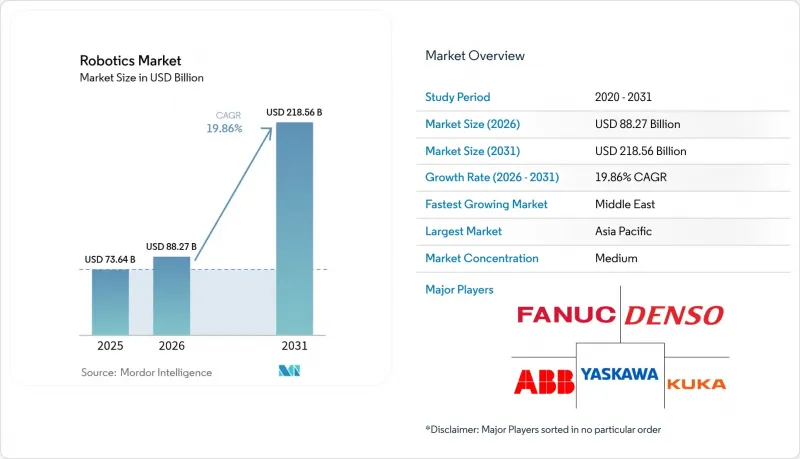
根據 Mordor Intelligence 估計,到 2026 年,機器人市值將達到 882.7 億美元,高於 2025 年的 736.4 億美元,預計到 2031 年將達到 2,185.6 億美元。
預計 2026 年至 2031 年的複合年成長率為 19.86%。
本報告按機器人類型(工業機器人、服務機器人等)、組件(硬體、軟體、服務)、應用領域(製造和組裝、物流和倉儲、醫療和外科等)、終端用戶行業(汽車、電子和半導體、食品和飲料等)以及地區進行細分。市場預測以美元計價。
全球機器人市場趨勢與洞察
勞動力短缺加劇,推動了對自動化的需求。
日本、美國和西歐大部分地區的人口結構變化,使得自動化的重點從降低成本轉向產能建設。到2024年,七國集團(G7)製造業的空缺職位將超過200萬個,而日本的機器人密度(每萬名員工擁有399台機器人)將達到創紀錄的399台。像Stellantis這樣的汽車製造商正在採用「人性化」的機器人單元,既能保障員工安全,又能減輕重複性勞損,這表明機器人部署正悄然向協作模式轉變。由於這些結構性缺口持續存在,且不受經濟週期的影響,全球機器人市場正從中受益,為供應商提供了一個與GDP波動脫鉤的可預測需求基礎。
機器人單位運作時間的平均價格正在下降。
預計從2024年起,零件的商品化和大規模生產將推動協作機器人價格每年下降約15%,而軟體升級將使性能價格比翻倍。中國供應商目前以19.9萬元人民幣(約27,512美元)的價格銷售入門級人形機器人,使得小規模工廠能夠將機器人納入其資本預算。硬體成本的下降正在加速中小型製造商和新興市場企業的採用進程,從而擴大全球機器人市場的潛在客戶群。
中小企業在引進機器人方面仍有技能差距。
68%的中小企業仍缺乏實施機器人所需的工程技術人才,導致投資回收期延長和運轉率降低。系統整合商集中在都市區,導致農村地區的企業無法獲得足夠的服務。除非加快技能發展並引入承包服務模式,否則全球機器人市場仍存在巨大的未開發潛在需求。
細分市場分析
到2025年,工業機器人將佔全球機器人市場71.04%的佔有率,主要得益於高產能汽車和電子產品組裝的持續需求。同時,協作機器人預計到2031年將以25.64%的複合年成長率成長,這得益於安全認證的力感測器和低於3萬美元的價格,使其能夠被中小企業所接受。這種轉變表明,靈活的、由人工監督的單元,而非封閉的生產線,將推動下一波全球機器人技術的應用浪潮。
中國協作機器人製造商的快速成長使其國內市場佔有率在2017年至2024年間從35%躍升至73%,加劇了市場競爭,並加速了全球銷售成長。服務機器人這一細分市場也蓬勃發展,預計到2025年,手術系統市場規模將超過41.8億美元,再次印證了醫療產業是成長最快的終端用戶領域。這種多元化發展有助於緩解全球機器人市場的波動性,使硬體供應商不易受到特定產業經濟衰退的影響。
儘管硬體在2025年仍佔支出的63.12%,但隨著人工智慧成為主要的價值創造驅動力,軟體銷售額預計將以22.91%的年均成長率成長。進階控制堆疊現已整合雲端分析與強化學習技術,ABB的OmniCore平台可將週期時間縮短25%,電力消耗20%。隨著客戶從資本支出(CAPEX)模式轉向營運支出(OPEX)模式,預計到2031年,全球基於訂閱的機器人即服務(RaaS)市場規模將成長兩倍。
整合、遠端監控和預測性維護等業務收益進一步強化了供應商鎖定。因此,軟體和服務之間的界線變得模糊,續約權和網路安全性修補程式也被納入多年合約。這一趨勢正在改變利潤結構,並提高了純粹以硬體為中心的新參與企業在全球機器人市場中的進入門檻。
區域分析
預計到2025年,亞太地區將佔據全球機器人市場佔有率的37.72%。這項預測得益於中國每年部署43萬台工業機器人,以及全球三分之二的機器人相關專利授權。在中國工廠,機器人正被引入鋰離子電池和家用電器生產線,同時,本土品牌也在擴大出口,這反映了該地區在全球機器人市場的成本競爭力。在日本,受中國市場需求復甦和日本國內人口壓力的推動,發FANUC)累計2024年利潤將達到1802億日圓(約16.4億美元)。在韓國,戰略重點正在被強調,一項價值26億美元的公私合營項目正在利用人形機器人技術訣竅來實現電池工廠的自動化。
在中東,主權財富基金正將過剩的油氣資本重新投入工業數位化、物流和醫療機器人領域,預計到2031年,該地區的複合年成長率將達到21.31%,位居全球之首。在阿拉伯聯合大公國(阿拉伯聯合大公國)自由貿易區,倉庫自主移動機器人(AMR)試點計畫正在進行中,以滿足該地區電子商務的發展趨勢,並減少對季節性外籍勞工的過度依賴。此外,各國政府也正在資助先進製造中心建設,並吸引全球系統整合商,從而擴大全球機器人市場的潛在基本客群。
北美市場需求仍然強勁,這主要得益於《晶片製造法案》(CHIPS Act)支持的半導體製造工廠以及國防契約,例如海軍授予Anduril公司的價值6.422億美元的無人機契約。在歐洲,重點在於安全的人機協作標準和永續性目標,德國每年投入6,900萬歐元(約7,500萬美元)用於人工智慧(AI)的整合,進一步推動了這一趨勢。這兩個地區都在將通用子組件的製造外包給亞洲,同時增加對高價值軟體和系統整合的投資,這體現了全球機器人市場「槓鈴策略」的趨勢。
其他好處:
- Excel格式的市場預測(ME)表
- 3個月的分析師支持
目錄
第1章:引言
- 研究假設和市場定義
- 調查範圍
第2章:調查方法
第3章執行摘要
第4章 市場狀況
- 市場概覽
- 市場促進因素
- 勞動力短缺日益嚴重,推動了對自動化技術的需求。
- 機器人單位運作時間的平均價格正在下降。
- 低程式碼機器人程式設計平台的普及
- 七國集團國家為製造業回流本國提供財政獎勵
- 電子商務第三方物流公司在倉庫中實施自主移動機器人(AMR)的現狀
- 國家級人形機器人研發任務(例如,中國2025)
- 市場限制因素
- 中小企業整合能力不足的問題仍然存在。
- 對先進伺服的地緣政治出口限制
- 稀土元素磁鐵價格波動
- ROS部署中的網路安全漏洞
- 價值鏈分析
- 監理情勢
- 技術展望
- 波特五力分析
- 市場宏觀經濟趨勢的評估
第5章 市場規模與成長預測
- 按機器人類型
- 工業機器人
- 服務機器人
- 協作機器人(cobots)
- 移動/AMR
- 按組件
- 硬體
- 軟體
- 服務(整合、RaaS)
- 透過使用
- 製造和組裝
- 物流和倉儲
- 醫療和外科用途
- 國防與安全
- 檢查和維護
- 清潔/消毒
- 按最終用戶行業分類
- 車
- 電子和半導體
- 食品/飲料
- 醫療服務提供方
- 軍事/國防
- 其他終端用戶產業
- 按地區
- 北美洲
- 美國
- 加拿大
- 墨西哥
- 歐洲
- 德國
- 英國
- 法國
- 其他歐洲國家
- 亞太地區
- 中國
- 印度
- 日本
- 其他亞太國家
- 南美洲
- 巴西
- 阿根廷
- 其他南美國家
- 中東
- 阿拉伯聯合大公國
- 沙烏地阿拉伯
- 其他中東國家
- 非洲
- 南非
- 奈及利亞
- 其他非洲國家
- 北美洲
第6章 競爭情勢
- 市場集中度
- 策略趨勢
- 市佔率分析
- 公司簡介
- ABB Ltd.
- Fanuc Corporation
- Yaskawa Electric Corporation
- KUKA AG
- Kawasaki Heavy Industries Ltd
- Universal Robots A/S(Teradyne)
- Denso Corporation
- Mitsubishi Electric Corporation
- Omron Corporation
- Staubli International AG
- Epson Robots(Seiko Epson)
- Comau SpA
- Nachi-Fujikoshi Corp.
- Toshiba Corporation
- Intuitive Surgical Inc.
- Stryker Corporation
- iRobot Corporation
- Boston Dynamics Inc.
- Locus Robotics Corp.
- DJI Technology Co. Ltd
第7章 市場機會與未來展望
According to Mordor Intelligence, robotics market size in 2026 is estimated at USD 88.27 billion, growing from 2025 value of USD 73.64 billion with 2031 projections showing USD 218.56 billion, growing at 19.86% CAGR over 2026-2031.
This report is Segmented by Robot Type (Industrial Robots, Service Robots, and More), Component (Hardware, Software, and Services), Application (Manufacturing and Assembly, Logistics and Warehousing, Medical and Surgical, and More), End-User Industry (Automotive, Electronics and Semiconductor, Food and Beverage, and More), and Geography. The Market Forecasts are Provided in Terms of Value (USD).
Global Robotics Market Trends and Insights
Rising Labour-Shortage Led Automation Demand
Demographic headwinds in Japan, the United States, and much of Western Europe have shifted automation from cost-saving to capacity-assurance mode. Unfilled factory vacancies topped 2 million roles across G-7 manufacturing in 2024, while Japan's robot density reached 399 units per 10,000 employees, the highest on record. Automakers such as Stellantis adopted human-centric robotic cells that trim repetitive strain injuries yet safeguard headcount, signalling a nuanced push toward collaborative deployment. The global robotics market benefits because these structural gaps persist through economic cycles, giving vendors a predictable demand base that decouples from GDP volatility.
Declining Average Robot Price Per Functional Hour
Component commoditisation and scale production cut collaborative robot prices by roughly 15% a year post-2024, while software upgrades doubled performance relative to price. Chinese suppliers even marketed entry-level humanoids at CNY 199,000 (USD 27,512), placing robots within small-factory capital budgets. As hardware costs slide, adoption curves steepen among small and emerging-market manufacturers, thereby widening the addressable pool for the global robotics market.
Persistent SME Integration Skill-Gap
Sixty-eight percent of SMEs still lack engineering talent for robotics deployment, prolonging payback periods and dampening utilisation rates. Integrators cluster in urban hubs, leaving regional firms underserved. Without accelerated skills development or turnkey service models, the global robotics market leaves considerable latent demand untapped.
Other drivers and restraints analyzed in the detailed report include:
- Proliferation of Low-Code Robot-Programming Platforms
- Fiscal Incentives for Reshoring Manufacturing in G-7
- Geopolitical Export-Control on Advanced Servos
For complete list of drivers and restraints, kindly check the Table Of Contents.
Segment Analysis
Industrial robots accounted for 71.04% of the global robotics market in 2025, riding sustained demand from high-throughput automotive and electronics assembly lines. Yet collaborative robots expand at a 25.64% CAGR to 2031, underpinned by safety-certified force-sensing and sub-USD 30,000 price tags that place them within SME budgets. This pivot signals that flexible, human-supervised cells, rather than fenced-off lines, will drive the next deployment wave of the global robotics market.
A surge in Chinese cobot makers lifted their domestic share from 35% to 73% between 2017 and 2024, heightening price competition and accelerating worldwide unit growth. Service-robot niches also flourish: surgical systems surpassed USD 4.18 billion in 2025, reaffirming healthcare as the fastest-rising end-use. This diversification reduces cyclicality for the global robotics market and cushions hardware vendors against single-sector downturns.
Hardware still represented 63.12% of 2025 spending, but software revenue is set to grow 22.91% annually as artificial intelligence becomes the primary value driver. Higher-level control stacks now incorporate cloud analytics and reinforcement learning that deliver 25% faster cycle times with 20% lower electricity use on ABB's OmniCore platform. The global robotics market size for subscription-based Robot-as-a-Service is projected to treble by 2031 as customers migrate from capital expenditure toward operating expenditure models.
Service revenues, covering integration, remote monitoring, and predictive maintenance, further solidify vendor lock-in. As a result, software and services blur, embedding update rights and cyber-security patches into multi-year contracts. This trend rewires profit pools and raises entry barriers for purely hardware-centric challengers within the global robotics market.
Complete Report Scope:
- By Robot Type
- Industrial Robots
- Service Robots
- Collaborative (Cobots)
- Mobile/AMR
- By Component
- Hardware
- Software
- Services (Integration, RaaS)
- By Application
- Manufacturing and Assembly
- Logistics and Warehousing
- Medical and Surgical
- Defense and Security
- Inspection and Maintenance
- Cleaning and Sanitation
- By End-User Industry
- Automotive
- Electronics and Semiconductor
- Food and Beverage
- Healthcare Providers
- Military and Defense
- Other End-user Industries
- By Geography
- North America
- United States
- Canada
- Mexico
- Europe
- Germany
- United Kingdom
- France
- Rest of Europe
- Asia-Pacific
- China
- India
- Japan
- Rest of Asia-Pacific
- South America
- Brazil
- Argentina
- Rest of South America
- Middle East
- United Arab Emirates
- Saudi Arabia
- Rest of Middle East
- Africa
- South Africa
- Nigeria
- Rest of Africa
- North America
Geography Analysis
Asia-Pacific secured 37.72% of global robotics market share in 2025, anchored by China's 430,000 annual industrial-robot installations and two-thirds of worldwide robotics patent grants. Chinese factories integrate robots into lithium-ion battery and consumer-electronics lines, while domestic brands escalate exports, embedding regional cost competitiveness into the global robotics market. Japan posted JPY 180.2 billion (USD 1.64 billion) profit at Fanuc in 2024 on revived Chinese demand and domestic demographic pressure. South Korea's USD 2.6 billion public-private programme channels humanoid expertise toward battery-plant automation, underscoring strategic prioritisation.
The Middle East registers the highest 21.31% CAGR to 2031 as sovereign wealth vehicles divert hydrocarbons surplus into industrial digitalisation, logistics, and healthcare robotics. Free-trade zones in the United Arab Emirates trial warehouse AMRs to service regional e-commerce flows, reducing over-reliance on seasonal migrant labour. National programmes additionally fund advanced manufacturing hubs that attract global integrators, amplifying the addressable base for the global robotics market.
North American demand remains resilient, propelled by CHIPS-Act-backed fabs and defence contracts such as the USD 642.2 million Navy counter-drone award to Anduril. Europe focuses on safe human-robot collaboration standards and sustainability targets, helped by EUR 69 million (USD 75 million) in annual German funding for artificial-intelligence integration. Both regions increasingly outsource commodity sub-assemblies to Asia while investing in high-value software and integration, reflecting a barbell strategy within the global robotics market.
- ABB Ltd.
- Fanuc Corporation
- Yaskawa Electric Corporation
- KUKA AG
- Kawasaki Heavy Industries Ltd
- Universal Robots A/S (Teradyne)
- Denso Corporation
- Mitsubishi Electric Corporation
- Omron Corporation
- Staubli International AG
- Epson Robots (Seiko Epson)
- Comau SpA
- Nachi-Fujikoshi Corp.
- Toshiba Corporation
- Intuitive Surgical Inc.
- Stryker Corporation
- iRobot Corporation
- Boston Dynamics Inc.
- Locus Robotics Corp.
- DJI Technology Co. Ltd
Additional Benefits:
- The market estimate (ME) sheet in Excel format
- 3 months of analyst support
TABLE OF CONTENTS
1 INTRODUCTION
- 1.1 Study Assumptions and Market Definition
- 1.2 Scope of the Study
2 RESEARCH METHODOLOGY
3 EXECUTIVE SUMMARY
4 MARKET LANDSCAPE
- 4.1 Market Overview
- 4.2 Market Drivers
- 4.2.1 Rising labour-shortage led automation demand
- 4.2.2 Declining average robot price per functional hour
- 4.2.3 Proliferation of low-code robot-programming platforms
- 4.2.4 Fiscal incentives for reshoring manufacturing in G-7
- 4.2.5 Warehouse AMR roll-outs by e-commerce 3PLs
- 4.2.6 Nation-level humanoid RandD missions (e.g., China 2025)
- 4.3 Market Restraints
- 4.3.1 Persistent SME integration skill-gap
- 4.3.2 Geopolitical export-control on advanced servos
- 4.3.3 Rare-earth magnet price volatility
- 4.3.4 Cyber-security vulnerabilities in ROS deployments
- 4.4 Value Chain Analysis
- 4.5 Regulatory Landscape
- 4.6 Technological Outlook
- 4.7 Porter's Five Forces Analysis
- 4.7.1 Threat of New Entrants
- 4.7.2 Bargaining Power of Suppliers
- 4.7.3 Bargaining Power of Buyers
- 4.7.4 Threat of Substitutes
- 4.7.5 Intensity of Competitive Rivalry
- 4.8 Assessment of Macro Economic Trends on the Market
5 MARKET SIZE AND GROWTH FORECASTS (VALUES)
- 5.1 By Robot Type
- 5.1.1 Industrial Robots
- 5.1.2 Service Robots
- 5.1.3 Collaborative (Cobots)
- 5.1.4 Mobile/AMR
- 5.2 By Component
- 5.2.1 Hardware
- 5.2.2 Software
- 5.2.3 Services (Integration, RaaS)
- 5.3 By Application
- 5.3.1 Manufacturing and Assembly
- 5.3.2 Logistics and Warehousing
- 5.3.3 Medical and Surgical
- 5.3.4 Defense and Security
- 5.3.5 Inspection and Maintenance
- 5.3.6 Cleaning and Sanitation
- 5.4 By End-User Industry
- 5.4.1 Automotive
- 5.4.2 Electronics and Semiconductor
- 5.4.3 Food and Beverage
- 5.4.4 Healthcare Providers
- 5.4.5 Military and Defense
- 5.4.6 Other End-user Industries
- 5.5 By Geography
- 5.5.1 North America
- 5.5.1.1 United States
- 5.5.1.2 Canada
- 5.5.1.3 Mexico
- 5.5.2 Europe
- 5.5.2.1 Germany
- 5.5.2.2 United Kingdom
- 5.5.2.3 France
- 5.5.2.4 Rest of Europe
- 5.5.3 Asia-Pacific
- 5.5.3.1 China
- 5.5.3.2 India
- 5.5.3.3 Japan
- 5.5.3.4 Rest of Asia-Pacific
- 5.5.4 South America
- 5.5.4.1 Brazil
- 5.5.4.2 Argentina
- 5.5.4.3 Rest of South America
- 5.5.5 Middle East
- 5.5.5.1 United Arab Emirates
- 5.5.5.2 Saudi Arabia
- 5.5.5.3 Rest of Middle East
- 5.5.6 Africa
- 5.5.6.1 South Africa
- 5.5.6.2 Nigeria
- 5.5.6.3 Rest of Africa
- 5.5.1 North America
6 COMPETITIVE LANDSCAPE
- 6.1 Market Concentration
- 6.2 Strategic Moves
- 6.3 Market Share Analysis
- 6.4 Company Profiles (includes Global level Overview, Market level overview, Core Segments, Financials as available, Strategic Information, Market Rank/Share for key companies, Products and Services, and Recent Developments)
- 6.4.1 ABB Ltd.
- 6.4.2 Fanuc Corporation
- 6.4.3 Yaskawa Electric Corporation
- 6.4.4 KUKA AG
- 6.4.5 Kawasaki Heavy Industries Ltd
- 6.4.6 Universal Robots A/S (Teradyne)
- 6.4.7 Denso Corporation
- 6.4.8 Mitsubishi Electric Corporation
- 6.4.9 Omron Corporation
- 6.4.10 Staubli International AG
- 6.4.11 Epson Robots (Seiko Epson)
- 6.4.12 Comau SpA
- 6.4.13 Nachi-Fujikoshi Corp.
- 6.4.14 Toshiba Corporation
- 6.4.15 Intuitive Surgical Inc.
- 6.4.16 Stryker Corporation
- 6.4.17 iRobot Corporation
- 6.4.18 Boston Dynamics Inc.
- 6.4.19 Locus Robotics Corp.
- 6.4.20 DJI Technology Co. Ltd
7 MARKET OPPORTUNITIES AND FUTURE OUTLOOK
- 7.1 White-Space and Unmet-Need Assessment

 半導體機器人市場分析及預測(至2035年):依類型、產品、服務、技術、組件、應用、製程、最終用戶、功能及安裝類型分類
 機器人塗層及應用技術市場規模、佔有率及成長分析:按塗層類型、塗層材料、應用技術、機器人類型、終端用戶產業和地區分類-2026-2033年產業預測
 機器人市場預測至2034年:按組件、類型、應用、最終用戶和地區分類的全球分析
 機器人市場:2026-2032年全球市場預測(按組件、機器人類型、移動性、感測與感知、電源、應用和最終用途行業分類)
 全球烹飪機器人市場規模、佔有率、趨勢和成長分析報告(2026-2034)採礦機器人市場規模、佔有率、成長、全球產業分析、區域趨勢及2026-2034年預測
 2026年全球清洗機器人市場報告
 視覺引導機器人市場:按組件、機器人類型、視覺類型、應用、最終用途、國家和地區分類-全球產業分析、市場規模、市場佔有率及2026年至2033年預測
 2026-2030年全球機器人市場用於機器人的半導體附件