


 |
市場調查報告書
商品編碼
2120356
建築塗料:市場佔有率分析、產業趨勢與統計、成長預測(2026-2031)Architectural Coatings - Market Share Analysis, Industry Trends & Statistics, Growth Forecasts (2026 - 2031) |
||||||

※ 本網頁內容可能與最新版本有所差異。詳細情況請與我們聯繫。
根據 Mordor Intelligence 預測,建築塗料市場規模預計將在 2025 年達到 961.2 億美元,2026 年達到 1,002.8 億美元,2031 年達到 1,239.6 億美元,2026 年至 2031 年的複合年成長率為 4.33%。
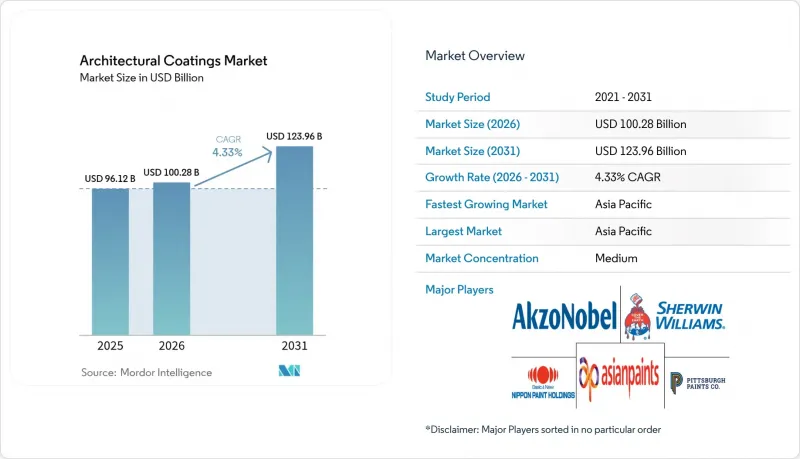
本報告按樹脂類型(丙烯酸樹脂、醇酸樹脂、環氧樹脂、聚酯樹脂、聚氨酯樹脂及其他樹脂)、技術(水性、溶劑型及其他技術)、應用領域(住宅和商業)以及地區(亞太地區、北美地區、歐洲地區、南美地區以及中東和非洲地區)進行細分。市場預測以美元計價。
全球建築塗料市場趨勢及洞察
低揮發性有機化合物法規正在加速全球向水生系統的轉型。
2024年,加州將室內塗料的VOC(揮發性有機化合物)限值降至50克/公升。這將迫使該州銷售的40%的產品重新設計配方,並鼓勵全球製造商實現配方標準化,從而達到規模經濟效益。歐盟於2025年效仿,將限值設定為30克/公升。在此限值下,除非引入高成本的生物基替代品,否則傳統的溶劑型醇酸底漆將有效地被淘汰。中國將低VOC法規擴展至三線城市,使該法規的適用範圍擴大到另外1.8億居民,加速了溶劑型產品的淘汰。雖然大型跨國公司可以將重新設計配方的成本分攤到更大的銷售量上,但小規模的區域性企業卻被迫在兩種選擇中做出抉擇:要么支付佔銷售額3%至5%的技術許可費,要么徹底退出高階市場。
北美和歐洲自 1970 年以來建造的住宅存量維修需求激增。
在美國,1970年至1990年間建造的住宅需要進行外牆維修,預計到2026年,維修支出將達到5,100億美元。加拿大的「綠色住宅補助金」計畫為節能維修提供高達3,700美元的補貼,2025年的申請量增加了19%。歐洲的「翻新浪潮」計畫旨在2030年將維修加倍,光是德國在2025年就投入了130億美元用於外牆維修利率貸款。這些計劃推動了對使用壽命為15至20年的丙烯酸和彈性體塗料的需求,滿足了希望盡量減少重複施工的住宅的需求。然而,技術純熟勞工的短缺導致專案前置作業時間延長至8至12週,減緩了短期銷售量。
2024 年供應衝擊後二氧化鈦 (TiO2) 和環氧樹脂原料的價格波動。
受中國環保法規導致停產的影響,二氧化鈦(TiO2)價格從2024年第一季的每噸2800美元上漲至2025年第一季的每噸3,300美元,但隨著沙烏地阿拉伯產能的投產,價格隨後趨於運作。然而,外匯波動導致印度和巴西生產商的利潤率下降了高達180個基點。由於一家雙酚A工廠發生不可抗力事件,環氧樹脂成本飆升22%,迫使混煉商在較不重要的應用領域轉向使用聚酯。大型企業正透過部分持有二氧化鈦資產來對沖風險,例如PPG透過持有其在中國供應商30%的股份,以固定價格確保每年4萬噸的供應,從而保障了其利潤。同時,中小企業在應對季度成本上漲時,戰略柔軟性有限。
細分市場分析
到2025年,丙烯酸塗料的需求量將佔建築塗料市場54.13%,佔據市場最大佔有率,預計到2031年將以4.68%的複合年成長率成長,超過建築塗料市場的整體表現。丙烯酸塗料符合低VOC排放標準,且在潮濕氣候下具有卓越的戶外耐久性,這些優勢鞏固了其主導地位。醇酸塗料的需求正在下降。這是因為溶劑使用限制意味著,除非採用昂貴的回收系統,否則許多產品線將不再符合相關法規。
環氧塗料以其高耐磨性而聞名,但其對紫外線的不穩定性以及高昂的成本仍然是其應用限制因素。另一方面,聚氨酯塗料則因其在沿海地區保持光澤的需求而備受青睞。聚酯粉末塗料是工廠預製金屬框架的理想選擇,而生物基混合塗料的研發工作也正在進行中,因為企業正在尋求差異化優勢,以符合循環經濟的理念。
區域分析
預計到2025年,亞太地區將佔銷售量的46.11%,以5.57%的年成長率推動建築塗料市場成長。在印度,由於「智慧城市」計畫的資金支持,中產階級住宅率達到58%,市場正在擴張。在東南亞市場,由於物流樞紐的擴張和外商直接投資(FDI)支持的社會住宅項目,塗料消費量有所成長。
在北美,美國佔據了建築裝修支出的大部分,因為在高利率房屋抵押貸款環境下,屋主更傾向於維修而非搬遷。加拿大則受惠於節能維修的獎勵而成長,墨西哥則隨著近岸外包帶來的工業建設增加而成長。
在歐洲,德國、法國和英國合計佔據了全部區域市場規模的大部分,各國都利用公共貸款和津貼計劃來促進外牆維修和低排放量內牆塗料的使用。中東歐國家在歐盟結構基金的資助下迎頭趕上,而北歐國家則在嚴格的環境法規下保持小眾成長。
在南美洲,巴西社會住宅的擴張和以農產品主導的商業設施建設推動了經濟成長;而在阿根廷,貨幣貶值的壓力促使消費者轉向本土品牌。智利、秘魯和哥倫比亞則受惠於與採礦相關的基礎設施項目所帶來的工人住宅需求。
儘管中東和非洲的需求仍然較低,但由於沙烏地阿拉伯的「2030願景」大型企劃需要能夠承受極端高溫的高品質外牆塗料,以及撒哈拉以南非洲地區儘管物流網路不發達,但由於都市化進程加快,基本消費也在擴張,預計未來需求將大幅成長。
其他好處:
- Excel格式的市場預測(ME)表
- 3個月的分析師支持
目錄
第1章:引言
- 研究假設和市場定義
- 調查範圍
第2章:調查方法
第3章執行摘要
第4章 市場狀況
- 市場概覽
- 市場促進因素
- 低VOC法規正在加速全球向水基系統的轉變。
- 北美和歐洲對1970年以來建造的住宅存量進行維修的浪潮正在席捲而來。
- 東協主要大都會圈有組織的DIFM貿易油漆工網路爆炸性成長。
- 電子商務的快速發展使得直接向消費者配送油漆成為可能。
- 需要奈米填充塗層/3D列印外牆模組的現場使用機器人
- 市場限制因素
- 從 2024 年起,由於供應衝擊,二氧化鈦和環氧樹脂原料的價格將出現波動。
- 成熟市場熟練油漆工短缺,導致安裝成本上升。
- 歐盟的除生物劑法規減少了罐頭中允許使用的防腐劑含量。
- 價值鏈分析
- 波特五力模型
第5章 市場規模與成長預測
- 依樹脂類型
- 丙烯酸纖維
- 阿爾基多
- 環氧樹脂
- 聚酯纖維
- 聚氨酯
- 其他樹脂類型
- 透過技術
- 水溶液
- 溶劑型
- 其他技術
- 透過使用
- 住宅
- 商業
- 按地區
- 亞太地區
- 中國
- 印度
- 日本
- 韓國
- 印尼
- 越南
- 泰國
- 菲律賓
- 新加坡
- 其他亞太國家
- 北美洲
- 美國
- 加拿大
- 墨西哥
- 歐洲
- 德國
- 英國
- 法國
- 義大利
- 西班牙
- 波蘭
- 北歐國家
- 俄羅斯
- 其他歐洲國家
- 南美洲
- 巴西
- 阿根廷
- 其他南美國家
- 中東和非洲
- 沙烏地阿拉伯
- 南非
- 其他中東和非洲國家
- 亞太地區
第6章 競爭情勢
- 市場集中度
- 策略趨勢
- 市佔率和排名分析
- 公司簡介
- 3 TREES Group
- AkzoNobel NV
- Asian Paints Ltd.
- BASF
- Beckers Group
- Benjamin Moore and Company
- Berger Paints India Ltd.
- Brillux GmbH and Co. KG
- CIN SA
- DAW SE
- Flugger group AS
- Hempel A/S
- Jotun
- Kansai Paint Co., Ltd.
- Masco Corporation
- Nippon Paint Holdings Co., Ltd
- Pittsburgh Paints Co.
- RPM International
- Sniezka SA
- The Sherwin-Williams Company
第7章 市場機會與未來展望
According to Mordor Intelligence, the Architectural Coatings Market size is projected to be USD 96.12 billion in 2025, USD 100.28 billion in 2026, and reach USD 123.96 billion by 2031, growing at a CAGR of 4.33% from 2026 to 2031.
This report is Segmented by Resin Type (Acrylic, Alkyd, Epoxy, Polyester, Polyurethane, and Other Resin Types), Technology (Water-Borne, Solvent-Borne, and Other Technologies), End-Use (Residential and Commercial), and Geography (Asia-Pacific, North America, Europe, South America, and Middle-East and Africa). The Market Forecasts are Provided in Terms of Value (USD).
Global Architectural Coatings Market Trends and Insights
Low-VOC Regulations Accelerating Global Switch to Water-Borne Systems
California lowered the VOC ceiling for interior flats to 50 g/L in 2024, forcing reformulation of 40% of products sold in the state and nudging manufacturers everywhere to harmonize recipes for scale. The EU followed in 2025 with a 30 g/L cap, a level that effectively eliminates traditional solvent-rich alkyd primers unless costly bio-based substitutes are introduced. China's extension of its low-VOC mandate to Tier-3 cities widened compliance coverage to another 180 million residents and accelerated the retirement of solvent lines. Global majors amortize reformulation costs across wider volumes, but small regional firms either license technology at 3%-5% of sales or cede premium segments entirely.
Surging Renovation of Post-1970 Housing Stock in North America and Europe
The United States houses built between 1970 and 1990 now require exterior refreshes, driving USD 510 billion in improvement spending projected for 2026. Canada's Greener Homes Grant covers up to USD 3,700 for energy upgrades, propelling a 19% increase in applications during 2025. Europe's Renovation Wave aims to double retrofit rates by 2030, and Germany alone disbursed USD 13 billion in low-interest loans for facade updates in 2025. These programs tilt demand toward acrylic and elastomeric coatings with 15-20 year lifespans that satisfy homeowners looking to minimize repeat labor. Skilled labor shortages, however, have stretched project lead times to eight-to-twelve weeks, tempering near-term volume growth.
Volatile TiO2 and Epoxy Feedstock Prices Post-2024 Supply Shocks
TiO2 climbed from USD 2,800/t in Q1 2024 to USD 3,300/t in Q1 2025 after Chinese environmental shutdowns, easing later when Saudi capacity came online, yet margins for Indian and Brazilian producers still fell by up to 180 basis points because of currency swings. Epoxy costs spiked 22% after force-majeure events at bisphenol-A plants, forcing formulators to shift to polyester in non-critical roles. Majors hedge via partial ownership of TiO2 assets; PPG's 30% stake in a Chinese supplier secures 40,000 t per year at fixed prices, insulating earnings. Smaller firms negotiate quarterly pass-throughs, limiting strategic flexibility.
Other drivers and restraints analyzed in the detailed report include:
- Explosive Growth of Organized DIFM Trade-Painter Networks in ASEAN Metros
- Rapid E-Commerce Penetration Enabling Direct-to-Consumer Paint Fulfillment
- Scarcity of Skilled Painters in Mature Markets Inflating Installation Costs
For complete list of drivers and restraints, kindly check the Table Of Contents.
Segment Analysis
Acrylic commanded 54.13% of 2025 demand, the largest slice of the architectural coatings market size, and is projected to outpace the overall architectural coatings market at a 4.68% CAGR to 2031. Low-VOC compliance and robust exterior durability in humid climates underpin this leadership. Alkyd demand is contracting as solvent caps render many lines non-compliant without expensive capture systems.
Epoxies are known for their high abrasion resistance but remain constrained by UV instability and elevated cost, while polyurethanes are driven by coastal gloss-retention needs. Polyester powder coatings are favoured for factory-finished metal framing, and bio-based hybrids draw fresh R&D as firms seek differentiators for circular-economy labels.
Complete Report Scope:
- By Resin Type
- Acrylic
- Alkyd
- Epoxy
- Polyester
- Polyurethane
- Other Resin Types
- By Technology
- Water-borne
- Solvent-borne
- Other Technologies
- By End-use
- Residential
- Commercial
- By Geography
- Asia-Pacific
- China
- India
- Japan
- South Korea
- Indonesia
- Vietnam
- Thailand
- Philippines
- Singapore
- Rest of Asia-Pacific
- North America
- United States
- Canada
- Mexico
- Europe
- Germany
- United Kingdom
- France
- Italy
- Spain
- Poland
- NORDIC Countries
- Russia
- Rest of Europe
- South America
- Brazil
- Argentina
- Rest of South America
- Middle-East and Africa
- Saudi Arabia
- South Africa
- Rest of Middle-East and Africa
- Asia-Pacific
Geography Analysis
Asia-Pacific contributed 46.11% of the 2025 volume and will lead the architectural coatings market growth at 5.57%. India is advancing under Smart Cities funding that raised middle-class homeownership to 58%. Southeast Asian markets grew as FDI-backed logistics hubs and social-housing programs expanded coating consumption .
In North America, the United States accounted for most of the spending on architectural finishes as owners chose upgrades over moving in a high-rate mortgage environment. Canada added growth on the back of energy-retrofit incentives, while Mexico grew with near-shoring industrial builds.
In Europe, Germany, France, and the United Kingdom together represented the majority of regional value, each leveraging public loan or grant schemes to spur facade upgrades and low-emission interior paints. Central and Eastern Europe caught up with growth funded by EU structural allocations, while NORDIC markets maintained niche growth under strict environmental codes.
In South America, Brazil's social-housing expansion and agribusiness-led commercial builds drove growth, whereas currency pressures in Argentina redirected buyers to local brands. Chile, Peru, and Colombia benefited from mining-related infrastructure projects needing worker housing.
The Middle-East and Africa comprised lower demand but will post a substantial demand as Saudi Vision 2030 mega-projects require premium exterior coatings tolerant of extreme heat, and sub-Saharan urbanization lifts baseline consumption despite fragmented logistics.
- 3 TREES Group
- AkzoNobel N.V.
- Asian Paints Ltd.
- BASF
- Beckers Group
- Benjamin Moore and Company
- Berger Paints India Ltd.
- Brillux GmbH and Co. KG
- CIN S.A.
- DAW SE
- Flugger group AS
- Hempel A/S
- Jotun
- Kansai Paint Co., Ltd.
- Masco Corporation
- Nippon Paint Holdings Co., Ltd
- Pittsburgh Paints Co.
- RPM International
- Sniezka SA
- The Sherwin-Williams Company
Additional Benefits:
- The market estimate (ME) sheet in Excel format
- 3 months of analyst support
TABLE OF CONTENTS
1 Introduction
- 1.1 Study Assumptions and Market Definition
- 1.2 Scope of the Study
2 Research Methodology
3 Executive Summary
4 Market Landscape
- 4.1 Market Overview
- 4.2 Market Drivers
- 4.2.1 Low-VOC regulations accelerating global switch to water-borne systems
- 4.2.2 Surging renovation of post-1970 housing stock in North America and Europe
- 4.2.3 Explosive growth of organised DIFM trade-painter networks in ASEAN metros
- 4.2.4 Rapid e-commerce penetration enabling direct-to-consumer paint fulfilment
- 4.2.5 On-site robotic/3-D-printed facade modules demanding nano-filled coatings
- 4.3 Market Restraints
- 4.3.1 Volatile TiO2 and epoxy feedstock prices post-2024 supply shocks
- 4.3.2 Scarcity of skilled painters in mature markets inflating installation costs
- 4.3.3 EU biocide restrictions cutting allowable in-can preservative loadings
- 4.4 Value Chain Analysis
- 4.5 Porter's Five Forces
- 4.5.1 Bargaining Power of Suppliers
- 4.5.2 Bargaining Power of Buyers
- 4.5.3 Threat of New Entrants
- 4.5.4 Threat of Substitutes
- 4.5.5 Degree of Competition
5 Market Size and Growth Forecasts (Value)
- 5.1 By Resin Type
- 5.1.1 Acrylic
- 5.1.2 Alkyd
- 5.1.3 Epoxy
- 5.1.4 Polyester
- 5.1.5 Polyurethane
- 5.1.6 Other Resin Types
- 5.2 By Technology
- 5.2.1 Water-borne
- 5.2.2 Solvent-borne
- 5.2.3 Other Technologies
- 5.3 By End-use
- 5.3.1 Residential
- 5.3.2 Commercial
- 5.4 By Geography
- 5.4.1 Asia-Pacific
- 5.4.1.1 China
- 5.4.1.2 India
- 5.4.1.3 Japan
- 5.4.1.4 South Korea
- 5.4.1.5 Indonesia
- 5.4.1.6 Vietnam
- 5.4.1.7 Thailand
- 5.4.1.8 Philippines
- 5.4.1.9 Singapore
- 5.4.1.11 Rest of Asia-Pacific
- 5.4.2 North America
- 5.4.2.1 United States
- 5.4.2.2 Canada
- 5.4.2.3 Mexico
- 5.4.3 Europe
- 5.4.3.1 Germany
- 5.4.3.2 United Kingdom
- 5.4.3.3 France
- 5.4.3.4 Italy
- 5.4.3.5 Spain
- 5.4.3.6 Poland
- 5.4.3.7 NORDIC Countries
- 5.4.3.8 Russia
- 5.4.3.9 Rest of Europe
- 5.4.4 South America
- 5.4.4.1 Brazil
- 5.4.4.2 Argentina
- 5.4.4.3 Rest of South America
- 5.4.5 Middle-East and Africa
- 5.4.5.1 Saudi Arabia
- 5.4.5.2 South Africa
- 5.4.5.3 Rest of Middle-East and Africa
- 5.4.1 Asia-Pacific
6 Competitive Landscape
- 6.1 Market Concentration
- 6.2 Strategic Moves
- 6.3 Market Share(%)/Ranking Analysis
- 6.4 Company Profiles (includes Global Overview, Market Overview, Core Segments, Financials, Strategic Information, Products and Services, Recent Developments)
- 6.4.1 3 TREES Group
- 6.4.2 AkzoNobel N.V.
- 6.4.3 Asian Paints Ltd.
- 6.4.4 BASF
- 6.4.5 Beckers Group
- 6.4.6 Benjamin Moore and Company
- 6.4.7 Berger Paints India Ltd.
- 6.4.8 Brillux GmbH and Co. KG
- 6.4.9 CIN S.A.
- 6.4.10 DAW SE
- 6.4.11 Flugger group AS
- 6.4.12 Hempel A/S
- 6.4.13 Jotun
- 6.4.14 Kansai Paint Co., Ltd.
- 6.4.15 Masco Corporation
- 6.4.16 Nippon Paint Holdings Co., Ltd
- 6.4.17 Pittsburgh Paints Co.
- 6.4.18 RPM International
- 6.4.19 Sniezka SA
- 6.4.20 The Sherwin-Williams Company
7 Market Opportunities and Future Outlook
- 7.1 White-space and Unmet-need Assessment

 高鋅含量容器塗料市場:全球市場預測,2026-2032年
 丙烯酸石材塗料市場規模、佔有率和成長分析:按塗料類型、表面處理、應用、分銷管道、最終用戶和地區分類-2026-2033年產業預測
 2026-2030年全球建築塗料市場
 外牆塗料市場規模、佔有率和成長分析:按樹脂類型、配方、應用、最終用戶、分銷管道和地區分類-2026-2033年產業預測住宅和建築塗料市場:2026-2032年全球市場預測(按產品類型、技術、飾面類型、應用、最終用戶和分銷管道分類)水性建築塗料市場:2026-2032年全球市場預測(依功能、產品類型、目標表面、表面暴露程度、應用、最終用途和通路分類)
 建築塗料市場規模、佔有率和成長分析:按樹脂類型、產品類型、技術、應用、最終用戶、分銷管道和地區分類-2026-2033年產業預測
 全球建築塗料市場規模、佔有率、趨勢和成長分析報告(2026-2034)
 歐洲建築塗料市場:按應用、技術、基材、最終用途和國家分類-預測至2031年
 2034年外牆塗料市場預測-按塗料類型、技術、應用、最終用戶和地區分類的全球分析