


 |
市場調查報告書
商品編碼
2058126
歐洲建築塗料市場:按應用、技術、基材、最終用途和國家分類-預測至2031年Europe Architectural Coatings Market by Technology, Substrate, Application, End-Use, and Country - Global Forecast to 2031 |
||||||


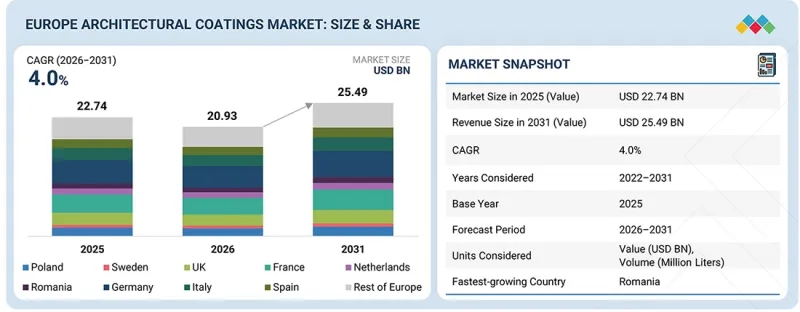
歐洲建築塗料市場預計將從 2026 年的 209.3 億美元成長到 2031 年的 254.9 億美元,預測期內複合年成長率為 4.0%。
| 調查範圍 | |
|---|---|
| 調查期 | 2022-2031 |
| 基準年 | 2025 |
| 預測期 | 2026-2031 |
| 計算單位 | 金額(100萬/10億美元),數量(100萬公升) |
| 部分 | 按應用、技術、基材、最終用途和國家分類 |
| 目標區域 | 歐洲 |
由於各種應用領域維修工程的頻繁進行,歐洲建築塗料市場預計將持續成長。該地區建設產業發達,被視為成熟市場,其需求主要由重新粉刷而非新建工程驅動。在西歐國家,由於旨在提高建築耐久性、表面美觀性和防護性能的建築維修不斷推進,市場持續穩定成長。歐洲鼓勵使用環境影響最小且不含有害物質的塗料的政策和法律規範,也促進了市場的快速發展。隨著節能建築的普及,具有隔熱、耐候性強等諸多優勢的反射塗料越來越受歡迎。經驗豐富的專業承包商的存在,以及DIY用戶(尤其是在德國、英國和法國等已開發國家)日益活躍,為該地區的塗料製造商創造了有利的市場環境。住宅標準的提高以及高購買力人口數量的成長,也推動了中東歐國家的市場擴張。
“按應用領域分類,預計在預測期內,外立面 2 細分市場將佔據最大佔有率。”
預計在預測期內,外牆塗料2細分市場將成為成長最快的細分市場。這是因為塗料市場的大部分需求都與兼具保溫和其他功能的帷幕牆系統有關。這些帷幕牆系統在塗覆面漆之前,需要使用多層底漆、底塗層和增強劑進行表面處理,以確保其正常發揮作用。保溫塗料在帷幕牆應用中最常見的例子之一是外牆外保溫複合系統(ETICS)。在這種類型的帷幕牆系統中,面漆下方的這些層對於實現高品質的附著力、防止開裂和優異的防潮性能至關重要。歐洲對保溫塗料的需求不斷成長,是由於歐盟要求推動了節能建築的建造和建築能耗的降低。此外,表面處理層在建構持久且高效的帷幕牆隔熱系統中的重要性也影響著市場需求。建設產業永續發展趨勢的轉變也促進了綠色技術的應用,包括環保塗料的使用。
按應用領域分類,預計專業領域在預測期內將佔據最大佔有率。
在預測期內,專業領域預計將佔據最大佔有率。這一主導地位歸因於歐洲建設產業對傳統承包方式的強烈依賴以及專案執行中對專業技能的高要求。建築、維修和整修專案都需要高度的專業知識和技能。由於這些項目通常涉及多種施工流程,預計未來幾年該領域將持續成長。推動專業領域發展的另一個關鍵因素是歐洲建築塗料市場專案的規模和複雜性。老舊建築的維修往往更為複雜,通常需要專家參與。這種對專業知識的需求在大規模商業建築、辦公大樓和住宅開發項目中尤其突出,因為這些項目的塗料施工複雜,需要專家監督。
預計德國將佔據歐洲建築塗料市場最大的佔有率。
到2025年,德國已躍居歐洲建築塗料市場榜首。這一強勢地位歸功於其高度發展的建築業以及在新建築和維修項目中對專業施工的依賴。在德國,建築塗料的專業施工至關重要,因為大多數產品都由油漆工和執照施工人員進行施工。他們的參與在商業、工業和住宅建築領域尤其重要,尤其是在那些需要高精度施工的專案中。
全國各地老舊基礎設施和建築的翻新維修項目正帶動專業塗料行業的發展。這些維修,尤其是老舊住宅和維修的翻新改造,大大增加了對建築塗料的需求。此外,大規模商業設施、辦公大樓和多用戶住宅的塗料需求也高度依賴專業人員來確保高品質的施工。
現有基礎設施和建築物的大規模維修進一步提升了專業承包商產業的信譽。包括老舊住宅和基礎設施現代化改造在內的維修項目,佔據了相當大的市場需求。在大規模商業設施、辦公大樓和住宅中,人們越來越依賴專業承包商來有效、持久地安裝塗層系統。此外,對基礎設施建設、節能維修和新建商業建築的持續投資,也推動了德國對塗層解決方案的高需求,使德國成為該地區的主要市場參與企業。更先進的塗層解決方案,例如包含牆體隔熱系統解決方案,需要專業的安裝技術,這進一步凸顯了專家在這過程中的重要性。
- By Company Type::Tier 1-50%, Tier 2-30%, and Tier 3-20%
- By Designation::Directors-20%, Managers-15%, and Others-65%
- By Region::UK-25%, Germany-35%, Sweden-25%, Netherlands-10%, and Poland-5%
歐洲建築塗料市場的主要參與者包括:阿克蘇諾貝爾公司(荷蘭)、PPG工業公司(美國)、宣偉公司(美國)、日本立邦塗料控股公司(日本)、RPM國際公司(美國)、關西塗料公司(日本)、艾仕得塗料系統公司(美國)、DAW SE公司(德國)、漢敦高(丹麥)和佐敦公司(挪威)。
本研究對歐洲建築塗料市場的主要參與者進行了詳細的競爭分析,包括各公司的概況、近期發展和關鍵市場策略。
調查範圍
本報告按技術、基材、最終用途、應用和國家/地區對歐洲建築塗料市場進行細分,並提供了各地區整體市場規模的估算。該報告還對主要行業參與企業進行了詳細分析,深入剖析了他們的業務概況、產品和服務、關鍵戰略以及與歐洲建築塗料市場相關的業務拓展情況。
購買本報告的主要好處
本研究報告著重於多方面分析,包括行業分析(行業趨勢)、主要公司市場排名分析以及公司概況。透過整合這些內容,報告整體情況了競爭格局、新興和高成長細分市場、高成長地區以及市場促進因素、限制因素、機會和挑戰。
本報告深入分析了以下幾點:
- 促進因素分析:(維修和整修需求、樹脂和黏合劑技術的進步、電子商務和D2C通路的成長),阻礙因素(嚴格的環境法規和合規成本、原料價格波動),機會(生物基和循環塗料的發展、東歐業務擴張、先進的塗料技術和耐候塗料),挑戰(消費者偏好轉向DIY)。
- 市場滲透率:領先公司提供的關於歐洲建築塗料的全面信息
- 產品開發與創新:對歐洲建築塗料市場的未來技術趨勢、新產品發布、業務擴張和併購進行詳細分析。
- 市場開發:提供各地區盈利新興市場的全面資訊。
- 市場產能:本節介紹各公司目前的產能,並描述歐洲建築塗料市場的未來產能。
- 競爭分析:對歐洲建築塗料市場主要參與者的市場佔有率、策略、產品和製造能力進行詳細分析。
目錄
第1章:引言
第2章執行摘要
第3章重要考察
第4章 市場概覽
- 市場動態
- 促進因素
- 抑制因子
- 機會
- 任務
- 未滿足的需求和未開發的領域
- 相互關聯的市場與跨產業機遇
- 參與企業一級/二級/三級市場的策略性舉措。
第5章 產業趨勢
- 波特五力分析
- 總體經濟指標
- 供應鏈分析
- 價格分析(2022-2025)
- 生態系分析
- 貿易分析
- 2026年重大會議和活動
- 影響客戶業務的趨勢/顛覆性因素
- 投資和資金籌措場景
- 案例研究分析
- 2025年美國關稅對歐洲建築塗料市場的影響
第6章:技術進步、人工智慧的影響、專利、創新與未來應用
- 主要新興技術
- 互補技術
- 鄰近技術
- 技術/產品藍圖
- 專利分析
- 未來應用
- 人工智慧/生成式人工智慧對歐洲建築塗料市場的影響
- 成功案例和實際應用
第7章永續性和監管情勢
- 當地法規和合規性
- 監管機構、政府機構和其他組織
- 業界標準
- 對永續性的承諾
- 歐洲建築塗料的碳排放與環保應用
- 對永續性和監管政策舉措的影響
- 認證、標籤檢視、環境標準
第8章:顧客趨勢與購買行為
- 決策流程
- 買方相關人員和採購評估標準
- 實施障礙和內部挑戰
- 各個終端用戶產業中尚未滿足的需求
- 市場盈利
第9章:歐洲建築塗料市場(依應用領域分類)
- 內牆塗料
- 裝飾條、清漆、亮光漆
- 立面 1
- 立面 2
- 木材護理
- 其他
第10章:歐洲建築塗料市場(依技術分類)
- 水溶液
- 溶劑型
- 高固體
- 其他
第11章:歐洲建築塗料市場(以基材分類)
- 金屬
- 木頭
- 塑膠和複合材料
- 其他
第12章:歐洲建築塗料市場(依最終用途分類)
- 消費者
- 專業的
第13章:歐洲建築塗料市場(按國家分類)
- 歐洲
- 德國
- 義大利
- 法國
- 英國
- 西班牙
- 瑞典
- 波蘭
- 荷蘭
- 羅馬尼亞
- 其他
第14章 競爭格局
- 主要公司的策略/優勢
- 2025年市佔率分析
- 收入分析
- 企業估值矩陣:主要公司,2026 年
- 公司估值矩陣:新創企業/中小企業,2024 年
- 品牌/產品對比
- 企業估值和財務指標
- 競爭格局
第15章:公司簡介
- 大公司
- THE SHERWIN-WILLIAMS COMPANY
- AKZO NOBEL NV
- PPG INDUSTRIES, INC.
- STO SE & CO. KGAA
- FLUGGER GROUP A/S
- SNIEzKA TRADE OF COLOURS SP. Z OO
- MAPEI SPA.
- DAW SE
- JOTUN
- HEMPEL A/S
- 其他公司
- BRILLUX GMBH & CO. KG
- TEKNOS GROUP
- BECKERS GROUP
- MEFFERT AG FARBWERKE
- KARL BUBENHOFER AG
- BERLING PAINTS
- VITEX SA
- KEIMFARBEN GMBH
- SAN MARCO GROUP
- OIKOS PAINT SRL
- CIN, SA
- TERRACO HOLDINGS LTD.
- BARPIMO COATINGS
- CROMOLOGY
- BENJAMIN MOORE & CO.
第16章調查方法
第17章附錄
The Europe architectural coatings market is projected to grow from USD 20.93 billion in 2026 to USD 25.49 billion by 2031, registering a CAGR of 4.0% during the forecast period.
| Scope of the Report | |
|---|---|
| Years Considered for the Study | 2022-2031 |
| Base Year | 2025 |
| Forecast Period | 2026-2031 |
| Units Considered | Value (USD Million/Billion), Volume (Million Liters) |
| Segments | By Country, By Technology, By Substrate, By Application, By End-Use |
| Regions covered | Europe |
The architectural coating market in Europe is anticipated to expand due to the high frequency of renovations across different applications. With a developed construction industry, the region can be characterized as mature, and demand will be determined mainly by repainting projects rather than constructions of entirely new buildings. Western European states continue experiencing steady growth thanks to building refurbishments aimed at providing better wearability, surface appearance, and protection. European policies and regulatory frameworks also contribute to faster development by encouraging the use of coatings that minimize environmental impact and are free from harmful substances. The development of energy-efficient buildings has caused increased popularity for reflective coatings, which prevent heat transfer, resist weathering, and provide other similar advantages. The presence of experienced and professional contractors together with increased activity of DIY segment users, especially in such developed states as Germany, Great Britain, and France, has made the region favorable for coatings producers. Improving housing standards, combined with the growing number of people with higher purchasing capacity, also contributes to the expansion in Central and Eastern European countries.
"By application, the facade 2 segment is expected to account for the largest share during the forecast period."
The facade 2 segment is expected to be the fastest-growing segment during the forecast period, since a great part of the coatings market demand is linked to facade systems that combine insulation and other functions. These facade systems need to be prepared by using several layers of primers and basecoats and reinforcing agents to function properly prior to applying the coating layer. When it comes to insulation coating applications on facades, one of the most common examples is External Thermal Insulation Composite Systems (ETICS). In this type of facade system, the presence of the layers under the coating is necessary to achieve high-quality adhesion, crack prevention, and better moisture protection. Increased demand for insulation coatings in Europe can be explained by a growing trend towards building energy-efficient structures and lowering the amount of energy consumed in buildings as per EU requirements. Additionally, the importance of the preparatory layer in creating a long-lasting and efficient facade insulation system also influences its demand. Moreover, changes in sustainability-related trends in the construction industry encourage the use of green technologies, including eco-friendly coatings.
By end-use, the professional segment is expected to account for the largest share during the forecast period.
The professional segment is expected to account for the largest share during the forecast period. This dominance can be attributed to the European construction industry's strong reliance on traditional contracting methods and high level of professionalism in executing projects. Construction, renovation, and refurbishment projects require a high degree of expertise and professionalism. Since these projects often involve multiple layers of application, the segment is expected to grow in the coming years. Another significant factor reinforcing the professional category is the size and complexity of the projects executed within the developed Europe architectural coatings market. Renovation of older structures tends to be more complicated and typically requires professional involvement. This need for professional expertise is particularly evident in large commercial buildings, office complexes, and residential developments, where the application of coatings is complex and requires expert supervision.
Germany is expected to account for the largest share of the Europe architectural coatings market.
In 2025, Germany emerged as the leader in the Europe architectural coatings market. This strong position of the country can be attributed to its well-developed construction sector and its reliance on professional applications for new constructions and renovations. In Germany, the professional application of architectural coatings is crucial as painters and certified builders apply most products. Their involvement is especially significant in commercial, industrial, and residential construction sectors, particularly in projects that demand precision.
The professional sector significantly benefits from the ongoing renovation of old infrastructure and buildings across the country. A substantial portion of the demand for architectural coatings arises from these renovation efforts, particularly regarding older residential properties and infrastructure upgrades. Additionally, the need for coatings in large commercial, office, and multi-residential buildings relies heavily on professionals to ensure high-quality application.
Extensive renovation of existing infrastructure and buildings further reinforces the reliability of the professional sector. Renovation projects, including the modernization of old housing and infrastructure, generate a major part of the demand. Large commercial facilities, offices, and multi-family residential complexes also depend on professional contractors for the efficient and lasting application of coating systems. Additionally, ongoing investments in infrastructure improvements, energy-efficient renovations, and new commercial construction contribute to the high demand for coating solutions in Germany, making it a dominant market player in the region. Moreover, more sophisticated coating solutions that incorporate wall insulation systems require specialized application techniques, highlighting the importance of professionals in this process.
In-depth interviews were conducted with Chief Executive Officers (CEOs), marketing directors, and other innovation and technology executives from various key organizations operating in the Europe architectural coatings market.
- By Company Type: Tier 1 - 50%, Tier 2 - 30%, and Tier 3 - 20%
- By Designation: Directors - 20%, Managers- 15%, and Others - 65%
- By Region: UK - 25%, Germany - 35%, Sweden - 25%, Netherlands -10%, and Poland- 5%
The Europe architectural coatings market comprises of major companies, including AkzoNobel N.V. (Netherlands), PPG Industries, Inc. (United States), The Sherwin-Williams Company (United States), Nippon Paint Holdings (Japan), RPM International, Inc. (United States), Kansai Paint (Japan), Axalta Coating Systems (United States), DAW SE (Germany), Hempel (Denmark), Jotun (Norway).
This study covers an in-depth competitive analysis of these key players in the Europe architectural coatings market. It also covers their company profiles, recent developments, and key market strategies.
Research Coverage
This report segments the Europe architectural coatings market by technology, substrate, end-use, application, and country. It provides estimations for the overall value of the market across various regions. A detailed analysis of key industry players has been conducted to provide insights into their business overviews, products & services, key strategies, and expansions associated with the Europe architectural coatings market.
Key Benefits of Buying this Report
This research report is focused on various levels of analysis - industry analysis (industry trends), market ranking analysis of top players, and company profiles - which together provide an overall view of the competitive landscape; emerging and high-growth segments; high-growth regions; and market drivers, restraints, opportunities, and challenges.
The report provides insights into the following pointers:
- Analysis of drivers: (Demand for renovation & refurbishment, advancements in resin & binder technologies, growth of e-commerce & direct-to-consumer channels), restraints (Stringent environmental regulations & compliant costs, volatility in raw material prices), opportunities (Development of bio-based & circular coatings, expansion in Eastern Europe, advanced application technologies and climate-resilient coatings), and challenges (Shifting consumer preferences toward DIY)
- Market Penetration: Comprehensive information on the Europe architectural coatings offered by top players
- Product Development/Innovation: Detailed insights on upcoming technologies, product launches, expansions, and acquisitions in the Europe architectural coatings market
- Market Development: Comprehensive information about lucrative, emerging markets across regions
- Market Capacity: Production capacity of the companies is provided wherever available, with upcoming capacities for the Europe architectural coatings market
- Competitive Assessment: In-depth assessment of market shares, strategies, products, and manufacturing capabilities of leading players in the Europe architectural coatings market
TABLE OF CONTENTS
1 INTRODUCTION
- 1.1 STUDY OBJECTIVES
- 1.2 MARKET DEFINITION
- 1.3 STUDY SCOPE
- 1.3.1 MARKETS COVERED AND REGIONAL SCOPE
- 1.3.2 INCLUSIONS AND EXCLUSIONS
- 1.3.3 YEARS CONSIDERED
- 1.3.4 CURRENCY CONSIDERED
- 1.3.5 UNIT CONSIDERED
- 1.4 STAKEHOLDERS
2 EXECUTIVE SUMMARY
- 2.1 KEY INSIGHTS AND MARKET HIGHLIGHTS
- 2.2 KEY MARKET PARTICIPANTS: SHARE INSIGHTS AND STRATEGIC DEVELOPMENTS
- 2.3 DISRUPTIVE TRENDS SHAPING MARKET
- 2.4 HIGH-GROWTH SEGMENTS & EMERGING FRONTIERS
- 2.5 SNAPSHOT: MARKET SIZE, GROWTH RATE, AND FORECAST
3 PREMIUM INSIGHTS
- 3.1 ATTRACTIVE OPPORTUNITIES FOR PLAYERS IN EUROPEAN ARCHITECTURAL COATINGS MARKET
- 3.2 EUROPEAN ARCHITECTURAL COATINGS MARKET, BY TECHNOLOGY AND COUNTRY
- 3.3 EUROPEAN ARCHITECTURAL COATINGS MARKET, BY SUBSTRATE
- 3.4 EUROPEAN ARCHITECTURAL COATINGS MARKET, BY APPLICATION
- 3.5 EUROPEAN ARCHITECTURAL COATINGS MARKET, BY END USE
- 3.6 EUROPEAN ARCHITECTURAL COATINGS MARKET, BY COUNTRY
4 MARKET OVERVIEW
- 4.1 INTRODUCTION
- 4.2 MARKET DYNAMICS
- 4.2.1 DRIVERS
- 4.2.1.1 Strong renovation & refurbishment demand
- 4.2.1.2 Advancements in resin & binder technologies
- 4.2.1.3 Growth of e-commerce & direct-to-consumer channels
- 4.2.2 RESTRAINTS
- 4.2.2.1 Stringent environmental regulations & compliance costs
- 4.2.2.2 Volatility in raw material prices
- 4.2.3 OPPORTUNITIES
- 4.2.3.1 Bio-based & circular coatings
- 4.2.3.2 Expansion in Eastern Europe
- 4.2.3.3 Functional & smart coatings creating high-margin innovation segments
- 4.2.4 CHALLENGES
- 4.2.4.1 Shifting consumer preference toward DIY, resulting in margin dilution and demand fragmentation
- 4.2.1 DRIVERS
- 4.3 UNMET NEEDS AND WHITE SPACES
- 4.3.1 UNMET NEEDS IN EUROPEAN ARCHITECTURAL COATINGS MARKET
- 4.3.2 WHITE SPACE OPPORTUNITIES
- 4.4 INTERCONNECTED MARKETS AND CROSS-SECTOR OPPORTUNITIES
- 4.4.1 INTERCONNECTED MARKETS
- 4.4.2 CROSS-SECTOR OPPORTUNITIES
- 4.5 STRATEGIC MOVES BY TIER-1/2/3 PLAYERS
- 4.5.1 KEY MOVES AND STRATEGIC FOCUS
5 INDUSTRY TRENDS
- 5.1 PORTER'S FIVE FORCES ANALYSIS
- 5.1.1 THREAT OF NEW ENTRANTS
- 5.1.2 THREAT OF SUBSTITUTES
- 5.1.3 BARGAINING POWER OF SUPPLIERS
- 5.1.4 BARGAINING POWER OF BUYERS
- 5.1.5 INTENSITY OF COMPETITIVE RIVALRY
- 5.2 MACROECONOMICS INDICATORS
- 5.2.1 INTRODUCTION
- 5.2.2 GDP TRENDS AND FORECAST
- 5.2.3 TRENDS IN EUROPEAN PAINTS & COATINGS INDUSTRY
- 5.3 SUPPLY CHAIN ANALYSIS
- 5.4 PRICING ANALYSIS (2022-2025)
- 5.4.1 AVERAGE SELLING PRICE TREND, BY COUNTRY (2022-2025)
- 5.4.2 AVERAGE SELLING PRICE TREND OF EUROPEAN ARCHITECTURAL COATINGS, BY TECHNOLOGY (2022-2025)
- 5.4.3 AVERAGE SELLING PRICE TREND OF EUROPEAN ARCHITECTURAL COATINGS, BY SUBSTRATE (2022-2025)
- 5.4.4 AVERAGE SELLING PRICE OF EUROPEAN ARCHITECTURAL COATINGS AMONG KEY PLAYERS, BY TECHNOLOGY, 2025
- 5.5 ECOSYSTEM ANALYSIS
- 5.6 TRADE ANALYSIS
- 5.6.1 IMPORT SCENARIO (HS CODE 320910)
- 5.6.2 EXPORT SCENARIO (HS CODE 320910)
- 5.7 KEY CONFERENCES AND EVENTS, 2026
- 5.8 TRENDS/DISRUPTIONS IMPACTING CUSTOMER BUSINESS
- 5.9 INVESTMENT AND FUNDING SCENARIO
- 5.10 CASE STUDY ANALYSIS
- 5.10.1 TRANSITIONING TO HIGH-PERFORMANCE WATER-BASED TECHNOLOGIES IN EUROPEAN ARCHITECTURAL COATINGS
- 5.10.2 ENHANCING DURABILITY AND SUSTAINABILITY FOR PLASTIC & COMPOSITE SUBSTRATES IN ARCHITECTURAL APPLICATIONS
- 5.10.3 OPTIMIZING REGIONAL PRICING STRATEGIES AND PERFORMANCE COATINGS ACROSS EUROPEAN MARKETS
- 5.11 IMPACT OF 2025 US TARIFF - EUROPEAN ARCHITECTURAL COATINGS MARKET
- 5.11.1 INTRODUCTION
- 5.11.2 KEY TARIFF RATES
- 5.11.3 PRICE IMPACT ANALYSIS
- 5.11.4 IMPACT ON COUNTRIES
- 5.11.4.1 Germany
- 5.11.4.2 Italy
- 5.11.4.3 France
- 5.11.4.4 Spain
- 5.11.4.5 UK
- 5.11.5 IMPACT ON END-USE SECTORS
6 TECHNOLOGICAL ADVANCEMENTS, AI-DRIVEN IMPACT, PATENTS, INNOVATIONS, AND FUTURE APPLICATIONS
- 6.1 KEY EMERGING TECHNOLOGIES
- 6.1.1 WATERBORNE COATINGS TECHNOLOGY
- 6.1.2 ACRYLIC RESIN SYSTEMS
- 6.1.3 LOW/ZERO-VOC FORMULATION TECHNOLOGY
- 6.1.4 FUNCTIONAL COATINGS TECHNOLOGY
- 6.2 COMPLEMENTARY TECHNOLOGIES
- 6.2.1 DIGITAL COLOR MATCHING & VISUALIZATION TOOLS
- 6.2.2 ADVANCED TINTING SYSTEMS
- 6.2.3 SURFACE PREPARATION & PRIMER TECHNOLOGIES
- 6.3 ADJACENT TECHNOLOGIES
- 6.3.1 SMART COATINGS & SENSOR-INTEGRATED MATERIALS
- 6.3.2 BIO-BASED & CIRCULAR MATERIAL TECHNOLOGIES
- 6.4 TECHNOLOGY/PRODUCT ROADMAP
- 6.4.1 NEAR-TERM: OPTIMIZATION OF WATERBORNE & LOW-VOC TECHNOLOGIES
- 6.4.2 MID-TERM: EXPANSION OF FUNCTIONAL & HIGH-PERFORMANCE COATINGS
- 6.4.3 MID- TO LONG-TERM: DIGITALIZATION & CUSTOMIZATION TECHNOLOGIES
- 6.4.4 LONG-TERM: DIGITALIZATION & CUSTOMIZATION TECHNOLOGIES
- 6.5 PATENT ANALYSIS
- 6.5.1 METHODOLOGY
- 6.5.2 GRANTED PATENTS, 2016-2025
- 6.5.2.1 Publication trends for last ten years
- 6.5.3 INSIGHTS
- 6.5.4 LEGAL STATUS
- 6.5.5 JURISDICTION ANALYSIS
- 6.5.6 TOP APPLICANTS
- 6.5.7 LIST OF MAJOR PATENTS
- 6.6 FUTURE APPLICATIONS
- 6.6.1 ENERGY-EFFICIENT BUILDING ENVELOPES
- 6.6.2 SMART & SELF-MONITORING SURFACES
- 6.6.3 HYGIENIC & HEALTH-ENHANCING SPACES
- 6.6.4 SELF-CLEANING & LOW-MAINTENANCE INFRASTRUCTURE
- 6.7 IMPACT OF AI/GEN AI ON EUROPEAN ARCHITECTURAL COATINGS MARKET
- 6.7.1 TOP USE CASES AND MARKET POTENTIAL
- 6.7.2 BEST PRACTICES IN ARCHITECTURAL COATINGS MANUFACTURING
- 6.7.3 CASE STUDIES OF AI IMPLEMENTATION IN EUROPEAN ARCHITECTURAL COATINGS MARKET
- 6.7.4 INTERCONNECTED ADJACENT ECOSYSTEM AND IMPACT ON MARKET PLAYERS
- 6.7.5 CLIENTS' READINESS TO ADOPT GENERATIVE AI IN EUROPEAN ARCHITECTURAL COATINGS MARKET
- 6.8 SUCCESS STORIES AND REAL-WORLD APPLICATIONS
- 6.8.1 AKZONOBEL N.V.: ADVANCED LOW-VOC AND DIGITAL COLOR SOLUTIONS FOR SUSTAINABLE BUILDINGS
- 6.8.2 PPG INDUSTRIES, INC.: HIGH-PERFORMANCE AND DURABILITY-DRIVEN COATINGS FOR COMMERCIAL INFRASTRUCTURE
- 6.8.3 DAW SE: ENERGY-EFFICIENT FACADE COATINGS AND INSULATION-INTEGRATED SYSTEMS
7 SUSTAINABILITY AND REGULATORY LANDSCAPE
- 7.1 REGIONAL REGULATIONS AND COMPLIANCE
- 7.1.1 REGULATORY BODIES, GOVERNMENT AGENCIES, AND OTHER ORGANIZATIONS
- 7.1.2 INDUSTRY STANDARDS
- 7.2 SUSTAINABILITY INITIATIVES
- 7.2.1 CARBON IMPACT AND ECO-APPLICATIONS OF EUROPEAN ARCHITECTURAL COATINGS
- 7.3 SUSTAINABILITY IMPACT AND REGULATORY POLICY INITIATIVES
- 7.4 CERTIFICATIONS, LABELING, ECO-STANDARDS
8 CUSTOMER LANDSCAPE & BUYER BEHAVIOR
- 8.1 DECISION-MAKING PROCESS
- 8.2 BUYER STAKEHOLDERS AND BUYING EVALUATION CRITERIA
- 8.2.1 KEY STAKEHOLDERS IN BUYING PROCESS
- 8.2.2 BUYING CRITERIA
- 8.3 ADOPTION BARRIERS & INTERNAL CHALLENGES
- 8.4 UNMET NEEDS FROM VARIOUS END-USE INDUSTRIES
- 8.5 MARKET PROFITABILITY
- 8.5.1 PREMIUMIZATION & PRODUCT DIFFERENTIATION
- 8.5.2 RAW MATERIAL COST VOLATILITY
- 8.5.3 COMPETITIVE INTENSITY & PRICING PRESSURE
- 8.5.4 DEMAND STRUCTURE (RENOVATION VS. NEW BUILD)
- 8.5.5 OPERATIONAL EFFICIENCY & DIGITALIZATION
9 EUROPEAN ARCHITECTURAL COATINGS MARKET, BY APPLICATION
- 9.1 INTRODUCTION
- 9.2 INTERIOR WALL PAINT
- 9.2.1 DOMINATING VOLUME THROUGH RENOVATION-LED DEMAND AND INDOOR AIR QUALITY FOCUS
- 9.3 TRIM, LACQUERS, VARNISH
- 9.3.1 ENHANCING AESTHETICS AND PROTECTION FOR INTERIOR WOOD SURFACES
- 9.4 FACADE 1
- 9.4.1 DRIVING EXTERIOR DURABILITY AND AESTHETIC DIFFERENTIATION
- 9.5 FACADE 2
- 9.5.1 ENABLING ENERGY EFFICIENCY AND STRUCTURAL PROTECTION
- 9.6 WOOD CARE
- 9.6.1 PROTECTING AND PRESERVING NATURAL WOOD IN OUTDOOR ENVIRONMENTS
- 9.7 OTHER APPLICATIONS
10 EUROPEAN ARCHITECTURAL COATINGS MARKET, BY TECHNOLOGY
- 10.1 INTRODUCTION
- 10.2 WATER BASED
- 10.2.1 DRIVING SUSTAINABLE DOMINANCE THROUGH LOW-EMISSION INNOVATION
- 10.3 SOLVENT-BASED
- 10.3.1 SUSTAINING NICHE DEMAND THROUGH PERFORMANCE RELIABILITY
- 10.4 HIGH SOLID
- 10.4.1 ENHANCING PERFORMANCE WHILE REDUCING ENVIRONMENTAL FOOTPRINT
- 10.5 OTHER TECHNOLOGIES
11 EUROPEAN ARCHITECTURAL COATINGS MARKET, BY SUBSTRATE
- 11.1 INTRODUCTION
- 11.2 METAL
- 11.2.1 DOMINATING THROUGH DURABILITY AND CORROSION PROTECTION NEEDS
- 11.3 WOOD
- 11.3.1 BALANCING AESTHETICS WITH PROTECTION AND SUSTAINABILITY
- 11.4 PLASTIC & COMPOSITES
- 11.4.1 ENABLING LIGHTWEIGHT AND VERSATILE ARCHITECTURAL APPLICATIONS
- 11.5 OTHER SUBSTRATES
12 EUROPEAN ARCHITECTURAL COATINGS MARKET, BY END USE
- 12.1 INTRODUCTION
- 12.2 CONSUMER
- 12.2.1 EXPANDING THROUGH ACCESSIBILITY, AESTHETICS, AND RETAIL-DRIVEN ENGAGEMENT
- 12.3 PROFESSIONAL
- 12.3.1 DRIVING VOLUME THROUGH LARGE-SCALE PROJECTS AND PERFORMANCE REQUIREMENTS
13 EUROPEAN ARCHITECTURAL COATINGS MARKET, BY COUNTRY
- 13.1 EUROPE
- 13.1.1 GERMANY
- 13.1.1.1 Renovation-led facade upgrades driving architectural coatings demand
- 13.1.2 ITALY
- 13.1.2.1 Heritage renovation and decorative finishes driving architectural coatings demand
- 13.1.3 FRANCE
- 13.1.3.1 Indoor air quality focus driving interior wall paint demand
- 13.1.4 UK
- 13.1.4.1 DIY renovation culture driving interior wall paint demand
- 13.1.5 SPAIN
- 13.1.5.1 Climate exposure and facade protection driving architectural coatings demand
- 13.1.6 SWEDEN
- 13.1.6.1 Timber-based construction driving exterior woodcare coatings demand
- 13.1.7 POLAND
- 13.1.7.1 Rapid residential construction driving interior wall paint demand
- 13.1.8 NETHERLANDS
- 13.1.8.1 Moisture-resistant facade systems driving coatings demand
- 13.1.9 ROMANIA
- 13.1.9.1 Urban housing expansion driving interior wall paint demand
- 13.1.10 REST OF EUROPE
- 13.1.1 GERMANY
14 COMPETITIVE LANDSCAPE
- 14.1 INTRODUCTION
- 14.2 KEY PLAYERS' STRATEGIES/RIGHT TO WIN
- 14.3 MARKET SHARE ANALYSIS, 2025
- 14.4 REVENUE ANALYSIS
- 14.5 COMPANY EVALUATION MATRIX: KEY PLAYERS, 2026
- 14.5.1 STARS
- 14.5.2 EMERGING LEADERS
- 14.5.3 PERVASIVE PLAYERS
- 14.5.4 PARTICIPANTS
- 14.5.5 COMPANY FOOTPRINT: KEY PLAYERS, 2026
- 14.5.5.1 Company footprint
- 14.5.5.2 Technology footprint
- 14.5.5.3 Substrate Footprint
- 14.5.5.4 Application footprint
- 14.5.5.5 Country footprint
- 14.6 COMPANY EVALUATION MATRIX: STARTUPS/SMES, 2024
- 14.6.1 PROGRESSIVE COMPANIES
- 14.6.2 RESPONSIVE COMPANIES
- 14.6.3 DYNAMIC COMPANIES
- 14.6.4 STARTING BLOCKS
- 14.6.5 COMPETITIVE BENCHMARKING
- 14.6.5.1 Detailed list of key startups/SMEs
- 14.6.5.2 Competitive benchmarking of key startups/SMEs
- 14.7 BRAND/PRODUCT COMPARISON
- 14.8 COMPANY VALUATION AND FINANCIAL METRICS
- 14.9 COMPETITIVE SCENARIO
- 14.9.1 PRODUCT LAUNCHES
- 14.9.2 DEALS
- 14.9.3 EXPANSIONS
15 COMPANY PROFILES
- 15.1 KEY PLAYERS
- 15.1.1 THE SHERWIN-WILLIAMS COMPANY
- 15.1.1.1 Business overview
- 15.1.1.2 Products/Solutions/Services offered
- 15.1.1.3 Recent developments
- 15.1.1.3.1 Product launches
- 15.1.1.3.2 Deals
- 15.1.1.3.3 Expansions
- 15.1.1.4 MnM view
- 15.1.1.4.1 Right to win
- 15.1.1.4.2 Strategic choices
- 15.1.1.4.3 Weaknesses and competitive threats
- 15.1.2 AKZO NOBEL N.V.
- 15.1.2.1 Business overview
- 15.1.2.2 Products/Solutions/Services offered
- 15.1.2.3 Recent developments
- 15.1.2.3.1 Product launches
- 15.1.2.3.2 Deals
- 15.1.2.3.3 Expansions
- 15.1.2.4 MnM view
- 15.1.2.4.1 Right to win
- 15.1.2.4.2 Strategic choices
- 15.1.2.4.3 Weaknesses and competitive threats
- 15.1.3 PPG INDUSTRIES, INC.
- 15.1.3.1 Business overview
- 15.1.3.2 Products/Solutions/Services offered
- 15.1.3.3 Recent developments
- 15.1.3.3.1 Product launches
- 15.1.3.3.2 Deals
- 15.1.3.4 MnM view
- 15.1.3.4.1 Right to win
- 15.1.3.4.2 Strategic choices
- 15.1.3.4.3 Weaknesses and competitive threats
- 15.1.4 STO SE & CO. KGAA
- 15.1.4.1 Business overview
- 15.1.4.2 Products/Solutions/Services offered
- 15.1.4.3 Recent developments
- 15.1.4.3.1 Product launches
- 15.1.4.3.2 Expansions
- 15.1.4.4 MnM view
- 15.1.4.4.1 Right to win
- 15.1.4.4.2 Strategic choices
- 15.1.4.4.3 Weaknesses and competitive threats
- 15.1.5 FLUGGER GROUP A/S
- 15.1.5.1 Business overview
- 15.1.5.2 Products/Solutions/Services offered
- 15.1.5.3 Recent developments
- 15.1.5.3.1 Product launches
- 15.1.5.3.2 Deals
- 15.1.5.4 MnM view
- 15.1.5.4.1 Right to win
- 15.1.5.4.2 Strategic choices
- 15.1.5.4.3 Weaknesses and competitive threats
- 15.1.6 SNIEzKA TRADE OF COLOURS SP. Z O.O.
- 15.1.6.1 Business overview
- 15.1.6.2 Products/Solutions/Services offered
- 15.1.6.3 MnM view
- 15.1.6.3.1 Right to win
- 15.1.6.3.2 Strategic choices
- 15.1.6.3.3 Weaknesses and competitive threats
- 15.1.7 MAPEI SPA.
- 15.1.7.1 Business overview
- 15.1.7.2 Products/Solutions/Services offered
- 15.1.7.3 Recent developments
- 15.1.7.3.1 Product launches
- 15.1.7.3.2 Expansions
- 15.1.7.4 MnM view
- 15.1.7.4.1 Right to win
- 15.1.7.4.2 Strategic choices
- 15.1.7.4.3 Weaknesses and competitive threats
- 15.1.8 DAW SE
- 15.1.8.1 Business overview
- 15.1.8.2 Products/Solutions/Services offered
- 15.1.8.3 MnM view
- 15.1.8.3.1 Right to win
- 15.1.8.3.2 Strategic choices
- 15.1.8.3.3 Weaknesses and competitive threats
- 15.1.9 JOTUN
- 15.1.9.1 Business overview
- 15.1.9.2 Products/Solutions/Services offered
- 15.1.9.3 Recent developments
- 15.1.9.3.1 Product launches
- 15.1.9.4 MnM view
- 15.1.9.4.1 Right to win
- 15.1.9.4.2 Strategic choices
- 15.1.9.4.3 Weaknesses and competitive threats
- 15.1.10 HEMPEL A/S
- 15.1.10.1 Business overview
- 15.1.10.2 Products/Solutions/Services offered
- 15.1.10.3 Recent developments
- 15.1.10.3.1 Product launches
- 15.1.10.3.2 Deals
- 15.1.10.4 MnM view
- 15.1.10.4.1 Right to win
- 15.1.10.4.2 Strategic Choices
- 15.1.10.4.3 Weaknesses and competitive threats
- 15.1.1 THE SHERWIN-WILLIAMS COMPANY
- 15.2 OTHER PLAYERS
- 15.2.1 BRILLUX GMBH & CO. KG
- 15.2.2 TEKNOS GROUP
- 15.2.3 BECKERS GROUP
- 15.2.4 MEFFERT AG FARBWERKE
- 15.2.5 KARL BUBENHOFER AG
- 15.2.6 BERLING PAINTS
- 15.2.7 VITEX SA
- 15.2.8 KEIMFARBEN GMBH
- 15.2.9 SAN MARCO GROUP
- 15.2.10 OIKOS PAINT SRL
- 15.2.11 CIN, S.A.
- 15.2.12 TERRACO HOLDINGS LTD.
- 15.2.13 BARPIMO COATINGS
- 15.2.14 CROMOLOGY
- 15.2.15 BENJAMIN MOORE & CO.
16 RESEARCH METHODOLOGY
- 16.1 RESEARCH DATA
- 16.1.1 SECONDARY DATA
- 16.1.1.1 Key data from secondary sources
- 16.1.2 PRIMARY DATA
- 16.1.2.1 Key data from primary sources
- 16.1.2.2 Key primary interview participants
- 16.1.2.3 Breakdown of primary interviews
- 16.1.2.4 Key industry insights
- 16.1.1 SECONDARY DATA
- 16.2 MARKET SIZE ESTIMATION
- 16.2.1 BOTTOM-UP APPROACH
- 16.2.2 TOP-DOWN APPROACH
- 16.3 BASE NUMBER CALCULATION
- 16.3.1 APPROACH 1: SUPPLY-SIDE ANALYSIS
- 16.3.2 APPROACH 2: DEMAND-SIDE ANALYSIS
- 16.4 MARKET FORECAST APPROACH
- 16.4.1 SUPPLY SIDE
- 16.4.2 DEMAND SIDE
- 16.5 DATA TRIANGULATION
- 16.6 FACTOR ANALYSIS
- 16.7 RESEARCH ASSUMPTIONS
- 16.8 RESEARCH LIMITATIONS AND RISK ASSESSMENT
17 APPENDIX
- 17.1 DISCUSSION GUIDE
- 17.2 KNOWLEDGESTORE: MARKETSANDMARKETS' SUBSCRIPTION PORTAL
- 17.3 CUSTOMIZATION OPTIONS
- 17.4 RELATED REPORTS
- 17.5 AUTHOR DETAILS
List of Tables
- TABLE 1 EUROPEAN ARCHITECTURAL COATINGS MARKET: PORTER'S FIVE FORCES ANALYSIS
- TABLE 2 GDP PERCENTAGE CHANGE, BY KEY COUNTRY, 2021-2029
- TABLE 3 AVERAGE SELLING PRICE TREND OF EUROPEAN ARCHITECTURAL COATINGS, BY COUNTRY, 2022-2025 (USD/LITER)
- TABLE 4 AVERAGE SELLING PRICE TREND OF EUROPEAN ARCHITECTURAL COATINGS, BY TECHNOLOGY, 2022-2025 (USD/LITER)
- TABLE 5 AVERAGE SELLING PRICE TREND OF EUROPEAN ARCHITECTURAL COATINGS, BY SUBSTRATE, 2022-2025 (USD/LITER)
- TABLE 6 AVERAGE SELLING PRICE OF EUROPEAN ARCHITECTURAL COATINGS AMONG KEY PLAYERS, BY TECHNOLOGY, 2025, (USD/LITER)
- TABLE 7 ROLES OF COMPANIES IN EUROPEAN ARCHITECTURAL COATINGS ECOSYSTEM
- TABLE 8 IMPORT DATA FOR HS CODE 320910-COMPLIANT PRODUCTS (USD THOUSAND)
- TABLE 9 EXPORT DATA FOR HS CODE 320910-COMPLIANT PRODUCTS (USD THOUSAND)
- TABLE 10 EUROPEAN ARCHITECTURAL COATINGS: KEY CONFERENCES AND EVENTS, 2026
- TABLE 11 US-ADJUSTED RECIPROCAL TARIFF RATES
- TABLE 12 EXPECTED CHANGE IN PRICES AND IMPACT ON END-USE MARKET DUE TO TARIFFS
- TABLE 13 TOTAL NUMBER OF PATENTS
- TABLE 14 EUROPEAN ARCHITECTURAL COATINGS: LIST OF MAJOR PATENTS, 2016-2025
- TABLE 15 TOP USE CASES AND MARKET POTENTIAL
- TABLE 16 BEST PRACTICES: COMPANIES IMPLEMENTING USE CASES
- TABLE 17 EUROPEAN ARCHITECTURAL COATINGS MARKET: CASE STUDIES RELATED TO GEN AI IMPLEMENTATION
- TABLE 18 INTERCONNECTED ADJACENT ECOSYSTEM AND IMPACT ON MARKET PLAYERS
- TABLE 19 EUROPE: REGULATORY BODIES, GOVERNMENT AGENCIES, AND OTHER ORGANIZATIONS
- TABLE 20 INDUSTRY STANDARDS IN EUROPEAN ARCHITECTURAL COATINGS MARKET
- TABLE 21 CERTIFICATIONS, LABELING, ECO-STANDARDS IN EUROPEAN ARCHITECTURAL COATINGS MARKET
- TABLE 22 INFLUENCE OF STAKEHOLDERS ON BUYING PROCESS, BY APPLICATION (%)
- TABLE 23 KEY BUYING CRITERIA, BY APPLICATION
- TABLE 24 UNMET NEEDS IN EUROPEAN ARCHITECTURAL COATINGS IN VARIOUS END-USE SECTORS
- TABLE 25 EUROPEAN ARCHITECTURAL COATINGS MARKET, BY APPLICATION, 2022-2025 (USD MILLION)
- TABLE 26 EUROPEAN ARCHITECTURAL COATINGS MARKET, BY APPLICATION, 2026-2031 (USD MILLION)
- TABLE 27 EUROPEAN ARCHITECTURAL COATINGS MARKET, BY APPLICATION, 2022-2025 (MILLION LITERS)
- TABLE 28 EUROPEAN ARCHITECTURAL COATINGS MARKET, BY APPLICATION, 2026-2031 (MILLION LITERS)
- TABLE 29 EUROPEAN ARCHITECTURAL COATINGS MARKET, BY TECHNOLOGY, 2022-2025 (USD MILLION)
- TABLE 30 EUROPEAN ARCHITECTURAL COATINGS MARKET, BY TECHNOLOGY, 2026-2031 (USD MILLION)
- TABLE 31 EUROPEAN ARCHITECTURAL COATINGS MARKET, BY TECHNOLOGY, 2022-2025 (MILLION LITERS)
- TABLE 32 EUROPEAN ARCHITECTURAL COATINGS MARKET, BY TECHNOLOGY, 2026-2031 (MILLION LITERS)
- TABLE 33 EUROPEAN ARCHITECTURAL COATINGS MARKET, BY SUBSTRATE, 2022-2025 (USD MILLION)
- TABLE 34 EUROPEAN ARCHITECTURAL COATINGS MARKET, BY SUBSTRATE, 2026-2031 (USD MILLION)
- TABLE 35 EUROPEAN ARCHITECTURAL COATINGS MARKET, BY SUBSTRATE, 2022-2025 (MILLION LITERS)
- TABLE 36 EUROPEAN ARCHITECTURAL COATINGS MARKET, BY SUBSTRATE, 2026-2031 (MILLION LITERS)
- TABLE 37 EUROPEAN ARCHITECTURAL COATINGS MARKET, BY END USE, 2022-2025 (USD MILLION)
- TABLE 38 EUROPEAN ARCHITECTURAL COATINGS MARKET, BY END USE, 2026-2031 (USD MILLION)
- TABLE 39 EUROPEAN ARCHITECTURAL COATINGS MARKET, BY END USE, 2022-2025 (MILLION LITERS)
- TABLE 40 EUROPEAN ARCHITECTURAL COATINGS MARKET, BY END USE, 2026-2031 (MILLION LITERS)
- TABLE 41 EUROPEAN ARCHITECTURAL COATINGS MARKET, BY COUNTRY, 2022-2025 (USD MILLION)
- TABLE 42 EUROPEAN ARCHITECTURAL COATINGS MARKET, BY COUNTRY, 2026-2031 (USD MILLION)
- TABLE 43 EUROPEAN ARCHITECTURAL COATINGS MARKET, BY COUNTRY, 2022-2025 (MILLION LITERS)
- TABLE 44 EUROPEAN ARCHITECTURAL COATINGS MARKET, BY COUNTRY, 2026-2031 (MILLION LITERS)
- TABLE 45 GERMANY: ARCHITECTURAL COATINGS MARKET, BY TECHNOLOGY, 2022-2025 (USD MILLION)
- TABLE 46 GERMANY: ARCHITECTURAL COATINGS MARKET, BY TECHNOLOGY, 2026-2031 (USD MILLION)
- TABLE 47 GERMANY: ARCHITECTURAL COATINGS MARKET, BY TECHNOLOGY, 2022-2025 (MILLION LITERS)
- TABLE 48 GERMANY: ARCHITECTURAL COATINGS MARKET, BY TECHNOLOGY, 2026-2031 (MILLION LITERS)
- TABLE 49 GERMANY: ARCHITECTURAL COATINGS MARKET, BY SUBSTRATE, 2022-2025 (USD MILLION)
- TABLE 50 GERMANY: ARCHITECTURAL COATINGS MARKET, BY SUBSTRATE, 2026-2031 (USD MILLION)
- TABLE 51 GERMANY: ARCHITECTURAL COATINGS MARKET, BY SUBSTRATE, 2022-2025 (MILLION LITERS)
- TABLE 52 GERMANY: ARCHITECTURAL COATINGS MARKET, BY SUBSTRATE, 2026-2031 (MILLION LITERS)
- TABLE 53 GERMANY: ARCHITECTURAL COATINGS MARKET, BY APPLICATION, 2022-2025 (USD MILLION)
- TABLE 54 GERMANY: ARCHITECTURAL COATINGS MARKET, BY APPLICATION, 2026-2031 (USD MILLION)
- TABLE 55 GERMANY: ARCHITECTURAL COATINGS MARKET, BY APPLICATION, 2022-2025 (MILLION LITERS)
- TABLE 56 GERMANY: ARCHITECTURAL COATINGS MARKET, BY APPLICATION, 2026-2031 (MILLION LITERS)
- TABLE 57 GERMANY: ARCHITECTURAL COATINGS MARKET, BY END USE, 2022-2025 (USD MILLION)
- TABLE 58 GERMANY: ARCHITECTURAL COATINGS MARKET, BY END USE, 2026-2031 (USD MILLION)
- TABLE 59 GERMANY: ARCHITECTURAL COATINGS MARKET, BY END USE, 2022-2025 (MILLION LITERS)
- TABLE 60 GERMANY: ARCHITECTURAL COATINGS MARKET, BY END USE, 2026-2031 (MILLION LITERS)
- TABLE 61 ITALY: ARCHITECTURAL COATINGS MARKET, BY TECHNOLOGY, 2022-2025 (USD MILLION)
- TABLE 62 ITALY: ARCHITECTURAL COATINGS MARKET, BY TECHNOLOGY, 2026-2031 (USD MILLION)
- TABLE 63 ITALY: ARCHITECTURAL COATINGS MARKET, BY TECHNOLOGY, 2022-2025 (MILLION LITERS)
- TABLE 64 ITALY: ARCHITECTURAL COATINGS MARKET, BY TECHNOLOGY, 2026-2031 (MILLION LITERS)
- TABLE 65 ITALY: ARCHITECTURAL COATINGS MARKET, BY SUBSTRATE, 2022-2025 (USD MILLION)
- TABLE 66 ITALY: ARCHITECTURAL COATINGS MARKET, BY SUBSTRATE, 2026-2031 (USD MILLION)
- TABLE 67 ITALY: ARCHITECTURAL COATINGS MARKET, BY SUBSTRATE, 2022-2025 (MILLION LITERS)
- TABLE 68 ITALY: ARCHITECTURAL COATINGS MARKET, BY SUBSTRATE, 2026-2031 (MILLION LITERS)
- TABLE 69 ITALY: ARCHITECTURAL COATINGS MARKET, BY APPLICATION, 2022-2025 (USD MILLION)
- TABLE 70 ITALY: ARCHITECTURAL COATINGS MARKET, BY APPLICATION, 2026-2031 (USD MILLION)
- TABLE 71 ITALY: ARCHITECTURAL COATINGS MARKET, BY APPLICATION, 2022-2025 (MILLION LITERS)
- TABLE 72 ITALY: ARCHITECTURAL COATINGS MARKET, BY APPLICATION, 2026-2031 (MILLION LITERS)
- TABLE 73 ITALY: ARCHITECTURAL COATINGS MARKET, BY END USE, 2022-2025 (USD MILLION)
- TABLE 74 ITALY: ARCHITECTURAL COATINGS MARKET, BY END USE, 2026-2031 (USD MILLION)
- TABLE 75 ITALY: ARCHITECTURAL COATINGS MARKET, BY END USE, 2022-2025 (MILLION LITERS)
- TABLE 76 ITALY: ARCHITECTURAL COATINGS MARKET, BY END USE, 2026-2031 (MILLION LITERS)
- TABLE 77 FRANCE: ARCHITECTURAL COATINGS MARKET, BY TECHNOLOGY, 2022-2025 (USD MILLION)
- TABLE 78 FRANCE: ARCHITECTURAL COATINGS MARKET, BY TECHNOLOGY, 2026-2031 (USD MILLION)
- TABLE 79 FRANCE: ARCHITECTURAL COATINGS MARKET, BY TECHNOLOGY, 2022-2025 (MILLION LITERS)
- TABLE 80 FRANCE: ARCHITECTURAL COATINGS MARKET, BY TECHNOLOGY, 2026-2031 (MILLION LITERS)
- TABLE 81 FRANCE: ARCHITECTURAL COATINGS MARKET, BY SUBSTRATE, 2022-2025 (USD MILLION)
- TABLE 82 FRANCE: ARCHITECTURAL COATINGS MARKET, BY SUBSTRATE, 2026-2031 (USD MILLION)
- TABLE 83 FRANCE: ARCHITECTURAL COATINGS MARKET, BY SUBSTRATE, 2022-2025 (MILLION LITERS)
- TABLE 84 FRANCE: ARCHITECTURAL COATINGS MARKET, BY SUBSTRATE, 2026-2031 (MILLION LITERS)
- TABLE 85 FRANCE: ARCHITECTURAL COATINGS MARKET, BY APPLICATION, 2022-2025 (USD MILLION)
- TABLE 86 FRANCE: ARCHITECTURAL COATINGS MARKET, BY APPLICATION, 2026-2031 (USD MILLION)
- TABLE 87 FRANCE: ARCHITECTURAL COATINGS MARKET, BY APPLICATION, 2022-2025 (MILLION LITERS)
- TABLE 88 FRANCE: ARCHITECTURAL COATINGS MARKET, BY APPLICATION, 2026-2031 (MILLION LITERS)
- TABLE 89 FRANCE: ARCHITECTURAL COATINGS MARKET, BY END USE, 2022-2025 (USD MILLION)
- TABLE 90 FRANCE: ARCHITECTURAL COATINGS MARKET, BY END USE, 2026-2031 (USD MILLION)
- TABLE 91 FRANCE: ARCHITECTURAL COATINGS MARKET, BY END USE, 2022-2025 (MILLION LITERS)
- TABLE 92 FRANCE: ARCHITECTURAL COATINGS MARKET, BY END USE, 2026-2031 (MILLION LITERS)
- TABLE 93 UK: ARCHITECTURAL COATINGS MARKET, BY TECHNOLOGY, 2022-2025 (USD MILLION)
- TABLE 94 UK: ARCHITECTURAL COATINGS MARKET, BY TECHNOLOGY, 2026-2031 (USD MILLION)
- TABLE 95 UK: ARCHITECTURAL COATINGS MARKET, BY TECHNOLOGY, 2022-2025 (MILLION LITERS)
- TABLE 96 UK: ARCHITECTURAL COATINGS MARKET, BY TECHNOLOGY, 2026-2031 (MILLION LITERS)
- TABLE 97 UK: ARCHITECTURAL COATINGS MARKET, BY SUBSTRATE, 2022-2025 (USD MILLION)
- TABLE 98 UK: ARCHITECTURAL COATINGS MARKET, BY SUBSTRATE, 2026-2031 (USD MILLION)
- TABLE 99 UK: ARCHITECTURAL COATINGS MARKET, BY SUBSTRATE, 2022-2025 (MILLION LITERS)
- TABLE 100 UK: ARCHITECTURAL COATINGS MARKET, BY SUBSTRATE, 2026-2031 (MILLION LITERS)
- TABLE 101 UK: ARCHITECTURAL COATINGS MARKET, BY APPLICATION, 2022-2025 (USD MILLION)
- TABLE 102 UK: ARCHITECTURAL COATINGS MARKET, BY APPLICATION, 2026-2031 (USD MILLION)
- TABLE 103 UK: ARCHITECTURAL COATINGS MARKET, BY APPLICATION, 2022-2025 (MILLION LITERS)
- TABLE 104 UK: ARCHITECTURAL COATINGS MARKET, BY APPLICATION, 2026-2031 (MILLION LITERS)
- TABLE 105 UK: ARCHITECTURAL COATINGS MARKET, BY END USE, 2022-2025 (USD MILLION)
- TABLE 106 UK: ARCHITECTURAL COATINGS MARKET, BY END USE, 2026-2031 (USD MILLION)
- TABLE 107 UK: ARCHITECTURAL COATINGS MARKET, BY END USE, 2022-2025 (MILLION LITERS)
- TABLE 108 UK: ARCHITECTURAL COATINGS MARKET, BY END USE, 2026-2031 (MILLION LITERS)
- TABLE 109 SPAIN: ARCHITECTURAL COATINGS MARKET, BY TECHNOLOGY, 2022-2025 (USD MILLION)
- TABLE 110 SPAIN: ARCHITECTURAL COATINGS MARKET, BY TECHNOLOGY, 2026-2031 (USD MILLION)
- TABLE 111 SPAIN: ARCHITECTURAL COATINGS MARKET, BY TECHNOLOGY, 2022-2025 (MILLION LITERS)
- TABLE 112 SPAIN: ARCHITECTURAL COATINGS MARKET, BY TECHNOLOGY, 2026-2031 (MILLION LITERS)
- TABLE 113 SPAIN: ARCHITECTURAL COATINGS MARKET, BY SUBSTRATE, 2022-2025 (USD MILLION)
- TABLE 114 SPAIN: ARCHITECTURAL COATINGS MARKET, BY SUBSTRATE, 2026-2031 (USD MILLION)
- TABLE 115 SPAIN: ARCHITECTURAL COATINGS MARKET, BY SUBSTRATE, 2022-2025 (MILLION LITERS)
- TABLE 116 SPAIN: ARCHITECTURAL COATINGS MARKET, BY SUBSTRATE, 2026-2031 (MILLION LITERS)
- TABLE 117 SPAIN: ARCHITECTURAL COATINGS MARKET, BY APPLICATION, 2022-2025 (USD MILLION)
- TABLE 118 SPAIN: ARCHITECTURAL COATINGS MARKET, BY APPLICATION, 2026-2031 (USD MILLION)
- TABLE 119 SPAIN: ARCHITECTURAL COATINGS MARKET, BY APPLICATION, 2022-2025 (MILLION LITERS)
- TABLE 120 SPAIN: ARCHITECTURAL COATINGS MARKET, BY APPLICATION, 2026-2031 (MILLION LITERS)
- TABLE 121 SPAIN: ARCHITECTURAL COATINGS MARKET, BY END USE, 2022-2025 (USD MILLION)
- TABLE 122 SPAIN: ARCHITECTURAL COATINGS MARKET, BY END USE, 2026-2031 (USD MILLION)
- TABLE 123 SPAIN: ARCHITECTURAL COATINGS MARKET, BY END USE, 2022-2025 (MILLION LITERS)
- TABLE 124 SPAIN: ARCHITECTURAL COATINGS MARKET, BY END USE, 2026-2031 (MILLION LITERS)
- TABLE 125 SWEDEN: ARCHITECTURAL COATINGS MARKET, BY TECHNOLOGY, 2022-2025 (USD MILLION)
- TABLE 126 SWEDEN: ARCHITECTURAL COATINGS MARKET, BY TECHNOLOGY, 2026-2031 (USD MILLION)
- TABLE 127 SWEDEN: ARCHITECTURAL COATINGS MARKET, BY TECHNOLOGY, 2022-2025 (MILLION LITERS)
- TABLE 128 SWEDEN: ARCHITECTURAL COATINGS MARKET, BY TECHNOLOGY, 2026-2031 (MILLION LITERS)
- TABLE 129 SWEDEN: ARCHITECTURAL COATINGS MARKET, BY SUBSTRATE, 2022-2025 (USD MILLION)
- TABLE 130 SWEDEN: ARCHITECTURAL COATINGS MARKET, BY SUBSTRATE, 2026-2031 (USD MILLION)
- TABLE 131 SWEDEN: ARCHITECTURAL COATINGS MARKET, BY SUBSTRATE, 2022-2025 (MILLION LITERS)
- TABLE 132 SWEDEN: ARCHITECTURAL COATINGS MARKET, BY SUBSTRATE, 2026-2031 (MILLION LITERS)
- TABLE 133 SWEDEN: ARCHITECTURAL COATINGS MARKET, BY APPLICATION, 2022-2025 (USD MILLION)
- TABLE 134 SWEDEN: ARCHITECTURAL COATINGS MARKET, BY APPLICATION, 2026-2031 (USD MILLION)
- TABLE 135 SWEDEN: ARCHITECTURAL COATINGS MARKET, BY APPLICATION, 2022-2025 (MILLION LITERS)
- TABLE 136 SWEDEN: ARCHITECTURAL COATINGS MARKET, BY APPLICATION, 2026-2031 (MILLION LITERS)
- TABLE 137 SWEDEN: ARCHITECTURAL COATINGS MARKET, BY END USE, 2022-2025 (USD MILLION)
- TABLE 138 SWEDEN: ARCHITECTURAL COATINGS MARKET, BY END USE, 2026-2031 (USD MILLION)
- TABLE 139 SWEDEN: ARCHITECTURAL COATINGS MARKET, BY END USE, 2022-2025 (MILLION LITERS)
- TABLE 140 SWEDEN: ARCHITECTURAL COATINGS MARKET, BY END USE, 2026-2031 (MILLION LITERS)
- TABLE 141 POLAND: ARCHITECTURAL COATINGS MARKET, BY TECHNOLOGY, 2022-2025 (USD MILLION)
- TABLE 142 POLAND: ARCHITECTURAL COATINGS MARKET, BY TECHNOLOGY, 2026-2031 (USD MILLION)
- TABLE 143 POLAND: ARCHITECTURAL COATINGS MARKET, BY TECHNOLOGY, 2022-2025 (MILLION LITERS)
- TABLE 144 POLAND: ARCHITECTURAL COATINGS MARKET, BY TECHNOLOGY, 2026-2031 (MILLION LITERS)
- TABLE 145 POLAND: ARCHITECTURAL COATINGS MARKET, BY SUBSTRATE, 2022-2025 (USD MILLION)
- TABLE 146 POLAND: ARCHITECTURAL COATINGS MARKET, BY SUBSTRATE, 2026-2031 (USD MILLION)
- TABLE 147 POLAND: ARCHITECTURAL COATINGS MARKET, BY SUBSTRATE, 2022-2025 (MILLION LITERS)
- TABLE 148 POLAND: ARCHITECTURAL COATINGS MARKET, BY SUBSTRATE, 2026-2031 (MILLION LITERS)
- TABLE 149 POLAND: ARCHITECTURAL COATINGS MARKET, BY APPLICATION, 2022-2025 (USD MILLION)
- TABLE 150 POLAND: ARCHITECTURAL COATINGS MARKET, BY APPLICATION, 2026-2031 (USD MILLION)
- TABLE 151 POLAND: ARCHITECTURAL COATINGS MARKET, BY APPLICATION, 2022-2025 (MILLION LITERS)
- TABLE 152 POLAND: ARCHITECTURAL COATINGS MARKET, BY APPLICATION, 2026-2031 (MILLION LITERS)
- TABLE 153 POLAND: ARCHITECTURAL COATINGS MARKET, BY END USE, 2022-2025 (USD MILLION)
- TABLE 154 POLAND: ARCHITECTURAL COATINGS MARKET, BY END USE, 2026-2031 (USD MILLION)
- TABLE 155 POLAND: ARCHITECTURAL COATINGS MARKET, BY END USE, 2022-2025 (MILLION LITERS)
- TABLE 156 POLAND: ARCHITECTURAL COATINGS MARKET, BY END USE, 2026-2031 (MILLION LITERS)
- TABLE 157 NETHERLANDS: ARCHITECTURAL COATINGS MARKET, BY TECHNOLOGY, 2022-2025 (USD MILLION)
- TABLE 158 NETHERLANDS: ARCHITECTURAL COATINGS MARKET, BY TECHNOLOGY, 2026-2031 (USD MILLION)
- TABLE 159 NETHERLANDS: ARCHITECTURAL COATINGS MARKET, BY TECHNOLOGY, 2022-2025 (MILLION LITERS)
- TABLE 160 NETHERLANDS: ARCHITECTURAL COATINGS MARKET, BY TECHNOLOGY, 2026-2031 (MILLION LITERS)
- TABLE 161 NETHERLANDS: ARCHITECTURAL COATINGS MARKET, BY SUBSTRATE, 2022-2025 (USD MILLION)
- TABLE 162 NETHERLANDS: ARCHITECTURAL COATINGS MARKET, BY SUBSTRATE, 2026-2031 (USD MILLION)
- TABLE 163 NETHERLANDS: ARCHITECTURAL COATINGS MARKET, BY SUBSTRATE, 2022-2025 (MILLION LITERS)
- TABLE 164 NETHERLANDS: ARCHITECTURAL COATINGS MARKET, BY SUBSTRATE, 2026-2031 (MILLION LITERS)
- TABLE 165 NETHERLANDS: ARCHITECTURAL COATINGS MARKET, BY APPLICATION, 2022-2025 (USD MILLION)
- TABLE 166 NETHERLANDS: ARCHITECTURAL COATINGS MARKET, BY APPLICATION, 2026-2031 (USD MILLION)
- TABLE 167 NETHERLANDS: ARCHITECTURAL COATINGS MARKET, BY APPLICATION, 2022-2025 (MILLION LITERS)
- TABLE 168 NETHERLANDS: ARCHITECTURAL COATINGS MARKET, BY APPLICATION, 2026-2031 (MILLION LITERS)
- TABLE 169 NETHERLANDS: ARCHITECTURAL COATINGS MARKET, BY END USE, 2022-2025 (USD MILLION)
- TABLE 170 NETHERLANDS: ARCHITECTURAL COATINGS MARKET, BY END USE, 2026-2031 (USD MILLION)
- TABLE 171 NETHERLANDS: ARCHITECTURAL COATINGS MARKET, BY END USE, 2022-2025 (MILLION LITERS)
- TABLE 172 NETHERLANDS: ARCHITECTURAL COATINGS MARKET, BY END USE, 2026-2031 (MILLION LITERS)
- TABLE 173 ROMANIA: ARCHITECTURAL COATINGS MARKET, BY TECHNOLOGY, 2022-2025 (USD MILLION)
- TABLE 174 ROMANIA: ARCHITECTURAL COATINGS MARKET, BY TECHNOLOGY, 2026-2031 (USD MILLION)
- TABLE 175 ROMANIA: ARCHITECTURAL COATINGS MARKET, BY TECHNOLOGY, 2022-2025 (MILLION LITERS)
- TABLE 176 ROMANIA: ARCHITECTURAL COATINGS MARKET, BY TECHNOLOGY, 2026-2031 (MILLION LITERS)
- TABLE 177 ROMANIA: ARCHITECTURAL COATINGS MARKET, BY SUBSTRATE, 2022-2025 (USD MILLION)
- TABLE 178 ROMANIA: ARCHITECTURAL COATINGS MARKET, BY SUBSTRATE, 2026-2031 (USD MILLION)
- TABLE 179 ROMANIA: ARCHITECTURAL COATINGS MARKET, BY SUBSTRATE, 2022-2025 (MILLION LITERS)
- TABLE 180 ROMANIA: ARCHITECTURAL COATINGS MARKET, BY SUBSTRATE, 2026-2031 (MILLION LITERS)
- TABLE 181 ROMANIA: ARCHITECTURAL COATINGS MARKET, BY APPLICATION, 2022-2025 (USD MILLION)
- TABLE 182 ROMANIA: ARCHITECTURAL COATINGS MARKET, BY APPLICATION, 2026-2031 (USD MILLION)
- TABLE 183 ROMANIA: ARCHITECTURAL COATINGS MARKET, BY APPLICATION, 2022-2025 (MILLION LITERS)
- TABLE 184 ROMANIA: ARCHITECTURAL COATINGS MARKET, BY APPLICATION, 2026-2031 (MILLION LITERS)
- TABLE 185 ROMANIA: ARCHITECTURAL COATINGS MARKET, BY END USE, 2022-2025 (USD MILLION)
- TABLE 186 ROMANIA: ARCHITECTURAL COATINGS MARKET, BY END USE, 2026-2031 (USD MILLION)
- TABLE 187 ROMANIA: ARCHITECTURAL COATINGS MARKET, BY END USE, 2022-2025 (MILLION LITERS)
- TABLE 188 ROMANIA: ARCHITECTURAL COATINGS MARKET, BY END USE, 2026-2031 (MILLION LITERS)
- TABLE 189 REST OF EUROPE: ARCHITECTURAL COATINGS MARKET, BY TECHNOLOGY, 2022-2025 (USD MILLION)
- TABLE 190 REST OF EUROPE: ARCHITECTURAL COATINGS MARKET, BY TECHNOLOGY, 2026-2031 (USD MILLION)
- TABLE 191 REST OF EUROPE: ARCHITECTURAL COATINGS MARKET, BY TECHNOLOGY, 2022-2025 (MILLION LITERS)
- TABLE 192 REST OF EUROPE: ARCHITECTURAL COATINGS MARKET, BY TECHNOLOGY, 2026-2031 (MILLION LITERS)
- TABLE 193 REST OF EUROPE: ARCHITECTURAL COATINGS MARKET, BY SUBSTRATE, 2022-2025 (USD MILLION)
- TABLE 194 REST OF EUROPE: ARCHITECTURAL COATINGS MARKET, BY SUBSTRATE, 2026-2031 (USD MILLION)
- TABLE 195 REST OF EUROPE: ARCHITECTURAL COATINGS MARKET, BY SUBSTRATE, 2022-2025 (MILLION LITERS)
- TABLE 196 REST OF EUROPE: ARCHITECTURAL COATINGS MARKET, BY SUBSTRATE, 2026-2031 (MILLION LITERS)
- TABLE 197 REST OF EUROPE: ARCHITECTURAL COATINGS MARKET, BY APPLICATION, 2022-2025 (USD MILLION)
- TABLE 198 REST OF EUROPE: ARCHITECTURAL COATINGS MARKET, BY APPLICATION, 2026-2031 (USD MILLION)
- TABLE 199 REST OF EUROPE: ARCHITECTURAL COATINGS MARKET, BY APPLICATION, 2022-2025 (MILLION LITERS)
- TABLE 200 REST OF EUROPE: ARCHITECTURAL COATINGS MARKET, BY APPLICATION, 2026-2031 (MILLION LITERS)
- TABLE 201 REST OF EUROPE: ARCHITECTURAL COATINGS MARKET, BY END USE, 2022-2025 (USD MILLION)
- TABLE 202 REST OF EUROPE: ARCHITECTURAL COATINGS MARKET, BY END USE, 2026-2031 (USD MILLION)
- TABLE 203 REST OF EUROPE: ARCHITECTURAL COATINGS MARKET, BY END USE, 2022-2025 (MILLION LITERS)
- TABLE 204 REST OF EUROPE: ARCHITECTURAL COATINGS MARKET, BY END USE, 2026-2031 (MILLION LITERS)
- TABLE 205 EUROPE ARCHITECTURAL COATINGS MARKET: OVERVIEW OF STRATEGIES ADOPTED BY KEY PLAYERS
- TABLE 206 EUROPE ARCHITECTURAL COATINGS MARKET: DEGREE OF COMPETITION, 2025
- TABLE 207 EUROPE ARCHITECTURAL COATINGS MARKET: TECHNOLOGY FOOTPRINT
- TABLE 208 EUROPEAN ARCHITECTURAL COATINGS MARKET: SUBSTRATE FOOTPRINT
- TABLE 209 EUROPEAN ARCHITECTURAL COATINGS MARKET: APPLICATION FOOTPRINT
- TABLE 210 EUROPEAN ARCHITECTURAL COATINGS MARKET: COUNTRY FOOTPRINT
- TABLE 211 EUROPEAN ARCHITECTURAL COATINGS MARKET: DETAILED LIST OF KEY STARTUPS/SMES
- TABLE 212 EUROPEAN ARCHITECTURAL COATINGS MARKET: COMPETITIVE BENCHMARKING OF KEY STARTUPS/SMES (1/2)
- TABLE 213 EUROPEAN ARCHITECTURAL COATINGS MARKET: COMPETITIVE BENCHMARKING OF KEY STARTUPS/SMES (2/2)
- TABLE 214 EUROPEAN ARCHITECTURAL COATINGS MARKET: PRODUCT LAUNCHES, JANUARY 2021-APRIL 2026
- TABLE 215 EUROPEAN ARCHITECTURAL COATINGS MARKET: DEALS, JANUARY 2021-APRIL 2026
- TABLE 216 EUROPEAN ARCHITECTURAL COATINGS MARKET: EXPANSIONS, JANUARY 2021-APRIL 2026
- TABLE 217 THE SHERWIN-WILLIAMS COMPANY: COMPANY OVERVIEW
- TABLE 218 THE SHERWIN-WILLIAMS COMPANY: PRODUCTS/SOLUTIONS/SERVICES OFFERED
- TABLE 219 THE SHERWIN-WILLIAMS COMPANY: PRODUCT LAUNCHES, JANUARY 2021-APRIL 2026
- TABLE 220 THE SHERWIN-WILLIAMS COMPANY: DEALS, JANUARY 2021-APRIL 2026
- TABLE 221 THE SHERWIN-WILLIAMS COMPANY: EXPANSIONS, JANUARY 2021-APRIL 2026
- TABLE 222 AKZO NOBEL N.V.: COMPANY OVERVIEW
- TABLE 223 AKZO NOBEL N.V.: PRODUCTS/SOLUTIONS/SERVICES OFFERED
- TABLE 224 AKZO NOBEL N.V.: PRODUCT LAUNCHES, JANUARY 2021-APRIL 2026
- TABLE 225 AKZO NOBEL N.V.: DEALS, JANUARY 2021-APRIL 2026
- TABLE 226 AKZO NOBEL N.V.: EXPANSIONS, JANUARY 2021-APRIL 2026
- TABLE 227 PPG INDUSTRIES, INC.: COMPANY OVERVIEW
- TABLE 228 PPG INDUSTRIES, INC.: PRODUCTS/SOLUTIONS/SERVICES OFFERED
- TABLE 229 PPG INDUSTRIES, INC.: PRODUCT LAUNCHES, JANUARY 2021-APRIL 2026
- TABLE 230 PPG INDUSTRIES, INC.: DEALS, JANUARY 2021-APRIL 2026
- TABLE 231 STO SE & CO. KGAA: COMPANY OVERVIEW
- TABLE 232 STO SE & CO. KGAA: PRODUCTS/SOLUTIONS/SERVICES OFFERED
- TABLE 233 STO SE & CO. KGAA: PRODUCT LAUNCHES, JANUARY 2021-APRIL 2026
- TABLE 234 STO SE & CO. KGAA: EXPANSIONS, JANUARY 2021-APRIL 2026
- TABLE 235 FLUGGER GROUP A/S: COMPANY OVERVIEW
- TABLE 236 FLUGGER GROUP A/S: PRODUCTS/ SOLUTIONS/ SERVICES OFFERED
- TABLE 237 FLUGGER GROUP A/S: PRODUCT LAUNCHES, JANUARY 2021-APRIL 2026
- TABLE 238 FLUGGER GROUP A/S: DEALS, JANUARY 2021-APRIL 2026
- TABLE 239 SNIEzKA TRADE OF COLOURS SP. Z O.O.: COMPANY OVERVIEW
- TABLE 240 SNIEzKA TRADE OF COLOURS SP. Z O.O.: PRODUCTS/SOLUTIONS/ SERVICES OFFERED
- TABLE 241 MAPEI SPA.: COMPANY OVERVIEW
- TABLE 242 MAPEI SPA.: PRODUCTS/SOLUTIONS/SERVICES OFFERED
- TABLE 243 MAPEI SPA.: PRODUCT LAUNCHES, JANUARY 2021-APRIL 2026
- TABLE 244 MAPEI SPA: EXPANSIONS, JANUARY 2021-APRIL 2026
- TABLE 245 DAW SE: COMPANY OVERVIEW
- TABLE 246 DAW SE: PRODUCTS/SOLUTIONS/SERVICES OFFERED
- TABLE 247 JOTUN: COMPANY OVERVIEW
- TABLE 248 JOTUN: PRODUCTS/SOLUTIONS/SERVICES OFFERED
- TABLE 249 JOTUN: PRODUCT LAUNCHES, JANUARY 2021-APRIL 2026
- TABLE 250 HEMPEL A/S: COMPANY OVERVIEW
- TABLE 251 HEMPEL A/S : PRODUCTS/SOLUTIONS/SERVICES OFFERED
- TABLE 252 HEMPEL A/S: PRODUCT LAUNCHES, JANUARY 2021-APRIL 2026
- TABLE 253 HEMPEL A/S: DEALS JANUARY 2021- APRIL 2026
- TABLE 254 BRILLUX GMBH & CO. KG: COMPANY OVERVIEW
- TABLE 255 TEKNOS GROUP: COMPANY OVERVIEW
- TABLE 256 BECKERS GROUP: COMPANY OVERVIEW
- TABLE 257 MEFFERT AG FARBWERKE: COMPANY OVERVIEW
- TABLE 258 KARL BUBENHOFER AG: COMPANY OVERVIEW
- TABLE 259 BERLING PAINTS: COMPANY OVERVIEW
- TABLE 260 VITEX SA: COMPANY OVERVIEW
- TABLE 261 SAN MARCO GROUP: COMPANY OVERVIEW
- TABLE 262 OIKOS PAINT SRL: COMPANY OVERVIEW
- TABLE 263 CIN, S.A.: COMPANY OVERVIEW
- TABLE 264 TERRACO HOLDINGS LTD.: COMPANY OVERVIEW
- TABLE 265 BARPIMO COATINGS: COMPANY OVERVIEW
- TABLE 266 CROMOLOGY: COMPANY OVERVIEW
- TABLE 267 BENJAMIN MOORE & CO.: COMPANY OVERVIEW
List of Figures
- FIGURE 1 EUROPE ARCHITECTURAL COATINGS MARKET SEGMENTATION AND COUNTRY-LEVEL SCOPE
- FIGURE 2 KEY INSIGHTS AND MARKET HIGHLIGHTS
- FIGURE 3 EUROPEAN ARCHITECTURAL COATINGS MARKET, 2022-2031
- FIGURE 4 MAJOR STRATEGIES ADOPTED BY KEY PLAYERS IN EUROPEAN ARCHITECTURAL COATINGS MARKET (2021-2025)
- FIGURE 5 DISRUPTIVE TRENDS IMPACTING GROWTH OF EUROPE ARCHITECTURAL COATINGS MARKET
- FIGURE 6 HIGH-GROWTH SEGMENTS AND EMERGING FRONTIERS IN EUROPEAN ARCHITECTURAL COATINGS MARKET, 2026
- FIGURE 7 ROMANIA TO REGISTER HIGHEST GROWTH DURING FORECAST PERIOD
- FIGURE 8 INCREASING RENOVATION ACTIVITIES AND RISING ADOPTION OF SUSTAINABLE, ENERGY-EFFICIENT BUILDING MATERIALS TO DRIVE GROWTH
- FIGURE 9 WATER-BASED SEGMENT ACCOUNTED FOR LARGEST MARKET SHARE IN 2025
- FIGURE 10 METAL TO BE FASTEST-GROWING SUBSTRATE SEGMENT IN EUROPEAN ARCHITECTURAL COATINGS MARKET
- FIGURE 11 INTERIOR WALL PAINT SEGMENT ACCOUNTED FOR LARGEST MARKET SHARE IN 2025
- FIGURE 12 PROFESSIONAL SEGMENT ACCOUNTED FOR LARGER MARKET SHARE IN 2025
- FIGURE 13 ROMANIA TO REGISTER HIGHEST CAGR DURING FORECAST PERIOD
- FIGURE 14 DRIVERS, RESTRAINTS, OPPORTUNITIES, AND CHALLENGES: EUROPEAN ARCHITECTURAL COATINGS MARKET
- FIGURE 15 EUROPEAN ARCHITECTURAL COATINGS MARKET: PORTER'S FIVE FORCES ANALYSIS
- FIGURE 16 EUROPEAN ARCHITECTURAL COATINGS MARKET: SUPPLY CHAIN ANALYSIS
- FIGURE 17 AVERAGE SELLING PRICE TREND OF EUROPEAN ARCHITECTURAL COATINGS, BY COUNTRY, 2022-2025 (USD/LITER)
- FIGURE 18 AVERAGE PRICING OF EUROPEAN ARCHITECTURAL COATINGS AMONG KEY PLAYERS, BY TECHNOLOGY, 2025 (USD/LITER)
- FIGURE 19 KEY PARTICIPANTS IN EUROPEAN ARCHITECTURAL COATINGS ECOSYSTEM
- FIGURE 20 EUROPEAN ARCHITECTURAL COATINGS MARKET: ECOSYSTEM ANALYSIS
- FIGURE 21 IMPORT DATA RELATED TO HS CODE 320910-COMPLIANT PRODUCTS, BY KEY COUNTRY, 2021-2024 (USD THOUSAND)
- FIGURE 22 EXPORT DATA RELATED TO HS CODE 320910-COMPLIANT PRODUCTS, BY KEY COUNTRY, 2021-2024 (USD THOUSAND)
- FIGURE 23 TRENDS/DISRUPTIONS INFLUENCING CUSTOMER BUSINESS
- FIGURE 24 PATENT ANALYSIS, BY DOCUMENT TYPE, JANUARY 2016-DECEMBER 2025
- FIGURE 25 PATENTS PUBLICATION TRENDS, 2016-2025
- FIGURE 26 PATENT ANALYSIS, BY LEGAL STATUS
- FIGURE 27 REGIONAL ANALYSIS OF ARCHITECTURAL COATINGS-RELATED PATENTS GRANTED, 2025
- FIGURE 28 TOP 10 PATENT APPLICANTS IN LAST TEN YEARS
- FIGURE 29 FUTURE APPLICATIONS OF EUROPEAN ARCHITECTURAL COATINGS
- FIGURE 30 EUROPEAN ARCHITECTURAL COATINGS MARKET DECISION-MAKING FACTORS
- FIGURE 31 INFLUENCE OF STAKEHOLDERS ON BUYING PROCESS, BY APPLICATION
- FIGURE 32 KEY BUYING CRITERIA, BY APPLICATION
- FIGURE 33 ADOPTION BARRIERS & INTERNAL CHALLENGES
- FIGURE 34 INTERIOR WALL PAINT SEGMENT TO LEAD MARKET DURING FORECAST PERIOD
- FIGURE 35 WATER-BASED SEGMENT TO LEAD MARKET DURING FORECAST PERIOD
- FIGURE 36 METAL SEGMENT TO LEAD MARKET DURING FORECAST PERIOD
- FIGURE 37 PROFESSIONAL SEGMENT TO LEAD MARKET DURING FORECAST PERIOD
- FIGURE 38 ROMANIA TO BE FASTEST-GROWING MARKET DURING FORECAST PERIOD
- FIGURE 39 EUROPE: ARCHITECTURAL COATINGS MARKET SNAPSHOT
- FIGURE 40 EUROPE ARCHITECTURAL COATINGS MARKET SHARE ANALYSIS, 2025
- FIGURE 41 EUROPEAN ARCHITECTURAL COATINGS MARKET: REVENUE ANALYSIS OF KEY PLAYERS, 2020-2024
- FIGURE 42 EUROPE ARCHITECTURAL COATINGS MARKET: COMPANY EVALUATION MATRIX (KEY PLAYERS), 2026
- FIGURE 43 EUROPEAN ARCHITECTURAL COATINGS MARKET: COMPANY FOOTPRINT
- FIGURE 44 EUROPEAN ARCHITECTURAL COATINGS MARKET: COMPANY EVALUATION MATRIX (STARTUPS/SMES), 2026
- FIGURE 45 EUROPEAN ARCHITECTURAL COATINGS: BRAND/PRODUCT COMPARISON
- FIGURE 46 EUROPEAN ARCHITECTURAL COATINGS MARKET: EV/EBITDA OF KEY COMPANIES, 2026
- FIGURE 47 EUROPEAN ARCHITECTURAL COATINGS MARKET: YEAR-TO-DATE (YTD) PRICE TOTAL RETURN, 5-YEAR STOCK BETA 2026
- FIGURE 48 THE SHERWIN-WILLIAMS COMPANY: COMPANY SNAPSHOT
- FIGURE 49 AKZO NOBEL N.V.: COMPANY SNAPSHOT
- FIGURE 50 PPG INDUSTRIES, INC.: COMPANY SNAPSHOT
- FIGURE 51 STO SE & CO. KGAA: COMPANY SNAPSHOT
- FIGURE 52 FLUGGER GROUP A/S: COMPANY SNAPSHOT
- FIGURE 53 SNIEzKA TRADE OF COLOURS SP. Z O.O.: COMPANY SNAPSHOT
- FIGURE 54 EUROPEAN ARCHITECTURAL COATINGS MARKET: RESEARCH DESIGN
- FIGURE 55 EUROPE ARCHITECTURAL COATINGS MARKET: BOTTOM-UP APPROACH
- FIGURE 56 EUROPE ARCHITECTURAL COATINGS MARKET: TOP-DOWN APPROACH
- FIGURE 57 EUROPEAN ARCHITECTURAL COATINGS MARKET: DATA TRIANGULATION

 高鋅含量容器塗料市場:全球市場預測,2026-2032年
 丙烯酸石材塗料市場規模、佔有率和成長分析:按塗料類型、表面處理、應用、分銷管道、最終用戶和地區分類-2026-2033年產業預測
 2026-2030年全球建築塗料市場
 外牆塗料市場規模、佔有率和成長分析:按樹脂類型、配方、應用、最終用戶、分銷管道和地區分類-2026-2033年產業預測
 建築塗料:市場佔有率分析、產業趨勢與統計、成長預測(2026-2031)住宅和建築塗料市場:2026-2032年全球市場預測(按產品類型、技術、飾面類型、應用、最終用戶和分銷管道分類)水性建築塗料市場:2026-2032年全球市場預測(依功能、產品類型、目標表面、表面暴露程度、應用、最終用途和通路分類)
 建築塗料市場規模、佔有率和成長分析:按樹脂類型、產品類型、技術、應用、最終用戶、分銷管道和地區分類-2026-2033年產業預測
 全球建築塗料市場規模、佔有率、趨勢和成長分析報告(2026-2034)
 2034年外牆塗料市場預測-按塗料類型、技術、應用、最終用戶和地區分類的全球分析