


 |
市場調查報告書
商品編碼
2120353
汽車微型馬達:市場佔有率分析、產業趨勢與統計及成長預測(2026-2031)Automotive Micro Motor - Market Share Analysis, Industry Trends & Statistics, Growth Forecasts (2026 - 2031) |
||||||

※ 本網頁內容可能與最新版本有所差異。詳細情況請與我們聯繫。
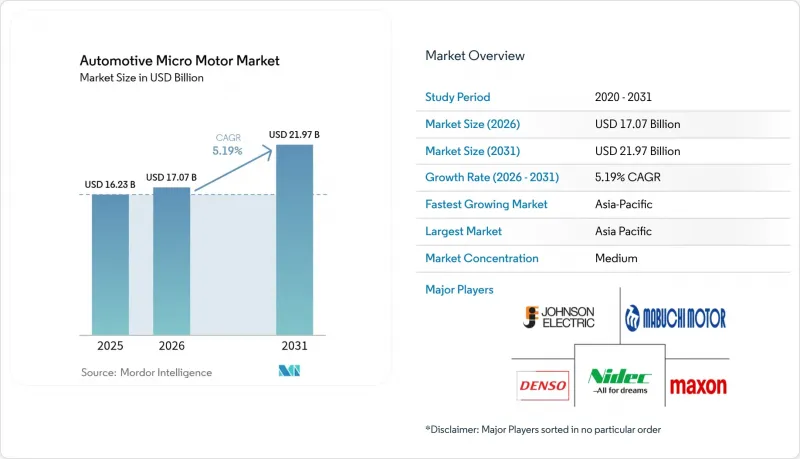
根據 Mordor Intelligence 估計,到 2026 年,汽車微型馬達市值將達到 170.7 億美元,高於 2025 年的 162.3 億美元,預計到 2031 年將達到 219.7 億美元。
預計從 2026 年到 2031 年,其複合年成長率將達到 5.19%。
本報告按功耗(低於11V、12-24V及其他)、馬達類型(DC馬達和AC馬達)、技術(有刷微型馬達和無刷微型馬達)、應用領域(汽車電子及其他)、車輛類型(乘用車和商用車)、銷售管道(OEM和售後市場)以及地區進行細分。市場預測以價值(美元)和銷售(台)為單位呈現。
全球汽車微型馬達市場趨勢與洞察
電動車產量激增
全球電動車出貨量持續超過整個微型車市場的成長速度,每款純電動車都依賴數十個輔助微型馬達來實現溫度控管、空氣動力學性能、轉向、煞車和電池組冷卻。 《組裝雜誌》預測,到2034年,驅動馬達的產量將成長四倍,超過1.2億台,這一趨勢也帶動了整個子系統對小型馬達日益成長的需求。中國2023年的汽車出口量超過日本,達到491萬輛,反映了這一轉變,而中國也是汽車微型馬達市場的主要集中地。高階電動車中800V架構的普及進一步提高了基於碳化矽元件的微型馬達控制電子元件的性能標準,迫使供應商開發穩健且相容高頻的驅動模組。
48V輕混架構的興起
從傳統的12V電氣系統轉向48V基板,將使汽車製造商能夠降低高達15%的油耗,並為微型馬達在主動懸吊、怠速熄火系統和電動超級充電站等領域開闢新的應用。 CLEPA預測,到2025年,十分之一的新車將配備48V系統。這將推動48V電池市場的擴張,並為汽車微型馬達市場帶來巨大的設計和應用機會。特斯拉在Cybertruck中採用48V線路加速了這一行業轉型,迫使傳統汽車製造商徹底重新設計其線束、連接器和檢驗工具,以適應更高的電壓。
稀土元素磁鐵價格上漲趨勢
永久磁鐵價格波動是汽車微型馬達供應商面臨的最嚴峻成本挑戰。儘管釹的現貨價格在過去一年下跌了42%,但隨著中國收緊出口限制,長期供應風險仍令人擔憂。已有報導稱,由於磁鐵供應中斷,一些汽車項目,例如日本鈴木Swift的生產線,已經出現停產。業內公司正在尋求採購多元化。 NIDEK已簽署一份契約,使用Noveon公司在美國生產的EcoFlux磁體,有效期至2025年,以此作為抵禦外匯和地緣政治衝擊的緩衝。
細分市場分析
預計到2025年,12-24V微型馬達將佔據汽車微型馬達市場42.14%的佔有率,這反映了所有輕型車輛車型普遍採用的傳統電氣架構。然而,由於汽車製造商(OEM)採用輕度混合動力和800V電動車動力系統以提高效率,高壓(48V以上)細分市場預計將以5.61%的複合年成長率(CAGR)實現最高成長。這種轉變正在擴大汽車微型馬達市場,推動高扭力無刷馬達與低規格線束相結合,旨在降低電阻損耗和熱負載。特斯拉推出48V線束凸顯了業界對下一代電氣標準的廣泛共識。
CLEPA 已證實,48V 技術可降低高達 15% 的油耗,從而加速其在歐洲二氧化碳排放合規策略中的應用。因此,供應商正在擴展其模組化定子產品系列,涵蓋從 24V 鼓風機電機到 400V 牽引輔助電機,以最大限度地提高平台復用率。新興的低功耗(11V 以下)細分市場在感測器節點領域仍然十分重要,但其銷售佔有率有限。
到2025年,DC馬達的銷售佔比將達到59.10%,這主要得益於其在車窗升降器、座椅調節器和空調擋板等領域的具成本效益設計。然而,AC馬達維持了強勁的複合年成長率(CAGR),達到6.29%,因為其變速運轉能夠降低轉向系統、煞車系統和冷卻液泵的能耗。因此,汽車微型馬達市場呈現均衡的產品陣容:直流平台仍然適用於開關驅動,而變頻驅動的交流馬達則滿足了電動方向盤的效率目標。
Nidec 的「SynRA」系列馬達是同步磁阻轉矩馬達技術轉型的典型例子,它無需稀土元素磁體,並提高了供電穩定性。 Johnson Johnson Electric 2023/24年度的銷售數據顯示,兩種類型的馬達均持續獲得原始設備製造商 (OEM) 的採用,這證實了其多技術策略的有效性。
區域分析
預計到2025年,亞太地區將佔全球汽車微型馬達銷售額的48.10%,並將繼續引領汽車微型馬達市場,到2031年複合年成長率將達到6.03%。 2023年,中國出口汽車數量達到491萬輛,超過日本,並已建立龐大的微型馬達、半導體和磁鐵供應基地。日本電產(Nidec)計劃將其大連工廠的員工人數增加至多50%,使其成為全球最大的電動車馬達生產基地,年產能達100萬台。泰國和印尼正在吸引新的投資,以建立一體化的電動車供應鏈,從而擴大區域內的採購選擇。
在歐洲,隨著48V系統的引入在日益嚴格的排放氣體法規背景下穩步推進,豪華車製造商也開始採用主動空氣動力學設計,歐洲汽車技術正穩步發展。歐洲汽車工業協會(CLEPA)對輕度混合動力傳動系統的推廣,以及舍弗勒和維特斯科於2024年完成的合併,都增強了歐洲本土的電機技術實力。德國新創公司DeepDrive成功資金籌措3,350萬美元,用於將雙轉子設計商業化,該設計可將磁鐵用量減少50%,凸顯了歐洲對輕量化創新的堅定承諾。
在北美,推動這一趨勢的因素是生產回流政策和特斯拉主導的電壓標準化。 KPS Capital Partners以35億歐元收購西門子InnoMotics部門,顯示私募股權對高價值馬達品牌的需求強勁。
南美洲從較低的基數呈現較高的成長率,這得益於巴西和阿根廷生產中電子元件的日益普及。
其他好處:
- Excel格式的市場預測(ME)表
- 3個月的分析師支持
目錄
第1章:引言
- 研究假設和市場定義
- 調查範圍
第2章:調查方法
第3章執行摘要
第4章 市場狀況
- 市場概覽
- 市場促進因素
- 電動車產量激增
- 消費者對豪華和高階內裝的需求日益成長。
- 促進車輛輕量化和零件小型化
- 48V輕混架構的興起
- 整合到主動空氣動力學系統中
- 車載健康功能(離子產生器、香氛擴散器)的普及
- 市場限制因素
- 稀土元素磁鐵價格上漲趨勢
- 由於技術不斷升級,單價不斷上漲。
- 公差標準的收緊增加了認證成本。
- 新推出的壓電致動器替代品
- 價值供應鏈分析
- 監理情勢
- 技術展望
- 波特五力模型
第5章 市場規模與成長預測
- 按電力消耗量
- 低於11伏
- 12~24 V
- 25~48 V
- 48伏特或以上
- 依馬達類型
- DC馬達
- AC馬達
- 透過技術
- 有刷微型電機
- 無刷微型電機
- 透過使用
- 車身電子設備(車窗、座椅、後視鏡)
- 動力傳動系統/傳動系統
- 底盤和轉向系統
- 安全和ADAS模組
- 資訊娛樂和互聯
- 車輛類型
- 搭乘用車
- 商用車輛
- 按銷售管道
- OEM
- 售後市場
- 按地區
- 北美洲
- 美國
- 加拿大
- 其他北美國家
- 南美洲
- 巴西
- 阿根廷
- 其他南美國家
- 歐洲
- 德國
- 英國
- 法國
- 義大利
- 西班牙
- 俄羅斯
- 其他歐洲國家
- 亞太地區
- 中國
- 日本
- 印度
- 韓國
- 澳洲和紐西蘭
- 其他亞太國家
- 中東和非洲
- 沙烏地阿拉伯
- 阿拉伯聯合大公國
- 土耳其
- 南非
- 其他中東和非洲國家
- 北美洲
第6章 競爭情勢
- 市場集中度
- 策略趨勢
- 市佔率分析
- 公司簡介
- Nidec Corporation
- Johnson Electric Holdings Ltd.
- Mabuchi Motor Co., Ltd.
- Maxon Motor AG
- Mitsuba Corporation
- Buhler Motor GmbH
- Denso Corporation
- Robert Bosch GmbH
- Continental AG
- Valeo SA
- Brose Fahrzeugteile SE
- Ametek Inc.
- MinebeaMitsumi Inc.
- Mitsumi Electric Co., Ltd.
- Shenzhen Kinmore Motor Co.
- Constar MicroMotor
- Wellings Holdings Ltd.
第7章 市場機會與未來展望
According to Mordor Intelligence, automotive micromotor market size in 2026 is estimated at USD 17.07 billion, growing from 2025 value of USD 16.23 billion with 2031 projections showing USD 21.97 billion, growing at 5.19% CAGR over 2026-2031.
This report is Segmented by Power Consumption (Below 11V, 12 To 24V, and More), Motor Type (DC Motor and AC Motor), Technology (Brushed Micromotor and Brushless Micromotor), Application (Body Electronics and More), Vehicle Type (Passenger Cars and Commercial Vehicles), Sales Channel (OEM and Aftermarket), and Geography. The Market Forecasts are Provided in Terms of Value (USD) and Volume (Units).
Global Automotive Micro Motor Market Trends and Insights
Surge in EV Production Volumes
Global EV shipments continue to outpace overall light-vehicle growth, and each pure battery model relies on dozens of auxiliary micromotors for thermal management, aerodynamics, steering, braking and battery-pack cooling. Assembly Magazine forecasts a fourfold jump in traction-motor output to more than 120 million units by 2034, a trend that cascades into parallel demand for smaller motors across sub-systems. China's rise to 4.91 million vehicle exports in 2023, surpassing Japan, reflects this shift and concentrates much of the automotive micromotor market in the region. Higher 800 V architectures in premium EVs further raise the performance bar for micromotor control electronics built around silicon-carbide devices, pushing suppliers toward robust, high-frequency driver modules.
Rise in 48V Mild-Hybrid Architectures
Moving from traditional 12 V electrics to 48 V boards allows automakers to cut fuel use by up to 15% while unlocking new micromotor applications in active suspension, start-stop and electric superchargers. CLEPA projects 48 V systems in one out of every ten new cars by 2025. The accompanying 48 V battery segment is anticipated to climb, giving the automotive micromotor market a sizeable design-in opportunity. Tesla's adoption of 48 V wiring in the Cybertruck accelerates industry conversion, although legacy manufacturers must overhaul harnesses, connectors and validation tools to cope with higher voltages.
Up-trend in Rare-Earth Magnet Prices
Permanent-magnet pricing volatility is the most acute cost challenge for automotive micromotor suppliers. Neodymium spot values slid 42% over the past year, yet long-term supply risk looms as China tightens export controls. Vehicle programmes already report production pauses, such as Suzuki's Swift line in Japan, when magnet shipments stalled. Industry players are diversifying sourcing: Nidec signed a 2025 deal to adopt Noveon Ecoflux magnets produced in the United States, buffering currency and geopolitical shocks.
Other drivers and restraints analyzed in the detailed report include:
- Growing Demand for Luxury & Premium Interiors
- Vehicle Lightweighting & Component Miniaturisation Push
- Constant Tech Upgrades Inflating Unit Costs
For complete list of drivers and restraints, kindly check the Table Of Contents.
Segment Analysis
The 12 to 24 V class held 42.14% of the 2025 automotive micromotor market share, reflecting legacy electrical architectures across the light-vehicle parc. Higher-voltage (More than 48 V) segments, however, register the fastest 5.61% CAGR as OEMs adopt mild-hybrid and 800 V EV drivetrains for efficiency gains. This shift enlarges the automotive micromotor market size for high-torque brushless units paired with low-gauge wiring harnesses, cutting resistive losses and easing thermal loads. Tesla's 48 V harness rollout underscores broad industry alignment on the next electrical standard.
CLEPA confirms that 48 V technology can trim fuel use by up to 15%, accelerating its inclusion in European CO2-compliance strategies. Suppliers therefore scale modular stator families that cover 24 V blower motors through 400 V traction auxiliaries, maximising platform reuse. Emerging low-power (Less than 11 V) niches remain relevant for sensor nodes yet represent a limited portion of revenue.
DC motors commanded 59.10% of 2025 revenue thanks to cost-effective designs for window lifts, seat adjusters and HVAC flaps. Nevertheless, AC machines record a robust 6.29% CAGR because variable-speed operation reduces energy draw in steering, braking and coolant pumps. The automotive micromotor market therefore witnesses a balanced portfolio where DC platforms remain viable for on-off actuation, while inverter-driven AC options satisfy efficiency targets in electric power steering.
Nidec's SynRA line illustrates the push toward synchronous-reluctance architectures that remove rare-earth magnets, boosting supply resilience. Johnson Electric's FY23/24 sales indicate sustained OEM uptake across both motor types, validating a multi-technology roadmap.
Complete Report Scope:
- By Power Consumption
- Below 11 V
- 12 to 24 V
- 25 to 48 V
- Above 48 V
- By Motor Type
- DC Motor
- AC Motor
- By Technology
- Brushed Micromotor
- Brushless Micromotor
- By Application
- Body Electronics (window, seat, mirror)
- Powertrain & Drivetrain Systems
- Chassis & Steering
- Safety & ADAS Modules
- Infotainment & Connectivity
- By Vehicle Type
- Passenger Cars
- Commercial Vehicles
- By Sales Channel
- OEM
- Aftermarket
- By Geography
- North America
- United States
- Canada
- Rest of North America
- South America
- Brazil
- Argentina
- Rest of South America
- Europe
- Germany
- United Kingdom
- France
- Italy
- Spain
- Russia
- Rest of Europe
- Asia-Pacific
- China
- Japan
- India
- South Korea
- Australia & New Zealand
- Rest of Asia-Pacific
- Middle East and Africa
- Saudi Arabia
- United Arab Emirates
- Turkey
- South Africa
- Rest of Middle East and Africa
- North America
Geography Analysis
Asia-Pacific generated 48.10% of global revenue in 2025, and its 6.03% CAGR to 2031 keeps the region at the forefront of the automotive micromotor market. Chinese exporters shipped 4.91 million vehicles in 2023, surpassing Japan and consolidating a broad supply base for micromotors, semiconductors and magnets. Nidec plans to raise headcount at its Dalian complex by up to 50%, turning it into the world's largest EV-motor site capable of one-million-unit output a year. Thailand and Indonesia court fresh investment to create integrated EV supply chains, broadening regional sourcing options.
Europe advances at a steady rate as strict emissions targets spur 48 V roll-outs and premium OEMs adopt active aerodynamics. CLEPA's promotion of mild-hybrid powertrains and Schaeffler's 2024 merger with Vitesco bolster local motor expertise. German start-up DeepDrive secured USD 33.5 million to commercialise dual-rotor designs using 50% fewer magnets, highlighting Europe's push for material-light innovations.
North America is powered by reshoring policies and Tesla-led voltage standardisation. KPS Capital Partners' EUR 3.5 billion takeover of Siemens' Innomotics division signals private equity appetite for high-value motor brands.
South America exhibits the highr growth off a smaller base, aided by rising electronics content in Brazilian and Argentine production.
- Nidec Corporation
- Johnson Electric Holdings Ltd.
- Mabuchi Motor Co., Ltd.
- Maxon Motor AG
- Mitsuba Corporation
- Buhler Motor GmbH
- Denso Corporation
- Robert Bosch GmbH
- Continental AG
- Valeo SA
- Brose Fahrzeugteile SE
- Ametek Inc.
- MinebeaMitsumi Inc.
- Mitsumi Electric Co., Ltd.
- Shenzhen Kinmore Motor Co.
- Constar MicroMotor
- Wellings Holdings Ltd.
Additional Benefits:
- The market estimate (ME) sheet in Excel format
- 3 months of analyst support
TABLE OF CONTENTS
1 Introduction
- 1.1 Study Assumptions & Market Definition
- 1.2 Scope of the Study
2 Research Methodology
3 Executive Summary
4 Market Landscape
- 4.1 Market Overview
- 4.2 Market Drivers
- 4.2.1 Surge in EV production volumes
- 4.2.2 Growing demand for luxury & premium interiors
- 4.2.3 Vehicle lightweighting & component miniaturisation push
- 4.2.4 Rise in 48 V mild-hybrid architectures
- 4.2.5 Integration in active aerodynamics systems
- 4.2.6 Proliferation of cabin wellness features (ionizers, scent dispensers)
- 4.3 Market Restraints
- 4.3.1 Up-trend in rare-earth magnet prices
- 4.3.2 Constant tech upgrades inflating unit costs
- 4.3.3 Tight tolerance specs raising qualification costs
- 4.3.4 Emerging piezo-actuator substitutes
- 4.4 Value/Supply-Chain Analysis
- 4.5 Regulatory Landscape
- 4.6 Technological Outlook
- 4.7 Porter's Five Forces
- 4.7.1 Bargaining Power of Suppliers
- 4.7.2 Bargaining Power of Buyers
- 4.7.3 Threat of New Entrants
- 4.7.4 Threat of Substitutes
- 4.7.5 Intensity of Competitive Rivalry
5 Market Size & Growth Forecasts (Value (USD) and Volume (Units))
- 5.1 By Power Consumption
- 5.1.1 Below 11 V
- 5.1.2 12 to 24 V
- 5.1.3 25 to 48 V
- 5.1.4 Above 48 V
- 5.2 By Motor Type
- 5.2.1 DC Motor
- 5.2.2 AC Motor
- 5.3 By Technology
- 5.3.1 Brushed Micromotor
- 5.3.2 Brushless Micromotor
- 5.4 By Application
- 5.4.1 Body Electronics (window, seat, mirror)
- 5.4.2 Powertrain & Drivetrain Systems
- 5.4.3 Chassis & Steering
- 5.4.4 Safety & ADAS Modules
- 5.4.5 Infotainment & Connectivity
- 5.5 By Vehicle Type
- 5.5.1 Passenger Cars
- 5.5.2 Commercial Vehicles
- 5.6 By Sales Channel
- 5.6.1 OEM
- 5.6.2 Aftermarket
- 5.7 By Geography
- 5.7.1 North America
- 5.7.1.1 United States
- 5.7.1.2 Canada
- 5.7.1.3 Rest of North America
- 5.7.2 South America
- 5.7.2.1 Brazil
- 5.7.2.2 Argentina
- 5.7.2.3 Rest of South America
- 5.7.3 Europe
- 5.7.3.1 Germany
- 5.7.3.2 United Kingdom
- 5.7.3.3 France
- 5.7.3.4 Italy
- 5.7.3.5 Spain
- 5.7.3.6 Russia
- 5.7.3.7 Rest of Europe
- 5.7.4 Asia-Pacific
- 5.7.4.1 China
- 5.7.4.2 Japan
- 5.7.4.3 India
- 5.7.4.4 South Korea
- 5.7.4.5 Australia & New Zealand
- 5.7.4.6 Rest of Asia-Pacific
- 5.7.5 Middle East and Africa
- 5.7.5.1 Saudi Arabia
- 5.7.5.2 United Arab Emirates
- 5.7.5.3 Turkey
- 5.7.5.4 South Africa
- 5.7.5.5 Rest of Middle East and Africa
- 5.7.1 North America
6 Competitive Landscape
- 6.1 Market Concentration
- 6.2 Strategic Moves
- 6.3 Market Share Analysis
- 6.4 Company Profiles (Includes Global Level Overview, Market Level Overview, Core Segments, Financials as Available, Strategic Information, Market Rank/Share for Key Companies, Products and Services, and Recent Developments)
- 6.4.1 Nidec Corporation
- 6.4.2 Johnson Electric Holdings Ltd.
- 6.4.3 Mabuchi Motor Co., Ltd.
- 6.4.4 Maxon Motor AG
- 6.4.5 Mitsuba Corporation
- 6.4.6 Buhler Motor GmbH
- 6.4.7 Denso Corporation
- 6.4.8 Robert Bosch GmbH
- 6.4.9 Continental AG
- 6.4.10 Valeo SA
- 6.4.11 Brose Fahrzeugteile SE
- 6.4.12 Ametek Inc.
- 6.4.13 MinebeaMitsumi Inc.
- 6.4.14 Mitsumi Electric Co., Ltd.
- 6.4.15 Shenzhen Kinmore Motor Co.
- 6.4.16 Constar MicroMotor
- 6.4.17 Wellings Holdings Ltd.


