


 |
市場調查報告書
商品編碼
2120332
隔音和隔聲材料:市場佔有率分析、行業趨勢和統計數據、成長預測(2026-2031)Acoustic Insulation - Market Share Analysis, Industry Trends & Statistics, Growth Forecasts (2026 - 2031) |
||||||

※ 本網頁內容可能與最新版本有所差異。詳細情況請與我們聯繫。
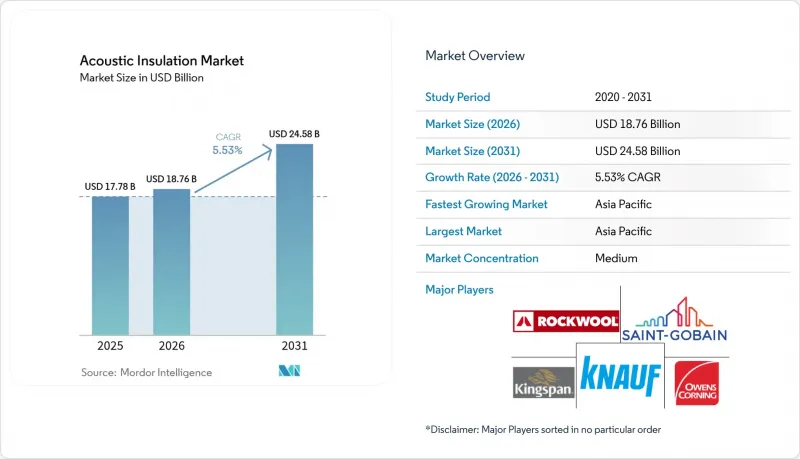
據 Mordor Intelligence 稱,2025 年隔音和隔聲市場價值 177.8 億美元,預計到 2026 年將成長至 187.6 億美元,到 2031 年將成長至 245.8 億美元。
預測期(2026-2031 年)的複合年成長率預計為 5.53%。
本報告按材料類型(礦棉、玻璃絨等)、安裝位置(牆體/隔間、地面/基材等)、最終用戶行業(住宅建築、商業建築等)和地區(亞太地區、北美地區、歐洲地區、南美地區、中東和非洲地區)進行細分。市場預測以美元計價。
全球隔音及聲控市場趨勢及洞察
亞洲基礎建設熱潮推動了降噪法規的推出
中國、印度和東南亞地區對鐵路、機場和綜合用途物業的大規模投資,推動了對輕薄高性能隔音材料的需求。中國修訂後的《建築標準法》(GB 50118)引入了更嚴格的隔音等級(STC)標準,開發商必須從2025年1月起滿足這些標準,這要求隔音材料市場大規模供應經過測試的系統。印度分階段修訂其國家建築標準也反映了這一監管趨勢,強制要求在設計和競標的早期階段就納入隔音措施,而不是在最後時刻才進行修改。多用戶住宅、高架地鐵線和物流走廊的噪音對當地社區的影響正受到嚴格審查,促使建築師採用礦物棉和聚合物泡沫的混合複合複合材料,以阻隔各種頻寬的聲音。製造商正在將生產設施位置在成長走廊附近,以減少物流運輸過程中的噪音,並縮短大規模基礎設施項目的前置作業時間。因此,以合規為導向的採購正在加速價值從基礎卷材產品轉向整合隔音、隔熱和防火功能的認證系統。這一趨勢在確保隔音和隔聲市場長期需求下限的同時,也促使銷售管道朝向以規格主導的模式轉型。
政府制定法規控制噪音污染
政策框架正從簡單的分貝限制轉向全面的、基於健康的指標,要求設計人員記錄吸聲係數、隔音等級(STC)值和生命週期概況。歐盟已修訂其《環境噪音指令》和關於機動車噪音的第540/2014號條例,要求成員國在2026年前繪製並實施主要公路、鐵路和機場走廊的噪音控制措施。在美國,針對環保署(EPA)的持續訴訟,旨在強制執行長期擱置的《噪音管制法》,重新引發了關於國家標準的辯論。這進一步促使一些市政當局要求對混合用途許可證進行聲學調查。隨著法規的生效,採購部門現在要求提供第三方認證以證明合規性,這為擁有完整文件的供應商打開了溢價空間。聲學標準和能源標準之間的協調也在不斷加強。目前,一些歐盟成員國已將礦物棉製成的空心隔音材料認定為隔音和隔聲材料,這創造了雙重價值提案,並增強了隔音和隔聲材料市場的定價權。
石油化學原料價格波動會影響發泡塑膠。
異氰酸酯和發泡價格飆升,導致聚合物發泡體和礦物棉之間的成本差距進一步擴大,擾亂了既定的專案預算。對價格敏感的市場承包商在發泡體飆升之際,轉而使用低等級纖維氈,導致聚氨酯和押出成型聚苯乙烯產品的需求短期下降。為了應對這一局面,調查團隊正致力於利用回收的PET、甘蔗渣衍生的多元醇和生物二氧化碳發泡來重新組合發泡材,以抵禦原油價格波動的影響。然而,大規模生產的進展並不穩定,而且由於價格波動預計將持續到2026年,儘管發泡材性能依然優異,但其應用速度可能會放緩。
細分市場分析
預計到2025年,礦物棉的銷售額將佔總銷售額的37.42%,這主要得益於其固有的耐火性、卓越的低頻吸音性能以及符合不斷發展的安全標準。 ROCKWOOL公司估計,2024年售出的岩棉系統在其使用壽命內將節省818太瓦時(TWh)的能源,同時改善全球180萬名學生的學習環境。玻璃棉緊接在石棉之後,這得益於其輕質、經濟高效且易於現場切割的特性,尤其適用於坡屋頂住宅。聚合物泡棉的複合年成長率(CAGR)最高,達到5.94%,因為暖通空調工程師優先考慮濕度控制和對複雜風管形狀的靈活適應性,但原料價格的波動限制了其應用。天然纖維產品在低碳建築規劃中取得了進展,例如IndiTherm隔熱棉等產品展現出卓越的性能,例如50毫米厚度即可達到40分貝的隔音效果,以及負碳含量。透過消除甲醛並使用生物基認證的再生黏合劑,礦物棉能夠承受競爭壓力,在隔音和隔聲市場中保持材料的平衡多樣性。
區域分析
預計到2025年,亞太地區將佔據市場主導地位,市佔率達36.58%,並有望在2031年之前維持7.38%的複合年成長率。這主要得益於中國、印度和新興東協經濟體大力推動大型鐵路走廊、智慧城市區域和高層住宅綜合體的建設。在中國,由於社區對噪音問題的強烈不滿,地方政府正在推動提高建築外牆的隔音等級標準,從而帶動了高密度岩絨幕牆嵌件的大量訂單。在印度,在邦政府獎勵的支持下,城市住宅建設的推廣也使得隔音標準從“可選”提升至“強制”,進而帶動了玻璃絨卷材和輕質隔間套件需求的激增。
2024年,北美地區在全球銷售額中貢獻顯著,這主要得益於辦公大樓的大規模維修以及市政噪音法規執行力度的加大。城市負責人在為混合用途建築申請許可證時,越來越要求進行噪音影響評估;建築師也開始採用礦棉和再生PET相結合的混合面板,以平衡成本和LEED認證積分。在人口密集的城市地區,由於建築面積比的限制,外牆厚度受到限制,因此用於幕牆橫樑的高級氣凝膠膠帶越來越受歡迎。歐洲在監管進步方面繼續發揮關鍵作用,歐盟的《環境噪音指令》要求在2026年前製定最新的噪音地圖和行動計畫。多用戶住宅和交通樞紐受益於礦棉空心隔音材料和符合嚴格防火等級的高NRC值天花板構件的使用。中東和非洲地區正經歷強勁成長,尤其是在波灣合作理事會(GCC)成員國,這些國家正在體育場館、地鐵和機場航站大樓實施世界一流的聲學標準。南美洲的銷售額也相當可觀。在巴西,公寓維修以玻璃棉槽的應用為主導;而在阿根廷,隨著人們意識的提高,模組化牆板正逐漸普及。這些區域差異凸顯了隔音材料市場的全球廣度,並展現了其對市場週期波動的韌性。
其他好處:
- Excel格式的市場預測(ME)表
- 3個月的分析師支持
目錄
第1章:引言
- 研究假設和市場定義
- 調查範圍
第2章:調查方法
第3章執行摘要
第4章 市場狀況
- 市場概覽
- 市場促進因素
- 亞洲基礎建設熱潮推動了降噪法規的推出
- 政府推出法規控制噪音污染,以及住宅用戶數量激增。
- 新興國家需求增加
- 開放式辦公室的增加帶動了對天花板和隔間用吸音板的需求。
- 市場限制因素
- 高揮發性石油化學原料正在影響發泡塑膠的成本競爭力。
- 新興市場氣凝膠毯安裝技能缺口
- 多層複合材料廢棄物回收法規合規壓力
- 價值鏈分析
- 波特五力模型
第5章 市場規模與成長預測
- 依材料類型
- 礦棉
- 玻璃絨
- 聚合物發泡體
- 天然材質
- 按安裝位置
- 牆壁和隔間
- 地板和地板下空間
- 天花板和屋頂
- 暖通空調管道及管路保溫
- 按最終用戶行業分類
- 住宅
- 商業建築
- 運輸
- 產業
- 按地區
- 亞太地區
- 中國
- 印度
- 日本
- 韓國
- ASEAN
- 其他亞太國家
- 北美洲
- 美國
- 加拿大
- 墨西哥
- 歐洲
- 德國
- 英國
- 法國
- 義大利
- 西班牙
- 其他歐洲國家
- 南美洲
- 巴西
- 阿根廷
- 其他南美國家
- 中東和非洲
- 沙烏地阿拉伯
- 南非
- 其他中東和非洲國家
- 亞太地區
第6章 競爭情勢
- 市場集中度
- 策略趨勢
- 市佔率分析
- 公司簡介
- 3M
- Armacell
- Aspen Aerogels, Inc.
- BASF SE
- Cabot Corporation
- CSR Pty Limited
- Fletcher Insulation
- Huntsman International LLC
- Hush Acoustics
- Johns Manville
- Kingspan Group
- Knauf Group
- Owens Corning
- Recticel Insulation
- ROCKWOOL A/S
- Saint-Gobain
- Siderise Group
- Sika AG
- Trelleborg AB
- Xella International(Etex Group)
第7章 市場機會與未來展望
According to Mordor Intelligence, the acoustic insulation market size was valued at USD 17.78 billion in 2025 and estimated to grow from USD 18.76 billion in 2026 to reach USD 24.58 billion by 2031, at a CAGR of 5.53% during the forecast period (2026-2031).
This report is Segmented by Material Type (Mineral Wool, Glass Wool, and More), Installation Zone (Wall and Partition, Floor and Sub-Floor, and More), End-User Industry (Residential Construction, Commercial Construction, and More), and Geography (Asia-Pacific, North America, Europe, South America, and Middle East and Africa). The Market Forecasts are Provided in Terms of Value (USD).
Global Acoustic Insulation Market Trends and Insights
Infrastructure Boom-Driven Noise Mitigation Mandates in Asia
Massive investment in rail, airport, and mixed-use real estate across China, India, and Southeast Asia is amplifying demand for low-profile yet high-performance acoustic barriers. China's updated GB 50118 building code introduces stricter STC thresholds that developers must meet from January 2025, forcing the acoustic insulation market to supply tested systems at scale. India's phased amendments to its National Building Code replicate this regulatory momentum, locking acoustics into early design and tender stages instead of late-cycle fixes. Multi-tower housing, elevated metro lines, and logistics corridors are now heavily scrutinized for community noise impact, which is pushing architects toward hybrid mineral-wool and polymeric-foam composites that block wide frequency ranges. Manufacturers are localizing production near growth corridors to cut transport noise during logistics and to shorten lead times for large infrastructure lots. Consequently, compliance-driven procurement is accelerating value migration from basic bulk rolls toward certified systems that bundle acoustic, thermal, and fire performance attributes within one product line. This activity is securing a long-run demand floor for the acoustic insulation market while re-shaping sales channels toward specification-led models.
Government Regulations for Controlling Noise Pollution
Policy frameworks are moving beyond simple decibel caps to holistic health-based indicators, forcing specifiers to document absorption coefficients, STC ratings, and life-cycle profiles. The European Union has refreshed the Environmental Noise Directive and Regulation No 540/2014 on vehicle noise, obliging member states to map and treat major road, rail, and airport corridors by 2026. In the United States, ongoing litigation against the EPA to enforce the dormant Noise Control Act has reignited debate on national standards, energizing municipalities that already require acoustic studies for mixed-use permitting. As regulations solidify, procurement teams now demand third-party certificates that prove compliance, opening premium price territory for suppliers with complete documentation packages. Coupling of acoustic standards with energy codes is also growing; several EU states now recognise mineral-wool cavity barriers as both thermal and sound partitions, generating dual-value propositions that fortify pricing power in the acoustic insulation market.
Volatile Petrochemical Feedstock Impacting Foamed-Plastic Cost Parity
Surging prices for isocyanates and blowing agents widen cost differentials between polymeric foams and mineral wool, disrupting established project budgets. Contractors in price-sensitive markets now substitute lower-grade fibre batts when foam quotes spike, trimming short-term demand for polyurethane and extruded polystyrene lines. In response, research teams are reformulating foams with recycled PET, sugarcane bagasse polyols, and bio-CO2 expansion to insulate against crude-oil price swings. Yet scale-up remains uneven, and volatility is expected to persist through 2026, tempering foam uptake even as performance credentials remain strong.
Other drivers and restraints analyzed in the detailed report include:
- Rise in Demand from Emerging Economies
- Growth of Open-Plan Offices Spurring Ceiling & Partition Acoustic Panels
- Installation Skill Gap for Aerogel Blankets in Emerging Markets
For complete list of drivers and restraints, kindly check the Table Of Contents.
Segment Analysis
Mineral wool generated 37.42% of 2025 revenue, propelled by inherent fire resistance, robust low-frequency absorption, and compatibility with evolving safety codes. ROCKWOOL estimates that stone-wool systems sold in 2024 will save 818 TWh of lifetime energy while enhancing learning conditions for 1.8 million students worldwide. Glass-wool follows closely thanks to lightweight, cost efficiency, and ease of cutting on job sites, especially in pitched-roof housing. Polymeric foams post the quickest 5.94% CAGR as HVAC engineers prioritise moisture control and flexible fit for complex duct geometries, though feedstock volatility moderates uptake. Natural-fiber categories are advancing in low-carbon building schemes, with products like IndiTherm batts delivering a 40 dB reduction at 50 mm thickness and negative embodied carbon scores. Reformulated binders that eliminate formaldehyde and achieve biobased certification are helping mineral wool withstand competitive pressure, ensuring the acoustic insulation market maintains balanced material diversity.
Complete Report Scope:
- By Material Type
- Mineral Wool
- Glass Wool
- Polymeric Foams
- Natural
- By Installation Zone
- Wall and Partition
- Floor and Sub-Floor
- Ceiling and Roof
- HVAC Duct and Pipe Wrap
- By End-User Industry
- Residential Construction
- Commercial Construction
- Transportation
- Industrial
- By Geography
- Asia-Pacific
- China
- India
- Japan
- South Korea
- ASEAN
- Rest of Asia-Pacific
- North America
- United States
- Canada
- Mexico
- Europe
- Germany
- United Kingdom
- France
- Italy
- Spain
- Rest of Europe
- South America
- Brazil
- Argentina
- Rest of South America
- Middle East and Africa
- Saudi Arabia
- South Africa
- Rest of Middle East and Africa
- Asia-Pacific
Geography Analysis
Asia-Pacific dominated with a 36.58% revenue share in 2025, and the region is forecast to log a 7.38% CAGR through 2031 as China, India, and emerging ASEAN economies advance mega-rail corridors, smart-city zones, and high-rise residential clusters. China's community backlash against elevated noise has spurred local authorities to enforce stricter facade STC benchmarks, translating into bulk orders for dense stone-wool curtain-wall inserts. India's urban housing drive, backed by state incentives, similarly elevates acoustic compliance from optional to mandatory, swelling demand for glass-wool rolls and lightweight partition kits.
In 2024, North America significantly contributed to global revenue, driven by proactive office retrofits and heightened enforcement of municipal noise ordinances. Municipal planners increasingly require noise-impact studies for mixed-use permits, and architects respond with hybrid mineral-wool and recycled-PET panels to balance cost and LEED credits. Premium aerogel tapes for curtain-wall spandrels are gaining traction in dense city cores where floor-area ratios pressure facade thickness. Europe remains a key player in regulatory advancements, with the EU's Environmental Noise Directive driving the requirement for updated noise maps and action plans by 2026. Multi-family housing and transport hubs are benefiting significantly, utilizing mineral-wool cavity barriers and high-NRC ceiling clouds that comply with stringent fire classifications. The Middle East and Africa region is experiencing robust growth, particularly in Gulf Cooperation Council states, which are incorporating world-class acoustic standards into their stadiums, metros, and airport terminals. South America contributes notably to sales, with Brazil leading through condominium retrofits favoring glass-wool batts, while Argentina is gradually adopting modular wall panels as awareness increases. This diverse regional landscape highlights the global scope of the acoustic insulation market and provides resilience against market cyclicality
- 3M
- Armacell
- Aspen Aerogels, Inc.
- BASF SE
- Cabot Corporation
- CSR Pty Limited
- Fletcher Insulation
- Huntsman International LLC
- Hush Acoustics
- Johns Manville
- Kingspan Group
- Knauf Group
- Owens Corning
- Recticel Insulation
- ROCKWOOL A/S
- Saint-Gobain
- Siderise Group
- Sika AG
- Trelleborg AB
- Xella International (Etex Group)
Additional Benefits:
- The market estimate (ME) sheet in Excel format
- 3 months of analyst support
TABLE OF CONTENTS
1 Introduction
- 1.1 Study Assumptions and Market Definition
- 1.2 Scope of the Study
2 Research Methodology
3 Executive Summary
4 Market Landscape
- 4.1 Market Overview
- 4.2 Market Drivers
- 4.2.1 Infrastructure Boom-Driven Noise Mitigation Mandates in Asia
- 4.2.2 Government Regulations for Controlling Noise Pollution and Surge in Adoption in Residential Application
- 4.2.3 Rise in Demand from Emerging Economies
- 4.2.4 Growth of Open-Plan Offices Spurring Ceiling and Partition Acoustic Panels
- 4.3 Market Restraints
- 4.3.1 Volatile Petrochemical Feedstock Impacting Foamed-Plastic Cost Parity
- 4.3.2 Installation Skill Gap for Aerogel Blankets in Emerging Markets
- 4.3.3 Recycling Compliance Pressures on Multilayer Composite Waste Streams
- 4.4 Value Chain Analysis
- 4.5 Porter's Five Forces
- 4.5.1 Bargaining Power of Suppliers
- 4.5.2 Bargaining Power of Buyers
- 4.5.3 Threat of New Entrants
- 4.5.4 Threat of Substitute Products and Services
- 4.5.5 Degree of Competition
5 Market Size and Growth Forecasts (Value)
- 5.1 By Material Type
- 5.1.1 Mineral Wool
- 5.1.2 Glass Wool
- 5.1.3 Polymeric Foams
- 5.1.4 Natural
- 5.2 By Installation Zone
- 5.2.1 Wall and Partition
- 5.2.2 Floor and Sub-Floor
- 5.2.3 Ceiling and Roof
- 5.2.4 HVAC Duct and Pipe Wrap
- 5.3 By End-User Industry
- 5.3.1 Residential Construction
- 5.3.2 Commercial Construction
- 5.3.3 Transportation
- 5.3.4 Industrial
- 5.4 By Geography
- 5.4.1 Asia-Pacific
- 5.4.1.1 China
- 5.4.1.2 India
- 5.4.1.3 Japan
- 5.4.1.4 South Korea
- 5.4.1.5 ASEAN
- 5.4.1.6 Rest of Asia-Pacific
- 5.4.2 North America
- 5.4.2.1 United States
- 5.4.2.2 Canada
- 5.4.2.3 Mexico
- 5.4.3 Europe
- 5.4.3.1 Germany
- 5.4.3.2 United Kingdom
- 5.4.3.3 France
- 5.4.3.4 Italy
- 5.4.3.5 Spain
- 5.4.3.6 Rest of Europe
- 5.4.4 South America
- 5.4.4.1 Brazil
- 5.4.4.2 Argentina
- 5.4.4.3 Rest of South America
- 5.4.5 Middle East and Africa
- 5.4.5.1 Saudi Arabia
- 5.4.5.2 South Africa
- 5.4.5.3 Rest of Middle East and Africa
- 5.4.1 Asia-Pacific
6 Competitive Landscape
- 6.1 Market Concentration
- 6.2 Strategic Moves
- 6.3 Market Share Analysis
- 6.4 Company Profiles {(includes Global level Overview, Market level overview, Core Segments, Financials as available, Strategic Information, Market Rank/Share for key companies, Products and Services, and Recent Developments)}
- 6.4.1 3M
- 6.4.2 Armacell
- 6.4.3 Aspen Aerogels, Inc.
- 6.4.4 BASF SE
- 6.4.5 Cabot Corporation
- 6.4.6 CSR Pty Limited
- 6.4.7 Fletcher Insulation
- 6.4.8 Huntsman International LLC
- 6.4.9 Hush Acoustics
- 6.4.10 Johns Manville
- 6.4.11 Kingspan Group
- 6.4.12 Knauf Group
- 6.4.13 Owens Corning
- 6.4.14 Recticel Insulation
- 6.4.15 ROCKWOOL A/S
- 6.4.16 Saint-Gobain
- 6.4.17 Siderise Group
- 6.4.18 Sika AG
- 6.4.19 Trelleborg AB
- 6.4.20 Xella International (Etex Group)
7 Market Opportunities and Future Outlook
- 7.1 White-space and Unmet-Need Assessment
- 7.2 Demand for Aesthetic Prospects and Fire-resistant Properties of Acoustic Insulation

 木纖維隔熱材料:市場佔有率分析、產業趨勢與統計、成長預測(2026-2031)
 2026-2030年全球木纖維隔熱材料材料市場
 玻璃纖維隔熱材料市場報告:趨勢、預測及競爭分析(至2035年)
 建築隔聲市場:全球市場預測(2026-2032)
 戶外隔音屏障市場規模、佔有率和成長分析:按材料、產品類型、安裝方式、應用、最終用戶和地區分類-2026-2033年產業預測隔音材料市場:2026-2032年全球市場預測(按材料、產品類型、安裝方法、應用、最終用戶產業和分銷管道分類)
 高超音速飛機隔熱材料市場:商業機會、成長要素、產業趨勢分析及2026-2035年預測
 吸音板市場規模、佔有率和成長分析:按產品類型、材料類型、應用、安裝類型、最終用戶產業、面板形狀和地區分類-2026-2033年產業預測
 住宅隔音市場-全球產業規模、佔有率、趨勢、機會、預測:按類型、地區和競爭格局分類,2021-2031年
 高性能隔熱材料市場預測至2034年-按材料類型、防護機制、應用、形態、最終用戶和地區分類的全球分析