


 |
市場調查報告書
商品編碼
2117259
木纖維隔熱材料:市場佔有率分析、產業趨勢與統計、成長預測(2026-2031)Wood Fiber Insulation - Market Share Analysis, Industry Trends & Statistics, Growth Forecasts (2026 - 2031) |
||||||

※ 本網頁內容可能與最新版本有所差異。詳細情況請與我們聯繫。
根據 Mordor Intelligence 預測,木纖維隔熱材料市場規模預計在 2025 年達到 9.3 億美元,2026 年達到 9.9 億美元,到 2031 年達到 13.4 億美元,2026 年至 2031 年的複合年成長率為 6.25%。
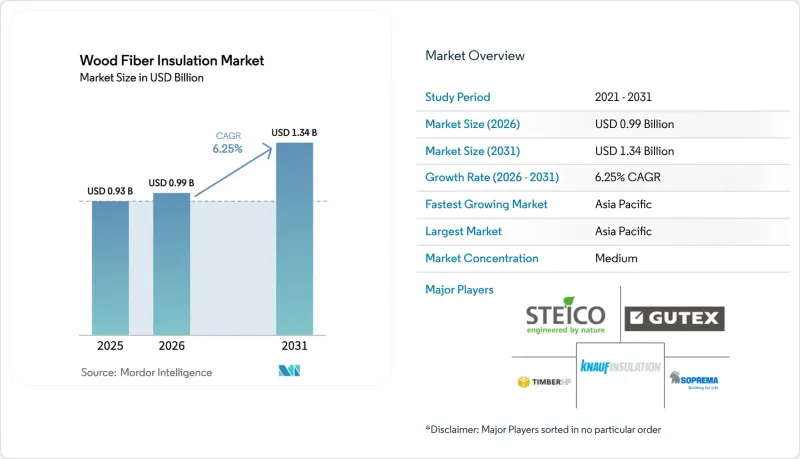
本報告按產品類型(剛性板材、軟性條板等)、應用領域(保溫、隔音、電氣/防火)、終端用戶產業(住宅、商業、公共、工業、基礎設施)和地區(亞太、北美、歐洲、南美、中東和非洲)進行細分。市場預測以美元計價。
全球木纖維隔熱材料市場趨勢及洞察
更嚴格的淨零能耗建築標準
牆體R值和碳預算上限的強制性提高正在縮短生物基隔熱材料的投資回收期。加州2025年第24號法規修正案將牆體R值提高了15%,禁止在3-16氣候區使用單層玻璃纖維,並指導建築師採用符合透氣性要求的連續外牆木纖維板。挪威2025年建築技術法規將營運和製造過程中的總總合限制在每平方公尺每年8公斤二氧化碳當量,並將明確的碳預算納入許可審查。愛爾蘭和德國的淨零排放標準也類似地將生命週期碳模組納入合格評定軟體,使得木纖維中的生物來源碳在設計初期階段即可體現。隨著許可機構和能源模擬顧問在碳排放上限方面達成一致,木纖維正從一種小眾的環保選擇轉變為一種主流的合規工具,尤其是在溫帶和寒冷氣候地區的建築圍護結構中。如果加州和紐約州以外的其他美國州將其建築規範與 ASHRAE 即將發布的 CH-36 碳補充標準保持一致,預計這項運動的影響將會更加強烈。
大規模住宅維修工程激增。
公共資金投入達到歷史新高,刺激了兼具隔熱性和氣密性的牆體填充材的潛在需求。紐約州的EmPower+節能維修規定,牆體保溫材料的鼓風門性能標準為每平方英尺0.25 cfm50,而高密度纖維填充物無需使用甲醛粘合劑即可滿足此標準。加拿大的「綠色住宅貸款」計畫在2025年將貸款上限提高至4萬加元(約2.96萬美元),由於住宅將熱泵與閣樓隔熱材料更換相結合,申請量已超出預期40%。德國的BEG津貼目前為「節能住宅55」維修提供45%的材料成本補貼,而滲透性水蒸氣纖維填充物透過防止牆體內部冷凝,為實現這一目標做出了貢獻。津貼的申請資格要求促使承包商投資於鼓風門測試和熱成像技術,從而形成良性循環:經過檢驗的氣密性性能鞏固了未來木纖維建築規範的發展。因此,維修工程的激增既是推動建築量成長的因素,也是加速技能發展的驅動力。
與礦物棉和玻璃纖維的競爭
在美國和亞太地區的住宅市場,由於碳含量尚未被納入強制性規範,含碳材料的成本溢價仍比傳統礦棉高出10-20%。 2025年,玻璃纖維棉在大型量販店通路的交付價為每板英尺R值0.45美元,而硬質木纖維板則為0.55美元。礦棉作為一種防火結構材料,其市場佔有率得以維持,是因為其符合ASTM E136不燃標準,無需額外塗層。而木纖維板則可能需要採用混合結構才能達到相同的防火等級。雖然在大規模維修中,人事費用的協同效應可以抵消部分成本差異,但許多地區的補貼計劃將補貼上限設定在產品價格水平,迫使住宅自行承擔差價。在補貼計劃直接獎勵低碳材料之前,價格的挑戰可能會限制預算受限項目中低碳材料的採用率。
細分市場分析
預計到2025年,硬質板材將佔總銷售額的57.57%,其在雨幕系統和需要尺寸穩定性的連續保溫結構中的適用性尤其值得關注。在預製工廠中,兼具結構襯墊功能的板材越來越受歡迎,從而減少了產品種類和施工流程。軟性氈在龍骨間距不均勻的區域仍屬於小眾產品,但由於礦棉在該領域仍佔據主導地位,其普及率仍不高。同時,散裝填充和DensePak產品的複合年成長率達到6.97%。這是因為維修承包商能夠將這些材料注入不規則空間而無需擔心沉降風險,而且其卓越的耐久性已在加拿大的實地研究中得到證實。將木纖維表面材料與礦棉或PIR芯材結合的複合板材是發展最快的產品類別,無需使用膨脹噴塗劑即可達到EN 13501-2防火等級標準。隨著 Kingspan 和 Gutex 的真空吸塑板材合資企業在 2025 年日益成熟,混合解決方案將蠶食被動式房屋維修中硬質板材的市場佔有率。然而,在符合最低建築規範要求的住宅建築中,單一材料板材預計仍將佔據主導地位。
第二代濕式生產線透過降低18%的生產能耗(與傳統系統相比),鞏固了硬質板材的市場地位,從而降低了價格。同時,散裝填料(噴塗填充材)生產商正投資於纖維精煉廠,將堆積密度提高12%,從而降低運輸成本並確保噴塗過程中的均勻覆蓋。因此,產品趨勢呈現兩極化。高性能複合複合材料產品瞄準了商業建築維修,因為牆體厚度是關鍵因素;而精簡型硬板材則在住宅市場保持核心銷售量。在這兩個管道中,數位化建模工具現在都整合了濕度和熱模組,突顯了木纖維的緩衝性能,鼓勵建築師在基礎設計階段早期就指定使用透氣層。
區域分析
預計到2025年,亞太地區將維持全球木纖維隔熱材料市場51.19%的最大佔有率,並將成為成長最快的地區,2026年至2031年的複合年成長率將達到6.19%。然而,由於安裝人員培訓不足和運輸成本高等因素,該地區許多市場對木纖維隔熱材料的應用仍處於起步階段。在日本,《2025年建築標準法》對面積超過2000平方公尺的公共建築的碳排放量設定了限制,積水住宅正在使用歐洲製造的板材在模組化鋼骨框架中進行測試。在澳大利亞,《2025年國家建築標準法》提高了山區保溫性能(R值)的標準,在塔斯馬尼亞州和新南威爾斯等高海拔地區創造了新的市場需求。由於運輸成本每板英尺增加 0.10 至 0.12 美元,在該地區建立工廠之前,木纖維隔熱材料預計將僅限於高階綠色建築項目。
到2025年,以德國、法國和英國為首的歐洲將佔據區域市場佔有率的很大一部分。英國的「未來住宅標準」將於2026年生效,該標準要求住宅在運作過程中減少75%的二氧化碳排放。設計被動式住宅的建築師正在採用連續木纖維層來消除熱橋效應。在歐洲,阿爾卑斯山和斯堪的納維亞半島新建住宅中被動式住宅的採用率已接近40%,即使新建住宅市場的成長潛力有所萎縮,房屋維修工程仍在支撐著被動式住宅市場的溫和成長。
在北美,加州、奧勒岡州和華盛頓州已將「蘊藏量碳儲量」計算表納入其能源標準合規要求,而紐約州則正在資助大規模節能維修,這些項目結合了熱泵和連續外牆保溫技術。加拿大將「綠色住宅」貸款額度提高至4萬加元(約2.96萬美元)後,多個州啟動了批量採購計劃,使得木纖維板的價格降低了12%至15%。墨西哥對NOM-020-ENER標準的修訂,明確了木纖維板必須滿足的建築圍護結構要求,蒙特雷和瓜達拉哈拉等地的高階項目正在迅速採用這種材料。
雖然在南美洲、中東和非洲仍然落後,但在杜拜的 Al Sa'fat 評級體系中,豪華飯店專案採用木纖維隔熱材料的情況正在改善,該系統會授予低碳權額度。
其他好處:
- Excel格式的市場預測(ME)表
- 3個月的分析師支持
目錄
第1章:引言
- 研究假設和市場定義
- 調查範圍
第2章:調查方法
第3章執行摘要
第4章 市場狀況
- 市場概覽
- 市場促進因素
- 更嚴格的「淨零能耗」建築標準
- 激進式住宅維修計畫激增
- 公共採購中隱含碳排放的相關規定
- 異地模組化建築的擴張正在推動對透氣材料的需求。
- 供應鏈本地化以因應循環經濟
- 市場限制因素
- 與礦物棉和玻璃纖維的競爭
- 除歐洲以外,安裝人員的意識程度較低。
- 由於其體積密度低,物流成本高。
- 價值鏈分析
- 監理情勢
- 技術展望
- 波特五力模型
第5章 市場規模與成長預測
- 按產品形式
- 剛性基板
- 軟性球棒
- 鬆散填充物/密實填充物
- 複合板和混合板
- 透過使用
- 隔熱材料
- 隔音
- 電氣/防火襯裡
- 按最終用戶行業分類
- 住宅
- 商業的
- 公共機構
- 工業和基礎設施
- 按地區
- 亞太地區
- 中國
- 日本
- 印度
- 韓國
- 澳洲和紐西蘭
- 其他亞太國家
- 北美洲
- 美國
- 加拿大
- 墨西哥
- 歐洲
- 德國
- 英國
- 法國
- 義大利
- 其他歐洲國家
- 南美洲
- 巴西
- 阿根廷
- 其他南美國家
- 中東和非洲
- 沙烏地阿拉伯
- 阿拉伯聯合大公國
- 南非
- 奈及利亞
- 其他中東和非洲國家
- 亞太地區
第6章 競爭情勢
- 市場集中度
- 策略趨勢
- 市佔率和排名分析
- 公司簡介
- Beltermo
- BISCHOFF SCHAFER Holz GmbH
- DIEFFENBACHER GmbH
- EWI Pro Insulation Systems Ltd
- Gutex Holzfaserplattenwerk H. Henselmann GmbH+Co. KG
- ISOCELL GmbH & Co KG
- Kingspan Group
- Knauf Insulation
- Swiss Krono
- LIGNOTREND GmbH & Co. KG.
- Lime Green Products Ltd
- Schneider GmbH
- Soprema
- STEICO SE
- TimberHP
第7章 市場機會與未來展望
According to Mordor Intelligence, the wood fiber insulation market size is projected to be USD 0.93 billion in 2025, USD 0.99 billion in 2026, and reach USD 1.34 billion by 2031, growing at a CAGR of 6.25% from 2026 to 2031.
This report is Segmented by Product Form (Rigid Boards, Flexible Batts, and More), Application (Thermal, Acoustic, and Electrical/Fire-Protection), End-User Industry (Residential, Commercial, Institutional, Industrial and Infrastructure), and Geography (Asia-Pacific, North America, Europe, South America, Middle East and Africa). Market Forecasts are Provided in Terms of Value (USD).
Global Wood Fiber Insulation Market Trends and Insights
Stricter Net-Zero Building Energy Codes
Mandatory upgrades to wall R-values and carbon-budget ceilings are compressing payback periods for bio-based insulation. California's 2025 Title 24 amendments raised wall R-values by 15%, disqualifying single-layer fiberglass in climate zones 3-16 and steering architects toward continuous exterior wood fiber boards that satisfy vapor-open requirements. Norway's 2025 Technical Building Regulation capped operational plus embodied emissions at 8 kg CO2-equivalent per m2 annually, adding explicit carbon budgets to permit reviews. Irish and German net-zero standards likewise embed whole-life-carbon modules in compliance software, making the biogenic carbon of wood fiber visible at early design stages. As permit officers and energy-modeling consultants align on carbon ceilings, wood fiber moves from niche eco-choice to mainstream compliance route, especially in temperate and cold-climate envelopes. The driver's influence is expected to intensify once U.S. states beyond California and New York harmonize codes with ASHRAE's forthcoming CH-36 carbon appendix.
Surge in Residential Deep-Retrofit Programs
Public funding has reached record levels, unlocking latent demand for cavity-infilling materials that combine insulation and air-sealing in a single work step. New York's EmPower+ weatherization mandate pegs blower-door performance at 0.25 cfm50 per ft2, a threshold dense-pack wood fiber satisfies without formaldehyde-based binders. Canada's Greener Homes Loan lifted its ceiling to CAD 40,000 (USD 29,600) in 2025, and application volume exceeded forecasts by 40% after homeowners paired heat pumps with attic re-insulation. Germany's BEG grant now covers 45% of material costs for Efficiency House 55 retrofits, a target that vapor-open wood fiber helps achieve by preventing interstitial condensation. Funding milestones have forced contractors to invest in blower-door testing and thermal imaging, creating a feedback loop where verified air-sealing performance cements future wood fiber specifications. The retrofit surge is therefore both a volume catalyst and a skills-development accelerator.
Price Competition vs. Mineral Wool and Fiberglass
Delivered cost remains 10-20% higher than commodity mineral wool in U.S. and APAC housing markets where embodied-carbon premiums have yet to translate into mandatory specifications. Fiberglass batts retailed at USD 0.45 per board-foot R-value in 2025 big-box channels, compared with USD 0.55 for rigid wood fiber boards. Mineral wool keeps share in fire-rated assemblies because its non-combustible ASTM E136 classification eliminates extra coatings, whereas wood fiber boards sometimes require hybrid constructs to meet the same rating. Although deep-retrofit labor synergies close part of the gap, rebate structures in many jurisdictions cap reimbursements at commodity pricing, leaving homeowners to self-fund the premium. Until subsidy frameworks reward low-carbon materials directly, price tension will cap penetration in budget-constrained projects.
Other drivers and restraints analyzed in the detailed report include:
- Embodied-Carbon Rules in Public Procurement
- Off-Site Modular Growth Driving Vapor-Open Materials
- Limited Installer Familiarity Outside Europe
For complete list of drivers and restraints, kindly check the Table Of Contents.
Segment Analysis
Rigid boards commanded 57.57% of 2025 revenue, underscoring their fit with rain-screen and continuous-insulation assemblies that require dimensional stability. Prefab plants value boards that double as structural sheathing, trimming SKUs, and installation steps. Flexible batts remain niche where stud cavities vary, but mineral wool still dominates that channel, keeping batt uptake modest. Loose-fill and dense-pack products, however, are growing at a 6.97% CAGR because retrofit contractors blow material into irregular bays without settling risk, a durability edge verified in Canadian field studies. Composite panels pairing wood fiber facings with mineral wool or PIR cores are the fastest-evolving line, allowing EN 13501-2 fire ratings without intumescent sprays. As Kingspan's 2025 vacuum-panel joint venture with Gutex matures, hybrid solutions will erode rigid-board share in passive-house retrofits, though single-material boards will stay dominant in code-minimum residential builds.
Second-generation wet-process lines reduce embodied energy by 18% versus legacy systems, enabling price cuts that buttress rigid-board market position. Meanwhile, loose-fill producers are investing in fiber-conditioning mills that raise bulk density by 12%, paring freight cost and smoothing blown coverage. The product-form landscape is therefore bifurcating: high-performance composite offerings target commercial retrofits where wall thickness is at a premium, while streamlined rigid boards defend core residential volume. Across both channels, digital modeling tools now include hygrothermal modules that highlight wood fiber's buffering advantage, nudging architects to specify vapor-open layers early in schematic design.
Complete Report Scope:
- By Product Form
- Rigid Boards
- Flexible Batts
- Loose-Fill / Dense-Pack
- Composite and Hybrid Panels
- By Application
- Thermal Insulation
- Acoustic Insulation
- Electrical / Fire-Protection Linings
- By End-User Industry
- Residential
- Commercial
- Institutional
- Industrial and Infrastructure
- By Geography
- Asia-Pacific
- China
- Japan
- India
- South Korea
- Australia and New Zealand
- Rest of Asia-Pacific
- North America
- United States
- Canada
- Mexico
- Europe
- Germany
- United Kingdom
- France
- Italy
- Rest of Europe
- South America
- Brazil
- Argentina
- Rest of South America
- Middle East and Africa
- Saudi Arabia
- United Arab Emirates
- South Africa
- Nigeria
- Rest of Middle-East and Africa
- Asia-Pacific
Geography Analysis
Asia-Pacific retained the largest revenue share at 51.19% of the global wood fiber insulation market in 2025, and is also estimated to be the fastest-growing region with a CAGR of 6.19% from 2026-2031. Wood fiber insulation adoption in the region is still developing in many markets due to sparse installer training and freight cost penalties. Japan's 2025 Building Standard Law now caps embodied carbon in public buildings above 2,000 m2, and Sekisui House is testing European-sourced boards in modular steel frames. Australia's National Construction Code 2025 tightened R-values in alpine zones, creating niche demand in Tasmania and high-altitude New South Wales. Freight costs add USD 0.10-0.12 per board-foot, limiting wood fiber to premium green-build projects until regional plants emerge.
Europe accounted for a significant regional share in 2025, underpinned by Germany, France, and the United Kingdom. The United Kingdom's Future Homes Standard, effective 2026, requires 75% operational-carbon reductions; passive-house architects wield continuous wood fiber layers to eliminate thermal bridges. Although Europe's penetration rate nears 40% in Alpine and Nordic new-builds, retrofit programs sustain modest growth even as new-construction upside narrows.
In North America, California, Oregon, and Washington integrate embodied-carbon tables into energy-code compliance, while New York funds deep-energy retrofits that pair heat pumps with continuous exterior insulation. Canada's Greener Homes loan boost to CAD 40,000 (USD 29,600) sparked provincial bulk-purchase programs that shaved 12-15% off wood fiber board pricing. Mexico's NOM-020-ENER update set envelope requirements that wood fiber fulfills, birthing an early-adopter cluster in Monterrey and Guadalajara luxury projects.
South America and the Middle East and Africa trail, though Dubai's Al Sa'fat rating system grants low-carbon credits that tilt high-end hospitality projects toward wood fiber.
- Beltermo
- BISCHOFF SCHAFER Holz GmbH
- DIEFFENBACHER GmbH
- EWI Pro Insulation Systems Ltd
- Gutex Holzfaserplattenwerk H. Henselmann GmbH + Co. KG
- ISOCELL GmbH & Co KG
- Kingspan Group
- Knauf Insulation
- Swiss Krono
- LIGNOTREND GmbH & Co. KG.
- Lime Green Products Ltd
- Schneider GmbH
- Soprema
- STEICO SE
- TimberHP
Additional Benefits:
- The market estimate (ME) sheet in Excel format
- 3 months of analyst support
TABLE OF CONTENTS
1 Introduction
- 1.1 Study Assumptions and Market Definition
- 1.2 Scope of the Study
2 Research Methodology
3 Executive Summary
4 Market Landscape
- 4.1 Market Overview
- 4.2 Market Drivers
- 4.2.1 Stricter net-zero building energy codes
- 4.2.2 Surge in residential deep-retrofit programs
- 4.2.3 Embodied-carbon rules in public procurement
- 4.2.4 Off-site modular growth driving vapor-open materials
- 4.2.5 Supply-chain localization for circular-economy compliance
- 4.3 Market Restraints
- 4.3.1 Price competition vs. mineral wool and fiberglass
- 4.3.2 Limited installer familiarity outside Europe
- 4.3.3 High logistics cost from low bulk density
- 4.4 Value Chain Analysis
- 4.5 Regulatory Landscape
- 4.6 Technological Outlook
- 4.7 Porter's Five Forces
- 4.7.1 Bargaining Power of Suppliers
- 4.7.2 Bargaining Power of Buyers
- 4.7.3 Threat of New Entrants
- 4.7.4 Threat of Substitutes
- 4.7.5 Degree of Competition
5 Market Size and Growth Forecasts (Value)
- 5.1 By Product Form
- 5.1.1 Rigid Boards
- 5.1.2 Flexible Batts
- 5.1.3 Loose-Fill / Dense-Pack
- 5.1.4 Composite and Hybrid Panels
- 5.2 By Application
- 5.2.1 Thermal Insulation
- 5.2.2 Acoustic Insulation
- 5.2.3 Electrical / Fire-Protection Linings
- 5.3 By End-User Industry
- 5.3.1 Residential
- 5.3.2 Commercial
- 5.3.3 Institutional
- 5.3.4 Industrial and Infrastructure
- 5.4 By Geography
- 5.4.1 Asia-Pacific
- 5.4.1.1 China
- 5.4.1.2 Japan
- 5.4.1.3 India
- 5.4.1.4 South Korea
- 5.4.1.5 Australia and New Zealand
- 5.4.1.6 Rest of Asia-Pacific
- 5.4.2 North America
- 5.4.2.1 United States
- 5.4.2.2 Canada
- 5.4.2.3 Mexico
- 5.4.3 Europe
- 5.4.3.1 Germany
- 5.4.3.2 United Kingdom
- 5.4.3.3 France
- 5.4.3.4 Italy
- 5.4.3.5 Rest of Europe
- 5.4.4 South America
- 5.4.4.1 Brazil
- 5.4.4.2 Argentina
- 5.4.4.3 Rest of South America
- 5.4.5 Middle East and Africa
- 5.4.5.1 Saudi Arabia
- 5.4.5.2 United Arab Emirates
- 5.4.5.3 South Africa
- 5.4.5.4 Nigeria
- 5.4.5.5 Rest of Middle-East and Africa
- 5.4.1 Asia-Pacific
6 Competitive Landscape
- 6.1 Market Concentration
- 6.2 Strategic Moves
- 6.3 Market Share(%)/Ranking Analysis
- 6.4 Company Profiles (includes Global level Overview, Market level overview, Core Segments, Financials as available, Strategic Information, Market Rank/Share, Products and Services, Recent Developments)
- 6.4.1 Beltermo
- 6.4.2 BISCHOFF SCHAFER Holz GmbH
- 6.4.3 DIEFFENBACHER GmbH
- 6.4.4 EWI Pro Insulation Systems Ltd
- 6.4.5 Gutex Holzfaserplattenwerk H. Henselmann GmbH + Co. KG
- 6.4.6 ISOCELL GmbH & Co KG
- 6.4.7 Kingspan Group
- 6.4.8 Knauf Insulation
- 6.4.9 Swiss Krono
- 6.4.10 LIGNOTREND GmbH & Co. KG.
- 6.4.11 Lime Green Products Ltd
- 6.4.12 Schneider GmbH
- 6.4.13 Soprema
- 6.4.14 STEICO SE
- 6.4.15 TimberHP
7 Market Opportunities and Future Outlook
- 7.1 White-space and Unmet-Need Assessment
- 7.2 Technological Advancements and Product Innovation

 2026-2030年全球木纖維隔熱材料材料市場
 玻璃纖維隔熱材料市場報告:趨勢、預測及競爭分析(至2035年)
 建築隔聲市場:全球市場預測(2026-2032)
 隔音和隔聲材料:市場佔有率分析、行業趨勢和統計數據、成長預測(2026-2031)
 戶外隔音屏障市場規模、佔有率和成長分析:按材料、產品類型、安裝方式、應用、最終用戶和地區分類-2026-2033年產業預測隔音材料市場:2026-2032年全球市場預測(按材料、產品類型、安裝方法、應用、最終用戶產業和分銷管道分類)
 高超音速飛機隔熱材料市場:商業機會、成長要素、產業趨勢分析及2026-2035年預測
 吸音板市場規模、佔有率和成長分析:按產品類型、材料類型、應用、安裝類型、最終用戶產業、面板形狀和地區分類-2026-2033年產業預測
 住宅隔音市場-全球產業規模、佔有率、趨勢、機會、預測:按類型、地區和競爭格局分類,2021-2031年
 高性能隔熱材料市場預測至2034年-按材料類型、防護機制、應用、形態、最終用戶和地區分類的全球分析