


 |
市場調查報告書
商品編碼
2119904
LED顯示器:市場佔有率分析、產業趨勢與統計、成長預測(2026-2031年)LED Display - Market Share Analysis, Industry Trends & Statistics, Growth Forecasts (2026 - 2031) |
||||||

※ 本網頁內容可能與最新版本有所差異。詳細情況請與我們聯繫。
據 Mordor Intelligence 稱,2025 年 LED 顯示器市值為 196.7 億美元,預計到 2031 年將達到 269.8 億美元,而 2026 年為 207.3 億美元,預測期(2026-2031 年)的複合年成長率為 5.41%。
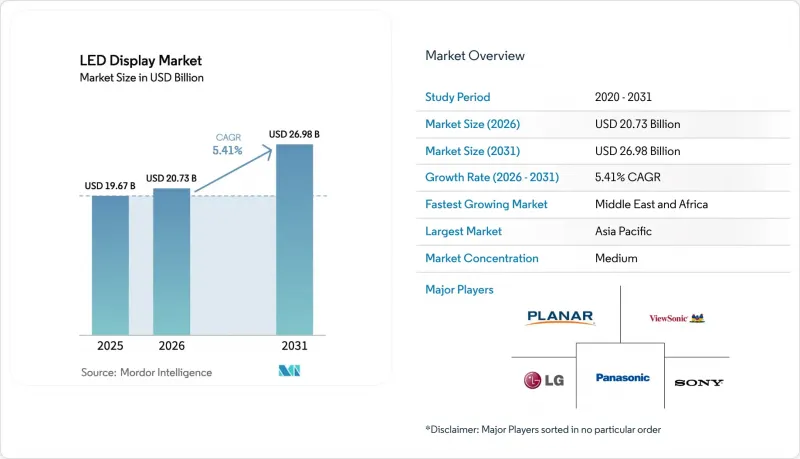
本報告依安裝類型(例如,固定式)、顯示類型(例如,戶外式)、技術(例如,microLED、OLED)、像素間距(小於1.5毫米和1.5毫米或更小)、彩色顯示(例如,單色)、螢幕大小(小於10平方公尺及其他)、應用領域(廣告/媒體及其他)、終端用戶行業(商業細分。市場預測以美元計價。
全球LED顯示器市場趨勢與洞察
海灣合作理事會地區控制室向小像素間距室內牆面顯示器過渡
目前,海灣合作理事會(GCC)地區的新控制室規範傾向於採用像素間距小於1.5毫米的高解析度顯示螢幕,以取代能源、交通和安防中心的拼接式液晶顯示螢幕牆。沙烏地阿拉伯和阿拉伯聯合大公國已將其每年150億美元的數位基礎設施預算中的相當一部分用於無邊框視覺化系統,該系統可即時顯示多個資料流。在2024年發布的控制室競標中,超過60%的投標方要求使用DirectView LED顯示螢幕,並指出與傳統解決方案相比,五年內總擁有成本(TCO)可降低22%。這項額外成本的合理性體現在操作清晰度、更低的雜訊以及消除阻礙關鍵資料的接縫等。整合服務仍然是一個瓶頸,因此供應商正在整合自動對準和遠端校準功能,以縮短試運行週期。
數位戶外廣告在中國二線城市的快速普及
預計2024年,中國數位戶外廣告網路的廣告支出將達到74億美元,其中二線城市已佔38%。廣告主高度重視人工智慧驅動的受眾分析,與靜態廣告看板相比,該技術可將宣傳活動的效果提升27%。較低的安裝場地租金和簡化的本地授權流程,使得二線城市的部署速度比飽和的一線城市市場更快。顯示器供應商報告稱,指示牌銷售額實現了兩位數的成長,這得益於像素間距價格的下降以及模組化框架簡化了屋頂和街道的安裝。這種擴張趨勢也正蔓延至大都會圈,中國媒體投資者正在這些地區複製成熟的營運模式。
微型LED大批量轉移設備需要高資本投資
商用轉移設備每條生產線的成本在 5,000 萬美元到 7,500 萬美元之間,這使得 2024 年全球微型 LED 的生產規模僅限於 12 家公司。目前 6,400 個晶片轉移的良率高達 99.3%,但仍不足以實現成本效益高的大規模生產,阻礙了其主流應用。雷射導引正向轉移和流體組裝等創新技術在降低單位成本方面前景廣闊,但工廠改造需要多個規劃週期。因此,製造商將微型 LED 生產線的產能分配給了亮度更高、對比度更強的超高級產品,這些產品的價格也更高。
細分市場分析
固定位置市場(主要由零售店、企業和控制室等需要解析度小於2.9毫米的固定安裝應用程式驅動)將在2025年占到總銷售額的62.35%。多源儀錶板和品牌牆對無縫影像的需求,使得這些設備在LED顯示器市場中保持著較高的運轉率。同時,隨著實況活動、展覽會和混合型企業會議的復甦,租賃和行動解決方案預計將在2031年之前以6.78%的複合年成長率成長。免工具框架可將安裝時間縮短40%,而整合的自動校準功能則縮小了與固定安裝之間的品質差距。供應商也正在整合航空箱物流和快速鎖定連接器,幫助租賃業者縮短專案前置作業時間並提高周轉率。
專業活動策劃人員越來越傾向於採用訂閱模式,將資本支出 (Capex) 轉化為營運支出 (OpEx),以適應現代企業活動的靈活性。技術供應商透過遠端監控螢幕狀態,在熟練勞動力持續短缺的情況下,最大限度地減少了對現場技術人員的需求。這些趨勢正在推動潛在需求,尤其是對像素間距小於 2.9 毫米的產品,這類產品即使在臨時舞台上也能顯示超高清內容。因此,LED 顯示器市場正在接受租賃解決方案,將其作為展示尖端像素技術的前沿平台,未來預計將過渡到永久安裝。
到2025年,亮度在5000至8000尼特之間、外殼堅固機殼的戶外系統(適用於廣告和交通樞紐)將佔總銷售額的55.30%。同時,室內系統預計到2031年將維持6.5%的複合年成長率。 1.5毫米或更小的像素間距實現了無邊框、清晰的影像,在會議室、廣播演播室和旗艦店等零售場所的應用方面超越了液晶電視牆。表面處理有效抑制了眩光,面板厚度也減少到40毫米以下,從而可以貼牆安裝。
企業房地產負責人非常欣賞這些顯示器的纖薄外形,它們不僅節省占地面積,還能與現代辦公室設計完美融合。整合在機櫃中的智慧建築感測器進一步拓展了其應用場景,使其能夠進行人員佔用分析和環境監測。這些多功能優勢增強了其在室內市場的商業價值,使LED顯示器不再僅僅被視為視覺媒介,而是全方位的辦公室解決方案。
憑藉數十年的供應鏈經驗和久經考驗的可靠性,傳統的SMD架構在2025年佔據了77.20%的出貨量佔有率。雖然Mini-LED在中端市場提供了更大的柔軟性,但Micro-LED預計8.75%的複合年成長率反映了市場對極致性能日益成長的需求,例如用於清晰汽車抬頭顯示器的1000萬尼特綠色像素。儘管雷射光刻和晶圓級鍵合技術預計在未來降低成本,但短期內,其產量仍嚴重偏向高階家庭劇院、航太駕駛座和擴增實境(AR)穿戴式裝置等領域。
目前的LED顯示生態系呈現出層級分明的金字塔結構。 SMD技術推動了廣泛的商業部署,Mini-LED技術滿足了中高階指示牌的需求,而Micro-LED技術則定義了頂級應用,在這些應用中,能源效率和對比度比價格更為重要。隨著良率的提高,Micro-LED產品的市場規模預計將超越高階細分市場,在汽車、國防和專業零售等領域實現營收成長。
區域分析
到2025年,亞太地區將佔全球收入的47.60%,這主要得益於中國在生產和國內市場的巨大優勢。該地區擁有全球整體約80%的製造能力,從而實現了規模經濟,降低了單位成本,並加快了研發和產品發布週期。預計到2024年,中國LED顯示器市場規模將達到6,600億元人民幣,複合年成長率達15.79%,遠超全球平均。中國二線城市持續推廣戶外數位廣告(DOOH),以及印度和印尼公共工程項目對經濟型LED模組的進口,進一步鞏固了該地區的成長動能。
北美和歐洲仍然是高階技術創新的中心。美國的體育場館、電影片場和企業大廳對符合廣播級色彩精度要求的Micro-LED、Mini-LED和細間距模組的需求量龐大。歐盟的能源指令迫使製造商最佳化功耗和可回收性,推動了驅動電路和可回收鋁製機殼設計的突破性進步。雖然出貨量落後於亞洲,但平均售價依然居高不下,為擁有先進製造技術的供應商帶來了豐厚的利潤。
中東和非洲地區雖然規模較小,但預計將呈現最快的成長軌跡,2026年至2031年的複合年成長率將達到6.78%。海灣合作理事會(GCC)國家,尤其是沙烏地阿拉伯和阿拉伯聯合大公國,正在大力投資酒店項目,這些項目兼具安全控制室、智慧城市顯示器和彰顯國家聲望的地標性建築等功能。飛利浦專業顯示解決方案將於2024年推出全系列LED產品,這表明該地區正在發展成為一個強大的商業中心。非洲主要城市也正逐步效仿,利用行動業者推廣的數位戶外廣告(DOOH)概念,超越傳統的靜態看板。在這些新興市場,高階定位和承包服務往往比價格更為重要的選擇標準。
其他好處:
- Excel格式的市場預測(ME)表
- 3個月的分析師支持
目錄
第1章:引言
- 研究假設和市場定義
- 調查範圍
第2章:調查方法
第3章執行摘要
第4章 市場狀況
- 市場概覽
- 市場促進因素
- 海灣合作理事會(GCC)國家控制室向高解析度室內牆面顯示器過渡
- 數位戶外廣告在中國二線城市的快速普及
- 體育場大小的LED巨型螢幕正在提升美國運動俱樂部球迷的參與度。
- 在東協智慧城市走廊,用於交通管理的可變訊息板(VMS)的安裝正在迅速增加。
- 在歐洲,支援 8K 的廣播攝影棚正在升級到 DirectView LED 系統。
- 日本零售連鎖店維修為節能型Mini-LED燈
- 市場限制因素
- 用於微型LED大規模生產的轉移設備的高資本投資成本
- 尺寸小於 10µm 的紅色和綠色微晶片供應瓶頸
- 歐盟關於城市中心數位電子看板亮度的規定
- 撒哈拉以南非洲地區熟練安裝技術人員短缺
- 產業生態系分析
- 技術展望
- 波特五力分析
第5章 市場規模與成長預測
- 按安裝類型
- 固定式LED顯示螢幕
- 租賃/移動式LED顯示螢幕
- 顯示類型
- 戶外LED顯示器
- 室內LED顯示器
- 透過技術
- 傳統SMD LED
- Micro-LED
- Mini-LED
- OLED
- 板載晶片(COB)LED
- 按下像素間距
- 小於 1.5 毫米和 1.5 毫米或更小(精細像素間距)
- 1.6~2.9 mm
- 3~6 mm
- 6毫米或以上
- 彩色顯示類型
- 黑白
- 三色顯示器
- 全彩
- 按螢幕尺寸
- 不足10平方公尺
- 10-50平方公尺
- 50平方公尺或以上
- 透過使用
- 廣告與媒體
- 體育場館
- 交通/交通管制
- 零售和酒店業
- 公司及控制室
- 教育和醫療保健
- 公共空間與智慧城市的家具
- 按最終用途行業分類
- 商業的
- 政府/國防
- 產業
- 娛樂
- 按地區
- 北美洲
- 美國
- 加拿大
- 墨西哥
- 歐洲
- 德國
- 英國
- 法國
- 義大利
- 西班牙
- 其他歐洲國家
- 亞太地區
- 中國
- 日本
- 韓國
- 印度
- 東南亞
- 其他亞太國家
- 南美洲
- 巴西
- 其他南美國家
- 中東和非洲
- 中東
- 阿拉伯聯合大公國
- 沙烏地阿拉伯
- 其他中東國家
- 非洲
- 南非
- 其他非洲國家
- 中東
- 北美洲
第6章 競爭情勢
- 市場集中度
- 策略趨勢
- 市佔率分析
- 公司簡介
- Samsung Electronics Co. Ltd.
- LG Electronics Inc.
- Leyard Optoelectronic Co. Ltd.
- Unilumin Group Co. Ltd.
- Absen Optoelectronics Co. Ltd.
- Daktronics Inc.
- Barco NV
- Sony Group Corp.
- Toshiba Corp.
- Panasonic Holdings Corp.
- NEC Corp.
- Planar Systems Inc.
- Christie Digital Systems USA Inc.
- ROE Visual Co. Ltd.
- AOTO Electronics Co. Ltd.
- Infiled Electronics Co. Ltd.
- Liantronics Co. Ltd.
- Lighthouse Technologies Ltd.
- ViewSonic Corp.
- Delta Electronics Inc.
- Sansi Technology Co. Ltd.
第7章 市場機會與未來展望
According to Mordor Intelligence, the LED display market size was valued at USD 19.67 billion in 2025 and estimated to grow from USD 20.73 billion in 2026 to reach USD 26.98 billion by 2031, at a CAGR of 5.41% during the forecast period (2026-2031).
This report is Segmented by Installation Type (Fixed, and More), Display Type (Outdoor, and More), Technology (Micro-LED, OLED, and More), Pixel Pitch (Sub and Up To 1. 5 Mm), Color Display (Monochrome, and More), Screen Size (Sub 10 Sq. M., and More), Application (Advertising and Media, and More), End-User Industry (Commercial, and More), and Geography. The Market Forecasts are Provided in Terms of Value (USD).
Global LED Display Market Trends and Insights
Shift to Fine-Pixel-Pitch Indoor Walls in GCC Control Rooms
Fine-pixel-pitch displays below 1.5 mm now dominate new GCC control room specifications, replacing tiled LCD walls in energy, transport, and security hubs. Saudi Arabia and the UAE allocated sizable portions of their USD 15 billion annual digital-infrastructure budgets to bezel-free visualization suites that show multiple data streams in real time. Over 60% of control room tenders released in 2024 required direct-view LED, citing 22% lower five-year total cost of ownership compared with legacy solutions. The premium is justified by operational clarity, noise reduction, and the elimination of seams that obscure critical data. Integration services remain a bottleneck, so vendors are embedding auto-alignment and remote calibration to shorten commissioning cycles.
Rapid Adoption of Digital-Out-of-Home Advertising in Tier-2 Chinese Cities
DOOH networks in China posted USD 7.4 billion in 2024 spend, and tier-2 cities already contribute 38% of that outlay. Advertisers value AI-driven audience analytics that raise campaign effectiveness 27% compared with static boards. Lower site rents and streamlined local approvals unlock faster rollouts than in saturated tier-1 markets. Display suppliers report double-digit signage growth, helped by falling pixel-pitch prices and modular frames that simplify rooftop and street-level mounting. Scaling momentum is also spilling over to Southeast Asian metros where Chinese media investors replicate proven operating models.
High CapEx for Micro-LED Mass-Transfer Equipment
Commercial transfer tools cost USD 50-75 million per line, restricting Micro-LED scale-up to 12 global operators in 2024.Current yields of 99.3% for 6,400-chip transfers remain shy of cost-effective mass production, delaying mainstream adoption. Innovations such as laser-induced forward transfer and fluidic assembly show promise by lowering per-unit capital intensity, yet factory conversions will take several planning cycles. Consequently, manufacturers allocate Micro-LED output to ultra-premium products where superior brightness and contrast warrant higher pricing.
Other drivers and restraints analyzed in the detailed report include:
- Stadium-Scale LED Megascreens Driving U.S. Sports Fan Engagement
- Surge in Traffic-Management Variable-Message Signs Across ASEAN Smart-City Corridors
- Supply Bottlenecks of Red and Green Micro Chips Sub 10 µm
For complete list of drivers and restraints, kindly check the Table Of Contents.
Segment Analysis
The fixed segment generated 62.35% of 2025 revenue, driven by permanent retail, corporate, and control-room deployments that specify sub-2.9 mm resolutions. The LED display market continues to see high utilization of these units because multi-source dashboards and brand walls demand seamless visuals. Conversely, rental and mobile solutions will add 6.78% CAGR through 2031 as live events, trade shows, and hybrid corporate meetings rebound. Tool-free frames now reduce set-up labor 40% and incorporate auto-calibration that narrows quality gaps with permanent structures. Vendors also embed flight-case logistics and quick-lock connectors, supporting shorter project lead times and higher asset turns for rental operators.
Professional event planners increasingly prefer subscription models that convert capex to opex, aligning with the flexible nature of modern corporate gatherings. Technology suppliers track screen health remotely, minimizing on-site technician requirements amid skilled-labor shortages. These trends widen addressable demand, especially for pixel pitches below 2.9 mm that can present ultra-high-definition content even on temporary stages. As a result, the LED display market welcomes rental solutions as a frontline showcase for cutting-edge pixels that later transition into fixed installations.
Outdoor systems retained 55.30% of revenue in 2025 based on brightness levels of 5,000-8,000 nits and ruggedized cabinets suited to advertising and transit hubs. Yet indoor units will secure a faster 6.5% CAGR through 2031. Fine pitches of <= 1.5 mm deliver bezel-free clarity that eclipses LCD videowalls in boardrooms, broadcast studios, and flagship retail venues. Surface treatments now suppress glare, while panel depths drop below 40 mm for flush wall integration.
Corporate real estate sponsors value such slim profiles that preserve floor space and align with contemporary workplace design. Smart-building sensors embedded in the cabinets further broaden the use case to occupancy analytics and environmental monitoring. These multifunctional benefits heighten the indoor business case, positioning the LED display market as a full-stack workplace solution rather than a pure visual medium.
Conventional SMD architectures retained 77.20% of 2025 shipments, benefiting from decades-long supply chains and proven reliability. Mini-LED adds mid-market flexibility, yet Micro-LED's 8.75% forecast CAGR reflects rising appetite for performance extremes such as 10-million-nit green pixels that enable clear automotive head-up display. Laser lithography and wafer-level bonding promise future cost deflation, but near-term output remains skewed to luxury home cinema, aerospace cockpits, and augmented-reality wearables.
The ecosystem now resembles a tiered pyramid. SMD fulfills broad commercial rollouts, Mini-LED addresses premium mid-tier signage, and Micro-LED defines pinnacle applications where power efficiency and contrast overshadow price sensitivity. As yields improve, the LED display market size for Micro-LED products is likely to widen beyond prestige niches, expanding addressable revenues across automotive, defense, and specialty retail environments.
Complete Report Scope:
- By Installation Type
- Fixed LED Display
- Rental/Mobile LED Display
- By Display Type
- Outdoor LED Display
- Indoor LED Display
- By Technology
- Conventional SMD LED
- Micro-LED
- Mini-LED
- OLED
- Chip-on-Board (COB) LED
- By Pixel Pitch
- Sub and Up to 1.5 mm (Fine Pixel Pitch)
- 1.6 - 2.9 mm
- 3 - 6 mm
- Above 6 mm
- By Color Display
- Monochrome
- Tricolor
- Full Color
- By Screen Size
- Less than 10 Square Meter
- 10 - 50 Square Meter
- Above 50 Square Meter
- By Application
- Advertising and Media
- Sports and Stadiums
- Transportation and Traffic Control
- Retail and Hospitality
- Corporate and Control Rooms
- Education and Healthcare
- Public Spaces and Smart-City Furniture
- By End-use Industry
- Commercial
- Government and Defense
- Industrial
- Entertainment
- By Geography
- North America
- United States
- Canada
- Mexico
- Europe
- Germany
- United Kingdom
- France
- Italy
- Spain
- Rest of Europe
- Asia-Pacific
- China
- Japan
- South Korea
- India
- South East Asia
- Rest of Asia-Pacific
- South America
- Brazil
- Rest of South America
- Middle East and Africa
- Middle East
- United Arab Emirates
- Saudi Arabia
- Rest of Middle East
- Africa
- South Africa
- Rest of Africa
- Middle East
- North America
Geography Analysis
Asia Pacific generated 47.60% of global revenue in 2025 thanks to China's dominance in production and domestic deployment. The region hosts roughly 80% of worldwide manufacturing capacity, enabling economies of scale that compress unit pricing while funding rapid R&D release cycles. China's LED display market size is projected to reach 660 billion RMB in 2024, expanding at 15.79% annual compound growth, significantly ahead of global averages. Tier-2 Chinese cities fuel sustained DOOH rollouts, while India and Indonesia import economical modules for civic projects, further amplifying regional momentum.
North America and Europe remain centers of premium innovation. U.S. sports arenas, film production sets, and corporate lobbies anchor demand for Micro-LED, Mini-LED, and fine-pitch modules that meet broadcast-grade color accuracy. EU energy directives push manufacturers to optimize power consumption and recyclability, spurring breakthroughs in driver circuitry and recyclable aluminum chassis designs. Although shipment volumes lag Asia, average selling prices stay higher, securing substantial profit pools for vendors with advanced manufacturing know-how.
The Middle East and Africa region, though smaller, represents the fastest growth trajectory at 6.78% CAGR between 2026 and 2031. GCC states, particularly Saudi Arabia and the UAE, allocate sizeable capital to security control rooms, smart-city displays, and hospitality projects that double as national prestige landmarks. Philips Professional Display Solutions' 2024 introduction of a full LED portfolio illustrates the region's maturation as a viable commercial hub. African metros follow gradually, leveraging mobile network operators' digital-out-of-home ambitions to leapfrog legacy static signage. Across these emerging markets, premium positioning and turnkey service offerings often outweigh price as the decisive selection criteria.
- Samsung Electronics Co. Ltd.
- LG Electronics Inc.
- Leyard Optoelectronic Co. Ltd.
- Unilumin Group Co. Ltd.
- Absen Optoelectronics Co. Ltd.
- Daktronics Inc.
- Barco NV
- Sony Group Corp.
- Toshiba Corp.
- Panasonic Holdings Corp.
- NEC Corp.
- Planar Systems Inc.
- Christie Digital Systems USA Inc.
- ROE Visual Co. Ltd.
- AOTO Electronics Co. Ltd.
- Infiled Electronics Co. Ltd.
- Liantronics Co. Ltd.
- Lighthouse Technologies Ltd.
- ViewSonic Corp.
- Delta Electronics Inc.
- Sansi Technology Co. Ltd.
Additional Benefits:
- The market estimate (ME) sheet in Excel format
- 3 months of analyst support
TABLE OF CONTENTS
1 INTRODUCTION
- 1.1 Study Assumptions and Market Definition
- 1.2 Scope of the Study
2 RESEARCH METHODOLOGY
3 EXECUTIVE SUMMARY
4 MARKET LANDSCAPE
- 4.1 Market Overview
- 4.2 Market Drivers
- 4.2.1 Shift to Fine-Pixel-Pitch Indoor Walls in Gulf Cooperation Council Countries Control Rooms
- 4.2.2 Rapid Adoption of Digital-Out-of-Home (DOOH) advertising in Tier-2 Chinese Cities
- 4.2.3 Stadium-Scale LED Megascreens Driving United States Sports Franchises' Fan-Engagement
- 4.2.4 Surge in Traffic-Management Variable-Message Signs (VMS) Installations Across ASEAN Smart-City Corridors
- 4.2.5 8K-Ready Broadcast Studios Upgrading to Direct-View LED in Europe
- 4.2.6 Energy-Efficient Mini-LED Retrofits in Japanese Retail Chains
- 4.3 Market Restraints
- 4.3.1 High CapEx for Micro-LED Mass-Transfer Equipment
- 4.3.2 Supply Bottlenecks of Red and Green Micro Chips Sub 10 µm
- 4.3.3 Regulatory Limits on Digital-Signage Brightness in EU City Centers
- 4.3.4 Skilled-Installer Shortage in Sub-Saharan Africa
- 4.4 Industry Ecosystem Analysis
- 4.5 Technological Outlook
- 4.6 Porter's Five Forces Analysis
- 4.6.1 Bargaining Power of Suppliers
- 4.6.2 Bargaining Power of Buyers
- 4.6.3 Threat of New Entrants
- 4.6.4 Threat of Substitutes
- 4.6.5 Competitive Rivalry
5 MARKET SIZE AND GROWTH FORECASTS (VALUES)
- 5.1 By Installation Type
- 5.1.1 Fixed LED Display
- 5.1.2 Rental/Mobile LED Display
- 5.2 By Display Type
- 5.2.1 Outdoor LED Display
- 5.2.2 Indoor LED Display
- 5.3 By Technology
- 5.3.1 Conventional SMD LED
- 5.3.2 Micro-LED
- 5.3.3 Mini-LED
- 5.3.4 OLED
- 5.3.5 Chip-on-Board (COB) LED
- 5.4 By Pixel Pitch
- 5.4.1 Sub and Up to 1.5 mm (Fine Pixel Pitch)
- 5.4.2 1.6 - 2.9 mm
- 5.4.3 3 - 6 mm
- 5.4.4 Above 6 mm
- 5.5 By Color Display
- 5.5.1 Monochrome
- 5.5.2 Tricolor
- 5.5.3 Full Color
- 5.6 By Screen Size
- 5.6.1 Less than 10 Square Meter
- 5.6.2 10 - 50 Square Meter
- 5.6.3 Above 50 Square Meter
- 5.7 By Application
- 5.7.1 Advertising and Media
- 5.7.2 Sports and Stadiums
- 5.7.3 Transportation and Traffic Control
- 5.7.4 Retail and Hospitality
- 5.7.5 Corporate and Control Rooms
- 5.7.6 Education and Healthcare
- 5.7.7 Public Spaces and Smart-City Furniture
- 5.8 By End-use Industry
- 5.8.1 Commercial
- 5.8.2 Government and Defense
- 5.8.3 Industrial
- 5.8.4 Entertainment
- 5.9 By Geography
- 5.9.1 North America
- 5.9.1.1 United States
- 5.9.1.2 Canada
- 5.9.1.3 Mexico
- 5.9.2 Europe
- 5.9.2.1 Germany
- 5.9.2.2 United Kingdom
- 5.9.2.3 France
- 5.9.2.4 Italy
- 5.9.2.5 Spain
- 5.9.2.6 Rest of Europe
- 5.9.3 Asia-Pacific
- 5.9.3.1 China
- 5.9.3.2 Japan
- 5.9.3.3 South Korea
- 5.9.3.4 India
- 5.9.3.5 South East Asia
- 5.9.3.6 Rest of Asia-Pacific
- 5.9.4 South America
- 5.9.4.1 Brazil
- 5.9.4.2 Rest of South America
- 5.9.5 Middle East and Africa
- 5.9.5.1 Middle East
- 5.9.5.1.1 United Arab Emirates
- 5.9.5.1.2 Saudi Arabia
- 5.9.5.1.3 Rest of Middle East
- 5.9.5.2 Africa
- 5.9.5.2.1 South Africa
- 5.9.5.2.2 Rest of Africa
- 5.9.5.1 Middle East
- 5.9.1 North America
6 COMPETITIVE LANDSCAPE
- 6.1 Market Concentration
- 6.2 Strategic Moves
- 6.3 Market Share Analysis
- 6.4 Company Profiles (includes Global-level Overview, Market-level Overview, Core Segments, Financials as available, Strategic Information, Market Rank/Share, Products and Services, Recent Developments)
- 6.4.1 Samsung Electronics Co. Ltd.
- 6.4.2 LG Electronics Inc.
- 6.4.3 Leyard Optoelectronic Co. Ltd.
- 6.4.4 Unilumin Group Co. Ltd.
- 6.4.5 Absen Optoelectronics Co. Ltd.
- 6.4.6 Daktronics Inc.
- 6.4.7 Barco NV
- 6.4.8 Sony Group Corp.
- 6.4.9 Toshiba Corp.
- 6.4.10 Panasonic Holdings Corp.
- 6.4.11 NEC Corp.
- 6.4.12 Planar Systems Inc.
- 6.4.13 Christie Digital Systems USA Inc.
- 6.4.14 ROE Visual Co. Ltd.
- 6.4.15 AOTO Electronics Co. Ltd.
- 6.4.16 Infiled Electronics Co. Ltd.
- 6.4.17 Liantronics Co. Ltd.
- 6.4.18 Lighthouse Technologies Ltd.
- 6.4.19 ViewSonic Corp.
- 6.4.20 Delta Electronics Inc.
- 6.4.21 Sansi Technology Co. Ltd.
7 MARKET OPPORTUNITIES AND FUTURE OUTLOOK
- 7.1 White-Space and Unmet-Need Assessment

 櫃檯LED市場規模、佔有率和成長分析:按產品組成、發射頻譜、最終用途、銷售管道、分銷通路和地區分類-2026-2033年產業預測
 迷你LED顯示器:市佔率分析、產業趨勢與統計及成長預測(2026-2031年)
 LED模組化顯示器市場預測至2034年-全球分析(按類型、彩色顯示器、像素間距、控制系統、安裝方式、技術、應用、最終用戶和地區分類)
 小像素間距LED顯示器市場:2026-2032年全球市場預測(依產品類型、像素間距、技術、安裝方式、應用領域及最終用戶分類)數位看板市場:按格式、安裝位置、交付方式、產業、最終用途和應用分類-2026-2032年全球市場預測
 全球LED顯示器市場規模、佔有率、趨勢及成長分析報告(2026-2034年)
 LED電影螢幕市場規模、佔有率和成長分析(按產品類型、技術、螢幕尺寸、最終用戶、銷售管道和地區分類)-2026-2033年產業預測
 LED模組化顯示器市場分析及預測(至2035年):按類型、產品類型、服務、技術、組件、應用、形狀、材質、最終用戶和安裝類型分類迷你LED顯示器市場分析及預測(至2035年):依類型、產品類型、技術、組件、應用、材料類型、最終用戶、功能及安裝類型分類
 日本LED顯示器市場規模、佔有率、趨勢及預測(依技術、顏色、應用、最終用途及地區分類),2026-2034年