


 |
市場調查報告書
商品編碼
2119901
工業雲:市場佔有率分析、產業趨勢與統計、成長預測(2026-2031)Industrial Cloud - Market Share Analysis, Industry Trends & Statistics, Growth Forecasts (2026 - 2031) |
||||||

※ 本網頁內容可能與最新版本有所差異。詳細情況請與我們聯繫。
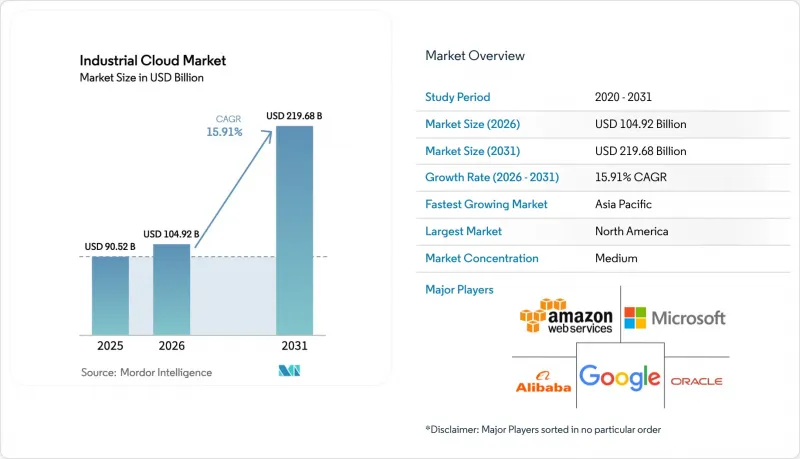
據 Mordor Intelligence 稱,2025 年工業雲市場價值為 905.2 億美元,預計到 2031 年將達到 2196.8 億美元,而 2026 年為 1049.2 億美元,預測期(2026-2031 年)的複合年成長率為 15.91%。
本報告依產品類型(平台、服務)、服務模式(基礎設施即服務、平台即服務、軟體即服務)、部署方式(公共雲端、私有雲端)、終端用戶產業(石油天然氣、能源與公共產業、化學及其他)、公司規模(大型企業、中小企業)及地區進行細分。市場預測以美元計價。
全球工業雲市場趨勢與洞察
工業4.0舉措簡介
製造業對數位轉型的需求正迫使企業將雲端環境與現場控制系統整合,持續推動對工業級雲端平台的需求。西門子累計2024年銷售額將達到759億歐元,其數位化工業部門報告稱,雲端製造執行系統(MES)的訂單正在加速成長。德國和日本的能源效率指令要求實施數位孿生技術以即時監控資源消耗,這迫使工廠將營運資料遷移到雲端。先行者在生產效率和品質方面取得了顯著提升,提高了競爭對手的標準,並迫使落後者加快轉型步伐。自動化供應商透過提供連接器庫來降低整合門檻,這些連接器庫可以將傳統的PLC協定轉換為安全的雲端API,從而在現有設施(棕地)上使用雲端分析,而無需透過更換資產來中斷營運。
雲端運算的成本效益擴充性
經濟波動迫使製造商轉向變動成本的IT模式。 Oracle的雲端基礎設施營收在2024年第四季成長了52%,達到159億美元,這主要得益於工業ERP系統遷移到雲端,這些系統需要彈性容量來應對季節性需求高峰和新產品發布帶來的需求激增。營運支出(Op-ex)模式透過避免閒置的本地伺服器並利用由可再生能源運作的超大規模資料中心,降低了電力成本和範圍2排放。這種價值提案與先前在固定基礎設施上運行高能耗批處理工作負載的金屬和礦業公司產生了強烈的共鳴。隨著雲端供應商將最佳實踐安全性和高可用性(HA)配置整合到預定價方案中,中小企業無需內部專家即可獲得相對更大的收益。
資料安全和合規性問題
攻擊者正將攻擊目標從IT系統轉向雲端連接的營運技術(OT)資產,這提高了經營團隊的風險意識。 IBM的《X-Force 2025報告》重點指出,勒索軟體攻擊導致汽車和化學生產停產數日,不僅造成經濟損失,也直接影響了安全。製藥和食品加工廠需要證明電子記錄在整個產品生命週期中不可篡改,但許多雲端平台仍然依賴模糊責任界限的「責任共擔模型」。技能差距進一步加劇了這個問題,因為工廠工程師很少持有身分和存取管理(IAM)或網路分段認證。因此,企業正在推遲某些遷移,直到參考架構和託管服務成熟為止。
細分市場分析
到2025年,服務領域將佔工業雲端市場的58.12%,因為製造商越來越依賴專業合作夥伴將雲端平台與其異質工廠設備整合。預計到2031年,該領域將以20.17%的年均成長率成長,證實了諮詢、遷移和託管服務並非可有可無的附加服務,而是必不可少的需求。服務供應商正在建構中間件,將20年前的PLC與最新的API連接起來,將引進週期從季度縮短到每週,使工廠員工能夠專注於更高價值的任務。平台收入雖然市場佔有率較小,但利潤豐厚,並推動了研發投入,從而將人工智慧、數位孿生和網路安全安全功能更深入地整合到整個技術堆疊中。許多供應商現在將參考架構與其平台和認證服務合作夥伴捆綁在一起,強化了一個良性循環:平台增強功能提升業務收益,反之亦然。
儘管軟體即服務 (SaaS) 在 2025 年佔總營收的 46.55%,但平台即服務 (PaaS) 到 2031 年的複合年成長率 (CAGR) 將達到 20.8%,成為成長最快的服務。 SaaS 在 ERP 和 CRM 領域的初步成功為基於低程式碼 PaaS 工具包建構的客製化工業應用鋪平了道路。工程師現在無需高級編碼技能即可配置預測性維護儀表板和品質檢測流程,從而減輕了企業 IT 部門的工作量。基礎設施即服務 (IaaS) 仍發揮基礎性作用,但隨著超大規模資料中心業者服務供應商之間的價格競爭加劇,利潤率面臨的壓力也越來越大。差異化的重點正在轉向確定性網路和時間相關的工作負載——這些特性是通用雲端所缺乏的。這種分層結構正展現出成熟的跡象。一旦基礎運算環境的遷移完成,價值將轉移到託管競爭性智慧財產權 (IP) 的開發平台上。
區域分析
北美以48.35%的市佔率位居榜首,這主要得益於其對工業4.0的早期應用以及超大規模資料中心的集中佈局。亞太地區預計到2031年將以22.78%的年均成長率成長,這主要得益於印度和越南從一開始就將配備雲原生生產單元的新工廠運作運作。這些市場的政府正透過將稅收優惠與數位孿生技術的應用掛鉤來鞏固市場需求。在永續性和主權需求的推動下,歐洲正穩步成長,而中東、非洲和南美洲的成長預計將與石油、採礦和農業的數位轉型密切相關。
其他好處:
- Excel格式的市場預測(ME)表
- 3個月的分析師支持
目錄
第1章:引言
- 研究假設和市場定義
- 調查範圍
第2章:調查方法
第3章執行摘要
第4章 市場狀況
- 市場概覽
- 市場促進因素
- 引入工業4.0計劃
- 雲端運算的成本效益擴充性
- 後疫情時代的遠距辦公與韌性
- 面向主權/受監管產業的雲端框架
- 以OT軟體為導向的產業特定雲端市場
- 將邊緣到雲端技術整合到現有工廠
- 市場限制因素
- 資料安全和合規性問題
- 發展中地區IT基礎設施不足
- 超大規模資料中心碳足跡的限制
- 對專有雲端服務中供應商鎖定問題的擔憂
- 價值供應鏈分析
- 監理情勢
- 技術展望
- 波特五力分析
第5章 市場規模與成長預測
- 報價
- 平台
- 服務
- 按服務模式
- Infrastructure-as-a-Service(IaaS)
- Platform-as-a-Service(PaaS)
- Software-as-a-Service(SaaS)
- 不同的發展
- 公共雲端
- 私有雲端
- 按最終用戶行業分類
- 石油和天然氣
- 能源公用事業
- 化學品
- 食品/飲料
- 製藥
- 汽車和運輸業
- 金屬和採礦
- 其他製程工業和離散工業
- 按公司規模
- 大公司
- 中小企業
- 按地區
- 北美洲
- 美國
- 加拿大
- 墨西哥
- 南美洲
- 巴西
- 阿根廷
- 其他南美國家
- 歐洲
- 英國
- 德國
- 法國
- 義大利
- 西班牙
- 俄羅斯
- 其他歐洲國家
- 亞太地區
- 中國
- 日本
- 印度
- 韓國
- 澳洲和紐西蘭
- 其他亞太國家
- 中東和非洲
- 中東
- 沙烏地阿拉伯
- UAE
- 土耳其
- 其他中東國家
- 非洲
- 南非
- 奈及利亞
- 肯亞
- 其他非洲國家
- 中東
- 北美洲
第6章 競爭情勢
- 市場集中度
- Strategic Initiatives and MandA
- 市佔率分析
- 公司簡介
- Amazon Web Services
- Microsoft Corporation
- Google LLC
- Alibaba Group Holdings Limited
- Oracle Corporation
- IBM Corporation
- Siemens Digital Industries
- ABB Ltd.
- Schneider Electric
- Honeywell Forge
- Bosch Connected Industry
- GE Vernova(Predix)
- SAP SE
- Cisco Systems
- Dell Technologies
- Rockwell Automation
- Tencent Cloud
- OVH Cloud
- DigitalOcean
- Akamai Technologies
- Snowflake Inc.
第7章 市場機會與未來展望
According to Mordor Intelligence, the industrial cloud market size was valued at USD 90.52 billion in 2025 and estimated to grow from USD 104.92 billion in 2026 to reach USD 219.68 billion by 2031, at a CAGR of 15.91% during the forecast period (2026-2031).
This report is Segmented by Offering (Platforms, Services), Service Model (Infrastructure-As-A-Service, Platform-As-A-Service, Software-As-A-Service), Deployment (Public Cloud, Private Cloud), End-User Vertical (Oil and Gas, Energy and Utilities, Chemicals, and More), Enterprise Size (Large Enterprises, Small and Medium Enterprises), and by Geography. The Market Forecasts are Provided in Terms of Value (USD).
Global Industrial Cloud Market Trends and Insights
Adoption of Industry 4.0 Initiatives
Manufacturing digitalization mandates are pushing enterprises to link cloud environments with shop-floor control systems, driving sustained demand for industrial-grade cloud platforms. Siemens generated EUR 75.9 billion revenue in 2024 with its Digital Industries division reporting accelerated orders for cloud-enabled manufacturing execution systems. Energy-efficiency directives in Germany and Japan now require digital twins that monitor resource consumption in real time, compelling plants to migrate operational data to the cloud. Early adopters are capturing productivity and quality gains that raise competitive thresholds and pressure lagging peers to fast-track migration. Automation vendors are lowering integration hurdles by shipping connector libraries that translate legacy PLC protocols into secure cloud APIs, opening brownfield footprints to cloud analytics without disruptive asset swaps.
Cost-efficient Scalability of Cloud
Economic volatility is pushing manufacturers toward variable-cost IT models. Oracle's cloud-infrastructure revenue rose 52% in Q4 2024 to USD 15.9 billion, with a material share coming from industrial ERP migrations seeking elastic capacity for seasonal or launch-driven demand spikes.Op-ex models avoid idle on-premises servers and leverage renewable-powered hyperscale data centers that cut both electricity bills and Scope 2 emissions. The value prop resonates with metals and mining firms that previously ran energy-intensive, batch-driven workloads on fixed infrastructure. SMEs gain proportionally more because cloud providers wrap best-practice security and HA configurations into pre-priced bundles that negate the need for in-house specialists.
Data-security and Compliance Concerns
Attackers are pivoting from IT systems to cloud-connected operational-technology assets, heightening risk awareness in boardrooms. IBM's 2025 X-Force report highlights ransomware strikes that halted automotive and chemical production for multiple days, adding direct safety impacts to financial losses. Pharmaceutical and food-processing plants must prove that electronic records remain immutable throughout the product life-cycle, yet many cloud platforms still rely on shared-responsibility models that blur accountability. The skills gap compounds the issue because plant engineers seldom hold certifications in IAM or network segmentation. As a result, organizations delay certain migrations until reference architectures and managed services mature.
Other drivers and restraints analyzed in the detailed report include:
- Remote Operations and Resilience Post-COVID-19
- Sovereign/Regulated Industry-Cloud Frameworks
- Vendor Lock-in Fears for Proprietary Clouds
For complete list of drivers and restraints, kindly check the Table Of Contents.
Segment Analysis
Services captured 58.12% of the industrial cloud market in 2025 as manufacturers turned to specialist partners to integrate cloud platforms with heterogeneous factory equipment. The segment is forecast to grow 20.17% annually to 2031, reinforcing how consulting, migration and managed services are prerequisites rather than optional add-ons. Service providers are building middleware that bridges 20-year-old PLCs with modern APIs, cutting deployment cycles from quarters to weeks and freeing plant staff for higher-value tasks. Platform revenue, although a smaller slice, carries better margins and funds RandD that pushes AI, digital twins and cybersecurity features deeper into the stack. Many vendors now bundle reference architectures that couple their platforms with certified services partners, reinforcing a flywheel where platform enhancements boost service revenue and vice versa.
Software-as-a-Service preserved 46.55% of 2025 revenue, yet Platform-as-a-Service is the fastest mover at 20.8% CAGR through 2031. Early wins in SaaS for ERP and CRM paved the runway for bespoke industrial apps built on low-code PaaS toolkits. Engineers can now configure predictive-maintenance dashboards or quality-inspection flows without deep coding skills, reducing backlog on corporate IT. Infrastructure-as-a-Service remains foundational, though margin pressure rises as hyperscalers battle on price. Differentiation shifts toward deterministic networking and time-sensitive workloads, traits that general-purpose clouds lack. The hierarchy shows maturation: once basic compute shifts are complete, value migrates to development platforms that host competitive IP.
Complete Report Scope:
- By Offering
- Platforms
- Services
- By Service Model
- Infrastructure-as-a-Service (IaaS)
- Platform-as-a-Service (PaaS)
- Software-as-a-Service (SaaS)
- By Deployment
- Public Cloud
- Private Cloud
- By End-user Vertical
- Oil and Gas
- Energy and Utilities
- Chemicals
- Food and Beverages
- Pharmaceuticals
- Automotive and Transportation
- Metals and Mining
- Other Process and Discrete Industries
- By Enterprise Size
- Large Enterprises
- Small and Medium Enterprises (SMEs)
- By Geography
- North America
- United States
- Canada
- Mexico
- South America
- Brazil
- Argentina
- Rest of South America
- Europe
- United Kingdom
- Germany
- France
- Italy
- Spain
- Russia
- Rest of Europe
- Asia-Pacific
- China
- Japan
- India
- South Korea
- Australia and New Zealand
- Rest of Asia-Pacific
- Middle East and Africa
- Middle East
- Saudi Arabia
- UAE
- Turkey
- Rest of Middle East
- Africa
- South Africa
- Nigeria
- Kenya
- Rest of Africa
- Middle East
- North America
Geography Analysis
North America led with 48.35% share owing to early Industry 4.0 rollouts and dense hyperscale regions. Asia-Pacific is forecast to grow 22.78% annually through 2031 as India and Vietnam commission new factories with cloud-native cells from day one. Governments in these markets link tax incentives to digital-twin adoption, locking in demand. Europe grows steadily under sustainability and sovereignty mandates, whereas Middle East and Africa and South America present upside tied to oil, mining and agriculture digitalization.
- Amazon Web Services
- Microsoft Corporation
- Google LLC
- Alibaba Group Holdings Limited
- Oracle Corporation
- IBM Corporation
- Siemens Digital Industries
- ABB Ltd.
- Schneider Electric
- Honeywell Forge
- Bosch Connected Industry
- GE Vernova (Predix)
- SAP SE
- Cisco Systems
- Dell Technologies
- Rockwell Automation
- Tencent Cloud
- OVH Cloud
- DigitalOcean
- Akamai Technologies
- Snowflake Inc.
Additional Benefits:
- The market estimate (ME) sheet in Excel format
- 3 months of analyst support
TABLE OF CONTENTS
1 INTRODUCTION
- 1.1 Study Assumptions and Market Definition
- 1.2 Scope of the Study
2 RESEARCH METHODOLOGY
3 EXECUTIVE SUMMARY
4 MARKET LANDSCAPE
- 4.1 Market Overview
- 4.2 Market Drivers
- 4.2.1 Adoption of Industry 4.0 Initiatives
- 4.2.2 Coste Efficient Scalability of Cloud
- 4.2.3 Remote Operations and Resilience Post-COVID-19
- 4.2.4 Sovereign/Regulated Industry-Cloud Frameworks
- 4.2.5 Vertical Cloud Marketplaces for OT Software
- 4.2.6 Edge-to-Cloud Convergence in Brownfield Plants
- 4.3 Market Restraints
- 4.3.1 Data-security and Compliance Concerns
- 4.3.2 Lack of IT Infrastructure in Developing Regions
- 4.3.3 Carbon-Footprint Limits on Hyperscale DCs
- 4.3.4 Vendor Lock-in Fears for Proprietary Clouds
- 4.4 Value / Supply-Chain Analysis
- 4.5 Regulatory Landscape
- 4.6 Technological Outlook
- 4.7 Porter's Five Forces Analysis
- 4.7.1 Bargaining Power of Suppliers
- 4.7.2 Bargaining Power of Buyers
- 4.7.3 Threat of New Entrants
- 4.7.4 Threat of Substitutes
- 4.7.5 Competitive Rivalry
5 MARKET SIZE AND GROWTH FORECASTS (VALUE)
- 5.1 By Offering
- 5.1.1 Platforms
- 5.1.2 Services
- 5.2 By Service Model
- 5.2.1 Infrastructure-as-a-Service (IaaS)
- 5.2.2 Platform-as-a-Service (PaaS)
- 5.2.3 Software-as-a-Service (SaaS)
- 5.3 By Deployment
- 5.3.1 Public Cloud
- 5.3.2 Private Cloud
- 5.4 By End-user Vertical
- 5.4.1 Oil and Gas
- 5.4.2 Energy and Utilities
- 5.4.3 Chemicals
- 5.4.4 Food and Beverages
- 5.4.5 Pharmaceuticals
- 5.4.6 Automotive and Transportation
- 5.4.7 Metals and Mining
- 5.4.8 Other Process and Discrete Industries
- 5.5 By Enterprise Size
- 5.5.1 Large Enterprises
- 5.5.2 Small and Medium Enterprises (SMEs)
- 5.6 By Geography
- 5.6.1 North America
- 5.6.1.1 United States
- 5.6.1.2 Canada
- 5.6.1.3 Mexico
- 5.6.2 South America
- 5.6.2.1 Brazil
- 5.6.2.2 Argentina
- 5.6.2.3 Rest of South America
- 5.6.3 Europe
- 5.6.3.1 United Kingdom
- 5.6.3.2 Germany
- 5.6.3.3 France
- 5.6.3.4 Italy
- 5.6.3.5 Spain
- 5.6.3.6 Russia
- 5.6.3.7 Rest of Europe
- 5.6.4 Asia-Pacific
- 5.6.4.1 China
- 5.6.4.2 Japan
- 5.6.4.3 India
- 5.6.4.4 South Korea
- 5.6.4.5 Australia and New Zealand
- 5.6.4.6 Rest of Asia-Pacific
- 5.6.5 Middle East and Africa
- 5.6.5.1 Middle East
- 5.6.5.1.1 Saudi Arabia
- 5.6.5.1.2 UAE
- 5.6.5.1.3 Turkey
- 5.6.5.1.4 Rest of Middle East
- 5.6.5.2 Africa
- 5.6.5.2.1 South Africa
- 5.6.5.2.2 Nigeria
- 5.6.5.2.3 Kenya
- 5.6.5.2.4 Rest of Africa
- 5.6.5.1 Middle East
- 5.6.1 North America
6 COMPETITIVE LANDSCAPE
- 6.1 Market Concentration
- 6.2 Strategic Initiatives and MandA
- 6.3 Market Share Analysis
- 6.4 Company Profiles (includes Global level Overview, Market level overview, Core Segments, Financials as available, Strategic Information, Market Rank/Share for key companies, Products and Services, and Recent Developments)
- 6.4.1 Amazon Web Services
- 6.4.2 Microsoft Corporation
- 6.4.3 Google LLC
- 6.4.4 Alibaba Group Holdings Limited
- 6.4.5 Oracle Corporation
- 6.4.6 IBM Corporation
- 6.4.7 Siemens Digital Industries
- 6.4.8 ABB Ltd.
- 6.4.9 Schneider Electric
- 6.4.10 Honeywell Forge
- 6.4.11 Bosch Connected Industry
- 6.4.12 GE Vernova (Predix)
- 6.4.13 SAP SE
- 6.4.14 Cisco Systems
- 6.4.15 Dell Technologies
- 6.4.16 Rockwell Automation
- 6.4.17 Tencent Cloud
- 6.4.18 OVH Cloud
- 6.4.19 DigitalOcean
- 6.4.20 Akamai Technologies
- 6.4.21 Snowflake Inc.
7 MARKET OPPORTUNITIES AND FUTURE OUTLOOK
- 7.1 White-space and Unmet-Need Assessment

 印尼雲端運算市場:市場佔有率分析、產業趨勢與統計及成長預測(2026-2031)
 能源雲市場:組件、服務、通訊技術、應用與最終用途-2026-2032年全球市場預測雲端應用市場:依服務類型、部署模式、組織規模和產業分類-2026-2032年全球市場預測
 雲端語音輸入解決方案市場規模、佔有率和成長分析:按解決方案類型、部署模式、最終用戶產業、最終用戶、分銷管道和地區分類-2026-2033年產業預測
 印度雲端運算現況(2025 年展望)永續人工智慧模型訓練平台:市場佔有率分析、產業趨勢與統計、成長預測(2026-2031)
 職業發展路徑市場預測——按組成部分、功能、應用、最終用戶和地區分類的全球分析——2034 年雲端原生連線市場預測至 2034 年—按元件、部署模式、連線類型、企業規模、應用程式、最終使用者和地區分類的全球分析雲端應用領域十大成長機遇
 雲端原生軟體市場-全球產業規模、佔有率、趨勢、機會、預測:按組件、部署模式、組織規模、垂直市場、地區和競爭格局分類,2021-2031年