


 |
市場調查報告書
商品編碼
2072956
永續人工智慧模型訓練平台:市場佔有率分析、產業趨勢與統計、成長預測(2026-2031)Sustainable AI Model Training Platform - Market Share Analysis, Industry Trends & Statistics, Growth Forecasts (2026 - 2031) |
||||||

※ 本網頁內容可能與最新版本有所差異。詳細情況請與我們聯繫。
據 Mordor Intelligence 稱,2025 年永續AI 模型訓練平台市場價值為 10.8 億美元,預計到 2031 年將從 2026 年的 13.1 億美元成長至 39.3 億美元,預測期(2026-2031 年)複合年成長率為 24.57%。
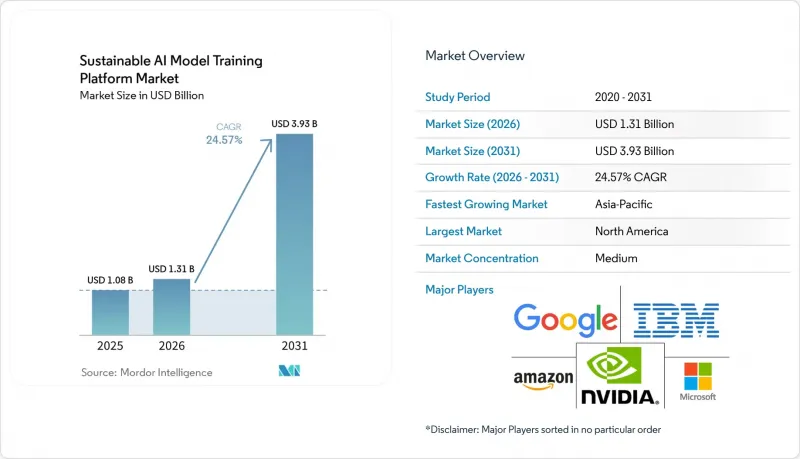
本報告按組件(軟體和服務)、部署類型(雲端、本地、混合)、技術(碳感知調度、分散式訓練最佳化、模型壓縮和剪枝等)、最終用戶(超大規模雲端和人工智慧基礎設施提供者等)以及地區進行細分。市場預測以美元計價。
全球永續人工智慧模型訓練平台市場趨勢與洞察
底層模型的擴充需要最佳化每個令牌的計算量。
大規模語言模式的尖端訓練徹底改變了永續人工智慧模式訓練平台市場的成本邏輯,因為電力消耗量現在直接影響著每項重要的採購決策。發表在《PLOS ONE》上的一項基於場景的建模研究表明,訓練 GPT-3 消耗了 1287 兆瓦時 (MWh) 的電力,後續模型迭代消耗了 50-70 吉瓦時 (GWh) 的電力,在當前條件下,訓練過程可能佔人工智慧生命週期碳排放的 68.5%。麻省理工學院電腦科學與人工智慧實驗室 (CSAIL) 和馬克斯普朗克研究所的研究人員也表明,使用 CompreSSM 在訓練過程中壓縮模型可以消除剪枝後所需的額外訓練步驟,從而改變最佳化模組的設計方式。這一結果有利於那些將壓縮和效率控制整合到訓練循環中,而不是將其視為執行完成後清理過程的平台供應商。從商業性角度來看,買家也面臨類似的壓力。 CoreWeave報告稱,到2025年底,累積訂單。這顯示人工智慧研究機構正竭力獲取需要大量前期投入的處理能力。在永續人工智慧模型學習平台市場,那些能夠在訓練過程中減少每個代幣浪費的供應商,在平台選擇和合約續約決策中變得越來越重要。
對碳感知模型訓練工作流程的需求日益成長
在永續人工智慧模型訓練平台市場,碳感知調度正成為一項核心需求。這是因為資料中心的位置、電源和工作負載時間都會影響排放和營運成本。 2026 年發表在《能源資訊學》(Energy Informatics)上的一項系統性綜述表明,資料中心位置、電網碳排放強度、PUE(電源使用效率)和工作負載調度會導致整體訓練排放波動超過一個數量級,而採用地理路由的碳感知調度可以根據電網配置將排放減少 20% 到 70%。這項需求正迅速擴展到商業層面。這是因為歐盟人工智慧法(適用於通用人工智慧)於 2025 年 8 月生效,要求提供者記錄並揭露已知或預估模型的能耗。 AWS 於 2026 年 3 月推出了1-3 範圍的報告功能和永續發展主機,可提供區域排放的近即時排放可見度。這將使 MLOps 團隊在準備報告截止日期時更清楚地了解其營運狀態。這項研究也正朝著實用化的方向發展。 CarbonGearRL透過根據實際電網訊號調整群集寬度和計算精度,在一個擁有700億參數的LLaMA型模型中,實現了高達52%的二氧化碳減排,且吞吐量沒有下降。永續人工智慧模型訓練平台市場的商業機會在於,如何將這些前景廣闊的調查方法轉化為實用、可審計且易於大規模部署的工作流程,供買家使用。
高功率密度和散熱限制了訓練吞吐量。
功率密度和冷卻方面的限制正在阻礙永續人工智慧模型訓練平台市場的發展。許多現有設施若不進行大規模維修,就無法容納最新的人工智慧機架。換句話說,除非實體設施能夠承受持續的高密度負載,否則僅靠可再生能源無法擴展訓練容量。 Crusoe 位於阿比林的園區第一期工程的設計目標 PUE 為每年 1.2-1.4,但 2026 年專案的永續性要求將目標值提高到 1.1-1.25。這說明基礎設施設計必須精準。平台層面的影響同樣重要,因為如果無法即時監控熱裕度,熱飽和導致的運算能力限制就會表現為軟體效率低。 2026 年 3 月,Preferred Networks、IIJ 和 JAIST 透過在專用模組化資料中心部署直接液冷的高密度人工智慧伺服器,進一步強調了這一點。該資料中心旨在作為水冷基礎設施能源指標的案例研究。因此,永續的AI 模型學習平台市場不僅取決於軟體控制的改進,還取決於編配層與運行這些工作負載的設施的熱限制之間更緊密的協調。
細分市場分析
到2025年,軟體將佔據永續人工智慧模型訓練平台市場佔有率的69.85%,這表明買家在決定投資實體基礎設施之前,仍然優先考慮編配、最佳化和碳智慧層。核心訓練平台軟體仍然是最大的細分市場,因為訓練編配、工作排程和資源分配是永續人工智慧模型訓練平台市場中任何大規模訓練運作的基礎。碳智慧模組正在迅速商業化,因為它們既支援成本管理又支援合規性,因為買家需要更清晰地記錄其模型的能耗情況。 NVIDIA於2026年5月發布的開放原始碼模組化軟體DSX OS生動地展現了這一轉變,它將「每瓦令牌數」等遙測資料直接整合到人工智慧工廠的運作層中。此舉也表明,硬體相關企業正在向軟體堆疊的更高層級移動,以獲取永續人工智慧模型訓練平台市場中更多的最佳化價值。
預計2026年至2031年間,服務市場將以25.34%的複合年成長率成長,並有望成為永續人工智慧模型訓練平台市場中成長最快的細分領域。這一成長反映了一個實際缺口:許多公司可以購買平台,但仍需要幫助來實施具體的改進措施,以利用遙測數據來提高執行效率和報告品質。隨著企業尋求使軟體工具產生的數據與其營運相關,託管服務、永續發展諮詢和模型效率諮詢的需求正在上升。這一趨勢類似於雲端MLOps的早期發展,當時企業首先採用這些工具,然後添加服務合作夥伴,將平台的輸出整合到日常決策中。對服務日益成長的需求表明,永續人工智慧模型訓練平台行業正在從最初的工具採用階段轉向以執行為中心的階段,在這個階段,軟體和人類專業知識的融合程度越來越高。
到2025年,基於雲端的部署將佔據永續人工智慧模型訓練平台市場67.12%的佔有率。這是因為許多組織仍然無法在其自身設施內複製超大規模的訓練能力。在永續人工智慧模型訓練平台市場,雲端仍然是需要大量GPU存取、快速擴展以及與各種基礎設施服務緊密整合的尖端工作負載的首選。根據微軟2025年環境永續性報告,該公司將在24個國家採購34吉瓦的無碳電力,比2020年成長18倍。這將使雲端客戶能夠存取低碳訓練運算資源,而無需管理自身的電力採購。這種可再生能源為支撐的基礎設施是雲端平台繼續主導永續人工智慧模型訓練平台市場的原因之一,即使買家越來越注重能源課責。本地部署仍然很重要,但其使用主要集中在金融服務、醫療保健和國防等高度監管的行業,在這些行業中,敏感資料無法自由遷移到共用的雲端環境中。
混合部署預計將在 2026 年至 2031 年間以 25.89% 的複合年成長率成長,成為永續AI 模型訓練平台市場中成長最快的部署模式。這主要是由於結構性需求而非風格需求所致。國家主導的AI 專案和受監管行業需要在本地控制資料儲存和處理位置的同時,保持對超大規模工具的存取。 AWS AI Factory 透過在客戶資料中心內部署專用的 AWS AI 基礎架構並將其作為私有 AWS 區域運行,解決了這個設計難題。這種架構為企業和主權買家在永續AI 模型訓練平台市場中結合在地化、策略控制和超大規模訓練工作流程打開了大門。對於希望為擁有模型或無法快速建立自有專用基礎設施的客戶提供 GPU 密集、永續供電容量的託管服務供應商而言,這種架構也變得越來越重要。
區域分析
2025年,北美將佔據永續人工智慧模型訓練平台市場34.56%的佔有率,成為最大的區域貢獻者。美國仍然是核心需求中心,這得益於其密集的供應商基礎,涵蓋超大規模資料中心業者、尖端模型開發人員、專業人工智慧雲端平台以及基礎設施和MLOps層。 CoreWeave 2026年第一季的業績顯示,其2026年全年容量幾乎售罄,合約展望已延續至2027年,反映出該地區強勁的訓練需求。加拿大正憑藉著政府主導和可再生能源主導的基礎設施,崛起為一個獨特的細分市場。 TELUS和加拿大政府正在溫哥華開發一座設施,該設施運作可再生能源,並採用液冷系統,預計與傳統資料中心相比,冷卻能耗將降低80%。墨西哥仍處於發展初期,其成長主要依賴提供近岸人工智慧服務和接近性美國的需求,而非先進的國內訓練基礎設施。
預計2026年至2031年,亞太地區永續人工智慧模型訓練平台市場將以26.45%的複合年成長率(CAGR)實現最高成長。該地區的發展受到多種因素的共同驅動,包括國家主導的人工智慧投資、超大規模資料中心的建設以及對更環保的運算系統的政策關注。 2024年,中國資料中心的電力消耗量將達到1.66兆千瓦時,佔全國電力消耗量總量的1.68%,並產生8,590萬噸二氧化碳排放。同時,在「東西向計算」政策的推動下,一些先進設施的可再生能源利用率已達80%。印度也佔有重要的結構性地位。阿達尼集團承諾在2035年投資1,000億美元興建由可再生能源運作的人工智慧資料中心,而Google計劃於2026年在維沙卡帕特南啟動一個價值150億美元的人工智慧中心建設。該項目被認為是谷歌最具環保意識的資料中心項目之一。日本也在積極佈局,Eurus Energy和豐田通商將於2026年4月開始建造一座綠色資料中心,該資料中心將透過專用輸電線路直接連接到一座風力發電廠。
預計到2025年,歐洲將佔據全球第三大市場佔有率,歐盟人工智慧法案的合規要求將顯著影響永續人工智慧模型學習平台的採購。北歐國家表現突出,丹麥的國家級人工智慧超級電腦將廢熱回收與市政二氧化碳中和能源系統相結合,為該地區高效的學習基礎設施樹立了強力的標竿。中東和非洲的情況則有所不同。海灣國家佔據了政府主導的人工智慧需求的大部分,而其他國家則處於應用初期,這為能夠平衡可追溯能源性能和區域合規要求的供應商創造了商機。在南美洲,巴西處於主導地位,但由於當地機器學習運維(MLOps)人才短缺以及跨境資料傳輸成本高於其他成熟地區,其應用仍然有限。
其他好處:
- Excel格式的市場預測(ME)表
- 3個月的分析師支持
目錄
第1章:引言
- 研究假設和市場定義
- 調查範圍
第2章:調查方法
第3章執行摘要
第4章 市場狀況
- 市場概覽
- 市場促進因素
- 建構自主人工智慧將有助於提高各地區的訓練效率。
- 對注重碳排放的模型訓練工作流程的需求日益成長
- 擴展基礎模型有助於最佳化每個代幣的運算資源。
- 企業 MLOps 團隊優先考慮能源遙測和成本管治。
- 採購利用可再生能源的資料中心將是一個差異化因素。
- 我們的人工智慧管治計畫正在推動建立可追溯、可審計的訓練流程。
- 市場限制因素
- 高功率密度和散熱限制了訓練吞吐量。
- GPU短缺正在減緩永續基礎設施的部署。
- 碳計量的碎片化使得平台標準化變得複雜。
- 綠色運算的高成本正在減緩中小企業對其的採用。
- 宏觀經濟因素對市場的影響
- 產業價值鏈分析
- 監理情勢
- 技術展望
- 波特五力分析
第5章 市場規模與成長預測
- 按組件
- 軟體
- 核心平台
- 最佳化模組
- 碳智慧模組
- 服務
- 軟體
- 部署模式
- 基於雲端的
- 現場
- 混合
- 透過技術
- 碳意識調度
- 分散式訓練的最佳化
- 模型壓縮和剪枝
- 最佳化超參數以提高效率
- 聯邦學習與分散式學習
- 綠色 MLOps 自動化
- 最終用戶
- 超大規模雲端和人工智慧基礎設施供應商
- 託管資料中心供應商
- 企業資料中心
- 研究機構
- 人工智慧新創公司和模型開發公司
- 按地區
- 北美洲
- 美國
- 加拿大
- 墨西哥
- 南美洲
- 巴西
- 阿根廷
- 其他南美國家
- 歐洲
- 德國
- 英國
- 法國
- 義大利
- 西班牙
- 俄羅斯
- 其他歐洲國家
- 亞太地區
- 中國
- 印度
- 日本
- 韓國
- 澳洲
- 其他亞太國家
- 中東和非洲
- 中東
- 沙烏地阿拉伯
- 阿拉伯聯合大公國
- 土耳其
- 其他中東國家
- 非洲
- 南非
- 埃及
- 其他非洲國家
- 中東
- 北美洲
第6章 競爭情勢
- 市場集中度
- 策略趨勢
- 市佔率分析
- 公司簡介
- NVIDIA Corporation
- Microsoft Corporation
- Google LLC
- Amazon.com, Inc.
- International Business Machines Corporation
- Databricks, Inc.
- Hugging Face, Inc.
- CoreWeave, Inc.
- Lambda Labs, Inc.
- Crusoe Energy Systems LLC
- DataRobot, Inc.
- C3.ai, Inc.
- H2O.ai, Inc.
- Weights and Biases, Inc.
- Snorkel AI, Inc.
- Anyscale, Inc.
- SkyPilot(Sky Computing Lab),
- Stability AI Ltd.
- Cerebras Systems Inc.
- Advanced Micro Devices, Inc
第7章 市場機會與未來展望
According to Mordor Intelligence, the sustainable AI model training platform market size was valued at USD 1.08 billion in 2025 and is estimated to grow from USD 1.31 billion in 2026 to reach USD 3.93 billion by 2031, at a CAGR of 24.57% during the forecast period (2026-2031).
This report is Segmented by Component (Software, and Services), Deployment Mode (Cloud-Based, On-Premises, and Hybrid), Technology (Carbon-Aware Scheduling, Distributed Training Optimization, Model Compression and Pruning, and More), End User (Hyperscale Cloud and AI Infrastructure Providers, and More), and Geography. The Market Forecasts are Provided in Terms of Value (USD).
Global Sustainable AI Model Training Platform Market Trends and Insights
Foundation Model Scale Forces Optimization of Compute Per Token
Training large language models at frontier scale has changed the cost logic of the sustainable AI model training platform market, as electricity use now directly affects every major procurement decision. A scenario-based modeling study published in PLOS ONE showed that GPT-3 training consumed 1,287MWh of electricity, later model generations consumed 50-70GWh, and that training could account for as much as 68.5% of lifecycle AI carbon emissions under business-as-usual conditions. Researchers from MIT CSAIL and the Max Planck Institute also showed that compressing models during training with CompreSSM removes the extra training pass required by post-hoc pruning, thereby changing how optimization modules are designed. That result favors platform vendors that place compression and efficiency controls within the training loop rather than treating them as a cleanup step after the run is complete. Buyers are responding to the same pressure in commercial terms, with CoreWeave reporting a USD 66.8 billion revenue backlog at the end of 2025, which shows how strongly AI labs are locking in costly capacity ahead of time. In the sustainable AI model training platform market, vendors that reduce waste per token during training are moving closer to the center of platform selection and contract renewal decisions.
Rising Demand for Carbon-Aware Model Training Workflows
Carbon-aware scheduling is becoming a core requirement in the sustainable AI model training platform market because location, power source, and workload timing now shape both emissions and operating cost. A 2026 systematic review in Energy Informatics found that data center location, grid carbon intensity, PUE, and workload scheduling can shift total training emissions by more than an order of magnitude, and carbon-aware scheduling with geo-routing can cut emissions by 20% to 70%, depending on the grid mix. This demand is reaching the commercial layer quickly because the EU AI Act obligations for general-purpose AI took effect in August 2025 and require providers to document and disclose known or estimated model energy consumption. AWS responded in March 2026 by launching its Sustainability console with Scope 1-3 reporting and near-real-time regional-level emissions visibility, which gives MLOps teams a clearer operating view as they prepare for reporting timelines. Research is also moving toward production relevance, with CarbonGearRL demonstrating up to 52% CO2 reduction without throughput loss on 70-billion-parameter LLaMA-style models by adjusting cluster width and arithmetic precision against live grid signals. The commercial opening in the sustainable AI model training platform market lies in turning those promising research methods into workflows that are usable, auditable, and easy for buyers to deploy at scale.
High Power Density And Cooling Constraints Limit Training Throughput
Power density and cooling limitations are slowing the sustainable AI model training platform market, as many legacy facilities cannot host the latest AI racks without major retrofit work. This means renewable procurement alone does not unlock training capacity if the physical plant still cannot support sustained high-density loads. Crusoe's Abilene campus was designed to an annualized PUE of 1.2-1.4 for Phase 1, and its 2026 project sustainability requirements tightened the target to 1.1-1.25, which shows how precise the infrastructure design now has to be. The platform-level consequences are equally important because throttled compute due to thermal saturation can appear as software inefficiency unless thermal headroom is monitored in real time. Preferred Networks, IIJ, and JAIST reinforced that link in March 2026 when they deployed direct-liquid-cooled, high-density AI servers in a purpose-built, modular data center designed as a reference case for water-cooled infrastructure energy metrics. The sustainable AI model training platform market will therefore depend not only on better software controls but also on tighter coordination between orchestration layers and the thermal limits of the facilities where those workloads run.
Other drivers and restraints analyzed in the detailed report include:
- Enterprise MLOps Teams Prioritize Energy Telemetry and Cost Governance
- Sovereign AI Buildouts Favor Regional Training Efficiency
- GPU Supply Tightness Delays Sustainable Infrastructure Rollouts
For complete list of drivers and restraints, kindly check the Table Of Contents.
Segment Analysis
Software held 69.85% of the sustainable AI model training platform market share in 2025, indicating that buyers still place the greatest value on orchestration, optimization, and carbon intelligence layers before committing to physical infrastructure. Core training platform software remains the largest sub-segment because training orchestration, job scheduling, and resource allocation are the foundation of every large training run in the sustainable AI model training platform market. Carbon intelligence modules are commercializing quickly because they support both cost control and compliance readiness, where buyers need clearer records of model energy use. NVIDIA's DSX OS, released as open-source modular software in May 2026, illustrates this shift by bringing tokens-per-watt telemetry directly into the operating layer for AI factories. That move also shows how hardware-linked companies are pushing up the software stack to capture more of the optimization value in the sustainable AI model training platform market.
Services are projected to grow at a 25.34% CAGR from 2026 to 2031, making them the fastest-growing component of the sustainable AI model training platform market. This growth reflects a practical gap, because many enterprises can buy the platform but still need help turning telemetry into changes that improve run efficiency and reporting quality. Managed services, sustainability advisory, and model efficiency consulting are therefore gaining ground as companies try to operationalize the data generated by software tools. The pattern resembles the earlier development of cloud MLOps, where organizations first adopted the tooling and then added service partners to translate platform outputs into day-to-day decisions. That service pull also suggests that the sustainable AI model training platform industry is moving from an early tooling phase toward an execution-focused phase, where software and human expertise are increasingly sold together.
Cloud-based deployment accounted for 67.12% of the sustainable AI model training platform market in 2025, as most organizations still cannot replicate hyperscale training capacity in their own facilities. The cloud remains the default mode for frontier workloads that require heavy GPU access, rapid scaling, and close integration with broader infrastructure services in the sustainable AI model training platform market. Microsoft's FY2025 Environmental Sustainability Report stated that the company contracted 34GW of carbon-free electricity across 24 countries, an 18-fold increase since 2020, which helps cloud customers access lower-carbon training compute without managing power sourcing themselves. That renewable-backed infrastructure is part of the reason cloud platforms continue to dominate the sustainable AI model training platform market even when buyers care more about energy accountability. On-premises deployment still matters, but it is concentrated in regulated sectors such as financial services, healthcare, and defense, where sensitive data cannot be moved freely into shared cloud environments.
Hybrid deployment is expected to grow at a 25.89% CAGR from 2026 to 2031, making it the fastest-rising mode in the sustainable AI model training platform market. The main reason is structural, not stylistic, because sovereign AI programs and regulated industries need local control over where data is stored and processed while still needing access to hyperscale-grade tooling. AWS AI Factories reflect that design response by placing dedicated AWS AI infrastructure in customer data centers and operating it as a private AWS Region. This architecture gives enterprise and sovereign buyers a path to combine locality, policy control, and hyperscale training workflows inside the sustainable AI model training platform market. It is also becoming more relevant for colocation operators that want to offer GPU-dense, sustainably powered capacity to customers who own the models but cannot build dedicated infrastructure quickly enough on their own.
Complete Report Scope:
- By Component
- Software
- Core Platform
- Optimization Modules
- Carbon Intelligence Modules
- Services
- Software
- By Deployment Mode
- Cloud-Based
- On-Premises
- Hybrid
- By Technology
- Carbon-Aware Scheduling
- Distributed Training Optimization
- Model Compression and Pruning
- Efficient Hyperparameter Optimization
- Federated and Distributed Learning
- Green MLOps Automation
- By End User
- Hyperscale Cloud and AI Infrastructure Providers
- Colocation Data Center Operators
- Enterprise Data Centers
- Research Institutions
- AI Startups and Model Developers
- By Geography
- North America
- United States
- Canada
- Mexico
- South America
- Brazil
- Argentina
- Rest of South America
- Europe
- Germany
- United Kingdom
- France
- Italy
- Spain
- Russia
- Rest of Europe
- Asia-Pacific
- China
- India
- Japan
- South Korea
- Australia
- Rest of Asia-Pacific
- Middle East and Africa
- Middle East
- Saudi Arabia
- United Arab Emirates
- Turkey
- Rest of Middle East
- Africa
- South Africa
- Egypt
- Rest of Africa
- Middle East
- North America
Geography Analysis
North America accounted for 34.56% of the sustainable AI model training platform market in 2025, making it the largest regional contributor. The United States remains the core demand center because it hosts hyperscalers, frontier model developers, specialized AI clouds, and a dense vendor base across infrastructure and MLOps layers. CoreWeave's Q1 2026 results showed capacity was effectively sold out for all of 2026, with contract visibility stretching into 2027, reflecting the strong training demand in the region. Canada is emerging as a distinct sub-market through sovereign- and renewable-led infrastructure, with TELUS and the Government of Canada advancing facilities in Vancouver powered by 98% renewable energy and liquid-cooling systems, projected to reduce cooling energy use by 80% compared to traditional data centers. Mexico remains earlier in development, with growth tied more to nearshore AI service delivery and proximity to U.S. demand than to frontier-scale domestic training infrastructure.
Asia-Pacific is expected to record the fastest CAGR at 26.45% from 2026 to 2031 in the sustainable AI model training platform market. The region is advancing through a mix of sovereign AI investment, hyperscale buildouts, and policy attention to greener compute systems. China's data center electricity consumption reached 1,660 billion kWh in 2024, equal to 1.68% of national power consumption and linked to 85.9 million tonnes of CO2 emissions, while some advanced facilities reached renewable electricity use rates of 80% under the country's East-to-West computing push. India is also becoming structurally important, with Adani Group committing USD 100 billion to renewable-energy-powered AI-ready data centers by 2035 and Google beginning construction in 2026 on a USD 15 billion AI hub in Visakhapatnam described as one of its greenest data center projects. Japan adds another important path, with Eurus Energy and Toyota Tsusho commencing construction in April 2026 on a green data center directly connected to a wind power plant through a private power line.
Europe held the third-largest regional share in 2025, and compliance requirements under the EU AI Act heavily shape procurement in the sustainable AI model training platform market. The Nordic countries stand out because Denmark's national AI supercomputer links waste heat recovery to a municipal CO2-neutral energy system, providing the region with a strong reference model for efficient training infrastructure. The Middle East and Africa are more uneven, with the Gulf states driving most sovereign AI demand while other countries are earlier in deployment, creating room for vendors that can combine traceable energy performance with regional compliance needs. Brazil leads South America, but adoption remains limited by thinner local MLOps talent pools and higher cross-border data transfer costs than buyers face in more mature regions.
- NVIDIA Corporation
- Microsoft Corporation
- Google LLC
- Amazon.com, Inc.
- International Business Machines Corporation
- Databricks, Inc.
- Hugging Face, Inc.
- CoreWeave, Inc.
- Lambda Labs, Inc.
- Crusoe Energy Systems LLC
- DataRobot, Inc.
- C3.ai, Inc.
- H2O.ai, Inc.
- Weights and Biases, Inc.
- Snorkel AI, Inc.
- Anyscale, Inc.
- SkyPilot (Sky Computing Lab),
- Stability AI Ltd.
- Cerebras Systems Inc.
- Advanced Micro Devices, Inc
Additional Benefits:
- The market estimate (ME) sheet in Excel format
- 3 months of analyst support
TABLE OF CONTENTS
1 INTRODUCTION
- 1.1 Study Assumptions and Market Definition
- 1.2 Scope of the Study
2 RESEARCH METHODOLOGY
3 EXECUTIVE SUMMARY
4 MARKET LANDSCAPE
- 4.1 Market Overview
- 4.2 Market Drivers
- 4.2.1 Sovereign AI Buildouts Favor Regional Training Efficiency
- 4.2.2 Rising Demand for Carbon-Aware Model Training Workflows
- 4.2.3 Foundation Model Scale Forces Optimization of Compute per Token
- 4.2.4 Enterprise MLOps Teams Prioritize Energy Telemetry and Cost Governance
- 4.2.5 Renewable-Powered Data Center Procurement Becomes A Differentiator
- 4.2.6 AI Governance Programs Push Traceable, Auditable Training Pipelines
- 4.3 Market Restraints
- 4.3.1 High Power Density and Cooling Constraints Limit Training Throughput
- 4.3.2 GPU Supply Tightness Delays Sustainable Infrastructure Rollouts
- 4.3.3 Carbon Accounting Fragmentation Complicates Platform Standardization
- 4.3.4 Premium Pricing of Green Compute Slows SME Adoption
- 4.4 Impact Of Macroeconomic Factors On The Market
- 4.5 Industry Value-Chain Analysis
- 4.6 Regulatory Landscape
- 4.7 Technological Outlook
- 4.8 Porter's Five Forces Analysis
- 4.8.1 Bargaining Power Of Buyers
- 4.8.2 Bargaining Power Of Suppliers
- 4.8.3 Threat Of New Entrants
- 4.8.4 Threat Of Substitutes
- 4.8.5 Intensity Of Competitive Rivalry
5 MARKET SIZE AND GROWTH FORECASTS (VALUE)
- 5.1 By Component
- 5.1.1 Software
- 5.1.1.1 Core Platform
- 5.1.1.2 Optimization Modules
- 5.1.1.3 Carbon Intelligence Modules
- 5.1.2 Services
- 5.1.1 Software
- 5.2 By Deployment Mode
- 5.2.1 Cloud-Based
- 5.2.2 On-Premises
- 5.2.3 Hybrid
- 5.3 By Technology
- 5.3.1 Carbon-Aware Scheduling
- 5.3.2 Distributed Training Optimization
- 5.3.3 Model Compression and Pruning
- 5.3.4 Efficient Hyperparameter Optimization
- 5.3.5 Federated and Distributed Learning
- 5.3.6 Green MLOps Automation
- 5.4 By End User
- 5.4.1 Hyperscale Cloud and AI Infrastructure Providers
- 5.4.2 Colocation Data Center Operators
- 5.4.3 Enterprise Data Centers
- 5.4.4 Research Institutions
- 5.4.5 AI Startups and Model Developers
- 5.5 By Geography
- 5.5.1 North America
- 5.5.1.1 United States
- 5.5.1.2 Canada
- 5.5.1.3 Mexico
- 5.5.2 South America
- 5.5.2.1 Brazil
- 5.5.2.2 Argentina
- 5.5.2.3 Rest of South America
- 5.5.3 Europe
- 5.5.3.1 Germany
- 5.5.3.2 United Kingdom
- 5.5.3.3 France
- 5.5.3.4 Italy
- 5.5.3.5 Spain
- 5.5.3.6 Russia
- 5.5.3.7 Rest of Europe
- 5.5.4 Asia-Pacific
- 5.5.4.1 China
- 5.5.4.2 India
- 5.5.4.3 Japan
- 5.5.4.4 South Korea
- 5.5.4.5 Australia
- 5.5.4.6 Rest of Asia-Pacific
- 5.5.5 Middle East and Africa
- 5.5.5.1 Middle East
- 5.5.5.1.1 Saudi Arabia
- 5.5.5.1.2 United Arab Emirates
- 5.5.5.1.3 Turkey
- 5.5.5.1.4 Rest of Middle East
- 5.5.5.2 Africa
- 5.5.5.2.1 South Africa
- 5.5.5.2.2 Egypt
- 5.5.5.2.3 Rest of Africa
- 5.5.5.1 Middle East
- 5.5.1 North America
6 COMPETITIVE LANDSCAPE
- 6.1 Market Concentration
- 6.2 Strategic Moves
- 6.3 Market Share Analysis
- 6.4 Company Profiles (includes Global Level Overview, Market Level Overview, Core Segments, Financials as available, Strategic Information, Market Rank/Share, Products and Services, Recent Developments)
- 6.4.1 NVIDIA Corporation
- 6.4.2 Microsoft Corporation
- 6.4.3 Google LLC
- 6.4.4 Amazon.com, Inc.
- 6.4.5 International Business Machines Corporation
- 6.4.6 Databricks, Inc.
- 6.4.7 Hugging Face, Inc.
- 6.4.8 CoreWeave, Inc.
- 6.4.9 Lambda Labs, Inc.
- 6.4.10 Crusoe Energy Systems LLC
- 6.4.11 DataRobot, Inc.
- 6.4.12 C3.ai, Inc.
- 6.4.13 H2O.ai, Inc.
- 6.4.14 Weights and Biases, Inc.
- 6.4.15 Snorkel AI, Inc.
- 6.4.16 Anyscale, Inc.
- 6.4.17 SkyPilot (Sky Computing Lab),
- 6.4.18 Stability AI Ltd.
- 6.4.19 Cerebras Systems Inc.
- 6.4.20 Advanced Micro Devices, Inc
7 MARKET OPPORTUNITIES AND FUTURE OUTLOOK
- 7.1 White-Space and Unmet-Need Assessment

 雲端無線存取網市場預測至2034年-按組件、架構、網路世代、最終用戶和區域分類的分析
 印尼雲端運算市場:市場佔有率分析、產業趨勢與統計及成長預測(2026-2031)工業雲:市場佔有率分析、產業趨勢與統計、成長預測(2026-2031)
 雲端語音輸入解決方案市場規模、佔有率、成長、全球產業分析、區域趨勢及2026年至2034年預測
 能源雲市場:組件、服務、通訊技術、應用與最終用途-2026-2032年全球市場預測雲端應用市場:依服務類型、部署模式、組織規模和產業分類-2026-2032年全球市場預測
 雲端語音輸入解決方案市場規模、佔有率和成長分析:按解決方案類型、部署模式、最終用戶產業、最終用戶、分銷管道和地區分類-2026-2033年產業預測印度雲端運算現況(2025 年展望)職業發展路徑市場預測——按組成部分、功能、應用、最終用戶和地區分類的全球分析——2034 年雲端原生連線市場預測至 2034 年—按元件、部署模式、連線類型、企業規模、應用程式、最終使用者和地區分類的全球分析