


 |
市場調查報告書
商品編碼
2119898
黏合劑點膠系統:市場佔有率分析、行業趨勢和統計數據、成長預測(2026-2031 年)Adhesive Dispensing System - Market Share Analysis, Industry Trends & Statistics, Growth Forecasts (2026 - 2031) |
||||||

※ 本網頁內容可能與最新版本有所差異。詳細情況請與我們聯繫。
根據 Mordor Intelligence 預測,黏合劑點膠系統市場規模預計將在 2025 年達到 62.4 億美元,2026 年達到 65.9 億美元,到 2031 年達到 86.6 億美元,2026 年至 2031 年的複合年成長率為 4.85%。
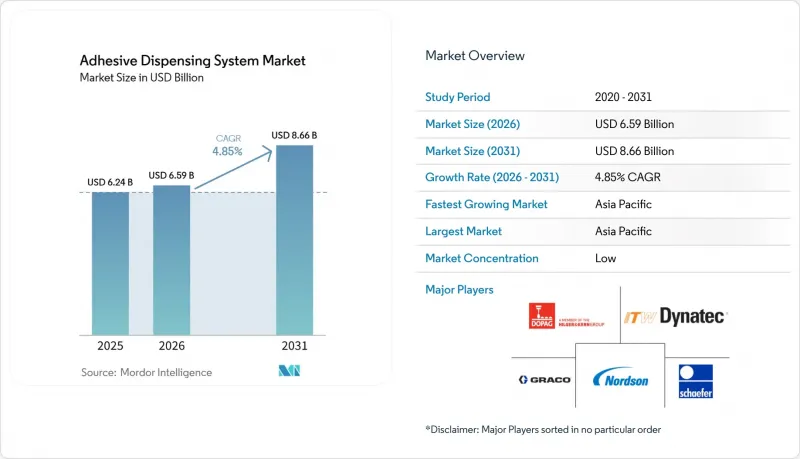
本報告按產品類型(例如,容積式點膠系統、噴射式點膠系統和微量點膠系統)、終端用戶行業(例如,包裝、電子和半導體)、技術(例如,氣壓系統、電動伺服系統)、自動化程度(例如,桌上型/手動)和地區進行細分。市場預測以美元(USD)計價。
全球黏合劑點膠系統市場趨勢及洞察
隨著電動車電池組尺寸的增大,需要微米級的測量精度。
隨著超級工廠的建設,導熱界面材料的應用精度要求日益嚴格,許多生產線現在要求黏合層厚度控制在25µm以下,以改善溫度控管和提升車輛續航里程。漸進式腔體幫浦和壓電噴射模組實現了±0.5%的單次重複性,結構性黏著劑取代了機械緊固件,從而實現了高達15%的減重。亞太地區領先的電動車公司正在採用基於等離子體的表面活化技術來增強黏合力,無需使用化學底塗劑,這進一步提升了對高精度點膠機的需求。格雷科的專用電動車電池平台表明,黏合劑點膠系統市場的核心在於電池載體黏合和阻燃塗層。因此,電池OEM廠商不僅將一流的點膠機視為輔助工具,更將其視為提高良率的關鍵要素,這也維持了黏合劑點膠系統市場長期投資的動能。
電子設備的微型化正在推動噴射式分配器的應用。
下一代穿戴式裝置和植入式感測器需要以 0.1 nL 的極微量進行點膠,這是傳統氣動針頭無法實現的。壓電噴射系統能夠以超過 1000 Hz 的循環頻率,對寬度小於 25 µm 的微結構進行非接觸式點膠。球柵陣列 (BGA) 和板載晶片(COB) 架構的普及,推動了對能夠在不犧牲速度的前提下應對日益成長的熱環境的點膠機的需求。 Nordson 的「PICO Nexus」系統配備了工業乙太網和基於 Web 的控制面板,展示了黏合劑點膠系統市場如何將工業物聯網 (IIoT) 整合到系統中,從而實現遠端程式設計和進程內分析。 Viscotec 的無限活塞系統能夠實現光學鍵合中的無氣泡點膠,而光學鍵結是 AR/VR 顯示器的關鍵技術。
多成分分配單元需要高額資本投入。
配備先進齒輪泵和靜態混合頭的高精度雙組分計量生產線,每個單元的成本通常超過10萬美元,這阻礙了中小型製造商的採用。 Zenith 2K 精密系統雖然擁有無與倫比的配比控制能力,但也體現了這個成本障礙。儘管模組化租賃模式和按次收費合約正在興起以分攤財務負擔,但許多買家仍在推遲投資,直到產量達到足以支撐投資的水平。在資金籌措環境依然嚴峻的發展中地區,資金限制正在阻礙黏合劑點膠系統市場的成長。
細分市場分析
到2025年,體積式點膠平台將佔據黏合劑點膠系統市場56.02%的佔有率,這得益於其在包裝、汽車和消費品行業久經考驗的可靠性。隨著小型化趨勢的推進,對非接觸式、奈米升級精度的需求日益成長,噴射式和微量點膠裝置預計將以8.21%的複合年成長率成長。在大規模安裝項目和持續的組件銷售的支撐下,體積式黏合劑點膠系統市場預計將穩定成長。
向諾信公司「Vulcan Jet」等壓電噴射模組的轉變,體現了精準度挑戰如何推動創新。此模組採用雙加熱區和模組化驅動堆疊。 ITW Dynatek 的「Vector」平台可在五分鐘內實現縫隙、噴塗和輪胎邊緣的切換,進而提升生產線的彈性。 Unity 龍門單元結合了視覺引導和±0.02毫米的重複精度,鞏固了其在高性能應用中的價值。噴嘴和靜態混合器等耗材約佔生命週期成本的25%,為供應商提供了穩定的售後市場收入來源,並鞏固了黏合劑點膠系統市場。
到2025年,汽車和電動車產業將佔據黏合劑點膠系統市場32.05%的佔有率,這主要得益於電池組設計中為減輕重量而採用的結構性黏著劑。醫療設備產業以7.46%的複合年成長率成長,正在利用納升級點膠技術生產連續血糖監測儀、導管和診斷試劑盒。電子、包裝、建築和航太產業各自具有獨特的性能要求,從而豐富了黏合劑點膠系統市場的收入來源。
醫療設備原始設備製造商 (OEM) 正在採用符合 FDA 指南的閉合迴路點膠機,這推動了高精度機器人和線上視覺系統的銷售成長。航太公司正在極端溫度環境下實現密封和塗覆的自動化,從而擴大了高混合、小批量生產細分市場的黏合劑點膠系統市場。包裝製造商正在推動熱熔膠的升級,而建設產業公司則專注於玻璃輪胎邊緣和防水處理。總體而言,終端用戶多樣化的需求正在推動整個黏合劑點膠系統市場的創新發展。
區域分析
預計到2025年,亞太地區將佔據黏合劑點膠系統市場39.12%的佔有率,並在2031年之前以7.98%的複合年成長率成長,這主要得益於電動車、智慧型手機和消費品製造業的蓬勃發展。在中國,寧德時代和比亞迪的千兆級電池生產線整合了等離子輔助鍵合技術和精密點膠機,以支援多班次生產。在印度,與生產掛鉤的獎勵正在推動微點膠技術在行動電話組裝製程的應用,而日本和韓國則正利用其在半導體領域的專業知識,試行下一代噴射塗覆技術。
北美位居第二,這主要得益於航太、醫療設備和先進汽車計畫對嚴格檢驗的要求。美國FDA關於醫療設備可追溯性的法規正在推動視覺引導式點膠機器人的應用,這種機器人能夠以納升級的精度進行點膠。加拿大的複合材料密集型航太業和墨西哥的汽車平台進一步擴大了該地區的需求。工業4.0的廣泛應用正在推動連網點膠機的普及,這些點膠機能夠將OEE(整體設備運轉率)指標傳輸到公司儀錶板。
其他好處:
- Excel格式的市場預測(ME)表
- 3個月的分析師支持
目錄
第1章:引言
- 研究假設和市場定義
- 調查範圍
第2章:調查方法
第3章執行摘要
第4章 市場狀況
- 市場概覽
- 市場促進因素
- 電動車電池組的成長需要微米等級的精度。
- 電子設備的微型化正在推動噴射點膠技術的應用。
- 包裝到無罐式熱熔膠點膠機的過渡
- 工廠車間自動化和工業4.0的整合
- 用於資料中心和ADAS的熱界面材料
- 歐盟的生產者責任延伸(EPR)法規正在推動可填充墨盒的技術創新。
- 市場限制因素
- 多成分分配單元需要高額資本投入。
- 複雜的化學反應導致維護和清潔時間延長。
- 校準技術熟練的技師短缺
- 黏合劑組件回收的面臨挑戰
- 供應鏈分析
- 監理情勢
- 技術展望
- 當前回收和永續性狀況
- 波特五力分析
第5章 市場規模與成長預測
- 依產品類型
- 容積式分配系統
- 噴射和微量點膠系統
- 熱熔膠塗佈機
- 閥式分配系統
- 配件和耗材
- 按最終用途行業分類
- 包裝
- 電子和半導體
- 汽車和電動旅行
- 工業組裝和一般製造
- 建造
- 醫療器材
- 航太
- 其他終端用戶產業
- 透過技術
- 氣壓系統
- 電動伺服系統
- 壓電噴射系統
- 螺桿泵
- 數位流量控制平台
- 按自動化級別
- 桌上型/手動
- 半自動
- 全機器人線上系統
- 按地區
- 北美洲
- 美國
- 加拿大
- 墨西哥
- 歐洲
- 德國
- 英國
- 法國
- 義大利
- 西班牙
- 俄羅斯
- 其他歐洲國家
- 亞太地區
- 中國
- 印度
- 日本
- 韓國
- 澳洲和紐西蘭
- 其他亞太國家
- 中東和非洲
- 中東
- 阿拉伯聯合大公國
- 沙烏地阿拉伯
- 土耳其
- 其他中東國家
- 非洲
- 南非
- 奈及利亞
- 埃及
- 其他非洲國家
- 中東
- 南美洲
- 巴西
- 阿根廷
- 其他南美國家
- 北美洲
第6章 競爭情勢
- 市場集中度
- 策略趨勢
- 市佔率分析
- 公司簡介
- Nordson Corporation
- Graco Inc.
- ITW Dynatec
- Dopag Group
- Robatech AG
- Schaefer Technologie GmbH
- Dymax Corporation
- Valco Melton
- Musashi Engineering
- Viscotec(Preeflow)
- RAMPF Production Systems
- Scheugenpflug GmbH
- Henkel LOCTITE Equipment
- Atlas Copco(SCA Schucker)
- Fisnar Inc.
- Buhnen GmbH
- Hernon Manufacturing
- Glue Dispensing Ltd
- Sulzer Mixpac
- Shenzhen Second Intelligent Equipment
- Gulf Coast Robotics
- Techcon Systems
第7章 市場機會與未來展望
According to Mordor Intelligence, the adhesive dispensing system market size is projected to be USD 6.24 billion in 2025, USD 6.59 billion in 2026, and reach USD 8.66 billion by 2031, growing at a CAGR of 4.85% from 2026 to 2031.
This report is Segmented by Product Type (Volumetric Dispensing Systems, Jetting and Micro-Dispensing Systems, and More), End-Use Industry (Packaging, Electronics and Semiconductors, and More), Technology (Pneumatic Systems, Electric Servo Systems, and More), Automation Level (Bench-top/Manual, and More), and by Geography. The Market Forecasts are Provided in Terms of Value (USD).
Global Adhesive Dispensing System Market Trends and Insights
EV Battery-Pack Growth Demands Micro-Metering Accuracy
Gigafactory build-out places stringent accuracy targets on thermal-interface material placement, with many lines now demanding bond-line thickness below 25 µm to manage heat and improve vehicle range. Progressive cavity pumps and piezo-jet modules deliver shot-to-shot repeatability within +-0.5% tolerance, enabling weight savings of up to 15% when structural adhesives replace mechanical fasteners. EV leaders in Asia-Pacific deploy plasma-based surface activation that boosts adhesion without chemical primers, further elevating demand for precise dispensers . Graco's dedicated EV battery platforms underscore how the adhesive dispensing system market pivots around cell-to-carrier bonding and fireproof coatings . As a result, battery OEMs view best-in-class dispensers as core yield enablers, not auxiliary tooling, sustaining long-term investment momentum for the adhesive dispensing system market.
Electronics Miniaturization Pushes Jet-Dispense Adoption
Next-generation wearables and implantable sensors now require deposits as tiny as 0.1 nL, levels unreachable with legacy pneumatic needles. Piezo-driven jetting systems enable touch-free placement onto features under 25 µm wide while operating at cycle rates exceeding 1,000 Hz. Ball Grid Array and Chip-on-Board architectures boost demand for dispensers that manage rising thermal profiles without sacrificing speed Nordson's PICO Nexus, featuring Industrial Ethernet and web-based dashboards, showcases how the adhesive dispensing system market integrates IIoT for remote programming and in-process analytics . ViscoTec's endless piston principle addresses bubble-free delivery for optical bonding, proving essential for AR/VR displays.
High Capex of Multi-Component Dispensing Cells
High-precision two-part metering lines with advanced gear pumps and static mix heads often top USD 100,000 per cell, slowing adoption among small and medium manufacturers. Zenith 2K precision systems exemplify the cost obstacle despite their unrivaled ratio control, and although modular leasing models and pay-per-shot contracts are emerging to spread the financial burden, many buyers defer investment until volumes justify the spend. Capital constraints restrain the adhesive dispensing system market in developing regions where financing terms remain prohibitive.
Other drivers and restraints analyzed in the detailed report include:
- Packaging Shift to Hot-Melt Tank-Free Applicators
- Factory-Floor Automation and Industry 4.0 Integration
- Complex Chemistries Raise Maintenance/Clean-Out Time
For complete list of drivers and restraints, kindly check the Table Of Contents.
Segment Analysis
Volumetric platforms held 56.02% of the adhesive dispensing system market in 2025 amid proven reliability across packaging, automotive, and consumer-goods lines. Jetting and micro-dispensing units are forecast to expand at 8.21% CAGR as miniaturization propels demand for non-contact, nanoliter accuracy. The adhesive dispensing system market size for volumetric machines is expected to widen steadily, supported by large installed bases and recurring parts revenue.
The shift toward piezo-jet modules like Nordson's Vulcan Jet, featuring dual heat zones and modular drive stacks, illustrates how precision challenges catalyze innovation. ITW Dynatec's Vector platform enables slot, spray, or bead exchange within five minutes, enhancing line agility. Unity gantry cells combine vision guidance with +-0.02 mm repeatability, cementing value in high-performance sectors. Consumables such as nozzles and static mixers represent nearly 25% of lifecycle cost, providing vendors with stable aftermarket revenue streams and reinforcing the adhesive dispensing system market.
Automotive and e-mobility retained 32.05% of the adhesive dispensing system market share in 2025 as battery pack designs embraced structural adhesives for weight savings. Medical devices, advancing at 7.46% CAGR, rely on nanoliter deposition for continuous glucose monitors, catheters, and diagnostic cartridges. Electronics, packaging, construction, and aerospace each contribute distinct performance demands, diversifying revenue drivers for the adhesive dispensing system market.
Medical-device OEMs adopt closed-loop dispensers validated under FDA guidelines, reinforcing sales of high-precision robots and in-line vision. Aerospace firms automate sealing and coating for extreme-temperature zones, widening the adhesive dispensing system market size among high-mix, low-volume niches. Packaging converters fuel hot-melt upgrades, while construction players focus on glazing beads and weatherproofing. Collectively, diverse end-user requirements sustain innovation pipelines across the adhesive dispensing system market.
Complete Report Scope:
- By Product Type
- Volumetric Dispensing Systems
- Jetting and Micro-Dispensing Systems
- Hot Melt Applicators
- Valve-Based Dispensing Systems
- Accessories and Consumables
- By End-Use Industry
- Packaging
- Electronics and Semiconductors
- Automotive and e-Mobility
- Industrial Assembly and General Manufacturing
- Construction
- Medical Devices
- Aerospace
- Other End-Use Industry
- By Technology
- Pneumatic Systems
- Electric Servo Systems
- Piezo-Jet Systems
- Progressive Cavity Pumps
- Digital Flow-Control Platforms
- By Automation Level
- Bench-top/Manual
- Semi-Automatic
- Fully Robotic in-Line Systems
- By Geography
- North America
- United States
- Canada
- Mexico
- Europe
- Germany
- United Kingdom
- France
- Italy
- Spain
- Russia
- Rest of Europe
- Asia-Pacific
- China
- India
- Japan
- South Korea
- Australia and New Zealand
- Rest of Asia-Pacific
- Middle East and Africa
- Middle East
- United Arab Emirates
- Saudi Arabia
- Turkey
- Rest of Middle East
- Africa
- South Africa
- Nigeria
- Egypt
- Rest of Africa
- Middle East
- South America
- Brazil
- Argentina
- Rest of South America
- North America
Geography Analysis
Asia-Pacific commanded 39.12% of the adhesive dispensing system market in 2025 and is forecast to compound at 7.98% CAGR to 2031, buoyed by surging EV, smartphone, and consumer-goods manufacturing. China's giga-scale battery lines from CATL and BYD integrate plasma-assisted bonding and precision dispensers that sustain multi-shift output. India's production-linked incentives catalyze micro-dispensing adoption in handset assembly, while Japan and South Korea leverage semiconductor know-how to pilot next-generation jetting.
North America ranks second, supported by aerospace, medical device, and advanced automotive programs requiring strict validation. United States FDA mandates for device traceability drive uptake of vision-guided dispensing robots capable of nanoliter deposits. Canada's composite-rich aerospace sector and Mexico's vehicle platforms further enlarge regional demand. Broad Industry 4.0 adoption favors connected dispensers broadcasting OEE metrics to enterprise dashboards.
- Nordson Corporation
- Graco Inc.
- ITW Dynatec
- Dopag Group
- Robatech AG
- Schaefer Technologie GmbH
- Dymax Corporation
- Valco Melton
- Musashi Engineering
- Viscotec (Preeflow)
- RAMPF Production Systems
- Scheugenpflug GmbH
- Henkel LOCTITE Equipment
- Atlas Copco (SCA Schucker)
- Fisnar Inc.
- Buhnen GmbH
- Hernon Manufacturing
- Glue Dispensing Ltd
- Sulzer Mixpac
- Shenzhen Second Intelligent Equipment
- Gulf Coast Robotics
- Techcon Systems
Additional Benefits:
- The market estimate (ME) sheet in Excel format
- 3 months of analyst support
TABLE OF CONTENTS
1 INTRODUCTION
- 1.1 Study Assumptions and Market Definition
- 1.2 Scope of the Study
2 RESEARCH METHODOLOGY
3 EXECUTIVE SUMMARY
4 MARKET LANDSCAPE
- 4.1 Market Overview
- 4.2 Market Drivers
- 4.2.1 EV battery-pack growth demands micro-metering accuracy
- 4.2.2 Electronics miniaturisation pushes jet-dispense adoption
- 4.2.3 Packaging shift to hot-melt tank-free applicators
- 4.2.4 Factory-floor automation and Industry 4.0 integration
- 4.2.5 Thermal-interface materials for data-centres and ADAS
- 4.2.6 EU EPR rules drive refillable cartridge innovations
- 4.3 Market Restraints
- 4.3.1 High capex of multi-component dispensing cells
- 4.3.2 Complex chemistries raise maintenance/clean-out time
- 4.3.3 Scarcity of calibration-skilled technicians
- 4.3.4 Recycling hurdles for adhesive-bonded assemblies
- 4.4 Supply-Chain Analysis
- 4.5 Regulatory Landscape
- 4.6 Technological Outlook
- 4.7 Recycling and Sustainability Landscape
- 4.8 Porter's Five Forces Analysis
- 4.8.1 Bargaining Power of Suppliers
- 4.8.2 Bargaining Power of Buyers
- 4.8.3 Threat of New Entrants
- 4.8.4 Threat of Substitutes
- 4.8.5 Intensity of Competitive Rivalry
5 MARKET SIZE AND GROWTH FORECASTS (VALUE)
- 5.1 By Product Type
- 5.1.1 Volumetric Dispensing Systems
- 5.1.2 Jetting and Micro-Dispensing Systems
- 5.1.3 Hot Melt Applicators
- 5.1.4 Valve-Based Dispensing Systems
- 5.1.5 Accessories and Consumables
- 5.2 By End-Use Industry
- 5.2.1 Packaging
- 5.2.2 Electronics and Semiconductors
- 5.2.3 Automotive and e-Mobility
- 5.2.4 Industrial Assembly and General Manufacturing
- 5.2.5 Construction
- 5.2.6 Medical Devices
- 5.2.7 Aerospace
- 5.2.8 Other End-Use Industry
- 5.3 By Technology
- 5.3.1 Pneumatic Systems
- 5.3.2 Electric Servo Systems
- 5.3.3 Piezo-Jet Systems
- 5.3.4 Progressive Cavity Pumps
- 5.3.5 Digital Flow-Control Platforms
- 5.4 By Automation Level
- 5.4.1 Bench-top/Manual
- 5.4.2 Semi-Automatic
- 5.4.3 Fully Robotic in-Line Systems
- 5.5 By Geography
- 5.5.1 North America
- 5.5.1.1 United States
- 5.5.1.2 Canada
- 5.5.1.3 Mexico
- 5.5.2 Europe
- 5.5.2.1 Germany
- 5.5.2.2 United Kingdom
- 5.5.2.3 France
- 5.5.2.4 Italy
- 5.5.2.5 Spain
- 5.5.2.6 Russia
- 5.5.2.7 Rest of Europe
- 5.5.3 Asia-Pacific
- 5.5.3.1 China
- 5.5.3.2 India
- 5.5.3.3 Japan
- 5.5.3.4 South Korea
- 5.5.3.5 Australia and New Zealand
- 5.5.3.6 Rest of Asia-Pacific
- 5.5.4 Middle East and Africa
- 5.5.4.1 Middle East
- 5.5.4.1.1 United Arab Emirates
- 5.5.4.1.2 Saudi Arabia
- 5.5.4.1.3 Turkey
- 5.5.4.1.4 Rest of Middle East
- 5.5.4.2 Africa
- 5.5.4.2.1 South Africa
- 5.5.4.2.2 Nigeria
- 5.5.4.2.3 Egypt
- 5.5.4.2.4 Rest of Africa
- 5.5.4.1 Middle East
- 5.5.5 South America
- 5.5.5.1 Brazil
- 5.5.5.2 Argentina
- 5.5.5.3 Rest of South America
- 5.5.1 North America
6 COMPETITIVE LANDSCAPE
- 6.1 Market Concentration
- 6.2 Strategic Moves
- 6.3 Market Share Analysis
- 6.4 Company Profiles (includes Global Level Overview, Market Level Overview, Core Segments, Financials, Strategic Information, Market Rank/Share, Products and Services, Recent Developments)
- 6.4.1 Nordson Corporation
- 6.4.2 Graco Inc.
- 6.4.3 ITW Dynatec
- 6.4.4 Dopag Group
- 6.4.5 Robatech AG
- 6.4.6 Schaefer Technologie GmbH
- 6.4.7 Dymax Corporation
- 6.4.8 Valco Melton
- 6.4.9 Musashi Engineering
- 6.4.10 Viscotec (Preeflow)
- 6.4.11 RAMPF Production Systems
- 6.4.12 Scheugenpflug GmbH
- 6.4.13 Henkel LOCTITE Equipment
- 6.4.14 Atlas Copco (SCA Schucker)
- 6.4.15 Fisnar Inc.
- 6.4.16 Buhnen GmbH
- 6.4.17 Hernon Manufacturing
- 6.4.18 Glue Dispensing Ltd
- 6.4.19 Sulzer Mixpac
- 6.4.20 Shenzhen Second Intelligent Equipment
- 6.4.21 Gulf Coast Robotics
- 6.4.22 Techcon Systems
7 MARKET OPPORTUNITIES AND FUTURE OUTLOOK
- 7.1 White-Space and Unmet-Need Assessment

 黏合劑設備市場:2026-2032年全球市場預測(按產品類型、技術、銷售管道、應用和最終用途產業分類)
 黏合劑設備市場規模、佔有率和成長分析:按產品類型、技術、應用、黏合劑類型、最終用途產業、設備類型和地區分類-2026-2033年產業預測
 黏合劑相關設備市場規模、佔有率、趨勢和預測:按產品、應用、分銷管道和地區分類,2026-2034 年黏合劑化學品、類型、測試技術、最終用途產業和應用分類-全球預測,2026-2032年
 全球黏合劑設備市場規模、佔有率、趨勢和成長分析報告(2026-2034年)
 標籤設備市場規模、佔有率和成長分析(按類型、產品類型、技術、標籤設備、標籤類型和地區分類)-2026-2033年產業預測全球膠合劑設備市場:2025 年至 2030 年預測
 標籤服務市場規模、佔有率、趨勢分析報告:按服務類型、最終用途、地區、細分市場預測,2025-2030 年
 全球黏合劑設備市場規模研究(按類型、設備類型、最終用途產業、應用方法和 2022-2032 年區域預測)
 黏合劑和黏合劑塗布設備:各種技術和全球市場