


 |
市場調查報告書
商品編碼
2119889
衛生紙加工機械:市場佔有率分析、產業趨勢與統計、成長預測(2026-2031)Tissue Paper Converting Machines - Market Share Analysis, Industry Trends & Statistics, Growth Forecasts (2026 - 2031) |
||||||

※ 本網頁內容可能與最新版本有所差異。詳細情況請與我們聯繫。
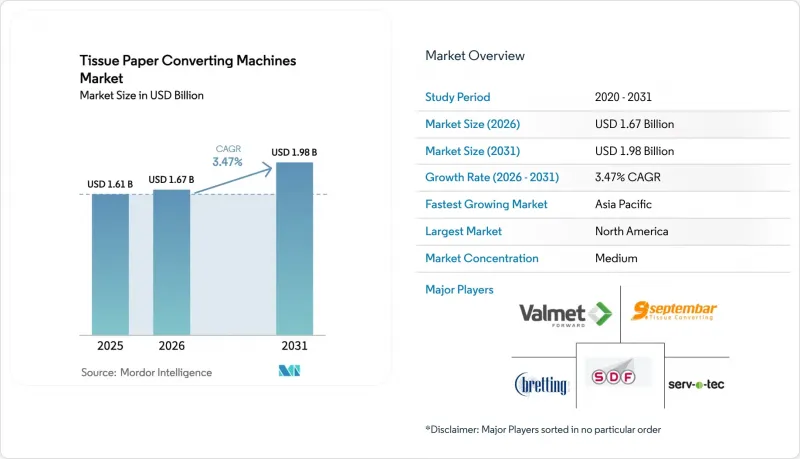
據 Mordor Intelligence 稱,2026 年衛生紙加工機械市場規模預計為 16.7 億美元,高於 2025 年的 16.1 億美元,預計到 2031 年將達到 19.8 億美元。
預計從 2026 年到 2031 年,其複合年成長率將達到 3.47%。
衛生紙加工機械市場按技術(全自動、半自動)、機器類型(廁所用衛生紙生產線、廚房用紙生產線等)、終端用戶行業(家庭(零售)、非家庭)、生產速度(高速生產線(800米/分鐘或以上)等)和地區進行細分。市場預測以美元價值表示。
全球衛生紙加工機械市場趨勢與洞察
全球紙巾消耗量增加及衛生意識提高
後疫情時代,人們對衛生的重視程度持續上升,紙巾消費量也隨之成長。機構買家現在需要能夠處理更柔軟基材、進行深度壓紋並能快速切換以實現差異化品牌的優質加工生產線。像 Toscotec 的「INGENIA」這樣的新型節能機器,透過空氣乾燥技術在維持品質的同時,將能耗降低 35%,從而兼具成本和環保優勢。商用廚房和餐飲連鎖店對高吸水性廚房用紙的需求持續穩定,促使加工商採用多重壓花設備和在線層間黏合技術。隨著產品配置日益複雜,工廠擴大採用軟性放捲架和可程式設計刀具系統,從而能夠在零售和商用SKU 之間快速切換,而不會造成嚴重的停機時間。這種持續的需求支撐著紙巾加工機械市場,儘管表面上的成長率並不高,但它正在推動設備的持續現代化。
組織處理自動化擴展趨勢
自動化如今已成為塑造競爭優勢的關鍵因素。自動化系統已占到總裝置容量的三分之二,且其成長速度超過了整體衛生紙加工機械市場的成長速度。 TAPPI 的「Tissue 101」和「Tissue 202」課程凸顯了業界為提升生產線操作人員技能所做的努力。 BW Converting 在 2024 年 MIAC 展會上展示了高速折疊機和無芯捲繞模組,證明了自動化如何開闢新的產品線。全整合驅動裝置、伺服控制刀具定位和自動化捲筒處理機器人縮短了設定時間、降低了人事費用並提高了安全性。尚未採用這些技術的工廠將面臨在成本、品質和準時交付可靠性方面落後的風險,從而引發了一波設備升級浪潮,持續推動衛生紙加工機械市場的擴張。
待開發區造紙廠的巨額資本投資
新建綜合造紙廠需要數億美元的投資。第一優質紙業公司(First Quality Tissue)近期累計9.84億美元在俄亥俄州興建兩條空氣乾燥生產線和一座加工廠。即使對於老字型大小企業,如此龐大的投資也需要較長的投資回收期。中小企業往往避免大規模新建項目,而是選擇升級現有生產線,這限制了衛生紙加工機械市場產能的逐步提升。利率波動進一步加劇了投資時機的複雜性,這一趨勢在新興市場尤其突出,因為這些地區的信貸成本仍然居高不下。
細分市場分析
預計到2025年,自動化生產線將佔衛生紙加工機械市場65.15%的佔有率,並將以4.66%的複合年成長率持續成長至2031年。這些智慧型系統整合了伺服驅動、機器人捲筒搬運和基於攝影機的缺陷偵測功能。其卓越的加工能力和較低的勞動生產比提高了工廠的生產效率,使買家能夠在設備的使用壽命內抵消較高的購置成本。對於尋求柔軟性和適度資本投入的小眾加工商而言,半自動化設備仍然十分重要,並且需求持續成長,尤其是在工資結構仍然偏向體力勞動的開發中國家。
先進的自動化技術也為數位化技術的應用奠定了基礎。 Valmet 目前持有多數股權的 FactoryPal 公司,將來自自動化生產線的即時數據輸入人工智慧模型,從而提案設定調整建議,以提高運轉率。隨著加工企業不斷升級,衛生紙加工機械市場中全自動解決方案的市場規模預計將穩步擴大,進一步鞏固該技術的領先地位。
廁所用衛生紙生產線仍是產量的主要驅動力,預計2025年將佔紙巾加工機械市場規模的44.92%。同時,廚房用紙生產線以7.12%的複合年成長率位居榜首,反映出消費者對更厚廚房用紙的偏好以及餐飲服務業清潔頻率的增加。目前,壓紋圖案的柔軟性和層間黏合品質比簡單的加工速度更能影響消費者的購買決策,這促使原始設備製造商(OEM)提供可快速更換的列印和壓紋組件。
折疊式紙巾和餐巾紙生產線主要供應給商用餐飲、航空公司和酒店業。儘管這些領域的成長速度相對緩慢,但快速調整包裝量和線上折疊的精確性仍然至關重要。開發多規格平台的原始設備製造商 (OEM) 正在吸引那些希望透過多元化產品系列攤銷資本支出 (CAPEX) 的買家,這加劇了紙巾加工機械市場的競爭。
區域分析
到2025年,北美將以40.12%的市佔率引領衛生紙加工機械市場。近期的一些舉措,例如金佰利公司斥資20億美元啟動的多年升級計劃,以及第一品質紙業公司斥資近10億美元擴建其直通式風乾設備,都清楚地表明了對先進設備的持續投資。此外,隨著造紙企業為提高能源效率和採用數位控制面板以應對人手不足而積極推進現有設備的翻新改造,市場依然活躍。儘管由於市場需求趨於成熟,整體成長受到限制,但這為原始設備製造商(OEM)提供了堅實的基礎,並支撐著一個可靠的服務和維修市場。
亞太地區預計將成為主要的成長引擎,到2031年複合年成長率將達到6.63%。中國加工企業正迅速擴大規模,並從歐洲訂購高速生產線以提高國內品質標準。寶梭和大連機械等區域供應商提供更具成本效益的替代方案,加劇了市場競爭,並擴大了設備的供應管道。隨著中產階級收入的成長,人均紙巾消費量也在增加,政府的衛生宣傳活動也促進了公共機構的消費。這些因素綜合起來,預計將使亞太地區成為所有地區中紙巾加工機械市場絕對成長量最大的地區。
歐洲在技術領先地位和嚴格的永續性標準之間取得了平衡。義大利品牌OMET、Maflex和Korber Tissue透過將機械性能與噪音和能耗法規的合規性相結合,保持了其市場影響力。 Valmet和Korber在數位服務領域的合資企業表明,創新將進一步集中於歐洲。儘管需求成長較為溫和,但高階設備的價格以及售後市場的大量投入,使歐洲在全球衛生紙加工機械市場的技術擴散方面佔據了重要的戰略地位。
其他好處:
- Excel格式的市場預測(ME)表
- 3個月的分析師支持
目錄
第1章:引言
- 研究假設和市場定義
- 調查範圍
第2章:調查方法
第3章執行摘要
第4章 市場狀況
- 市場概覽
- 市場促進因素
- 全球紙巾消耗量增加及衛生意識提高
- 組織處理行業自動化擴張趨勢
- 強調加工技術永續性的創新
- 數位孿生和物聯網可提高 OEE(卓越企業體驗)。
- 自有品牌售後產品小批量需求激增
- 市場限制因素
- 興建新加工廠需要大量資金投入。
- 紙漿和能源價格波動
- 熟練操作人員短缺,無法勝任先進生產線的操作工作
- 加強機械設備的噪音和能耗法規
- 供應鏈分析
- 監理情勢
- 技術展望
- 波特五力分析
- 衛生紙需求趨勢及其對生產設備的影響
- 紙巾加工機械產業的市場趨勢
- 未來市場趨勢與成長前景
- 主要挑戰和競爭性創新
- 比較分析 - OMET Srl 與競爭對手
- 技術趨勢—組織處理機械
第5章 市場規模與成長預測
- 透過技術
- 自動的
- 半自動
- 按機器類型
- 廁所用衛生紙加工生產線
- 廚房用紙生產線
- 折疊紙巾加工生產線
- 紙巾生產線
- 獨立系統
- 按最終用途行業分類
- 家庭(零售)
- 家庭以外(商業和工業用途)
- 按生產速度
- 高速線(800公尺/分鐘或以上)
- 中速線(400-799 公尺/分鐘)
- 低速線路(低於400公尺/分鐘)
- 按地區
- 北美洲
- 美國
- 加拿大
- 墨西哥
- 歐洲
- 德國
- 英國
- 法國
- 義大利
- 俄羅斯
- 其他歐洲國家
- 亞太地區
- 中國
- 日本
- 印度
- 韓國
- 東南亞
- 澳洲和紐西蘭
- 其他亞太國家
- 中東和非洲
- 中東
- 沙烏地阿拉伯
- 阿拉伯聯合大公國
- 土耳其
- 其他中東國家
- 非洲
- 南非
- 奈及利亞
- 埃及
- 其他非洲國家
- 南美洲
- 巴西
- 阿根廷
- 其他南美國家
- 中東
- 北美洲
第6章 競爭情勢
- 市場集中度
- 策略趨勢
- 市佔率分析
- 公司簡介
- CG Bretting Manufacturing Company Inc.
- Valmet Oyj
- 9. Septembar Tissue Converting
- SERV-O-TEC GmbH
- SDF Spezialmaschinen GmbH
- Zambak Kagit
- OMET Srl
- Kawanoe Zoki Co. Ltd
- MTorres Disenos Industriales SAU
- Baosuo Paper Machinery Manufacture Co. Ltd
- A.Celli Paper SpA
- United Converting Tissue SRL
- Futura SpA
- Paper Converting Machine Company(PCMC)
- Fujian TMX Machinery Mfg. Co. Ltd
- Chan Li Machinery Co. Ltd
- Unimax Group Engineering & Development Corp.
- ICM Makina
- Gambini SpA
- Korber Tissue(Korber Solutions)
第7章 市場機會與未來展望
According to Mordor Intelligence, tissue paper converting machines market size in 2026 is estimated at USD 1.67 billion, growing from 2025 value of USD 1.61 billion with 2031 projections showing USD 1.98 billion, growing at 3.47% CAGR over 2026-2031.
Tissue Paper Converting Machines Market by Technology (Automatic, Semi-Automatic), by Machine Type (Toilet Roll Converting Lines, Kitchen Roll Converting Lines, and More), End-Use Sector (At-Home (Retail), Away-From-Home), Production Speed (High-Speed Lines (>=800 M/Min, and More)), and by Geography. The Market Forecasts are Provided in Terms of Value (USD).
Global Tissue Paper Converting Machines Market Trends and Insights
Rising Global Tissue Consumption and Hygiene Awareness
Sustained post-pandemic hygiene priorities keep tissue volumes on an upward curve. Institutional buyers now request premium converting lines that can handle softer substrates, deeper embossing, and rapid changeovers for differentiated branding. New energy-efficient machines such as Toscotec's INGENIA cut energy use by 35% yet maintain through-air-dried quality, a combination that unlocks both cost and environmental gains. Commercial kitchens and food-service chains fuel steady orders for kitchen-roll formats with higher absorbency standards, pushing converters toward multi-emboss units and in-line ply bonding. Product mix complexity encourages factories to add flexible unwind stands and programmable knife systems, enabling them to shift between retail and institutional SKUs without long downtime. This sustained demand backdrop undergirds the tissue paper converting machines market and encourages continued equipment modernisation despite moderate headline growth.
Growing Trend of Automation in Tissue Converting
Automation now shapes competitive advantage. Automatic systems already represent two-thirds of installed capacity and grow faster than the broader tissue paper converting machines market. TAPPI's Tissue 101 and Tissue 202 courses highlight the sector's commitment to up-skilling operators for such lines. BW Converting's MIAC 2024 showcase introduced high-speed interfolders and coreless rewinding modules, proving that automation opens new product avenues. Fully integrated drives, servo knife positions, and automatic roll-handling robots shorten changeovers and trim labor costs while improving safety. Factories without such technology risk falling behind on cost, quality, and delivery reliability, prompting a replacement wave that keeps the tissue paper converting machines market expansion intact.
High Capex for Greenfield Converting Plants
A new integrated mill demands hundreds of millions of dollars. First Quality Tissue recently earmarked USD 984 million for two Thru-Air-Dried lines plus converting halls in Ohio. Even for established firms, such sums dictate lengthy payback horizons. Smaller companies often forgo large-scale builds and instead upgrade existing lines, which tempers incremental capacity growth in the tissue paper converting machines market. Interest-rate swings further complicate investment timing, especially in emerging regions where credit costs stay elevated.
Other drivers and restraints analyzed in the detailed report include:
- Sustainability-Oriented Innovations in Converting Tech
- Digital-Twin and IoT Boosting OEE
- Volatile Pulp and Energy Prices
For complete list of drivers and restraints, kindly check the Table Of Contents.
Segment Analysis
Automatic lines hold 65.15% of tissue paper converting machines market share in 2025 and expand at a 4.66% CAGR through 2031. These smart systems integrate servo drives, robotic roll handling, and camera-based defect detection. Their superior throughput and lower labor-to-output ratio lift factory productivity, helping purchasers offset higher sticker prices over the asset life. Semi-automatic units remain relevant to niche converters needing flexibility at modest capex, especially in developing economies where wage structures still favor manual intervention.
Advanced automation also provides the foundation for digital overlays. FactoryPal, now majority-owned by Valmet, feeds real-time data from automatic lines into AI models that propose set-point changes for uptime improvement. As more converters upgrade, the tissue paper converting machines market size for fully automatic solutions is projected to expand steadily, reinforcing the technology's dominant status.
Toilet-roll lines remain the volume backbone, accounting for 44.92% of the tissue paper converting machines market size in 2025. Yet kitchen-roll lines post the strongest 7.12% CAGR, reflecting consumer preference for thicker kitchen towels and heightened cleaning routines in food-service outlets. Embossing-pattern flexibility and ply bonding quality now influence purchase decisions more than raw speed, spurring OEMs to offer rapid-change print and emboss cassettes.
Folded-tissue and paper-napkin lines serve institutional catering, airlines, and hospitality. Although these segments grow slower, quick pack count changeovers and inline folding accuracy retain importance. OEMs developing multi-format platforms attract buyers aiming to amortise capex across diversified product portfolios, strengthening competition inside the tissue paper converting machines market.
Complete Report Scope:
- By Technology
- Automatic
- Semi-automatic
- By Machine Type
- Toilet-Roll Converting Lines
- Kitchen-Roll Converting Lines
- Folded-Tissue Converting Lines
- Paper-Napkin Converting Lines
- Stand-alone Systems
- By End-Use Sector
- At-Home (Retail)
- Away-from-Home (Commercial / Industrial)
- By Production Speed
- High-speed Lines (greater than 800 m/min)
- Medium-speed Lines (400-799 m/min)
- Low-speed Lines (less than 400 m/min)
- By Geography
- North America
- United States
- Canada
- Mexico
- Europe
- Germany
- United Kingdom
- France
- Italy
- Russia
- Rest of Europe
- Asia-Pacific
- China
- Japan
- India
- South Korea
- Southeast Asia
- Australia and New Zealand
- Rest of Asia-Pacific
- Middle East and Africa
- Middle East
- Saudi Arabia
- United Arab Emirates
- Turkey
- Rest of Middle East
- Africa
- South Africa
- Nigeria
- Egypt
- Rest of Africa
- South America
- Brazil
- Argentina
- Rest of South America
- Middle East
- North America
Geography Analysis
North America led the tissue paper converting machines market with 40.12% share in 2025. Recent commitments such as Kimberly-Clark's USD 2 billion multiyear upgrade program and First Quality Tissue's nearly USD 1 billion Thru-Air-Dried expansion illustrate continuous reinvestment in advanced assets. Retrofit activity also remains robust as mills pursue energy savings and digital dashboards to counter tight labor pools. Mature demand limits headline growth but underpins a reliable service and upgrade market for OEMs.
Asia-Pacific represents the principal growth engine with a forecast 6.63% CAGR to 2031. China's converters scale quickly, ordering European high-speed lines to raise domestic quality standards. Regional suppliers such as Baosuo and Dalian Mach provide cost-efficient alternatives, intensifying competition and broadening equipment access. Rising middle-class incomes raise per-capita tissue use, while government hygiene campaigns spur institutional consumption. These factors together promise the strongest absolute gains for the tissue paper converting machines market across all regions.
Europe balances technology leadership with strict sustainability codes. Italian brands OMET, Maflex, and Korber Tissue keep market clout by coupling mechanical performance with noise and energy compliance. Valmet's joint venture with Korber on digital services signals further innovation clustering in Europe. Although demand volumes rise modestly, premium equipment pricing and high aftermarket spend make Europe strategically important for technology diffusion across the global tissue paper converting machines market.
- C.G. Bretting Manufacturing Company Inc.
- Valmet Oyj
- 9. Septembar Tissue Converting
- SERV-O-TEC GmbH
- SDF Spezialmaschinen GmbH
- Zambak Kagit
- OMET Srl
- Kawanoe Zoki Co. Ltd
- MTorres Disenos Industriales S.A.U
- Baosuo Paper Machinery Manufacture Co. Ltd
- A.Celli Paper SpA
- United Converting Tissue SRL
- Futura SpA
- Paper Converting Machine Company (PCMC)
- Fujian TMX Machinery Mfg. Co. Ltd
- Chan Li Machinery Co. Ltd
- Unimax Group Engineering & Development Corp.
- ICM Makina
- Gambini SpA
- Korber Tissue (Korber Solutions)
Additional Benefits:
- The market estimate (ME) sheet in Excel format
- 3 months of analyst support
TABLE OF CONTENTS
1 INTRODUCTION
- 1.1 Study Assumptions and Market Definition
- 1.2 Scope of the Study
2 RESEARCH METHODOLOGY
3 EXECUTIVE SUMMARY
4 MARKET LANDSCAPE
- 4.1 Market Overview
- 4.2 Market Drivers
- 4.2.1 Rising global tissue consumption and hygiene awareness
- 4.2.2 Growing trend of automation in tissue converting
- 4.2.3 Sustainability-oriented innovations in converting tech
- 4.2.4 Digital-twin and IoT boosting OEE
- 4.2.5 Surge in private-label AfH short-run demand
- 4.3 Market Restraints
- 4.3.1 High capex for greenfield converting plants
- 4.3.2 Volatile pulp and energy prices
- 4.3.3 Shortage of skilled operators for advanced lines
- 4.3.4 Stricter noise and energy rules on machinery
- 4.4 Supply-Chain Analysis
- 4.5 Regulatory Landscape
- 4.6 Technological Outlook
- 4.7 Porter's Five Forces Analysis
- 4.7.1 Threat of New Entrants
- 4.7.2 Bargaining Power of Suppliers
- 4.7.3 Bargaining Power of Buyers
- 4.7.4 Threat of Substitutes
- 4.7.5 Industry Rivalry
- 4.8 Tissue-Paper Demand Trends and Impact on Production and Equipment
- 4.9 Market Trends in Tissue Converting Machines Industry
- 4.9.1 Future Market Trends and Growth Expectations
- 4.9.2 Key Challenges vs Competitor Innovations
- 4.9.3 Comparative Analysis - OMET Srl vs Competitors
- 4.9.4 Technology Insights - Tissue Converting Machines
5 MARKET SIZE AND GROWTH FORECASTS (VALUE)
- 5.1 By Technology
- 5.1.1 Automatic
- 5.1.2 Semi-automatic
- 5.2 By Machine Type
- 5.2.1 Toilet-Roll Converting Lines
- 5.2.2 Kitchen-Roll Converting Lines
- 5.2.3 Folded-Tissue Converting Lines
- 5.2.4 Paper-Napkin Converting Lines
- 5.2.5 Stand-alone Systems
- 5.3 By End-Use Sector
- 5.3.1 At-Home (Retail)
- 5.3.2 Away-from-Home (Commercial / Industrial)
- 5.4 By Production Speed
- 5.4.1 High-speed Lines (greater than 800 m/min)
- 5.4.2 Medium-speed Lines (400-799 m/min)
- 5.4.3 Low-speed Lines (less than 400 m/min)
- 5.5 By Geography
- 5.5.1 North America
- 5.5.1.1 United States
- 5.5.1.2 Canada
- 5.5.1.3 Mexico
- 5.5.2 Europe
- 5.5.2.1 Germany
- 5.5.2.2 United Kingdom
- 5.5.2.3 France
- 5.5.2.4 Italy
- 5.5.2.5 Russia
- 5.5.2.6 Rest of Europe
- 5.5.3 Asia-Pacific
- 5.5.3.1 China
- 5.5.3.2 Japan
- 5.5.3.3 India
- 5.5.3.4 South Korea
- 5.5.3.5 Southeast Asia
- 5.5.3.6 Australia and New Zealand
- 5.5.3.7 Rest of Asia-Pacific
- 5.5.4 Middle East and Africa
- 5.5.4.1 Middle East
- 5.5.4.1.1 Saudi Arabia
- 5.5.4.1.2 United Arab Emirates
- 5.5.4.1.3 Turkey
- 5.5.4.1.4 Rest of Middle East
- 5.5.4.2 Africa
- 5.5.4.2.1 South Africa
- 5.5.4.2.2 Nigeria
- 5.5.4.2.3 Egypt
- 5.5.4.2.4 Rest of Africa
- 5.5.4.3 South America
- 5.5.4.3.1 Brazil
- 5.5.4.3.2 Argentina
- 5.5.4.3.3 Rest of South America
- 5.5.4.1 Middle East
- 5.5.1 North America
6 COMPETITIVE LANDSCAPE
- 6.1 Market Concentration
- 6.2 Strategic Moves
- 6.3 Market Share Analysis
- 6.4 Company Profiles (includes Global-level Overview, Market-level Overview, Core Segments, Financials, Strategic Information, Market Rank/Share, Products and Services, Recent Developments)
- 6.4.1 C.G. Bretting Manufacturing Company Inc.
- 6.4.2 Valmet Oyj
- 6.4.3 9. Septembar Tissue Converting
- 6.4.4 SERV-O-TEC GmbH
- 6.4.5 SDF Spezialmaschinen GmbH
- 6.4.6 Zambak Kagit
- 6.4.7 OMET Srl
- 6.4.8 Kawanoe Zoki Co. Ltd
- 6.4.9 MTorres Disenos Industriales S.A.U
- 6.4.10 Baosuo Paper Machinery Manufacture Co. Ltd
- 6.4.11 A.Celli Paper SpA
- 6.4.12 United Converting Tissue SRL
- 6.4.13 Futura SpA
- 6.4.14 Paper Converting Machine Company (PCMC)
- 6.4.15 Fujian TMX Machinery Mfg. Co. Ltd
- 6.4.16 Chan Li Machinery Co. Ltd
- 6.4.17 Unimax Group Engineering & Development Corp.
- 6.4.18 ICM Makina
- 6.4.19 Gambini SpA
- 6.4.20 Korber Tissue (Korber Solutions)
7 MARKET OPPORTUNITIES AND FUTURE OUTLOOK
- 7.1 White-space and Unmet-Need Assessment

 造紙機械:市場佔有率分析、產業趨勢與統計、成長預測(2026-2031)
 木工刨床市場規模、佔有率和成長分析:按刨床類型、操作模式、應用、最終用戶、分銷管道和地區分類-2026-2033年產業預測
 造紙機械市場分析及預測(至2035年):類型、產品類型、技術、組件、應用、材料類型、製造流程、最終用戶、安裝配置
 2026-2030年全球木工機械市場
 瓦楞紙板製造設備市場規模、佔有率和成長分析:按設備類型、技術、應用、最終用戶和地區分類-2026-2033年產業預測
 紙漿和造紙機械市場:按紙張類型、機械類型、工藝類型、產能、機械速度、技術類型和應用分類-全球預測,2026-2032年
 2026年全球木工及造紙加工機械市場報告2026年全球木工銑刀市場報告2026年全球紙巾加工機械市場報告2026年全球紙漿和造紙機械市場報告