


 |
市場調查報告書
商品編碼
2116946
造紙機械:市場佔有率分析、產業趨勢與統計、成長預測(2026-2031)Paper Industry Machinery - Market Share Analysis, Industry Trends & Statistics, Growth Forecasts (2026 - 2031) |
||||||

※ 本網頁內容可能與最新版本有所差異。詳細情況請與我們聯繫。
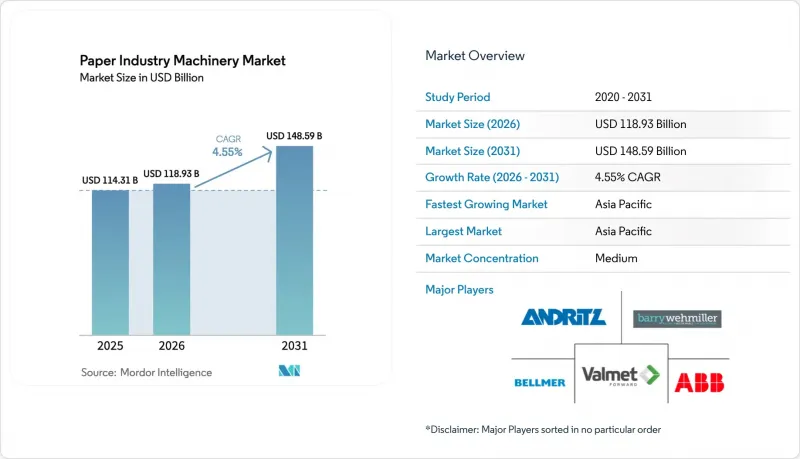
根據 Mordor Intelligence 預測,造紙機械市場規模預計將在 2025 年達到 1,143.1 億美元,2026 年達到 1,189.3 億美元,2031 年達到 1,485.9 億美元,2026 年至 2031 年的複合年成長率為 4.55%。
本報告按運作模式(全自動、半自動、手動)、機器類型(木材預處理和製漿、造紙、其他)、紙張類型(包裝紙和牛皮紙、衛生紙和生活用紙、印刷用紙、其他)、最終用戶(包裝材料製造商、紙漿和造紙廠、其他)以及地區進行細分。市場預測以美元(USD)為單位。
造紙機械市場洞察與趨勢
電子商務主導了瓦楞紙板和包裝材料需求的激增。
線上零售的成長速度持續超過GDP增速,迫使加工商採用高速瓦楞紙板生產設備,以應對訂單量的波動,同時避免長時間的換線。例如,Graphic Packaging等製造商於2024年在德克薩斯州投資12億美元興建了一座再生瓦楞紙板廠,以滿足消費者對瓦楞紙箱的直接銷售需求。 Mondi在捷克共和國投資4億歐元(約4.4億美元)興建的牛皮紙生產設備,每年新增33萬噸產能,緩解了中歐地區的供應短缺。如今,數位印刷和線上模切已成為新生產線的標配,縮短了設定時間,並實現了24小時客製化包裝交貨。自動化進程緩慢的加工商將面臨被競爭對手搶走合約的風險,因為競爭對手能夠提供更快、更有廢棄物的生產方式。
利用紙漿模塑技術擴大永續包裝生產線
品牌商從發泡塑膠翻蓋式容器轉向模塑纖維產品,正在推動全球紙漿模塑機的普及。 PulPac與安德里茨和維美德合作開發的乾式模塑纖維技術,無需耗水的乾燥爐,即可實現與塑膠相當的生產週期。為回應一次性塑膠禁令,Huhtamaki正在歐洲和北美地區擴大其模塑纖維產能。 Toscotec向沙烏地阿拉伯紙業集團交付的衛生紙生產線表明,中東造紙商正在向模塑纖維食品包裝領域多元化經營。只要原生紙漿價格維持在每噸1200美元以下,模塑纖維的總成本就會低於塑膠。當加工商在較長的生產週期內攤提模具成本時,這種差異尤其顯著。在同一工廠內安裝紙漿模塑生產線和衛生紙生產線的造紙商可以降低纖維物流成本,並提高設備運轉率。
紙漿和再生纖維價格波動
2024年第一季,美國二手瓦楞紙箱價格年增117%,但隨後隨著中國進口限制緩解了回收壓力而回落。聯準會的紙漿和造紙生產者物價指數在2024年於105至115之間波動,對造紙商的利潤率帶來壓力。亞太地區每年新增1,600萬噸產能,加上北美地區的停產,加劇了區域纖維價格的差異。由於纖維成本飆升,利潤率較低的中小型造紙商推遲了設備升級,導致OEM廠商的訂單不穩定。長期纖維合約和後向整合有助於穩定投入成本,但這需要大量資金,而許多獨立製造商恰恰缺乏這筆資金。
細分市場分析
到2025年,半自動化設備將佔據造紙機械市場48.89%的佔有率,這充分證明了其作為亞太和非洲造紙廠的資本效率之選的優勢。預計年成長率為5.84%的全自動化系統,憑藉其預測性維護和自主品管,能夠減少停機時間,因此正吸引人事費用高的造紙廠。手動機械仍處於研發和專業細分市場階段,但市佔率持續下滑。 Voit的數位孿生套件MillOne透過提高產量高達10%和減少停機喬治亞20%,充分展現了其價值提案。 Georgia Pacific透過將dataPARC的分析功能與蒸氣最佳化相結合,在不到一年的時間內實現了投資回報。目前,中國和印度的OEM製造商正在交付採用PLC控制的中端生產線,這些生產線以一半的成本實現了歐洲產品70-80%的功能,而且差距正在縮小。隨著資深技術人員加速退休,技術純熟勞工的人事費用成本持續上漲,自動化轉型正在加速前進。在整個預測期內,升級到全自動化平台的造紙廠將滿足品牌所有者和監管機構要求的效率標準。
儘管發展勢頭強勁,但與半自動化生產線相關的造紙機械市場規模仍然龐大,因為許多中型造紙廠缺乏資金實現端到端自動化。由於資金籌措和紙漿利潤率波動,逐步升級正在推動生產,通常從自動捲筒紙處理開始,然後逐步過渡到人工智慧驅動的品管迴路。能夠為現有設備加裝智慧模組的供應商具有優勢,可以緩解買家的現金流壓力。這兩種模式的並存正在形成兩極分化的服務格局:原始設備製造商 (OEM) 為全自動化工廠提供長期數位化契約,而零部件供應商則致力於解決需要定期機械檢修的半自動化設備問題。
到2025年,造紙機械將佔據42.35%的市場佔有率,其中大型衛生紙和箱板生產線是驅動原紙生產的關鍵。紙漿模塑機械正以每年5.35%的速度成長,透過安德里茨和維美德共同開發的乾式模塑纖維技術,應對塑膠的強制替代需求。瓦楞紙板製造機等加工設備正受惠於電子商務的發展,但隨著再生紙漿比例的增加,對傳統紙漿蒸煮器的需求正在放緩。安德里茨以7,000萬歐元(7,700萬美元)收購A. Celli公司,增強了其衛生紙產品線。在歐洲,廢熱回收和廢水處理輔助系統正成為強制要求,銷售結構也正向整合包裝轉型。
儘管造紙機械市場仍然主導著紙漿成型設備市場,但兩者的成長率差異有利於模塑纖維線。原始設備製造商 (OEM) 現在正將成型模組、去毛邊機器人和質量掃描器整合到「即插即用」的單元中,使加工商能夠以 1 萬件為單位調整產量,而不是傳統的 10 萬件。造紙廠正在將紙漿成型生產線與衛生紙生產線並聯,並在廠內回收碎紙和廢料,從而減少纖維損失和運輸距離。這些協同效應提高了內部獲利能力,也證明了整合生產線價格更高的合理性。將成型設備定位為現有機械輔助設備的供應商最有可能獲得工廠的整體資本投資預算。
區域分析
預計到2025年,亞太地區將佔據40.16%的市場佔有率,並將在2031年之前保持5.71%的複合年成長率。中國在2024年生產了1.58469億噸紙張,年增8.6%。中國也持續訂購寬度達11公尺的瓦楞紙板原紙生產設備,其產能可與歐洲一些最大的生產線相媲美。在印度,約有550家造紙廠在運作,但人均消費量僅16公斤,成長空間龐大,促使印度加大對中型半自動化衛生紙生產線的投資。越南和印尼正在迅速追趕,這主要得益於電子商務的普及帶動了瓦楞紙板需求的成長。
在北美,重點正從新建設轉向現有設施的現代化改造。在美國,老舊設備的退役使得2024年的設備運轉率達到了87.5%,這趨勢有助於維持定價權。維美德公司為喬治亞歐文消費品公司訂購的紙巾訂單,以及喬治亞太平洋公司在奧勒岡州斥資1.5億美元的維修項目,都凸顯了向更高品質和更節能配置發展的趨勢。加拿大生產商正在升級其設備,以確保供應穩定並降低外匯風險。
在歐洲,各公司正努力在嚴格的排放法規和競爭力之間尋求平衡。 Voigt公司在瑞典和奧地利的「XcelLine」維修專案在減少蒸氣和水投入的同時,提高了產量並達到了碳排放目標。 Mondi公司投資4.4億美元建設的Stetti牛皮紙製造廠以及Heinzel Paper公司將年產能擴大至47萬噸的舉措,都體現了對高利潤細分市場的選擇性投資。隨著服務西歐的加工商縮短前置作業時間,東歐也受益於近岸外包模式。
南美洲正利用低成本的桉樹紙漿和可再生能源。蘇札諾投資28億美元的單線造紙廠正在產生剩餘電力,鞏固了巴西作為全球紙漿出口國的地位。 2024年,巴西的機械進口量激增172.7%,其中43.3%來自芬蘭。儘管中東和非洲的市場規模仍然較小,但沙烏地阿拉伯和阿拉伯聯合大公國正在部署衛生紙生產線,以減少進口並應對人口成長。
其他好處:
- Excel格式的市場預測(ME)表
- 3個月的分析師支持
目錄
第1章:引言
- 研究假設和市場定義
- 調查範圍
第2章:調查方法
第3章執行摘要
第4章 市場狀況
- 市場概覽
- 市場促進因素
- 電子商務推動了瓦楞紙板和包裝材料需求的激增。
- 利用紙漿模塑技術擴大永續包裝產品的生產線
- 麵粉廠設備升級改造,以提高能源和水資源生產效率
- 政府禁止使用一次性塑膠製品
- 造紙廠的快速自動化與工業4.0維修
- 紙製品供應鏈中的近岸外包
- 市場限制因素
- 紙漿和再生纖維價格波動
- 對下一代自動化機械的高資本投入
- 智慧機器操作領域技術純熟勞工短缺
- 高耗能工廠遵守排放法規的成本
- 產業價值鏈分析
- 監理情勢
- 技術展望
- 宏觀經濟因素的影響
- 波特五力分析
第5章 市場規模與成長預測
- 透過運作模式
- 全自動
- 半自動
- 手動的
- 按機器類型
- 木材預處理和紙漿廠機械
- 造紙機械
- 加工和精加工機械
- 紙漿模塑機
- 輔助系統
- 按最終用戶行業分類
- 包裝
- 紙漿和造紙廠
- 印刷/出版
- 食品/飲料
- 其他終端用戶產業
- 按紙張類型
- 包裝紙和牛皮紙產品線
- 紙巾和衛生紙產品系列
- 圖印用紙產品線
- 特種紙和安全紙產品線
- 按地區
- 北美洲
- 美國
- 加拿大
- 墨西哥
- 南美洲
- 巴西
- 阿根廷
- 智利
- 其他南美國家
- 歐洲
- 英國
- 德國
- 法國
- 義大利
- 西班牙
- 其他歐洲國家
- 亞太地區
- 中國
- 印度
- 日本
- 韓國
- 澳洲
- 其他亞太國家
- 中東和非洲
- 中東
- 沙烏地阿拉伯
- 阿拉伯聯合大公國
- 土耳其
- 其他中東國家
- 非洲
- 南非
- 奈及利亞
- 其他非洲國家
- 中東
- 北美洲
第6章 競爭情勢
- 市場集中度
- 策略趨勢
- 市佔率分析
- 公司簡介
- Voith GmbH & Co. KGaA
- Valmet Oyj
- ANDRITZ AG
- ABB Ltd.
- Bellmer GmbH
- Barry-Wehmiller Group
- Toscotec SpA
- Kadant Inc.
- Mitsubishi Heavy Industries Machinery Systems, Ltd.
- IHI Corporation
- A.Celli Group
- Kawanoe Zoki Co., Ltd.
- Parason Machinery India Pvt. Ltd.
- Beston Group Co., Ltd.
- HOBEMA Maschinenfabrik GmbH
- Popp Maschinenbau GmbH
- Baosuo Paper Machinery Manufacture Co., Ltd.
- Recard SpA
- Cellwood Machinery AB
第7章 市場機會與未來展望
According to Mordor Intelligence, the paper industry machinery market size is projected to be USD 114.31 billion in 2025, USD 118.93 billion in 2026, and reach USD 148.59 billion by 2031, growing at a CAGR of 4.55% from 2026 to 2031.
This report is Segmented by Operation Mode (Fully Automatic, Semi-Automatic, and Manual), Machinery Type (Wood Preparation and Pulping, Paper Production, and More), Paper Type (Packaging and Kraft, Tissue and Hygiene, Graphic and Printing, and More), End-User (Packaging Material Manufacturers, Pulp and Paper Mills, and More), and Geography. The Market Forecasts are Provided in Terms of Value (USD).
Insights and Trends of Paper Industry Machinery Market
E-Commerce-Led Surge in Corrugated and Packaging Demand
Online retail continues to grow faster than GDP, pushing converters to install high-speed corrugators that handle variable order sizes without lengthy changeovers. Producers such as Graphic Packaging allocated USD 1.2 billion in 2024 for a recycled-containerboard mill in Texas to capture direct-to-consumer box demand. Mondi's EUR 400 million (USD 440 million) kraft-paper machine in the Czech Republic added 330,000 tpy and relieved supply tightness in Central Europe. Digital printing and inline die-cut attachments are now standard on new lines, shrinking setup time and enabling 24-hour turnaround for custom packs. Converters delaying automation risk contract losses to rivals offering rapid, low-waste production.
Expansion of Pulp-Molded Sustainable Packaging Lines
Brand owners switching from foam clamshells to molded fiber are fueling a global build-out of pulp-molding machines. PulPac's dry-molded-fiber technology, commercialized with ANDRITZ and Valmet, eliminates water-intensive drying ovens and reaches plastic-grade cycle times. Huhtamaki is enlarging molded-fiber capacity across Europe and North America to supply bans on single-use plastics. Toscotec's tissue machine for Saudi Paper Group shows Middle Eastern mills diversifying into fiber-formed food packaging. Once virgin-pulp stays below USD 1,200 per tonne, the total cost of molded fiber undercuts plastic, especially when converters amortize tooling over long runs. Mills that colocate pulp-molding with tissue lines cut fiber logistics and raise asset utilization.
Volatility in Pulp and Recycled-Fiber Prices
Old corrugated container prices in the United States spiked 117% year-on-year in Q1 2024, then retreated as Chinese import curbs relaxed collection pressures. The Federal Reserve's pulp and paper Producer Price Index swung between 105 and 115 in 2024, squeezing mill margins. Capacity additions of 16 million tpy in Asia-Pacific and retirements in North America deepened regional fiber price gaps. Small mills facing thin margins defer machinery upgrades when fiber costs jump, causing uneven order pipelines for OEMs. Long-term fiber contracts or backward integration help stabilize input costs but demand large capital that many independents lack.
Other drivers and restraints analyzed in the detailed report include:
- Mill Upgrades for Energy and Water-Efficient Production
- Government Bans on Single-Use Plastics
- High CAPEX of Next-Gen Automated Machines
For complete list of drivers and restraints, kindly check the Table Of Contents.
Segment Analysis
Semi-automatic equipment held 48.89% of the paper industry machinery market in 2025, mirroring its capital-efficient appeal for mills in Asia-Pacific and Africa. Fully automatic systems, forecast to grow at 5.84% annually, entice high-wage mills with predictive maintenance and autonomous quality control that cut downtime. Manual machines linger in R&D or specialty niches but keep losing ground. Voith's MillOne digital-twin suite delivers up to 10% throughput gains and 20% downtime cuts, validating the value proposition. Georgia-Pacific achieved sub-year payback after linking dataPARC analytics to steam optimization. Chinese and Indian OEMs now ship mid-tier lines with PLC controls that offer 70-80% of European functionality at half the cost, narrowing the gap. As retirement of older technicians accelerates, the calculus tilts further toward automation since skilled labor premiums keep climbing. Over the forecast horizon, mills upgrading to fully automatic platforms will underpin efficiency benchmarks demanded by brand owners and regulators.
Despite the momentum, the paper industry machinery market size tied to semi-automatic lines will remain substantial because many mid-scale mills lack financing for end-to-end autonomy. Credit constraints and volatile pulp margins encourage staged upgrades, often beginning with automated reel handling before moving into AI quality loops. Vendors able to retrofit smart modules onto existing frames gain an advantage by stretching buyer cash flows. The coexistence of both modes creates a bifurcated servicing landscape, with OEMs offering long-term digital contracts to fully automated sites while component suppliers cater to semi-automatic installations needing periodic mechanical overhauls.
Paper production machinery accounted for 42.35% of market share in 2025, anchored by large tissue and containerboard lines that drive base-sheet output. Pulp-molding machinery, expanding at 5.35% annually, addresses plastic-replacement mandates through dry-molded-fiber technology co-developed by ANDRITZ and Valmet. Converting equipment rides the same e-commerce wave as corrugators, whereas demand for conventional pulp digesters softens as recycled furnish grows in share. ANDRITZ's EUR 70 million (USD 77 million) purchase of A. Celli strengthened its tissue offering. Ancillary systems that capture waste heat or treat effluent are becoming mandatory in Europe, altering the sales mix toward integrated packages.
The paper industry machinery market for core paper machines will still dwarf pulp-molding gear, but the growth differential favors molded-fiber lines. OEMs now bundle forming modules, deflashing robots, and quality scanners into plug-and-play cells, allowing converters to scale output in 10,000-unit increments rather than traditional 100,000-unit steps. Mills are adding pulp-molding adjacent to tissue production, recycling broke and edge trim internally, cutting fiber loss and truck miles. Those synergies raise internal rates of return and justify premium pricing for integrated lines. Vendors that treat molding as an adjunct to traditional machines are best placed to win mill-wide CAPEX budgets.
Complete Report Scope:
- By Operation Mode
- Fully Automatic
- Semi-automatic
- Manual
- By Machinery Type
- Wood Preparation and Pulp Mill Machinery
- Paper Production Machines
- Converting and Finishing Machines
- Pulp-Moulding Machines
- Ancillary Systems
- By End-user Industry
- Packaging
- Pulp and Paper Producers
- Print and Publishing
- Food and Beverage
- Other End-user Industries
- By Paper Grade
- Packaging and Kraft Paper Lines
- Tissue and Hygiene Paper Lines
- Graphic and Printing Paper Lines
- Specialty and Security Paper Lines
- By Geography
- North America
- United States
- Canada
- Mexico
- South America
- Brazil
- Argentina
- Chile
- Rest of South America
- Europe
- United Kingdom
- Germany
- France
- Italy
- Spain
- Rest of Europe
- Asia-Pacific
- China
- India
- Japan
- South Korea
- Australia
- Rest of Asia-Pacific
- Middle East and Africa
- Middle East
- Saudi Arabia
- United Arab Emirates
- Turkey
- Rest of Middle East
- Africa
- South Africa
- Nigeria
- Rest of Africa
- Middle East
- North America
Geography Analysis
Asia-Pacific generated 40.16% of market share in 2025 and is projected to post a 5.71% CAGR through 2031. China produced 158.469 million t of paper in 2024, up 8.6%, and continues ordering 11-meter-wide containerboard machines that rival Europe's largest lines. India operates roughly 550 mills yet consumes only 16 kg per capita, leaving ample growth headroom and spurring fresh investment in mid-scale semi-automatic tissue lines. Vietnam and Indonesia are fast followers as e-commerce adoption pushes box demand.
North America focuses on modernization rather than greenfield builds. The U.S. operating rate reached 87.5% in 2024 as older machines were scrapped, a dynamic that sustains pricing power. Valmet's tissue order for Irving Consumer Products in Georgia and Georgia-Pacific's USD 150 million rebuild in Oregon highlight the trend toward premium grades and energy-efficient configurations. Canadian producers upgrade machines to lock in supply security and cut currency exposure.
Europe balances strict emission rules with competitiveness. Voith's XcelLine rebuilds in Sweden and Austria cut steam and water inputs, meeting carbon targets while raising output. Mondi's USD 440 million Steti kraft-paper machine and heinzelpaper's capacity jump to 470,000 tpy exemplify selective investment in high-margin niches. Eastern Europe benefits from near-shoring as converters serving Western Europe shorten lead times.
South America leverages low-cost eucalyptus pulp and renewable energy. Suzano's USD 2.8 billion single-line mill generates surplus power and cements Brazil's position as a global pulp exporter. Brazilian machinery imports soared 172.7% in 2024, with Finland accounting for 43.3% of shipments. Middle East and Africa remain small but are installing tissue lines in Saudi Arabia and the UAE to cut imports and meet population growth.
- Voith GmbH & Co. KGaA
- Valmet Oyj
- ANDRITZ AG
- ABB Ltd.
- Bellmer GmbH
- Barry-Wehmiller Group
- Toscotec S.p.A.
- Kadant Inc.
- Mitsubishi Heavy Industries Machinery Systems, Ltd.
- IHI Corporation
- A.Celli Group
- Kawanoe Zoki Co., Ltd.
- Parason Machinery India Pvt. Ltd.
- Beston Group Co., Ltd.
- HOBEMA Maschinenfabrik GmbH
- Popp Maschinenbau GmbH
- Baosuo Paper Machinery Manufacture Co., Ltd.
- Recard S.p.A.
- Cellwood Machinery AB
Additional Benefits:
- The market estimate (ME) sheet in Excel format
- 3 months of analyst support
TABLE OF CONTENTS
1 INTRODUCTION
- 1.1 Study Assumptions and Market Definition
- 1.2 Scope of the Study
2 RESEARCH METHODOLOGY
3 EXECUTIVE SUMMARY
4 MARKET LANDSCAPE
- 4.1 Market Overview
- 4.2 Market Drivers
- 4.2.1 E-Commerce-Led Surge in Corrugated and Packaging Demand
- 4.2.2 Expansion of Pulp-Molded Sustainable Packaging Lines
- 4.2.3 Mill Upgrades for Energy and Water Efficient Production
- 4.2.4 Government Bans on Single-use Plastics
- 4.2.5 Rapid Automation and Industry 4.0 Retrofits In Mills
- 4.2.6 Near-Shoring of Paper Product Supply Chains
- 4.3 Market Restraints
- 4.3.1 Volatility In Pulp and Recycled-Fiber Prices
- 4.3.2 High CAPEX Of Next-Gen Automated Machines
- 4.3.3 Skilled-Labour Shortages for Smart-Machine Operation
- 4.3.4 Emission-Compliance Costs in Energy-Intensive Mills
- 4.4 Industry Value Chain Analysis
- 4.5 Regulatory Landscape
- 4.6 Technological Outlook
- 4.7 Impact of Macroeconomic Factors
- 4.8 Porter's Five Forces Analysis
- 4.8.1 Threat of New Entrants
- 4.8.2 Bargaining Power of Suppliers
- 4.8.3 Bargaining Power of Buyers
- 4.8.4 Threat of Substitutes
- 4.8.5 Industry Rivalry
5 MARKET SIZE AND GROWTH FORECASTS (VALUE)
- 5.1 By Operation Mode
- 5.1.1 Fully Automatic
- 5.1.2 Semi-automatic
- 5.1.3 Manual
- 5.2 By Machinery Type
- 5.2.1 Wood Preparation and Pulp Mill Machinery
- 5.2.2 Paper Production Machines
- 5.2.3 Converting and Finishing Machines
- 5.2.4 Pulp-Moulding Machines
- 5.2.5 Ancillary Systems
- 5.3 By End-user Industry
- 5.3.1 Packaging
- 5.3.2 Pulp and Paper Producers
- 5.3.3 Print and Publishing
- 5.3.4 Food and Beverage
- 5.3.5 Other End-user Industries
- 5.4 By Paper Grade
- 5.4.1 Packaging and Kraft Paper Lines
- 5.4.2 Tissue and Hygiene Paper Lines
- 5.4.3 Graphic and Printing Paper Lines
- 5.4.4 Specialty and Security Paper Lines
- 5.5 By Geography
- 5.5.1 North America
- 5.5.1.1 United States
- 5.5.1.2 Canada
- 5.5.1.3 Mexico
- 5.5.2 South America
- 5.5.2.1 Brazil
- 5.5.2.2 Argentina
- 5.5.2.3 Chile
- 5.5.2.4 Rest of South America
- 5.5.3 Europe
- 5.5.3.1 United Kingdom
- 5.5.3.2 Germany
- 5.5.3.3 France
- 5.5.3.4 Italy
- 5.5.3.5 Spain
- 5.5.3.6 Rest of Europe
- 5.5.4 Asia-Pacific
- 5.5.4.1 China
- 5.5.4.2 India
- 5.5.4.3 Japan
- 5.5.4.4 South Korea
- 5.5.4.5 Australia
- 5.5.4.6 Rest of Asia-Pacific
- 5.5.5 Middle East and Africa
- 5.5.5.1 Middle East
- 5.5.5.1.1 Saudi Arabia
- 5.5.5.1.2 United Arab Emirates
- 5.5.5.1.3 Turkey
- 5.5.5.1.4 Rest of Middle East
- 5.5.5.2 Africa
- 5.5.5.2.1 South Africa
- 5.5.5.2.2 Nigeria
- 5.5.5.2.3 Rest of Africa
- 5.5.5.1 Middle East
- 5.5.1 North America
6 COMPETITIVE LANDSCAPE
- 6.1 Market Concentration
- 6.2 Strategic Moves
- 6.3 Market Share Analysis
- 6.4 Company Profiles (includes Global level Overview, Market level overview, Core Segments, Financials as available, Strategic Information, Market Rank/Share for key companies, Products and Services, and Recent Developments)
- 6.4.1 Voith GmbH & Co. KGaA
- 6.4.2 Valmet Oyj
- 6.4.3 ANDRITZ AG
- 6.4.4 ABB Ltd.
- 6.4.5 Bellmer GmbH
- 6.4.6 Barry-Wehmiller Group
- 6.4.7 Toscotec S.p.A.
- 6.4.8 Kadant Inc.
- 6.4.9 Mitsubishi Heavy Industries Machinery Systems, Ltd.
- 6.4.10 IHI Corporation
- 6.4.11 A.Celli Group
- 6.4.12 Kawanoe Zoki Co., Ltd.
- 6.4.13 Parason Machinery India Pvt. Ltd.
- 6.4.14 Beston Group Co., Ltd.
- 6.4.15 HOBEMA Maschinenfabrik GmbH
- 6.4.16 Popp Maschinenbau GmbH
- 6.4.17 Baosuo Paper Machinery Manufacture Co., Ltd.
- 6.4.18 Recard S.p.A.
- 6.4.19 Cellwood Machinery AB
7 MARKET OPPORTUNITIES AND FUTURE OUTLOOK
- 7.1 White-space and Unmet-need Assessment

 衛生紙加工機械:市場佔有率分析、產業趨勢與統計、成長預測(2026-2031)
 木工刨床市場規模、佔有率和成長分析:按刨床類型、操作模式、應用、最終用戶、分銷管道和地區分類-2026-2033年產業預測
 造紙機械市場分析及預測(至2035年):類型、產品類型、技術、組件、應用、材料類型、製造流程、最終用戶、安裝配置
 2026-2030年全球木工機械市場
 瓦楞紙板製造設備市場規模、佔有率和成長分析:按設備類型、技術、應用、最終用戶和地區分類-2026-2033年產業預測
 紙漿和造紙機械市場:按紙張類型、機械類型、工藝類型、產能、機械速度、技術類型和應用分類-全球預測,2026-2032年
 2026年全球木工及造紙加工機械市場報告2026年全球木工銑刀市場報告2026年全球紙巾加工機械市場報告2026年全球紙漿和造紙機械市場報告