


 |
市場調查報告書
商品編碼
2119819
德國電動車充電基礎設施:市場佔有率分析、產業趨勢和統計數據以及成長預測(2026-2031 年)Germany EV Charging Infrastructure - Market Share Analysis, Industry Trends & Statistics, Growth Forecasts (2026 - 2031) |
||||||

※ 本網頁內容可能與最新版本有所差異。詳細情況請與我們聯繫。
根據 Mordor Intelligence 估計,德國電動車充電基礎設施市場在 2026 年的價值將達到 17.5 億美元,高於 2025 年的 13.6 億美元,預計到 2031 年將達到 60.8 億美元。
預計從 2026 年到 2031 年,其複合年成長率將達到 28.35%。
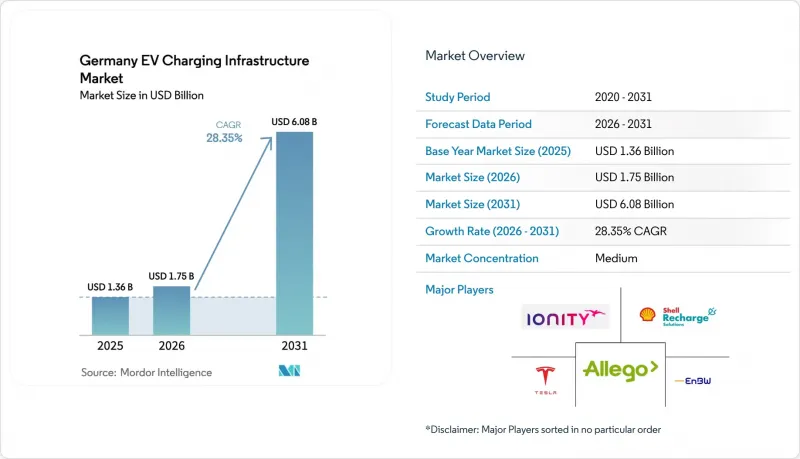
本報告按充電地點(商業、住宅)、充電類型(高功率直流、其他)、輸出功率(低於22kW、其他)、連接器類型(CCS2、其他)、安裝方式(壁掛式、其他)、車輛類型(乘用車、其他)以及德國聯邦州進行分類。市場預測以美元計價。
德國電動車充電基礎設施市場趨勢與洞察
國家政策目標(Radinha II 總體規劃)
德國正致力於建立覆蓋全國的電動車充電網路。透過「德國網路」(Deutschlandnetz)舉措,政府大力投資快速充電樁的部署,以確保電動車用戶能夠可靠且廣泛地使用充電服務。這些目標將透過增強消費者信心和鼓勵私營部門參與,加速向電動出行的轉型。沿著泛歐交通網路(TEN-T)每隔60公里強制設置快速充電站,正將充電樁的部署模式從市場主導的集群式佈局轉向系統性覆蓋,從而穩定對高功率硬體的需求。聯邦和州級計畫(例如巴登-符騰堡州的「Charge@BW」計畫)的結合使用,最大限度地減少了資金缺口,並促進了採購規模經濟。因此,充電樁的普及鼓勵私人業者投資建造400-600千瓦的系統,儘管初始投資成本較高。地方授權機構也越來越重視聯邦目標,縮短了前置作業時間,降低了專案風險。
電動車普及率不斷提高
2025年第一季,電池式電動車(BEV)新註冊量創歷史新高,使其在總擁有成本(TCO)方面相比內燃機汽車具有顯著優勢。每增加一輛電動車,都會增加平均每日充電需求,從而強化基礎設施擴大與汽車銷售之間的良性循環。商用車的電氣化正在為公共網路帶來過載,因為貨車和卡車耗電量更大,佔用充電樁的時間也更長。都市區電動車普及率的不平衡正在影響投資邏輯。在大都會圈,家用和職場充電樁的建設被優先考慮;而在城際走廊,為了滿足週末和假日出行需求的激增,超快速充電站的建設則被優先考慮。汽車製造商的2030年銷售目標正在建立一個可預測的電動車供應管道,這將為充電業者進行多年需求預測提供基礎。
都市區電網容量瓶頸
電網容量的限制日益阻礙著都市區快速充電設施的普及。據主要城市的配電系統營運商(DSO)稱,許多規劃中的安裝地點都存在容量瓶頸,使得大規模部署高功率充電樁面臨挑戰。在通勤者需要充電的晚尖峰時段,中壓饋線往往容量不足。智慧充電、電池緩衝和分時電價等臨時措施可以延緩升級改造的必要性,但無法從根本解決問題。目前,配電系統營運商正在逐個專案地協調升級改造,導致前置作業時間過長。儘管各方正在討論將充電基礎設施規劃納入城市發展規劃,但市政當局、配電系統營運商和私人企業在資金分攤方面仍未達成協議。
細分市場分析
至2025年,商業設施將佔德國電動車充電基礎設施市場佔有率的60.72%。這主要得益於高速公路沿線、零售商店和物流樞紐等場所的充電需求。這些場所的充電利用率將達到每天20-25次,即使在電網升級改造後,也能維持盈利的收費系統。車輛的電氣化,尤其是物流公司的車輛電氣化,正在推動對配備350千瓦或以上充電樁和現場儲能設施的專用充電站的需求。飯店和超級市場的目的地充電將充分利用60-120分鐘的停留時間,使企業能夠安裝中功率(50-150千瓦)的充電樁,從而創造額外的零售收入。
由於《住宅條例》(WEG) 的修訂消除了多用戶住宅的法律障礙,住宅插座的安裝量正以28.84%的複合年成長率快速成長,直至2031年。然而,公寓業主之間的專案協調工作延長了實施時間。停車位和主配電盤容量充足的獨棟住宅繼續保持較高的採用率。整體而言,住宅領域的成長速度為28.84%,超過了規模更大的商業領域,但其插座安裝量起點較低。這種用電負載模式的轉變可能會透過將用電時間轉移到夜間來減輕都市區電網的部分負擔,但也增加了對智慧充電演算法的需求。
在德國,交流充電樁預計到2025年仍將佔電動車充電基礎設施市場規模的55.62%,這主要得益於其較低的資本支出(CAPEX)以及與現有三相電力系統的無縫整合。在車輛停放時間接近8小時的職場和住宅環境中,通常使用11-22kW的交流充電插座,從而最大限度地減少了電網改造的需求。超過10年的使用壽命和成熟的標準確保了可預測的維護。
預計到2031年,功率超過150kW的直流快速充電樁將以30.02%的複合年成長率成長,因為汽車製造商正在部署可實現270-350kW峰值充電功率的高壓電池系統。城際路線目前已配備400kW充電樁,可將充電時間縮短10-80%,僅需15-20分鐘。此類充電樁採用水冷電纜和高功率模組,雖然單位成本較高,但每個充電樁的盈利也得到提升。中功率在50-150kW之間的中型直流充電樁主要面向二線城市和郊區商業中心,在安裝成本和駕駛員便利性之間取得平衡。
其他好處
- Excel格式的市場預測(ME)表
- 3個月的分析師支持
目錄
第1章:引言
- 研究假設和市場定義
- 調查範圍
第2章:調查方法
第3章執行摘要
第4章 市場狀況
- 市場概覽
- 市場促進因素
- 國家政策目標(充電基礎設施二期基本規劃)
- 電動車普及率的成長
- 私營和公共產業的投資熱潮
- 電網業務收益(V2G、負載平衡)
- 公寓維修經費(WEG改革)
- 貨運走廊電氣化的激勵措施
- 市場限制因素
- 高昂的安裝成本和電網維修成本
- 都市區電網容量瓶頸
- 文化財產許可核准流程延誤
- 網路安全合規成本(IT-Sig 3.0)
- 價值供應鏈分析
- 監理情勢
- 技術展望
- 波特五力模型
第5章 市場規模與成長預測
- 充電點
- 商業充電站
- 目的地充電站
- 高速公路充電站
- 公車充電站
- 車隊充電站
- 其他商業設施
- 住宅充電站
- 獨立式住宅
- 公寓
- 商業充電站
- 按充電類型
- 直流高功率(最大150kW)
- 直流低功率(50-150kW)
- 交流電(22千瓦或以下)
- 依輸出類型
- 22千瓦或以下
- 23~99kW
- 100~150kW
- 150千瓦或以上(超高速)
- 依連接器類型
- CCS2
- 類型 2
- CHAdeMO
- Tesla(V3)
- 其他
- 透過安裝配置
- 壁掛式
- 底座安裝式/獨立式
- 受電弓式
- 按車輛類型
- 搭乘用車
- 輕型商用車
- 巴士和長途汽車
- 中型和大型卡車
- 聯邦州
- 巴登-符騰堡州
- 巴伐利亞
- 柏林
- 布蘭登堡
- 不來梅
- 漢堡
- 黑森州
- 下薩克森州
- 梅克倫堡-前波美拉尼亞
- 北萊茵-威斯特法倫州
- 萊茵蘭-普法爾茨
- 薩爾蘭
- 薩克森
- 薩克森-安哈特
- 石勒蘇益格-荷爾斯泰因州
- 圖林根
第6章 競爭情勢
- 市場集中度
- 策略趨勢
- 市佔率分析
- 公司簡介
- EnBW Baden-Wurttemberg AG
- Ionity GmbH
- Allego BV
- Shell Plc
- ChargePoint Inc.
- Tesla Inc.(Supercharger Network)
- E.ON Drive GmbH
- ABB Ltd.
- Siemens AG
- EVBox Group
- Webasto Group
- Leviton Manufacturing Co.
- Compleo Charging Solutions AG
- BP脈搏(德國)
- Fastned BV
- TotalEnergies SE
- EWE Go GmbH
- Stadtwerke Munchen GmbH
- SWARCO AG
- ADS-TEC Energy GmbH
第7章 市場機會與未來展望
According to Mordor Intelligence, German EV charging infrastructure market size in 2026 is estimated at USD 1.75 billion, growing from 2025 value of USD 1.36 billion with 2031 projections showing USD 6.08 billion, growing at 28.35% CAGR over 2026-2031.
This report is Segmented by Charging Site (Commercial and Residential), Charger Type (DC High Power, and More), Power Output (Up To 22 KW, and More), Connector Type (CCS2, and More), Mounting Configuration (Wall-Mounted, and More), Vehicle Type (Passenger Cars, and More), and German Federal State. The Market Forecasts are Provided in Terms of Value (USD).
Germany EV Charging Infrastructure Market Trends and Insights
National Policy Targets (Masterplan Ladeinfrastruktur II)
Germany is committed to building a nationwide EV charging network. Through the Deutschlandnetz initiative, the government invests heavily in fast-charger deployment to ensure reliable and widespread accessibility for EV users. These targets enhance consumer confidence and drive private-sector participation, accelerating the shift to electric mobility. Mandatory 60 km fast-charging intervals on TEN-T routes shift deployment from market-led clustering to systematic coverage, stabilizing demand for high-power hardware. Federal-state program stacking, such as Baden-Wurttemberg's Charge@BW, minimizes funding gaps and drives procurement scale economies. The resulting certainty in utilization encourages private operators to invest in 400-600 kW equipment despite higher capex. Local permitting agencies increasingly mirror federal targets, reducing approval lead times and lowering project risk.
Growing BEV Adoption Rates
Q1 2025 battery-electric registrations attained record highs, with total-cost-of-ownership parity versus combustion vehicles tipping decisively in favor of EVs. Each incremental EV lifts average daily charging demand, reinforcing the feedback loop between infrastructure expansion and vehicle sales. Commercial fleet electrification exerts an outsized load on public networks because vans and trucks draw higher currents and occupy bays longer. Urban-rural adoption asymmetry shapes investment logic: metropolitan areas prioritize home and workplace chargers, while intercity corridors prioritize ultra-fast hubs to support weekend and holiday travel surges. Automakers' sales targets for 2030 create a predictable pipeline of EVs that underpins multi-year volume forecasts for charging operators.
Urban Grid-Capacity Bottlenecks
Grid limitations increasingly constrain urban fast-charging expansion. Distribution system operators in major cities report that many proposed sites face capacity bottlenecks, challenging the deployment of high-powered chargers at scale. Medium-voltage feeders often lack spare headroom during evening peak demand, the window when commuters require charging. Interim mitigations-smart charging, battery buffering, and time-of-use pricing-can defer but not eliminate the need for reinforcement. DSOs presently coordinate upgrades on a project-by-project basis, stretching lead times. Policy discussions are underway to integrate charging infrastructure planning into urban development plans, but alignment on funding responsibility between municipalities, DSOs, and private operators remains unresolved.
Other drivers and restraints analyzed in the detailed report include:
- Private-Utility Investment Boom
- Freight-Corridor Electrification Incentives
- Heritage-Site Permitting Delays
For complete list of drivers and restraints, kindly check the Table Of Contents.
Segment Analysis
Commercial sites accounted for 60.72% of the German EV charging infrastructure market share in 2025, propelled by highway corridors, retail destinations, and logistics hubs. Utilization rates at these locations reach 20-25 sessions daily, supporting profitable tariff structures even after grid-upgrade outlays. Fleet electrification, notably among logistics providers, fuels demand for dedicated depots with>=350 kW dispensers and onsite storage. Destination charging at hotels and supermarkets leverages dwell times of 60-120 minutes, enabling operators to deploy mid-power 50-150 kW units and capture incremental retail spend.
Residential installations are scaling rapidly at a CAGR of 28.84% through 2031, as WEG reforms remove legal barriers in multi-unit buildings, although project coordination among apartment owners prolongs timelines. Private homes maintain high adoption where parking spaces and main-panel capacity are readily available. Collectively, the residential segment expands at 28.84% CAGR, its growth outpacing the larger commercial base but starting from a smaller installed-socket count. The shift rebalances load profiles toward overnight hours, which may ease some urban grid stress but heightens the need for smart-charging algorithms.
AC chargers continued to represent 55.62% of the German EV charging infrastructure market size 2025, favored for low capex and seamless integration with existing three-phase electrical systems. Workplace and residential settings, where vehicles remain parked nearly 8 hours, rely on 11-22 kW AC outlets that minimize grid-reinforcement needs. Equipment lifecycles of above 10 years and mature standards ensure predictable maintenance profiles.
DC fast chargers above 150 kW post a 30.02% CAGR through 2031, as automakers launch higher-voltage battery systems enabling 270-350 kW peak intake. Intercity routes now host 400 kW-capable dispensers, reducing 10-80% charge times to 15-20 minutes. The hardware incorporates liquid-cooled cables and larger power modules, keeping unit prices high but achieving better revenue per connector. Mid-power 50-150 kW DC units address Tier-2 cities and suburban commercial centers, offering a compromise between installation cost and driver convenience.
Complete Report Scope:
- By Charging Site
- Commercial Charging Stations
- Destination Charging Stations
- Highway Charging Stations
- Bus Charging Stations
- Fleet Charging Stations
- Other Commercial Sites
- Residential Charging Stations
- Private Houses
- Apartments
- Commercial Charging Stations
- By Charger Type
- DC High Power (Up to 150 kW)
- DC Low Power (50 - 150 kW)
- AC (Below 22 kW)
- By Power Output
- Up to 22 kW
- 23-99 kW
- 100-150 kW
- Above 150 kW (Ultra-fast)
- By Connector Type
- CCS2
- Type 2
- CHAdeMO
- Tesla (V3)
- Others
- By Mounting Configuration
- Wall-mounted
- Pedestal / Stand-alone
- Pantograph
- By Vehicle Type
- Passenger Cars
- Light Commercial Vehicles
- Buses and Coaches
- Medium and Heavy Trucks
- By Federal State
- Baden-Wurttemberg
- Bavaria
- Berlin
- Brandenburg
- Bremen
- Hamburg
- Hesse
- Lower Saxony
- Mecklenburg-Western Pomerania
- North Rhine-Westphalia
- Rhineland-Palatinate
- Saarland
- Saxony
- Saxony-Anhalt
- Schleswig-Holstein
- Thuringia
List of Companies Covered in this Report:
- EnBW Baden-Wurttemberg AG
- Ionity GmbH
- Allego B.V.
- Shell Plc
- ChargePoint Inc.
- Tesla Inc. (Supercharger Network)
- E.ON Drive GmbH
- ABB Ltd.
- Siemens AG
- EVBox Group
- Webasto Group
- Leviton Manufacturing Co.
- Compleo Charging Solutions AG
- BP Pulse (Germany)
- Fastned B.V.
- TotalEnergies SE
- EWE Go GmbH
- Stadtwerke Munchen GmbH
- SWARCO AG
- ADS-TEC Energy GmbH
Additional Benefits:
- The market estimate (ME) sheet in Excel format
- 3 months of analyst support
TABLE OF CONTENTS
1 Introduction
- 1.1 Study Assumptions & Market Definition
- 1.2 Scope of the Study
2 Research Methodology
3 Executive Summary
4 Market Landscape
- 4.1 Market Overview
- 4.2 Market Drivers
- 4.2.1 National Policy Targets (Masterplan Ladeinfrastruktur II)
- 4.2.2 Growing BEV Adoption Rates
- 4.2.3 Private-Utility Investment Boom
- 4.2.4 Grid Services Revenue (V2G, Load-Balancing)
- 4.2.5 Condominium Modernization Funding (WEG Reforms)
- 4.2.6 Freight-Corridor Electrification Incentives
- 4.3 Market Restraints
- 4.3.1 High Install and Grid-Upgrade Costs
- 4.3.2 Urban Grid-Capacity Bottlenecks
- 4.3.3 Heritage-Site Permitting Delays
- 4.3.4 Cyber-Security Compliance Costs (IT-Sig 3.0)
- 4.4 Value / Supply-Chain Analysis
- 4.5 Regulatory Landscape
- 4.6 Technological Outlook
- 4.7 Porter's Five Forces
- 4.7.1 Bargaining Power of Suppliers
- 4.7.2 Bargaining Power of Buyers/Consumers
- 4.7.3 Threat of New Entrants
- 4.7.4 Threat of Substitute Products
- 4.7.5 Intensity of Competitive Rivalry
5 Market Size and Growth Forecasts (Value (USD))
- 5.1 By Charging Site
- 5.1.1 Commercial Charging Stations
- 5.1.1.1 Destination Charging Stations
- 5.1.1.2 Highway Charging Stations
- 5.1.1.3 Bus Charging Stations
- 5.1.1.4 Fleet Charging Stations
- 5.1.1.5 Other Commercial Sites
- 5.1.2 Residential Charging Stations
- 5.1.2.1 Private Houses
- 5.1.2.2 Apartments
- 5.1.1 Commercial Charging Stations
- 5.2 By Charger Type
- 5.2.1 DC High Power (Up to 150 kW)
- 5.2.2 DC Low Power (50 - 150 kW)
- 5.2.3 AC (Below 22 kW)
- 5.3 By Power Output
- 5.3.1 Up to 22 kW
- 5.3.2 23-99 kW
- 5.3.3 100-150 kW
- 5.3.4 Above 150 kW (Ultra-fast)
- 5.4 By Connector Type
- 5.4.1 CCS2
- 5.4.2 Type 2
- 5.4.3 CHAdeMO
- 5.4.4 Tesla (V3)
- 5.4.5 Others
- 5.5 By Mounting Configuration
- 5.5.1 Wall-mounted
- 5.5.2 Pedestal / Stand-alone
- 5.5.3 Pantograph
- 5.6 By Vehicle Type
- 5.6.1 Passenger Cars
- 5.6.2 Light Commercial Vehicles
- 5.6.3 Buses and Coaches
- 5.6.4 Medium and Heavy Trucks
- 5.7 By Federal State
- 5.7.1 Baden-Wurttemberg
- 5.7.2 Bavaria
- 5.7.3 Berlin
- 5.7.4 Brandenburg
- 5.7.5 Bremen
- 5.7.6 Hamburg
- 5.7.7 Hesse
- 5.7.8 Lower Saxony
- 5.7.9 Mecklenburg-Western Pomerania
- 5.7.10 North Rhine-Westphalia
- 5.7.11 Rhineland-Palatinate
- 5.7.12 Saarland
- 5.7.13 Saxony
- 5.7.14 Saxony-Anhalt
- 5.7.15 Schleswig-Holstein
- 5.7.16 Thuringia
6 Competitive Landscape
- 6.1 Market Concentration
- 6.2 Strategic Moves
- 6.3 Market Share Analysis
- 6.4 Company Profiles (Includes Global & Market Level Overview, Core Segments, Financials, Strategic Info, Market Share, Products, Service & Recent Developments)
- 6.4.1 EnBW Baden-Wurttemberg AG
- 6.4.2 Ionity GmbH
- 6.4.3 Allego B.V.
- 6.4.4 Shell Plc
- 6.4.5 ChargePoint Inc.
- 6.4.6 Tesla Inc. (Supercharger Network)
- 6.4.7 E.ON Drive GmbH
- 6.4.8 ABB Ltd.
- 6.4.9 Siemens AG
- 6.4.10 EVBox Group
- 6.4.11 Webasto Group
- 6.4.12 Leviton Manufacturing Co.
- 6.4.13 Compleo Charging Solutions AG
- 6.4.14 BP Pulse (Germany)
- 6.4.15 Fastned B.V.
- 6.4.16 TotalEnergies SE
- 6.4.17 EWE Go GmbH
- 6.4.18 Stadtwerke Munchen GmbH
- 6.4.19 SWARCO AG
- 6.4.20 ADS-TEC Energy GmbH
7 Market Opportunities & Future Outlook

 充電站監控系統市場:全球市場預測,2026-2032年
 電動車充電基礎設施市場:按連接器類型、車輛類型、充電器類型、充電位置、輸出功率、組件和地區分類-全球產業分析、市場規模、市場佔有率和預測(2026-2033年)
 電動車充電基礎設施市場預測至2034年-全球分析(按充電技術、充電等級、輸出功率、連接器類型、安裝配置、車輛類型、最終用戶和地區分類)
 2026年全球電動車充電基礎設施:成長軌跡與新機會全球電動車充電基礎設施金屬市場:規模、佔有率、趨勢和成長分析報告(2026-2034)
 中國電動車充電基礎設施:市場佔有率分析、產業趨勢與統計及成長預測(2026-2031年)電動車充電基礎設施市場:規模、佔有率、成長、全球產業分析、區域趨勢及2026年至2034年預測
 全球電動車充電基礎設施(EVCI)硬體市場:市場分析歐洲電動車充電基礎設施(EVCI)市場分析(按地區分類)電動車充電基礎設施(EVCI)區域市場分析:北美