


 |
市場調查報告書
商品編碼
2115040
中國電動車充電基礎設施:市場佔有率分析、產業趨勢與統計及成長預測(2026-2031年)China EV Charging Infrastructure - Market Share Analysis, Industry Trends & Statistics, Growth Forecasts (2026 - 2031) |
||||||

※ 本網頁內容可能與最新版本有所差異。詳細情況請與我們聯繫。
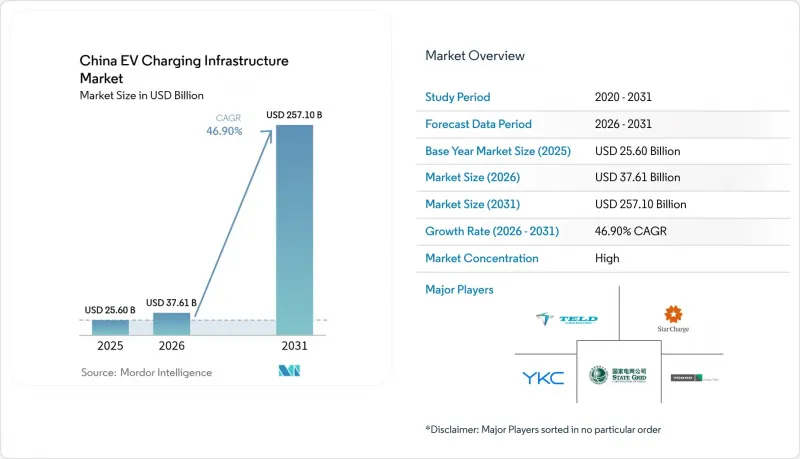
根據 Mordor Intelligence 預測,中國電動車充電基礎設施市場規模將從 2025 年的 256 億美元成長到 2026 年的 376.1 億美元,到 2031 年將達到 2,571 億美元,2026 年至 2031 年的複合年成長率為 46.9%。
本報告按充電站類型(交流充電站、直流充電站等)、輸出功率(小於7千瓦、7.1-22千瓦、其他)、安裝地點(住宅、職場等)、用戶應用(私人基礎設施、公共基礎設施等)、連接器標準、車輛類型和地區進行細分。市場預測以美元計價。
中國電動車充電基礎設施市場趨勢與洞察
積極的新能源汽車雙積分獎勵計劃正在加速對充電樁的需求。
中國的新能源汽車雙積分政策結合了燃油效率積分和新能源汽車產量配額,是推動充電基礎設施擴張的強大動力。該政策要求汽車製造商要么達到特定的新能源汽車產量目標,要么從其他製造商購買積分,從而為電動車的普及提供了結構性獎勵。到2024年,該政策要求新能源汽車產量至少佔汽車製造商總產量的28%,預計2030年將提高到40%(混合動力汽車技術規劃)。這個法規結構正在推動對充電基礎設施的需求,尤其是在電動車普及率最高的都市區。該政策的影響不僅限於乘用車,還延伸至商用車領域,要求公共運輸和物流公司達到電氣化目標。這種綜合性的方法正在建構一個強大的充電基礎設施發展生態系統,政府的目標是到2025年實現2:1的車輛與充電站比例,到2030年實現1:1。
以「新基礎設施」為核心的超快速充電站的獎勵策略和補貼
中國政府將電動車充電基礎設施納入「新基建」舉措,並獲得了大量資金和政策支持。這項戰略定位,連同5G網路和資料中心,將充電基礎設施提升為國家優先發展項目,吸引了來自公共和私營部門的投資。 2024年,中國新增電動車充電樁422.2萬個,比2023年增加25%。其中,公共充電樁83萬個,私人充電樁336.8萬個。目前,重點已轉向超快速充電站,並為功率超過150kW的高功率設備提供專案補助。這些充電站策略性地分佈在高速公路沿線和城市中心,以緩解續航里程問題,並提升充電便利性。政府的財政支持包括直接補貼、稅收優惠和優先土地分配,為基礎設施擴建創造了有利環境。這項措施在加速低度開發地區充電基礎設施的部署方面尤其有效,並有助於縮小都市區地區在充電便利性方面的差距。
都市區配電網路中變壓器的限制導致核准流程延誤。
成熟城市中心的高功率充電站正接近區域變壓器容量的極限,導致核准時間延長和併網成本增加。儘管電力公司正在升級基礎設施,但建設進度跟不上充電樁的需求,尤其是在老舊城市輸電網路中。營運商正透過部署現場儲能系統來平衡尖峰負載,但這種混合系統增加了資本密集度,擠壓了短期盈利,暫時減緩了中國電動車充電基礎設施市場的成長。
細分市場分析
至2025年,交流充電器仍將佔據中國電動車充電基礎設施市場57.21%的佔有率。這反映了其在住宅和職場車庫部署的成本效益。同時,功率超過150千瓦的高功率直流充電站實現了26.41%的複合年成長率,並在政府支持的高速公路和城市中心發揮核心作用。政府對超快充電樁的補貼以及比亞迪部署的1000千瓦系統,都凸顯了實現充電時間與加油時間相當的趨勢。路邊無線充電板目前仍是小眾市場,但由於其「免持」的便利性,其在計程車候車區和公車站等場所的實用性正逐漸得到認可,從而抵消了投資成本。隨著汽車製造商整合各自的直流充電網路,競爭日益激烈,迫使電力公司和獨立營運商升級其現有的交流電充電基礎設施。
直流充電的蓬勃發展也正在改變收入結構。營運商可以透過提高單價和提供車輛預熱、電池狀態檢查、現場零售等附加價值服務來增加每次充電的收入。整合到新一代直流設備中的併網逆變器正在支援V2G(車輛到電網)試點項目,從而產生輔助收入並提高這些項目的資金籌措潛力。隨著市場需求向高功率充電模式轉變,交流充電設備將轉向低功率充電模式,而直流充電站將在中國電動車充電基礎設施市場中發揮主導作用。
至2025年,二級充電樁(7.1-22千瓦)將佔中國電動車充電基礎設施市場43.67%的佔有率,主要提供夜間家用充電和職場補電服務。成長重心正轉向350千瓦以上的充電樁,其複合年成長率將達到37.21%,主要得益於電動卡車和城際公車對快速充電的需求。溫度控管技術的突破使得液冷電纜和電力電子設備能夠安全地輸送兆瓦級功率,而緩衝電池則可以抵消電網的尖峰負載。 151-350千瓦等級的充電樁正在都市區快速充電站中廣泛應用,為搭乘用電動車提供了成本和充電速度的平衡。
兆瓦級充電設施,通常與太陽能座艙罩和現場儲能系統結合,正在將物流樞紐轉變為綜合能源中心。在國家電網的高速公路樞紐,700千瓦的連接器已針對長途貨運進行了測試,驗證了其在電網側的可行性。隨著標準的成熟,重型運輸業預計將重新定義容量規劃,並開啟新的資本投資週期,而高功率充電設施將成為中國電動車充電基礎設施市場的核心成長動力。
其他好處:
- Excel格式的市場預測(ME)表
- 3個月的分析師支持
目錄
第1章:引言
- 研究假設和市場定義
- 調查範圍
第2章:調查方法
第3章執行摘要
第4章 市場狀況
- 市場概覽
- 市場促進因素
- 針對新能源汽車(NEV)的強制性雙積分制正在加速對充電站的需求。
- 中央政府針對「新基礎設施」的獎勵策略以及對超高速鐵路樞紐的補貼
- 叫車和物流行業電動汽車車隊的快速成長,使得站點需要快速充電。
- 配備可更換電池的電動車正在推動混合動力電池更換和充電站的普及。
- 電網邊緣數位化和V2G試點計畫正在加速智慧充電器的普及。
- 綠色走廊,優先發展高速公路超快速充電樁的州。
- 市場限制因素
- 由於都市區配電網路變壓器受到限制,許可證的辦理被推遲了。
- 公共充電站利用率低(少於 10%),給服務提供者的利潤率帶來了壓力。
- 由於防火和土地使用法規的要求,對高功率場所設備的投資正在增加。
- 儘管存在國家級平台,但電子漫遊和支付標準仍然分散。
- 價值供應鏈分析
- 監理展望
- 技術展望
- 波特五力模型
第5章 市場規模與成長預測
- 按充電站類型
- 交流充電站
- 直流充電站
- 無線/感應式觸控板
- 依輸出類型
- 小於 7 千瓦(低速交流電)
- 7.1–22 千瓦(2 級)
- 23~50 kW(Rapid DC)
- 51-150千瓦(高速)
- 151至350千瓦(超高速)
- 350千瓦或以上(兆瓦/大型)
- 按安裝位置
- 住宅(家庭用途)
- 職場
- 城市公共設施(零售商店和停車場)
- 高速公路/城際走廊
- 車輛維修基地和物流中心
- 巴士和貨車終點站
- 透過用戶應用程式
- 私人基礎設施
- 公共基礎設施
- 車隊/商業
- 依連接器標準
- GB/T AC
- GB/T DC
- CCS2(導入)
- CHAdeMO
- 特斯拉 NACS(適配器)
- 車輛類型
- 搭乘用車
- 輕型商用車(LCV)
- 大型卡車和巴士
- 電動二輪車和三輪車
- 按地區(中國)
- 華北
- 中國東部
- 中國中南部
- 中國東北
- 中國西南地區
- 中國西北地區
- 香港和澳門
第6章 競爭情勢
- 市場集中度
- 策略趨勢
- 市佔率分析
- 公司簡介
- State Grid Corporation of China
- TELD
- StarCharge(Wanbang Digital Energy Co. Ltd.)
- Southern Power Grid EV Service
- TGood
- Potevio New Energy
- YKC
- EV Power(EV P)
- ShenZhen CarEnergy Net
- Hooenergy
- Wancheng Wanchong
- Winlands
- XCharge
- NIO Power
- SAIC Anyo Charging
- BAIC Blue Park Charging
- Shell Recharge China
- BP Pulse China
- Tesla Supercharger China
- Xpeng Pengyun Charging
第7章 市場機會與未來展望
According to Mordor Intelligence, the China's EV charging infrastructure market size market is expected to grow from USD 25.60 billion in 2025 to USD 37.61 billion in 2026 and is forecast to reach USD 257.1 billion by 2031 at 46.9% CAGR over 2026-2031.
This report is Segmented by Charging Station Type (AC Charging Station, DC Charging Station, and More), Power Output (Less Than 7 KW, 7. 1 To 22 KW, and More), Installation Site (Residential, Workplace, and More), User Application (Private Infrastructure, Public Infrastructure, and More), Connector Standard, Vehicle Type and Geography. The Market Forecasts are Provided in Terms of Value (USD).
China EV Charging Infrastructure Market Trends and Insights
Aggressive NEV Dual-Credit Mandate Accelerating Charger Demand
China's NEV dual-credit policy, which combines fuel consumption credits with NEV production quotas, has become a powerful driver for charging infrastructure expansion. The policy requires automakers to achieve specific NEV production targets or purchase credits from other manufacturers, creating a structural incentive for EV adoption. As of 2024, the policy mandates that NEVs represent at least 28% of an automaker's production, with this percentage set to increase to 40% by 2030 HEV TCP. This regulatory framework has catalyzed demand for charging infrastructure, particularly in urban centers where EV adoption is highest. The mandate's impact extends beyond passenger vehicles to commercial fleets, with requirements for public transportation and logistics companies to achieve electrification targets. This comprehensive approach has created a robust ecosystem for charging infrastructure development, with the government aiming to establish a vehicle-to-charging station ratio of 2:1 by 2025 and 1:1 by 2030.
Central "New Infrastructure" Stimulus and Subsidies for Ultra-Fast Hubs
The Chinese government's designation of EV charging infrastructure as part of the "New Infrastructure" initiative has unlocked significant funding and policy support. This strategic categorization, alongside 5G networks and data centers, has elevated charging infrastructure to a national priority, attracting both public and private investments. In 2024, China added 4.222 million EV charging points, a 25% increase from 2023, with 830,000 public and 3.368 million private point. The focus has shifted toward ultra-fast charging hubs, with subsidies specifically targeting high-power installations above 150 kW. These hubs are strategically positioned along highways and in urban centers to address range anxiety and improve charging convenience. The government's financial support includes direct subsidies, tax incentives, and preferential land allocation, creating a favorable environment for infrastructure expansion. This approach has been particularly effective in accelerating the deployment of charging infrastructure in less developed regions, helping to address the urban-rural disparity in charging access.
Urban Distribution-Grid Transformer Constraints Delaying Permits
High-power hubs in mature city cores are hitting the ceiling of local transformer capacity, extending permitting cycles and inflating grid-connection costs. Utilities are upgrading hardware, yet construction timelines lag charger demand, especially in legacy downtown grids. Operators are countering with on-site battery storage to shave peaks, but such hybrid systems raise capital intensity and challenge near-term returns, temporarily tempering expansion of the China EV charging infrastructure market.
Other drivers and restraints analyzed in the detailed report include:
- Ride-Hailing and Logistics EV-Fleet Boom Requiring Depot Fast-Charging
- Grid-Edge Digitalization and V2G Pilots Promoting Smart Charger Roll-outs
- Low Public-Charger Utilization Squeezing Operator Margins
For complete list of drivers and restraints, kindly check the Table Of Contents.
Segment Analysis
AC chargers retained a 57.21% share of the China EV charging infrastructure market in 2025, reflecting cost-efficient deployment in residential and workplace garages. However, high-power DC stations above 150 kW posted a 26.41% CAGR and now anchor state-backed highway corridors and urban hubs. Government subsidies for ultra-fast terminals and BYD's introduction of 1,000 kW systems underscore the momentum toward refueling-like charge times. Wireless curbside pads remain niche yet are viable for taxi queues and bus layovers where zero-touch convenience offsets capex. Competitive intensity is rising as automakers integrate proprietary DC networks, challenging utilities and independent operators to upgrade existing AC footprints.
DC momentum is also reshaping revenue mixes. Higher tariffs and value-added services, such as vehicle preconditioning, battery health checks, and onsite retail, enable operators to lift yield per session. Grid-interactive inverters in next-generation DC gear support V2G pilots, creating ancillary income and boosting project bankability. As demand consolidates around high-power formats, AC installations will shift toward slow-charge settings, while DC stations define the public face of the China EV charging infrastructure market.
Level 2 units (7.1 to 22 kW) represented 43.67% of the China EV charging infrastructure market size in 2025, providing overnight home charging and workplace top-ups. Growth pivots to the more than 350 kW class, expanding at 37.21% CAGR as electric trucks and intercity coaches require swift turnaround. Thermal-management breakthroughs allow liquid-cooled cables and power electronics to safely deliver megawatt levels, while buffer batteries offset grid peaks. The 151-350 kW tier is scaling inside urban fast-charge plazas, balancing cost and speed for passenger EVs.
Megawatt charging co-locates with solar canopies and onsite storage, turning logistics depots into integrated energy hubs. State Grid's expressway sites have tested 700 kW connectors for long-haul freight, confirming grid-side feasibility. Heavy-duty transport could redefine capacity planning as standards mature and create another capex cycle, cementing high-output formats as a core growth axis for the China EV charging infrastructure market.
Complete Report Scope:
- By Charging Station Type
- AC Charging Station
- DC Charging Station
- Wireless/Inductive Pad
- By Power Output
- Less Than 7 kW (Slow AC)
- 7.1 to 22 kW (Level 2)
- 23 to 50 kW (Rapid DC)
- 51 to 150 kW (Fast)
- 151 to 350 kW (Ultra-fast)
- More than 350 kW (Megawatt/Heavy-Duty)
- By Installation Site
- Residential (Home)
- Workplace
- Public Urban (Retail and Parking)
- Highway/Inter-city Corridor
- Fleet Depot and Logistics Hub
- Bus and Truck Terminal
- By User Application
- Private Infrastructure
- Public Infrastructure
- Fleet/Commercial
- By Connector Standard
- GB/T AC
- GB/T DC
- CCS2 (Imports)
- CHAdeMO
- Tesla NACS (Adapter)
- By Vehicle Type
- Passenger Vehicles
- Commercial Light-duty (LCVs)
- Heavy-duty Truck and Bus
- Electric Two- and Three-wheelers
- By Geography (China)
- North China
- East China
- South-Central China
- Northeast China
- Southwest China
- Northwest China
- Hong Kong and Macau
List of Companies Covered in this Report:
- State Grid Corporation of China
- TELD
- StarCharge (Wanbang Digital Energy Co. Ltd.)
- Southern Power Grid EV Service
- TGood
- Potevio New Energy
- YKC
- EV Power (EV P)
- ShenZhen CarEnergy Net
- Hooenergy
- Wancheng Wanchong
- Winlands
- XCharge
- NIO Power
- SAIC Anyo Charging
- BAIC Blue Park Charging
- Shell Recharge China
- BP Pulse China
- Tesla Supercharger China
- Xpeng Pengyun Charging
Additional Benefits:
- The market estimate (ME) sheet in Excel format
- 3 months of analyst support
TABLE OF CONTENTS
1 Introduction
- 1.1 Study Assumptions and Market Definition
- 1.2 Scope of the Study
2 Research Methodology
3 Executive Summary
4 Market Landscape
- 4.1 Market Overview
- 4.2 Market Drivers
- 4.2.1 Aggressive NEV Dual-Credit Mandate Accelerating Charger Demand
- 4.2.2 Central "New Infrastructure" Stimulus and Subsidies for Ultra-Fast Hubs
- 4.2.3 Ride-Hailing and Logistics EV-Fleet Boom Requiring Depot Fast-Charging
- 4.2.4 Battery-Swap Compatible EV Models Driving Hybrid Swap-Charge Stations
- 4.2.5 Grid-Edge Digitalization and V2G Pilots Promoting Smart Charger Roll-Outs
- 4.2.6 Provincial Green Corridors Prioritizing Highway Ultra-Fast Charger Buildouts
- 4.3 Market Restraints
- 4.3.1 Urban Distribution-Grid Transformer Constraints Delaying Permits
- 4.3.2 Low Public-Charger Utilization (Less Than 10%) Squeezing Operator Margins
- 4.3.3 Fire-Safety and Land-Use Rules Inflating CapEx for High-Power Sites
- 4.3.4 Fragmented E-Roaming and Payment Standards Despite National Platform
- 4.4 Value / Supply-Chain Analysis
- 4.5 Regulatory Outlook
- 4.6 Technological Outlook
- 4.7 Porter's Five Forces
- 4.7.1 Bargaining Power of Suppliers
- 4.7.2 Bargaining Power of Buyers
- 4.7.3 Threat of New Entrants
- 4.7.4 Threat of Substitutes
- 4.7.5 Intensity of Competitive Rivalry
5 Market Size and Growth Forecasts (Value, USD)
- 5.1 By Charging Station Type
- 5.1.1 AC Charging Station
- 5.1.2 DC Charging Station
- 5.1.3 Wireless/Inductive Pad
- 5.2 By Power Output
- 5.2.1 Less Than 7 kW (Slow AC)
- 5.2.2 7.1 to 22 kW (Level 2)
- 5.2.3 23 to 50 kW (Rapid DC)
- 5.2.4 51 to 150 kW (Fast)
- 5.2.5 151 to 350 kW (Ultra-fast)
- 5.2.6 More than 350 kW (Megawatt/Heavy-Duty)
- 5.3 By Installation Site
- 5.3.1 Residential (Home)
- 5.3.2 Workplace
- 5.3.3 Public Urban (Retail and Parking)
- 5.3.4 Highway/Inter-city Corridor
- 5.3.5 Fleet Depot and Logistics Hub
- 5.3.6 Bus and Truck Terminal
- 5.4 By User Application
- 5.4.1 Private Infrastructure
- 5.4.2 Public Infrastructure
- 5.4.3 Fleet/Commercial
- 5.5 By Connector Standard
- 5.5.1 GB/T AC
- 5.5.2 GB/T DC
- 5.5.3 CCS2 (Imports)
- 5.5.4 CHAdeMO
- 5.5.5 Tesla NACS (Adapter)
- 5.6 By Vehicle Type
- 5.6.1 Passenger Vehicles
- 5.6.2 Commercial Light-duty (LCVs)
- 5.6.3 Heavy-duty Truck and Bus
- 5.6.4 Electric Two- and Three-wheelers
- 5.7 By Geography (China)
- 5.7.1 North China
- 5.7.2 East China
- 5.7.3 South-Central China
- 5.7.4 Northeast China
- 5.7.5 Southwest China
- 5.7.6 Northwest China
- 5.7.7 Hong Kong and Macau
6 Competitive Landscape
- 6.1 Market Concentration
- 6.2 Strategic Moves
- 6.3 Market Share Analysis
- 6.4 Company Profiles (Includes Global Level Overview, Market Level Overview, Core Segments, Financials as Available, Strategic Information, Market Rank/Share for Key Companies, Products and Services, SWOT Analysis, and Recent Developments)
- 6.4.1 State Grid Corporation of China
- 6.4.2 TELD
- 6.4.3 StarCharge (Wanbang Digital Energy Co. Ltd.)
- 6.4.4 Southern Power Grid EV Service
- 6.4.5 TGood
- 6.4.6 Potevio New Energy
- 6.4.7 YKC
- 6.4.8 EV Power (EV P)
- 6.4.9 ShenZhen CarEnergy Net
- 6.4.10 Hooenergy
- 6.4.11 Wancheng Wanchong
- 6.4.12 Winlands
- 6.4.13 XCharge
- 6.4.14 NIO Power
- 6.4.15 SAIC Anyo Charging
- 6.4.16 BAIC Blue Park Charging
- 6.4.17 Shell Recharge China
- 6.4.18 BP Pulse China
- 6.4.19 Tesla Supercharger China
- 6.4.20 Xpeng Pengyun Charging
7 Market Opportunities and Future Outlook
- 7.1 White-space and Unmet-Need Assessment

 充電站監控系統市場:全球市場預測,2026-2032年
 電動車充電基礎設施市場:按連接器類型、車輛類型、充電器類型、充電位置、輸出功率、組件和地區分類-全球產業分析、市場規模、市場佔有率和預測(2026-2033年)
 電動車充電基礎設施市場預測至2034年-全球分析(按充電技術、充電等級、輸出功率、連接器類型、安裝配置、車輛類型、最終用戶和地區分類)
 2026年全球電動車充電基礎設施:成長軌跡與新機會全球電動車充電基礎設施金屬市場:規模、佔有率、趨勢和成長分析報告(2026-2034)
 德國電動車充電基礎設施:市場佔有率分析、產業趨勢和統計數據以及成長預測(2026-2031 年)電動車充電基礎設施市場:規模、佔有率、成長、全球產業分析、區域趨勢及2026年至2034年預測
 全球電動車充電基礎設施(EVCI)硬體市場:市場分析歐洲電動車充電基礎設施(EVCI)市場分析(按地區分類)電動車充電基礎設施(EVCI)區域市場分析:北美