


 |
市場調查報告書
商品編碼
2119801
印度汽車貸款:市場佔有率分析、產業趨勢與統計及成長預測(2026-2031)India Auto Loan - Market Share Analysis, Industry Trends & Statistics, Growth Forecasts (2026 - 2031) |
||||||

※ 本網頁內容可能與最新版本有所差異。詳細情況請與我們聯繫。
據 Mordor Intelligence 稱,2025 年印度汽車貸款市值為 434.5 億美元,預計到 2031 年將達到 638.2 億美元,而 2026 年為 463.3 億美元,預測期(2026-2031 年)複合年成長率為 6.62%。
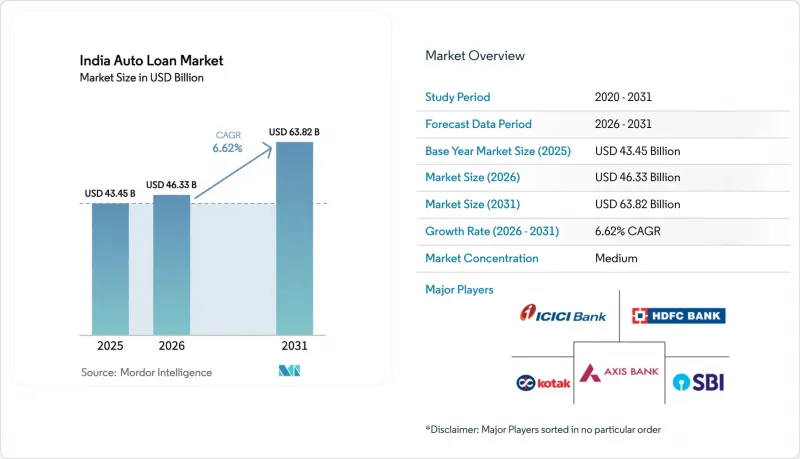
本報告按貸款機構類型(非專屬銀行、非銀行金融公司、OEM專屬金融部門等)、車輛類型(乘用車、商用車)、所有權類型(新車、二手車)、銷售管道(經銷商銷售網點、線上直接融資等)和地區(印度)進行細分。市場預測以美元計價。
印度汽車貸款市場的趨勢和洞察
汽車擁有需求的成長和GDP的成長
人均GDP的穩定成長提振了消費者信心,促使首次購車者從摩托車升級到入門級乘用車,或從乘用車升級到多用途車。道路網路的改善使個人出行更加便捷,推動了二、三線城市地區汽車貸款業務的快速成長。微企業利用融資來滿足電子商務發展帶來的「最後一公里」物流合約激增的需求,並轉向使用小型商用貨車。貸款機構則透過延長還款期限和逐步提高每月還款額(EMI)來應對,以使每月還款負擔與預期收入成長相匹配。這些趨勢使得印度汽車貸款市場的貸款發放保持強勁,即使在燃油價格波動的情況下也是如此。
印度儲備銀行的帳戶聚合器能夠利用替代數據進行信用評分。
這種基於用戶同意的模式使貸款機構能夠即時追蹤活期帳戶現金流量、共同基金定期定額投資計畫(SIP)和保險費。先前信用局數據不足的都市區信用記錄較弱的借款人,現在可以透過現金盈餘分析獲得貸款資格。採用此框架的銀行在信用評估的準確性方面實現了兩位數的提升,從而降低了臨時風險緩衝。在卡納塔克邦和馬哈拉斯特拉邦的早期試點表明,整合商品及服務稅(GST)申報數據能夠進一步提升中小企業的信用模型,尤其是在商用車貸款方面。預計該架構將提升印度汽車貸款市場的數據質量,並成為信用評估的基礎。
汽車價格上漲給購買力帶來了壓力。
2024年至2025年間,展示室價格上漲了15%至18%,遠超薪資中位數成長,而這主要受到供應鏈中斷和強制監管安全標準的限制。在某些邦,入門級掀背車的月供(EMI)超過1萬印度盧比(約120美元),令首次購車者望而卻步。為因應此問題,金融機構已將貸款期限延長至七年。然而,此舉導致總利息支出增加,殘值風險也隨之上升。此外,汽車共享服務的用戶推遲了購車計劃,導致新增需求下降,並阻礙了印度汽車貸款市場的短期成長。
細分市場分析
到2025年,非專屬式銀行仍將在印度汽車貸款市場佔據主導地位,市場佔有率高達51.72%,但隨著非銀行金融公司(NBFC)貸款發放量以7.34%的複合年成長率成長,預計市場格局將發生重組。汽車製造商(OEM)旗下的金融部門正利用其專業知識開發客製化方案,例如電池訂閱服務;同時,金融科技聚合平台正在建立數位化聯合貸款池。在三、四線城市,非銀行金融企業發展透過非正式的收入評估和靈活的還款計劃,將信貸覆蓋範圍擴大到傳統業務範圍之外。
印度汽車貸款市場受益於銀行與非銀行金融中心(NBFC)之間的共生關係。銀行提供低成本資金和監管可靠性,而NBFC則提供貸款能力和嚴格的借款人篩選。聯合貸款API可即時同步信用評估,從而減少操作摩擦。更精細的風險定價體系的出現,加上NBFC豐富的數據資源,使其擁有更低的資金籌措成本,從而提升了印度汽車貸款行業的整體競爭力。
到2025年,乘用車貸款將主導印度汽車貸款市場,佔71.55%的市場。然而,商用車貸款的成長速度更快,年複合成長率達7.69%。這一成長主要得益於電子商務帶來的配送需求增加以及全國高速公路網路的持續擴張。為了進行風險管理,商用車貸款機構正在利用遠端資訊處理系統監控車輛使用情況,確保還款與車輛使用量掛鉤。此策略有助於降低運費波動的影響,否則可能導致違約風險增加。
車隊電氣化正在為市場創造新的機會。用於都市區配送的輕型商用車(電動車)運行時間可預測,因此適合在夜間於充電站充電。這種可預測性降低了營運成本,從長遠來看,也降低了這些車輛的購置成本。貸款機構也正在試用電池狀態監控工具,以便更準確地預測潛在的違約風險。這些進步使得商用車貸款更具吸引力,其在印度汽車貸款市場的地位也日益穩固。
其他好處:
- Excel格式的市場預測(ME)表
- 3個月的分析師支持
目錄
第1章 目錄 - 印度汽車貸款市場
第2章:引言
- 研究假設和市場定義
- 調查範圍
第3章:調查方法
第4章執行摘要
第5章 市場狀況
- 市場概覽
- 市場促進因素
- 對汽車擁有量日益成長的需求和GDP成長
- 二手車貸款日益普及
- 數位借貸業務的擴張和電子身份驗證(e-KYC)的日益普及
- RBI帳戶聚合器能夠使用替代資料進行評分。
- 汽車製造商自有的電動車融資補助計劃
- 一種聯合融資模式,可以實現三級和四級商品的分銷。
- 市場限制因素
- 汽車價格上漲導致購車成本增加。
- 對非銀行金融機構(NBFC)資產品質的擔憂
- 缺乏可靠的電動車電池殘值數據
- 預計銀行將收緊對非銀行金融機構(NBFC)的風險敞口權重。
- 價值供應鏈分析
- 監理情勢
- 技術展望
- 波特五力模型
第6章 市場規模與成長預測
- 按貸款提供者類型
- 非專屬銀行
- 非銀行金融公司(NBFC)
- OEM旗下的財務部門
- 其他提供者(聯合融資和金融科技平台)
- 按車輛類型
- 搭乘用車
- 商用車輛
- 依所有權類型
- 新車
- 二手車
- 透過分銷管道
- 在零售商的銷售點
- 線上直接貸款
- 仲介業者與市場
第7章 競爭情勢
- 市場集中度
- 策略趨勢
- 市佔率分析
- 公司簡介
- State Bank of India
- HDFC Bank
- ICICI Bank
- Axis Bank
- Kotak Mahindra Bank
- Shriram Finance
- Mahindra & Mahindra Financial Services
- Bajaj Finance
- Cholamandalam Investments & Finance
- Tata Motors Finance
- Hyundai Motor India Captive Finance
- Maruti Suzuki Smart Finance
- Toyota Financial Services India
- Volkswagen Financial Services India
- Sundaram Finance
- Hero FinCorp
- Muthoot Capital Services
- L&T Finance
- RevFin Services
- Rupyy(CarDekho)
- Paytm Loans(Clix Capital partnership)
- KreditBee Auto
第8章 市場機會與未來展望
- 評估閒置頻段和未滿足的需求
According to Mordor Intelligence, the India auto loan market size was valued at USD 43.45 billion in 2025 and estimated to grow from USD 46.33 billion in 2026 to reach USD 63.82 billion by 2031, at a CAGR of 6.62% during the forecast period (2026-2031).
This report is Segmented by Loan Provider Type (Non-Captive Banks, Non-Banking Financial Companies, OEM-Captive Finance Arms, and More), Vehicle Type (Passenger Vehicles, Commercial Vehicles), Ownership (New Vehicles, Used Vehicles), Distribution Channel (Dealership Point-Of-Sale, Online Direct Lending, and More), and Geography (India). The Market Forecasts are Provided in Terms of Value (USD).
India Auto Loan Market Trends and Insights
Rising Vehicle-Ownership Aspirations & GDP Growth
A steady elevation in per-capita GDP fortifies consumer confidence, encouraging first-time buyers to migrate from two-wheelers to entry-segment cars or from cars to utility vehicles. Tier-2 and tier-3 agglomerations post the fastest credit off-take as road-network upgrades make private mobility more practical. Micro-enterprise owners also pivot toward small commercial vans, harnessing credit for last-mile logistics contracts that mushroom amid e-commerce penetration. Lenders respond with longer tenors and step-up EMIs, enabling alignment between monthly obligations and anticipated income growth. These trends ensure resilient origination volumes within the India auto loan market even during fuel-price volatility.
RBI Account-Aggregator Enabling Alternative Data Scoring
The consent-based model gives lenders real-time visibility into current-account cash flows, mutual-fund SIPs, and insurance premiums. Thin-file borrowers in semi-urban areas who lacked bureau depth now qualify through cash-surplus analytics. Banks deploying the framework observe double-digit improvements in underwriting accuracy, translating to lower provisional buffers. Early adoption in Karnataka and Maharashtra demonstrates that integrating GST-return feeds further enriches SME credit models, particularly for commercial-vehicle loans. The architecture is poised to become the default underwriting backbone, elevating data granularity across the India auto loan market.
Rising Vehicle Prices Pressuring Affordability
Between 2024 and 2025, ex-showroom prices rose by 15-18%, driven by supply-chain disruptions and regulatory safety mandates, significantly outpacing median wage growth. In several states, monthly EMIs for entry-level hatchbacks have crossed INR 10,000 (USD 120), discouraging first-time buyers. Lenders are extending loan tenors to seven years as a countermeasure. However, this approach results in a higher total interest payout and amplifies residual-value risk. Additionally, users of shared mobility are postponing their purchases, leading to a decline in incremental demand and hindering the short-term growth of India's auto loan market.
Other drivers and restraints analyzed in the detailed report include:
- Captive EV-Finance Subsidy Programs by OEMs
- Co-lending Model Unlocking Tier-3/4 Distribution
- Asset-Quality Concerns Among NBFCs
For complete list of drivers and restraints, kindly check the Table Of Contents.
Segment Analysis
Non-captive banks retained dominance with a 51.72% India auto loan market share in 2025, yet NBFC disbursements are compounding at a 7.34% CAGR, signaling a redistribution of power. OEM-captive finance arms exploit manufacturer insights to innovate bespoke schemes such as battery subscriptions, while fintech aggregators orchestrate digital co-lending pools. NBFC outreach in tier-3/4 locations capitalizes on informal income assessment and flexible repayment calendars, extending credit inclusion beyond traditional footprints.
The India auto loan market benefits from symbiotic bank-NBFC ties: banks supply low-cost capital and regulatory credibility, whereas NBFCs deliver origination throughput and nuanced borrower vetting. Co-lending APIs synchronize underwriting in real time, lowering operational friction. A more granular risk-pricing regime emerges, rewarding data-rich NBFCs with superior cost-of-funds and elevating competitive benchmarks across the India auto loan industry.
In 2025, passenger cars dominated the Indian auto loan market, holding a significant 71.55% share. However, commercial vehicle (CV) loans are growing at a faster rate, with a 7.69% CAGR. This growth is driven by the increasing demand for e-commerce deliveries and the ongoing expansion of highways across the country. To manage risks, CV lenders are using telematics systems to monitor vehicle usage and ensure repayments are tied to how the vehicles are utilized. This strategy helps reduce the impact of fluctuating freight rates, which can otherwise lead to higher default risks.
Electrification of vehicle fleets is opening up new opportunities in the market. Light commercial electric vehicles (EVs) used for urban deliveries follow predictable schedules, making them suitable for overnight charging at depots. This predictability lowers operating costs and makes these vehicles more affordable in the long run. Lenders are also testing tools to monitor battery health, which helps them better predict potential defaults. These advancements are making CV loans more attractive and strengthening their position in the Indian auto loan market over time.
Complete Report Scope:
- By Loan Provider Type
- Non-Captive Banks
- Non-Banking Financial Companies (NBFCs)
- OEM-Captive Finance Arms
- Other Providers (Co-lending & FinTech Platforms)
- By Vehicle Type
- Passenger Vehicles
- Commercial Vehicles
- By Ownership
- New Vehicles
- Used Vehicles
- By Distribution Channel
- Dealership Point-of-Sale
- Online Direct Lending
- Brokers & Marketplaces
List of Companies Covered in this Report:
- State Bank of India
- HDFC Bank
- ICICI Bank
- Axis Bank
- Kotak Mahindra Bank
- Shriram Finance
- Mahindra & Mahindra Financial Services
- Bajaj Finance
- Cholamandalam Investments & Finance
- Tata Motors Finance
- Hyundai Motor India Captive Finance
- Maruti Suzuki Smart Finance
- Toyota Financial Services India
- Volkswagen Financial Services India
- Sundaram Finance
- Hero FinCorp
- Muthoot Capital Services
- L&T Finance
- RevFin Services
- Rupyy (CarDekho)
- Paytm Loans (Clix Capital partnership)
- KreditBee Auto
Additional Benefits:
- The market estimate (ME) sheet in Excel format
- 3 months of analyst support
TABLE OF CONTENTS
1 Table of Contents - India Auto Loan Market
2 Introduction
- 2.1 Study Assumptions & Market Definition
- 2.2 Scope of the Study
3 Research Methodology
4 Executive Summary
5 Market Landscape
- 5.1 Market Overview
- 5.2 Market Drivers
- 5.2.1 Rising vehicle-ownership aspirations & GDP growth
- 5.2.2 Increasing penetration of used-car financing
- 5.2.3 Expanding digital lending & e-KYC adoption
- 5.2.4 RBI Account-Aggregator enabling alternative data scoring
- 5.2.5 Captive EV-finance subsidy programmes by OEMs
- 5.2.6 Co-lending model unlocking Tier-3/4 distribution
- 5.3 Market Restraints
- 5.3.1 Rising vehicle prices pressuring affordability
- 5.3.2 Asset-quality concerns among NBFCs
- 5.3.3 Scarcity of reliable EV-battery residual-value data
- 5.3.4 Possible tightening of bank risk-weights on NBFC exposure
- 5.4 Value / Supply-Chain Analysis
- 5.5 Regulatory Landscape
- 5.6 Technological Outlook
- 5.7 Porter's Five Forces
- 5.7.1 Threat of New Entrants
- 5.7.2 Bargaining Power of Suppliers
- 5.7.3 Bargaining Power of Buyers
- 5.7.4 Threat of Substitutes
- 5.7.5 Competitive Rivalry
6 Market Size & Growth Forecasts (Value)
- 6.1 By Loan Provider Type
- 6.1.1 Non-Captive Banks
- 6.1.2 Non-Banking Financial Companies (NBFCs)
- 6.1.3 OEM-Captive Finance Arms
- 6.1.4 Other Providers (Co-lending & FinTech Platforms)
- 6.2 By Vehicle Type
- 6.2.1 Passenger Vehicles
- 6.2.2 Commercial Vehicles
- 6.3 By Ownership
- 6.3.1 New Vehicles
- 6.3.2 Used Vehicles
- 6.4 By Distribution Channel
- 6.4.1 Dealership Point-of-Sale
- 6.4.2 Online Direct Lending
- 6.4.3 Brokers & Marketplaces
7 Competitive Landscape
- 7.1 Market Concentration
- 7.2 Strategic Moves
- 7.3 Market Share Analysis
- 7.4 Company Profiles (includes Global level Overview, Market level overview, Core Segments, Financials as available, Strategic Information, Market Rank/Share for key companies, Products & Services, and Recent Developments)
- 7.4.1 State Bank of India
- 7.4.2 HDFC Bank
- 7.4.3 ICICI Bank
- 7.4.4 Axis Bank
- 7.4.5 Kotak Mahindra Bank
- 7.4.6 Shriram Finance
- 7.4.7 Mahindra & Mahindra Financial Services
- 7.4.8 Bajaj Finance
- 7.4.9 Cholamandalam Investments & Finance
- 7.4.10 Tata Motors Finance
- 7.4.11 Hyundai Motor India Captive Finance
- 7.4.12 Maruti Suzuki Smart Finance
- 7.4.13 Toyota Financial Services India
- 7.4.14 Volkswagen Financial Services India
- 7.4.15 Sundaram Finance
- 7.4.16 Hero FinCorp
- 7.4.17 Muthoot Capital Services
- 7.4.18 L&T Finance
- 7.4.19 RevFin Services
- 7.4.20 Rupyy (CarDekho)
- 7.4.21 Paytm Loans (Clix Capital partnership)
- 7.4.22 KreditBee Auto
8 Market Opportunities & Future Outlook
- 8.1 White-space & Unmet-Need Assessment

 汽車貸款:市場佔有率分析、產業趨勢與統計、成長預測(2026-2031)
 全球汽車金融市場規模、佔有率、趨勢和成長分析報告(2026-2034)
 人工智慧交通號誌管理市場預測至2034年:按解決方案、組件、技術、部署模式、最終用戶和區域分類的全球分析
 汽車金融市場:2026-2032年全球市場預測(依資金籌措方式、客戶類型、車輛類型、車輛狀況、信用評級、合約期限、驅動方式及通路分類)
 汽車金融市場分析及至2035年的預測:類型、產品類型、服務、技術、組件、應用、流程、部署狀態、最終用戶
 汽車金融市場規模、佔有率和成長分析:按交易類型、資金提供來源、車輛類型、金融工具類型、用途和地區分類-2026-2033年產業預測人工智慧驅動的交通預測市場預測至2034年:全球分析(按組件、技術、部署模式、資料來源、應用、最終用戶和地區分類)
 汽車金融市場-全球產業規模、佔有率、趨勢、機會與預測:按車輛類型、供應商、地區和競爭對手分類,2021-2031年汽車金融市場預測至2034年-全球分析(按提供者、用途、融資方式、資金來源、服務、車輛類型和地區分類)汽車金融市場規模、佔有率、成長及全球產業分析:按類型、應用和地區分類的洞察,2026-2034 年預測