


 |
市場調查報告書
商品編碼
2119746
使用者生成內容平台:市場佔有率分析、產業趨勢與統計、成長預測(2026-2031)User-Generated Content Platform - Market Share Analysis, Industry Trends & Statistics, Growth Forecasts (2026 - 2031) |
||||||

※ 本網頁內容可能與最新版本有所差異。詳細情況請與我們聯繫。
根據 Mordor Intelligence 預測,用戶生成內容 (UGC) 平台的市場規模預計將從 2025 年的 98.5 億美元成長到 2026 年的 126.3 億美元,然後在 2031 年達到 439.2 億美元,2026 年至 2031 年的複合年成長率為 28.3%。
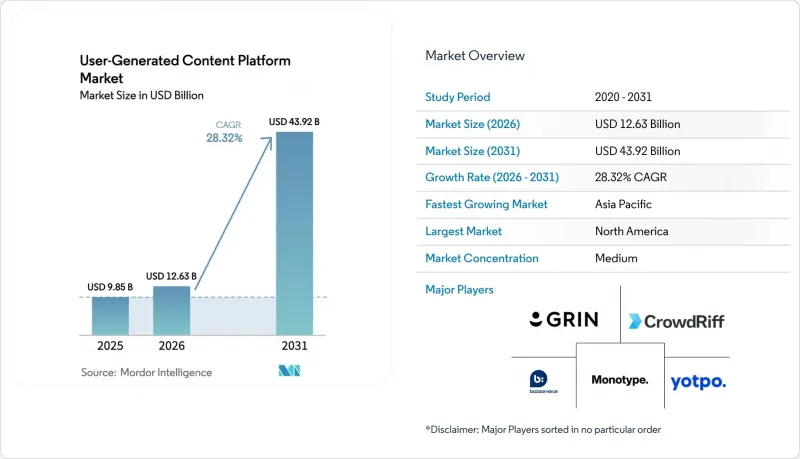
本報告按產品類型(部落格、社群媒體貼文、音訊/影片等)、最終用戶(個人、中小企業、大型企業)、部署模式(雲端、本地/私有雲端)、收入模式(廣告、訂閱/SaaS 等)和地區進行細分。市場預測以美元計價。
全球用戶生成內容(UGC)平台市場趨勢及洞察
網紅主導的商業模式正在加速發展。
將創作者網路與整合結帳功能相結合的品牌正在縮短購買流程,並實現可衡量的投資回報率提升。預計到2024年,網紅行銷平台的營收將達到210億美元,其中微型網紅的互動率比大型網紅高出60%。企業對可擴展地識別小眾創作者的需求正在推動對基於人工智慧的發現引擎的投資。可購買內容的整合平均減少了2.3個客戶接點,進一步凸顯了利用即時使用者生成內容(UGC)的策略必要性。美國聯邦貿易委員會(FTC)修訂後的建議指南有利於那些能夠自動披露合規資訊的平台,從而提高信任度並刺激整個用戶生成內容平台市場的成長。
短影片平台推動了用戶生成內容(UGC)的成長。
2024年下半年,所有平台每天處理的影片長度超過72萬小時。這一激增凸顯了智慧內容篩選系統的重要性,該系統能夠為品牌提取容易被淹沒在大量內容中的相關影片片段。針對行動裝置最佳化的垂直螢幕視訊格式如今的用戶參與度提高了40%,促使各大平台重新建構其建議演算法。 Meta於2024年9月推出的AI Studio進一步推動了對分析工具的需求,這些工具能夠提高創作者的效率,保持內容的獨特“真實性”,過濾掉虛假內容,並檢驗內容表現。這些因素共同作用,正在擴大用戶生成內容(UGC)平台市場的留存率和獲利機會。
品牌安全與內容審核成本
2024年,全產業的審核成本超過250億美元,超過一百萬名人工緩和劑與人工智慧過濾器協同工作。歐盟的《數位服務法案》(DSA)收緊了相關義務,強制要求進行高級分類和24小時內刪除,導致大型企業每年額外支出28億美元的遵循成本。雖然人工智慧工具可以將每次審核的成本降低35%,但人工審核對於評估微妙的內容情境仍然至關重要,尤其是在企業宣傳活動中,一條不當內容就可能導致合約失效。這些營運負擔正在拖累盈利,並減緩用戶生成內容(UGC)平台市場的短期成長。
細分市場分析
到2025年,社群媒體貼文將佔總收入的41.18%,凸顯其在品牌故事敘述中的重要角色。到2031年,直播將以30.12%的複合年成長率保持最高水平,反映出消費者對即時互動和打賞式獲利模式的需求。 2024年,以遊戲為中心的直播為創作者創造了42億美元的收入。隨著製作設備價格的下降,影片混合內容持續穩定成長。評分和評論仍然是衡量可信度的重要指標,尤其是在電商結帳頁面中嵌入這些指標時。部落格市場雖然已經成熟,但人工智慧驅動的多媒體插入功能正在為其重新註入活力。
雲端原生人工智慧標籤系統確保符合歐盟《數位服務法案》不斷演變的分類標準,從而減少人工操作。針對智慧型手機最佳化的垂直螢幕影片演算法可提升觀看時間和點擊率。隨著行動優先體驗的日益普及,提供跨格式整合服務的供應商正在贏得更多市場佔有率,從而推動用戶生成內容 (UGC) 平台市場的擴張。
大型企業預計在2025年將佔總收入的43.21%,並透過整合客戶關係管理(CRM)和行銷技術堆疊來衡量全通路投資報酬率(ROI)。同時,由於訂閱模式消除了初始投資門檻,中小企業預計到2031年將達到30.25%的複合年成長率(CAGR)。與品牌創建的素材相比,客戶生成的照片和影片將中小企業的參與度提升了45%,從而縮小了與大型競爭對手之間的業績差距。
大型企業買家需要強大的品牌安全儀錶板和用於歸因建模的 API 級資料傳輸。而中小企業則更注重快速部署、引導式工作流程和捆綁式版權管理。提供逐步配置的平台能夠滿足這兩類使用者的需求,從而擴大用戶生成內容 (UGC) 平台市場的潛在基本客群。
區域分析
北美用戶生成內容 (UGC) 平台市場保持著較高的用戶平均收入 (ARPU),這得益於以美元計價的品牌預算和企業級 SaaS 的廣泛應用。該地區嚴格的品牌安全要求推動了高級審核工具的開發,提高了小規模競爭對手的進入門檻。各州正在實施的隱私立法也帶來了類似的合規要求,平台營運商必須在不犧牲靈活性的前提下協調這些要求。
在亞太地區,內容數量和創作者數量的爆炸性成長催生了充滿活力的競爭環境。在地化的支付基礎設施和超級應用生態系統促進了直播中的微交易,推動了獲利模式的創新。韓國和印尼等國政府透過津貼數位技能培訓等扶持項目,擴大了對創作者和平台服務的需求。然而,為了遵守內容審查準則,我們需要一個彈性的分類引擎來規避內容刪除。
中東和非洲地區預計將實現最高的複合年成長率,這主要得益於智慧型手機價格的親民以及電信營運商對覆蓋範圍不斷擴大的社交平臺的零費率支援。波灣合作理事會成員國的電子商務發展正在整合可購買的用戶生成內容(UGC),以前所未有的速度加速從社交發現到購買的轉變。地方語言和方言為全球人工智慧過濾器帶來了挑戰,但也促進了區域夥伴關係關係的形成,從而提供情境化的訓練資料。這些多元化的區域趨勢共同作用,進一步增強了全球用戶生成內容(UGC)平台市場的多樣性。
其他好處:
- Excel格式的市場預測(ME)表
- 3個月的分析師支持
目錄
第1章:引言
- 研究假設和市場定義
- 調查範圍
第2章:調查方法
第3章執行摘要
第4章 市場狀況
- 市場概覽
- 市場促進因素
- 網紅主導的商業模式正在加速發展。
- 短影片平台正在推動用戶生成內容(UGC)貼文數量的成長。
- 大型零售商整合社交電商。
- 利用生成式人工智慧進行內容創作
- 憑證式的創作者變現模式
- 第一方資料在隱私權保護上的優勢
- 市場限制因素
- 與品牌安全和內容審核相關的成本。
- 加強對數據使用的監管
- 第三方 Cookie 的減少導致廣告收入下降。
- 人工智慧產生假資訊的風險
- 產業價值鏈分析
- 監理情勢
- 技術展望
- 波特五力分析
- 宏觀經濟因素的影響
第5章 市場規模與成長預測
- 依產品類型
- 部落格
- 社群媒體貼文
- 音訊和視訊
- 評分和評論
- 直播
- 最終用戶
- 個人
- 小型企業
- 大公司
- 部署模式
- 基於雲端的
- 本地部署/私有雲端
- 按收入模式
- 廣告收入
- 訂閱/SaaS
- 免費增值模式和交易模式
- 按地區
- 北美洲
- 南美洲
- 歐洲
- 亞太地區
- 中東和非洲
第6章 競爭情勢
- 市場集中度
- 策略趨勢
- 市佔率分析
- 公司簡介
- Bazaarvoice Inc.
- Yotpo Ltd.
- Pixlee TurnTo Corp.
- CrowdRiff Inc.
- Grin Technologies Inc.
- Upfluence SAS
- Taggbox Private Limited
- Stackla Pty Ltd(a Nosto company)
- Olapic Inc.
- TINT(Filestack Inc.)
- Social Native Inc.
- Khoros LLC
- Sprinklr Inc.
- Nosto Solutions Oy
- Adobe Inc.(UGC Framework)
- Hootsuite Inc.
- Later Media Inc.
- Dash Hudson Inc.
- Curalate, LLC
- Monotype Imaging Holdings Inc.
- Pancake Laboratories Inc.
第7章 市場機會與未來展望
According to Mordor Intelligence, the user-generated content platform market size is expected to grow from USD 9.85 billion in 2025 to USD 12.63 billion in 2026 and is forecast to reach USD 43.92 billion by 2031 at 28.32% CAGR over 2026-2031.
This report is Segmented by Product Type (Blogs, Social Media Posts, Audio and Video, and More), End-User (Individuals, Small and Medium Enterprises, and Large Enterprises), Deployment Mode (Cloud-Based, and On-premises/Private Cloud), Revenue Model (Advertising-Supported, Subscription/SaaS, and More), and Geography. The Market Forecasts are Provided in Terms of Value (USD).
Global User-Generated Content Platform Market Trends and Insights
Influencer-Driven Commerce Acceleration
Brands fusing creator networks with integrated checkout features are shortening purchase funnels and driving measurable ROI improvements. Influencer marketing platforms generated USD 21 billion in 2024 revenue, with micro-influencers producing 60% higher engagement than macro creators. Enterprise demand for scalable identification of niche creators is propelling investment in AI-based discovery engines. Shoppable content integrations are eliminating an average of 2.3 customer touchpoints, reinforcing the strategic imperative for real-time UGC activation. Updated FTC endorsement guidelines are encouraging platforms that automate disclosure compliance, boosting trust and reinforcing growth across the user-generated content platform market.
Short-Form Video Platforms Fueling UGC Volumes
Platforms processed more than 720,000 video hours daily in late 2024. This surge increases the need for intelligent curation systems that surface relevant clips for brands drowning in content abundance. Vertical-video formats optimized for mobile use now deliver 40% higher engagement, prompting platforms to redeploy recommendation algorithms. Meta's September 2024 AI studio rollout accelerated creator productivity and preserved hallmark authenticity, fueling additional demand for analytics that validate performance while filtering deceptive content. These forces collectively expand platform stickiness and monetization opportunities inside the user-generated content platform market.
Brand-Safety and Content-Moderation Costs
Industry-wide moderation spend surpassed USD 25 billion in 2024, with more than 1 million human moderators supplementing AI filters. The EU Digital Services Act heightened obligations, forcing sophisticated classification and 24-hour takedown windows that add USD 2.8 billion in annual compliance expenses for dominant firms. AI tools trim per-item costs by 35%, yet nuanced contextual evaluation still demands human oversight, especially for enterprise campaigns where a single unsafe placement can void contracts. These operating burdens temper profitability and slow near-term expansion in the user-generated content platform market.
Other drivers and restraints analyzed in the detailed report include:
- Social-Commerce Integrations by Major Retailers
- Generative-AI-Assisted Content Creatio
- Rising Regulatory Scrutiny on Data Use
For complete list of drivers and restraints, kindly check the Table Of Contents.
Segment Analysis
Social media posts contributed 41.18% of 2025 revenue, underscoring their entrenched role in brand storytelling. Live-streaming boasts the highest 30.12% CAGR through 2031, reflecting consumer appetite for real-time interaction and tipping-based monetization. Gaming-centric broadcasts produced USD 4.2 billion in creator revenue during 2024. Audio-video hybrids continue steady growth as production kits become affordable. Ratings and reviews remain foundational trust signals, especially when embedded in e-commerce checkouts. Blogs, while mature, are regaining momentum through AI-enhanced multimedia inserts.
Cloud-native AI tagging systems ensure compliance with evolving classification standards set by the EU's Digital Services Act, reducing manual workload. Vertical video algorithms optimized for smartphones are lifting dwell times and click-throughs. As these mobile-first experiences proliferate, providers capable of cross-format orchestration gain share, sustaining the user-generated content platform market expansion.
Large enterprises held 43.21% of 2025 revenue, leveraging integrations with CRM and martech stacks to measure full-funnel ROI. SMEs, however, post a 30.25% CAGR to 2031 as subscription tiers remove upfront investment hurdles. Authentic customer photos and videos drive 45% higher SME engagement than brand-authored assets, closing performance gaps with larger competitors.
Enterprise buyers demand robust brand-safety dashboards and API-level data transfers for attribution modeling. SMEs prioritize quick onboarding, guided workflows, and bundled rights management. Platforms offering tiered configurations appease both cohorts, broadening the user-generated content platform market addressable base.
Complete Report Scope:
- By Product Type
- Blogs
- Social Media Posts
- Audio and Video
- Ratings and Reviews
- Live-Streaming
- By End-user
- Individuals
- Small and Medium Enterprises
- Large Enterprises
- By Deployment Mode
- Cloud-based
- On-premise / Private Cloud
- By Revenue Model
- Advertising-supported
- Subscription / SaaS
- Freemium and Transaction-based
- By Geography
- North America
- South America
- Europe
- Asia-Pacific
- Middle East and Africa
Geography Analysis
North America's user-generated content platform market size benefited from USD-denominated brand budgets and broad enterprise SaaS penetration, sustaining higher average revenue per user. The region's stringent brand-safety demands foster advanced moderation tooling, elevating barrier-to-entry for smaller competitors. Ongoing state privacy bills create parallel compliance tracks that platforms must harmonize without sacrificing agility.
Asia-Pacific's explosive content volume and creator population underpin a vibrant competitive field. Localized payment rails and super-app ecosystems catalyze micro-transactions within live-streams, driving monetization innovation. Government support programs in South Korea and Indonesia subsidize digital-skills training, expanding the creator base and demand for platform services. However, content censorship guidelines require adaptable classification engines to avert takedowns.
The Middle East and Africa records the highest forecast CAGR, propelled by smartphone affordability and carrier-backed zero-rating of social platforms that amplify reach. E-commerce rollouts across Gulf Cooperation Council states integrate shoppable UGC feeds, translating social discovery into purchase at unprecedented speed. Local languages and dialects challenge global AI filters, incentivizing regional partnerships that supply contextual training data. Collectively, divergent regional dynamics reinforce the heterogeneity of the global user-generated content platform market.
- Bazaarvoice Inc.
- Yotpo Ltd.
- Pixlee TurnTo Corp.
- CrowdRiff Inc.
- Grin Technologies Inc.
- Upfluence SAS
- Taggbox Private Limited
- Stackla Pty Ltd (a Nosto company)
- Olapic Inc.
- TINT (Filestack Inc.)
- Social Native Inc.
- Khoros LLC
- Sprinklr Inc.
- Nosto Solutions Oy
- Adobe Inc. (UGC Framework)
- Hootsuite Inc.
- Later Media Inc.
- Dash Hudson Inc.
- Curalate, LLC
- Monotype Imaging Holdings Inc.
- Pancake Laboratories Inc.
Additional Benefits:
- The market estimate (ME) sheet in Excel format
- 3 months of analyst support
TABLE OF CONTENTS
1 INTRODUCTION
- 1.1 Study Assumptions and Market Definition
- 1.2 Scope of the Study
2 RESEARCH METHODOLOGY
3 EXECUTIVE SUMMARY
4 MARKET LANDSCAPE
- 4.1 Market Overview
- 4.2 Market Drivers
- 4.2.1 Influencer-driven commerce acceleration
- 4.2.2 Short-form video platforms fueling UGC volumes
- 4.2.3 Social-commerce integrations by major retailers
- 4.2.4 Generative-AI-assisted content creation
- 4.2.5 Web3 token-based creator monetisation models
- 4.2.6 Privacy-centric first-party data advantages
- 4.3 Market Restraints
- 4.3.1 Brand-safety and content-moderation costs
- 4.3.2 Rising regulatory scrutiny on data use
- 4.3.3 Decline of third-party cookies reducing ad yields
- 4.3.4 Generative-AI misinformation risks
- 4.4 Industry Value Chain Analysis
- 4.5 Regulatory Landscape
- 4.6 Technological Outlook
- 4.7 Porter's Five Forces Analysis
- 4.7.1 Bargaining Power of Buyers
- 4.7.2 Bargaining Power of Suppliers
- 4.7.3 Threat of New Entrants
- 4.7.4 Threat of Substitutes
- 4.7.5 Intensity of Competitive Rivalry
- 4.8 Impact of Macroeconomic Factors
5 MARKET SIZE AND GROWTH FORECASTS (VALUE)
- 5.1 By Product Type
- 5.1.1 Blogs
- 5.1.2 Social Media Posts
- 5.1.3 Audio and Video
- 5.1.4 Ratings and Reviews
- 5.1.5 Live-Streaming
- 5.2 By End-user
- 5.2.1 Individuals
- 5.2.2 Small and Medium Enterprises
- 5.2.3 Large Enterprises
- 5.3 By Deployment Mode
- 5.3.1 Cloud-based
- 5.3.2 On-premise / Private Cloud
- 5.4 By Revenue Model
- 5.4.1 Advertising-supported
- 5.4.2 Subscription / SaaS
- 5.4.3 Freemium and Transaction-based
- 5.5 By Geography
- 5.5.1 North America
- 5.5.2 South America
- 5.5.3 Europe
- 5.5.4 Asia-Pacific
- 5.5.5 Middle East and Africa
6 COMPETITIVE LANDSCAPE
- 6.1 Market Concentration
- 6.2 Strategic Moves
- 6.3 Market Share Analysis
- 6.4 Company Profiles (includes Global Overview, Market Overview, Core Segments, Financials, Strategic Information, Market Rank/Share, Products and Services, Recent Developments)
- 6.4.1 Bazaarvoice Inc.
- 6.4.2 Yotpo Ltd.
- 6.4.3 Pixlee TurnTo Corp.
- 6.4.4 CrowdRiff Inc.
- 6.4.5 Grin Technologies Inc.
- 6.4.6 Upfluence SAS
- 6.4.7 Taggbox Private Limited
- 6.4.8 Stackla Pty Ltd (a Nosto company)
- 6.4.9 Olapic Inc.
- 6.4.10 TINT (Filestack Inc.)
- 6.4.11 Social Native Inc.
- 6.4.12 Khoros LLC
- 6.4.13 Sprinklr Inc.
- 6.4.14 Nosto Solutions Oy
- 6.4.15 Adobe Inc. (UGC Framework)
- 6.4.16 Hootsuite Inc.
- 6.4.17 Later Media Inc.
- 6.4.18 Dash Hudson Inc.
- 6.4.19 Curalate, LLC
- 6.4.20 Monotype Imaging Holdings Inc.
- 6.4.21 Pancake Laboratories Inc.
7 MARKET OPPORTUNITIES AND FUTURE OUTLOOK
- 7.1 White-space and Unmet-Need Assessment

 全球用戶生成內容(UGC)平台市場規模、佔有率、趨勢和成長分析報告(2026-2034)
 使用者產生內容管理軟體:市場佔有率分析、產業趨勢與統計、成長預測(2026-2031)
 神經多樣性主導的心理健康內容平台市場預測至 2034 年:按內容類型、分發方式、經營模式、最終用戶和地區進行全球分析。
 用戶生成內容平台市場-全球產業規模、佔有率、趨勢、機會、預測:按產品類型、最終用戶、地區和競爭對手分類,2021-2031年
 2026年全球內容來源驗證與真實性聯盟(C2PA)內容來源驗證解決方案市場報告2026年全球用戶生成內容版權平台市場報告
 評論系統市場分析及預測(至2035年):按類型、產品類型、服務、技術、組件、應用、部署類型、最終用戶和功能分類全球社交計算市場規模、佔有率、趨勢和成長分析報告(2026-2034)使用者生成內容(UGC)平台市場規模、佔有率、成長及全球產業分析:依類型、應用和地區劃分的洞察與預測(2026–2034)
 韓國網路漫畫市場:2026年至2032年全球預測(按類型、裝置、平台、廣告形式和最終用戶分類)