


 |
市場調查報告書
商品編碼
2117590
使用者產生內容管理軟體:市場佔有率分析、產業趨勢與統計、成長預測(2026-2031)User Generated Content Management Software - Market Share Analysis, Industry Trends & Statistics, Growth Forecasts (2026 - 2031) |
||||||

※ 本網頁內容可能與最新版本有所差異。詳細情況請與我們聯繫。
根據 Mordor Intelligence 預測,用戶生成內容 (UGC) 管理軟體的市場規模預計將從 2025 年的 16.4 億美元和 2026 年的 18.6 億美元成長到 2031 年的 34.9 億美元,2026 年至 2031 年的年複合成長率(CAGR)率為 13.41%。
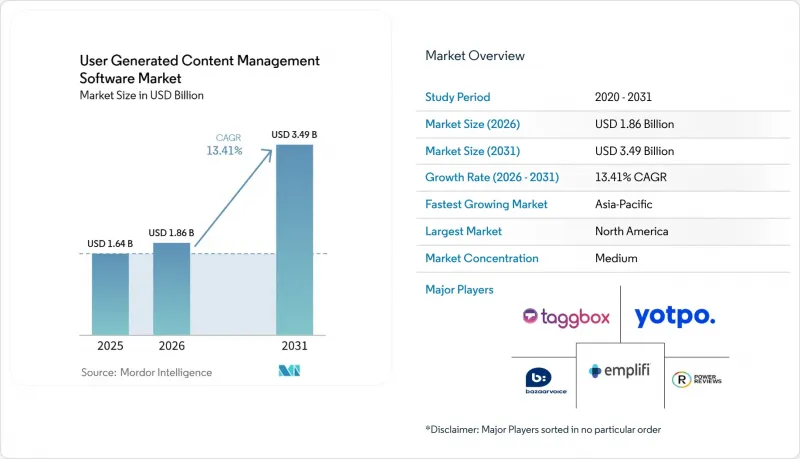
本報告按部署類型(雲端部署和本地部署)、應用程式領域(使用者生成內容收集/內容聚合、內容審核等)、公司規模(中小企業和大型企業)、最終用戶行業(零售/電子商務、媒體/娛樂等)以及地區進行細分。市場預測以美元計價。
全球用戶生成內容管理軟體市場趨勢及洞察
電子商務中評論數量的不斷增加以及對「社會認同」的日益依賴
客戶評論數量的成長速度已經超過了傳統團隊手動審核、分類和發佈內容的速度。這推動了對大規模內容管理工具的需求,並促進了使用者生成內容管理軟體市場的發展。一項2024年的研究表明,用戶生成內容透過提供網路購物時的直接用戶評論,降低了消費者的購買風險。隨著評論數量的成長,資訊的時效性、相關性和檢驗變得比單純展示大量評論更為重要。具備語意過濾功能的平台可以幫助消費者找到更符合其疑問、使用場景和購買意願的產品內容。根據Bazaarvoice的報告,到2026年,透過與Shopify合作,同時包含圖片和文字內容的產品頁面轉換率平均提高了17%。
引進人工智慧驅動的內容審核和元資料增強功能。
生成式人工智慧正在改變內容審核的經濟模式,它能幫助平台更快地對海量內容進行分類、標記和路由。因此,用戶生成內容管理軟體市場正朝著能夠在單一工作流程中處理文字、圖像、影片和音訊審核的工具方向發展。 TikTok 報告稱,其自動化系統在一個季度內刪除了超過 8,600 萬個虛假帳戶,這表明該平台在自動化檢測的支持下,其維護平台健康的工作規模已相當龐大。在 CVPR 2025 上發表的研究表明,基於舊基準訓練的檢測器可能難以處理新型的 AI 生成影片。這凸顯了能夠識別多種格式和不斷演變的內容模式的合成內容的審核系統的價值日益成長。 Sprinklr 於 2026 年 5 月收購了 ViralMoment,以增強其影片和多模態智慧能力。
內容真實性、同意和揭露方面的合規負擔。
對於中型品牌而言,用戶生成內容 (UGC) 項目的部署可能會受到許可、內容所有權和揭露要求等因素的限制。當品牌在廣告中重複使用顧客照片、使用者評價、參賽作品和創作者投稿時,使用者生成內容管理軟體市場將面臨更大的複雜性。美國聯邦貿易委員會 (FTC) 的指導意見要求,當代言人與品牌之間存在實質關係時,必須進行明確的揭露。核准、揭露和平台要求可能因內容格式而異。當宣傳活動涉及眾多創作者和多個市場時,人工版權審核可能非常耗時。此外,對於自動化系統無法可靠解讀的特殊情況,人工負責人仍然至關重要。
細分市場分析
到2025年,基於雲端的部署將佔用戶生成內容管理軟體市場收入的81.43%,成為該市場的主導部署方式。企業行銷和電商團隊更傾向於選擇基於雲端的部署,因為它能夠實現快速部署和產品自動更新。此外,基於使用量的收費模式比大規模基礎設施採購更適合宣傳活動週期。雲端系統還支援靈活的資源擴展,即使在評論、社交媒體活動和病毒式宣傳活動激增的情況下也能保持穩定。這種柔軟性使品牌即使在大量客戶內容同時湧入的情況下也能保持效能穩定。
預計到2031年,本地部署將以13.98%的複合年成長率成長。需求主要集中在監管嚴格的環境中,在這些環境中,使用公共雲端環境受到資料居住法規和內部安全控制的限制。金融服務機構、政府機構和教育機構可能需要對客戶內容記錄進行更嚴格的控制。採用混合解決方案可以在本地系統中保留敏感元資料,同時在託管雲端資源上運行人工智慧分析。 Sprout Social在其2025年年度報告中指出,其擁有3,803家年經常性收入超過3萬美元的客戶,這表明市場對透過雲端交付的高級社交和內容管理平台有著強勁的需求。
到2025年,用戶生成內容(UGC)分析和宣傳活動效果將佔應用程式收入的28.76%。這一主導地位反映了企業對能夠將消費者內容與轉換率、廣告支出回報率(ROAS)和客戶終身價值(CLV)關聯起來的系統的需求。分析功能可以幫助行銷團隊在預算審查期間展示商業性成果,並透過提供支持內容效果的證據來協助合約續約。使用者生成內容管理軟體市場正日益受到那些期望獲得可衡量結果(而不僅僅是互動指標)的買家的影響。
內容審核和品牌安全預計將以16.17%的複合年成長率成長至2031年。雖然內容收集和聚合仍然是一項基本功能,但隨著主流社交平臺不斷改進其專有收集工具,其重要性正在下降。社區管理對於維護客戶互動和處理客戶諮詢仍然至關重要。隨著品牌在付費管道上使用消費者內容並要求授權證明,版權管理的重要性日益凸顯。 2026年4月,Bazaarvoice推出了Authentic Discovery API,使其人工智慧搜尋和購物工具能夠存取企業聯合組織的評論內容。這項措施將版權管理內容、評論聯合發布和人工智慧發現整合到一個更加一體化的工作流程中。
區域分析
到2025年,北美將佔全球銷售額的36.29%,成為用戶生成內容管理軟體市場中最大的區域佔有率。該地區受益於數位原生品牌的高度集中以及成熟的軟體採購模式。美國憑藉其龐大的零售、媒體和消費品產業,仍是該地區的主要需求來源。加拿大則透過金融服務和電子商務的蓬勃發展,為市場需求做出了貢獻。在墨西哥,隨著創作者經濟和數位零售基礎設施的發展,中型企業對這類軟體的採用率也不斷提高。
預計到2031年,亞太地區將以14.32%的複合年成長率成長,成為成長最快的地區。以行動優先的商務模式、超級應用程式的使用以及內容創作者主導的銷售正在推動全部區域的普及。在中國,一種先進的模式已經建立,該模式利用評論、短影片和社群內容來支援應用程式內購買。韓國、印度、印尼和東南亞國家也正在採用類似的模式,並根據當地消費者的行為進行調整。在韓國,K-pop社群、內容出口以及支援頻繁影片製作的先進5G網路進一步推動了這一成長。
在歐洲,《數位服務法案》對內容審核、透明度和資訊揭露的要求正在產生重大影響。根據歐盟委員會統計,自法案實施以來,已有1.65億項審核決定受到質疑,其中30%的決定被推翻。英國、德國、法國和義大利正在投資建造支持舉報和版權管理的系統。南美洲的成長潛力主要來自巴西的社交電商活動以及阿根廷不斷擴大的創作者群體。中東和非洲仍是新興市場,沙烏地阿拉伯、阿拉伯聯合大公國和南非的旅遊、零售和消費品產業已出現早期需求。
其他好處:
- Excel格式的市場預測(ME)表
- 3個月的分析師支持
目錄
第1章:引言
- 研究假設和市場定義
- 調查範圍
第2章:調查方法
第3章執行摘要
第4章 市場狀況
- 市場概覽
- 市場促進因素
- 電子商務中評論數量的增加以及對社會認同的依賴
- 利用 GenAI 實現內容審核和元資料增強
- 拓展創作者與網紅電商的工作流程
- 提高所有自有管道和付費管道的品牌安全要求。
- 在隱私限制下,個人化需求催生了對零方資料收集的需求。
- 透過短影片和即時電商,用戶對多種格式的用戶生成內容(UGC)的需求日益成長。
- 市場限制因素
- 關於內容真實性、同意和披露的合規負擔
- 影片、音訊和多語言內容的審核成本很高。
- 將原生用戶生成內容 (UGC) 功能整合到大規模社交和電商平台中
- 檢測深度造假和合成媒體的挑戰
- 產業價值鏈分析
- 宏觀經濟因素對市場的影響
- 監理情勢
- 技術展望
- 波特五力分析
第5章 市場規模與成長預測
- 部署模式
- 基於雲端的
- 現場
- 透過使用
- 使用者生成內容收集和內容聚合
- 內容審核與品牌安全
- 社區和社會參與管理
- 使用者生成內容權利管理與合規
- 使用者產生內容分析和宣傳活動結果
- 其他用途
- 按公司規模
- 小型企業
- 大公司
- 按最終用戶行業分類
- 零售與電子商務
- 媒體與娛樂
- 銀行、金融服務和保險(BFSI)
- 旅遊與飯店
- 教育和研究機構
- 消費品和品牌 (CGP)
- 其他終端用戶產業
- 按地區
- 北美洲
- 美國
- 加拿大
- 墨西哥
- 南美洲
- 巴西
- 阿根廷
- 其他南美國家
- 歐洲
- 英國
- 德國
- 法國
- 義大利
- 西班牙
- 俄羅斯
- 其他歐洲國家
- 亞太地區
- 中國
- 印度
- 日本
- 韓國
- 澳洲
- 其他亞太國家
- 中東和非洲
- 中東
- 土耳其
- 沙烏地阿拉伯
- 阿拉伯聯合大公國
- 其他中東國家
- 非洲
- 南非
- 埃及
- 其他非洲國家
- 中東
- 北美洲
第6章 競爭情勢
- 市場集中度
- 策略趨勢
- 市佔率分析
- 公司簡介
- Bazaarvoice, Inc.
- Yotpo Ltd.
- Emplifi Inc.
- PowerReviews, Inc.
- Taggbox
- Pixlee TurnTo, Inc.
- Curalate, Inc.
- TINT
- CrowdRiff Inc.
- Stackla Pty Ltd
- Nosto Solutions Ltd.
- Hootsuite Inc.
- Sprout Social, Inc.
- Sprinklr, Inc.
- Khoros, LLC
- Adobe Inc.
- Meltwater NV
- Crowdangle, Inc.
- Later, Inc.
- Brandwatch, a Cision Ltd. company
- Foursixty, Inc.
- Photoslurp, SL
- Flowbox AB
第7章 市場機會與未來展望
According to Mordor Intelligence, the user generated content management software market size is projected to expand from USD 1.64 billion in 2025 and USD 1.86 billion in 2026 to USD 3.49 billion by 2031, registering a CAGR of 13.41% between 2026 to 2031.
This report is Segmented by Deployment Mode (Cloud-Based, and On-Premises), Application (UGC Collection and Content Aggregation, Content Moderation, and More), Enterprise Size (Small and Medium Enterprises, and Large Enterprises), End-User Industry (Retail and E-Commerce, Media and Entertainment, and More), and Geography. The Market Forecasts are Provided in Terms of Value (USD).
Global User Generated Content Management Software Market Trends and Insights
Rising E-Commerce Review Volume and Social Proof Dependency
Customer review volumes are increasing faster than traditional teams can manually review, classify, and publish the content. This is increasing demand for the user generated content management software market, as brands need tools to manage content at scale. Research published in 2024 found that user-generated content reduces perceived purchase risk by providing direct peer validation during online shopping. As review libraries grow, freshness, relevance, and verification become more important than merely displaying a large number of reviews. Platforms with semantic filtering can help shoppers find product content that better matches their questions, use cases, and purchase intent. Bazaarvoice reported that product pages featuring both photo and text content recorded a median conversion improvement of 17% through its Shopify partner integration in 2026.
GenAI-Assisted Moderation and Metadata Enrichment Adoption
Generative AI is changing moderation economics by helping platforms classify, label, and route large content volumes faster. The user generated content management software market is therefore moving toward tools that support text, image, video, and audio review within one workflow. TikTok reported that its automated systems removed more than 86 million fake accounts during a single quarter, showing the scale of platform integrity work now supported by automated detection. Research presented at CVPR 2025 found that detectors trained on older benchmarks can struggle with newer forms of AI-generated video. This raises the value of moderation systems that can identify synthetic content across multiple formats and changing content patterns. Sprinklr strengthened its video and multimodal intelligence capabilities through the acquisition of ViralMoment in May 2026.
Content Authenticity, Consent, and Disclosure Compliance Burden
Consent, content ownership, and disclosure requirements can slow UGC program deployment for mid-sized brands. The user generated content management software market faces added complexity when brands reuse customer photos, testimonials, contest submissions, and creator posts in advertising. FTC guidance requires clear disclosure where a material relationship exists between an endorser and a brand. Each content format can have different approval, disclosure, and platform requirements. Manual rights clearance can create delays when campaigns involve many creators or multiple markets. Human reviewers also remain necessary for unusual cases that automated systems cannot interpret reliably.
Other drivers and restraints analyzed in the detailed report include:
- Creator and Influencer Commerce Workflow Expansion
- Rising Brand Safety Requirements Across Owned and Paid Channels
- High Moderation Cost for Video, Audio, and Multilingual Content
For complete list of drivers and restraints, kindly check the Table Of Contents.
Segment Analysis
Cloud-based deployment held 81.43% of revenue in 2025, making it the leading deployment approach in the user generated content management software market. Enterprise marketing and e-commerce teams favor cloud delivery because it supports rapid implementation and automatic product updates. Usage-based pricing also fits campaign cycles better than large infrastructure purchases. Cloud systems can scale resources during sudden spikes in reviews, social activity, or viral campaigns. This flexibility helps brands maintain consistent performance when large volumes of customer content arrive at the same time.
On-premises deployment is projected to grow at 13.98% CAGR through 2031. Demand is concentrated in regulated settings where data residency rules and internal security controls restrict the use of public-cloud environments. Financial services, government, and education organizations may require tighter control over customer content records. Hybrid options can allow sensitive metadata to remain within company systems while AI analysis runs through controlled cloud resources. Sprout Social reported 3,803 customers with at least USD 30,000 in annual recurring revenue in its fiscal 2025 annual report, demonstrating demand for premium cloud-delivered social and content management platforms.
UGC Analytics and Campaign Performance accounted for 28.76% of application revenue in 2025. This leading position reflects enterprise demand for systems that connect consumer content with conversion rates, return on advertising spend, and customer lifetime value. Analytics features help marketing teams demonstrate commercial outcomes during budget reviews. These functions also support contract renewals because they provide evidence of content performance. The user generated content management software market is increasingly shaped by buyers who expect measurable results rather than engagement metrics alone.
Content Moderation and Brand Safety is expected to grow at a 16.17% CAGR through 2031. Content collection and aggregation remain foundational capabilities, but they face pressure as large social platforms improve their native collection tools. Community management also remains important for maintaining customer participation and responding to questions. Rights management is becoming more valuable when brands use consumer content in paid channels and need proof of consent. Bazaarvoice introduced its Authentic Discovery API in April 2026 to make syndicated review content accessible to AI search and shopping tools. This development links rights-managed content, review syndication, and AI discovery within a more unified workflow.
Complete Report Scope:
- By Deployment Mode
- Cloud-Based
- On-Premises
- By Application
- UGC Collection and Content Aggregation
- Content Moderation and Brand Safety
- Community and Social Engagement Management
- UGC Rights Management and Compliance
- UGC Analytics and Campaign Performance
- Other Applications
- By Enterprise Size
- Small and Medium Enterprises
- Large Enterprises
- By End User Industry
- Retail and E-Commerce
- Media and Entertainment
- Banking, Financial Services, and insurance (BFSI)
- Travel and Hospitality
- Education and Research institutions
- Consumer Goods and Brands (CGP)
- Other End User Industries
- By Geography
- North America
- United States
- Canada
- Mexico
- South America
- Brazil
- Argentina
- Rest of South America
- Europe
- United Kingdom
- Germany
- France
- Italy
- Spain
- Russia
- Rest of Europe
- Asia-Pacific
- China
- India
- Japan
- South Korea
- Australia
- Rest of Asia-Pacific
- Middle East and Africa
- Middle East
- Turkey
- Saudi Arabia
- United Arab Emirates
- Rest of Middle East
- Africa
- South Africa
- Egypt
- Rest of Africa
- Middle East
- North America
Geography Analysis
North America held 36.29% of revenue in 2025, representing the largest regional user generated content management software market share. The region benefits from a high concentration of digital-native brands and established software purchasing practices. The United States remains the main source of regional demand because of its large retail, media, and consumer goods sectors. Canada contributes to demand through financial services and e-commerce adoption. Mexico is attracting more mid-market deployments as its creator economy and digital retail infrastructure develop.
Asia-Pacific is projected to expand to a 14.32% CAGR through 2031, making it the fastest-growing regional area. Mobile-first commerce, super-app use, and creator-led selling are supporting adoption across the region. China provides an advanced model where reviews, short-form videos, and community content support in-app purchasing. South Korea, India, Indonesia, and Southeast Asian countries are adapting similar models to local consumer behavior. South Korea also benefits from K-pop communities, content exports, and advanced 5G networks that support frequent video creation.
Europe is shaped by content moderation, transparency, and disclosure requirements under the Digital Services Act. The European Commission reported that 165 million moderation decisions had been appealed, with 30% reversed after Digital Services Act implementation. The United Kingdom, Germany, France, and Italy are investing in systems that support reporting and rights management. South America offers growth potential through Brazil's social commerce activity and Argentina's expanding creator base. The Middle East and Africa remain an emerging area, with early demand in Saudi Arabia, the UAE, and South Africa across travel, retail, and consumer goods.
- Bazaarvoice, Inc.
- Yotpo Ltd.
- Emplifi Inc.
- PowerReviews, Inc.
- Taggbox
- Pixlee TurnTo, Inc.
- Curalate, Inc.
- TINT
- CrowdRiff Inc.
- Stackla Pty Ltd
- Nosto Solutions Ltd.
- Hootsuite Inc.
- Sprout Social, Inc.
- Sprinklr, Inc.
- Khoros, LLC
- Adobe Inc.
- Meltwater N.V.
- Crowdangle, Inc.
- Later, Inc.
- Brandwatch, a Cision Ltd. company
- Foursixty, Inc.
- Photoslurp, S.L.
- Flowbox AB
Additional Benefits:
- The market estimate (ME) sheet in Excel format
- 3 months of analyst support
TABLE OF CONTENTS
1 INTRODUCTION
- 1.1 Study Assumptions and Market Definition
- 1.2 Scope of the Study
2 RESEARCH METHODOLOGY
3 EXECUTIVE SUMMARY
4 MARKET LANDSCAPE
- 4.1 Market Overview
- 4.2 Market Drivers
- 4.2.1 Rising E-Commerce Review Volume and Social Proof Dependency
- 4.2.2 GenAI-Assisted Moderation and Metadata Enrichment Adoption
- 4.2.3 Creator and Influencer Commerce Workflow Expansion
- 4.2.4 Rising Brand Safety Requirements Across Owned and Paid Channels
- 4.2.5 Zero-Party Data Capture Demand From Privacy-Constrained Personalization
- 4.2.6 Multi-Format UGC Demand From Short-Form Video and Live Commerce
- 4.3 Market Restraints
- 4.3.1 Content Authenticity, Consent, and Disclosure Compliance Burden
- 4.3.2 High Moderation Cost for Video, Audio, and Multilingual Content
- 4.3.3 Native UGC Features Embedded in Large Social and Commerce Platforms
- 4.3.4 Deepfake and Synthetic Media Detection Gaps
- 4.4 Industry Value-Chain Analysis
- 4.5 Impact of Macroeconomic Factors on the Market
- 4.6 Regulatory Landscape
- 4.7 Technological Outlook
- 4.8 Porter's Five Forces Analysis
- 4.8.1 Threat of New Entrants
- 4.8.2 Bargaining Power of Suppliers
- 4.8.3 Bargaining Power of Buyers
- 4.8.4 Threat of Substitutes
- 4.8.5 Intensity of Competitive Rivalry
5 MARKET SIZE AND GROWTH FORECASTS (VALUE)
- 5.1 By Deployment Mode
- 5.1.1 Cloud-Based
- 5.1.2 On-Premises
- 5.2 By Application
- 5.2.1 UGC Collection and Content Aggregation
- 5.2.2 Content Moderation and Brand Safety
- 5.2.3 Community and Social Engagement Management
- 5.2.4 UGC Rights Management and Compliance
- 5.2.5 UGC Analytics and Campaign Performance
- 5.2.6 Other Applications
- 5.3 By Enterprise Size
- 5.3.1 Small and Medium Enterprises
- 5.3.2 Large Enterprises
- 5.4 By End User Industry
- 5.4.1 Retail and E-Commerce
- 5.4.2 Media and Entertainment
- 5.4.3 Banking, Financial Services, and insurance (BFSI)
- 5.4.4 Travel and Hospitality
- 5.4.5 Education and Research institutions
- 5.4.6 Consumer Goods and Brands (CGP)
- 5.4.7 Other End User Industries
- 5.5 By Geography
- 5.5.1 North America
- 5.5.1.1 United States
- 5.5.1.2 Canada
- 5.5.1.3 Mexico
- 5.5.2 South America
- 5.5.2.1 Brazil
- 5.5.2.2 Argentina
- 5.5.2.3 Rest of South America
- 5.5.3 Europe
- 5.5.3.1 United Kingdom
- 5.5.3.2 Germany
- 5.5.3.3 France
- 5.5.3.4 Italy
- 5.5.3.5 Spain
- 5.5.3.6 Russia
- 5.5.3.7 Rest of Europe
- 5.5.4 Asia-Pacific
- 5.5.4.1 China
- 5.5.4.2 India
- 5.5.4.3 Japan
- 5.5.4.4 South Korea
- 5.5.4.5 Australia
- 5.5.4.6 Rest of Asia-Pacific
- 5.5.5 Middle East and Africa
- 5.5.5.1 Middle East
- 5.5.5.1.1 Turkey
- 5.5.5.1.2 Saudi Arabia
- 5.5.5.1.3 United Arab Emirates
- 5.5.5.1.4 Rest of Middle East
- 5.5.5.2 Africa
- 5.5.5.2.1 South Africa
- 5.5.5.2.2 Egypt
- 5.5.5.2.3 Rest of Africa
- 5.5.5.1 Middle East
- 5.5.1 North America
6 COMPETITIVE LANDSCAPE
- 6.1 Market Concentration
- 6.2 Strategic Moves
- 6.3 Market Share Analysis
- 6.4 Company Profiles (includes Global Level Overview, Market Level Overview, Core Segments, Financials as available, Strategic Information, Market Rank/Share, Products and Services, Recent Developments)
- 6.4.1 Bazaarvoice, Inc.
- 6.4.2 Yotpo Ltd.
- 6.4.3 Emplifi Inc.
- 6.4.4 PowerReviews, Inc.
- 6.4.5 Taggbox
- 6.4.6 Pixlee TurnTo, Inc.
- 6.4.7 Curalate, Inc.
- 6.4.8 TINT
- 6.4.9 CrowdRiff Inc.
- 6.4.10 Stackla Pty Ltd
- 6.4.11 Nosto Solutions Ltd.
- 6.4.12 Hootsuite Inc.
- 6.4.13 Sprout Social, Inc.
- 6.4.14 Sprinklr, Inc.
- 6.4.15 Khoros, LLC
- 6.4.16 Adobe Inc.
- 6.4.17 Meltwater N.V.
- 6.4.18 Crowdangle, Inc.
- 6.4.19 Later, Inc.
- 6.4.20 Brandwatch, a Cision Ltd. company
- 6.4.21 Foursixty, Inc.
- 6.4.22 Photoslurp, S.L.
- 6.4.23 Flowbox AB
7 MARKET OPPORTUNITIES AND FUTURE OUTLOOK
- 7.1 White-Space and Unmet-Need Assessment

 全球用戶生成內容(UGC)平台市場規模、佔有率、趨勢和成長分析報告(2026-2034)
 使用者生成內容平台:市場佔有率分析、產業趨勢與統計、成長預測(2026-2031)
 神經多樣性主導的心理健康內容平台市場預測至 2034 年:按內容類型、分發方式、經營模式、最終用戶和地區進行全球分析。
 用戶生成內容平台市場-全球產業規模、佔有率、趨勢、機會、預測:按產品類型、最終用戶、地區和競爭對手分類,2021-2031年
 2026年全球內容來源驗證與真實性聯盟(C2PA)內容來源驗證解決方案市場報告2026年全球用戶生成內容版權平台市場報告
 評論系統市場分析及預測(至2035年):按類型、產品類型、服務、技術、組件、應用、部署類型、最終用戶和功能分類全球社交計算市場規模、佔有率、趨勢和成長分析報告(2026-2034)使用者生成內容(UGC)平台市場規模、佔有率、成長及全球產業分析:依類型、應用和地區劃分的洞察與預測(2026–2034)
 韓國網路漫畫市場:2026年至2032年全球預測(按類型、裝置、平台、廣告形式和最終用戶分類)