


 |
市場調查報告書
商品編碼
2119601
印度衛星通訊:市場佔有率分析、產業趨勢與統計及成長預測(2026-2031)India Satellite Communication - Market Share Analysis, Industry Trends & Statistics, Growth Forecasts (2026 - 2031) |
||||||

※ 本網頁內容可能與最新版本有所差異。詳細情況請與我們聯繫。
根據 Mordor Intelligence 預測,印度衛星通訊市場規模將從 2025 年的 32.5 億美元成長到 2026 年的 37.7 億美元,然後在 2031 年達到 79.3 億美元,2026 年至 2031 年的複合年成長率為 16.04%。
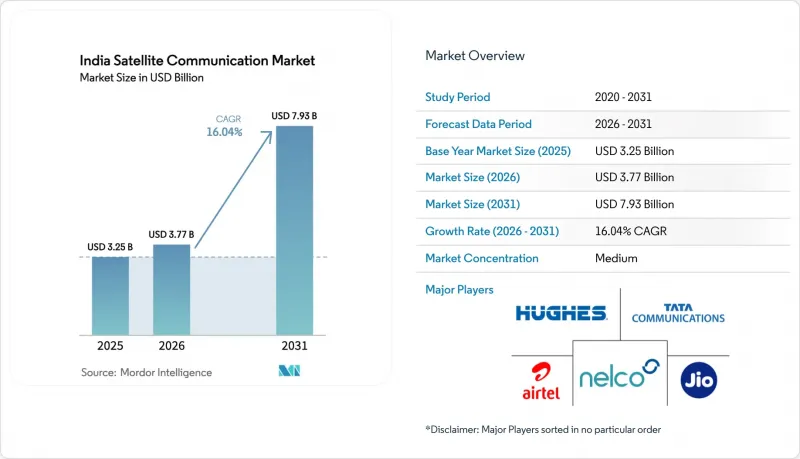
本報告按類型(地面設備和服務)、平台(可攜式、陸地、海上、機載式)、頻段(L波段、S波段、C波段、 X波段、 Ku波段、 Ka波段)、最終用戶產業(國防/政府、海事、企業等)和地區細分。市場預測以價值(美元)表示。
印度衛星通訊市場的趨勢與洞察
政府主導的「BharatNet」和「數位印度」寬頻部署
公共部門的大規模投資構成了長期需求的基礎。 Bharatnet 3.0 已撥款 13.9 億盧比(約 168 億美元)用於連接 2.5 億農村居民,刺激了衛星回程傳輸訂單,以覆蓋光纖電纜無法鋪設的地區。在 10 個邦實施的 5G 智慧鄉村試點計畫需要 1 Gbps 的衛星鏈路和可擴展的 10 Gbps 路徑,這使得衛星不僅是地面網路的替代方案,而且是其同等重要的合作夥伴。資料本地化法規強制要求的安全閘道器進一步刺激了對國內地面網路的投資。這些政策共同推動了電信營運商未來多年的穩定收入,並支持了印度衛星通訊市場的持續擴張。
OTT/影片流量的爆炸性成長正在推高對衛星頻寬的需求。
影片串流尖峰時段持續佔據地面骨幹網路。在2025年印度板球超級聯賽(IPL)期間,同時線上觀看人數超過3,200萬,由此產生的剩餘流量流入衛星容量租賃市場。隨著高清4K和HDR格式使每個用戶的資料傳輸速率翻倍,廣播公司正在二線城市租用GSAT-20衛星的Ka波段波束進行邊緣快取。主要串流媒體平台簽署的長期合約確保了穩定的資源利用率,提高了每兆赫茲的平均收入,並增強了印度衛星通訊市場的盈利。
網路入侵和破壞漏洞
NavIC的安全審計揭示了欺騙攻擊的風險,這些風險威脅著民用後勤和軍事導航。關鍵邊界附近發生的電子戰事件凸顯了潛在的服務中斷風險,促使TRAI強制要求採用端對端加密和雙重認證。合規工作在短期內減緩了這些措施的採用速度,因為它們會延長引進週期並增加營運成本。
細分市場分析
預計到2025年,服務業務將佔總收入的68.05%,因為企業更傾向於選擇承包頻寬和網路管理契約,而非硬體所有權。在銀行業和能源產業長期VSAT外包合約的推動下,印度衛星通訊市場服務業務的規模預計將以16.72%的複合年成長率成長。銀行依靠超過7萬個休斯VSAT設備來確保ATM機的運作,這表明託管容量能夠確保滿足監管機構的服務水準目標。 OTT平台和營運商也同樣租賃Ka波段波束作為備份,以確保在重大事件期間99.9%的可用性。
儘管地面設備仍保持著31.95%的市場佔有率,但這一類別正向軟體定義閘道器轉變,後者能夠遠端改變波束方向並分配流量負載。由於營運商更傾向於營運成本(OPEX)更低的模式,設備供應商在印度衛星通訊市場的佔有率可能會下降,但供應商正透過捆綁安全、分析和編配軟體來增強整合穩定性,從而抵消這種轉變的影響。
到2025年,BSNL在印度北部3500座4G基地台部署的衛星回程傳輸將佔其陸基平台收入的58.85%。隨著各邦政府機構在基層自治區(Panchayat)推行公共服務數位化,印度陸基衛星通訊市場預計將持續擴張。可攜式終端正被災害救援機構和需要高機動性和快速部署的電視台新聞攝製組廣泛使用。
預計機載系統將以17.05%的複合年成長率快速成長,因為航空公司正在對飛機進行Ka波段互連系統(IFC)改造,以滿足乘客對影片串流的需求。由印度空軍iDEX計畫資助的小型衛星正在實現對無人機群的超視距控制,展示了一個新的高吞吐量應用場景。供應商目前正在客製化可安裝在小型飛機空間內的電子控制相位陣列天線,消除了安裝障礙。
其他好處:
- Excel格式的市場預測(ME)表
- 3個月的分析師支持
目錄
第1章:引言
- 研究假設和市場定義
- 調查範圍
第2章:調查方法
第3章執行摘要
第4章 市場狀況
- 市場概覽
- 市場促進因素
- 政府主導的寬頻部署,透過「BharatNet」和「數位印度」計畫進行。
- OTT/影片流量的爆炸性成長正在推高對衛星頻寬的需求。
- 國防與國防安全保障現代化計劃
- 在農業和公共產業大規模部署物聯網/機器對機器通訊技術
- 直接到設備 (D2D) 衛星智慧型手機服務即將推出。
- 印度太空研究組織(ISRO)的低成本小型衛星運載火箭正在加速國內衛星星系的發展。
- 市場限制因素
- 易受網路入侵和破壞攻擊
- 閘道器/VSAT的高額資本支出(CAPEX)和頻率使用費
- 頻率分配延遲和監管不確定性
- 為應對太空碎片問題而製定的新規則正在增加衛星星系的成本。
- 產業價值鏈分析
- 監理情勢
- 技術展望
- 波特五力分析
- 宏觀經濟因素對市場的影響
第5章 市場規模與成長預測
- 按類型
- 地面設備
- 閘道
- 超小孔徑終端(VSAT)
- 網路營運中心(NOC)
- 衛星新聞採集(SNG)
- 服務
- 行動衛星服務(MSS)
- 固定衛星通訊服務(FSS)
- 地球觀測服務
- 地面設備
- 按平台
- 可攜式的
- 土地
- 海上
- 機載
- 按頻段
- L波段
- S波段
- C波段
- X波段
- Ku波段
- Ka波段
- 按最終用戶行業分類
- 國防/政府
- 海上
- 公司
- 媒體與娛樂
- 農業和環境監測
- 其他終端用戶產業
- 按地區
- 印度北部
- 西印度群島
- 南印度
- 印度東部和東北部
- 印度中部
第6章 競爭情勢
- 市場集中度
- 策略趨勢
- 市佔率分析
- 公司簡介
- Jio Satellite Communications Ltd.
- Hughes Communications India Ltd.
- Bharti Airtel Limited(incl. OneWeb India)
- Tata Communications Limited
- Nelco Limited
- ViaSat Inc.
- Thales Group
- ORBCOMM Inc.
- Precision Electronics Limited
- Avantel Limited
- Astrome Technologies Private Limited
- Dhruva Space Private Limited
- Pixxel Space Technologies Pvt. Ltd.
- Skylo Technologies, Inc.
- SES SA
- Inmarsat Global Limited
- Intelsat US LLC
- Eutelsat Group
- Antrix Corporation Limited
- NewSpace India Limited
- Kacific Broadband Satellites Group
- Larsen & Toubro Limited(Defence VSAT)
第7章 市場機會與未來展望
According to Mordor Intelligence, the India's satellite communication market size is expected to grow from USD 3.25 billion in 2025 to USD 3.77 billion in 2026 and is forecast to reach USD 7.93 billion by 2031 at 16.04% CAGR over 2026-2031.
This report is Segmented by Type (Ground Equipment and Services), Platform (Portable, Land, Maritime, and Airborne), Frequency Band (L-Band, S-Band, C-Band, X-Band, Ku-Band, and Ka-Band), End-User Vertical (Defence and Government, Maritime, Enterprises, and More), and Region. The Market Forecasts are Provided in Terms of Value (USD).
India Satellite Communication Market Trends and Insights
Government-Led BharatNet and Digital India Broadband Roll-Outs
Massive public-sector funding anchors long-term demand. BharatNet 3.0 allocates INR 1.39 lakh crore (USD 16.8 billion) to connect 250 million rural residents, funneling satellite backhaul orders to cover terrain where fiber is infeasible. The 5G Intelligent Village pilot in ten states calls for 1 Gbps satellite links with scalable 10 Gbps pathways, positioning satellites as equal partners to terrestrial networks rather than fallback options. Secure gateways mandated by data-localization rules further stimulate domestic ground-segment investments. Together, these policies provide operators with predictable multi-year revenue and underpin the continued expansion of the India satellite communication market.
OTT/Video Traffic Explosion Boosting Satellite Bandwidth Demand
Peak-time video streaming routinely saturates terrestrial backbones. During IPL 2025, concurrent viewership exceeded 32 million, sending spillover traffic to satellite capacity leases. High-definition 4K and HDR formats multiply per-user data rates, prompting broadcasters to reserve Ka-band beams on GSAT-20 for edge caching in Tier-2 cities. Long-term contracts signed by major streaming platforms create stable utilization rates that lift average revenue per megahertz and enhance the profitability of the India satellite communication market.
Cyber-Intrusion and Jamming Vulnerabilities
Security audits of NavIC exposed spoofing risks that threaten both civilian logistics and military navigation. Electronic warfare incidents near sensitive borders highlight potential service blackouts, prompting TRAI to mandate end-to-end encryption and two-factor terminal authentication. Compliance adds latency to deployment cycles and inflates opex, moderating near-term uptake.
Other drivers and restraints analyzed in the detailed report include:
- Defense and Homeland-Security Modernization Programs
- Mass-Scale IoT/M2M Roll-Outs in Agriculture and Utilities
- High CAPEX for Gateways/VSAT and Spectrum Fees
For complete list of drivers and restraints, kindly check the Table Of Contents.
Segment Analysis
Services commanded 68.05% of 2025 revenue as enterprises favored turnkey bandwidth and network-management contracts over owning hardware. India's satellite communication market size for services is projected to climb at a 16.72% CAGR, fueled by long-term VSAT outsourcing deals in banking and energy. Banks rely on 70,000+ Hughes VSATs for ATM uptime, illustrating how managed capacity assures regulatory service-level targets. OTT platforms and telecoms likewise lease backup Ka-band beams to guarantee 99.9% availability during marquee events.
Ground equipment retained a 31.95% share, yet the category is migrating toward software-defined gateways that remotely re-point beams and load-balance traffic. India's satellite communication market share for equipment suppliers could slide as operators prefer opex-light models, but vendors offset the shift by bundling security, analytics, and orchestration software that deepens integration stickiness.
Land platforms held 58.85% revenue in 2025, supported by BSNL's satellite backhaul roll-outs across 3,500 4G towers in North India. India's satellite communication market size for land-based links will continue growing as state agencies digitize public-service delivery across Panchayats. Portable terminals serve disaster-relief agencies and TV newsgathering units that need high mobility and quick setup.
Airborne systems will grow fastest at 17.05% CAGR as airlines retrofit fleets with Ka-band IFC to meet passenger expectations for streaming video. The Indian Air Force's iDEX-funded mini-satellites enable beyond-line-of-sight control of UAV swarms, showcasing new high-throughput use cases. Equipment vendors now tailor electronically steered phased-array antennas that fit small fuselage footprints, removing installation hurdles.
Complete Report Scope:
- By Type
- Ground Equipment
- Gateway
- Very Small Aperture Terminal (VSAT)
- Network Operation Centre (NOC)
- Satellite News Gathering (SNG)
- Services
- Mobile Satellite Services (MSS)
- Fixed Satellite Services (FSS)
- Earth-Observation Services
- Ground Equipment
- By Platform
- Portable
- Land
- Maritime
- Airborne
- By Frequency Band
- L-Band
- S-Band
- C-Band
- X-Band
- Ku-Band
- Ka-Band
- By End-user Vertical
- Defence and Government
- Maritime
- Enterprises
- Media and Entertainment
- Agriculture and Environmental Monitoring
- Other End-user Verticals
- By Region
- North India
- West India
- South India
- East and North-East India
- Central India
List of Companies Covered in this Report:
- Jio Satellite Communications Ltd.
- Hughes Communications India Ltd.
- Bharti Airtel Limited (incl. OneWeb India)
- Tata Communications Limited
- Nelco Limited
- ViaSat Inc.
- Thales Group
- ORBCOMM Inc.
- Precision Electronics Limited
- Avantel Limited
- Astrome Technologies Private Limited
- Dhruva Space Private Limited
- Pixxel Space Technologies Pvt. Ltd.
- Skylo Technologies, Inc.
- SES S.A.
- Inmarsat Global Limited
- Intelsat US LLC
- Eutelsat Group
- Antrix Corporation Limited
- NewSpace India Limited
- Kacific Broadband Satellites Group
- Larsen & Toubro Limited (Defence VSAT)
Additional Benefits:
- The market estimate (ME) sheet in Excel format
- 3 months of analyst support
TABLE OF CONTENTS
1 INTRODUCTION
- 1.1 Study Assumptions and Market Definition
- 1.2 Scope of the Study
2 RESEARCH METHODOLOGY
3 EXECUTIVE SUMMARY
4 MARKET LANDSCAPE
- 4.1 Market Overview
- 4.2 Market Drivers
- 4.2.1 Govt-led BharatNet and Digital India broadband roll-outs
- 4.2.2 OTT/video traffic explosion boosting satellite bandwidth demand
- 4.2.3 Defence and homeland-security modernisation programmes
- 4.2.4 Mass-scale IoT/M2M roll-outs in agriculture and utilities
- 4.2.5 Direct-to-Device (D2D) satellite smartphone services on the anvil
- 4.2.6 ISRO's low-cost small-sat launchers accelerating domestic constellations
- 4.3 Market Restraints
- 4.3.1 Cyber-intrusion and jamming vulnerabilities
- 4.3.2 High CAPEX for gateways/VSAT and spectrum fees
- 4.3.3 Spectrum-allocation delays and regulatory ambiguity
- 4.3.4 New debris-mitigation rules raising constellation costs
- 4.4 Industry Value Chain Analysis
- 4.5 Regulatory Landscape
- 4.6 Technological Outlook
- 4.7 Porter's Five Forces Analysis
- 4.7.1 Bargaining Power of Buyers
- 4.7.2 Bargaining Power of Suppliers
- 4.7.3 Threat of New Entrants
- 4.7.4 Threat of Substitutes
- 4.7.5 Intensity of Competitive Rivalry
- 4.8 Impact of Macroeconomic Factors on the Market
5 MARKET SIZE AND GROWTH FORECASTS (VALUES)
- 5.1 By Type
- 5.1.1 Ground Equipment
- 5.1.1.1 Gateway
- 5.1.1.2 Very Small Aperture Terminal (VSAT)
- 5.1.1.3 Network Operation Centre (NOC)
- 5.1.1.4 Satellite News Gathering (SNG)
- 5.1.2 Services
- 5.1.2.1 Mobile Satellite Services (MSS)
- 5.1.2.2 Fixed Satellite Services (FSS)
- 5.1.2.3 Earth-Observation Services
- 5.1.1 Ground Equipment
- 5.2 By Platform
- 5.2.1 Portable
- 5.2.2 Land
- 5.2.3 Maritime
- 5.2.4 Airborne
- 5.3 By Frequency Band
- 5.3.1 L-Band
- 5.3.2 S-Band
- 5.3.3 C-Band
- 5.3.4 X-Band
- 5.3.5 Ku-Band
- 5.3.6 Ka-Band
- 5.4 By End-user Vertical
- 5.4.1 Defence and Government
- 5.4.2 Maritime
- 5.4.3 Enterprises
- 5.4.4 Media and Entertainment
- 5.4.5 Agriculture and Environmental Monitoring
- 5.4.6 Other End-user Verticals
- 5.5 By Region
- 5.5.1 North India
- 5.5.2 West India
- 5.5.3 South India
- 5.5.4 East and North-East India
- 5.5.5 Central India
6 COMPETITIVE LANDSCAPE
- 6.1 Market Concentration
- 6.2 Strategic Moves
- 6.3 Market Share Analysis
- 6.4 Company Profiles (includes Global level Overview, Market level overview, Core Segments, Financials as available, Strategic Information, Market Rank/Share for key companies, Products and Services, and Recent Developments)
- 6.4.1 Jio Satellite Communications Ltd.
- 6.4.2 Hughes Communications India Ltd.
- 6.4.3 Bharti Airtel Limited (incl. OneWeb India)
- 6.4.4 Tata Communications Limited
- 6.4.5 Nelco Limited
- 6.4.6 ViaSat Inc.
- 6.4.7 Thales Group
- 6.4.8 ORBCOMM Inc.
- 6.4.9 Precision Electronics Limited
- 6.4.10 Avantel Limited
- 6.4.11 Astrome Technologies Private Limited
- 6.4.12 Dhruva Space Private Limited
- 6.4.13 Pixxel Space Technologies Pvt. Ltd.
- 6.4.14 Skylo Technologies, Inc.
- 6.4.15 SES S.A.
- 6.4.16 Inmarsat Global Limited
- 6.4.17 Intelsat US LLC
- 6.4.18 Eutelsat Group
- 6.4.19 Antrix Corporation Limited
- 6.4.20 NewSpace India Limited
- 6.4.21 Kacific Broadband Satellites Group
- 6.4.22 Larsen & Toubro Limited (Defence VSAT)
7 MARKET OPPORTUNITIES AND FUTURE OUTLOOK
- 7.1 White-space and Unmet-need Assessment

 高通量衛星(HTS)全球市場規模、佔有率、趨勢和成長分析報告(2026-2034)全球衛星寬頻通訊市場規模、佔有率、趨勢和成長分析報告(公共安全領域,2026-2034年)
 衛星物聯網通訊:市場佔有率分析、產業趨勢與統計、成長預測(2026-2031)
 2026-2030年全球衛星通訊市場
 高通量衛星市場規模、佔有率和成長分析:按頻段、軌道、應用、最終用戶和地區分類-2026-2033年產業預測地面軍事衛星通訊市場規模、佔有率、成長、全球產業分析、區域洞察以及2026年至2034年的預測軟體定義衛星市場:規模、佔有率、成長、全球產業分析、區域趨勢及2026年至2034年預測
 衛星通訊市場:按類型、應用、最終用戶、企業、國家和地區分類-全球產業分析、市場規模、市場佔有率及2026年至2033年預測軟體定義衛星(SDS)全球市場規模、佔有率、趨勢和成長分析報告(2026-2034)
 衛星通訊市場預測(2034 年)—按組件、頻段、軌道類型、應用、最終用戶和地區分類的全球分析