


 |
市場調查報告書
商品編碼
2117243
衛星物聯網通訊:市場佔有率分析、產業趨勢與統計、成長預測(2026-2031)Satellite IoT Communication - Market Share Analysis, Industry Trends & Statistics, Growth Forecasts (2026 - 2031) |
||||||

※ 本網頁內容可能與最新版本有所差異。詳細情況請與我們聯繫。
據 Mordor Intelligence 稱,2025 年衛星物聯網通訊市值為 22.4 億美元,預計到 2031 年將從 2026 年的 26.8 億美元成長至 65.2 億美元,預測期(2026-2031 年)複合年成長率為 19.52%。
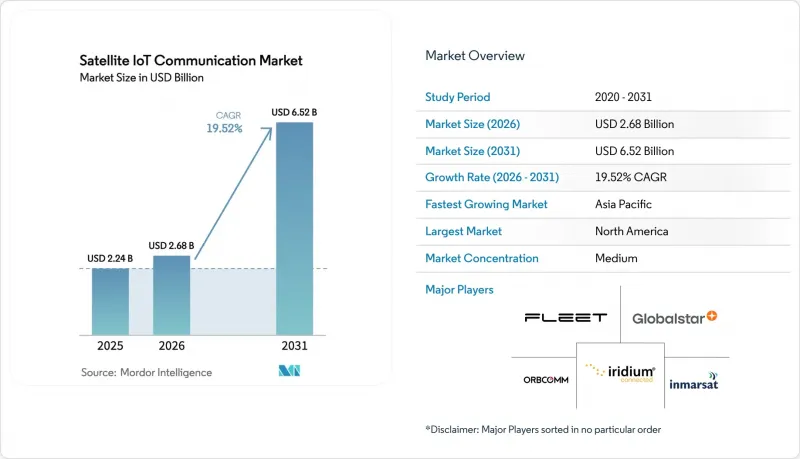
本報告按軌道類型(低地球軌道、中地球軌道、地球靜止軌道)、頻段(L波段、S波段等)、終端用戶行業(海事和航運、農業和林業等)、服務類型(衛星資產追蹤、遠端監控等)以及地區進行細分。市場預測以美元計價。
全球衛星物聯網通訊市場趨勢與洞察
5G-Advanced NTN規範的開發與發展
Release 17 和 Release 18 規範整合了地面和衛星連接,無需雙模晶片組,並將設備組件成本降低高達 30%。內建的多普勒頻移校正和定時提前演算法可穩定來自高速低地球軌道 (LEO) 太空船的鏈路,從而支援對延遲敏感的應用,例如遠端機器人。包括 FCC 和 ETSI 在內的監管機構目前正在將這些規則納入設備認證,縮短產品上市週期。無縫漫遊功能使工業IoT設備即使在地面通訊中斷的情況下也能保持連接,這在極端天氣緊急情況下尤其明顯。該框架還支援原生智慧型手機連接,提高了消費者的熟悉度,並刺激了企業需求的成長。
重量小於200公斤的小型衛星的製造成本和發射成本迅速下降
標準化的衛星載具、積層製造和批量零件訂購已將單顆衛星的製造成本從2020年的50萬美元降至2024年的不到15萬美元。隨著共乘發射任務的成本降至每公斤5,000美元以下,將一個由24顆衛星組成的物聯網衛星群送入軌道的成本將低於8,000萬美元,滿足了創業投資認可的資金籌措標準。新參與企業正利用這條成本曲線,最佳化低速率遙測的功率預算和天線方向圖,而不是改造寬頻衛星。例如,在農業網路中,他們正在發射針對土壤感測器資料包通訊最佳化的窄波束L波段有效載荷。隨著在軌維護延長太空船的使用壽命並減少補給需求,預計這一成本下降趨勢將持續下去。
擁擠的L波段和S波段的擁塞和干擾
在L波段和S波段通訊鏈路上,隨著海事和物流用戶終端數量的增加,資料包衝突現像也日益增多,干擾事件在2023年至2024年間預計將增加45%。在尖峰時段,吞吐量可能下降30%,導致重送並耗盡感測器電池電量。傳統的語音線路設計方案無法應付數百萬流量的物聯網通訊突發。儘管營運商正在將部分流量遷移到Ka波段,但雨致衰減和高昂的終端成本阻礙了大規模部署。在自適應波束成形和動態通道分配技術成熟之前,服務品質的不確定性可能會減緩短期內的應用普及,並抑制衛星物聯網通訊市場的成長。
細分市場分析
2025年,低地球軌道(LEO)平台將佔據衛星物聯網通訊市場61.65%的佔有率,其低於100毫秒的往返延遲將為自動駕駛車輛遙測和封閉回路型工業控制提供支援。這項優勢將促成太空船的大規模生產,有時產量甚至超過1000顆,從而獲得供應商的批量折扣並加快產品改進週期。同時,中地球軌道(MEO)網路正以20.05%的複合年成長率快速擴張。這是因為MEO只需8到20顆衛星即可覆蓋全球,與LEO衛星星座相比,衛星群資本投資最多可減少50%。
不同客戶群的營運標準各不相同。對於偏遠礦區中的電池供電感測器,低地球軌道(LEO)通常是首選,因為其鏈路預算更低,電池壽命更長。同時,航運公司則傾向於選擇中地球軌道(MEO),因為在極地航線上,LEO 軌道的穿越可能會造成暫時的通訊中斷,而 MEO 軌道可以確保不間斷的通訊覆蓋。鑑於太空碎片減少計劃,監管機構目前正在審查軌道槽位申請,這可能會促使未來的發射任務轉向高空,從而延長衛星的軌道壽命。因此,這兩種架構並存,為衛星物聯網通訊市場中各種不同的服務等級協定(SLA)提供支援。
預計到2025年, L波段將維持28.25%的市場佔有率,它是值得信賴的全天候通訊鏈路,能夠穿透樹木,對航運和作物監測等應用至關重要。終端可以毫瓦級功耗運行,從而延長電池壽命,並為對價格敏感的農業相關企業提供經濟實惠的定價。雖然Ka波段更容易受到天氣條件的影響,但其豐富的頻寬支援高吞吐量,可支援邊緣分析,特別是影像和影片,從而實現了業界領先的20.12%的複合年成長率。
不同產業的轉型路徑各不相同。環境監測機構正在採用Ka波段傳輸頻譜數據,而用於資產追蹤的車隊則傾向於繼續使用L波段,直到終端成本下降。頻段協調方面的挑戰依然存在。新進業者必須與持有全球頻率註冊的現有業者進行談判,這可能會延遲其進入競爭市場,但也有助於保障服務品質。這種平衡預示著未來將出現多頻段格局,營運商可以透過組合有效載荷來規避特定頻率的限制,從而拓寬衛星物聯網通訊市場的解決方案範圍。
區域分析
在國防監視預算和「重建連接」(ReConnect)撥款的支持下,北美地區預計將在2025年佔全球銷售額的35.05%,這些撥款旨在促進向農村地區的部署。加拿大正在增加耐寒感測器的採購,以應對其在北極的主權巡邏;與此同時,美國沿海航運路線正在實施排放追蹤,以滿足環境、社會和治理(ESG)評分卡的要求。墨西哥沿海製造業出口企業正在利用衛星遙測技術,在內陸工廠和邊境檢查站之間維持準時制庫存流動。
預計到2031年,亞太地區將以20.85%的複合年成長率領先全球,主要得益於中國、印度和東南亞國家對數位農業的大力發展。中國的農村發展政策正推動公共資金投入合作社所有的感測器網路建設,而印度國內發射能力的提升則降低了本地系統整合商的接取成本。日本和韓國正依賴不間斷的物聯網資料饋送來推進工廠自動化,而澳洲的礦區則在運輸道路和輸送機沿線部署衛星閘道器,以監控設備狀態。
在歐洲,衛星物聯網市場正穩步擴張,這得益於ESG法規和CEF-Digital基金的支持。德國的精密農業補貼涵蓋了衛星使用費,法國水產養殖企業則透過持續遙測技術滿足可追溯性要求。在英國,智慧港口計畫正在推進,利用衛星分析技術最佳化泊位分配。除了這些成熟地區,中東和非洲也正在崛起,成為蘊藏著巨大新機會的寶庫。隨著石油公司和農業技術專案利用衛星物聯網技術彌補地面通訊的不足,衛星物聯網通訊市場的地域收入來源也日益多元化。
其他好處:
- Excel格式的市場預測(ME)表
- 3個月的分析師支持
目錄
第1章:引言
- 研究假設和市場定義
- 調查範圍
第2章:調查方法
第3章執行摘要
第4章 市場狀況
- 市場概覽
- 市場促進因素
- 5G-Advanced NTN規範的開發與進展
- 重量小於200公斤的小型衛星的製造成本和發射成本迅速下降
- 政府補貼以支持農村網路連接(例如美國的 ReConnect 計劃、歐盟的 CEF-Digital 計劃等)
- 國際電信聯盟為窄頻聯網鏈路分配新的頻率(WRC-23)
- 航運業對持續資產遙測技術的需求日益成長,以滿足ESG合規要求。
- 偏遠地區農業和林業碳權的可追溯性
- 市場限制因素
- L波段和S波段擁塞和干擾。
- 偏遠寒冷地區地面感測器電池壽命的限制。
- 衛星到設備天線模組缺乏全球標準
- 太空碎片防護保險費上漲
- 價值鏈分析
- 監理情勢
- 技術展望
- 波特五力分析
第5章 市場規模與成長預測
- 按軌道類型
- 低地球軌道(LEO)
- 中軌道(MEO)
- 地球靜止軌道(GEO)
- 按頻段
- L波段
- S波段
- C波段
- Ku波段
- Ka波段
- 按最終用戶行業分類
- 海事/航運
- 農業和林業
- 物流和多式聯運
- 國防與安全
- 環境監測
- 其他終端用戶產業
- 按服務類型
- 衛星資產追蹤
- 遠端監控和控制
- 直接連接裝置
- 回程傳輸連線
- 按地區
- 北美洲
- 美國
- 加拿大
- 墨西哥
- 南美洲
- 巴西
- 阿根廷
- 其他南美國家
- 歐洲
- 德國
- 英國
- 法國
- 義大利
- 西班牙
- 俄羅斯
- 其他歐洲國家
- 亞太地區
- 中國
- 日本
- 韓國
- 印度
- 澳洲和紐西蘭
- 東南亞
- 其他亞太國家
- 中東
- 沙烏地阿拉伯
- 阿拉伯聯合大公國
- 其他中東國家
- 非洲
- 南非
- 奈及利亞
- 其他非洲國家
- 北美洲
第6章 競爭情勢
- 市場集中度
- 策略趨勢
- 市佔率分析
- 公司簡介
- Iridium Communications Inc.
- ORBCOMM Inc.
- Inmarsat(Viasat, Inc.)
- Globalstar, Inc.
- Fleet Space Technologies Pty Ltd.
- Sateliot IoT Services
- Swarm Technologies, Inc.(SpaceX)
- Astrocast SA
- Myriota Pty Ltd.
- Hiber AB
- Kepler Communications Inc.
- SES SA
- Eutelsat Group(OneWeb)
- EchoStar Corporation
- Cobham Satcom
- L3Harris Technologies, Inc.
- Omnispace LLC
- Lacuna Space Ltd.
- China Satellite Communications Co., Ltd.(China Satcom)
- Addvalue Technologies Ltd.
第7章 市場機會與未來展望
According to Mordor Intelligence, the satellite ioT communication market size was valued at USD 2.24 billion in 2025 and estimated to grow from USD 2.68 billion in 2026 to reach USD 6.52 billion by 2031, at a CAGR of 19.52% during the forecast period (2026-2031).
This report is Segmented by Type of Orbit (Low-Earth Orbit, Medium-Earth Orbit, Geostationary Orbit), Frequency Band (L-Band, S-Band, and More), End-User Industry (Maritime and Shipping, Agriculture and Forestry, and More), Service Type (Satellite Asset Tracking, Remote Monitoring and Control, and More), and Geography. The Market Forecasts are Provided in Terms of Value (USD).
Global Satellite IoT Communication Market Trends and Insights
Development and Growth of 5G-Advanced NTN Specifications
Release 17 and 18 specifications unify terrestrial and satellite connectivity, removing the need for dual-mode chipsets and cutting device bill-of-materials by up to 30%. Doppler shift compensation and timing-advance algorithms built into the standard stabilize links from rapidly moving LEO spacecraft, supporting delay-sensitive applications such as remote robotics. Regulators, including the FCC and ETSI, now embed these rules in device certification, trimming launch-to-market cycles. Seamless roaming means industrial IoT installations remain connected during terrestrial outages, an advantage heightened during extreme-weather emergencies. The framework also opens native smartphone connectivity, driving consumer familiarity that will spill over into enterprise demand.
Rapid Drop in Manufacturing and Launch Costs of Sub-200 kg Satellites
Standardized satellite buses, additive manufacturing, and bulk component orders have cut per-unit build costs from USD 500,000 in 2020 to under USD 150,000 in 2024. With launch fees now below USD 5,000 per kg on rideshare missions, a 24-satellite IoT constellation can orbit for under USD 80 million, hitting financing thresholds that venture capital is willing to underwrite. New entrants exploit this cost curve to tailor power budgets and antenna patterns for low-rate telemetry instead of retrofitting broadband birds. Agriculture-focused networks, for example, fly narrow-beam L-Band payloads optimized for soil-sensor packets. Cost trajectories are expected to fall further as in-orbit servicing extends spacecraft life, reducing replenishment needs.
Congestion and Interference in Crowded L- and S-Bands
L- and S-band links face growing packet collisions as maritime and logistics users add endpoints, with interference incidents up 45% between 2023 and 2024. Peak traffic on shipping lanes can cut throughput by 30%, forcing resends that drain sensor batteries. Legacy coordination schemes designed for voice circuits cannot handle millions of bursty IoT transmissions. Operators shift some traffic into Ka-Band, but rain fade and higher terminal costs limit mass adoption. Until adaptive beamforming and dynamic channel allocation mature, service-quality uncertainty may dampen near-term uptake, shaving growth off the satellite IoT communication market.
Other drivers and restraints analyzed in the detailed report include:
- Government Rural-Connectivity Subsidies Drive Infrastructure Investment
- New ITU Spectrum Allocations Enable Expanded Capacity
- Limited Battery Life of Ground Sensors in Remote Cold Regions
For complete list of drivers and restraints, kindly check the Table Of Contents.
Segment Analysis
Low-Earth Orbit platforms captured 61.65% of the satellite IoT communication market share in 2025, leveraging sub-100 millisecond round-trip latency that supports autonomous vehicle telemetry and closed-loop industrial control. This dominance translates into large production runs, sometimes over 1,000 spacecraft, that unlock supplier volume discounts and rapid iteration cycles. However, MEO networks are expanding at a 20.05% CAGR because eight to twenty satellites can blanket the globe, cutting constellation capex by as much as 50% relative to LEO fleets.
The operational calculus differs across customer groups. Battery-powered sensors in remote mining sites often favor LEO because lower link budgets extend battery life. Maritime operators eye MEO for uninterrupted coverage on polar routes where LEO passes create brief outages. Regulatory bodies now weigh orbital-slot filings against debris-mitigation plans, a factor that could tilt future launches toward higher altitudes with longer orbital lifetimes. Both architectures, therefore, coexist, supporting varied service-level agreements inside the satellite IoT communication market.
L-Band maintained a 28.25% share of 2025 revenue, trusted for foliage-penetrating, all-weather links needed in maritime and crop-monitoring applications. Devices can operate on milliwatts, stretching battery life and bringing subscription fees within reach of price-sensitive agribusinesses. Ka-Band, despite its weather vulnerability, posts a leading 20.12% CAGR as spectrum abundance allows higher throughputs that support imagery and video-centric edge analytics.
Migration paths vary by vertical. Environmental monitoring agencies adopt Ka for streaming multispectral data, while asset-tracking fleets stick with L-Band until terminal costs fall. Spectrum coordination hurdles persist: newcomers must negotiate with incumbents that hold global filings, which could slow competitive entry but also safeguard service quality. The balance suggests a multiband future where operators mix payloads to hedge against frequency-specific constraints, enriching solution depth in the satellite IoT communication market.
Complete Report Scope:
- By Type of Orbit
- Low-Earth Orbit (LEO)
- Medium-Earth Orbit (MEO)
- Geostationary Orbit (GEO)
- By Frequency Band
- L-Band
- S-Band
- C-Band
- Ku-Band
- Ka-Band
- By End-user Industry
- Maritime and Shipping
- Agriculture and Forestry
- Logistics and Intermodal Freight
- Defense and Security
- Environmental Monitoring
- Other End-user Industries
- By Service Type
- Satellite Asset Tracking
- Remote Monitoring and Control
- Direct-to-Device Connectivity
- Backhaul Connectivity
- By Geography
- North America
- United States
- Canada
- Mexico
- South America
- Brazil
- Argentina
- Rest of South America
- Europe
- Germany
- United Kingdom
- France
- Italy
- Spain
- Russia
- Rest of Europe
- Asia Pacific
- China
- Japan
- South Korea
- India
- Australia and New Zealand
- Southeast Asia
- Rest of Asia Pacific
- Middle East
- Saudi Arabia
- United Arab Emirates
- Rest of Middle East
- Africa
- South Africa
- Nigeria
- Rest of Africa
- North America
Geography Analysis
North America commanded 35.05% of 2025 revenue, buoyed by defense surveillance budgets and the ReConnect subsidy that underwrites rural deployments. Arctic sovereignty patrols drive Canada's purchase of cold-weather-tolerant sensors, while US coastal shipping lanes adopt emissions tracking to comply with ESG scorecards. Mexico's near-shore manufacturing exports rely on satellite telemetry to maintain just-in-time inventory flows between inland plants and border crossings.
Asia Pacific registers the fastest 20.85% CAGR to 2031 as China, India, and Southeast Asian states scale digital agriculture. China's rural revitalization agenda channels public lending into cooperative-owned sensor networks, and India's domestic launch capacity lowers access costs for local integrators. Japan and South Korea showcase factory-floor automation that depends on uninterrupted IoT data feeds, while Australia's mining belts outfit haul-roads and conveyor lines with satellite gateways to monitor equipment health.
Europe delivers steady expansion underpinned by ESG regulation and the CEF-Digital fund. Germany's precision-farming subsidies reimburse satellite subscription fees, and French aquaculture firms meet traceability mandates via continuous telemetry. The U.K. advances smart-port initiatives that use satellite analytics to optimize berth allocation. Beyond these mature regions, the Middle East and Africa emerge as opportunity pools where oil operators and agritech programs tap satellite IoT to overcome terrestrial gaps, broadening geographic revenue diversity in the satellite IoT communication market.
- Iridium Communications Inc.
- ORBCOMM Inc.
- Inmarsat (Viasat, Inc.)
- Globalstar, Inc.
- Fleet Space Technologies Pty Ltd.
- Sateliot IoT Services
- Swarm Technologies, Inc. (SpaceX)
- Astrocast SA
- Myriota Pty Ltd.
- Hiber AB
- Kepler Communications Inc.
- SES S.A.
- Eutelsat Group (OneWeb)
- EchoStar Corporation
- Cobham Satcom
- L3Harris Technologies, Inc.
- Omnispace LLC
- Lacuna Space Ltd.
- China Satellite Communications Co., Ltd.(China Satcom)
- Addvalue Technologies Ltd.
Additional Benefits:
- The market estimate (ME) sheet in Excel format
- 3 months of analyst support
TABLE OF CONTENTS
1 INTRODUCTION
- 1.1 Study Assumptions and Market Definition
- 1.2 Scope of the Study
2 RESEARCH METHODOLOGY
3 EXECUTIVE SUMMARY
4 MARKET LANDSCAPE
- 4.1 Market Overview
- 4.2 Market Drivers
- 4.2.1 Development and growth of 5G-Advanced NTN specifications
- 4.2.2 Rapid drop in manufacturing and launch costs of <200 kg satellites
- 4.2.3 Government rural-connectivity subsidies (e.g., US ReConnect, EU CEF-Digital)
- 4.2.4 New ITU spectrum allocations (WRC-23) for narrowband IoT links
- 4.2.5 Maritime ESG compliance demand for continuous asset telemetry
- 4.2.6 Carbon-credit traceability for remote agriculture and forestry
- 4.3 Market Restraints
- 4.3.1 Congestion and interference in crowded L- and S-bands
- 4.3.2 Limited battery life of ground sensors in remote cold regions
- 4.3.3 Lack of global standard for Sat-to-Device antenna modules
- 4.3.4 Rising space-debris mitigation insurance premiums
- 4.4 Value Chain Analysis
- 4.5 Regulatory Landscape
- 4.6 Technological Outlook
- 4.7 Porter's Five Forces Analysis
- 4.7.1 Bargaining Power of Consumers
- 4.7.2 Bargaining Power of Suppliers
- 4.7.3 Threat of New Entrants
- 4.7.4 Threat of Substitute Products
- 4.7.5 Intensity of Competitive Rivalry
5 MARKET SIZE AND GROWTH FORECASTS (VALUE)
- 5.1 By Type of Orbit
- 5.1.1 Low-Earth Orbit (LEO)
- 5.1.2 Medium-Earth Orbit (MEO)
- 5.1.3 Geostationary Orbit (GEO)
- 5.2 By Frequency Band
- 5.2.1 L-Band
- 5.2.2 S-Band
- 5.2.3 C-Band
- 5.2.4 Ku-Band
- 5.2.5 Ka-Band
- 5.3 By End-user Industry
- 5.3.1 Maritime and Shipping
- 5.3.2 Agriculture and Forestry
- 5.3.3 Logistics and Intermodal Freight
- 5.3.4 Defense and Security
- 5.3.5 Environmental Monitoring
- 5.3.6 Other End-user Industries
- 5.4 By Service Type
- 5.4.1 Satellite Asset Tracking
- 5.4.2 Remote Monitoring and Control
- 5.4.3 Direct-to-Device Connectivity
- 5.4.4 Backhaul Connectivity
- 5.5 By Geography
- 5.5.1 North America
- 5.5.1.1 United States
- 5.5.1.2 Canada
- 5.5.1.3 Mexico
- 5.5.2 South America
- 5.5.2.1 Brazil
- 5.5.2.2 Argentina
- 5.5.2.3 Rest of South America
- 5.5.3 Europe
- 5.5.3.1 Germany
- 5.5.3.2 United Kingdom
- 5.5.3.3 France
- 5.5.3.4 Italy
- 5.5.3.5 Spain
- 5.5.3.6 Russia
- 5.5.3.7 Rest of Europe
- 5.5.4 Asia Pacific
- 5.5.4.1 China
- 5.5.4.2 Japan
- 5.5.4.3 South Korea
- 5.5.4.4 India
- 5.5.4.5 Australia and New Zealand
- 5.5.4.6 Southeast Asia
- 5.5.4.7 Rest of Asia Pacific
- 5.5.5 Middle East
- 5.5.5.1 Saudi Arabia
- 5.5.5.2 United Arab Emirates
- 5.5.5.3 Rest of Middle East
- 5.5.6 Africa
- 5.5.6.1 South Africa
- 5.5.6.2 Nigeria
- 5.5.6.3 Rest of Africa
- 5.5.1 North America
6 COMPETITIVE LANDSCAPE
- 6.1 Market Concentration
- 6.2 Strategic Moves
- 6.3 Market Share Analysis
- 6.4 Company Profiles (includes Global level Overview, Market level overview, Core Segments, Financials as available, Strategic Information, Market Rank/Share for key companies, Products and Services, and Recent Developments)
- 6.4.1 Iridium Communications Inc.
- 6.4.2 ORBCOMM Inc.
- 6.4.3 Inmarsat (Viasat, Inc.)
- 6.4.4 Globalstar, Inc.
- 6.4.5 Fleet Space Technologies Pty Ltd.
- 6.4.6 Sateliot IoT Services
- 6.4.7 Swarm Technologies, Inc. (SpaceX)
- 6.4.8 Astrocast SA
- 6.4.9 Myriota Pty Ltd.
- 6.4.10 Hiber AB
- 6.4.11 Kepler Communications Inc.
- 6.4.12 SES S.A.
- 6.4.13 Eutelsat Group (OneWeb)
- 6.4.14 EchoStar Corporation
- 6.4.15 Cobham Satcom
- 6.4.16 L3Harris Technologies, Inc.
- 6.4.17 Omnispace LLC
- 6.4.18 Lacuna Space Ltd.
- 6.4.19 China Satellite Communications Co., Ltd.(China Satcom)
- 6.4.20 Addvalue Technologies Ltd.
7 MARKET OPPORTUNITIES AND FUTURE OUTLOOK
- 7.1 White-space and Unmet-need Assessment

 高通量衛星(HTS)全球市場規模、佔有率、趨勢和成長分析報告(2026-2034)全球衛星寬頻通訊市場規模、佔有率、趨勢和成長分析報告(公共安全領域,2026-2034年)
 印度衛星通訊:市場佔有率分析、產業趨勢與統計及成長預測(2026-2031)
 2026-2030年全球衛星通訊市場
 高通量衛星市場規模、佔有率和成長分析:按頻段、軌道、應用、最終用戶和地區分類-2026-2033年產業預測地面軍事衛星通訊市場規模、佔有率、成長、全球產業分析、區域洞察以及2026年至2034年的預測軟體定義衛星市場:規模、佔有率、成長、全球產業分析、區域趨勢及2026年至2034年預測
 衛星通訊市場:按類型、應用、最終用戶、企業、國家和地區分類-全球產業分析、市場規模、市場佔有率及2026年至2033年預測軟體定義衛星(SDS)全球市場規模、佔有率、趨勢和成長分析報告(2026-2034)
 衛星通訊市場預測(2034 年)—按組件、頻段、軌道類型、應用、最終用戶和地區分類的全球分析