


 |
市場調查報告書
商品編碼
2119392
表面能改質劑:市場佔有率分析、產業趨勢與統計、成長預測(2026-2031)Surface Energy Modifier - Market Share Analysis, Industry Trends & Statistics, Growth Forecasts (2026 - 2031) |
||||||

※ 本網頁內容可能與最新版本有所差異。詳細情況請與我們聯繫。
根據 Mordor Intelligence 預測,表面能改質劑市場規模預計將在 2025 年達到 26.5 億美元,2026 年達到 28.2 億美元,到 2031 年達到 38.5 億美元,在預測期(2026-2031 年)內複合年成長率為 6.3%。
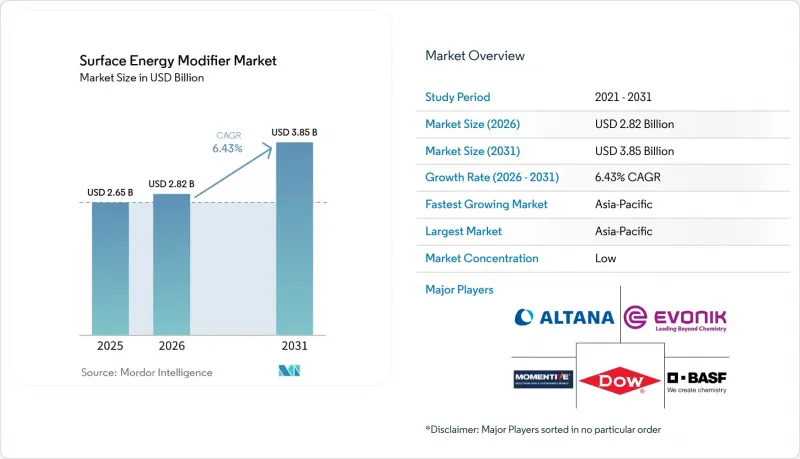
本報告按改質劑類型(矽基改質劑、氟聚合物基因改質劑)、基材(塑膠/聚合物、金屬、玻璃等)、應用(塗料、印刷油墨、黏合劑/密封劑等)和地區(亞太地區、北美地區、歐洲地區、南美地區、中東和非洲地區)進行細分。市場預測以美元計價。
全球表面能改質劑市場趨勢及洞察
水性配方和低VOC配方的應用日益廣泛
基於歐盟化學品註冊、評估、授權和限制(REACH)框架、美國環保署(EPA)有毒物質控制法(TSCA)以及中國生態環境部標準的法規,正推動塗料和油墨系統從溶劑型轉變為水性系統。由於水性和輻射固化配方需要添加劑來改善其在基材上的潤濕性和成膜性,因此表面能改質劑市場從中受益。水的表面張力為72毫牛/米,而典型有機溶劑的表面張力為20-30毫牛/米,這使得其難以自發潤濕基材。為了因應高pH值水性噴墨墨水的挑戰以及傳統矽氧烷基添加劑在長期儲存過程中效力下降的問題,贏創於2025年4月推出了「TEGO Wet 288」。雖然在成熟的北美和歐洲市場,90%的建築塗料配方都是水性體系,但亞太地區的滲透率較低,顯示該地區仍有進一步推廣的空間。此外,對於表面能改質劑市場的配方開發人員而言,水性配方具有較高的表面能,因此在向低VOC系統過渡時,需要更穩定的表面控制添加劑。
高性能塗料、油墨和黏合劑對添加劑的需求
汽車原始設備製造商 (OEM)、電子產品製造商和食品包裝加工商正在提高塗料和黏合劑的性能要求。表面能改質劑市場正透過改進抗刮性、紫外線耐久性、潤濕性均勻性和黏合力的產品來滿足這些要求。汽車車身面板通常由鋼、鋁和熱塑性聚烯等不同表面能特性的零件組成,因此傳統的添加劑可能無法滿足需求。 2025 年,贏創推出了“TEGO Addbond LTK”和“TEGO Addbond LTK-B”,作為用於鋼基材的聚酯基粘合促進劑,鋼基材佔預塗金屬產品的 65%。在印刷基板和先進封裝的三防膠,需要能夠在低表面能層壓板上形成均勻、無剝離的奈米級薄膜。隨著電動車重量的減輕,即使在熱循環條件下也能黏合碳纖維增強聚合物、鋁和鋼的黏合劑系統需求日益成長。
化合物相容性和層間黏合性的挑戰
表面能改質劑會遷移到介面,幫助控制潤濕性和表面張力,但添加不當或過量會破壞多層塗層系統。矽基改質劑會顯著降低塗層的表面能,導致後續塗層無法有效潤濕。這會導致層間附著力差,進而可能造成汽車和工業塗裝生產線上的返工或產品缺陷。由於水性配方與溶劑型標準配方在pH值、離子強度和助溶劑含量方面存在差異,表面能改質劑市場正轉向水性配方,這使得上述挑戰更加嚴峻。電塗裝底漆、水性底塗層和透明塗層系統的合格測試可能需要六個月或更長時間,導致配方變更的延遲。反應型矽酮改質劑在固化過程中可以與聚合物網路結合,抑制後續遷移,但其高昂的成本和需要合格限制了其在注重成本的客戶中的應用。
細分市場分析
按類型分析改質劑,預計到2025年,矽基改質劑將佔表面能改質劑市場38.56%的佔有率。聚二甲基矽氧烷和聚醚改質矽氧烷化合物適用於水性、溶劑型、紫外光固化和輻射固化系統。它們能夠降低表面張力、抑制發泡,並改善各種配方中基材的潤濕性和流平性。雖然傳統矽酮在多層塗層中可能導致遷移問題,但含有丙烯酸酯、羥基或環氧基團的反應型矽酮可以在固化膜內發生交聯,例如BYK公司用於紫外印刷油墨和罩光漆的“UV 3590”和“UV 3595”產品就證明了這一點。這種技術多樣性確保了矽酮產品即使在無氟替代品日益受到關注的情況下,仍能繼續發揮重要作用。
預計到2031年,氟聚合物改質劑的複合年成長率將達到7.21%。這一成長反映了半導體製造、阻隔性食品包裝和特種工業塗料等領域的剩餘需求,在這些領域,替代品尚未完全滿足所有性能要求。同時,低分子量氟聚合物的監管規定也在不斷完善,其監管地位與某些高分子量含氟聚合物有所不同。隨著氟替代技術的進步,丙烯酸酯改質劑正逐漸成為替代選擇,而聚烯和蠟基產品則被應用於塑膠化合物、脫模劑和再生基材等領域。 2025年7月,BASF推出了三款採用矽改質聚丙烯酸酯化學技術的「Efka FL」流平劑,該技術可在不引起滑移的情況下改善流動性和潤濕性。
區域分析
到2025年,亞太地區將佔據表面能改質劑市場40.21%的佔有率,預計到2031年將以7.63%的複合年成長率成長。中國在Delta和珠江三角洲的電子組裝、軟性包裝加工和汽車塗料製造活動是該地區需求的主要驅動力。生態環境部的揮發性有機化合物(VOC)標準正在推動溶劑型產品轉向水溶性矽氧烷聚醚的轉變。日本和韓國仍然是印刷基板保護和UV固化Delta的高規格需求中心。同時,日本汽車OEM廠商需要具有抗刮性和防水性的透明塗層薄膜。印度是該地區成長最快的國內市場,這得益於包裝生產和汽車製造業的蓬勃發展。 Nuriyon在2025年11月開設上海研發中心後,於2026年擴大了其在廣州的膠體二氧化矽「Levasil」產能。這表明該供應商正在擴大其在亞太地區的製造和技術服務覆蓋範圍。
在北美,環境法規正在影響需求的品質和組成。儘管美國針對含氟物質的措施以及各州的相關法規正在推動合作研發,但汽車原始設備製造商(OEM)正在其電塗裝生產線中對高性能潤濕劑進行標準化。歐洲則採取了更嚴格的監管方式,歐洲化學品管理局(ECHA)正在審查歐盟關於全氟烷基和多氟烷基物質(PFAS)的擬議法規。德國、英國、法國和義大利佔據了歐洲塗料添加劑需求的大部分,其中德國汽車和工業機械產業尤其在製定關鍵規格方面發揮著重要作用。
在南美洲,巴西汽車組裝、軟包裝和建築塗料的需求推動了市場成長。 BrentTag 和 Nourion 於 2025 年達成的銷售協議擴大了巴西水性塗料和油墨添加劑的供應,儘管阿根廷和其他南美國家對價格的敏感度和供應鏈限制仍然很高。中東和非洲市場與建築和工業多元化密切相關,沙烏地阿拉伯「2030 願景」下的投資支持了工業和防護塗料的發展。在南非,汽車組裝和軟包裝的需求也促進了市場成長,但與亞太地區相比,該地區對技術主導配方的需求較低。
其他好處:
- Excel格式的市場預測(ME)表
- 3個月的分析師支持
目錄
第1章:引言
- 研究假設和市場定義
- 調查範圍
第2章:調查方法
第3章執行摘要
第4章 市場狀況
- 市場概覽
- 市場促進因素
- 水性及低VOC產品的使用日益普及
- 高性能塗料、油墨和黏合劑對添加劑的需求
- 在包裝、汽車、電子和建築業等領域的應用不斷擴展。
- 產品改良旨在實現無 PFAS 和無氟表面控制技術
- 高速塗佈和印刷需要動態潤濕控制
- 對再生基板和低表面能基板的需求增加
- 市場限制因素
- 配方相容性和層間黏合性方面的挑戰。
- 原物料價格波動
- PFAS替代品的性能和合規要求負擔
- 價值鏈分析
- 波特五力分析
第5章 市場規模與成長預測
- 按改質劑類型
- 矽基改質劑
- 氟聚合物基因改質劑
- 丙烯酸改質劑
- 其他類型的改質劑(聚烯基因改造劑、蠟基改質劑和其他表面能改質劑)
- 按基礎材料
- 塑膠和聚合物
- 金屬
- 玻璃
- 複合材料
- 其他基材(紙張、紙板、紡織品和其他基材)
- 透過使用
- 塗層
- 印刷油墨
- 黏合劑和密封劑
- 其他應用(塑膠化合物、薄膜和包裝、脫模劑及其他應用)
- 按地區
- 亞太地區
- 中國
- 印度
- 日本
- 韓國
- 其他亞太國家
- 北美洲
- 美國
- 加拿大
- 墨西哥
- 歐洲
- 德國
- 英國
- 法國
- 義大利
- 其他歐洲國家
- 南美洲
- 巴西
- 阿根廷
- 其他南美國家
- 中東和非洲
- 沙烏地阿拉伯
- 南非
- 其他中東和非洲國家
- 亞太地區
第6章 競爭情勢
- 市場集中度
- 策略趨勢
- 市佔率和排名分析
- 公司簡介
- ALTANA
- Arkema
- BASF
- CLARIANT
- Croda International Plc
- Dow
- Eastman Chemical Company
- Elementis PLC
- Evonik Industries AG
- Huntsman Corporation
- Lubrizol
- Michelman, Inc.
- Momentive
- Munzing Corporation
- Nouryon
第7章 市場機會與未來展望
According to Mordor Intelligence, the surface energy modifier market was valued at USD 2.65 billion in 2025 and is estimated to grow from USD 2.82 billion in 2026 to reach USD 3.85 billion by 2031, at a CAGR of 6.43% during the forecast period (2026-2031).
This report is Segmented by Modifier Type (Silicone-Based Modifiers, Fluoropolymer-Based Modifiers, and More), Substrate (Plastics and Polymers, Metals, Glass, and More), Application (Coatings, Printing Inks, Adhesives and Sealants, and More), and Geography (Asia-Pacific, North America, Europe, South America, and Middle-East and Africa). The Market Forecasts are Provided in Terms of Value (USD).
Global Surface Energy Modifier Market Trends and Insights
Rising Adoption of Waterborne and Low-VOC Formulations
Regulations under the European Union Registration, Evaluation, Authorisation and Restriction of Chemicals (REACH) framework, the U.S. Environmental Protection Agency (EPA) Toxic Substances Control Act (TSCA), and China's Ministry of Ecology and Environment standards have shifted coatings and inks away from solvent-borne chemistry. The surface energy modifier market benefits because waterborne and radiation-curable formulations need additives that improve substrate wetting and film formation. Water has a surface tension of 72 millinewtons per meter, compared with 20-30 millinewtons per meter for typical organic solvents, which makes spontaneous substrate wetting more difficult. Evonik introduced TEGO Wet 288 in April 2025 to address the reduced effectiveness of conventional siloxane additives in high-pH waterborne inkjet inks and during extended storage. Waterborne systems accounted for 90% of architectural coating formulations in mature North American and European markets, while lower penetration across the Asia-Pacific left room for additional adoption. Formulators in the surface energy modifier market also need more stable surface-control additives when moving to low-VOC systems because water-based formulations have higher surface energy.
Demand for High-Performance Coating, Ink, and Adhesive Additives
Automotive original equipment manufacturers, electronics producers, and food packaging converters have tightened performance specifications for coatings and adhesives. The surface energy modifier market serves these requirements through products that support scratch resistance, ultraviolet durability, wetting uniformity, and adhesion. Automotive body panels often combine steel, aluminum, and thermoplastic polyolefin parts, which have different surface energy profiles and cannot always use a single conventional additive. Evonik launched TEGO Addbond LTK and TEGO Addbond LTK-B in 2025 as polyester-based adhesion promoters for steel substrates, which accounted for 65% of pre-coated metal products. Printed circuit board conformal coatings and advanced semiconductor packages also require uniform nanoscale films on low-energy laminates without delamination. Lightweight electric vehicle construction adds demand for adhesive systems that bond carbon-fiber-reinforced polymer, aluminum, and steel under thermal cycling.
Formulation Compatibility and Intercoat Adhesion Challenges
Surface energy modifiers migrate to interfaces, which helps them manage wetting and surface tension but can disrupt multilayer coating systems when the additive is mismatched or overdosed. Silicone-based modifiers can lower film-surface energy enough to prevent a subsequent coat from wetting properly. This can cause intercoat adhesion failures and create rework or scrap in automotive and industrial finishing lines. The challenge becomes stronger during waterborne conversions in the surface energy modifier market because pH, ionic strength, and co-solvent levels differ from those in solvent-borne reference formulations. Qualification testing for electrocoat primer, waterborne basecoat, and clearcoat systems can exceed 6 months, which slows reformulation. Reactive silicone grades can bond into the polymer network during curing and limit later migration, but their price premium and requalification needs restrict use among cost-sensitive customers.
Other drivers and restraints analyzed in the detailed report include:
- Growth of Packaging, Automotive, Electronics, and Construction Applications
- PFAS-Free Reformulation and Fluorine-Free Surface-Control Technologies
- Raw Material Price Volatility
For complete list of drivers and restraints, kindly check the Table Of Contents.
Segment Analysis
By modifier type, silicone-based modifiers held 38.56% of the surface energy modifier market share in 2025. Polydimethylsiloxane and polyether-modified siloxane chemistries work in waterborne, solvent-borne, ultraviolet-curable, and radiation-curable systems. They reduce surface tension, control foam, and improve substrate wetting and leveling across different formulations. Conventional silicone migration can cause problems in multilayer coatings, but reactive grades with acrylate, hydroxyl, or epoxide groups can crosslink into the cured film, as shown by BYK's UV 3590 and UV 3595 products for ultraviolet printing inks and overprint varnishes. This technical range helps silicone grades remain relevant as fluorine-free alternatives gain attention.
Fluoropolymer-based modifiers are projected to advance at a 7.21% CAGR through 2031. Their growth reflects residual demand in semiconductor manufacturing, high-barrier food packaging, and specialty industrial coatings, where alternatives do not yet meet every performance requirement. This demand exists alongside restrictions on low-molecular-weight fluorosurfactants, which have a different regulatory position from certain high-molecular-weight fluoropolymers. Acrylic-based modifiers provide a growing alternative as fluorine substitution progresses, while polyolefin-based and wax-based products serve plastic compounding, mold release, and recycled-substrate applications. BASF introduced three Efka FL leveling agents in July 2025 using silicone-modified polyacrylate chemistry to improve flow and wetting without introducing slip.
Complete Report Scope:
- By Modifier Type
- Silicone-Based Modifiers
- Fluoropolymer-Based Modifiers
- Acrylic-Based Modifiers
- Other Modifier Types (Polyolefin-Based, Wax-Based, Other Surface Energy Modifiers)
- By Substrate
- Plastics and Polymers
- Metals
- Glass
- Composites
- Other Substrates (Paper and Paperboard, Textiles, Other Substrates)
- By Application
- Coatings
- Printing Inks
- Adhesives and Sealants
- Other Applications (Plastic Compounding, Films and Packaging, Mold Release, Other Applications)
- By Geography
- Asia-Pacific
- China
- India
- Japan
- South Korea
- Rest of Asia-Pacific
- North America
- United States
- Canada
- Mexico
- Europe
- Germany
- United Kingdom
- France
- Italy
- Rest of Europe
- South America
- Brazil
- Argentina
- Rest of South America
- Middle-East and Africa
- Saudi Arabia
- South Africa
- Rest of Middle-East and Africa
- Asia-Pacific
Geography Analysis
Asia-Pacific held 40.21% of the surface energy modifier market in 2025 and is projected to advance at a 7.63% CAGR through 2031. China drives regional demand through electronics assembly, flexible packaging conversion, and automotive paint activity in the Yangtze River Delta and Pearl River Delta. The Ministry of Ecology and Environment's volatile organic compound standards have supported a shift from solvent-based products toward water-compatible silicone polyethers. Japan and South Korea remain high-specification demand centers for printed circuit board protection and ultraviolet-curing systems, while Japanese automotive original equipment manufacturers require scratch-resistant and hydrophobic clearcoat films. India is the fastest-growing national market in the region, supported by packaging production and automotive manufacturing. Nouryon expanded Levasil colloidal silica capacity in Guangzhou in 2026 after opening its Shanghai innovation center in November 2025, showing how suppliers are increasing manufacturing and technical service coverage in Asia-Pacific.
In North America, environmental requirements influence the quality and composition of demand. U.S. actions on fluorinated substances and state restrictions have increased co-development work, while automotive original equipment manufacturers have standardized high-performance wetting agents in electrodeposition primer lines. Europe follows a stricter regulatory path, with the European Chemicals Agency reviewing the European Union's per- and polyfluoroalkyl substance restriction proposal. Germany, the United Kingdom, France, and Italy account for much of European coatings additive demand, with Germany's automotive and industrial machinery base setting important specifications.
South America is led by Brazil's automotive assembly, flexible packaging, and architectural coatings demand. Brenntag's 2025 distribution agreement with Nouryon expanded access to waterborne paint and ink additives in Brazil, while Argentina and the Rest of South America remain more price-sensitive and face supply-chain limitations. The Middle-East and Africa markets are linked to construction and industrial diversification, with Saudi Arabia's Vision 2030 investments supporting industrial and protective coatings. South Africa adds demand from automotive assembly and flexible packaging, but the region has less technology-led formulation demand than the Asia-Pacific.
- ALTANA
- Arkema
- BASF
- CLARIANT
- Croda International Plc
- Dow
- Eastman Chemical Company
- Elementis PLC
- Evonik Industries AG
- Huntsman Corporation
- Lubrizol
- Michelman, Inc.
- Momentive
- Munzing Corporation
- Nouryon
Additional Benefits:
- The market estimate (ME) sheet in Excel format
- 3 months of analyst support
TABLE OF CONTENTS
1 Introduction
- 1.1 Study Assumptions and Market Definition
- 1.2 Scope of the Study
2 Research Methodology
3 Executive Summary
4 Market Landscape
- 4.1 Market Overview
- 4.2 Market Drivers
- 4.2.1 Rising Adoption of Waterborne and Low-VOC Formulations
- 4.2.2 Demand for High-Performance Coating, Ink, and Adhesive Additives
- 4.2.3 Growth of Packaging, Automotive, Electronics, and Construction Applications
- 4.2.4 PFAS-Free Reformulation and Fluorine-Free Surface-Control Technologies
- 4.2.5 High-Speed Coating and Printing Requiring Dynamic Wetting Control
- 4.2.6 Additive Demand for Recycled and Low-Surface-Energy Substrates
- 4.3 Market Restraints
- 4.3.1 Formulation Compatibility and Intercoat Adhesion Challenges
- 4.3.2 Raw Material Price Volatility
- 4.3.3 Performance and Qualification Burden for PFAS Alternatives
- 4.4 Value Chain Analysis
- 4.5 Porter's Five Forces Analysis
- 4.5.1 Bargaining Power of Suppliers
- 4.5.2 Bargaining Power of Buyers
- 4.5.3 Threat of New Entrants
- 4.5.4 Threat of Substitutes
- 4.5.5 Competitive Rivalry
5 Market Size and Growth Forecasts (Value)
- 5.1 By Modifier Type
- 5.1.1 Silicone-Based Modifiers
- 5.1.2 Fluoropolymer-Based Modifiers
- 5.1.3 Acrylic-Based Modifiers
- 5.1.4 Other Modifier Types (Polyolefin-Based, Wax-Based, Other Surface Energy Modifiers)
- 5.2 By Substrate
- 5.2.1 Plastics and Polymers
- 5.2.2 Metals
- 5.2.3 Glass
- 5.2.4 Composites
- 5.2.5 Other Substrates (Paper and Paperboard, Textiles, Other Substrates)
- 5.3 By Application
- 5.3.1 Coatings
- 5.3.2 Printing Inks
- 5.3.3 Adhesives and Sealants
- 5.3.4 Other Applications (Plastic Compounding, Films and Packaging, Mold Release, Other Applications)
- 5.4 By Geography
- 5.4.1 Asia-Pacific
- 5.4.1.1 China
- 5.4.1.2 India
- 5.4.1.3 Japan
- 5.4.1.4 South Korea
- 5.4.1.5 Rest of Asia-Pacific
- 5.4.2 North America
- 5.4.2.1 United States
- 5.4.2.2 Canada
- 5.4.2.3 Mexico
- 5.4.3 Europe
- 5.4.3.1 Germany
- 5.4.3.2 United Kingdom
- 5.4.3.3 France
- 5.4.3.4 Italy
- 5.4.3.5 Rest of Europe
- 5.4.4 South America
- 5.4.4.1 Brazil
- 5.4.4.2 Argentina
- 5.4.4.3 Rest of South America
- 5.4.5 Middle-East and Africa
- 5.4.5.1 Saudi Arabia
- 5.4.5.2 South Africa
- 5.4.5.3 Rest of Middle-East and Africa
- 5.4.1 Asia-Pacific
6 Competitive Landscape
- 6.1 Market Concentration
- 6.2 Strategic Moves
- 6.3 Market Share (%)/Ranking Analysis
- 6.4 Company Profiles (includes Global Overview, Market Overview, Core Segments, Financials as available, Strategic Information, Products and Services, and Recent Developments)
- 6.4.1 ALTANA
- 6.4.2 Arkema
- 6.4.3 BASF
- 6.4.4 CLARIANT
- 6.4.5 Croda International Plc
- 6.4.6 Dow
- 6.4.7 Eastman Chemical Company
- 6.4.8 Elementis PLC
- 6.4.9 Evonik Industries AG
- 6.4.10 Huntsman Corporation
- 6.4.11 Lubrizol
- 6.4.12 Michelman, Inc.
- 6.4.13 Momentive
- 6.4.14 Munzing Corporation
- 6.4.15 Nouryon
7 Market Opportunities and Future Outlook
- 7.1 White-Space and Unmet-Need Assessment

 PVD濺鍍塗層材料市場:全球市場預測,2026-2032年鉻酸鹽轉化塗層服務市場:全球市場預測,2026-2032年
 全球家用電器粉末塗料市場(至 2031 年):按樹脂類型(熱固性樹脂和熱塑性樹脂)和地區(亞太地區、歐洲、北美、南美、中東和非洲)分類
 超細纖維防脫落塗層:市場佔有率分析、行業趨勢和統計數據、成長預測(2026-2031 年)
 紫外光固化聚合物市場規模、佔有率和成長分析:按樹脂類型、應用、最終用戶、固化方法、形態和地區分類-2026-2033年產業預測
 紡織功能化學品市場:預測至2034年-按化學品類型、加工階段、纖維類型、功能特性、纖維類別和地區分類的全球分析高性能分散劑市場預測至2034年—按分散劑類型、相容性、分散介質、性能特徵、最終用戶和地區分類的全球分析高熵材料市場預測至2034年-全球材料類型、材料系統、成分、製造方法、形態、應用、終端用戶產業及區域分析
 2026年全球道路穩定聚合物市場報告先進表面工程市場預測至2034年—全球技術、材料、性能、應用、產業和區域分析