


 |
市場調查報告書
商品編碼
2119323
超細纖維防脫落塗層:市場佔有率分析、行業趨勢和統計數據、成長預測(2026-2031 年)Microfiber-Shedding Suppression Coatings - Market Share Analysis, Industry Trends & Statistics, Growth Forecasts (2026 - 2031) |
||||||

※ 本網頁內容可能與最新版本有所差異。詳細情況請與我們聯繫。
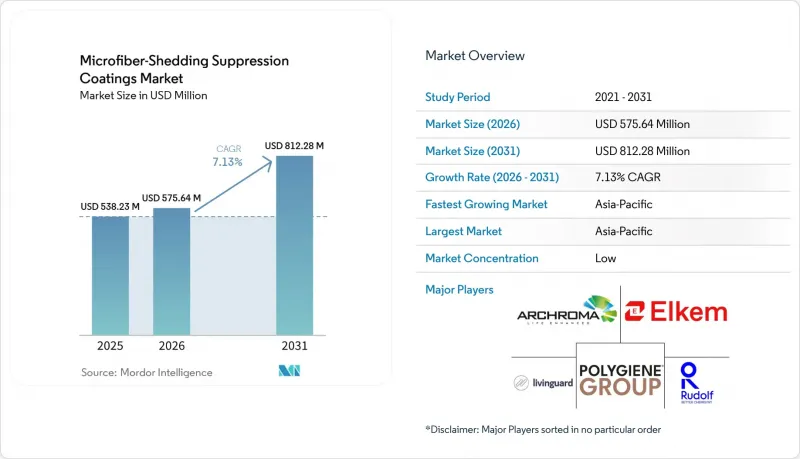
根據 Mordor Intelligence 預測,到 2025 年,超細纖維防脫落塗層市場規模將達到 5.3823 億美元,到 2026 年將達到 5.7564 億美元,到 2031 年將達到 8.1228 億美元。
預測期(2026-2031 年)的複合年成長率預計為 7.13%。
本報告按塗料類型(聚合物塗料等)、紡織基材(聚酯、尼龍、壓克力等)、配方(水性配方等)、終端應用產業(服裝時尚等)和地區(亞太、北美、歐洲、南美、中東和非洲)進行細分。市場預測以美元計價。
全球超細纖維防脫落塗層市場趨勢及洞察
品牌商和零售商對纖維脫落量可衡量的減少的需求日益成長。
品牌採購規範是超細纖維防脫落塗層市場的主要需求促進因素。這些規範有助於將未來的監管風險納入現有供應商契約,並將合規責任轉移給紡紗廠。一些運動和戶外品牌正在將量化的纖維脫落減少要求納入供應商規範,這可能要求供應商在法規生效前採用塗層。能夠根據國際標準化組織 (ISO) 4484-1 或美國紡織化學家和染色家協會 (AATCC) TM212 方法記錄洗滌測試數據的供應商,可以協助進行優選供應商選擇討論,並為紡紗廠提供買方審核所需的證據。由耐吉、阿迪達斯、H&M、蓋璞和瑪莎百貨支持的超細纖維聯盟的「2030 年藍圖」將可衡量的纖維脫落減少量列為一項基本要求。這項要求使得性能文件在超細纖維防脫落塗層市場的紡織品整理決策中發揮更直接的商業性作用。
水性及無溶劑整理化學品的廣泛應用
從溶劑型系統轉向水性及無溶劑化學品的轉變,為超細纖維防脫落塗層市場帶來了配方改良的機會。紡絲企業可以在配方改良週期內,無需更換所有塗層設備,即可在現有整理配方中添加功能性塗層,從而使現有營運結構內的轉型更加可行。 2025年2月,昂高(Archroma)、蒙特福特(Monforts)和BW Converting聯合發布報告稱,與傳統軋染製程相比,TexCoat G4數位噴塗製程可減少高達50%的水、化學品和能源消耗。 2025年的評估顯示,水性聚氨酯分散體在30次洗滌循環後仍維持90%以上的抗菌性能,並達到50以上的紫外線防護係數(UPF)。此外,精準的噴塗工藝可減少塗層疊加,並保持織物的透氣性,這對於功能性服裝至關重要。 「零有害化學物質(ZDHC)」合規性、Gateway標準和Bluesign認證等標準,持續推動企業採購經檢驗的低排放整理化學品。
全球微纖維排放檢測規程缺乏統一性
國際標準化組織 (ISO) 4484-1、美國紡織化學家和染料商協會 (AATCC) TM212 以及微纖維聯盟的測試方法在整個採購流程中可能無法直接比較結果。因此,為跨國品牌供貨的紡紗廠可能需要進行平行測試,並承擔額外的實驗室成本。這些額外的檢驗程序可能會延長紡紗廠驗證所有客戶性能聲明所需的時間,從而可能延遲商業化部署。雖然歐洲的要求擴大採用 ISO調查方法,但北美零售商可能仍會繼續引用美國紡織化學家和染料商協會 (AATCC) TM212。亞洲市場的國內標準則為跨區域營運的供應商增加了另一層要求。
細分市場分析
2025年,聚合物基塗料佔據了超細纖維防脫落塗料市場42.18%的佔有率。這一地位得益於其與多種基材的兼容性、成熟的供應鏈以及在各種測試框架下均表現出的優異耐洗性。聚合物黏合劑系統可根據纖維和織物結構進行客製化,幫助供應商滿足多樣化的後整理需求。 2025年發表的一項研究發現,撚係數為400的賽羅緊密紡絲製程能夠減少起毛和超細纖維脫落,顯示底布結構會影響塗層效果。因此,能夠根據纖維結構客製化化學成分而非提供單一通用後整理劑的供應商更受青睞。
預計到2031年,生物基塗料市場將以9.03%的複合年成長率成長。品牌方針對生物基碳的推廣活動以及與「零有害化學物質(ZDHC)」標準相關的規範,正在推動人們對生物基黏合劑的興趣。這些體係正在拓寬超細纖維防脫落塗料市場中使用的聚合物選擇範圍。矽基塗料因其能夠改善觸感和防水性能,在高檔外套領域繼續發揮重要作用。奈米技術產品被歸類為“其他塗料類型”,目前研究活動日益活躍,但商業化仍處於早期階段。
截至2025年,以紡織基材分類,聚酯纖維在超細纖維防脫落塗層市場中佔47.24%。此外,預計到2031年,聚酯纖維市場將以7.78%的複合年成長率成長。這項預測是基於聚酯纖維在全球紡織品生產中的高佔比以及洗滌過程中纖維脫落的風險。針對聚酯纖維最佳化的供應商正在抓住超細纖維防脫落塗層市場的商機,但該領域的競爭日益激烈。在這一領域,即使經過反覆洗滌,仍能保持性能且不改變織物預期性能的塗層備受青睞。
尼龍運動服的針織布料在洗滌過程中會掉落大量纖維。因此,針對尼龍布料最佳化的配方可以幫助倡導積極生活方式的品牌確立高階市場地位。對於專注於室內空氣微塑膠的家居服品牌而言,腈綸布料的掉纖維問題已成為關鍵考慮因素。其他紡織基材類別包括用於汽車和過濾紡織品的聚丙烯和聚醯胺-聚酯混紡織物。修訂後的2025年OEKO-TEX®標準要求認證化學品必須具備生物分解性,這推動了所有基材類型對生物基化學品的需求。
區域分析
預計到2025年,亞太地區將佔全球超細纖維防脫落塗層市場34.37%的佔有率,並在2031年之前以8.68%的複合年成長率成長。該地區擁有大規模的染色和整理能力,以及日益嚴格的測試要求。在中國,關於洗滌法測定纖維脫落的標準GB/T 45513-2025於2025年4月發布,並於2025年11月生效。此外,關於滾筒黏附法測定纖維脫落的標準FZ/T 01185-2025於2025年12月發布,並於2026年7月生效。
在北美,美國品牌的採購規範推動了紡織供應鏈中對檢驗的纖維脫落減少技術的需求。這種需求環境支撐了為美國品牌供貨的紡紗廠對減少微纖維脫落塗層的市場。歐盟的紡織品政策框架和數位產品護照也為歐洲市場提供了支持。歐盟委員會已將紡織品列為數位產品護照框架內的優先產品類別,並將透過授權法規制定特定的產品要求。德國、法國和義大利在歐洲市場中扮演著核心角色,其中德國工業紡織品製造商滿足了對性能認證系統的需求。
南美洲、中東和非洲雖然是規模較小的區域市場,但卻蘊藏著豐富的商機。巴西和阿根廷是南美洲的主要需求來源,尤其是在為全球買家提供符合紡織品標準的紡紗廠方面。許多塗層無需大規模的資本投資,利用現有的軋棉和排氣生產線即可降低實施成本。沙烏地阿拉伯透過其「2030願景」下的工業紡織活動以及對用於超細纖維防脫落塗層市場的國際認證化學產品的關注,為中東和非洲的需求提供了支持。
其他好處:
- Excel格式的市場預測(ME)表
- 3個月的分析師支持
目錄
第1章:引言
- 研究假設和市場定義
- 調查範圍
第2章:調查方法
第3章執行摘要
第4章 市場狀況
- 市場概覽
- 市場促進因素
- 品牌商和零售商越來越要求減少纖維脫落的數量。
- 水性及無溶劑整理化學品的應用日益廣泛
- 結合超細纖維控制技術,兼具除臭、防起毛球、耐用等優點。
- 功能性纖維和合成纖維的消耗量增加
- 利用現有的隔熱材料和排氣系統進行低成本維修的可能性。
- 標準化纖維碎片檢測作為採購指標的出現。
- 市場限制因素
- 全球微纖維排放測試規程的協調統一程度有限。
- 紡織廠額外的混紡和製程驗證成本
- 使用過程中存在塗層劣化和二次顆粒釋放的風險
- 減少掉毛、手感、透氣性和可回收性之間可能存在權衡。
- 價值和供應鏈分析
- 波特五力模型
第5章 市場規模與成長預測
- 按塗層類型
- 聚合物基塗料
- 矽基塗層
- 生物基塗料
- 其他塗層類型(無氟功能塗層、奈米技術塗層和其他特殊塗層)
- 纖維基材料
- 聚酯纖維
- 尼龍
- 丙烯酸纖維
- 其他纖維基材(聚丙烯、聚醯胺/聚酯混合物及其他合成纖維基材)
- 按配方形式
- 水性配方
- 溶劑型配方
- 無溶劑配方
- 其他製劑基質(粉末和固態製劑、混合製劑)
- 按最終用途行業分類
- 服裝與時尚
- 家用紡織品
- 技術紡織品
- 汽車紡織品
- 其他終端用途產業(工業紡織品、運動服和戶外裝備、醫療保健和衛生紡織品)
- 按地區
- 亞太地區
- 中國
- 印度
- 日本
- 韓國
- 其他亞太國家
- 北美洲
- 美國
- 加拿大
- 墨西哥
- 歐洲
- 德國
- 英國
- 法國
- 義大利
- 其他歐洲國家
- 南美洲
- 巴西
- 阿根廷
- 其他南美國家
- 中東和非洲
- 沙烏地阿拉伯
- 南非
- 其他中東和非洲國家
- 亞太地區
第6章 競爭情勢
- 市場集中度
- 策略趨勢
- 市佔率和排名分析
- 公司簡介
- Archroma
- BASF
- CLARIANT
- Covestro
- Dow
- Elkem ASA
- Evonik Industries AG
- HeiQ Materials AG
- Huntsman International LLC
- Livinguard
- NICCA CHEMICAL CO.,LTD.
- Polygiene Group AB
- RUDOLF Holding SE & Co. KG
- Tanatex Chemicals BV
第7章 市場機會與未來展望
According to Mordor Intelligence, the microfiber-Shedding suppression coatings market was valued at USD 538.23 million in 2025 and is estimated to grow from USD 575.64 million in 2026 to reach USD 812.28 million by 2031, at a CAGR of 7.13% during the forecast period (2026-2031).
This report is Segmented by Coating Type (Polymer-Based Coatings, and More), Textile Substrate (Polyester, Nylon, Acrylic, and More), Formulation Basis (Waterborne Formulations, and More), End-Use Industry (Apparel and Fashion, and More), and Geography (Asia-Pacific, North America, Europe, South America, and Middle-East and Africa). The Market Forecasts are Provided in Terms of Value (USD).
Global Microfiber-Shedding Suppression Coatings Market Trends and Insights
Growth in Brand and Retailer Requirements for Measurable Fiber-Shedding Reduction
Brand procurement specifications are a major demand factor for the microfiber-shedding suppression coatings market. They shift future regulatory risk into current supplier contracts and move compliance responsibility toward mills. Several sports and outdoor brands have incorporated quantified shedding-reduction requirements into supplier specifications, which can require coating adoption before legislation takes effect. Suppliers with documented wash-test data from International Organization for Standardization (ISO) 4484-1 or American Association of Textile Chemists and Colorists (AATCC) TM212 methods can support preferred-supplier discussions and give mills evidence for buyer audits. The Microfibre Consortium's 2030 Roadmap, supported by Nike, Adidas, H&M, Gap, and Marks & Spencer, treats measurable fiber-fragment reduction as a baseline expectation. This requirement gives performance documentation a more direct commercial role in textile finishing decisions across the microfiber-shedding suppression coatings market.
Increasing Adoption of Waterborne and Solvent-Free Finishing Chemistries
The move from solvent-based systems to waterborne and solvent-free chemistry creates reformulation opportunities for the microfiber-shedding suppression coatings market. Mills can add functional coatings to existing finishing recipes during these reformulation cycles without replacing all application equipment, which makes the transition more practical for established operations. Archroma, Monforts, and BW Converting reported in February 2025 that TexCoat G4 digital spray application reduced water, chemistry, and energy use by up to 50% compared with traditional pad processes. A 2025 review found that waterborne polyurethane dispersions maintained antibacterial performance above 90% after 30 wash cycles and achieved Ultraviolet Protection Factor protection above 50. Precision spray application can also reduce over-application and help retain fabric breathability, a key requirement in performance apparel. Zero Discharge of Hazardous Chemicals (ZDHC), Gateway alignment, and Bluesign certification continue to guide sourcing toward verified lower-emission finishing chemistry.
Limited Harmonization of Global Microfiber-Shedding Test Protocols
International Organization for Standardization 4484-1, American Association of Textile Chemists and Colorists TM212, and The Microfibre Consortium method can produce results that are not directly comparable across procurement workflows. Mills supplying multinational brands may therefore need parallel testing programs and additional laboratory spending. The extra validation steps can extend the period before a mill confirms performance claims to every customer and can delay commercial deployment. European requirements may increasingly use International Organization for Standardization methodology, while North American retailers may continue to cite American Association of Textile Chemists and Colorists TM212. Domestic standards in Asian markets add another layer of requirements for suppliers operating across regions.
Other drivers and restraints analyzed in the detailed report include:
- Expansion of Performance Textiles and Synthetic Fiber Consumption
- Emergence of Standardized Fiber-Fragment Testing as a Purchasing Metric
- Additional Formulation and Process Validation Costs for Textile Mills
For complete list of drivers and restraints, kindly check the Table Of Contents.
Segment Analysis
Polymer-based coatings held 42.18% of the microfiber-shedding suppression coatings market share in 2025. Their position reflected broad substrate compatibility, established supply chains, and wash-durability results across testing frameworks. Polymer binder systems can be customized for fiber structures and fabric constructions, which helps suppliers serve diverse finishing requirements. Research published in 2025 found that Siro compact spinning with a twist factor of 400 achieved low hairiness and microfiber release, showing that substrate construction affects coating outcomes. These conditions favor suppliers that can adapt chemistry to the textile construction rather than offer a single generic finish.
Bio-based coatings are projected to grow at a 9.03% CAGR through 2031. Brand commitments on biogenic carbon and specifications linked to the Zero Discharge of Hazardous Chemicals gateway support interest in bio-derived binders. These systems are extending the range of polymer options used in the microfiber-shedding suppression coatings market. Silicone-based coatings remain relevant for premium outerwear because they can support hand feel and water management. Nanotechnology-based products in the other coating types category are drawing research activity but remain at an earlier commercial stage.
Polyester accounted for 47.24% of the microfiber-shedding suppression coatings market size by textile substrate in 2025. Polyester is also forecast to expand at a 7.78% CAGR through 2031. Its large scale in global fiber production and fragmentation risk during laundering support both measures. Suppliers that optimize for polyester address the opportunity in the microfiber-shedding suppression coatings market, although this area also has high competitive density. The segment rewards coatings that maintain performance over repeated laundering without changing intended fabric properties.
Nylon activewear knits can release high levels of fiber during washing. Nylon-optimized formulations can therefore carry a premium position with active-lifestyle brands. Acrylic represents a relevant shedding concern for homeware brands focused on indoor air microplastics. The other textile substrates category includes polypropylene and polyamide-polyester blends used in automotive and filtration textiles. Updated 2025 OEKO-TEX criteria requiring evidence of biological degradability for certified chemicals support demand for bio-derived chemistry across substrate types.
Complete Report Scope:
- By Coating Type
- Polymer-Based Coatings
- Silicone-Based Coatings
- Bio-Based Coatings
- Other Coating Types (Fluorine-Free Functional Coatings, Nanotechnology-Based Coatings, Other Specialty Coatings)
- By Textile Substrate
- Polyester
- Nylon
- Acrylic
- Other Textile Substrates (Polypropylene, Polyamide-Polyester Blends, Other Synthetic Textile Substrates)
- By Formulation Basis
- Waterborne Formulations
- Solventborne Formulations
- Solvent-Free Formulations
- Other Formulation Bases (Powder and Solid-Content Formulations, Hybrid Formulations)
- By End-Use Industry
- Apparel and Fashion
- Home Textiles
- Technical Textiles
- Automotive Textiles
- Other End-Use Industries (Industrial Textiles, Sportswear and Outdoor Products, Healthcare and Hygiene Textiles)
- By Geography
- Asia-Pacific
- China
- India
- Japan
- South Korea
- Rest of Asia-Pacific
- North America
- United States
- Canada
- Mexico
- Europe
- Germany
- United Kingdom
- France
- Italy
- Rest of Europe
- South America
- Brazil
- Argentina
- Rest of South America
- Middle-East and Africa
- Saudi Arabia
- South Africa
- Rest of Middle-East and Africa
- Asia-Pacific
Geography Analysis
Asia-Pacific held 34.37% of the microfiber-shedding suppression coatings market share in 2025 and is forecast to grow at an 8.68% CAGR through 2031. The region combines large dyeing and finishing capacity with increasingly formal testing requirements. China published GB/T 45513-2025 for washing-based fiber-loss measurement in April 2025, and it took effect in November 2025. China also published FZ/T 01185-2025 for drum-adhesion fiber-loss determination in December 2025, and the standard took effect in July 2026.
In North America, U.S. brand sourcing specifications support demand for validated shedding reduction in textile supply chains. This demand environment supports the microfiber-shedding suppression coatings market among mills serving U.S. brands. The European Union policy framework for textiles and digital product passports supports Europe. The European Commission identifies textiles as a priority product group for the digital product passport framework, and product-specific requirements will be developed through delegated acts. Germany, France, and Italy anchor European value, while German technical textile producers support demand for performance-certified systems.
South America, and Middle-East and Africa are smaller regional markets with targeted opportunities. Brazil and Argentina lead South American demand, particularly where mills serve global buyers with textile standards. Existing padding and exhaust lines can lower adoption costs because many coatings do not require major capital equipment. Saudi Arabia supports Middle-East and Africa demand through Vision 2030 industrial textile activity and interest in internationally certified chemistry for the microfiber-shedding suppression coatings market.
- Archroma
- BASF
- CLARIANT
- Covestro
- Dow
- Elkem ASA
- Evonik Industries AG
- HeiQ Materials AG
- Huntsman International LLC
- Livinguard
- NICCA CHEMICAL CO.,LTD.
- Polygiene Group AB
- RUDOLF Holding SE & Co. KG
- Tanatex Chemicals B.V.
Additional Benefits:
- The market estimate (ME) sheet in Excel format
- 3 months of analyst support
TABLE OF CONTENTS
1 Introduction
- 1.1 Study Assumptions and Market Definition
- 1.2 Scope of the Study
2 Research Methodology
3 Executive Summary
4 Market Landscape
- 4.1 Market Overview
- 4.2 Market Drivers
- 4.2.1 Growth in Brand and Retailer Requirements for Measurable Fiber-Shedding Reduction
- 4.2.2 Increasing Adoption of Waterborne and Solvent-Free Finishing Chemistries
- 4.2.3 Integration of Microfiber Control With Odor, Anti-Pilling, and Durability Benefits
- 4.2.4 Expansion of Performance Textiles and Synthetic Fiber Consumption
- 4.2.5 Lower-Cost Retrofit Potential Through Existing Padding and Exhaust Equipment
- 4.2.6 Emergence of Standardized Fiber-Fragment Testing as a Purchasing Metric
- 4.3 Market Restraints
- 4.3.1 Limited Harmonization of Global Microfiber-Shedding Test Protocols
- 4.3.2 Additional Formulation and Process Validation Costs for Textile Mills
- 4.3.3 Risk of Coating Degradation and Secondary Particle Release During Use
- 4.3.4 Potential Trade-Offs Between Shedding Reduction, Hand Feel, Breathability, and Recyclability
- 4.4 Value and Supply-Chain Analysis
- 4.5 Porter's Five Forces
- 4.5.1 Bargaining Power of Suppliers
- 4.5.2 Bargaining Power of Buyers
- 4.5.3 Threat of New Entrants
- 4.5.4 Threat of Substitutes
- 4.5.5 Competitive Rivalry
5 Market Size and Growth Forecasts (Value)
- 5.1 By Coating Type
- 5.1.1 Polymer-Based Coatings
- 5.1.2 Silicone-Based Coatings
- 5.1.3 Bio-Based Coatings
- 5.1.4 Other Coating Types (Fluorine-Free Functional Coatings, Nanotechnology-Based Coatings, Other Specialty Coatings)
- 5.2 By Textile Substrate
- 5.2.1 Polyester
- 5.2.2 Nylon
- 5.2.3 Acrylic
- 5.2.4 Other Textile Substrates (Polypropylene, Polyamide-Polyester Blends, Other Synthetic Textile Substrates)
- 5.3 By Formulation Basis
- 5.3.1 Waterborne Formulations
- 5.3.2 Solventborne Formulations
- 5.3.3 Solvent-Free Formulations
- 5.3.4 Other Formulation Bases (Powder and Solid-Content Formulations, Hybrid Formulations)
- 5.4 By End-Use Industry
- 5.4.1 Apparel and Fashion
- 5.4.2 Home Textiles
- 5.4.3 Technical Textiles
- 5.4.4 Automotive Textiles
- 5.4.5 Other End-Use Industries (Industrial Textiles, Sportswear and Outdoor Products, Healthcare and Hygiene Textiles)
- 5.5 By Geography
- 5.5.1 Asia-Pacific
- 5.5.1.1 China
- 5.5.1.2 India
- 5.5.1.3 Japan
- 5.5.1.4 South Korea
- 5.5.1.5 Rest of Asia-Pacific
- 5.5.2 North America
- 5.5.2.1 United States
- 5.5.2.2 Canada
- 5.5.2.3 Mexico
- 5.5.3 Europe
- 5.5.3.1 Germany
- 5.5.3.2 United Kingdom
- 5.5.3.3 France
- 5.5.3.4 Italy
- 5.5.3.5 Rest of Europe
- 5.5.4 South America
- 5.5.4.1 Brazil
- 5.5.4.2 Argentina
- 5.5.4.3 Rest of South America
- 5.5.5 Middle-East and Africa
- 5.5.5.1 Saudi Arabia
- 5.5.5.2 South Africa
- 5.5.5.3 Rest of Middle-East and Africa
- 5.5.1 Asia-Pacific
6 Competitive Landscape
- 6.1 Market Concentration
- 6.2 Strategic Moves
- 6.3 Market Share (%)/Ranking Analysis
- 6.4 Company Profiles (includes Global Overview, Market Overview, Core Segments, Financials as available, Strategic Information, Products and Services, and Recent Developments)
- 6.4.1 Archroma
- 6.4.2 BASF
- 6.4.3 CLARIANT
- 6.4.4 Covestro
- 6.4.5 Dow
- 6.4.6 Elkem ASA
- 6.4.7 Evonik Industries AG
- 6.4.8 HeiQ Materials AG
- 6.4.9 Huntsman International LLC
- 6.4.10 Livinguard
- 6.4.11 NICCA CHEMICAL CO.,LTD.
- 6.4.12 Polygiene Group AB
- 6.4.13 RUDOLF Holding SE & Co. KG
- 6.4.14 Tanatex Chemicals B.V.
7 Market Opportunities and Future Outlook
- 7.1 White-Space and Unmet-Need Assessment

 PVD濺鍍塗層材料市場:全球市場預測,2026-2032年鉻酸鹽轉化塗層服務市場:全球市場預測,2026-2032年
 全球家用電器粉末塗料市場(至 2031 年):按樹脂類型(熱固性樹脂和熱塑性樹脂)和地區(亞太地區、歐洲、北美、南美、中東和非洲)分類
 表面能改質劑:市場佔有率分析、產業趨勢與統計、成長預測(2026-2031)
 紫外光固化聚合物市場規模、佔有率和成長分析:按樹脂類型、應用、最終用戶、固化方法、形態和地區分類-2026-2033年產業預測
 紡織功能化學品市場:預測至2034年-按化學品類型、加工階段、纖維類型、功能特性、纖維類別和地區分類的全球分析高性能分散劑市場預測至2034年—按分散劑類型、相容性、分散介質、性能特徵、最終用戶和地區分類的全球分析高熵材料市場預測至2034年-全球材料類型、材料系統、成分、製造方法、形態、應用、終端用戶產業及區域分析
 2026年全球道路穩定聚合物市場報告先進表面工程市場預測至2034年—全球技術、材料、性能、應用、產業和區域分析