


 |
市場調查報告書
商品編碼
2119373
智慧製造專用網路:市場佔有率分析、產業趨勢與統計及成長預測(2026-2031 年)Private Networks For Smart Manufacturing - Market Share Analysis, Industry Trends & Statistics, Growth Forecasts (2026 - 2031) |
||||||

※ 本網頁內容可能與最新版本有所差異。詳細情況請與我們聯繫。
根據 Mordor Intelligence 預測,智慧製造專用網路市場規模將從 2025 年的 8.9 億美元成長到 2026 年的 13.6 億美元,到 2031 年將達到 85.2 億美元,2026 年至 2031 年的年複合成長率(CAGR)為 44.34%。
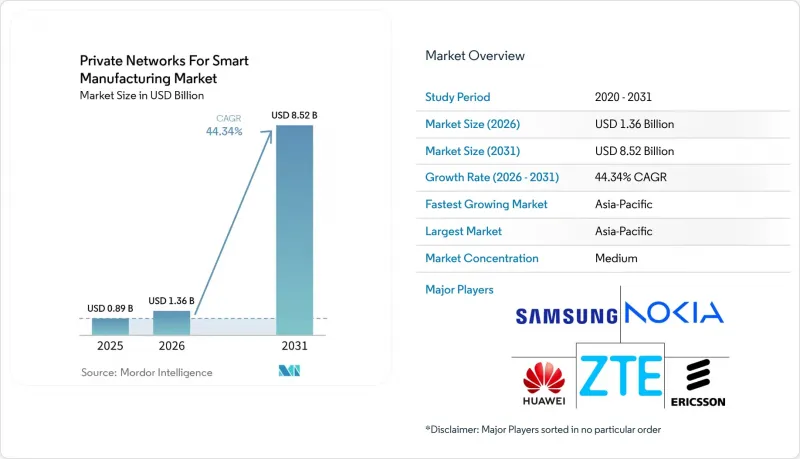
本報告按產品類型(硬體、軟體、服務)、頻段(頻寬、頻寬、毫米波)、部署架構(雲端、本地部署、混合式部署)、製造業(汽車、出行等)、企業規模(大型企業等)和地區進行細分。市場預測以美元計價。
智慧製造專用網路的全球市場趨勢與洞察
對工業自動化和智慧工廠的投資
對工廠自動化的投資正在拓展對專用無線連線的需求範圍。自動導引運輸車(AGV)、即時監控與資料擷取系統 (SCADA)、人工智慧驅動的偵測以及聯網工人工具都需要在整個生產區域內進行可靠的通訊。隨著這些系統從孤立的部署環境轉向互聯互通的運作環境,智慧製造專用網路市場正從中受益。隨著生產流程自動化程度的提高,專用網路幫助工廠繞過通用企業網路的限制。它們也為原本需要單獨連接的應用提供了一個通用的通訊平台。此外,製造商正在尋求能夠整合和支援自動化、分析和營運技術的基礎設施。
移動機器人和機器視覺的確定性連接
移動機器人和機器視覺需要穩定的服務水平,而共用無線網路難以滿足這項需求。產業指南的目標是協作運輸應用的可用性達到 99.9999% 或更高,延遲控制在 1-2.5 毫秒以內。三星和現代汽車於 2025 年 2 月在現代汽車蔚山工廠完成了端到端的私有 5G RedCap 測試,該測試用於傳輸日產 6000 輛汽車的工廠的車輛檢測數據。支援 RedCap 的裝置可以在保持關鍵 5G 功能的同時,縮小裝置尺寸和功耗。這使得感測器、攝影機和偵測終端的高密度部署更加可行。在需要可預測的連接性和高速資料傳輸的生產應用中,智慧製造的私有網路市場具有顯著優勢。
高昂的初始部署成本和終端成本
部署私人 5G 網路可能需要對無線存取硬體、專用核心網路、邊緣伺服器、系統整合以及(如有必要)頻段存取進行投資。對於中小型製造商而言,這筆初始投資可能是一筆不小的負擔,他們必須將其與那些投資回報更快的流程項目進行比較。此外,與更廣泛的 5G 設備生態系統相比,工業終端的選擇範圍有限。截至 2025 年 4 月,全球行動供應商協會 (GMSA) 在其 3378 年 5G 設備目錄中僅列出了 326 款 5G 模組和 330 款工業路由器和數據機。這種有限的選擇可能導致終端價格持續高企,並降低採購柔軟性。在製造商無法將成本分散到多個高價值應用領域的地區,智慧製造專用網路市場的成長速度可能會放緩。
細分市場分析
截至2025年,硬體在智慧製造專用網路市場中佔比48.21%。這反映了無線接取網路設備、專用5G核心網路硬體、邊緣伺服器和閘道的初始成本。當製造商首次在其工廠內建造本地覆蓋時,硬體仍然至關重要。開放式無線接取網路的設計使製造商能夠考慮多廠商配置,從而導致無線設備差異化程度的提高。由於許多製造商缺乏蜂巢式網路方面的內部專業知識,服務仍然至關重要。
預計到2031年,軟體市場將以44.61%的複合年成長率成長。隨著硬體部署規模的擴大,網路管理、編配、安全性和分析軟體的重要性日益凸顯。 NTT DOCOMO於2026年3月為企業客戶推出了5G切片服務。隨著工廠不再局限於初始設備採購,而是開始充分利用網路功能,智慧製造專用網路的業務收益。這種轉變使得持續的平台支援在供應商關係中變得愈發重要。
到了2025年,中頻段網路在智慧製造專用網路市場佔54.12%的佔有率。中頻段網路在大規模工廠車間中實現了覆蓋範圍、容量和部署密度之間的平衡。它們可以支援自動導引運輸車(AGV)、機器視覺和感測器系統,而無需像高頻率網路那樣部署高密度網路基地台。在美國,CBRS進一步鞏固了這一地位。根據2025年「美國製造5G」調查,當年美國部署的專用5G網路中,有75%使用了CBRS頻段。
毫米波預計到2031年將以44.83%的複合年成長率成長。 MDPI Electronics發表的一項行業評估證實,毫米波在視距環境的積層製造和精密機器人應用中具有可靠的高吞吐量性能。在戶外工業園區,低頻寬仍然至關重要,因為訊號繞過障礙物的傳播比高資料傳輸速率更為重要。高密度小型基地台設計和可配置的多頻段無線電有助於解決金屬結構較多的設施中毫米波的限制。在智慧製造的專用網路中,由於工廠佈局和應用需求的多樣性,將使用多種頻寬。
區域分析
預計到2025年,亞太地區將以41.21%的市佔率引領智慧製造專用網路市場,並在2031年之前維持46.14%的複合年成長率。這一成長主要得益於製造業集聚、區域頻率政策以及機器人技術的日益普及。 2026年2月,Softbank Corporation和村田製作所合作,在專用5G獨立組網中開展了時間敏感型網路的概念驗證,實現了122奈秒的時間同步精度。這項措施標誌著專用無線電的使用方式正從單純作為有線系統的附加組件,轉向5G原生生產控制。日本、韓國、中國、印度、東南亞和大洋洲等地區在汽車、電子和出口導向製造業等不同領域的推動要素尤為顯著。
北美地區在區域排名中排名第二,這得益於CBRS的普及以及在汽車、航太和食品飲料行業的製造業投資。 2025年9月,塞拉尼斯公司在德克薩斯州的兩家製造工廠部署了NTT Data的託管式私有5G網路。 2026年5月,Terago和愛立信在麥克馬斯特製造實驗室啟動了一個私人5G網路,用於檢驗感測器、機器人和人工智慧技術。在歐洲,德國的園區網路框架和現場部署活動正在取得進展。中東、非洲和南美洲推出處於早期階段,頻段法規和可用的製造資金將決定部署速度。
智慧製造專用網路市場擁有廣泛的地域覆蓋範圍,因為新建工廠可以從初始設計階段整合專用無線系統。在成熟的工業區,專用網路正被用於對現有複雜工廠進行現代化改造。在新興地區,工業園區和待開發區專案可以從一開始就部署專用無線系統。本地頻段的可用性將決定製造商能否快速部署,還是需要依賴與電信業者的合作。此外,對於跨境營運的製造商而言,能夠輕鬆適應當地法規和設備選項也是一項優勢。這些因素使得區域因素成為決定專用網路專案時機和設計的關鍵要素。
其他好處:
- Excel格式的市場預測(ME)表
- 3個月的分析師支持
目錄
第1章:引言
- 研究假設和市場定義
- 調查範圍
第2章:調查方法
第3章執行摘要
第4章 市場狀況
- 市場概覽
- 宏觀經濟因素對市場的影響
- 市場促進因素
- 對工業自動化和智慧工廠的投資
- 移動機器人和機器視覺的確定性連接
- 政策支援區域頻譜存取和工業5G
- 用於即時品質和流程決策的私有邊緣智慧
- 生產線的無線重構與數位孿生
- 擴大各工廠的實體人工智慧集群規模
- 市場限制因素
- 初始部署成本和終端成本較高。
- 缺乏OT-IT整合和多供應商支援技能
- 頻段監管碎片化以及跨境部署中的摩擦
- 工業5G終端選擇有限,且有生命週期風險
- 產業價值鏈分析
- 監理情勢
- 技術展望
- 波特五力分析
第5章 市場規模與成長預測
- 報價
- 硬體
- 無線接取網路硬體
- 用於專用 5G 核心網路的硬體
- 邊緣伺服器和閘道器
- 軟體
- 網路管理與編配
- 工業安全和分析軟體
- 服務
- 專業服務
- 託管服務
- 硬體
- 按頻段
- 低頻段
- 中頻
- 毫米波
- 依部署架構
- 基於雲端的
- 現場
- 混合
- 透過製造業
- 汽車與出行
- 電氣和電子設備
- 機械和工業設備
- 食品/飲料
- 藥品和醫療設備
- 航太和國防製造
- 化學、金屬、材料
- 按公司規模
- 大公司
- 小型企業
- 按地區
- 北美洲
- 美國
- 加拿大
- 墨西哥
- 南美洲
- 巴西
- 其他南美國家
- 歐洲
- 德國
- 英國
- 法國
- 義大利
- 俄羅斯
- 其他歐洲國家
- 亞太地區
- 中國
- 日本
- 韓國
- 印度
- 東南亞
- 其他亞太國家
- 中東
- 土耳其
- 沙烏地阿拉伯
- 阿拉伯聯合大公國
- 其他中東國家
- 非洲
- 南非
- 肯亞
- 其他非洲國家
- 北美洲
第6章 競爭情勢
- 市場集中度
- 策略趨勢
- 市佔率分析
- 公司簡介
- Huawei Technologies Co., Ltd.
- Nokia Corporation
- Telefonaktiebolaget LM Ericsson
- Samsung Electronics Co., Ltd.
- ZTE Corporation
- Siemens Aktiengesellschaft
- Cisco Systems, Inc.
- NEC Corporation
- Qualcomm Incorporated
- Hewlett Packard Enterprise Company
- Amazon Web Services, Inc.
- Deutsche Telekom AG
- Verizon Communications Inc.
- AT&T Inc.
- Vodafone Group Plc
- Orange SA
- Telefonica, SA
- NTT DATA Group Corporation
- Celona, Inc.
- Druid Software Limited
- Future Technologies, Inc.
- Cumucore Oy
第7章 市場機會與未來展望
According to Mordor Intelligence, the private networks for Smart Manufacturing Market size is projected to expand from USD 0.89 billion in 2025 to USD 1.36 billion in 2026, and to USD 8.52 billion by 2031, registering a CAGR of 44.34% between 2026 and 2031.
This report is Segmented by Offering (Hardware, Software, and Services), Frequency Band (Low Band, Mid Band, and Millimeter Wave), Deployment Architecture (Cloud-Based, On-Premise, and Hybrid), Manufacturing Industry (Automotive and Mobility, and More), Enterprise Size (Large Enterprises, and More), and Geography. The Market Forecasts are Provided in Terms of Value (USD).
Global Private Networks For Smart Manufacturing Market Trends and Insights
Industrial Automation and Smart Factory Investment
Factory automation investment is expanding the set of applications requiring dedicated wireless connectivity. Automated guided vehicles, real-time supervisory control and data acquisition systems, AI inspection, and connected-worker tools need dependable communications across production areas. The Private Networks for Smart Manufacturing Market benefits when these systems move from isolated deployments to linked operating environments. Dedicated networks help factories avoid the limitations of general-purpose enterprise networks when production processes become more automated. They provide a common communications base for applications that would otherwise require separate connectivity arrangements. Manufacturers are also seeking infrastructure that can support automation, analytics, and operational technology together.
Deterministic Connectivity for Mobile Robotics and Machine Vision
Mobile robotics and machine vision require stable service levels that shared wireless networks can struggle to provide. Industrial guidance targets availability above 99.9999% and latency of 1 to 2.5 milliseconds for cooperative carrying applications. Samsung and Hyundai Motor completed an end-to-end private 5G RedCap trial at Hyundai Motor's Ulsan plant in February 2025, transmitting vehicle inspection data at a facility producing 6,000 vehicles per day. RedCap devices can reduce device size and power requirements while retaining key 5G capabilities. This can make dense arrays of sensors, cameras, and inspection terminals more practical. The Private Networks for Smart Manufacturing Market benefits where production applications require predictable connectivity and fast data transmission.
High Initial Deployment and Endpoint Costs
A private 5G deployment may require investment in radio access hardware, a dedicated core, edge servers, system integration, and spectrum access where needed. This initial requirement can be difficult for small and medium manufacturers that must compare it with process projects that offer faster returns. Industrial endpoint selection is also more limited than the broader 5G device ecosystem. The Global Mobile Suppliers Association listed 326 5G modules and 330 industrial routers and modems within a catalog of 3,378 5G devices as of April 2025. The limited range can keep endpoint prices high and reduce procurement flexibility. The Private Networks for Smart Manufacturing Market may develop more slowly in regions where manufacturers cannot spread costs across multiple high-value applications.
Other drivers and restraints analyzed in the detailed report include:
- Private Edge Intelligence for Real-Time Quality and Process Decisions
- Localized Spectrum Access and Industrial 5G Policy Support
- OT-IT Integration and Multi-Vendor Skills Gaps
For complete list of drivers and restraints, kindly check the Table Of Contents.
Segment Analysis
Hardware represented 48.21% of the Private Networks for Smart Manufacturing Market in 2025. This reflects the initial cost of radio access network equipment, private 5G core hardware, edge servers, and gateways. Hardware remains necessary when a manufacturer first builds local coverage across a factory. Radio equipment is becoming more differentiated as open radio access network designs allow manufacturers to consider multi-vendor configurations. Services remain important because many manufacturers lack in-house expertise in cellular networks.
Software is forecast to grow at a 44.61% CAGR through 2031. Network management, orchestration, security, and analytics software become more important as the installed base of hardware expands. NTT Docomo launched 5G slicing services for enterprise customers in March 2026. Private networks in the smart manufacturing industry are shifting toward recurring software and service revenue as factories use network functions beyond the initial equipment purchase. This transition makes ongoing platform support more relevant to the supplier relationship.
Mid band held 54.12% of the Private Networks for Smart Manufacturing Market in 2025. It provides a balance between coverage, capacity, and deployment density for large factory floors. Mid-band networks can support automated guided vehicles, machine vision, and sensor systems without the dense access-point layout often required by higher frequencies. CBRS has reinforced this position in the United States. The 2025 American Made 5G study reported that 75% of U.S. private 5G networks deployed that year used CBRS spectrum.
Millimeter wave is forecast to grow at a 44.83% CAGR through 2031. An industrial evaluation published in MDPI Electronics found reliable high-throughput performance for additive manufacturing and precision robotics in line-of-sight environments. Low band remains relevant for outdoor industrial campuses where signal propagation around obstructions matters more than high data rates. Dense small-cell designs and configurable multi-band radios can help address millimeter-wave constraints in metal-heavy facilities. The private networks for the smart manufacturing industry will use several bands because factory layouts and application needs vary widely.
Complete Report Scope:
- By Offering
- Hardware
- Radio Access Network Hardware
- Private 5G Core Network Hardware
- Edge Servers and Gateways
- Software
- Network Management and Orchestration
- Industrial Security and Analytics Software
- Services
- Professional Services
- Managed Services
- Hardware
- By Frequency Band
- Low Band
- Mid Band
- Millimeter Wave
- By Deployment Architecture
- Cloud-Based
- ON Premise
- Hybrid
- By Manufacturing Industry
- Automotive and Mobility
- Electrical and Electronics
- Machinery and Industrial Equipment
- Food and Beverage
- Pharmaceuticals and Medical Devices
- Aerospace and Defense Manufacturing
- Chemicals, Metals, and Materials
- By Enterprise Size
- Large Enterprises
- Small and Medium Enterprises
- By Geography
- North America
- United States
- Canada
- Mexico
- South America
- Brazil
- Rest of South America
- Europe
- Germany
- United Kingdom
- France
- Italy
- Russia
- Rest of Europe
- Asia-Pacific
- China
- Japan
- South Korea
- India
- Southeast Asia
- Rest of Asia-Pacific
- Middle East
- Turkey
- Saudi Arabia
- United Arab Emirates
- Rest of Middle East
- Africa
- South Africa
- Kenya
- Rest of Africa
- North America
Geography Analysis
Asia-Pacific led the Private Networks for Smart Manufacturing Market with a 41.21% share in 2025 and is forecast to grow at a 46.14% CAGR through 2031. The region combines manufacturing density, local spectrum policy, and rising adoption of robotics. SoftBank and Murata Manufacturing demonstrated time-sensitive networking over a private 5G standalone network in February 2026, achieving a time synchronization accuracy of 122 nanoseconds. This work shows a shift toward 5G-native production control rather than using private wireless only as an add-on to wired systems. Japan, South Korea, China, India, Southeast Asia, and Oceania contribute different demand drivers across automotive, electronics, and export-oriented manufacturing.
North America held the second-largest regional position, supported by CBRS access and manufacturing investment in the automotive, aerospace, and food and beverage sectors. Celanese deployed NTT DATA's managed private 5G at 2 Texas manufacturing facilities in September 2025. TERAGO and Ericsson launched a private 5G network at the McMaster Manufacturing Research Institute in May 2026 for sensor, robotics, and AI validation. Europe is advancing through Germany's campus-network framework and production-grade deployment activity. The Middle East, Africa, and South America remain earlier-stage regions where spectrum rules and available manufacturing capital will shape rollout speed.
The Private Networks for Smart Manufacturing Market has a broad regional base because new facilities can incorporate dedicated wireless systems in their initial designs. Mature industrial regions are using private networks to update complex existing plants. Emerging regions can use industrial parks and greenfield projects to introduce dedicated wireless systems from the start. Local spectrum availability influences whether manufacturers can deploy quickly or must rely on operator partnerships. Cross-border manufacturers also benefit when regional rules and equipment options are easier to align. These conditions make geography an important factor in the timing and design of private-network projects.
- Huawei Technologies Co., Ltd.
- Nokia Corporation
- Telefonaktiebolaget LM Ericsson
- Samsung Electronics Co., Ltd.
- ZTE Corporation
- Siemens Aktiengesellschaft
- Cisco Systems, Inc.
- NEC Corporation
- Qualcomm Incorporated
- Hewlett Packard Enterprise Company
- Amazon Web Services, Inc.
- Deutsche Telekom AG
- Verizon Communications Inc.
- AT&T Inc.
- Vodafone Group Plc
- Orange S.A.
- Telefonica, S.A.
- NTT DATA Group Corporation
- Celona, Inc.
- Druid Software Limited
- Future Technologies, Inc.
- Cumucore Oy
Additional Benefits:
- The market estimate (ME) sheet in Excel format
- 3 months of analyst support
TABLE OF CONTENTS
1 INTRODUCTION
- 1.1 Study Assumptions and Market Definition
- 1.2 Scope of the Study
2 RESEARCH METHODOLOGY
3 EXECUTIVE SUMMARY
4 MARKET LANDSCAPE
- 4.1 Market Overview
- 4.2 Impact of Macroeconomic Factors on the Market
- 4.3 Market Drivers
- 4.3.1 Industrial Automation and Smart Factory Investment
- 4.3.2 Deterministic Connectivity for Mobile Robotics and Machine Vision
- 4.3.3 Localized Spectrum Access and Industrial 5G Policy Support
- 4.3.4 Private Edge Intelligence for Real-Time Quality and Process Decisions
- 4.3.5 Wireless Reconfiguration of Production Lines and Digital Twins
- 4.3.6 Physical AI Fleet Expansion Across Factories
- 4.4 Market Restraints
- 4.4.1 High Initial Deployment and Endpoint Costs
- 4.4.2 OT-IT Integration and Multi-Vendor Skills Gaps
- 4.4.3 Fragmented Spectrum Rules and Cross-Border Rollout Friction
- 4.4.4 Limited Industrial 5G Endpoint Variety and Lifecycle Risk
- 4.5 Industry Value Chain Analysis
- 4.6 Regulatory Landscape
- 4.7 Technological Outlook
- 4.8 Porter's Five Forces Analysis
- 4.8.1 Bargaining Power of Suppliers
- 4.8.2 Bargaining Power of Buyers
- 4.8.3 Threat of New Entrants
- 4.8.4 Threat of Substitutes
- 4.8.5 Competitive Rivalry
5 MARKET SIZE AND GROWTH FORECASTS (VALUE)
- 5.1 By Offering
- 5.1.1 Hardware
- 5.1.1.1 Radio Access Network Hardware
- 5.1.1.2 Private 5G Core Network Hardware
- 5.1.1.3 Edge Servers and Gateways
- 5.1.2 Software
- 5.1.2.1 Network Management and Orchestration
- 5.1.2.2 Industrial Security and Analytics Software
- 5.1.3 Services
- 5.1.3.1 Professional Services
- 5.1.3.2 Managed Services
- 5.1.1 Hardware
- 5.2 By Frequency Band
- 5.2.1 Low Band
- 5.2.2 Mid Band
- 5.2.3 Millimeter Wave
- 5.3 By Deployment Architecture
- 5.3.1 Cloud-Based
- 5.3.2 ON Premise
- 5.3.3 Hybrid
- 5.4 By Manufacturing Industry
- 5.4.1 Automotive and Mobility
- 5.4.2 Electrical and Electronics
- 5.4.3 Machinery and Industrial Equipment
- 5.4.4 Food and Beverage
- 5.4.5 Pharmaceuticals and Medical Devices
- 5.4.6 Aerospace and Defense Manufacturing
- 5.4.7 Chemicals, Metals, and Materials
- 5.5 By Enterprise Size
- 5.5.1 Large Enterprises
- 5.5.2 Small and Medium Enterprises
- 5.6 By Geography
- 5.6.1 North America
- 5.6.1.1 United States
- 5.6.1.2 Canada
- 5.6.1.3 Mexico
- 5.6.2 South America
- 5.6.2.1 Brazil
- 5.6.2.2 Rest of South America
- 5.6.3 Europe
- 5.6.3.1 Germany
- 5.6.3.2 United Kingdom
- 5.6.3.3 France
- 5.6.3.4 Italy
- 5.6.3.5 Russia
- 5.6.3.6 Rest of Europe
- 5.6.4 Asia-Pacific
- 5.6.4.1 China
- 5.6.4.2 Japan
- 5.6.4.3 South Korea
- 5.6.4.4 India
- 5.6.4.5 Southeast Asia
- 5.6.4.6 Rest of Asia-Pacific
- 5.6.5 Middle East
- 5.6.5.1 Turkey
- 5.6.5.2 Saudi Arabia
- 5.6.5.3 United Arab Emirates
- 5.6.5.4 Rest of Middle East
- 5.6.6 Africa
- 5.6.6.1 South Africa
- 5.6.6.2 Kenya
- 5.6.6.3 Rest of Africa
- 5.6.1 North America
6 COMPETITIVE LANDSCAPE
- 6.1 Market Concentration
- 6.2 Strategic Moves
- 6.3 Market Share Analysis
- 6.4 Company Profiles (includes Global Level Overview, Market Level Overview, Core Segments, Financials as available, Strategic Information, Market Rank/Share, Products and Services, Recent Developments)
- 6.4.1 Huawei Technologies Co., Ltd.
- 6.4.2 Nokia Corporation
- 6.4.3 Telefonaktiebolaget LM Ericsson
- 6.4.4 Samsung Electronics Co., Ltd.
- 6.4.5 ZTE Corporation
- 6.4.6 Siemens Aktiengesellschaft
- 6.4.7 Cisco Systems, Inc.
- 6.4.8 NEC Corporation
- 6.4.9 Qualcomm Incorporated
- 6.4.10 Hewlett Packard Enterprise Company
- 6.4.11 Amazon Web Services, Inc.
- 6.4.12 Deutsche Telekom AG
- 6.4.13 Verizon Communications Inc.
- 6.4.14 AT&T Inc.
- 6.4.15 Vodafone Group Plc
- 6.4.16 Orange S.A.
- 6.4.17 Telefonica, S.A.
- 6.4.18 NTT DATA Group Corporation
- 6.4.19 Celona, Inc.
- 6.4.20 Druid Software Limited
- 6.4.21 Future Technologies, Inc.
- 6.4.22 Cumucore Oy
7 MARKET OPPORTUNITIES AND FUTURE OUTLOOK
- 7.1 White-Space and Unmet-Need Assessment

 國防專用 5G/4G蜂巢式網路:2026-2030 年
 私人 5G/4G 網路部署:追蹤與預測(2026-2030 年)
 2026-2030年全球人工智慧網路基礎設施市場
 2G 和 3G 服務終止市場分析及預測(至 2035 年),按類型、產品、服務、技術、組件、應用、最終用戶、部署類型和解決方案分類
 專用蜂窩網路預測專用蜂窩網路:預測和市場數據概覽(2025 年第四季)
 專用蜂巢式網路市場預測至2032年:按服務、消費模式、最終用戶和地區分類的全球分析2032 年私有 LTE 與私有 5G 網路市場預測:按網路類型、組件、頻譜、應用、最終用戶和地區進行的全球分析
 全球專用蜂巢式網路:2025-2030私有蜂窩網路的 ISAC 用例