


 |
市場調查報告書
商品編碼
2119362
聚乙烯:市佔率分析、產業趨勢與統計、成長預測(2026-2031)Polyethylene - Market Share Analysis, Industry Trends & Statistics, Growth Forecasts (2026 - 2031) |
||||||

※ 本網頁內容可能與最新版本有所差異。詳細情況請與我們聯繫。
根據 Mordor Intelligence 預測,聚乙烯市場在 2025 年的價值將達到 1,613.3 億美元,並將持續成長,從 2026 年的 1,683.6 億美元成長到 2031 年的 2,084.1 億美元。
預測期(2026-2031 年)的複合年成長率預計為 4.36%。
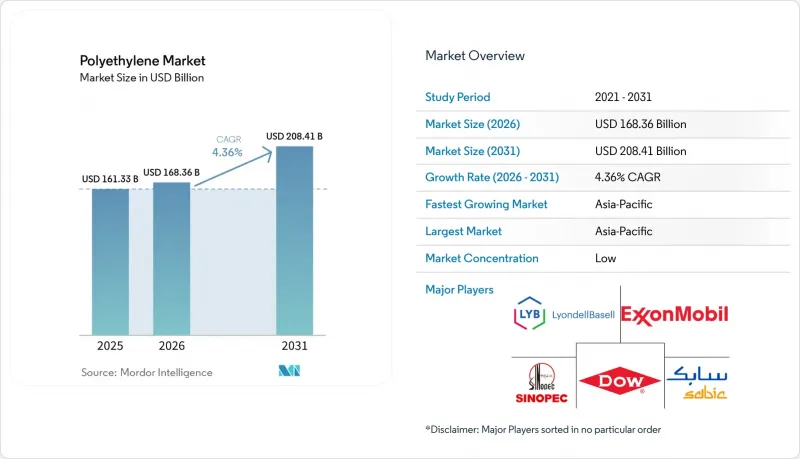
本報告按產品類型(例如,高密度聚苯乙烯(HDPE))、形態(例如,片材/薄膜、粉末)、製造程序(例如,擠出成型、吹塑成型)、最終用途行業(例如,包裝、建築)和地區(亞太地區、北美地區、歐洲地區、南美地區、中東和非洲)進行細分。市場預測以美元 (USD) 為單位。
全球聚乙烯市場趨勢及洞察
來自食品、飲料和電子商務通路的包裝需求
至2025年,包裝產業將佔聚乙烯終端需求的54.20%,其中食品、飲料和電子商務應用將繼續推動樹脂消費。在印度,快速商務服務的擴張正在推動對軟包裝的需求成長,尤其是用於拉伸膜和郵寄袋的線性低密度聚乙烯(LLDPE)。在新興市場的電子商務供應鏈中,更薄、更耐用的LLDPE薄膜比傳統的低密度聚乙烯(LDPE)薄膜更受歡迎。這種轉變正在推動對茂金屬基LLDPE的需求,因為薄膜製造商可以在保持密封強度和抗穿刺性的同時降低薄膜厚度。隨著軟包裝的擴張,食品和飲料用聚乙烯包裝的需求預計將會成長,而尋求可回收設計的品牌也開始關注單層薄膜。因此,高性能LLDPE供應商可以為聚乙烯市場創造超越標準樹脂供應的價值,尤其是在他們的材料能夠讓加工商使用更薄的基材,同時又能通過密封強度和抗穿刺性測試的情況下。因此,在聚乙烯市場中,差異化的薄膜等級比未差異化的樹脂具有優勢。
水、氣和灌溉基礎設施的擴建
北美地區的管道升級改造、非洲和南亞地區的水網項目以及東南亞地區的污水處理廠維修,都推動了對高密度聚苯乙烯(HDPE)管道的需求。美國自來水廠協會(AWWA)於2025年修訂了其HDPE管路標準,增加了管件要求並明確了無鉛應用。此次修訂鞏固了HDPE作為美國國家標準協會(ANSI)和AWWA認可的0.75-65英吋供水、配水和輸水管道標準化材料的地位。在非洲,HDPE的需求也不斷成長,涵蓋供水、污水處理、採礦、農業和阻燃管道等領域。在缺水的農業經濟體中,灌溉現代化正在創造一個永續的投資管道,使其不易受到國內生產總值)短期波動的影響。南達科他州的 70 英里農村供水管道和科羅拉多的 27 英里“Vita H2O 項目”表明,支持基礎設施級 HDPE 需求的項目範圍很廣,從農村供水到服務網路現代化項目。
原油和乙烯原料價格波動
除美國乙烷裂解區外,原料價格波動持續擠壓聚乙烯利潤率。歐洲和東北亞依賴石腦油的生產商在原油供應過剩的情況下,繼續受到原油價格波動的影響,無法將這些影響完全轉嫁給加工商。隨著北美和歐洲業務利潤率的收窄,里昂巴塞爾公司累計,2025年淨虧損7.38億美元,而2024年淨利潤為13.67億美元。利潤率壓力加速了產能最佳化決策,到2025年底,陶氏化學、沙烏地基礎工業公司和里昂巴塞爾在歐洲的乙烯產能總合減少了190萬噸/年。 2025年下半年,一些新加坡業者的石腦油和乙烯利潤率出現負成長,進一步限制了樹脂價格的下調空間。擁有乙烷進口碼頭、從事天然氣裂解或能夠從中東獲得低成本乙烯的生產商處於更有利的地位,但他們對原料的依賴在短期和中期內仍然是一個阻礙因素。
細分市場分析
受吹塑成型瓶、燃氣管道、飲用水管道、波紋管、工業保護膜和地工止水膜襯墊等產品需求的推動,預計到2025年,高密度聚乙烯(HDPE)將佔據聚乙烯市場49.12%的佔有率。由於其優異的耐腐蝕性、熔接性能以及能夠形成不同於傳統機械連接的整體接頭,HDPE在北美和大洋洲的城市供水系統中廣泛應用。其在容器、管道、建築和環境防護等領域的廣泛應用,在整個大批量加工鏈中形成了強勁的需求基礎。低密度聚乙烯(LDPE)由於其在低溫包裝、擠壓塗布(LLDPE)具有巨大的應用潛力。加工業者正擴大用LLDPE取代LDPE用於拉伸膜和農用薄膜,因為LLDPE更高的拉伸強度允許在相同厚度下減少樹脂用量,而不會影響薄膜所需的性能。
預計到2031年,線性低密度聚乙烯(LLDPE)的複合年成長率將達到4.74%,在所有產品類型中成長最高。這一成長主要得益於包裝從硬質向軟質的轉變、新興市場電子商務對拉伸膜需求的不斷成長以及茂金屬觸媒技術的進步。該技術使製造商能夠根據特定的薄膜應用客製化分子結構,從而提供具有所需密封強度和抗穿刺性的薄膜。這在電子商務包裝、食品包裝和超薄軟性結構中尤其重要。單層LLDPE薄膜可望取代多層複合材料,同時維持密封強度和防潮性,符合影響歐洲和北美採購的生產者延伸責任制(EPR)框架。 2025年9月,NOVA Chemicals推出了「9 SURPASS」、「SCLAIR」和「NOVAPOL」系列產品,這些產品均添加了非氟化聚合物加工助劑,在其基於性能的競爭基礎上增加了合規性要素。
截至2025年,片材和薄膜將佔聚乙烯市場佔有率的38.81%,預計到2031年將以4.89%的複合年成長率成長。這一構成反映了包裝、農業和建築等行業的廣泛需求,而非僅限於狹窄的應用領域。電子商務正在推動對拉伸膜、郵寄袋、保護性包裝和其他需要輕薄耐用材料的軟性包裝形式的需求。農業薄膜也是推動需求成長的重要因素。採用線性低密度聚乙烯(LLDPE)製成的溫室和青貯薄膜具有抗紫外線穩定性和跨季節耐久性,使其在保護性栽培中非常實用,因為種植者需要在反覆暴露循環中保持材料性能的穩定性。雖然薄膜應用推動了片材和薄膜的快速成長,但顆粒仍然是射出成型和吹塑成型製程中使用的原生樹脂的主要商業供應形式。
粉末狀聚乙烯廣泛應用於旋轉成型、電線電纜絕緣和熱熔膠黏合劑。其細小的顆粒尺寸使其能夠在不使用顆粒的加工系統中實現穩定的熱傳遞和熔化。其他形式的聚乙烯,例如顆粒、管材和管件,是與基礎設施採購週期相關的成品工業產品,而非原料加工商的原料。 2025年,陶氏推出了INNATE TF 220,一種用於雙向拉伸聚乙烯(BOPE)薄膜的精密包裝樹脂。與用於軟包裝的傳統拉伸薄膜相比,BOPE薄膜具有更高的剛性、透明度和可回收性。這些產品研發專注於片材和薄膜領域的材料創新,滿足了品牌對能夠滿足回收需求的包裝結構的需求。
區域分析
預計到2025年,亞太地區將佔據聚乙烯市場47.67%的佔有率,並在2031年之前以5.06%的複合年成長率持續成長。日本和韓國的區域產能合理化可能會影響整個預測期間的供應狀況。該地區擁有最大的生產基地和最強勁的消費成長。印度和東協國家也透過電子商務、食品包裝現代化和基礎設施投資來拓展市場。日本正處於第三個石化產業結構調整週期,目標是在2028年前將乙烯產能削減240萬噸。 2025年8月,韓國要求10家主要石化企業提交業務結構調整和競爭力提升計劃,目標是削減370萬噸的產能。
在北美,美國墨西哥灣沿岸的乙烷裂解過程正在推動市場成長。需求主要來自包裝、基礎設施管道和汽車應用領域。陶氏化學位於德克薩斯州弗里波特的Poly-7生產線已投產,年產59萬噸高密度聚乙烯(HDPE)或線性低密度聚乙烯(LLDPE)。位於德州德克薩斯州治的Golden Triangle Polymers公司計劃於2026年下半年完工,屆時將擁有兩座HDPE生產設施,年總合達200萬噸。隨著Blaschem公司於2025年投資5.8億美元興建乙烷進口碼頭,墨西哥正逐漸成為新興的需求中心。該碼頭的啟用改善了Blaschem Idesa工廠位於韋拉克魯斯的原料物流。
南美洲、中東和非洲是聚乙烯市場快速成長的地區。在巴西,包裝食品的需求、肉類出口包裝的需求以及對美國聚乙烯進口徵收的每噸199.04美元的臨時反傾銷稅,都對國內樹脂價格產生了影響。在包括阿根廷在內的南美國家,對農業薄膜和消費品包裝的需求支撐著市場。波灣合作理事會(GCC)成員國的生產商利用天然氣作為原料,保持成本優勢,儘管全球供應過剩,他們仍在繼續投資擴大產能。在撒哈拉以南非洲,都市化和供水基礎設施的匱乏推動了奈及利亞和南非對高密度聚苯乙烯(HDPE)管道的需求成長。
其他好處:
- Excel格式的市場預測(ME)表
- 3個月的分析師支持
目錄
第1章:引言
- 研究假設和市場定義
- 調查範圍
第2章:調查方法
第3章執行摘要
第4章 市場狀況
- 市場概覽
- 市場促進因素
- 來自食品飲料和電子商務通路的包裝需求
- 水、氣和灌溉基礎設施的擴建
- 各終端用戶產業的輕量化和性能要求
- 關於再生聚乙烯和再生材料含量的強制規定。
- 適用於氫氣的燃氣管網需要使用PE-100-RC管道
- 投資以解決顆粒損耗法規問題並確保樹脂可追溯性。
- 市場限制因素
- 原油和乙烯原料價格波動
- 規範一次性塑膠製品並以永續材料取代。
- 食品接觸級和醫用級再生樹脂認證的限制
- 碎片化物料平衡認證和CoC標準
- 價值鏈分析
- 波特五力分析
第5章 市場規模與成長預測
- 依產品類型
- 高密度聚苯乙烯(HDPE)
- 低密度聚乙烯(LDPE)
- 線型低密度聚乙烯(LLDPE)
- 其他產品類型(中密度聚乙烯(MDPE))
- 按形式
- 片材和薄膜
- 顆粒
- 粉末
- 其他形式(顆粒、管狀、管狀)
- 透過製造程序
- 擠壓
- 吹塑成型
- 射出成型
- 其他製造流程(旋轉成型、壓縮成型、熱成型)
- 按最終用途行業分類
- 包裝
- 建築/施工
- 車
- 其他終端使用者產業(電氣和電子、消費品、醫療保健、農業、工業製造)
- 按地區
- 亞太地區
- 中國
- 印度
- 日本
- 韓國
- 東南亞國協
- 其他亞太國家
- 北美洲
- 美國
- 加拿大
- 墨西哥
- 歐洲
- 德國
- 英國
- 法國
- 義大利
- 西班牙
- 北歐國家
- 俄羅斯
- 其他歐洲國家
- 南美洲
- 巴西
- 阿根廷
- 其他南美國家
- 中東和非洲
- 沙烏地阿拉伯
- 南非
- 埃及
- 奈及利亞
- 其他中東和非洲國家
- 亞太地區
第6章 競爭情勢
- 市場集中度
- 策略趨勢
- 市佔率和排名分析
- 公司簡介
- Braskem
- Chevron Phillips Chemical Company LLC
- China Petrochemical Corporation
- Dow
- Exxon Mobil Corporation
- Formosa Plastics Corporation
- INEOS
- LG Chem
- LOTTE Chemical CORPORATION
- LyondellBasell Industries Holdings NV
- Mitsui Chemicals, Inc.
- NOVA Chemicals Corporate
- PetroChina Company Limited
- Qatar Petrochemical Company(QAPCO)
- Reliance Industries Limited
- Repsol
- SABIC
- TotalEnergies
- Westlake Corporation
第7章 市場機會與未來展望
According to Mordor Intelligence, the polyethylene market was valued at USD 161.33 billion in 2025 and is estimated to grow from USD 168.36 billion in 2026 to reach USD 208.41 billion by 2031, at a CAGR of 4.36% during the forecast period (2026-2031).
This report is Segmented by Product Type (High-Density Polyethylene (HDPE), and More), Form (Sheets and Films, Powder, and More), Manufacturing Process (Extrusion, Blow Molding, and More), End-Use Industry (Packaging, Building and Construction, and More), and Geography (Asia-Pacific, North America, Europe, South America, and Middle-East and Africa). The Market Forecasts are Provided in Terms of Value (USD).
Global Polyethylene Market Trends and Insights
Packaging Demand from Food, Beverage and E-Commerce Channels
Packaging captured 54.20% of polyethylene end-use demand in 2025, and food, beverage, and e-commerce uses continue to support resin consumption. In India, the expansion of quick-commerce services is increasing demand for flexible packaging, especially linear low-density polyethylene (LLDPE) used in stretch films and mailer bags. Emerging-market e-commerce supply chains favor thin, durable LLDPE films over traditional low-density polyethylene (LDPE) films. This shift supports metallocene-grade LLDPE because it allows film producers to reduce thickness while maintaining seal strength and puncture resistance. Polyethylene packaging for food and beverages is expected to grow with flexible packaging, while mono-material films are gaining attention from brands seeking recyclable designs. Suppliers of higher-performance LLDPE grades can therefore capture value in the polyethylene market beyond standard resin volumes, particularly when their materials let converters use thinner substrates without failing seal-strength or puncture-resistance tests. This makes the polyethylene market more favorable to differentiated film grades than to undifferentiated resin alone.
Water, Gas and Irrigation Infrastructure Expansion
High-density polyethylene (HDPE) pipe demand is supported by replacement programs in North America, water grid projects in Africa and South Asia, and wastewater upgrades in Southeast Asia. The American Water Works Association updated its HDPE pipe standard in 2025 to add fitting requirements and clarify lead-free applications. The update reinforced HDPE as a material covered by American National Standards Institute and American Water Works Association standards for service, distribution, and transmission piping from 0.75 to 65 inches. African demand has also expanded across water, sewage, mining, agriculture, and fire-retardant pipe applications. Irrigation modernization in water-stressed agricultural economies creates a continuing investment channel that is less dependent on short-term gross domestic product cycles. The 70-mile rural water pipeline in South Dakota and the 27-mile Vita H2O Project in Colorado illustrate the range of projects supporting infrastructure-grade HDPE demand, from rural water supply to projects that modernize service networks.
Crude Oil and Ethylene Feedstock Price Volatility
Feedstock volatility continues to compress polyethylene margins outside the U.S. ethane-cracking corridor. Naphtha-dependent producers in Europe and Northeast Asia remain exposed to crude oil movements that they cannot fully pass on to converters in an oversupplied environment. LyondellBasell reported a USD 738 million net loss in 2025, compared with USD 1.367 billion net income in 2024, as margins declined across North American and European operations. Margin pressure accelerated rationalization decisions, and ethylene capacity at Dow, SABIC, and LyondellBasell sites in Europe declined by a combined 1.9 million metric tons per year by the end of 2025. Some Singapore-based operators had negative naphtha and ethylene margins in late 2025, which limited the scope for further resin-price reductions. Producers with ethane import terminals, gas-based cracking, or access to low-cost Middle Eastern ethylene have a stronger position, although feedstock exposure remains a near- and medium-term constraint.
Other drivers and restraints analyzed in the detailed report include:
- Circular Polyethylene and Recycled-Content Mandates
- Hydrogen-Ready Gas Networks Requiring PE-100-RC Pipes
- Single-Use Plastic Restrictions and Sustainable Material Substitution
For complete list of drivers and restraints, kindly check the Table Of Contents.
Segment Analysis
HDPE held 49.12% of the polyethylene market share in 2025, supported by demand for blow-molded bottles, gas distribution pipe, potable water pipe, corrugated pipe, protective industrial films, and geomembrane liners. The material is widely specified for municipal water systems in North America and Oceania because it resists corrosion and can be joined through fusion, creating monolithic joints that differ from conventional mechanical connections. Its broad use across containers, pipes, construction, and environmental containment provides a substantial demand base across high-volume processing chains. LDPE retained a role in low-temperature packaging, extrusion coatings, and film-blending uses where its processing characteristics remain useful, even as converters assess opportunities to use LLDPE in films that need more strength at the same gauge. Converters are increasingly replacing LDPE with LLDPE in stretch and agricultural films because greater tensile strength can reduce resin use at an equivalent gauge without sacrificing the required film performance.
LLDPE is projected to advance at a 4.74% CAGR through 2031, the fastest rate among product types. Its growth is supported by a shift from rigid to flexible packaging, stronger e-commerce demand for stretch film in emerging markets, and metallocene catalyst technology. This technology allows producers to tailor molecular architecture for specific film applications and to supply films with the required seal strength and puncture resistance, which is particularly relevant for e-commerce packaging, food wraps, and downgauged flexible structures. Mono-material LLDPE films can replace multilayer laminates while maintaining seal strength and moisture-barrier performance, aligning with extended producer responsibility frameworks that are influencing procurement in Europe and North America. NOVA Chemicals launched 9 SURPASS, SCLAIR, and NOVAPOL grades with a non-fluorinated polymer processing aid in September 2025, adding a regulatory-compliance element to performance-based competition.
Sheets and films held 38.81% of the polyethylene market share in 2025 and are projected to advance at a 4.89% CAGR through 2031. This combination reflects the depth of demand from packaging, agriculture, and construction rather than a narrow application base. E-commerce supports demand for stretch films, mailer bags, protective wrapping, and other flexible packaging formats that need thin, durable materials. Agricultural film also supports demand because LLDPE greenhouse and silage films provide ultraviolet stability and multi-season durability in protected cultivation, where growers depend on consistent material performance across repeated exposure cycles. Pellets remained the principal commercial delivery form for virgin resin used in injection-molding and blow-molding operations, even while film applications drove the faster growth of sheets and films.
Powder form polyethylene serves rotational molding, wire and cable coatings, and hot-melt adhesives. Its fine particle size supports consistent heat transfer and fusion in processing systems that do not use pellets. Other forms, including granules, pipes, and tubes, are finished industrial products tied to infrastructure purchasing cycles rather than raw converter feedstock. Dow introduced INNATE TF 220 precision packaging resin in 2025 for biaxially oriented polyethylene (BOPE) films. BOPE films can improve stiffness, transparency, and recyclability compared with conventional oriented films used in flexible packaging. These product developments concentrate material innovation in the sheets and films category, where brands also need packaging structures that can meet recyclability requirements.
Complete Report Scope:
- By Product Type
- High-Density Polyethylene (HDPE)
- Low-Density Polyethylene (LDPE)
- Linear Low-Density Polyethylene (LLDPE)
- Other Product Types (Medium-Density Polyethylene (MDPE))
- By Form
- Sheets and Films
- Pellets
- Powder
- Other Forms (Granules, Pipes and Tubes)
- By Manufacturing Process
- Extrusion
- Blow Molding
- Injection Molding
- Other Manufacturing Processes (Rotational Molding, Compression Molding, Thermoforming)
- By End-Use Industry
- Packaging
- Building and Construction
- Automotive
- Other End-Use Industries (Electrical and Electronics, Consumer Goods, Healthcare, Agriculture, Industrial Manufacturing)
- By Geography
- Asia-Pacific
- China
- India
- Japan
- South Korea
- ASEAN Countries
- Rest of Asia-Pacific
- North America
- United States
- Canada
- Mexico
- Europe
- Germany
- United Kingdom
- France
- Italy
- Spain
- NORDIC Countries
- Russia
- Rest of Europe
- South America
- Brazil
- Argentina
- Rest of South America
- Middle-East and Africa
- Saudi Arabia
- South Africa
- Egypt
- Nigeria
- Rest of Middle-East and Africa
- Asia-Pacific
Geography Analysis
Asia-Pacific held 47.67% of the polyethylene market share in 2025 and is projected to advance at a 5.06% CAGR through 2031. Regional capacity rationalization in Japan and South Korea can affect supply conditions through the forecast period. The region combines the largest production base with the strongest consumption growth. India and the Association of Southeast Asian Nations (ASEAN) countries are also expanding through e-commerce, food-packaging modernization, and infrastructure investment. Japan is in a third petrochemical rationalization cycle, targeting the removal of 2.4 million metric tons of ethylene capacity by 2028. South Korea requested restructuring and competitiveness plans from 10 major petrochemical companies in August 2025, targeting 3.7 million metric tons of capacity reduction.
North America benefits from ethane-based cracking on the U.S. Gulf Coast. Demand comes from packaging, infrastructure pipes, and automotive uses. Dow's Poly-7 line in Freeport, Texas, has started up with 590,000 metric tons per year of HDPE or LLDPE capacity. Golden Triangle Polymers in Orange, Texas, is scheduled for completion in the second half of 2026 with 2 HDPE units totaling 2 million metric tons per year. Mexico is an emerging demand center after Braskem opened a USD 580 million ethane import terminal in 2025, improving feedstock logistics at the Braskem Idesa plant in Veracruz.
South America, and the Middle-East and Africa are growing parts of the polyethylene market. Brazil's packaged food demand, meat-export packaging needs, and a preliminary antidumping duty of USD 199.04 per metric ton on U.S. polyethylene imports are affecting domestic resin pricing. Argentina and other South American countries are supported by agricultural film and consumer-goods packaging demand. Gulf Cooperation Council producers retain a cost advantage from gas-based feedstocks, supporting capacity investment despite global oversupply. In Sub-Saharan Africa, urbanization and water infrastructure gaps support HDPE pipe procurement in Nigeria and South Africa.
- Braskem
- Chevron Phillips Chemical Company LLC
- China Petrochemical Corporation
- Dow
- Exxon Mobil Corporation
- Formosa Plastics Corporation
- INEOS
- LG Chem
- LOTTE Chemical CORPORATION
- LyondellBasell Industries Holdings N.V.
- Mitsui Chemicals, Inc.
- NOVA Chemicals Corporate
- PetroChina Company Limited
- Qatar Petrochemical Company (QAPCO)
- Reliance Industries Limited
- Repsol
- SABIC
- TotalEnergies
- Westlake Corporation
Additional Benefits:
- The market estimate (ME) sheet in Excel format
- 3 months of analyst support
TABLE OF CONTENTS
1 Introduction
- 1.1 Study Assumptions and Market Definition
- 1.2 Scope of the Study
2 Research Methodology
3 Executive Summary
4 Market Landscape
- 4.1 Market Overview
- 4.2 Market Drivers
- 4.2.1 Packaging Demand from Food, Beverage and E-Commerce Channels
- 4.2.2 Water, Gas and Irrigation Infrastructure Expansion
- 4.2.3 Lightweighting and Performance Requirements Across End-Use Industries
- 4.2.4 Circular Polyethylene and Recycled-Content Mandates
- 4.2.5 Hydrogen-Ready Gas Networks Requiring PE-100-RC Pipes
- 4.2.6 Pellet-Loss Compliance and Resin Traceability Investments
- 4.3 Market Restraints
- 4.3.1 Crude Oil and Ethylene Feedstock Price Volatility
- 4.3.2 Single-Use Plastic Restrictions and Sustainable Material Substitution
- 4.3.3 Food-Contact and Medical-Grade Recycled Resin Qualification Constraints
- 4.3.4 Fragmented Mass-Balance Certification and Chain-of-Custody Standards
- 4.4 Value Chain Analysis
- 4.5 Porter's Five Forces Analysis
- 4.5.1 Bargaining Power of Suppliers
- 4.5.2 Bargaining Power of Buyers
- 4.5.3 Threat of New Entrants
- 4.5.4 Threat of Substitutes
- 4.5.5 Competitive Rivalry
5 Market Size and Growth Forecasts (Value)
- 5.1 By Product Type
- 5.1.1 High-Density Polyethylene (HDPE)
- 5.1.2 Low-Density Polyethylene (LDPE)
- 5.1.3 Linear Low-Density Polyethylene (LLDPE)
- 5.1.4 Other Product Types (Medium-Density Polyethylene (MDPE))
- 5.2 By Form
- 5.2.1 Sheets and Films
- 5.2.2 Pellets
- 5.2.3 Powder
- 5.2.4 Other Forms (Granules, Pipes and Tubes)
- 5.3 By Manufacturing Process
- 5.3.1 Extrusion
- 5.3.2 Blow Molding
- 5.3.3 Injection Molding
- 5.3.4 Other Manufacturing Processes (Rotational Molding, Compression Molding, Thermoforming)
- 5.4 By End-Use Industry
- 5.4.1 Packaging
- 5.4.2 Building and Construction
- 5.4.3 Automotive
- 5.4.4 Other End-Use Industries (Electrical and Electronics, Consumer Goods, Healthcare, Agriculture, Industrial Manufacturing)
- 5.5 By Geography
- 5.5.1 Asia-Pacific
- 5.5.1.1 China
- 5.5.1.2 India
- 5.5.1.3 Japan
- 5.5.1.4 South Korea
- 5.5.1.5 ASEAN Countries
- 5.5.1.6 Rest of Asia-Pacific
- 5.5.2 North America
- 5.5.2.1 United States
- 5.5.2.2 Canada
- 5.5.2.3 Mexico
- 5.5.3 Europe
- 5.5.3.1 Germany
- 5.5.3.2 United Kingdom
- 5.5.3.3 France
- 5.5.3.4 Italy
- 5.5.3.5 Spain
- 5.5.3.6 NORDIC Countries
- 5.5.3.7 Russia
- 5.5.3.8 Rest of Europe
- 5.5.4 South America
- 5.5.4.1 Brazil
- 5.5.4.2 Argentina
- 5.5.4.3 Rest of South America
- 5.5.5 Middle-East and Africa
- 5.5.5.1 Saudi Arabia
- 5.5.5.2 South Africa
- 5.5.5.3 Egypt
- 5.5.5.4 Nigeria
- 5.5.5.5 Rest of Middle-East and Africa
- 5.5.1 Asia-Pacific
6 Competitive Landscape
- 6.1 Market Concentration
- 6.2 Strategic Moves
- 6.3 Market Share (%)/Ranking Analysis
- 6.4 Company Profiles (includes Global Overview, Market Overview, Core Segments, Financials as available, Strategic Information, Products and Services, and Recent Developments)
- 6.4.1 Braskem
- 6.4.2 Chevron Phillips Chemical Company LLC
- 6.4.3 China Petrochemical Corporation
- 6.4.4 Dow
- 6.4.5 Exxon Mobil Corporation
- 6.4.6 Formosa Plastics Corporation
- 6.4.7 INEOS
- 6.4.8 LG Chem
- 6.4.9 LOTTE Chemical CORPORATION
- 6.4.10 LyondellBasell Industries Holdings N.V.
- 6.4.11 Mitsui Chemicals, Inc.
- 6.4.12 NOVA Chemicals Corporate
- 6.4.13 PetroChina Company Limited
- 6.4.14 Qatar Petrochemical Company (QAPCO)
- 6.4.15 Reliance Industries Limited
- 6.4.16 Repsol
- 6.4.17 SABIC
- 6.4.18 TotalEnergies
- 6.4.19 Westlake Corporation
7 Market Opportunities and Future Outlook
- 7.1 White-Space and Unmet-Need Assessment

 2026年全球聚乙烯市場報告
 中東聚乙烯市場:市場佔有率分析、產業趨勢與統計及成長預測(2026-2031)
 全球聚乙烯市場規模、佔有率、趨勢和成長分析報告(2026-2034年)
 2026-2030年全球聚乙烯市場
 聚乙烯編織袋市場規模、佔有率、成長和行業分析:按材料類型、產品類型、最終用途、地區分類,並預測至2034年2026年生物基聚乙烯全球市場報告聚乙烯市場規模、佔有率、成長及全球產業分析:按類型、應用和地區分類的洞察,2026-2034年預測全球聚乙烯(PE)蠟市場規模、佔有率、趨勢和成長分析報告:2026-2034年
 聚乙烯市場:依產品類型、回收製程、應用和最終用戶分類-2026-2032年全球市場預測
 聚乙烯(PE)母粒市場規模、佔有率和成長分析:按產品類型、載體樹脂等級、加工方法、最終用途產業和地區分類-2026-2033年產業預測