


 |
市場調查報告書
商品編碼
2119341
網路雲端成本最佳化:市場佔有率分析、產業趨勢與統計、成長預測(2026-2031)Network Cloud Cost Optimization - Market Share Analysis, Industry Trends & Statistics, Growth Forecasts (2026 - 2031) |
||||||

※ 本網頁內容可能與最新版本有所差異。詳細情況請與我們聯繫。
據 Mordor Intelligence 稱,2025 年網路雲端成本最佳化市值為 18.5 億美元,預計到 2031 年將從 2026 年的 22.3 億美元成長至 47.9 億美元,預測期(2026-2031 年)複合年成長率為 16.52%。
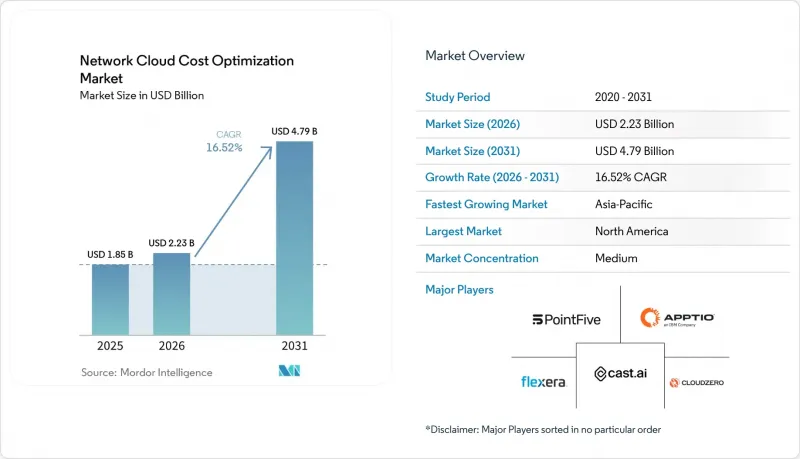
本報告按元件(解決方案和服務)、部署模式(雲端和本地部署)、組織規模(大型企業和中小企業)、應用程式(例如,最佳化雲端資源)、最終用戶(例如,資訊科技和電信、零售和電子商務)以及地區進行細分。市場預測以美元計價。
全球網路雲成本最佳化市場趨勢與洞察
多重雲端和混合雲端的成本複雜性
企業正在使用多個雲端環境,這使得確定資源和資料傳輸成本的責任變得困難。 Flexera 的一份報告顯示,到 2026 年,73% 的受訪公司將營運混合雲環境。併購、分散採購以及 SaaS(軟體即服務)的日益普及,都可能為這些環境增加帳戶、計費方式和未標記的資源。因此,雲端團隊需要集中查看跨供應商的使用情況、承諾和流量成本。由於單一供應商的控制面板無法完全解決跨雲端成本分配問題,網路雲端成本最佳化市場正受益於此需求。此外,歐洲的交換法規也使得資料傳輸成本成為企業在比較供應商選項時更為重要的考量。
人工智慧和數據密集型網路工作負載的擴展
人工智慧工作負載正給雲端預算帶來更大壓力,因為它們可能需要昂貴的GPU、大規模資料集和高流量資料傳輸。根據CAST AI的一項研究,2026年分析的生產環境Kubernetes配置的CPU利用率平均為8%。同一項分析也指出,GPU利用率僅為5%,這顯示昂貴的資源可能沒有充分利用。 FinOps基金會的一份報告顯示,98%的受訪者在2026年控制了他們的AI支出,而2025年這一比例為63%。網路雲端成本最佳化市場正在湧現一些工具,用於衡量GPU使用情況、分配AI支出並識別資料傳輸成本。能夠按產品、客戶和業務部門分配推理和基礎設施成本的平台需求日益成長。
認證的金融營運和雲端網路人才短缺
缺乏同時精通雲端收費和網路維運的人員可能會延緩以網路為中心的成本管理工具的普及。根據FinOps基金會的一項調查,到2026年,年雲端支出超過1億美元的公司平均擁有8-10名FinOps從業人員。這些團隊必須負責成本分配、報告、承諾管理、與工程部門的協作,以及日益重要的AI相關支出管理。沒有建立FinOps實踐的組織可能難以解讀結果並制定有效的政策。德國電信和資訊技術協會(Bitkom)的一項調查顯示,到2025年,德國64%的雲端用戶公司報告雲端營運成本增加。雖然託管服務可以彌補這一缺口,但採購方仍需要內部人員對成本和應用程式相關的決策課責。
細分市場分析
到 2025 年,解決方案將佔組件收入的 65.15%。這得歸功於在複雜的雲端環境中廣泛應用視覺化、最佳化、流量分析和規劃工具。隨著買家尋求協助,以便在財務、工程和營運團隊中應用相關建議,預計到 2031 年,服務業將以 18.46% 的複合年成長率成長。託管式財務營運 (FinOps)、諮詢、實施和支援服務可協助企業將計費資料轉化為持續的營運變更,並明確這些變更的責任歸屬。早期採用儀錶板的公司越來越需要協助承諾管理、標籤實務、業務部門分配和日常報告。這種轉變有利於那些能夠將軟體和專家交付服務結合,並根據每位客戶的營運模式調整服務的供應商。
網路和雲端成本最佳化產業正從工具部署轉向持續執行和管治。 2026年6月,IBM旗下Apptio部門發表了Conversational Insights,具備混合IT成本管理和雲端最佳化功能。該產品透過Apptio的財務智慧層將成本、使用情況、價值和行動連結起來。隨著企業尋求跨多個供應商提供標準化雲端成本資料的支持,FOCUS的採用也可能影響服務選擇。網路和雲端成本最佳化市場將受益於供應商提供的整合軟體、課責的服務交付和可衡量的後續行動。
到 2025 年,雲端部署將佔網路雲端成本最佳化市場 71.56% 的佔有率,這反映出大量工作負載已在公共雲端環境中運作。預計到 2031 年,本地部署將以 18.32% 的複合年成長率成長。雲端交付減少了設定工作量,簡化了跨多個帳戶的連接,並為分散式團隊提供一致的體驗。團隊還可以快速存取產品更新、託管功能和提供者整合。這些優勢確保了雲端部署仍然是能夠使用外部託管軟體的組織的首選模式。
由於無法將計費和營運資料匯出到外部 SaaS 環境,一些組織擴大使用本地部署解決方案。金融服務、公共部門和國防相關組織可能由於需要對遙測和存取進行更嚴格的控制而運行私有雲端雲或自主雲端基礎設施。在混合環境中,越來越需要能夠在公有雲和私有雲環境中運作且無需建置單獨成本管治流程的工具。 Flexera 的一份報告顯示,到 2026 年,73% 的受訪公司將運行混合環境。網路雲端成本最佳化市場需要同時支援託管和客戶管理的部署模式。
區域分析
預計到2025年,北美將佔據網路雲端成本最佳化市場37.45%的佔有率,這主要得益於大規模雲端用戶的高度集中以及成熟的FinOps實踐。 Flexera的數據顯示,2026年,76%的美國大型企業每月在雲端服務上的支出將超過500萬美元。該地區雲端最佳化供應商和雲端平台用戶密集,而人工智慧基礎設施的投入正在推動對精細化成本分配和網路出口控制的需求。在加拿大,金融服務業的雲端採用正在支撐這項需求;而在墨西哥,隨著雲端採用率的提高,成本管治的需求也開始顯現。
在歐洲,合規性要求和區域資料儲存位置的選擇正在塑造市場格局。 《資料法》為資料處理服務之間的切換創造了條件,使得可攜性和傳輸成本成為雲端決策的關鍵因素。同時,根據德國資訊科技協會(Bitkom)的一項調查,64%的德國雲端用戶預計2025年營運成本將會增加,54%的用戶預計2026年成本將進一步增加。德國、法國、英國、義大利和西班牙是重要的雲端市場,但俄羅斯的雲端市場活動受到地緣政治因素的限制,這些因素影響了用戶獲取大型超大規模資料中心業者的管道。網路雲端成本最佳化市場不僅需要解決成本分配問題,還需要滿足區域管治要求。
在亞太地區,企業對公共雲端的快速採用以及FinOps實踐的建立正在推動市場成長,預計到2031年複合年成長率將達到18.51%。 CAST AI於2026年6月在孟買推出了區域辦事處,提供與全球區域同等的在地支援和功能。印度是企業雲端最佳化需求不斷成長的地區。日本和韓國擁有高價值的市場機遇,因為其財務管治實務和複雜的Kubernetes環境為正式專案提供了支援。南美洲正在發展,主要由巴西和阿根廷推動;而中東和非洲仍處於起步階段,這與不斷擴展的雲端基礎設施和數位化項目密切相關。在雲端投資成長速度超過成本管理成熟度的地區,網路雲端成本最佳化市場仍有成長空間。
其他好處:
- Excel格式的市場預測(ME)表
- 3個月的分析師支持
目錄
第1章:引言
- 研究假設和市場定義
- 調查範圍
第2章:調查方法
第3章執行摘要
第4章 市場狀況
- 市場概覽
- 宏觀經濟因素對市場的影響
- 市場促進因素
- 多重雲端和混合雲端中的成本複雜性
- 人工智慧和數據密集型網路工作負載的擴展
- 對金融營運和基於雲端的金融管治的需求日益成長
- 需要即時網路出口流量和流量路徑經濟性分析。
- FinOps即程式碼和自動化策略執行
- 將雲端最佳化擴展到 SaaS、Kubernetes 和私人基礎設施
- 市場限制因素
- 認證的金融營運和雲端網路人才短缺
- 分散式收費數據、標記數據和網路遙測數據
- 不透明出口、跨區域和跨雲定價
- 自動化修復措施對應用程式效能的風險
- 產業價值鏈分析
- 監理情勢
- 技術展望
- 波特五力分析
第5章 市場規模與成長預測
- 按組件
- 解決方案
- 成本監控和視覺化
- 網路流量與出口分析
- 資源最佳化和工作負載最佳化
- 預算編制、預測與分配
- 服務
- 託管式財務營運與最佳化服務
- 諮詢及實施服務
- 支援和維護服務
- 解決方案
- 部署模式
- 雲
- 現場
- 按組織規模
- 大公司
- 小型企業
- 透過使用
- 最佳化網路出口和資料傳輸
- Kubernetes 和容器的成本管理
- 最佳化雲端資源
- 承諾和折扣管理
- 其他用途
- 按最終用戶行業分類
- 資訊科技/通訊
- 銀行業、金融服務業及保險業
- 零售與電子商務
- 醫療保健和生命科學
- 製造業和工業
- 其他終端用戶產業
- 按地區
- 北美洲
- 美國
- 加拿大
- 墨西哥
- 南美洲
- 巴西
- 阿根廷
- 其他南美國家
- 歐洲
- 德國
- 英國
- 法國
- 義大利
- 西班牙
- 俄羅斯
- 其他歐洲國家
- 亞太地區
- 中國
- 印度
- 日本
- 韓國
- 澳洲和紐西蘭
- 其他亞太國家
- 中東
- 沙烏地阿拉伯
- 阿拉伯聯合大公國
- 土耳其
- 以色列
- 其他中東國家
- 非洲
- 南非
- 奈及利亞
- 埃及
- 其他非洲國家
- 北美洲
第6章 競爭情勢
- 市場集中度
- 策略趨勢
- 市佔率分析
- 公司簡介
- IBM Corporation
- Broadcom Inc.
- Flexera Software LLC
- CloudZero, Inc.
- Harness, Inc.
- Amazon Web Services, Inc.
- Microsoft Corporation
- Google LLC
- ServiceNow, Inc.
- Kubecost
- Densify Inc.
- nOps, Inc.
- Yotascale, Inc.
- Finout Ltd.
- CAST AI Group Inc.
- Datadog, Inc.
- DoiT International
- Oracle Corporation
- Nutanix, Inc.
- PointFive
- Zesty Ltd.
- CloudBolt Software, Inc.
第7章 市場機會與未來展望
According to Mordor Intelligence, the network cloud cost optimization market size was valued at USD 1.85 billion in 2025 and is estimated to grow from USD 2.23 billion in 2026 to reach USD 4.79 billion by 2031, at a CAGR of 16.52% during the forecast period (2026-2031).
This report is Segmented by Component (Solutions, and Services), Deployment Mode (Cloud, and On Premise), Organization Size (Large Enterprises, and Small and Medium Enterprises), Application (Cloud Resource Rightsizing, and More), End-User (Information Technology and Telecommunications, Retail and E-Commerce, and More), and Geography. The Market Forecasts are Provided in Terms of Value (USD).
Global Network Cloud Cost Optimization Market Trends and Insights
Multi-Cloud and Hybrid-Cloud Cost Complexity
Organizations are using more than one cloud environment, which makes it harder to assign ownership of resource and data-transfer costs. Flexera reported that 73% of surveyed enterprises operated hybrid environments in 2026. Mergers, decentralized purchasing, and growth in software-as-a-service use can add accounts, billing formats, and untagged resources to these environments. Cloud teams therefore need one view of usage, commitments, and traffic costs across providers. The Network cloud cost optimization market gains from this need because individual provider dashboards do not fully address cross-cloud allocation. European switching rules also make data-transfer economics more relevant when organizations compare vendor options.
Growth of AI and Data-Intensive Network Workloads
AI workloads place greater pressure on cloud budgets because they can require expensive GPUs, large datasets, and high volumes of data movement. CAST AI found that CPU utilization averaged 8% across the production Kubernetes deployments it analyzed in 2026. The same analysis reported that GPU utilization was 5%, showing that expensive capacity can remain underused. The FinOps Foundation reported that 98% of respondents managed AI spend in 2026, compared with 63% in 2025. The Network cloud cost optimization market is responding with tools that measure GPU use, allocate AI spending, and identify data-transfer charges. Demand is moving toward platforms that can assign inference and infrastructure costs to products, customers, and business units.
Shortage of Certified FinOps and Cloud-Networking Talent
The shortage of people who understand both cloud billing and network operations can slow the deployment of network-focused cost tools. The FinOps Foundation found that enterprises managing more than USD 100 million in annual cloud spend had 8-10 FinOps practitioners on average in 2026. These teams must cover allocation, reporting, commitments, engineering engagement, and increasingly AI spending. Organizations without an established FinOps practice may have difficulty interpreting results or setting effective policies. Bitkom found that 64% of cloud-using enterprises in Germany reported rising cloud operating costs in 2025. Managed services can address this gap, although buyers still need internal accountability for cost and application decisions.
Other drivers and restraints analyzed in the detailed report include:
- Rising Demand for FinOps and Cloud Financial Governance
- Need for Real-Time Network Egress and Traffic-Path Economics
- Fragmented Billing, Tagging, and Network-Telemetry Data
For complete list of drivers and restraints, kindly check the Table Of Contents.
Segment Analysis
Solutions held 65.15% of component revenue in 2025, supported by the installed base of visibility, rightsizing, traffic analytics, and planning tools used across complex cloud estates. Services are projected to grow at an 18.46% CAGR through 2031 as buyers seek assistance in applying recommendations across finance, engineering, and operations teams. Managed FinOps, consulting, implementation, and support help organizations convert billing data into sustained operating changes and establish clear accountability for those changes. Earlier adopters of dashboards increasingly need help with commitment management, tagging practices, business-unit allocation, and recurring reporting routines. This shift favors vendors that can combine software with expert delivery while adapting services to each customer's operating model.
The Network cloud cost optimization industry is moving from tool deployment toward recurring execution and governance. IBM's Apptio unit launched Conversational Insights in June 2026 with hybrid IT cost management and cloud optimization capabilities. The product connects cost, consumption, value, and action through Apptio's Financial Intelligence Layer. FOCUS adoption can also influence service selection because enterprises want support for normalized cloud cost data that can be used across multiple providers. The Network cloud cost optimization market can benefit when vendors pair integrated software with accountable service delivery and measurable follow-through.
Cloud deployment held 71.56% of the Network cloud cost optimization market in 2025, reflecting the large share of workloads already operating in public cloud environments. On-premises deployment is projected to grow at an 18.32% CAGR through 2031. Cloud delivery can reduce setup effort, simplify connections across multiple accounts, and provide a consistent experience for distributed teams. It also gives teams faster access to product updates, managed capabilities, and provider integrations. These advantages sustain cloud deployment as the leading model for organizations that can use externally hosted software.
On-premises use is growing because some organizations cannot export billing or operational data to an external software-as-a-service environment. Financial services, public-sector, and defense-related organizations may operate private or sovereign cloud infrastructure with requirements for tighter control over telemetry and access. Hybrid environments increase the need for a tool that works across public and private estates without creating separate cost-governance processes. Flexera reported that 73% of surveyed enterprises operated hybrid environments in 2026. The Network cloud cost optimization market must support both hosted and customer-managed implementations.
Complete Report Scope:
- By Component
- Solutions
- Cost Monitoring and Visibility
- Network Traffic and Egress Analytics
- Resource Rightsizing and Workload Optimization
- Budgeting, Forecasting, and Allocation
- Services
- Managed FinOps and Optimization Services
- Consulting and Implementation Services
- Support and Maintenance Services
- Solutions
- By Deployment Mode
- Cloud
- On Premise
- By Organization Size
- Large Enterprises
- Small and Medium Enterprises
- By Application
- Network Egress and Data-Transfer Optimization
- Kubernetes and Container Cost Management
- Cloud Resource Rightsizing
- Commitment and Discount Management
- Other Applications
- By End-User Industry
- Information Technology and Telecommunications
- Banking, Financial Services, and Insurance
- Retail and E-Commerce
- Healthcare and Life Sciences
- Manufacturing and Industrial
- Other End-User Industries
- By Geography
- North America
- United States
- Canada
- Mexico
- South America
- Brazil
- Argentina
- Rest of South America
- Europe
- Germany
- United Kingdom
- France
- Italy
- Spain
- Russia
- Rest of Europe
- Asia-Pacific
- China
- India
- Japan
- South Korea
- Australia and New Zealand
- Rest of Asia-Pacific
- Middle East
- Saudi Arabia
- United Arab Emirates
- Turkey
- Israel
- Rest of Middle East
- Africa
- South Africa
- Nigeria
- Egypt
- Rest of Africa
- North America
Geography Analysis
North America held 37.45% of the Network cloud cost optimization market share in 2025, supported by a high concentration of large cloud consumers and mature FinOps practices. Flexera reported that 76% of large U.S. enterprises spent more than USD 5 million monthly on cloud services in 2026. The region has a dense base of optimization vendors and cloud platform users, while AI infrastructure spending is adding demand for granular allocation and network egress controls. Canada supports demand through financial services adoption, while Mexico is developing early-stage cost-governance needs as cloud use expands.
Europe is shaped by compliance requirements and regional data-location choices. The Data Act supports conditions for switching between data-processing services, making portability and transfer costs relevant in cloud decisions, while Bitkom found that 64% of cloud-using enterprises in Germany reported rising operating costs in 2025 and 54% expected further increases in 2026.Germany, France, the United Kingdom, Italy, and Spain are important adoption markets, while Russian activity is constrained by geopolitical factors that affect access to mainstream hyperscaler infrastructure. The Network cloud cost optimization market needs to address regional governance requirements as well as cost allocation.
Asia-Pacific is projected to grow at an 18.51% CAGR through 2031 as enterprises formalize FinOps practices alongside rapid public-cloud adoption. CAST AI launched a Mumbai region in June 2026 with in-country support and feature parity with its global regions. India represents a developing demand center for enterprise cloud optimization. Japan and South Korea offer high-value opportunities where financial governance practices and complex Kubernetes estates support formal programs. South America is developing through Brazil and Argentina, while the Middle East and Africa remain earlier-stage areas linked to expanding cloud infrastructure and digitalization programs. The Network cloud cost optimization market has room to grow where cloud investment is rising faster than cost-management maturity.
- IBM Corporation
- Broadcom Inc.
- Flexera Software LLC
- CloudZero, Inc.
- Harness, Inc.
- Amazon Web Services, Inc.
- Microsoft Corporation
- Google LLC
- ServiceNow, Inc.
- Kubecost
- Densify Inc.
- nOps, Inc.
- Yotascale, Inc.
- Finout Ltd.
- CAST AI Group Inc.
- Datadog, Inc.
- DoiT International
- Oracle Corporation
- Nutanix, Inc.
- PointFive
- Zesty Ltd.
- CloudBolt Software, Inc.
Additional Benefits:
- The market estimate (ME) sheet in Excel format
- 3 months of analyst support
TABLE OF CONTENTS
1 INTRODUCTION
- 1.1 Study Assumptions and Market Definition
- 1.2 Scope of the Study
2 RESEARCH METHODOLOGY
3 EXECUTIVE SUMMARY
4 MARKET LANDSCAPE
- 4.1 Market Overview
- 4.2 Impact of Macroeconomic Factors on the Market
- 4.3 Market Drivers
- 4.3.1 Multi-Cloud and Hybrid-Cloud Cost Complexity
- 4.3.2 Growth of AI and Data-Intensive Network Workloads
- 4.3.3 Rising Demand for FinOps and Cloud Financial Governance
- 4.3.4 Need for Real-Time Network Egress and Traffic-Path Economics
- 4.3.5 FinOps-as-Code and Automated Policy Enforcement
- 4.3.6 Expansion of Cloud Optimization into SaaS, Kubernetes, and Private Infrastructure
- 4.4 Market Restraints
- 4.4.1 Shortage of Certified FinOps and Cloud-Networking Talent
- 4.4.2 Fragmented Billing, Tagging, and Network-Telemetry Data
- 4.4.3 Opaque Egress, Inter-Region, and Cross-Cloud Pricing
- 4.4.4 Risk of Automated Remediation Affecting Application Performance
- 4.5 Industry Value Chain Analysis
- 4.6 Regulatory Landscape
- 4.7 Technological Outlook
- 4.8 Porter's Five Forces Analysis
- 4.8.1 Threat of New Entrants
- 4.8.2 Bargaining Power of Suppliers
- 4.8.3 Bargaining Power of Buyers
- 4.8.4 Threat of Substitutes
- 4.8.5 Competitive Rivalry
5 MARKET SIZE AND GROWTH FORECASTS
- 5.1 By Component
- 5.1.1 Solutions
- 5.1.1.1 Cost Monitoring and Visibility
- 5.1.1.2 Network Traffic and Egress Analytics
- 5.1.1.3 Resource Rightsizing and Workload Optimization
- 5.1.1.4 Budgeting, Forecasting, and Allocation
- 5.1.2 Services
- 5.1.2.1 Managed FinOps and Optimization Services
- 5.1.2.2 Consulting and Implementation Services
- 5.1.2.3 Support and Maintenance Services
- 5.1.1 Solutions
- 5.2 By Deployment Mode
- 5.2.1 Cloud
- 5.2.2 On Premise
- 5.3 By Organization Size
- 5.3.1 Large Enterprises
- 5.3.2 Small and Medium Enterprises
- 5.4 By Application
- 5.4.1 Network Egress and Data-Transfer Optimization
- 5.4.2 Kubernetes and Container Cost Management
- 5.4.3 Cloud Resource Rightsizing
- 5.4.4 Commitment and Discount Management
- 5.4.5 Other Applications
- 5.5 By End-User Industry
- 5.5.1 Information Technology and Telecommunications
- 5.5.2 Banking, Financial Services, and Insurance
- 5.5.3 Retail and E-Commerce
- 5.5.4 Healthcare and Life Sciences
- 5.5.5 Manufacturing and Industrial
- 5.5.6 Other End-User Industries
- 5.6 By Geography
- 5.6.1 North America
- 5.6.1.1 United States
- 5.6.1.2 Canada
- 5.6.1.3 Mexico
- 5.6.2 South America
- 5.6.2.1 Brazil
- 5.6.2.2 Argentina
- 5.6.2.3 Rest of South America
- 5.6.3 Europe
- 5.6.3.1 Germany
- 5.6.3.2 United Kingdom
- 5.6.3.3 France
- 5.6.3.4 Italy
- 5.6.3.5 Spain
- 5.6.3.6 Russia
- 5.6.3.7 Rest of Europe
- 5.6.4 Asia-Pacific
- 5.6.4.1 China
- 5.6.4.2 India
- 5.6.4.3 Japan
- 5.6.4.4 South Korea
- 5.6.4.5 Australia and New Zealand
- 5.6.4.6 Rest of Asia-Pacific
- 5.6.5 Middle East
- 5.6.5.1 Saudi Arabia
- 5.6.5.2 United Arab Emirates
- 5.6.5.3 Turkey
- 5.6.5.4 Israel
- 5.6.5.5 Rest of Middle East
- 5.6.6 Africa
- 5.6.6.1 South Africa
- 5.6.6.2 Nigeria
- 5.6.6.3 Egypt
- 5.6.6.4 Rest of Africa
- 5.6.1 North America
6 COMPETITIVE LANDSCAPE
- 6.1 Market Concentration
- 6.2 Strategic Moves
- 6.3 Market Share Analysis
- 6.4 Company Profiles (includes Global Level Overview, Market Level Overview, Core Segments, Financials as available, Strategic Information, Market Rank/Share, Products and Services, Recent Developments)
- 6.4.1 IBM Corporation
- 6.4.2 Broadcom Inc.
- 6.4.3 Flexera Software LLC
- 6.4.4 CloudZero, Inc.
- 6.4.5 Harness, Inc.
- 6.4.6 Amazon Web Services, Inc.
- 6.4.7 Microsoft Corporation
- 6.4.8 Google LLC
- 6.4.9 ServiceNow, Inc.
- 6.4.10 Kubecost
- 6.4.11 Densify Inc.
- 6.4.12 nOps, Inc.
- 6.4.13 Yotascale, Inc.
- 6.4.14 Finout Ltd.
- 6.4.15 CAST AI Group Inc.
- 6.4.16 Datadog, Inc.
- 6.4.17 DoiT International
- 6.4.18 Oracle Corporation
- 6.4.19 Nutanix, Inc.
- 6.4.20 PointFive
- 6.4.21 Zesty Ltd.
- 6.4.22 CloudBolt Software, Inc.
7 MARKET OPPORTUNITIES AND FUTURE OUTLOOK
- 7.1 White-Space and Unmet-Need Assessment

 2026年全球雲端成本管理與最佳化市場報告2026年全球雲端成本管理工具市場報告
 全球雲端成本管理市場規模、佔有率、趨勢和成長分析報告(2026-2034年)
 全球循環資產管理平台市場預測至2034年:依平台類型、資產類型、管理功能、部署方式、最終用戶及地區分類
 整合雲端管理平台市場-2026-2032年全球市場預測企業IT自動化市場預測至2034年-按類型、部署模式、組織規模、應用程式、最終用戶和地區分類的全球分析循環資產生命週期管理市場預測至2034年-按解決方案類型、資產類型、部署模式、服務模式、最終用戶和地區分類的全球分析雲端管理平台市場:依交付類型、技術、部署模式、企業規模與產業分類-2026-2032年全球市場預測Frost Radar™:整合雲端通訊平台,2026 年
 雲端管理交換器:市場佔有率分析、行業趨勢和統計數據以及成長預測(2026-2031 年)