


 |
市場調查報告書
商品編碼
2073380
雲端管理交換器:市場佔有率分析、行業趨勢和統計數據以及成長預測(2026-2031 年)Cloud Managed Switch - Market Share Analysis, Industry Trends & Statistics, Growth Forecasts (2026 - 2031) |
||||||

※ 本網頁內容可能與最新版本有所差異。詳細情況請與我們聯繫。
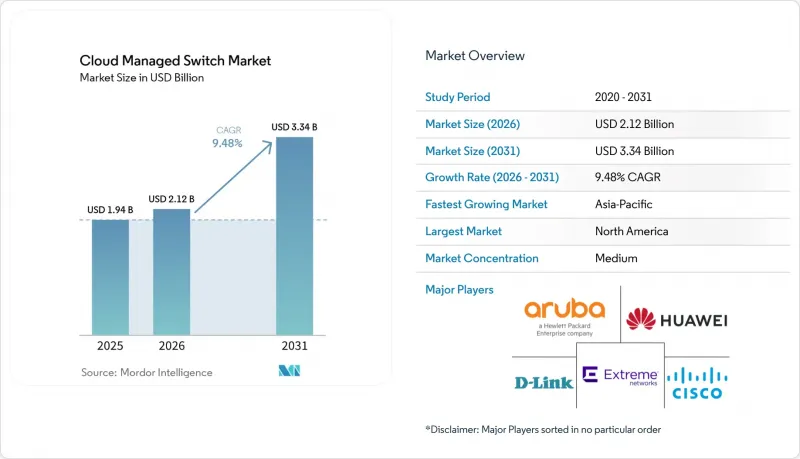
根據 Mordor Intelligence 預測,雲端管理交換器市場規模將從 2025 年的 19.4 億美元和 2026 年的 21.2 億美元成長到 2031 年的 33.4 億美元,2026 年至 2031 年的年複合成長率(CAGR)為 9.48%。
本報告按連接埠數量(8 埠或以下、16 埠型號、其他)、交換器容量(1 GbE、2.5/5 GbE 多千兆、其他)、企業規模(大型企業、中小企業)、最終用戶產業(教育機構、其他)、部署模式(公共雲端、其他)和地區進行細分。市場預測以美元 (USD) 為單位。
全球雲端管理交換器市場趨勢與洞察
對多GigabitWi-Fi 6/6E回程傳輸的需求正在激增。
企業正在提高Wi-Fi無線設備部署密度,為了避免網路擁塞,每個新的Wi-Fi 6E網路基地台通常需要Gigabit或Gigabit的上行鏈路。因此,在教育機構、醫療機構和大型企業園區,配備多速率(1/2.5/5/ Gigabit)BASE-T連接埠的雲端管理交換器正在取代傳統的Gigabit交換器。供應商正在檢驗多Gigabit部署方案的有效性,該方案可重複利用現有的6A類線纜,避免破壞性的重新佈線。美國和西歐部分地區的早期採用者比亞太地區提前12至18個月獲得了吉赫頻寬的發布,而現在,印度、日本和東南亞國協的頻率競標正在引發同步的更新周期。隨著通路合作夥伴將交換器、網路基地台和授權合約整合到一份合約中,財務長開始將多Gigabit升級視為營運支出而不是資本支出,這將簡化預算回程傳輸流程,並確保未來三年內持續的高出貨量。
中小企業採用營運支出模式的興起
中小企業缺乏專職網路工程師,更傾向於預先配置、自動更新且具備雲端自然語言故障排除功能的解決方案。訂閱式定價模式將硬體、韌體和支援服務整合到可預測的月費中,從而釋放資金用於業務成長。託管服務供應商(MSP) 正抓住這一機遇,將連接、安全性和協作打包成交承包解決方案,從而將需求擴展到擁有內部 IT 人員的大型企業之外。低階市場的激烈競爭促使價格保持競爭力,而人工智慧驅動的控制面板則降低了 MSP 的營運成本,使單一營運商能夠同時管理數百個地點。通常情況下,合約期限為三年,這種營運支出 (OPEX) 模式為供應商和合作夥伴提供了穩定的收入前景,並進一步增強了生態系統。
轉型過程中的複雜性與成本障礙
從本地控制器遷移到雲端管理通常需要支付資料傳輸費用、重新設計架構並簽署新的授權協議,這些加起來可能會使專案預算增加 15% 到 25%。專有 API 和唯一 ID 儲存空間進一步加劇了多供應商環境的複雜性。舊硬體停止支援的公告也迫使企業迅速做出決策。將對延遲敏感的工作負載保留在本地的企業會面臨工具碎片化的風險,因為在完全遷移完成之前,兩個控制平面必須共存。由此產生的營運開銷會將投資回收期延長至兩年以上,令保守的買家望而卻步。
細分市場分析
24埠交換器預計將在2025年佔據46.72%的市場佔有率,因為它適用於大多數電力預算和機架空間有限的分公司和中型園區機房。雖然這些固定配置交換器仍將維持較大的出貨量,但預計未來的成長將轉向支援分散式資料中心骨幹層的96埠交換器和底盤平台。受超大規模資料中心業者資料中心和人工智慧推理叢集的需求驅動,高密度底盤雲端管理交換器市場預計將以18.43%的複合年成長率成長。目前,用於人工智慧訓練的機架功耗超過30千瓦,而對於集中式冷卻系統,整合多個線路卡於單一管理平面下的模組化背板更受歡迎。各廠商均提供可現場更換的風扇、電源和交換矩陣模組,這使得平均故障間隔時間(MTBF)優於固定尺寸的設備,對於那些無法容忍模型訓練期間停機的運營商而言,這無疑是一個極具吸引力的選擇。
此外,戴爾 PowerSwitch Z9664F-ON 是一款 64 連接埠 400Gigabit乙太網路切換器,採用框架單位機架式設計,支援透過企業級 SONiC 分發和戴爾 SmartFabric OS10 實現硬體和軟體的分離。這使得用戶能夠使用 SmartFabric 服務實現零接觸安裝和自主架構部署。在分店部署中,8 埠和 16 埠交換器仍然適用於安裝空間有限的場所,例如零售自助服務終端和遠端醫療艙。教育和酒店行業的負責人更傾向於選擇 48 端口型號,因為它們在端口密度和可接受的初始成本之間取得了平衡,而 PoE 預算已達到現代網路基地台所需的 740 瓦閾值。雖然 24 埠型號的相對佔有率正在下降,但隨著新型物聯網終端、門禁讀卡機和感測器滿足存取層需求,其絕對出貨量仍然強勁。
成熟的萬兆Gigabit市場,得益於收發器的廣泛普及和低成本,預計到2025年將以36.77%的市佔率引領市場。然而,隨著Wi-Fi 6E網路基地台向2.5/5Gigabit上行鏈路遷移,以及邊緣伺服器標配25Gigabit網卡,25/40Gigabit市場預計將以13.26%的年成長率成長。這種轉變為園區網路環境提供了一條更便捷的升級路徑,在維持現有銅纜基礎設施的同時,也實現了更高的吞吐量。在高階市場,超大規模雲端平台已經開始部署400Gigabit和800Gigabit網路架構,為人工智慧加速器提供資料。雖然目前出貨量較低,但較高的平均售價對收入貢獻顯著,而且隨著早期用戶檢驗水冷設計,這項技術很可能會擴展到企業級應用。
在新興市場以及現有基礎設施維修方面,1 Gigabit頻段仍然至關重要,尤其是在預算限制或傳統控制器限制鏈路速度的情況下。然而,成長的重點在於能夠自動協商 1/2.5/5/10 Gigabit的多速率交換機,它們無需進行連接埠到連接埠的全面更換即可實現面向未來的應對力。到 2031 年,多速率晶片將滲透到入門級產品線,取代除超低定價模式之外的所有固定 1 Gigabit晶片。
區域分析
北美地區在2025年貢獻了36.77%的收入,這得益於Wi-Fi 6E頻寬的提前分配、多年教育津貼以及對人工智慧基礎設施的加速投資。雲端管理交換器的更新周期與美國和加拿大廣泛採用訂閱式軟體的趨勢保持同步,供應商報告稱,資料中心交換器訂單已連續六個季度實現兩位數以上的成長。儘管已部署的設備正步入成熟階段,但對節能型替代產品和持續網路安全可見度的需求依然存在,預計該地區到2031年將保持約8%的複合年成長率。
亞太地區是成長最快的區域,預計年增率將達到15.32%,這主要得益於中國、印度和東協成員國對智慧城市電網、主權雲和5G傳輸網路的投資。到2026年,該地區的資料中心容量預計將超過17吉瓦,每個機架的功率密度已超過30千瓦。這迫使營運商向水冷底盤和400/800Gigabit網路架構遷移。主權採購架構通常將網路、運算和資金籌措打包提供,這有利於主要企業,同時也為海外供應商在地化管理方案留出了空間。
歐洲的發展趨勢受到嚴格的隱私和永續性框架的影響,這些框架限制了公共雲端的採用,同時鼓勵功能豐富的私有雲端控制器。法國的SecNumCloud和德國的C5等認證要求提供處理地點的文件和供應鏈的透明度,而擁有碳中和藍圖的競標將獲得加分。隨著成員國對校園和城市交通網路進行現代化改造,並在主權雲要求(要求在支持終止前進行更新項目)的支持下,預計到2031年,歐洲的複合年成長率將達到約7.8%。
其他好處:
- Excel格式的市場預測(ME)表
- 3個月的分析師支持
目錄
第1章:引言
- 研究假設和市場定義
- 調查範圍
第2章:調查方法
第3章執行摘要
第4章 市場狀況
- 市場概覽
- 市場促進因素
- 對多GigabitWi-Fi 6/6E回程傳輸的需求正在激增。
- 採用營運支出模式的中小型企業(SME)的興起
- 隨著邊緣運算和物聯網的普及,交換器的遠端系統管理變得不可或缺。
- 以永續性為重點的PoE+功率最佳化
- 開放式無線存取網(Open-RAN)傳輸網路建設
- 基於人工智慧的雲端儀錶板網路分析
- 市場限制因素
- 轉型過程中的複雜性與成本障礙
- 基於資料主權的強制性本地部署
- 半導體供應鏈的波動性
- 供應商鎖定在專有雲端平台
- 產業供應鏈分析
- 宏觀經濟影響評估
- 監理情勢
- 技術趨勢(SDN、網路運維自動化)
- 波特五力模型
- 投資分析
第5章 市場規模與成長預測
- 按連接埠數量
- 8 個連接埠或更少
- 16埠型號
- 24埠型號
- 48埠型號
- 96埠和底盤型
- 交換器容量(資料傳輸速度)
- 1 GbE
- 2.5/5 GbE(多千兆)
- 10 GbE
- 25/40 GbE
- 100 GbE 或更高
- 按公司規模
- 大公司
- 小型企業
- 按最終用戶行業分類
- 教育機構
- 醫療機構
- 飯店和零售商店
- 公共部門和智慧城市
- 其他終端用戶產業
- 按部署模式
- 公共雲端管理
- 廠商託管的私有雲端
- 自架虛擬控制器(本機 IaaS)
- 按地區
- 北美洲
- 美國
- 加拿大
- 墨西哥
- 南美洲
- 巴西
- 阿根廷
- 其他南美國家
- 歐洲
- 英國
- 德國
- 法國
- 義大利
- 西班牙
- 俄羅斯
- 其他歐洲國家
- 亞太地區
- 中國
- 日本
- 印度
- 韓國
- ASEAN
- 澳洲和紐西蘭
- 亞太其他地區
- 中東和非洲
- 中東
- UAE
- 沙烏地阿拉伯
- 土耳其
- 其他中東國家
- 非洲
- 南非
- 其他非洲國家
- 中東
- 北美洲
第6章 競爭情勢
- 市場集中度
- 策略趨勢
- 市佔率分析
- 公司簡介
- Cisco Systems
- HPE(Aruba)
- Juniper Networks(Mist)
- Extreme Networks
- Huawei Technologies
- Arista Networks
- Ubiquiti Inc.
- CommScope(Ruckus)
- Fortinet
- TP-Link
- D-Link Corporation
- NETGEAR Inc.
- Alcatel-Lucent Enterprise
- Ruijie Networks
- Cambium Networks
- Zyxel Communications
- Allied Telesis
- MikroTik
- Dahua Technology
- H3C Technologies
第7章 市場機會與未來展望
According to Mordor Intelligence, the cloud managed switch market size is projected to expand from USD 1.94 billion in 2025 and USD 2.12 billion in 2026 to USD 3.34 billion by 2031, registering a CAGR of 9.48% between 2026 and 2031.
This report is Segmented by Port Count (8-Port and Below, 16-Port Models, and More), Switch Capacity (1 GbE, 2. 5/5 GbE Multigig, and More), Enterprise Size (Large Enterprises, and Small and Medium Enterprises), End-User Industry (Educational Institutions, and More), Deployment Model (Public-Cloud Managed, and More), and Geography. The Market Forecasts are Provided in Terms of Value (USD).
Global Cloud Managed Switch Market Trends and Insights
Surge in Multi-Gigabit Wi-Fi 6/6E Back-Haul Demand
Enterprises are densifying Wi-Fi radio deployments, and each new Wi-Fi 6E access point typically requires 2.5 gigabit or 5 gigabit uplinks to avoid congestion. Cloud-managed switches equipped with multi-rate 1/2.5/5/10-gigabit BASE-T ports therefore replace legacy 1-gigabit models in education, healthcare, and large corporate campuses. Vendors have validated multi-gigabit deployments that reuse existing Category 6A cabling, avoiding disruptive rewiring. Early adopters in the United States and parts of Western Europe benefited from 6 gigahertz spectrum clearance 12-18 months ahead of Asia-Pacific, but spectrum auctions across India, Japan, and ASEAN economies are now triggering synchronized refresh cycles. As channel partners bundle switches, access points, and license subscriptions under a single contract, CFOs perceive multi-gigabit back-haul upgrades as an operational rather than capital event, smoothing budget approvals and sustaining volume shipments over the next three years.
Rise of Small and Medium Enterprises Adopting OPEX Models
SMEs lack dedicated network engineers and favor solutions that arrive pre-provisioned, self-update, and deliver natural-language troubleshooting from the cloud. Subscription-first pricing turns hardware, firmware, and support into one predictable monthly fee, freeing cash for growth initiatives. Managed-service providers (MSPs) capitalize by packaging connectivity, security, and collaboration into turnkey offerings, expanding addressable demand beyond enterprises with in-house IT staff. Competitive intensity at the lower end of the market sustains aggressive price points, while AI-driven dashboards reduce MSP overhead and let a single operator manage hundreds of sites concurrently. Because contract lengths typically span three years, the OPEX model locks in revenue visibility for vendors and partners, further reinforcing ecosystem momentum.
Migration Complexity and Cost Barriers
Moving from on-premises controllers to cloud management often incurs data-egress fees, re-architecting efforts, and new licensing commitments that collectively inflate project budgets by 15-25%. Proprietary APIs and unique identity stores further complicate dual-vendor environments, while end-of-life announcements for older hardware force accelerated decision making. Enterprises that keep latency-sensitive workloads on-site risk tool fragmentation, as two control planes must co-exist until full migration completes. The resulting operational overhead extends payback periods out to two years or more, deterring conservative buyers.
Other drivers and restraints analyzed in the detailed report include:
- Edge and IoT Proliferation Needing Remote Switch Management
- Sustainability-Focused PoE+ Power Optimization
- Data-Sovereignty-Driven On-Prem Mandates
For complete list of drivers and restraints, kindly check the Table Of Contents.
Segment Analysis
The 24-port category captured 46.72% of 2025 revenue because it fits most branch and midsize campus closets, where power budgets and rack space are limited. These fixed-configuration switches will continue to ship in volume, but growth skews toward 96-port and chassis platforms that anchor spine layers in distributed data centers. The cloud managed switch market for high-density chassis is projected to expand at a 18.43% CAGR, driven by hyperscaler and AI inference cluster demand. AI training racks now draw over 30 kilowatts, and centralized cooling favors modular backplanes that consolidate multiple line cards under one management plane. Vendors offer field-replaceable fans, power supplies, and fabric modules, driving mean-time-between-failure metrics that surpass fixed-form-factor devices and appeal to operators who cannot tolerate downtime during model training.
Furthermore, Dell's PowerSwitch Z9664F-ON, a 64-port 400-gigabit Ethernet switch in 2-rack-unit form factor, supports disaggregated hardware and software via Enterprise SONiC Distribution and Dell SmartFabric OS10, enabling zero-touch installation and autonomous fabric deployment through SmartFabric Services. Furthermore, branch deployments continue to deploy 8-port and 16-port switches where space is tight, such as retail kiosks or remote healthcare pods. Education and hospitality buyers favor 48-port models that balance port density with acceptable upfront cost, and PoE budgets reach the 740-watt threshold required for modern access points. While the relative share of 24-port units will slip, absolute shipments remain healthy because new IoT endpoints, badge readers, and sensors replenish access-layer demand.
The mature 10 gigabit Ethernet segment dominated 2025 at 36.77% share due to broad transceiver availability and favorable cost per bit. Still, the 25/40 gigabit cohort is set to grow 13.26% annually as Wi-Fi 6E access points migrate to 2.5/5 gigabit uplinks and edge servers standardize on 25 gigabit network interface cards. This transition preserves the installed copper plant while unlocking higher throughput, making it a low-friction upgrade path for campuses. At the top end, hyperscale clouds already deploy 400 gigabit and 800 gigabit fabrics to feed AI accelerators. Although volumes are small, outsized average selling prices lift revenue contribution, and early adopters validate liquid-cooling designs that will trickle down to enterprise variants.
The 1 gigabit tier remains meaningful in emerging markets and brown-field retrofits where budget limitations or legacy controllers cap link speeds. Nevertheless, growth concentrates in multi-rate switches that auto-negotiate 1/2.5/5/10 gigabit, offering future readiness without a port-by-port forklift. By 2031, multi-rate silicon will permeate even entry-level lines, displacing static 1 gigabit chips except in ultra-low-cost models.
Complete Report Scope:
- By Port Count
- 8-port and below
- 16-port Models
- 24-port Models
- 48-port Models
- 96-port and Chassis-based
- By Switch Capacity (Data-rate)
- 1 GbE
- 2.5/5 GbE (Multigig)
- 10 GbE
- 25/40 GbE
- 100 GbE and above
- By Enterprise Size
- Large Enterprises
- Small and Medium Enterprises
- By End-user Industry
- Educational Institutions
- Healthcare Facilities
- Hospitality and Retail Locations
- Public Sector and Smart Cities
- Other End user Industries
- By Deployment Model
- Public-cloud managed
- Vendor-hosted private cloud
- Self-hosted virtual controller (on-prem IaaS)
- By Geography
- North America
- United States
- Canada
- Mexico
- South America
- Brazil
- Argentina
- Rest of South America
- Europe
- United Kingdom
- Germany
- France
- Italy
- Spain
- Russia
- Rest of Europe
- Asia-Pacific
- China
- Japan
- India
- South Korea
- ASEAN
- Australia and New Zealand
- Rest of the Asia-Pacific
- Middle East and Africa
- Middle East
- UAE
- Saudi Arabia
- Turkey
- Rest of the Middle East
- Africa
- South Africa
- Rest of Africa
- Middle East
- North America
Geography Analysis
North America held 36.77% of 2025 revenue, buoyed by early Wi-Fi 6E spectrum clearance, multi-year education grants, and accelerating AI infrastructure investment. Cloud managed switch refresh cycles align with broader shifts toward subscription software across the United States and Canada, and vendors report mid-teens data-center switch order growth for six consecutive quarters. Although the installed base is maturing, demand persists for power-efficient replacements and sustained cybersecurity visibility, keeping the regional CAGR near 8% through 2031.
Asia-Pacific is the fastest-growing territory, forecast to expand at 15.32% annually as China, India, and ASEAN members pour funding into smart-city grids, sovereign clouds, and 5G transport networks. Regional data-center capacity is on track to exceed 17 gigawatts by 2026, and rack power densities now breach 30 kilowatts, pushing operators toward liquid-cooled chassis and 400/800 gigabit fabrics. Sovereign procurement frameworks often bundle networking, compute, and financing, favoring domestic champions but still leaving room for foreign suppliers that localize management plans.
Europe's trajectory is shaped by stringent privacy and sustainability frameworks that constrain public-cloud adoption but incentivize feature-rich private-cloud controllers. Certifications such as SecNumCloud in France and C5 in Germany require documented processing locations and transparent supply chains, and bidders with carbon-neutral roadmaps secure bonus scoring. As member states modernize campus and metropolitan transport networks, Europe's CAGR should rise to roughly 7.8% through 2031, underpinned by sovereign-cloud mandates that force refresh projects ahead of support sunsets.
- Cisco Systems
- HPE (Aruba)
- Juniper Networks (Mist)
- Extreme Networks
- Huawei Technologies
- Arista Networks
- Ubiquiti Inc.
- CommScope (Ruckus)
- Fortinet
- TP-Link
- D-Link Corporation
- NETGEAR Inc.
- Alcatel-Lucent Enterprise
- Ruijie Networks
- Cambium Networks
- Zyxel Communications
- Allied Telesis
- MikroTik
- Dahua Technology
- H3C Technologies
Additional Benefits:
- The market estimate (ME) sheet in Excel format
- 3 months of analyst support
TABLE OF CONTENTS
1 INTRODUCTION
- 1.1 Study Assumptions and Market Definition
- 1.2 Scope of the Study
2 RESEARCH METHODOLOGY
3 EXECUTIVE SUMMARY
4 MARKET LANDSCAPE
- 4.1 Market Overview
- 4.2 Market Drivers
- 4.2.1 Surge in Multi-gigabit Wi-fi 6/6E Back-haul Demand
- 4.2.2 Rise of Small and Medium Enterprises (SMEs) Adopting OPEX Models
- 4.2.3 Edge and IoT Proliferation Needing Remote Switch Management
- 4.2.4 Sustainability-focused PoE+ Power Optimisation
- 4.2.5 Open-ran Transport Network Build-outs
- 4.2.6 AI-driven Network Analytics in Cloud Dashboards
- 4.3 Market Restraints
- 4.3.1 Migration Complexity and Cost Barriers
- 4.3.2 Data-sovereignty-driven On-prem Mandates
- 4.3.3 Semiconductor Supply-chain Volatility
- 4.3.4 Vendor Lock-in to Proprietary Clouds
- 4.4 Industry Supply-Chain Analysis
- 4.5 Macroeconomic Impact Assessment
- 4.6 Regulatory Landscape
- 4.7 Technological Outlook (SDN, NetOps Automation)
- 4.8 Porter's Five Forces
- 4.8.1 Bargaining Power of Suppliers
- 4.8.2 Bargaining Power of Buyers
- 4.8.3 Threat of New Entrants
- 4.8.4 Threat of Substitutes
- 4.8.5 Intensity of Competitive Rivalry
- 4.9 Investment Analysis
5 MARKET SIZE AND GROWTH FORECASTS (VALUE)
- 5.1 By Port Count
- 5.1.1 8-port and below
- 5.1.2 16-port Models
- 5.1.3 24-port Models
- 5.1.4 48-port Models
- 5.1.5 96-port and Chassis-based
- 5.2 By Switch Capacity (Data-rate)
- 5.2.1 1 GbE
- 5.2.2 2.5/5 GbE (Multigig)
- 5.2.3 10 GbE
- 5.2.4 25/40 GbE
- 5.2.5 100 GbE and above
- 5.3 By Enterprise Size
- 5.3.1 Large Enterprises
- 5.3.2 Small and Medium Enterprises
- 5.4 By End-user Industry
- 5.4.1 Educational Institutions
- 5.4.2 Healthcare Facilities
- 5.4.3 Hospitality and Retail Locations
- 5.4.4 Public Sector and Smart Cities
- 5.4.5 Other End user Industries
- 5.5 By Deployment Model
- 5.5.1 Public-cloud managed
- 5.5.2 Vendor-hosted private cloud
- 5.5.3 Self-hosted virtual controller (on-prem IaaS)
- 5.6 By Geography
- 5.6.1 North America
- 5.6.1.1 United States
- 5.6.1.2 Canada
- 5.6.1.3 Mexico
- 5.6.2 South America
- 5.6.2.1 Brazil
- 5.6.2.2 Argentina
- 5.6.2.3 Rest of South America
- 5.6.3 Europe
- 5.6.3.1 United Kingdom
- 5.6.3.2 Germany
- 5.6.3.3 France
- 5.6.3.4 Italy
- 5.6.3.5 Spain
- 5.6.3.6 Russia
- 5.6.3.7 Rest of Europe
- 5.6.4 Asia-Pacific
- 5.6.4.1 China
- 5.6.4.2 Japan
- 5.6.4.3 India
- 5.6.4.4 South Korea
- 5.6.4.5 ASEAN
- 5.6.4.6 Australia and New Zealand
- 5.6.4.7 Rest of the Asia-Pacific
- 5.6.5 Middle East and Africa
- 5.6.5.1 Middle East
- 5.6.5.1.1 UAE
- 5.6.5.1.2 Saudi Arabia
- 5.6.5.1.3 Turkey
- 5.6.5.1.4 Rest of the Middle East
- 5.6.5.2 Africa
- 5.6.5.2.1 South Africa
- 5.6.5.2.2 Rest of Africa
- 5.6.5.1 Middle East
- 5.6.1 North America
6 COMPETITIVE LANDSCAPE
- 6.1 Market Concentration
- 6.2 Strategic Moves
- 6.3 Market Share Analysis
- 6.4 Company Profiles (includes Global level Overview, Market level overview, Core Segments, Financials as available, Strategic Information, Market Rank/Share for key companies, Products and Services, and Recent Developments)
- 6.4.1 Cisco Systems
- 6.4.2 HPE (Aruba)
- 6.4.3 Juniper Networks (Mist)
- 6.4.4 Extreme Networks
- 6.4.5 Huawei Technologies
- 6.4.6 Arista Networks
- 6.4.7 Ubiquiti Inc.
- 6.4.8 CommScope (Ruckus)
- 6.4.9 Fortinet
- 6.4.10 TP-Link
- 6.4.11 D-Link Corporation
- 6.4.12 NETGEAR Inc.
- 6.4.13 Alcatel-Lucent Enterprise
- 6.4.14 Ruijie Networks
- 6.4.15 Cambium Networks
- 6.4.16 Zyxel Communications
- 6.4.17 Allied Telesis
- 6.4.18 MikroTik
- 6.4.19 Dahua Technology
- 6.4.20 H3C Technologies
7 MARKET OPPORTUNITIES AND FUTURE OUTLOOK
- 7.1 White-Space and Unmet-Need Assessment

 2026年全球雲端成本管理與最佳化市場報告2026年全球雲端成本管理工具市場報告
 網路雲端成本最佳化:市場佔有率分析、產業趨勢與統計、成長預測(2026-2031)
 全球雲端成本管理市場規模、佔有率、趨勢和成長分析報告(2026-2034年)
 全球循環資產管理平台市場預測至2034年:依平台類型、資產類型、管理功能、部署方式、最終用戶及地區分類
 整合雲端管理平台市場-2026-2032年全球市場預測企業IT自動化市場預測至2034年-按類型、部署模式、組織規模、應用程式、最終用戶和地區分類的全球分析循環資產生命週期管理市場預測至2034年-按解決方案類型、資產類型、部署模式、服務模式、最終用戶和地區分類的全球分析雲端管理平台市場:依交付類型、技術、部署模式、企業規模與產業分類-2026-2032年全球市場預測Frost Radar™:整合雲端通訊平台,2026 年