


 |
市場調查報告書
商品編碼
2119321
輪胎磨損減少劑添加劑:市場佔有率分析、行業趨勢和統計數據以及成長預測(2026-2031 年)Tire-Abrasion Reduction Compound Additives - Market Share Analysis, Industry Trends & Statistics, Growth Forecasts (2026 - 2031) |
||||||

※ 本網頁內容可能與最新版本有所差異。詳細情況請與我們聯繫。
據 Mordor Intelligence 稱,2025 年輪胎磨損減少化合物添加劑的市場規模為 29.3 億美元,預計到 2026 年將達到 31 億美元,到 2031 年將達到 41.7 億美元。
預測期(2026-2031 年)的複合年成長率預計為 6.07%。
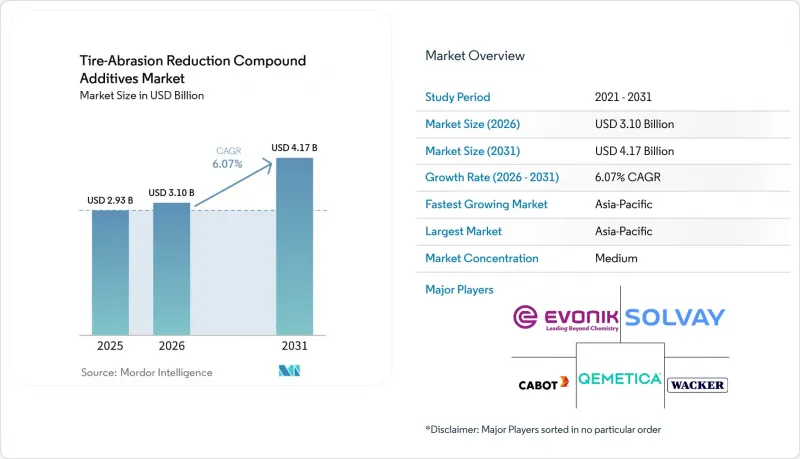
本報告按添加劑類型(例如,二氧化矽添加劑)、輪胎類型(例如,乘用車輪胎)、複合材料應用(例如,胎面膠料)、終端用戶產業(例如,OEM輪胎製造商)和地區(亞太地區、北美地區、歐洲地區、南美地區、中東和非洲地區)進行細分。市場預測以美元計價。
全球輪胎磨損減少劑添加劑市場趨勢及洞察
推動制定減少輪胎磨損和非廢氣排放的法規
2026年,歐盟7排放標準將重塑整個歐洲輪胎供應鏈中添加劑的採購方式。歐盟法規(EU) 2024/1257將車輛要求擴展至輪胎磨損,並將於2026年11月29日起適用於新的M1和N1車型。根據聯合國歐洲經濟委員會(UNECE)的框架,C1乘用車輪胎的法規計劃於2028年7月生效,C2輪胎將於2030年4月生效,C3輪胎將於2032年4月生效。因此,輪胎製造商需要研發能夠減少磨損造成的品質損失,同時又不犧牲濕地抓地力或燃油效率的胎面配方。這進一步凸顯了富含二氧化矽的化合物和偶聯劑的重要性,它們能夠改善橡膠與填料之間的相互作用。德國汽車俱樂部(ADAC)正在將輪胎磨損評估納入其綠色新車評估計畫(NCAP)協議,將於2025年進行修訂,這將在正式標準生效前加大市場壓力。此外,輪胎磨損減少化合物添加劑市場也受到聯合國法規 R117 標籤要求的影響,該法規建議在滾動阻力和濕地抓地性能方面使用高分散性二氧化矽體系。
由於電氣化,對高耐用性電動車(EV)輪胎的需求增加。
隨著電池式電動車(BEV)的普及,減少輪胎磨損已成為輪胎製造商日益關鍵的技術要求。由於瞬時扭力、滑行時間縮短以及電池重量增加,電動車的輪胎磨損速度比同級別的內燃機汽車快20-30%。純電動卡車面臨的挑戰更大,因為其牽引力對輪胎磨損的貢獻比柴油車高出120%以上。據倍耐力稱,在2026年上半年獲得的約200項新的OEM認證中,60%是針對電池式電動車或插電式混合動力汽車的。該公司還報告稱,這些認證中有90%針對的是19英寸或更大的輪圈直徑,需要先進的胎面設計。隨著輪胎製造商在其電動車專案中評估二氧化矽、功能性聚合物和偶聯劑等添加劑,輪胎磨損減少劑市場正從中受益。如果這些配方獲得生產批准,則有望建立長期的供應關係。
先進添加劑高成本、能耗高
高分散性沉澱二氧化矽成本高昂,限制了其在價格敏感型輪胎應用的使用。先進的二氧化矽-矽烷系統的成本比傳統炭黑高出40-60%。矽烷的生產需要鹵化前驅物的化學反應和多個反應步驟,阻礙了成本的快速降低。此外,高填充二氧化矽化合物需要更充分的混合才能實現良好的分散,這增加了輪胎製造商的能源消耗,並對生產效率造成了壓力。 Orion在2026年展望報告中指出,來自亞洲的輪胎進口給歐美輪胎OEM廠商的生產帶來了壓力。這種情況往往會導致廠商在材料成本方面採取更保守的決策。 2025年10月,Cabot擴大了其「EVOLVE」循環增強碳平台在北美的生產規模,該平台含有30%的再生炭黑,同時維持了N234的性能水準。此類替代方案可能會降低二氧化矽體系在商用和工業輪胎應用中的成本和永續性優勢。
細分市場分析
到2025年,二氧化矽基添加劑將佔據輪胎耐磨添加劑市場41.62%的佔有率。這一地位反映了高分散性沉澱二氧化矽在乘用車胎面和電動車輪胎專案中的優異性能。大陸集團30年的經驗表明,與傳統的炭黑基方法相比,二氧化矽基化合物可將煞車距離縮短約50%,並改善滾動阻力。功能化聚合物預計到2031年將以7.13%的複合年成長率成長,成為成長最快的添加劑類型。其胺基和烷氧基矽烷基團增強了橡膠鏈與二氧化矽表面之間的相互作用,從而在提高二氧化矽填料密度的同時,減少了可能損害化合物性能的填料間相互作用。
偶聯劑仍然至關重要,因為它們有助於將二氧化矽的增強作用傳遞到橡膠網路。在2026年輪胎技術博覽會上,邁圖科技(Momentive)發布了其NXT和NRX矽烷平台,用於在較低混煉溫度下增強橡膠,並適用於重型天然橡膠應用。加工助劑、增強樹脂、奈米材料和耐磨添加劑發揮著重要的輔助作用,儘管它們的市場規模較小。朗盛推出了用於二氧化矽分散的Aflux SD,而阿科瑪於2025年10月推出了Luperox NeatCure顆粒,可實現更安全、更高效的硫化。在輪胎耐磨添加劑市場,對毒性的擔憂正促使人們拋棄某些傳統的硫化促進劑,從而提升了生物基分散劑、替代硫化促進劑和特殊偶聯劑在新配方中的價值。
2025年,乘用車輪胎佔了輪胎耐磨添加劑市場56.84%的佔有率。此細分市場的特點是輪胎產量高,且在高階和主流子午線輪胎中廣泛使用二氧化矽和矽烷化合物。在電動乘用車(EV)中,由於重量和扭矩的增加,對耐磨性的要求也更高,因此胎面配方中添加劑的使用量也隨之增加。預計到2031年,商用車輪胎的複合年成長率將達到6.91%。與柴油車相比,純電動卡車由於軸荷和扭矩特性更高,因此需要更耐磨的配方。因此,隨著電動卡車數量的增加,用於卡車和客車的子午線輪胎的耐磨添加劑市場仍有成長空間。
非公路輪胎構成了一個獨特的技術細分市場,採用奈米碳增強聚合物和專用耐磨添加劑,主要用於採礦和建築作業。儘管由於產量較低,市場規模仍然較小,但延長輪胎的使用壽命對設備營運商至關重要。兩輪和三輪車輛輪胎主要集中在印度和東南亞,傳統上以炭黑含量較高的配方為主。高階輪胎製造商已開始在該類別中測試二氧化矽基胎面配方,為長期升級鋪平道路。此外,電動商用車的原始設備製造商 (OEM) 規範未來可能會影響替換輪胎市場,因為替換輪胎製造商可能需要採用類似的配方來保持耐磨性、抓地力和滾動阻力性能。這種連鎖反應將推動對商用輪胎配方中功能性聚合物、偶聯劑和加工助劑的需求。
區域分析
預計到2025年,亞太地區將佔據輪胎耐磨添加劑市場49.46%的佔有率,並在2031年之前以6.97%的複合年成長率成長。中國是該地區的主要生產基地,研究期間年產量將超過16億條。 2025年,中國輪胎市場價值將達到546.5億美元,而中國的GB-9743和GB-9744標準正在推動胎面配方轉變為二氧化矽基配方。印度也是一個重要的需求中心,其國內高階輪胎製造商正在測試用於二輪車和三輪車輪胎的二氧化矽基配方。日本和韓國是數位化配方開發的先驅。住友橡膠工業株式會社報告稱,其與NEC合作的AI驅動材料發現計劃,與傳統的專家主導方法相比,將配方提案所需時間縮短了95%。
歐洲是輪胎磨損減少劑添加劑市場第二大地區。德國擁有眾多高階輪胎製造商和特殊化學品供應商,正推動高矽含量系統的應用。歐盟7排放標準、REACH法規、永續產品生態設計法規(ESPR)以及聯合國R117號法規使得材料性能和碳強度的文件記錄日益重要。索爾維在義大利利沃諾開設了歐洲首家利用稻殼灰生產生物回收二氧化矽的工廠,並報告每噸二氧化碳排放量減少了35%。贏創計畫於2026年在其土耳其工廠擴大其循環二氧化矽「ULTRASIL eCO」的生產,該產品已獲得國際永續碳認證(ISCC)Plus。北美的情況較為特殊,隨著電動車(EV)平台的引入,目的地設備製造商(OEM)的規格要求日益嚴格,而2025年進口量的增加也給西方輪胎生產帶來了壓力。
在調查期間,南美洲和中東及非洲地區的市佔率最小。巴西是南美洲的主要需求中心,當地製造商已開始在乘用車胎面中使用高分散性二氧化矽。消費者和車隊對節能輪胎的需求推動了這項轉變。中東及非洲地區的供應主要依賴進口特殊添加劑。沙烏地阿拉伯為實現製造業多元化所做的努力以及南非的工業橡膠生產基地,正在催生對偶聯劑和加工助劑的新需求。阿根廷的化學工業以及該地區的生物基原料進一步支撐了南美洲其他地區的需求。在中東及非洲地區,對基礎設施相關的非公路輪胎的需求依然旺盛,傳統的炭黑基化合物仍佔主導地位。
其他好處:
- Excel格式的市場預測(ME)表
- 3個月的分析師支持
目錄
第1章:引言
- 研究假設和市場定義
- 調查範圍
第2章:調查方法
第3章執行摘要
第4章 市場狀況
- 市場概覽
- 市場促進因素
- 推動制定減少輪胎磨損和非廢氣排放的法規。
- 電動車的普及推動了對高耐用性電動車輪胎的需求。
- 採用二氧化矽-矽烷增強體系
- 高性能、長壽命輪胎的優質化
- 藥物製劑數位化和化合物最佳化加速
- 循環利用和生物基添加劑的開發
- 市場限制因素
- 先進添加劑高成本且能耗大
- 以炭黑和傳統橡膠化學品替代
- OEM認證和配方變更的周期越來越長。
- 生物基和回收原料的變異性
- 價值鏈分析
- 波特五力分析
第5章 市場規模與成長預測
- 按添加劑類型
- 二氧化矽基添加劑
- 功能化聚合物
- 偶聯劑
- 加工輔助工具
- 其他(奈米材料、增強樹脂、耐磨添加劑、特殊添加劑)
- 按輪胎類型
- 乘用車輪胎
- 商用車輛輪胎
- 越野輪胎
- 兩輪和三輪車輛輪胎
- 其他
- 混合用途
- 胎面膠料
- 側壁化合物
- 內襯用化合物
- 用於傳送帶和汽車胎體的化合物
- 其他(輪胎邊緣化合物)
- 按最終用戶行業分類
- OEM輪胎製造
- 替換輪胎市場
- 翻新和維修應用
- 其他
- 按地區
- 亞太地區
- 中國
- 印度
- 日本
- 韓國
- 其他亞太國家
- 北美洲
- 美國
- 加拿大
- 墨西哥
- 歐洲
- 德國
- 英國
- 法國
- 義大利
- 其他歐洲國家
- 南美洲
- 巴西
- 阿根廷
- 其他南美國家
- 中東和非洲
- 沙烏地阿拉伯
- 南非
- 其他中東和非洲國家
- 亞太地區
第6章 競爭情勢
- 市場集中度
- 策略趨勢
- 市佔率和排名分析
- 公司簡介
- Arkema
- BASF
- Birla Carbon
- Cabot Corporation
- Eastman Chemical Company
- Evonik Industries AG
- JM Huber Corporation
- LANXESS
- Madhu Silica Pvt. Ltd.
- Orion Engineered Carbons GmbH
- QEMETICA
- QUECHEN
- Shin-Etsu Chemical Co., Ltd.
- Solvay
- Sumitomo Chemical Co., Ltd.
- Tokuyama Corporation
- Tosoh Corporation
- Wacker Chemie AG
第7章 市場機會與未來展望
According to Mordor Intelligence, the tire-abrasion reduction compound additives market size was valued at USD 2.93 billion in 2025 and is estimated to grow from USD 3.10 billion in 2026 to reach USD 4.17 billion by 2031, at a CAGR of 6.07% during the forecast period (2026-2031).
This report is Segmented by Additive Type (Silica Additives and More), Tire Type (Passenger Car Tires and More), Compound Application (Tread Compounds and More), End-User Industry (OEM Tire Manufacturing and More), and Geography (Asia-Pacific, North America, Europe, South America, and Middle-East and Africa). The Market Forecasts are Provided in Terms of Value (USD).
Global Tire-Abrasion Reduction Compound Additives Market Trends and Insights
Regulatory Push for Tire Abrasion and Non-Exhaust Emission Reduction
Euro 7 is reshaping additive procurement across European tire supply chains in 2026. Regulation (EU) 2024/1257 extends vehicle requirements to tire abrasion and applies to new M1 and N1 vehicle types from November 29, 2026. Limits for C1 passenger-car tires are scheduled to take effect from July 2028, followed by C2 tires in April 2030 and C3 tires in April 2032 under the United Nations Economic Commission for Europe (UNECE) framework. Tire producers, therefore, need tread formulations that reduce abrasive mass loss without sacrificing wet grip or fuel efficiency. This places greater importance on silica-rich compounds and coupling agents that improve the interaction between rubber and filler. The Allgemeiner Deutscher Automobil-Club (ADAC) added a tire-wear assessment to its revised Green New Car Assessment Program (NCAP) protocol in 2025, increasing commercial pressure before the formal limits begin to apply. The tire-abrasion reduction compound additives market is also affected by UN R117 labeling requirements, where rolling resistance and wet-grip performance support the use of highly dispersible silica systems.
Electrification-Driven Demand for High-Durability Electric Vehicle (EV) Tires
Battery electric vehicles are making tire wear a more important engineering requirement for tire makers. Electric vehicles wear tires 20-30% faster than comparable internal-combustion vehicles because of instant torque, less coasting, and added battery weight. Battery electric trucks present an even greater challenge, as their traction-force contribution to tire wear is more than 120% higher than that of their diesel counterparts. Pirelli reported that 60% of its nearly 200 new Original Equipment Manufacturer (OEM) homologations in the first half of 2026 were for battery-electric or plug-in-hybrid vehicles. The company also reported that 90% of those homologations covered rim diameters of at least 19 inches, which require demanding tread designs. The tire-abrasion reduction compound additives market benefits as tire manufacturers evaluate silica, functionalized polymers, and coupling agents for electric-vehicle programs. These evaluations can lead to longer-term supply relationships once a formulation is approved for production.
High Cost and Energy Intensity of Advanced Additives
The higher cost of highly dispersible precipitated silica continues to limit its use in price-sensitive tire applications. Advanced silica-silane systems carry a 40-60% cost premium over conventional carbon black grades. Silane production requires halogenated precursor chemistry and multiple reaction stages, which limit rapid cost reduction. Highly filled silica compounds also require more intensive mixing to achieve adequate dispersion, adding to energy consumption and productivity pressure for tire manufacturers. Orion cited pressure on Western tire OEM output from Asian tire imports in its 2026 guidance, a condition that tends to make material-cost decisions more conservative. In October 2025, Cabot expanded North American production of its EVOLVE circular-reinforcing carbon platform, which offers N234 performance with 30% recycled carbon black content . These alternatives can narrow the cost and sustainability advantage of silica systems in commercial and industrial tire applications.
Other drivers and restraints analyzed in the detailed report include:
- Adoption of Silica-Silane Reinforcement Systems
- Premiumization of High-Performance and Long-Life Tires
- Substitution by Carbon Black and Conventional Rubber Chemicals
For complete list of drivers and restraints, kindly check the Table Of Contents.
Segment Analysis
Silica additives captured 41.62% of the tire-abrasion reduction compound additives market share in 2025. Their position reflects the performance of highly dispersible precipitated silica in passenger-car treads and electric-vehicle tire programs. Continental's three-decade experience has shown that silica compounds deliver nearly 50% shorter braking distances and improved rolling resistance compared with older carbon black approaches. Functionalized polymers are projected to grow at a 7.13% CAGR through 2031, making them the fastest-growing additive type. Their amine and alkoxysilyl groups enhance interactions between rubber chains and silica surfaces, supporting higher silica loading while reducing filler-filler interactions that can compromise compound properties.
Coupling agents remain necessary because they help transfer the reinforcing benefit of silica into the rubber network. Momentive presented NXT and NRX silane platforms at Tire Technology Expo 2026 for reinforcement at lower mixing temperatures and for heavy-duty natural-rubber applications. Processing aids, reinforcing resins, nanomaterials, and anti-wear additives represent smaller-value categories but play an important supporting role. LANXESS introduced Aflux SD for silica dispersion, while Arkema launched Luperox NeatCure granules in October 2025 to enable safer, more efficient curing. The tire-abrasion reduction compound additives market is also moving away from certain incumbent accelerators due to toxicological concerns, increasing the value of bio-based dispersants, alternative accelerators, and specialty coupling agents in new formulations.
Passenger-car tires held 56.84% of the tire-abrasion reduction compound additives market share in 2025. This segment combines high tire production numbers with the widespread use of silica-silane compounds in premium and mainstream radial tires. Passenger electric vehicles raise the additive intensity of tread compounds because added mass and torque increase wear requirements. Commercial-vehicle tires are projected to grow at a CAGR of 6.91% through 2031. Battery electric trucks require more abrasion-resistant compounds because their axle loads and torque profiles are more demanding than those of diesel vehicles. The tire-abrasion reduction compound additives market, therefore, has a path to growth in truck and bus radial applications as electric truck fleets expand.
Off-the-road tires constitute a distinct technical niche that employs nano-carbon-reinforced resins and specialty anti-wear additives for mining and construction operations. Their lower output keeps them a smaller segment, but extended wear life remains important for equipment operators. Two-wheeler and three-wheeler tires are concentrated in India and Southeast Asia and have historically used carbon black-heavy formulations. Premium tire producers are beginning to test silica-based tread compounds in this category, creating a longer-term upgrade path. OEM specifications for electric commercial vehicles are also likely to influence the replacement channel over time, as replacement compounders may need to adopt similar formulations to maintain wear, grip, and rolling resistance performance. This pull-through supports demand for functionalized polymers, coupling agents, and processing aids in commercial tire compounds.
Complete Report Scope:
- By Additive Type
- Silica Additives
- Functionalized Polymers
- Coupling Agents
- Processing Aids
- Others (Nanomaterials, Reinforcing Resins, Anti-Wear Additives, Specialty Additives)
- By Tire Type
- Passenger Car Tires
- Commercial Vehicle Tires
- Off-the-Road Tires
- Two- and Three-Wheeler Tires
- Others
- By Compound Application
- Tread Compounds
- Sidewall Compounds
- Inner Liner Compounds
- Belt and Carcass Compounds
- Others (Bead Compounds)
- By End-User Industry
- OEM Tire Manufacturing
- Replacement Tire Market
- Retread and Repair Applications
- Others
- By Geography
- Asia-Pacific
- China
- India
- Japan
- South Korea
- Rest of Asia-Pacific
- North America
- United States
- Canada
- Mexico
- Europe
- Germany
- United Kingdom
- France
- Italy
- Rest of Europe
- South America
- Brazil
- Argentina
- Rest of South America
- Middle-East and Africa
- Saudi Arabia
- South Africa
- Rest of Middle-East and Africa
- Asia-Pacific
Geography Analysis
Asia-Pacific held 49.46% of the tire-abrasion reduction compound additives market share in 2025 and is projected to grow at a CAGR of 6.97% through 2031. China is the region's primary production base, with annual output exceeding 1.6 billion tires in the study period. China's tire market was valued at USD 54.65 billion in 2025, and its GB-9743 and GB-9744 standards are supporting upgrades toward silica-based tread compounds. India is another significant demand center, as premium domestic tire producers are testing silica-based specifications for 2- and 3-wheeler tires. Japan and South Korea are early adopters of digital compound development. Sumitomo Rubber reported that its AI-based material discovery work with NEC reduced the time to propose compounds by 95% compared with conventional expert-led approaches.
Europe is the second-largest region in the tire-abrasion-reduction compound-additive market. Germany's concentration of premium tire producers and specialty chemical suppliers supports the adoption of silica-intensive systems. Euro 7, REACH, the Ecodesign for Sustainable Products Regulation (ESPR), and UN R117 are increasing the importance of documented material performance and carbon intensity. Solvay opened Europe's first bio-circular silica facility in Livorno, Italy, using rice husk ash and reporting a 35% per-ton CO2 reduction. Evonik is expanding International Sustainability and Carbon Certification (ISCC) Plus-certified ULTRASIL eCO circular silica production at its site in Turkey in 2026. North America has a distinct profile, with electric vehicle platform launches increasing original equipment manufacturer (OEM) specification requirements while imports pressured Western tire output in 2025.
South America and the Middle-East & Africa accounted for the smallest regional shares in the study period. Brazil is the main South American demand center, as local producers are beginning to use highly dispersible silica in passenger-car treads. Consumer and fleet demand for fuel-efficient tires is supporting this transition. The Middle-East & Africa are mainly served through specialty additive imports. Saudi Arabia's manufacturing diversification efforts and South Africa's industrial rubber base are creating emerging demand for coupling agents and processing aids. Argentina's chemical sector and regional bio-based feedstocks provide additional support across the rest of South America. Infrastructure-related off-the-road tire demand remains significant in the Middle-East & Africa, where conventional carbon-black-based compounds continue to dominate.
- Arkema
- BASF
- Birla Carbon
- Cabot Corporation
- Eastman Chemical Company
- Evonik Industries AG
- J.M. Huber Corporation
- LANXESS
- Madhu Silica Pvt. Ltd.
- Orion Engineered Carbons GmbH
- QEMETICA
- QUECHEN
- Shin-Etsu Chemical Co., Ltd.
- Solvay
- Sumitomo Chemical Co., Ltd.
- Tokuyama Corporation
- Tosoh Corporation
- Wacker Chemie AG
Additional Benefits:
- The market estimate (ME) sheet in Excel format
- 3 months of analyst support
TABLE OF CONTENTS
1 Introduction
- 1.1 Study Assumptions and Market Definition
- 1.2 Scope of the Study
2 Research Methodology
3 Executive Summary
4 Market Landscape
- 4.1 Market Overview
- 4.2 Market Drivers
- 4.2.1 Regulatory Push for Tire-Abrasion and Non-Exhaust Emission Reduction
- 4.2.2 Electrification-Driven Demand for High-Durability EV Tires
- 4.2.3 Adoption of Silica-Silane Reinforcement Systems
- 4.2.4 Premiumization of High-Performance and Long-Life Tires
- 4.2.5 Formulation Digitization and Faster Compound Optimization
- 4.2.6 Circular and Bio-Based Additive Development
- 4.3 Market Restraints
- 4.3.1 High Cost and Energy Intensity of Advanced Additives
- 4.3.2 Substitution by Carbon Black and Conventional Rubber Chemicals
- 4.3.3 Long OEM Qualification and Reformulation Cycles
- 4.3.4 Variability of Bio-Based Feedstocks and Recycled Inputs
- 4.4 Value Chain Analysis
- 4.5 Porter's Five Forces Analysis
- 4.5.1 Threat of New Entrants
- 4.5.2 Bargaining Power of Suppliers
- 4.5.3 Bargaining Power of Buyers
- 4.5.4 Threat of Substitutes
- 4.5.5 Competitive Rivalry
5 Market Size and Growth Forecasts (Value)
- 5.1 By Additive Type
- 5.1.1 Silica Additives
- 5.1.2 Functionalized Polymers
- 5.1.3 Coupling Agents
- 5.1.4 Processing Aids
- 5.1.5 Others (Nanomaterials, Reinforcing Resins, Anti-Wear Additives, Specialty Additives)
- 5.2 By Tire Type
- 5.2.1 Passenger Car Tires
- 5.2.2 Commercial Vehicle Tires
- 5.2.3 Off-the-Road Tires
- 5.2.4 Two- and Three-Wheeler Tires
- 5.2.5 Others
- 5.3 By Compound Application
- 5.3.1 Tread Compounds
- 5.3.2 Sidewall Compounds
- 5.3.3 Inner Liner Compounds
- 5.3.4 Belt and Carcass Compounds
- 5.3.5 Others (Bead Compounds)
- 5.4 By End-User Industry
- 5.4.1 OEM Tire Manufacturing
- 5.4.2 Replacement Tire Market
- 5.4.3 Retread and Repair Applications
- 5.4.4 Others
- 5.5 By Geography
- 5.5.1 Asia-Pacific
- 5.5.1.1 China
- 5.5.1.2 India
- 5.5.1.3 Japan
- 5.5.1.4 South Korea
- 5.5.1.5 Rest of Asia-Pacific
- 5.5.2 North America
- 5.5.2.1 United States
- 5.5.2.2 Canada
- 5.5.2.3 Mexico
- 5.5.3 Europe
- 5.5.3.1 Germany
- 5.5.3.2 United Kingdom
- 5.5.3.3 France
- 5.5.3.4 Italy
- 5.5.3.5 Rest of Europe
- 5.5.4 South America
- 5.5.4.1 Brazil
- 5.5.4.2 Argentina
- 5.5.4.3 Rest of South America
- 5.5.5 Middle-East and Africa
- 5.5.5.1 Saudi Arabia
- 5.5.5.2 South Africa
- 5.5.5.3 Rest of Middle-East and Africa
- 5.5.1 Asia-Pacific
6 Competitive Landscape
- 6.1 Market Concentration
- 6.2 Strategic Moves
- 6.3 Market Share (%)/Ranking Analysis
- 6.4 Company Profiles (includes Global Overview, Market Overview, Core Segments, Financials as available, Strategic Information, Products and Services, and Recent Developments)
- 6.4.1 Arkema
- 6.4.2 BASF
- 6.4.3 Birla Carbon
- 6.4.4 Cabot Corporation
- 6.4.5 Eastman Chemical Company
- 6.4.6 Evonik Industries AG
- 6.4.7 J.M. Huber Corporation
- 6.4.8 LANXESS
- 6.4.9 Madhu Silica Pvt. Ltd.
- 6.4.10 Orion Engineered Carbons GmbH
- 6.4.11 QEMETICA
- 6.4.12 QUECHEN
- 6.4.13 Shin-Etsu Chemical Co., Ltd.
- 6.4.14 Solvay
- 6.4.15 Sumitomo Chemical Co., Ltd.
- 6.4.16 Tokuyama Corporation
- 6.4.17 Tosoh Corporation
- 6.4.18 Wacker Chemie AG
7 Market Opportunities and Future Outlook
- 7.1 White-Space and Unmet-Need Assessment

 橡膠添加劑市場-2026-2032年全球市場預測
 全球橡膠添加劑市場規模、佔有率、趨勢和成長分析報告(2026-2034年)
 橡膠添加劑市場分析:按類型、橡膠類型、應用和地區分類(2026-2034 年)
 2026年全球橡膠添加劑市場報告
 汽車輪胎橡膠添加劑市場-全球產業規模、佔有率、趨勢、機會、預測:按類型、應用、地區和競爭格局分類,2021-2031年6PPD市場按聚合物類型、產品形式、最終用途產業和銷售管道-全球預測(2026-2032年)
 橡膠助劑市場規模、佔有率及成長分析(按類型、應用、填料和地區分類)-2026-2033年產業預測
 全球 6PPD 市場、表現與預測(2020-2031 年)全球橡膠添加劑市場規模(按類型、應用、最終用戶產業、地區、範圍和預測)