


 |
市場調查報告書
商品編碼
2119303
食品病原體檢測:市場佔有率分析、產業趨勢與統計、成長預測(2026-2031)Food Pathogen Testing - Market Share Analysis, Industry Trends & Statistics, Growth Forecasts (2026 - 2031) |
||||||

※ 本網頁內容可能與最新版本有所差異。詳細情況請與我們聯繫。
根據 Mordor Intelligence 預測,食品病原體檢測市場預計將從 2025 年的 153.8 億美元成長到 2026 年的 165.4 億美元,到 2031 年達到 237.4 億美元,2026 年至 2031 年的複合年預計成長率為 8.04%。
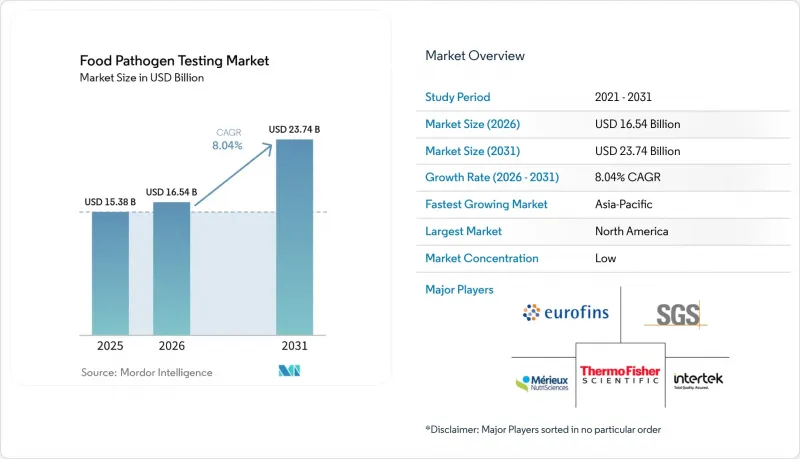
本報告按病原體類型(沙門氏菌、大腸桿菌、李斯特菌及其他病原體)、食品類型(肉類和家禽、乳製品、水果和蔬菜等)、檢測技術(聚合酵素鏈鎖反應、免疫檢測、層析法等)以及地區(北美、歐洲、亞太、南美、中東和非洲)進行細分。市場預測以美元計價。
全球食品病原體檢測市場趨勢及洞察
食物中毒病例的不斷增加,推動了檢測需求的持續成長。
根據世界衛生組織的報告,預計2026年,每年將發生8.66億例食源性疾病,造成3,100億美元的生產力損失。這為食品加工企業加強檢測項目提供了強而有力的經濟理由。沙門氏菌每年在全球造成2億至10億例感染,估計造成15.5萬人死亡,其中85%的死亡與受污染的食物有關。根據FoodNet系統的數據,2024年美國所有監測點共記錄24,624例檢查室確診的腸道感染疾病。與2016年至2018年的基準值相比,住院率仍然很高,這使得擴大環境監測和檢驗檢測的需求持續存在。非洲和東南亞佔全球整體食源性疾病病例的近四分之三,隨著檢測基礎設施的建設,對檢測能力的需求也顯著增加。
快速檢測技術徹底改變了檢測工作流程。
從基於培養的方法向分子檢測的轉變正在改變食品病原體檢測市場的檢查室工作流程。自動化PCR工作流程可在四小時內完成從檢體接收到結果報告的整個過程,而中檔即時PCR系統的價格低於4萬美元。這使得區域性合約實驗室能夠以比傳統平台更低的資本投入獲得分子診斷服務。賽默飛世爾科技於2026年7月推出了「InstaFlux」系統。該系統採用重量法分液,並具備可與實驗室資訊系統(LIS)整合的數位化審計追蹤功能,可在30分鐘內完成富集培養基的製備。 2026 年進行的 80 項研究的回顧表明,奈米孔平台可以在 24 小時內識別病原體,物種水平準確率為 95.00%–98.00%,對抗生素耐藥基因的靈敏度超過 90.00%,每個檢體的成本為 50-200 美元,而傳統的全基因測序的成本為 300-80 美元。
高昂的資本投入和營運成本阻礙了價格敏感型市場的普及。
高昂的資本投入和營運成本限制了價格敏感型市場對先進檢測技術的應用。分子診斷平台需要投資於設備、試劑、維護合約、專家校準和生物資訊支援。一項2025年的研究表明,在實施初期,每個樣本的全基因測序成本將超過傳統分型方法。只有當平台完成過渡並用於多種用途(例如血清分型和抗菌素抗藥性鑑定)時,才能實現成本平衡。投資水準過低可能會削弱疫情監測,導致缺乏實證數據來支持更嚴格的監管,並延緩南美洲和撒哈拉以南非洲檢查室的發展。
細分市場分析
2025年,沙門氏菌檢測在食品病原體檢測市場中佔43.28%。這一市場地位反映了整個家禽、肉類和蛋類供應鏈中廣泛的檢測需求。美國食品安全檢驗局(FSIS)在2025年4月至2026年4月期間,持續對幼雞胴體、雞絲和生雞肉進行沙門氏菌檢驗檢測。該計劃維持了屠宰、加工和二次加工階段的檢測需求。 2025年初,FSIS提案了一項針對生禽肉的框架,其中包括透過統計製程控制(SPC)進行監控的要求。如果該框架最終確定,將提高各加工廠的檢測頻率。沙門氏菌檢測在疫情調查和供應商檢驗中仍然至關重要。這些需求鞏固了沙門氏菌在食品病原體檢測市場的領先地位。
預計從2026年到2031年,大腸桿菌(E. coli)的複合年成長率將達到9.55%,成為所有病原體中最高的。乳製品、農產品和肉類產業是推動病原體檢測需求的主要因素。食品藥物管理局(FDA)根據《農產品安全規則》制定的收穫前農業用水要求也促進了這項需求。李斯特菌和其他病原體佔據了剩餘的檢測市場。 2026年6月,一起與軟乳酪相關的多州李斯特菌疫情導致一人死亡、七人住院。此事件凸顯了對乳製品加工廠進行李斯特菌持續環境監測的必要性。檢測項目越來越需要關注原料、設備表面和成品中的個別風險。這推動了對更廣泛病原體檢測組合的需求,而不僅限於最大的目標類別。
區域分析
2025年,北美佔據了食品病原體檢測市場41.36%的佔有率。此區域地位得益於《食品安全現代化法案》(FSMA)下的預防性控制措施以及美國食品安全檢驗局(FSIS)所進行的廣泛檢驗計畫。美國貢獻了該地區的大部分收入,並在2026年之前持續對家禽和肉類加工廠進行沙門氏菌檢驗檢測。 2026年乳製品產業爆發大腸桿菌和李斯特菌疫情後,受影響生產商加強了環境監測。 SGS於2026年3月收購了Murray Brown Laboratories,擴展了其在北美的PCR和先進微生物檢測能力。
歐洲是第二大市場,德國、英國、法國、義大利和荷蘭是其主要市場。大規模食品加工活動和基於(EC) 2073/2005號法規的統一微生物標準支撐了市場需求。歐盟委員會實施條例(EU) 2025/179規定,自2026年8月23日起,必須對四種主要病原體引起的疫情分離株進行全基因測序。各國的參考實驗室必須在2028年中期之前獲得ISO/IEC 17025:2017認證。 Eurofins Agro Testing於2026年6月完成了對捷克共和國Laborator Postropti的收購。巴西和阿根廷透過肉類、大豆和水產養殖的出口認證推動了南美地區的需求。 BioMérieux於2025年1月收購了巴西的NeoProspecta,從而加強了其在拉丁美洲的數據和基因組學相關服務。梅里埃營養科學公司也透過收購必維集團的食品檢測業務擴大了其業務範圍。
預計2026年至2031年,亞太地區的複合年成長率將達9.57%。在中國、印度、越南和印度尼西亞,分子生物學方法正被引入新的檢測基礎設施,而非主要取代成熟的培養為基礎的系統。中國的GB/T 27405-2026和GB/T 27403-2026建立了檢查室品管和分子生物學檢測的國家框架。印度修訂後的《食品安全與標準局法案》(FSSAI Act)將於2026年12月生效,這將為製造商、進口商和海鮮加工商帶來集中採購需求。中東和非洲是面積最小的地區,但作為主要食品進口國的阿拉伯聯合大公國(阿拉伯聯合大公國)和沙烏地阿拉伯保持著機構需求。非洲食源性疾病負擔沉重,顯示檢測需求與現有檢測能力之間仍有差距。未來,投資檢測設施和食品安全支援可望縮小這一差距。
其他好處:
- Excel格式的市場預測(ME)表
- 3個月的分析師支持
目錄
第1章:引言
- 研究假設和市場定義
- 調查範圍
第2章:調查方法
第3章執行摘要
第4章 市場狀況
- 市場概覽
- 市場促進因素
- 食物中毒病例增加
- 對食品安全和品質的需求日益成長
- 快速檢測技術正變得越來越普及。
- 人們越來越重視預防性食品安全系統。
- 新興市場食品加工業的擴張
- 嚴格的食品安全標準和政府關於病原體檢測的法規
- 市場限制因素
- 先進測試技術高成本
- 長期測試和驗證程序
- 各國之間缺乏標準化
- 食物基質的複雜性
- 供應鏈分析
- 監理情勢
- 技術展望
- 波特五力模型
第5章 市場規模與成長預測
- 按類型
- 沙門氏菌
- 大腸桿菌
- 李斯特菌
- 其他病原體
- 依食物類型
- 食物
- 肉類/家禽
- 乳製品
- 水果和蔬菜
- 加工食品
- 農作物
- 其他食物(香辛料、嬰兒配方奶粉)
- 寵物食品和動物飼料
- 食物
- 透過技術
- 聚合酵素鏈鎖反應
- 基於免疫檢測
- 層析法和光譜分析
- 其他
- 按地區
- 北美洲
- 美國
- 加拿大
- 墨西哥
- 其他北美國家
- 歐洲
- 德國
- 英國
- 法國
- 義大利
- 西班牙
- 荷蘭
- 瑞典
- 波蘭
- 比利時
- 其他歐洲國家
- 亞太地區
- 中國
- 印度
- 日本
- 澳洲
- 韓國
- 越南
- 印尼
- 其他亞太國家
- 南美洲
- 巴西
- 阿根廷
- 智利
- 秘魯
- 哥倫比亞
- 其他南美國家
- 中東和非洲
- 阿拉伯聯合大公國
- 沙烏地阿拉伯
- 南非
- 奈及利亞
- 其他中東和非洲國家
- 北美洲
第6章 競爭情勢
- 市場集中度
- 策略趨勢
- 市場排名分析
- 公司簡介
- Eurofins Scientific
- SGS SA
- Merieux NutriSciences
- Intertek Group plc
- Neogen Corporation
- Thermo Fisher Scientific Inc.
- Bio-Rad Laboratories, Inc.
- bioMerieux SA
- QIAGEN NV
- 3M Company
- ALS Limited
- Bureau Veritas SA
- TUV SUD AG
- Charm Sciences, Inc.
- Romer Labs
- Hygiena LLC
- Microbac Laboratories, Inc.
- AsureQuality Limited
- Tentamus Group GmbH
- Certified Group
- Element Materials Technology Group
第7章 市場機會與未來展望
According to Mordor Intelligence, the food pathogen testing market size is expected to increase from USD 15.38 billion in 2025 to USD 16.54 billion in 2026 and reach USD 23.74 billion by 2031, growing at a CAGR of 8.04% over 2026-2031.
This report is Segmented by Type (Salmonella, E. Coli, Listeria, and Other Pathogens), Food Type (Meat and Poultry, Dairy Products, Fruits and Vegetables, and More), Technology (Polymerase Chain Reaction, Immunoassay-Based, Chromatography, and More), and Geography (North America, Europe, Asia-Pacific, South America, and the Middle East and Africa). Market Forecasts are Provided in Terms of Value (USD).
Global Food Pathogen Testing Market Trends and Insights
Escalating Foodborne Disease Burden Sustaining Persistent Testing Demand
WHO reported 866 million foodborne illness episodes each year and USD 310 billion in productivity losses in 2026, which gives food processors an economic reason to strengthen testing programs. Salmonella causes 200 million to 1 billion cases globally and an estimated 155,000 deaths each year, with 85.00% of cases linked to contaminated food. The FoodNet system recorded 24,624 laboratory-confirmed enteric infections across United States surveillance sites in 2024. Hospitalization rates remained elevated against the 2016-2018 reference baseline, which maintains pressure for more environmental monitoring and verification testing. Africa and South-East Asia account for nearly three-quarters of global foodborne illnesses, leaving a substantial need for testing capacity as laboratory infrastructure develops
Rapid Testing Technologies Reshaping Laboratory Workflows
The shift from culture-based methods to molecular detection is changing laboratory workflows in the Food pathogen testing market. Automated PCR workflows can provide sample-to-answer results in under 4 hours, while mid-range real-time PCR instruments are available below USD 40,000.00. These conditions allow regional contract laboratories to use molecular diagnostics with lower capital requirements than earlier platforms. Thermo Fisher Scientific launched InstaFlux in July 2026, and the system prepares enrichment media in under 30 minutes with gravimetric dispensing and digital audit trails that can connect with laboratory information systems. A 2026 review of 80 studies found that nanopore platforms can identify pathogens in under 24 hours with 95.00%-98.00% species-level accuracy, more than 90.00% antimicrobial-resistance gene sensitivity, and per-sample costs of USD 50.00-USD 200.00, compared with USD 300.00-USD 800.00 for conventional whole-genome sequencing.
High Capital and Operating Costs Limiting Adoption in Price-Sensitive Markets
High capital and operating costs limit adoption of advanced testing technologies in price-sensitive markets. Molecular platforms require instrument investment, reagent spending, maintenance contracts, specialist calibration, and bioinformatics support. A 2025 study found that whole-genome sequencing costs per sample exceed traditional typing methods during initial implementation. Cost parity occurs only when platforms are fully transitioned and used for several purposes, including serotyping and antimicrobial-resistance characterization. Lower investment reduces outbreak surveillance, which can weaken the documented basis for tighter regulations and slow laboratory development in South America and sub-Saharan Africa.
Other drivers and restraints analyzed in the detailed report include:
- Preventive Food Safety Systems Driving Environmental Monitoring Volumes
- Food Processing Sector Expansion in Emerging Markets Opening New Testing Volumes
- Lack of Standardization Impeding Cross-Border Testing Recognition
For complete list of drivers and restraints, kindly check the Table Of Contents.
Segment Analysis
Salmonella held 43.28% of the Food pathogen testing market size by type in 2025. Its position reflects broad testing requirements across poultry, meat, and egg supply chains. The Food Safety and Inspection Service continued Salmonella verification testing across young chicken carcasses, comminuted poultry, and raw chicken parts through the April 2025-April 2026 cycle. This program maintains testing demand through slaughter, processing, and further-processing operations. The proposed Food Safety and Inspection Service framework for raw poultry included statistical process control monitoring requirements in early 2025. If finalized, this framework would raise testing frequency at individual establishments. Salmonella testing also remains central to outbreak investigation and supplier verification. These requirements support its leading revenue position in the Food pathogen testing market.
E. coli is forecast to record the highest type-level CAGR of 9.55% from 2026 to 2031. Testing demand comes from dairy, produce, and meat channels. The Food and Drug Administration's evolving pre-harvest agricultural water requirements under the Produce Safety Rule add to this demand. Listeria and other pathogens account for the remaining type revenue. A multistate Listeria outbreak linked to soft cheese in June 2026 caused 1 death and 7 hospitalizations. The event reinforced the case for continuous environmental Listeria monitoring in dairy facilities. Testing programs increasingly need to address distinct risks across raw materials, equipment surfaces, and finished products. This supports a broader pathogen panel beyond the largest target category.
Complete Report Scope:
- By Type
- Salmonella
- E-Coli
- Listeria
- Other Pathogens
- By Food Type
- Food
- Meat and Poultry
- Dairy Products
- Fruits and Vegetables
- Processed Food
- Crops
- Other Foods (Spices, Infant Formula)
- Pet Food and Animal Feed
- Food
- By Technology
- Polymerase Chain Reaction
- Immunoassay-based
- Chromatography and Spectrometry
- Others
- By Geography
- North America
- United States
- Canada
- Mexico
- Rest of North America
- Europe
- Germany
- United Kingdom
- France
- Italy
- Spain
- Netherlands
- Sweden
- Poland
- Belgium
- Rest of Europe
- Asia-Pacific
- China
- India
- Japan
- Australia
- South Korea
- Vietnam
- Indonesia
- Rest of Asia-Pacific
- South America
- Brazil
- Argentina
- Chile
- Peru
- Colombia
- Rest of South America
- Middle East and Africa
- United Arab Emirates
- Saudi Arabia
- South Africa
- Nigeria
- Rest of Middle East and Africa
- North America
Geography Analysis
North America held 41.36% of the Food pathogen testing market share in 2025. The region's position is supported by Food Safety Modernization Act preventive controls and extensive Food Safety and Inspection Service verification programs. The United States accounts for most regional revenue, with active Salmonella verification testing across poultry and meat establishments through 2026. E. coli and Listeria events in dairy during 2026 are increasing environmental monitoring among affected producers. SGS acquired Murray-Brown Laboratories in March 2026, expanding its North American PCR and advanced microbial detection capabilities.
Europe is the second-largest regional area, led by Germany, the United Kingdom, France, Italy, and the Netherlands. Demand is supported by major food processing activity and harmonized microbiological criteria under Regulation (EC) 2073/2005. Commission Implementing Regulation (EU) 2025/179 requires whole-genome sequencing of outbreak isolates for 4 key pathogens from August 23, 2026. National Reference Laboratories must obtain ISO/IEC 17025:2017 accreditation for this work by mid-2028. Eurofins Agro Testing completed the acquisition of Laborator Postoloprty in the Czech Republic in June 2026. Brazil and Argentina drive South American demand through meat, soy, and aquaculture export certification. bioMerieux acquired Neoprospecta in Brazil in January 2025, strengthening its data and genomics offering in Latin America. Merieux NutriSciences also expanded its footprint through the acquisition of Bureau Veritas food testing activities.
Asia-Pacific is forecast to grow at a 9.57% CAGR from 2026 to 2031. China, India, Vietnam, and Indonesia are adopting molecular methods on new testing infrastructure rather than primarily replacing mature culture-based systems. China's GB/T 27405-2026 and GB/T 27403-2026 create national frameworks for laboratory quality control and molecular biological testing. India's FSSAI amendment takes effect in December 2026 and creates a concentrated procurement need for manufacturers, importers, and seafood processors. Middle East and Africa is the smallest regional area, but the United Arab Emirates and Saudi Arabia maintain institutional demand as major food importers. Africa's large foodborne disease burden points to a continuing gap between testing needs and available laboratory capacity. Laboratory investment and food-safety assistance could help narrow this gap over time.
- Eurofins Scientific
- SGS S.A.
- Merieux NutriSciences
- Intertek Group plc
- Neogen Corporation
- Thermo Fisher Scientific Inc.
- Bio-Rad Laboratories, Inc.
- bioMerieux S.A.
- QIAGEN N.V.
- 3M Company
- ALS Limited
- Bureau Veritas S.A.
- TUV SUD AG
- Charm Sciences, Inc.
- Romer Labs
- Hygiena LLC
- Microbac Laboratories, Inc.
- AsureQuality Limited
- Tentamus Group GmbH
- Certified Group
- Element Materials Technology Group
Additional Benefits:
- The market estimate (ME) sheet in Excel format
- 3 months of analyst support
TABLE OF CONTENTS
1 INTRODUCTION
- 1.1 Study Assumptions and Market Definition
- 1.2 Scope of the Study
2 RESEARCH METHODOLOGY
3 EXECUTIVE SUMMARY
4 MARKET LANDSCAPE
- 4.1 Market Overview
- 4.2 Market Drivers
- 4.2.1 Increasing Incidence of Foodborne Diseases
- 4.2.2 Growing Demand for Food Safety and Quality
- 4.2.3 Increasing Adoption of Rapid Testing Technologies
- 4.2.4 Growing Emphasis on Preventive Food Safety Systems
- 4.2.5 Expansion of Food Processing Industries in Emerging Markets
- 4.2.6 Stringent Food Safety and Government Regulations on Pathogen Testing
- 4.3 Market Restraints
- 4.3.1 High Cost of Advanced Testing Technologies
- 4.3.2 Long Testing and Confirmation Procedures
- 4.3.3 Lack of Standardization Across Countries
- 4.3.4 Complexity of Food Matrices
- 4.4 Supply Chain Analysis
- 4.5 Regulatory Landscape
- 4.6 Technological Outlook
- 4.7 Porter's Five Forces
- 4.7.1 Bargaining Power of Suppliers
- 4.7.2 Bargaining Power of Buyers
- 4.7.3 Threat of New Entrants
- 4.7.4 Threat of Substitutes
- 4.7.5 Competitive Rivalry
5 MARKET SIZE AND GROWTH FORECASTS (VALUE)
- 5.1 By Type
- 5.1.1 Salmonella
- 5.1.2 E-Coli
- 5.1.3 Listeria
- 5.1.4 Other Pathogens
- 5.2 By Food Type
- 5.2.1 Food
- 5.2.1.1 Meat and Poultry
- 5.2.1.2 Dairy Products
- 5.2.1.3 Fruits and Vegetables
- 5.2.1.4 Processed Food
- 5.2.1.5 Crops
- 5.2.1.6 Other Foods (Spices, Infant Formula)
- 5.2.2 Pet Food and Animal Feed
- 5.2.1 Food
- 5.3 By Technology
- 5.3.1 Polymerase Chain Reaction
- 5.3.2 Immunoassay-based
- 5.3.3 Chromatography and Spectrometry
- 5.3.4 Others
- 5.4 By Geography
- 5.4.1 North America
- 5.4.1.1 United States
- 5.4.1.2 Canada
- 5.4.1.3 Mexico
- 5.4.1.4 Rest of North America
- 5.4.2 Europe
- 5.4.2.1 Germany
- 5.4.2.2 United Kingdom
- 5.4.2.3 France
- 5.4.2.4 Italy
- 5.4.2.5 Spain
- 5.4.2.6 Netherlands
- 5.4.2.7 Sweden
- 5.4.2.8 Poland
- 5.4.2.9 Belgium
- 5.4.2.10 Rest of Europe
- 5.4.3 Asia-Pacific
- 5.4.3.1 China
- 5.4.3.2 India
- 5.4.3.3 Japan
- 5.4.3.4 Australia
- 5.4.3.5 South Korea
- 5.4.3.6 Vietnam
- 5.4.3.7 Indonesia
- 5.4.3.8 Rest of Asia-Pacific
- 5.4.4 South America
- 5.4.4.1 Brazil
- 5.4.4.2 Argentina
- 5.4.4.3 Chile
- 5.4.4.4 Peru
- 5.4.4.5 Colombia
- 5.4.4.6 Rest of South America
- 5.4.5 Middle East and Africa
- 5.4.5.1 United Arab Emirates
- 5.4.5.2 Saudi Arabia
- 5.4.5.3 South Africa
- 5.4.5.4 Nigeria
- 5.4.5.5 Rest of Middle East and Africa
- 5.4.1 North America
6 COMPETITIVE LANDSCAPE
- 6.1 Market Concentration
- 6.2 Strategic Moves
- 6.3 Market Ranking Analysis
- 6.4 Company Profiles (Includes Global-level Overview, Market-level Overview, Core Segments, Financials, Strategic Info, Market Rank/Share, Products & Services, Recent Developments)
- 6.4.1 Eurofins Scientific
- 6.4.2 SGS S.A.
- 6.4.3 Merieux NutriSciences
- 6.4.4 Intertek Group plc
- 6.4.5 Neogen Corporation
- 6.4.6 Thermo Fisher Scientific Inc.
- 6.4.7 Bio-Rad Laboratories, Inc.
- 6.4.8 bioMerieux S.A.
- 6.4.9 QIAGEN N.V.
- 6.4.10 3M Company
- 6.4.11 ALS Limited
- 6.4.12 Bureau Veritas S.A.
- 6.4.13 TUV SUD AG
- 6.4.14 Charm Sciences, Inc.
- 6.4.15 Romer Labs
- 6.4.16 Hygiena LLC
- 6.4.17 Microbac Laboratories, Inc.
- 6.4.18 AsureQuality Limited
- 6.4.19 Tentamus Group GmbH
- 6.4.20 Certified Group
- 6.4.21 Element Materials Technology Group
7 MARKET OPPORTUNITIES AND FUTURE OUTLOOK

 食品病原體檢測市場:商業機會、成長要素、產業趨勢分析及 2026-2035 年預測。
 食品病原體安全檢測設備及耗材市場規模、佔有率及成長分析:依產品類型、技術、病原體類型、應用、最終用戶、部署模式及地區分類-2026-2033年產業預測
 全球食品病原體檢測市場:機會與策略展望(至2035年)
 2026-2030年全球食品病原體檢測市場
 全球食品病原體檢測市場:按病原體類型、檢測食品類型、技術、最終用戶、地區和預測(至 2031 年)分類
 全球食品病原體檢測市場規模、佔有率、趨勢和成長分析報告(2026-2034年)2026年全球食品病原體安全檢測設備及耗材市場報告
 食品病原體檢測市場:依產品類型、樣品類型、病原體類型、調查方法、最終用戶和通路分類-2026-2032年全球市場預測
 全球食品病原體安全檢測設備及耗材市場(至2031年):依類型(系統、耗材及用品)、檢測食品、檢測地點(內部實驗室、外包機構、政府實驗室)、技術及地區分類
 食品病原體檢測市場 - 全球產業規模、佔有率、趨勢、機會及預測(按類型、食品類型、技術、地區和競爭格局分類,2021-2031年)