


 |
市場調查報告書
商品編碼
2083288
食品病原體檢測市場:商業機會、成長要素、產業趨勢分析及 2026-2035 年預測。Food Pathogen Testing Market Opportunity, Growth Drivers, Industry Trend Analysis, and Forecast 2026 - 2035 |
||||||

全球食品病原體檢測市場預計到 2025 年價值 62 億美元,預計到 2035 年將以 7.7% 的複合年成長率成長至 130 億美元。
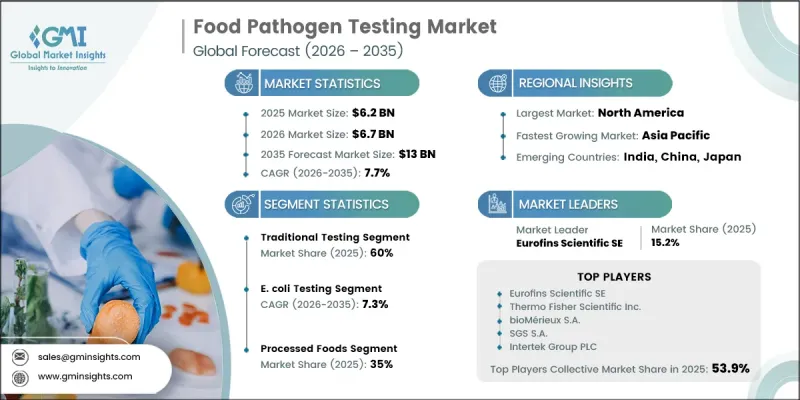
受食品安全監管力度加大、食品中毒問題日益嚴重以及先進檢測技術應用不斷擴展的推動,該市場正經歷穩步成長。隨著食品污染風險持續影響全球市場,食品生產商、零售商和監管機構正致力於加強檢測程序並提高安全標準。隨著食品產業向更快、更準確、更有效率的檢測方法轉型,現代病原體檢測解決方案的重要性日益凸顯。從傳統的實驗室檢測向先進的分子診斷和快速檢測平台的轉變,透過快速識別潛在風險因素,正在改變食品安全管理營運模式。食品生產商也增加對檢測項目的投入,以提高供應鏈透明度、降低污染風險並維護消費者信心。先進診斷技術的應用支援即時監控能力,幫助企業滿足日益嚴格的食品安全要求。儘管高昂的設備成本仍然是小規模企業面臨的挑戰,但持續的技術發展和對可靠食品安全解決方案日益成長的需求預計將推動市場擴張。
| 市場範圍 | |
|---|---|
| 開始年份 | 2025 |
| 預測期 | 2026-2035 |
| 初始市場規模 | 62億美元 |
| 預測金額 | 130億美元 |
| 複合年成長率 | 7.7% |
隨著食品生產環境中檢測方法的日益普及和整合化,食品病原體檢測流程正在經歷重大變革。先進分子技術、自動化檢測平台和高靈敏度檢測系統的廣泛應用,顯著提升了微生物風險的辨識效率。食品生產商和零售商投資病原體檢測解決方案,不僅是為了滿足監管要求,更是為了加強品質管理計畫,降低營運風險。
由於傳統檢測方法在監管檢驗、認證流程和合規性應用中發揮重要作用,預計到2025年,其市場佔有率將達到60%。基於培養的方法和成熟的免疫學檢測方法因其在食品安全框架內被公認為可靠、可接受且有效,而繼續廣泛應用。在需要正式確認和品質保證的、有據可查且標準化的檢測程序的情況下,這些方法仍然至關重要。
預計到2025年,加工食品市佔率將達到35%,並在2035年之前以7.4%的複合年成長率成長。此細分市場的成長主要得益於包裝食品供應鏈的複雜性,其中涉及多種原料和加工環節,因此有效的病原體監測顯得尤為重要。食品生產商越來越重視檢測程序,以確保產品安全、提高合規性,並最大限度地降低生產和分銷網路中的污染風險。
預計到2025年,北美食品病原體檢測市場佔有率將達到35%,並在2035年之前以6.8%的複合年成長率成長。這一市場成長主要得益於嚴格的食品安全法規、先進的檢測基礎設施以及最新檢測技術的高普及率。完善的食品生產網路和不斷增加的品質保證體系投入進一步強化了對病原體檢測解決方案的需求。該地區憑藉其對法規遵循、食品安全創新和先進檢測能力的重視,持續保持著強勁的市場地位。
目錄
第1章:調查方法和範圍
第2章執行摘要
第3章 行業洞察
- 產業生態系分析
- 供應商情況
- 利潤率
- 每個階段增加的價值
- 影響價值鏈的因素
- 中斷
- 影響產業的因素
- 促進因素
- 加強全球食品安全法規
- 食物中毒病例增加
- 對快速檢測技術的需求
- 產業潛在風險與挑戰
- 先進檢測系統高成本
- 檢測實驗室缺乏熟練人員
- 市場機遇
- 先進分子診斷技術的引入
- 新興食品加工市場的擴張
- 檢測實驗室自動化的引入
- 促進因素
- 成長潛力分析
- 監理情勢
- 波特的分析
- PESTLE分析
- 技術與創新展望
- 最新科技趨勢
- 新興技術
- 價格趨勢
- 按地區
- 透過技術
- 未來市場趨勢
- 專利趨勢
- 貿易統計
- 主要進口國
- 主要出口國
- 永續性和環境方面
- 永續計劃
- 減少廢棄物策略
- 生產中的能源效率
- 具有環保意識的舉措
- 考慮碳足跡
第4章 競爭情勢
- 介紹
- 企業市佔率分析
- 按地區
- 北美洲
- 歐洲
- 亞太地區
- LATAM
- 中東和非洲
- 按地區
- 企業矩陣分析
- 主要市場公司的競爭分析
- 競爭定位矩陣
- 主要進展
- 併購
- 夥伴關係和聯盟
- 新產品發布
- 業務拓展計劃
第5章 市場估計與預測:依技術分類,2022-2035年
- 快速檢測
- 常規測試
第6章 市場估算與預測:依病原體類型分類,2022-2035年
- 大腸桿菌
- 沙門氏菌
- 李斯特菌
- 曲狀桿菌
- 其他
第7章 市場估價與預測:依食品類型分類,2022-2035年
- 肉類/家禽
- 乳製品
- 加工食品
- 水果和蔬菜
- 穀類和穀類食品
- 其他
第8章 市場估算與預測:依最終使用者分類,2022-2035年
- 食品生產商和加工商
- 獨立測試機構
- 零售商及餐飲服務業
- 其他
第9章 市場估計與預測:依地區分類,2022-2035年
- 北美洲
- 美國
- 加拿大
- 歐洲
- 德國
- 英國
- 法國
- 西班牙
- 義大利
- 其他歐洲國家
- 亞太地區
- 中國
- 印度
- 日本
- 澳洲
- 韓國
- 其他亞太國家
- 拉丁美洲
- 巴西
- 墨西哥
- 阿根廷
- 其他拉丁美洲國家
- 中東和非洲
- 沙烏地阿拉伯
- 南非
- UAE
- 其他中東和非洲國家
第10章:公司簡介
- Thermo Fisher Scientific Inc.
- bioMerieux SA
- Eurofins Scientific SE
- SGS SA
- Intertek Group PLC
- Bureau Veritas SA
- Merieux NutriSciences
- Neogen Corporation
- Bio-Rad Laboratories, Inc.
- Merck KGaA
- 3M Food Safety
- ALS Limited
- AsureQuality Ltd
- Hygiena LLC
- Romer Labs
The Global Food Pathogen Testing Market was valued at USD 6.2 billion in 2025 and is estimated to grow at a CAGR of 7.7% to reach USD 13 billion by 2035.
The market is experiencing consistent growth due to increasing regulatory focus on food safety, rising concerns regarding foodborne illnesses, and the growing adoption of advanced detection technologies. The continued global impact of food contamination risks is encouraging food producers, retailers, and regulatory bodies to strengthen testing procedures and improve safety standards. Modern pathogen testing solutions are becoming increasingly important as the food industry moves toward faster, more accurate, and more efficient detection methods. The shift from conventional laboratory-based testing toward advanced molecular and rapid detection platforms is transforming food safety operations by enabling quicker identification of potential hazards. Food manufacturers are also increasing investments in testing programs to improve supply chain transparency, reduce contamination risks, and maintain consumer confidence. The adoption of advanced diagnostic technologies is supporting real-time monitoring capabilities and helping organizations meet increasingly strict food safety requirements. Although high equipment costs remain a challenge for smaller operators, ongoing technological development and rising demand for reliable food safety solutions are expected to support market expansion.
| Market Scope | |
|---|---|
| Start Year | 2025 |
| Forecast Year | 2026-2035 |
| Start Value | $6.2 Billion |
| Forecast Value | $13 Billion |
| CAGR | 7.7% |
Food pathogen detection processes are undergoing significant transformation as companies move toward faster and more integrated testing approaches within food production environments. The increasing adoption of advanced molecular technologies, automated testing platforms, and highly sensitive detection systems is improving the ability to identify microbial risks more efficiently. Food manufacturers and retailers are investing in pathogen testing solutions not only to meet regulatory obligations but also to strengthen quality control programs and reduce operational risks.
The traditional testing methods segment accounted for 60% share in 2025, owing to their established role in regulatory verification, certification processes, and compliance-based applications. Culture-based approaches and established immunological testing methods continue to be widely used because of their reliability, acceptance, and validation within food safety frameworks. These methods remain important where documented and standardized testing procedures are required for official confirmation and quality assurance purposes.
The processed foods segment held a 35% share in 2025 and is projected to grow at a CAGR of 7.4% through 2035. Growth in this segment is supported by the complexity of packaged food supply chains, where multiple ingredients and processing stages increase the importance of effective pathogen monitoring. Food manufacturers are placing greater emphasis on testing procedures to maintain product safety, improve compliance, and minimize contamination risks throughout production and distribution networks.
North America Food Pathogen Testing Market held a 35% share in 2025, growing at a CAGR of 6.8% through 2035. The region's market growth is supported by strong food safety regulations, advanced testing infrastructure, and high adoption of modern detection technologies. The presence of established food manufacturing networks and increasing investments in quality assurance systems are further strengthening demand for pathogen testing solutions. The region continues to maintain a strong position due to its focus on regulatory compliance, food safety innovation, and advanced laboratory capabilities.
Major companies operating in the global food pathogen testing market include Eurofins Scientific SE, Thermo Fisher Scientific Inc., bioMerieux S.A., Neogen Corporation, SGS S.A., Intertek Group PLC., Bureau Veritas S.A., Bio-Rad Laboratories, Inc., Merieux NutriSciences, Merck KGaA, 3M Food Safety, ALS Limited, AsureQuality Ltd, Hygiena LLC, and Romer Labs. Companies operating in the food pathogen testing market are adopting various strategies to strengthen their competitive position and expand their industry presence. Market participants are focusing on product innovation by developing faster, more accurate, and automated testing solutions to address evolving food safety requirements. Businesses are investing in research and development to improve molecular detection technologies, digital testing platforms, and laboratory efficiency. Strategic partnerships, acquisitions, and expansion of testing service networks are helping companies increase market reach and enhance customer support capabilities. Companies are also emphasizing customized testing solutions, regulatory compliance services, and integrated food safety management systems.
Table of Contents
Chapter 1 Methodology & Scope
- 1.1 Market scope and definition
- 1.2 Research design
- 1.2.1 Research approach
- 1.2.2 Data collection methods
- 1.3 Data mining sources
- 1.3.1 Global
- 1.3.2 Regional/Country
- 1.4 Base estimates and calculations
- 1.4.1 Base year calculation
- 1.4.2 Key trends for market estimation
- 1.5 Primary research and validation
- 1.5.1 Primary sources
- 1.6 Forecast model
- 1.7 Research assumptions and limitations
Chapter 2 Executive Summary
- 2.1 Industry 360° synopsis
- 2.2 Key market trends
- 2.2.1 Technology
- 2.2.2 Pathogen type
- 2.2.3 Food type
- 2.2.4 End user
- 2.2.5 Regional
- 2.3 TAM Analysis, 2026-2035
- 2.4 CXO perspectives: Strategic imperatives
- 2.5 Future outlook and strategic recommendations
Chapter 3 Industry Insights
- 3.1 Industry ecosystem analysis
- 3.1.1 Supplier landscape
- 3.1.2 Profit margin
- 3.1.3 Value addition at each stage
- 3.1.4 Factor affecting the value chain
- 3.1.5 Disruptions
- 3.2 Industry impact forces
- 3.2.1 Growth drivers
- 3.2.1.1 Increasing food safety regulations globally
- 3.2.1.2 Rising incidence of foodborne illnesses
- 3.2.1.3 Demand for rapid testing technologies
- 3.2.2 Industry pitfalls and challenges
- 3.2.2.1 High cost of advanced detection systems
- 3.2.2.2 Limited skilled workforce in testing laboratories
- 3.2.3 Market opportunities
- 3.2.3.1 Adoption of advanced molecular diagnostics
- 3.2.3.2 Expansion in emerging food processing markets
- 3.2.3.3 Integration of automation in testing labs
- 3.2.1 Growth drivers
- 3.3 Growth potential analysis
- 3.4 Regulatory landscape
- 3.4.1 North America
- 3.4.2 Europe
- 3.4.3 Asia Pacific
- 3.4.4 Latin America
- 3.4.5 Middle East & Africa
- 3.5 Porter's analysis
- 3.6 PESTEL analysis
- 3.7 Technology and innovation landscape
- 3.7.1 Current technological trends
- 3.7.2 Emerging technologies
- 3.8 Price trends
- 3.8.1 By region
- 3.8.2 By technology
- 3.9 Future market trends
- 3.10 Patent landscape
- 3.11 Trade statistics (HS code)
- 3.11.1 Major importing countries
- 3.11.2 Major exporting countries
- 3.12 Sustainability and environmental aspects
- 3.12.1 Sustainable practices
- 3.12.2 Waste reduction strategies
- 3.12.3 Energy efficiency in production
- 3.12.4 Eco-friendly initiatives
- 3.13 Carbon footprint consideration
Chapter 4 Competitive Landscape, 2025
- 4.1 Introduction
- 4.2 Company market share analysis
- 4.2.1 By region
- 4.2.1.1 North America
- 4.2.1.2 Europe
- 4.2.1.3 Asia Pacific
- 4.2.1.4 LATAM
- 4.2.1.5 MEA
- 4.2.1 By region
- 4.3 Company matrix analysis
- 4.4 Competitive analysis of major market players
- 4.5 Competitive positioning matrix
- 4.6 Key developments
- 4.6.1 Mergers & acquisitions
- 4.6.2 Partnerships & collaborations
- 4.6.3 New product launches
- 4.6.4 Expansion plans
Chapter 5 Market Estimates and Forecast, By Technology, 2022-2035 (USD Million) (Kilo Tons)
- 5.1 Key trends
- 5.2 Rapid testing
- 5.3 Traditional testing
Chapter 6 Market Estimates and Forecast, By Pathogen type, 2022-2035 (USD Million) (Kilo Tons)
- 6.1 Key trends
- 6.2 E. coli
- 6.3 Salmonella
- 6.4 Listeria
- 6.5 Campylobacter
- 6.6 Others
Chapter 7 Market Estimates and Forecast, By Food type, 2022-2035 (USD Million) (Kilo Tons)
- 7.1 Key trends
- 7.2 Meat & poultry
- 7.3 Dairy products
- 7.4 Processed foods
- 7.5 Fruits & vegetables
- 7.6 Cereals & grains
- 7.7 Others
Chapter 8 Market Estimates and Forecast, By End user, 2022-2035 (USD Million) (Kilo Tons)
- 8.1 Key trends
- 8.2 Food manufacturers & processors
- 8.3 Independent testing laboratories
- 8.4 Retailers & foodservice
- 8.5 Others
Chapter 9 Market Estimates and Forecast, By Region, 2022-2035 (USD Million) (Kilo Tons)
- 9.1 Key trends
- 9.2 North America
- 9.2.1 U.S.
- 9.2.2 Canada
- 9.3 Europe
- 9.3.1 Germany
- 9.3.2 UK
- 9.3.3 France
- 9.3.4 Spain
- 9.3.5 Italy
- 9.3.6 Rest of Europe
- 9.4 Asia Pacific
- 9.4.1 China
- 9.4.2 India
- 9.4.3 Japan
- 9.4.4 Australia
- 9.4.5 South Korea
- 9.4.6 Rest of Asia Pacific
- 9.5 Latin America
- 9.5.1 Brazil
- 9.5.2 Mexico
- 9.5.3 Argentina
- 9.5.4 Rest of Latin America
- 9.6 Middle East and Africa
- 9.6.1 Saudi Arabia
- 9.6.2 South Africa
- 9.6.3 UAE
- 9.6.4 Rest of Middle East and Africa
Chapter 10 Company Profiles
- 10.1 Thermo Fisher Scientific Inc.
- 10.2 bioMerieux S.A.
- 10.3 Eurofins Scientific SE
- 10.4 SGS S.A.
- 10.5 Intertek Group PLC
- 10.6 Bureau Veritas S.A.
- 10.7 Merieux NutriSciences
- 10.8 Neogen Corporation
- 10.9 Bio-Rad Laboratories, Inc.
- 10.10 Merck KGaA
- 10.11 3M Food Safety
- 10.12 ALS Limited
- 10.13 AsureQuality Ltd
- 10.14 Hygiena LLC
- 10.15 Romer Labs

 食品病原體檢測:市場佔有率分析、產業趨勢與統計、成長預測(2026-2031)
 食品病原體安全檢測設備及耗材市場規模、佔有率及成長分析:依產品類型、技術、病原體類型、應用、最終用戶、部署模式及地區分類-2026-2033年產業預測
 全球食品病原體檢測市場:機會與策略展望(至2035年)
 2026-2030年全球食品病原體檢測市場
 全球食品病原體檢測市場:按病原體類型、檢測食品類型、技術、最終用戶、地區和預測(至 2031 年)分類
 全球食品病原體檢測市場規模、佔有率、趨勢和成長分析報告(2026-2034年)2026年全球食品病原體安全檢測設備及耗材市場報告
 食品病原體檢測市場:依產品類型、樣品類型、病原體類型、調查方法、最終用戶和通路分類-2026-2032年全球市場預測
 全球食品病原體安全檢測設備及耗材市場(至2031年):依類型(系統、耗材及用品)、檢測食品、檢測地點(內部實驗室、外包機構、政府實驗室)、技術及地區分類
 食品病原體檢測市場 - 全球產業規模、佔有率、趨勢、機會及預測(按類型、食品類型、技術、地區和競爭格局分類,2021-2031年)