


 |
市場調查報告書
商品編碼
2119289
選擇性催化還原系統:市場佔有率分析、產業趨勢與統計及成長預測(2026-2031)Selective Catalytic Reduction System - Market Share Analysis, Industry Trends & Statistics, Growth Forecasts (2026 - 2031) |
||||||

※ 本網頁內容可能與最新版本有所差異。詳細情況請與我們聯繫。
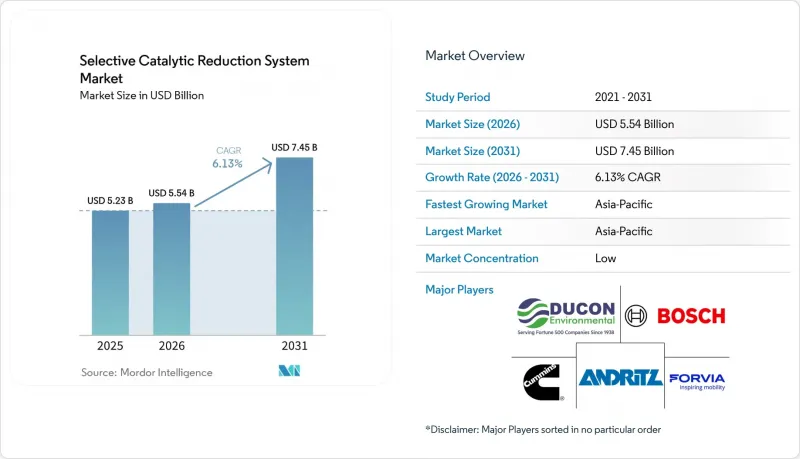
據 Mordor Intelligence 稱,2025 年選擇性催化還原 (SCR) 系統市場規模估計為 52.3 億美元,預計在預測期(2026-2031 年)內將以 6.13% 的複合年成長率成長,從 2026 年的 55.4 億美元成長到 74.5 億美元的 74.5 年。
本報告按催化劑類型(釩基催化劑、沸石基催化劑等)、安裝類型(新建安裝、維修安裝等)、終端用戶產業(汽車、船舶等)和地區(亞太、北美、歐洲、南美、中東和非洲)進行細分。市場預測以美元計價。
全球選擇性催化還原(SCR)系統市場趨勢與洞察
對固定源和移動源實施更嚴格的氮氧化物排放標準。
2026年,針對固定源和移動源的監管要求得到加強,選擇性催化還原(SCR)系統市場在合規性方面的作用也隨之擴大。 2026年1月9日,美國環保署(EPA)最終確定了新污染源排放標準(NSPS)的修訂版,指定SCR為輸出功率達到或超過8.5億英國熱單位/小時(MMBtu/h)、運轉率達到或超過45%的新型大型高運轉率天然氣燃氣渦輪機的最佳減排系統。該法規規定,2024年12月13日後動工的符合條件的機組,其氮氧化物(NOx)排放限值為5 ppm。這將使燃氣渦輪機項目引入後處理,而此前這些項目主要依賴燃燒控制。歐盟7排放標準將適用於2026年11月之後獲得型式認證的新型輕型車輛,該標準將柴油車的氮氧化物排放限值從80毫克/公里降低至30毫克/公里,並將測試範圍擴大到更低的溫度和更低的負載條件。這些條件促使人們採用在 150–180 度C範圍內保持活性的銅沸石催化劑,而傳統釩基催化劑的閾值則為 250 度C C。美國環保署 (EPA) 2026 年 7 月發布的草案維持了重型車輛引擎自 2027 年車型 (MY2027) 起 90% 的先前氮氧化物減排目標,因此商用車輛對選擇性催化還原 (SCR) 系統的需求仍然存在。
符合船舶三級排放標準及對SCR進行改造的需求。
由於遠洋船舶的營運年限通常為25至30年,船舶法規對船舶改造的需求持續不斷。國際海事組織(IMO)於2025年4月11日通過的MEPC.399(83)號決議於2026年5月1日生效,該決議修訂了適用船舶的選擇性催化指南(SCR)和氮氧化物(NOx)測量要求指南。新的框架採用基於性能的催化劑狀態監測精度證明,而非明確的±5%精度要求。隨著挪威海和加拿大北冰洋於2026年3月被指定為NOx排放控制區,此前無需後後處理的航線現在也需遵守Tier III排放標準。這些標準將低速引擎的排放量限制在3.4克/千瓦時,從而縮短了受影響營運商的規劃時間。此外,由於北極和亞北極港口缺乏符合ISO 18611-1標準的AUS 40催化劑的均勻分佈的供應和儲存基礎設施,選擇性催化還原(SCR)系統市場也面臨營運方面的限制。在 MEPC 83 上通過的 2008 年 NOx 技術規範修正案預計將於 2027 年 3 月 1 日生效,該修正案將更新從 2028 年 1 月起對進行重大改裝的船舶進行 SCR 認證的改裝要求。
高昂的資本成本、改造成本和生命週期營運成本
在監管執法力度不一致或罰款金額低於安裝成本的地區,資本需求仍然是一個重要的考慮因素。一座600兆瓦燃煤電廠機組的全面改造通常需要1500萬美元至2500萬美元(不包括運作、氨儲存和催化劑維護成本)。這筆成本對南亞和東南亞的電力公司造成影響,因為這些地區的監管電價利潤空間較小。在顆粒物和硫含量高的煤炭環境中,低於300 度C時發生的硫酸氫銨結垢可能需要每三年更換一次催化劑,而不是通常認為的五年。在監管執法不力的地區,對於小規模的水泥、鋼鐵和化學而言,設備維護成本可能超過違規罰款。雖然先進的計量控制可以減少試劑用量,但它並不能消除選擇性催化還原(SCR)系統市場中龐大的資本投資需求。
細分市場分析
截至2025年,釩基催化劑在選擇性催化還原(SCR)系統市場佔據50.18%的佔有率。這一地位反映了釩基催化劑在亞洲和北美粉塵較多的燃煤發電廠中長期應用的良好記錄。這些系統能夠承受二氧化硫和惡劣的廢氣環境。其成熟的應用記錄支撐了電力產業的替換需求。在採購決策中,當機械耐久性和可靠的現場性能成為優先考慮因素時,釩基催化劑仍然發揮著至關重要的作用。因此,釩基系統在選擇性催化還原(SCR)系統市場的許多大規模固定裝置中繼續被應用。
預計到2031年,沸石催化劑的年複合成長率將達到6.71%。 Cu-SSZ-13和Fe沸石配方在低於200 度C的溫度下即可實現更高的氮氧化物(NOx)轉化率,滿足歐7冷啟動要求以及排氣溫度波動較大的應用。中國江蘇的Cu-沸石生產正逐步拓展至汽車和非道路設備的OEM和售後市場管道。貴金屬觸媒則用於一些特殊應用,例如用於無尿素系統的氫燃料引擎的被動式選擇性催化還原(SCR)設計。其他材料,包括銅基、二氧化鈦和混合金屬配方,也能滿足特定的製程要求。五氧化二釩的價格走勢以及中國對用於Cu-沸石塗層應用的稀土元素前驅體的監管規定,都帶來了明顯的供應風險,促使OEM廠商採取雙管道採購策略。
區域分析
預計到2025年,亞太地區將佔據選擇性催化還原(SCR)系統市場37.15%的佔有率,並將在2031年之前維持6.84%的複合年成長率。在中國,裝置容量超過200兆瓦的燃煤電廠已建成完善的SCR基礎設施,氮氧化物(NOx)排放上限為50毫克/標準立方公尺。目前,中國的需求正轉向設備更新換代、中型工業鍋爐以及水泥、玻璃和鋼鐵業的排放氣體法規。在印度,中央電力局(CEA)正在分階段實施新的氮氧化物排放法規,目前已有210吉瓦的火力發電廠運作,新裝置的排放上限為100毫克/標準立方公尺。因此,印度正在推動大規模燃煤電廠的初始裝置維修。在日本和韓國,為了滿足工業鍋爐的監管要求,兩國正在推廣採用高性能、高反應活性的催化劑。
由於監管力道加大,北美和歐洲仍是選擇性催化還原(SCR)系統市場的主要區域。在美國,2026年1月生效的《新污染源排放標準》(NSPS)修正案強制要求符合條件的高運轉率天然氣燃氣渦輪機安裝SCR系統。此外,舊舊燃氣渦輪機在中期維修期間也出現了加裝SCR系統的機會。在歐洲,儘管小型車輛的需求因電氣化而逐漸下降,但對汽車SCR系統的支援將持續到歐盟7排放標準實施。水泥、鋼鐵和化工廠的最佳利用技術(BAT)循環推動了固定式SCR系統的需求。在北歐市場,隨著挪威海氮氧化物排放控制區(NECA)於2026年3月生效,海洋領域的需求進一步擴大。
南美洲、中東和非洲的需求模式各不相同。在巴西,聖保羅和里約熱內盧針對重型車輛和工業活動的排放氣體標準推動了汽車和石化產業對選擇性催化還原(SCR)技術的應用。在阿根廷和其他南美國家,外匯波動和試劑進口成本阻礙了小規模企業的發展。在沙烏地阿拉伯,工業多元化和燃氣發電裝置容量的成長加劇了對燃氣渦輪機SCR系統的競爭。西門子能源已獲得訂單,將於2025年為阿曼米斯法和杜庫姆的獨立發電工程提供六台SGT5-4000F燃氣渦輪機。在南非,老舊的燃煤電廠和日益嚴格的環境法規為工業SCR技術的早期應用創造了機會。然而,該國向可再生能源的轉型可能會限制其長期火力發電基礎。
其他好處:
- Excel格式的市場預測(ME)表
- 3個月的分析師支持
目錄
第1章:引言
- 研究假設和市場定義
- 調查範圍
第2章:調查方法
第3章執行摘要
第4章 市場狀況
- 市場概覽
- 市場促進因素
- 對固定源和移動源實施更嚴格的氮氧化物排放標準。
- 船舶符合Tier III排放標準以及對SCR改裝裝置的需求
- 亞太地區高氮氧化物排放工業設施及發電設備的擴張
- 低溫催化劑在水泥和生質能應用的引入
- 數位氨氣噴射和封閉回路型排放氣體控制
- 氫燃料內燃機選擇性催化還原(SCR)技術的檢驗
- 市場限制因素
- 初始投資高,維修成本高,且在整個生命週期內營運成本也高。
- 催化劑中毒、結垢和使用壽命縮短。
- 小型汽車的電氣化正在縮小柴油車的潛在市場規模。
- 船用燃料的供應、儲存和供應存在不確定性。
- 價值鏈分析
- 波特五力分析
第5章 市場規模與成長預測
- 按催化劑類型
- 釩基催化劑
- 沸石基催化劑
- 貴金屬催化劑
- 其他(銅基催化劑、二氧化鈦催化劑、混合金屬催化劑)
- 按安裝類型
- 新安裝
- 維修工程
- 其他(催化劑更換和再生)
- 按最終用戶行業分類
- 發電
- 車
- 海上
- 化工/石油化工
- 工業製造(水泥、鋼鐵、鍋爐等)
- 其他(廢棄物焚化、石油和天然氣、採礦、鐵路)
- 按地區
- 亞太地區
- 中國
- 印度
- 日本
- 韓國
- 東南亞國協
- 其他亞太國家
- 北美洲
- 美國
- 加拿大
- 墨西哥
- 歐洲
- 德國
- 英國
- 法國
- 義大利
- 北歐國家
- 其他歐洲國家
- 南美洲
- 巴西
- 阿根廷
- 其他南美國家
- 中東和非洲
- 沙烏地阿拉伯
- 南非
- 其他中東和非洲國家
- 亞太地區
第6章 競爭情勢
- 市場集中度
- 策略趨勢
- 市佔率和排名分析
- 公司簡介
- ANDRITZ
- Babcock & Wilcox Enterprises, Inc.
- Cummins Inc.
- Ducon Environmental Systems Inc.
- Durr CTS
- FORVIA
- GE Vernova
- Kautex Textron GmbH & Co. KG
- MITSUBISHI HEAVY INDUSTRIES, LTD.
- Robert Bosch GmbH
- Shandong Longking Environmental Protection Co., Ltd.
- Siemens Energy
- Sud-Chemie India Pvt. Ltd.
- Tenneco Inc.
- YANMAR Marine International
第7章 市場機會與未來展望
According to Mordor Intelligence, the selective catalytic reduction system market size was estimated at USD 5.23 billion in 2025 and is estimated to grow from USD 5.54 billion in 2026 to USD 7.45 billion by 2031, at a CAGR of 6.13% during the forecast period (2026-2031).
This report is Segmented by Catalyst Type (Vanadium-Based Catalysts, Zeolite-Based Catalysts, and More), Installation Type (New Installations, Retrofit Installations, and More), End-User Industry (Automotive, Marine, and More), and Geography (Asia-Pacific, North America, Europe, South America, and Middle-East and Africa). The Market Forecasts are Provided in Terms of Value (USD).
Global Selective Catalytic Reduction System Market Trends and Insights
Tightening NOx Emission Standards for Stationary and Mobile Sources
Regulatory requirements for stationary and mobile sources increased in 2026, expanding the role of the selective catalytic reduction (SCR) system market in compliance. The US Environmental Protection Agency finalized amendments to the New Source Performance Standards (NSPS) on January 9, 2026, identifying SCR as the best system of emission reduction for new large, high-utilization natural gas turbines above 850 million British thermal units per hour (MMBtu/h) and a 45% capacity factor. The rule set a 5-ppm NOx standard for covered units that began construction after December 13, 2024, bringing post-combustion treatment into gas turbine projects that previously relied on combustion controls. Euro 7 will apply to new light-duty type approvals from November 2026 and lower diesel NOx limits from 80 mg/km to 30 mg/km while extending testing to colder and lower-load conditions. These conditions support Cu-zeolite catalysts that remain active at 150-180°C, compared with the 250°C threshold cited for conventional vanadium formulations. The EPA's July 2026 draft proposal retained 90% of prior heavy-duty NOx reductions for Model Year 2027 (MY2027) and later engines, maintaining the need for commercial-vehicle SCR systems.
Marine Tier III Compliance and SCR Retrofit Demand
Marine regulations create a retrofit pipeline because ocean-going vessels often remain in operation for 25-30 years. IMO Resolution MEPC.399(83), adopted on April 11, 2025, entered into force on May 1, 2026, and updated SCR guidance and NOx measurement requirements for relevant vessels. The new framework uses a performance-based demonstration of sufficient accuracy for catalyst-condition monitoring rather than an explicit +-5% accuracy requirement. The March 2026 activation of the Norwegian Sea and Canadian Arctic as NOx Emission Control Areas applied Tier III requirements to routes that previously did not require aftertreatment. These requirements limit emissions from slow-speed engines to 3.4 g/kWh and shorten the planning window for affected operators. The selective catalytic reduction system market also faces an operational constraint, as ISO 18611-1-compliant AUS 40 supply and storage infrastructure has not scaled evenly across Arctic and sub-Arctic ports. Amendments to the NOx Technical Code 2008, adopted at MEPC 83 and expected to enter into force on March 1, 2027, will update SCR retrofit certification for vessels undergoing substantial modification from January 2028.
High Capital, Retrofit, and Lifecycle Operating Costs
Capital requirements remain a key consideration in regions where authorities enforce compliance inconsistently or impose penalties below installation costs. A full-scale retrofit of a 600 MW coal unit typically costs USD 15-25 million, excluding downtime, ammonia storage, and catalyst management. This cost affects utilities in South Asia and Southeast Asia that operate with narrow regulated tariff margins. In high-dust and high-sulfur coal environments, ammonium bisulfate fouling below 300°C can require catalyst replacement after 3 years instead of the usual 5-year assumption. Smaller cement, steel, and chemical companies may find that ownership costs exceed noncompliance penalties in areas with weak enforcement. Advanced dosing controls can reduce reagent use, but they do not eliminate the primary capital requirement for the Selective Catalytic Reduction System market.
Other drivers and restraints analyzed in the detailed report include:
- Expansion of High-NOx Industrial and Power Assets in Asia-Pacific
- Low-Temperature Catalyst Deployment, Digital Ammonia-Dosing, and Hydrogen Engine Validation
- Catalyst Poisoning, Electrification, and Reagent Availability
For complete list of drivers and restraints, kindly check the Table Of Contents.
Segment Analysis
Vanadium-based catalysts held 50.18% of the catalyst-type Selective Catalytic Reduction System market share in 2025. This position reflected their long-standing deployment in high-dust coal-fired power plants across Asia and North America. These systems tolerate SO2 exposure and demanding flue-gas conditions. Their established installed base supports replacement demand in utility applications. Vanadium remains relevant where procurement decisions prioritize mechanical durability and proven field performance. Therefore, the Selective Catalytic Reduction System market continues to rely on vanadium systems for many large stationary installations.
Zeolite-based catalysts are forecast to grow at a CAGR of 6.71% through 2031. Cu-SSZ-13 and Fe-zeolite formulations achieve higher nitrogen oxide (NOx) conversions below 200°C, supporting Euro 7 cold-start requirements and applications with variable exhaust temperatures. Cu-zeolite production in Jiangsu, China, has expanded across OEM and aftermarket channels for automotive and non-road equipment. Precious-metal catalysts are used in specialized applications, including passive Selective Catalytic Reduction (SCR) designs for hydrogen engines without urea infrastructure. Other materials, including copper-based, titanium dioxide, and mixed-metal formulations, address specific process requirements. Vanadium pentoxide pricing and China's control over rare-earth precursors for Cu-zeolite washcoats pose distinct supply risks, encouraging OEMs to maintain dual-sourcing strategies.
Complete Report Scope:
- By Catalyst Type
- Vanadium-Based Catalysts
- Zeolite-Based Catalysts
- Precious Metal Catalysts
- Others (Copper-Based, Titanium Dioxide, Mixed Metal Catalysts)
- By Installation Type
- New Installations
- Retrofit Installations
- Others (Catalyst Replacement and Regeneration)
- By End-User Industry
- Power Generation
- Automotive
- Marine
- Chemicals and Petrochemicals
- Industrial Manufacturing (Cement, Steel, Boilers, Others)
- Others (Waste Incineration, Oil and Gas, Mining, Rail)
- By Geography
- Asia-Pacific
- China
- India
- Japan
- South Korea
- ASEAN Countries
- Rest of Asia-Pacific
- North America
- United States
- Canada
- Mexico
- Europe
- Germany
- United Kingdom
- France
- Italy
- NORDIC Countries
- Rest of Europe
- South America
- Brazil
- Argentina
- Rest of South America
- Middle-East and Africa
- Saudi Arabia
- South Africa
- Rest of Middle-East and Africa
- Asia-Pacific
Geography Analysis
Asia-Pacific held 37.15% of the Selective Catalytic Reduction System market share in 2025 and is forecast to register a CAGR of 6.84% through 2031. China has an established SCR base for coal-fired capacity above 200 MW, with a 50 mg/Nm3 NOx ceiling. Demand in the country is shifting toward replacement cycles, mid-size industrial boilers, and emissions controls for cement, glass, and steel. India operates a 210 GW thermal fleet under phased Central Electricity Authority NOx requirements, including a 100 mg/Nm3 limit for new units. Therefore, India supports first-install retrofits across a large coal fleet. Japan and South Korea support adopting premium, high-activity catalysts to meet industrial boiler requirements.
North America and Europe remain key regions in the Selective Catalytic Reduction System market due to regulatory enforcement. The United States requires SCR for covered high-utilization natural gas turbines under the January 2026 New Source Performance Standards (NSPS) amendments. Aging gas turbines also create retrofit opportunities during mid-life renovations. Europe continues to support automotive SCR through Euro 7, even as electrification gradually reduces demand from the light-duty fleet. Stationary demand comes from best-available-technique cycles for cement, steel, and chemical facilities. Nordic markets gained additional marine demand from the activation of the Norwegian Sea NOx Emission Control Area (NECA) in March 2026.
South America, the Middle-East, and Africa have distinct demand conditions. Brazil supports automotive and petrochemical SCR applications through heavy-vehicle standards and industrial activity in Sao Paulo and Rio de Janeiro. Currency volatility and reagent import costs constrain smaller operators in Argentina and the rest of South America. Saudi Arabia's industrial diversification and additions to gas-fired power capacity support competition for gas-turbine SCR systems. Siemens Energy secured six SGT5-4000F turbine contracts for Oman's Misfah and Duqm independent power projects in 2025. South Africa's aging coal fleet and environmental enforcement create an early opportunity for industrial SCR. However, the country's renewable energy transition may limit the long-term thermal power base.
- ANDRITZ
- Babcock & Wilcox Enterprises, Inc.
- Cummins Inc.
- Ducon Environmental Systems Inc.
- Durr CTS
- FORVIA
- GE Vernova
- Kautex Textron GmbH & Co. KG
- MITSUBISHI HEAVY INDUSTRIES, LTD.
- Robert Bosch GmbH
- Shandong Longking Environmental Protection Co., Ltd.
- Siemens Energy
- Sud-Chemie India Pvt. Ltd.
- Tenneco Inc.
- YANMAR Marine International
Additional Benefits:
- The market estimate (ME) sheet in Excel format
- 3 months of analyst support
TABLE OF CONTENTS
1 Introduction
- 1.1 Study Assumptions and Market Definition
- 1.2 Scope of the Study
2 Research Methodology
3 Executive Summary
4 Market Landscape
- 4.1 Market Overview
- 4.2 Market Drivers
- 4.2.1 Tightening NOx Emission Standards for Stationary and Mobile Sources
- 4.2.2 Marine Tier III Compliance and SCR Retrofit Demand
- 4.2.3 Expansion of High-NOx Industrial and Power Assets in Asia-Pacific
- 4.2.4 Low-Temperature Catalyst Deployment in Cement and Biomass Applications
- 4.2.5 Digital Ammonia-Dosing and Closed-Loop Emissions Control
- 4.2.6 SCR Validation for Hydrogen-Fueled Internal-Combustion Engines
- 4.3 Market Restraints
- 4.3.1 High Capital, Retrofit, and Lifecycle Operating Costs
- 4.3.2 Catalyst Poisoning, Fouling, and Shortened Service Life
- 4.3.3 Light-Duty Electrification Reducing the Addressable Diesel Base
- 4.3.4 Reagent Availability, Storage, and Maritime Bunkering Uncertainty
- 4.4 Value Chain Analysis
- 4.5 Porter's Five Forces Analysis
- 4.5.1 Threat of New Entrants
- 4.5.2 Bargaining Power of Suppliers
- 4.5.3 Bargaining Power of Buyers
- 4.5.4 Threat of Substitutes
- 4.5.5 Competitive Rivalry
5 Market Size and Growth Forecasts (Value)
- 5.1 By Catalyst Type
- 5.1.1 Vanadium-Based Catalysts
- 5.1.2 Zeolite-Based Catalysts
- 5.1.3 Precious Metal Catalysts
- 5.1.4 Others (Copper-Based, Titanium Dioxide, Mixed Metal Catalysts)
- 5.2 By Installation Type
- 5.2.1 New Installations
- 5.2.2 Retrofit Installations
- 5.2.3 Others (Catalyst Replacement and Regeneration)
- 5.3 By End-User Industry
- 5.3.1 Power Generation
- 5.3.2 Automotive
- 5.3.3 Marine
- 5.3.4 Chemicals and Petrochemicals
- 5.3.5 Industrial Manufacturing (Cement, Steel, Boilers, Others)
- 5.3.6 Others (Waste Incineration, Oil and Gas, Mining, Rail)
- 5.4 By Geography
- 5.4.1 Asia-Pacific
- 5.4.1.1 China
- 5.4.1.2 India
- 5.4.1.3 Japan
- 5.4.1.4 South Korea
- 5.4.1.5 ASEAN Countries
- 5.4.1.6 Rest of Asia-Pacific
- 5.4.2 North America
- 5.4.2.1 United States
- 5.4.2.2 Canada
- 5.4.2.3 Mexico
- 5.4.3 Europe
- 5.4.3.1 Germany
- 5.4.3.2 United Kingdom
- 5.4.3.3 France
- 5.4.3.4 Italy
- 5.4.3.5 NORDIC Countries
- 5.4.3.6 Rest of Europe
- 5.4.4 South America
- 5.4.4.1 Brazil
- 5.4.4.2 Argentina
- 5.4.4.3 Rest of South America
- 5.4.5 Middle-East and Africa
- 5.4.5.1 Saudi Arabia
- 5.4.5.2 South Africa
- 5.4.5.3 Rest of Middle-East and Africa
- 5.4.1 Asia-Pacific
6 Competitive Landscape
- 6.1 Market Concentration
- 6.2 Strategic Moves
- 6.3 Market Share (%)/Ranking Analysis
- 6.4 Company Profiles (includes Global Overview, Market Overview, Core Segments, Financials as available, Strategic Information, Products and Services, and Recent Developments)
- 6.4.1 ANDRITZ
- 6.4.2 Babcock & Wilcox Enterprises, Inc.
- 6.4.3 Cummins Inc.
- 6.4.4 Ducon Environmental Systems Inc.
- 6.4.5 Durr CTS
- 6.4.6 FORVIA
- 6.4.7 GE Vernova
- 6.4.8 Kautex Textron GmbH & Co. KG
- 6.4.9 MITSUBISHI HEAVY INDUSTRIES, LTD.
- 6.4.10 Robert Bosch GmbH
- 6.4.11 Shandong Longking Environmental Protection Co., Ltd.
- 6.4.12 Siemens Energy
- 6.4.13 Sud-Chemie India Pvt. Ltd.
- 6.4.14 Tenneco Inc.
- 6.4.15 YANMAR Marine International
7 Market Opportunities and Future Outlook
- 7.1 White-Space and Unmet-Need Assessment

 選擇性催化還原(SCR)系統全球市場規模、佔有率、趨勢和成長分析報告(2026-2034)
 選擇性催化還原(SCR)系統市場機會、成長要素、產業趨勢分析及2026-2035年預測
 選擇性催化還原:市場佔有率分析、產業趨勢與統計、成長預測(2026-2031)
 選擇性催化還原市場-全球產業規模、佔有率、趨勢、機會、預測:按應用、類型、車輛類型、地區和競爭格局分類,2021-2031年
 選擇性催化還原市場,依催化劑類型、燃料類型、最終用途產業、國家及地區分類-2025 年至 2032 年全球產業分析、市場規模、市場佔有率及預測
 全球船用選擇性催化還原系統市場
 2032 年選擇性催化還原市場預測:按還原劑類型、催化劑類型、成分、應用、最終用戶和地區進行的全球分析
 選擇性催化還原市場規模、佔有率、趨勢分析報告:按最終用途、地區、細分市場預測,2025 年至 2030 年船用選擇性催化還原系統市場機會、成長動力、產業趨勢分析及 2025 - 2034 年預測