


 |
市場調查報告書
商品編碼
2062105
選擇性催化還原:市場佔有率分析、產業趨勢與統計、成長預測(2026-2031)Selective Catalytic Reduction - Market Share Analysis, Industry Trends & Statistics, Growth Forecasts (2026 - 2031) |
||||||

※ 本網頁內容可能與最新版本有所差異。詳細情況請與我們聯繫。
根據 Mordor Intelligence 預測,選擇性催化還原 (SCR) 市場規模將從 2025 年的 35.8 億美元成長到 2026 年的 37.9 億美元,然後在 2031 年達到 50.5 億美元,2026 年至 2031 年的複合年成長率為 5.89%。
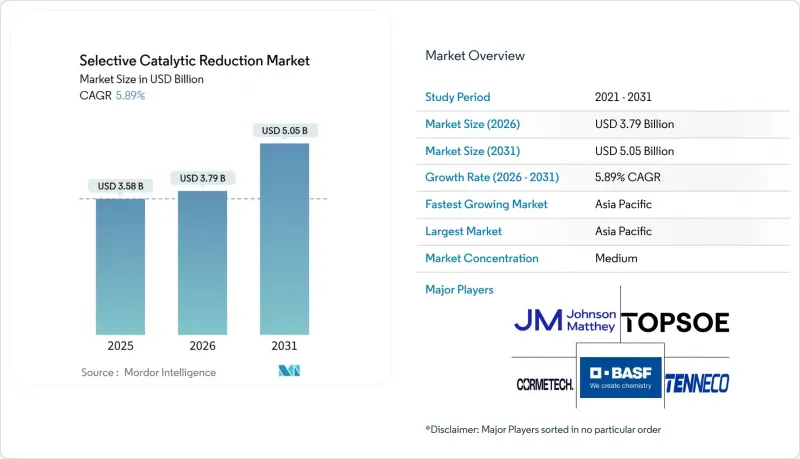
本報告按類型(高粉塵SCR、低粉塵SCR、尾端SCR)、應用領域(發電、工業鍋爐和爐窯、水泥和石灰窯、化學和石化、汽車(小型車)、其他)以及地區(亞太地區、北美地區、歐洲地區、南美地區、中東和非洲)進行細分。市場預測以美元(USD)為單位。
全球選擇性催化還原(SCR)市場趨勢與洞察
隨著 IMO Tier III 標準的臨近,船舶 SCR 的改裝數量激增。
第三階段排放標準要求氮氧化物排放減少80%,迫使船東在進入排放控制區(ECA)的船舶上維修選擇性催化還原(SCR)裝置。 2025年,挪威海和加拿大北極地區被劃為受監管區域,擴大了監管範圍,導致超過3000艘船舶需要進行維修。郵輪業者的反應最為迅速,到2025年已為81艘郵輪配備了SCR裝置,而2018年僅有7艘。每艘船的維修成本在150萬美元至400萬美元之間,但像WinGD的X-DF-HP這樣的新型引擎在出廠時就整合了SCR裝置,從而降低了15%的總擁有成本。雖然隨著更多符合第三階段排放標準的船舶在2028年後交付,預計維修需求將放緩,但催化劑更換的需求預計在整個2030年代仍將保持強勁。
亞太地區煤化工企業建設快速擴張
中國陝西榆林煤礦綜合體正在實施選擇性催化還原(SCR)技術,以達到50毫克/標準立方米的氮氧化物排放限值,為其他大型企劃樹立了先例。印度的百萬噸級煤炭氣化計畫也正在效仿,但高硫煤會加速催化劑中毒,並推高全生命週期成本。公共衛生需求依然明確,研究表明,實施SCR技術可在十年內預防多達21萬人過早死亡。
加速微型車電氣化
到2025年,全球電池式電動車(BEV)銷量將超過1,400萬輛,取代先前推動售後市場SCR觸媒銷售的柴油引擎。將於2027年生效的歐7排放標準將進一步收緊排放標準,但會優先考慮零排放方案。莊信萬豐公司已將其鉑族金屬(PGM)添加劑用量減少了20%,以保護其市場佔有率。預計美國的大型車輛法規將繼續支撐市場需求,直到燃料電池汽車和純電動卡車在2030年後得到更廣泛的應用。
細分市場分析
截至2025年,高粉塵系統佔選擇性催化還原(SCR)市場的45.12%。這些裝置運作在顆粒過濾器上游,溫度保持在300–420 度C範圍內,無需再加熱,但需要耐腐蝕的通道。 CORMETECH的Dustbuster模組突顯了這些設計特點。尾端SCR系統(廣泛應用於燃氣渦輪機和船用引擎)預計將在預測期(2026–2031年)內以6.18%的複合年成長率成長,這得益於低溫催化劑技術的成熟。預計到2031年,尾端選擇性催化還原(SCR)系統的市場規模將超過10億美元。
觸媒技術的持續進步預計將決定成長速度。使用3% V₂O₅-10% MoO₃/TiO₂催化劑的測試表明,在160–180 度C的條件下,兩年內平均去除率超過67%;而CERI的非加熱設計在120–140 度C下實現了超過90%的去除率。然而,低於200 度C時硫酸銨的結垢仍是操作人員面臨的一大挑戰。
區域分析
到2025年,亞太地區將佔選擇性催化還原(SCR)市場51.25%的佔有率,預計到2031年將以6.29%的複合年成長率成長。中國50毫克/立方米的工業排放上限推動了所有新建煤化工生產線採用SCR技術,印度的1億噸煤氣化計畫也遵循類似的路徑。印度高硫煤的使用推高了催化劑成本,同時也鞏固了對排煙脫硫(FGD)維修的需求。日本每年80萬噸的低碳氨合約表明,氨氣燃氣渦輪機將很快投入使用,而這將需要客製化的規格。
在北美,美國環保署 (EPA) 2027 年重型車輛法規正在推高道路需求,而聯合循環發電的改造也推動了電力公司持續的訂單。肯塔基州監管機構重點介紹了按預算完成的選擇性催化還原 (SCR) 項目,並提供了新建燃氣發電裝置的成本預測。加拿大北極地區的排放控制區 (ECA) 的劃定正在加速船舶改造,但寒冷的氣候為尿素處理帶來了挑戰。
在歐洲,燃煤發電廠的逐步淘汰減緩了電力公司的訂單,但工業排放指令對新建水泥窯200毫克/立方公尺的排放上限正在推動低溫催化劑的應用。挪威海排放控制區(ECA)向北擴展至2025年,促進了船舶遵守相關法規,並推動了渡輪和郵輪的改造。霍尼韋爾對莊信萬豐的收購提案反映了區域供應商格局的整合。
其他好處
- Excel格式的市場預測(ME)表
- 3個月的分析師支持
目錄
第1章:引言
- 研究假設和市場定義
- 調查範圍
第2章:調查方法
第3章執行摘要
第4章 市場狀況
- 市場概覽
- 市場促進因素
- 隨著 IMO Tier III 標準的臨近,船舶 SCR 的改裝數量激增。
- 亞太地區煤化工企業建設快速擴張
- 水泥窯中採用低溫釩鈰催化劑
- 氫燃料引擎SCR的OEM檢驗
- 人工智慧驅動的自適應氨噴射控制
- 市場限制因素
- 加速微型車電氣化
- SO2/SO3引起的催化劑失活會縮短催化劑的使用壽命。
- 藍氨作為船用燃料的供應存在監管方面的不確定性。
- 價值鏈分析
- 技術展望
- 波特五力模型
第5章 市場規模與成長預測
- 按類型
- 高粉塵選擇性催化還原
- 低粉塵SCR
- SCR尾端
- 透過使用
- 發電(煤炭、天然氣、生質能)
- 工業鍋爐和熔爐
- 水泥窯及石灰窯
- 鋼
- 化工/石油化工
- 汽車(小型汽車)
- 汽車(大型車輛)(公路行駛)
- 船用引擎
- 其他
- 按地區
- 亞太地區
- 中國
- 印度
- 日本
- 韓國
- ASEAN
- 其他亞太國家
- 北美洲
- 美國
- 加拿大
- 墨西哥
- 歐洲
- 德國
- 英國
- 法國
- 義大利
- 俄羅斯
- 北歐國家
- 其他歐洲國家
- 南美洲
- 巴西
- 阿根廷
- 其他南美國家
- 中東和非洲
- 沙烏地阿拉伯
- 南非
- 其他中東和非洲國家
- 亞太地區
第6章 競爭情勢
- 市場集中度
- 策略趨勢
- 市佔率和排名分析
- 公司簡介
- Babcock and Wilcox Enterprises Inc.
- BASF
- CLARIANT
- CORMETECH
- Dongfang Boiler Ltd
- DUCON
- FORVIA HELLA
- GE Vernova
- Hitachi Zosen India Private Limited
- Johnson Matthey
- MITSUBISHI HEAVY INDUSTRIES, LTD.
- Shandong Longking
- Siemens Energy
- Tenneco Inc
- Topsoe A/S
- Umicore
- YANMAR Marine International
第7章 市場機會與未來展望
According to Mordor Intelligence, the selective catalytic reduction market size is expected to grow from USD 3.58 billion in 2025 to USD 3.79 billion in 2026 and is forecast to reach USD 5.05 billion by 2031 at 5.89% CAGR over 2026-2031.
This report is Segmented by Type (High Dust SCR, Low Dust SCR, and Tail-End SCR), Application (Power Generation, Industrial Boilers and Furnaces, Cement and Lime Kilns, Chemicals and Petrochemicals, Automotive - Light-Duty, and More), and Geography (Asia-Pacific, North America, Europe, South America, and Middle-East and Africa). The Market Forecasts are Provided in Terms of Value (USD).
Global Selective Catalytic Reduction Market Trends and Insights
Surge in Marine SCR Retrofits Ahead of IMO Tier III
Tier III rules require an 80% NOx cut, driving owners to retrofit SCR on vessels that enter Emission Control Areas. The 2025 designation of the Norwegian Sea and Canadian Arctic widened compliance zones and generated a backlog exceeding 3,000 vessels. Cruise operators moved fastest, fitting 81 ships with SCR by 2025, up from 7 in 2018. Retrofit costs run USD 1.5-4 million per ship, but new engines such as WinGD's X-DF-HP integrate SCR from the factory, trimming total cost of ownership by 15%. As more Tier III-ready tonnage is delivered post-2028, retrofit demand will cool, yet catalyst replacement will stay resilient through the 2030s.
Rapid Build-Out of Coal-to-Chemicals Plants in Asia-Pacific
China's Shaanxi Coal Yulin complex embeds SCR to meet the 50 mg/Nm3 NOx cap, a precedent for other mega-projects. India's 100-ton coal-gasification mission follows suit, but higher sulfur coal accelerates catalyst poisoning, inflating lifecycle cost. The public-health imperative remains clear, with studies showing SCR deployment could avert up to 210,000 premature deaths over a decade.
Accelerating Electrification of Light-Duty Vehicles
Global BEV (battery electric vehicle) sales topped 14 million in 2025, displacing diesel engines that drove aftermarket SCR catalyst sales. Euro 7 rules, effective 2027, tighten limits further but favor zero-tailpipe options, prompting Johnson Matthey to cut Platinum Group Metal (PGM) loadings 20% to defend share. Heavy-duty regulations in the U.S. will cushion demand until fuel-cell and battery trucks scale after 2030.
Other drivers and restraints analyzed in the detailed report include:
- Adoption of Low-Temperature Vanadium-Ceria Catalysts in Cement Kilns
- OEM Validation of SCR for Hydrogen-Fuelled Engines
- SO2/SO3 Poisoning Shortening Catalyst Life
For complete list of drivers and restraints, kindly check the Table Of Contents.
Segment Analysis
High-Dust systems captured 45.12% of the Selective Catalytic Reduction market share in 2025. Operating upstream of particulate filters lets these units stay within 300-420°C, avoiding reheating but demanding erosion-resistant channels. CORMETECH's Dustbuster modules highlight such design features. Tail-End SCR, favored by gas turbines and marine engines, is expected to grow at the fastest CAGR of 6.18% during the forecast period (2026-2031) as low-temperature catalysts mature. The Selective catalytic reduction market size for Tail-End installations is projected to exceed USD 1 billion by 2031.
Continued catalyst advances will decide growth tempo. Trials of 3% V2O5-10 % MoO3/TiO2 show more than 67% average removal at 160-180°C over two years, while CERI's heat-free design achieved more than 90% removal at 120-140°C. Yet ammonium bisulfate fouling below 200°C remains a constraint for operators.
Geography Analysis
Asia-Pacific accounted for 51.25% of the Selective Catalytic Reduction market share in 2025 and is set to expand at 6.29% CAGR to 2031. China's 50 mg/Nm3 industrial cap embeds SCR in every new coal-to-chemicals line, while India's 100-ton gasification mission mirrors this pathway. Higher sulfur coal in India raises catalyst cost but also cements FGD retrofits. Japan's 800,000 tons per year low-carbon ammonia contracts point to early deployment of ammonia-fired turbines that will need to be tailored.
In North America, the EPA 2027 heavy-duty rule propels on-road demand, and combined-cycle retrofits keep utility orders flowing. Kentucky regulators highlighted a finished SCR project that closed under budget, informing cost expectations for new gas units. Canadian Arctic ECA status pushes vessel retrofits, but cold climate imposes urea-handling challenges.
In Europe, coal retirements dampen utility orders, yet the Industrial Emissions Directive's 200 mg/Nm3 limit for new cement kilns underpins low-temperature catalyst uptake. The 2025 Norwegian Sea ECA extended marine compliance northward, driving ferry and cruise retrofits. Honeywell's bid for Johnson Matthey reflects a consolidating regional supplier base.
- Babcock and Wilcox Enterprises Inc.
- BASF
- CLARIANT
- CORMETECH
- Dongfang Boiler Ltd
- DUCON
- FORVIA HELLA
- GE Vernova
- Hitachi Zosen India Private Limited
- Johnson Matthey
- MITSUBISHI HEAVY INDUSTRIES, LTD.
- Shandong Longking
- Siemens Energy
- Tenneco Inc
- Topsoe A/S
- Umicore
- YANMAR Marine International
Additional Benefits:
- The market estimate (ME) sheet in Excel format
- 3 months of analyst support
TABLE OF CONTENTS
1 Introduction
- 1.1 Study Assumptions and Market Definition
- 1.2 Scope of the Study
2 Research Methodology
3 Executive Summary
4 Market Landscape
- 4.1 Market Overview
- 4.2 Market Drivers
- 4.2.1 Surge in marine SCR retrofits ahead of IMO Tier III
- 4.2.2 Rapid build-out of coal-to-chemicals plants in Asia-Pacific
- 4.2.3 Adoption of low-temperature vanadium-ceria catalysts in cement kilns
- 4.2.4 OEM validation of SCR for hydrogen-fuelled engines
- 4.2.5 AI-driven adaptive ammonia injection controls
- 4.3 Market Restraints
- 4.3.1 Accelerating electrification of light-duty vehicles
- 4.3.2 SO2/SO3 poisoning shortening catalyst life
- 4.3.3 Regulatory ambiguity around blue-ammonia bunkering
- 4.4 Value Chain Analysis
- 4.5 Technological Outlook
- 4.6 Porter's Five Forces
- 4.6.1 Threat of New Entrants
- 4.6.2 Bargaining Power of Suppliers
- 4.6.3 Bargaining Power of Buyers
- 4.6.4 Threat of Substitutes
- 4.6.5 Competitive Rivalry
5 Market Size and Growth Forecasts (Value)
- 5.1 By Type
- 5.1.1 High Dust SCR
- 5.1.2 Low Dust SCR
- 5.1.3 Tail-End SCR
- 5.2 By Application
- 5.2.1 Power Generation (Coal, Gas, and Biomass)
- 5.2.2 Industrial Boilers and Furnaces
- 5.2.3 Cement and Lime Kilns
- 5.2.4 Iron and Steel
- 5.2.5 Chemicals and Petrochemicals
- 5.2.6 Automotive - Light-duty
- 5.2.7 Automotive - Heavy-duty (On-road)
- 5.2.8 Marine Engines
- 5.2.9 Others
- 5.3 By Geography
- 5.3.1 Asia-Pacific
- 5.3.1.1 China
- 5.3.1.2 India
- 5.3.1.3 Japan
- 5.3.1.4 South Korea
- 5.3.1.5 ASEAN Countries
- 5.3.1.6 Rest of Asia-Pacific
- 5.3.2 North America
- 5.3.2.1 United States
- 5.3.2.2 Canada
- 5.3.2.3 Mexico
- 5.3.3 Europe
- 5.3.3.1 Germany
- 5.3.3.2 United Kingdom
- 5.3.3.3 France
- 5.3.3.4 Italy
- 5.3.3.5 Russia
- 5.3.3.6 NORDIC Countries
- 5.3.3.7 Rest of Europe
- 5.3.4 South America
- 5.3.4.1 Brazil
- 5.3.4.2 Argentina
- 5.3.4.3 Rest of South America
- 5.3.5 Middle-East and Africa
- 5.3.5.1 Saudi Arabia
- 5.3.5.2 South Africa
- 5.3.5.3 Rest of Middle-East and Africa
- 5.3.1 Asia-Pacific
6 Competitive Landscape
- 6.1 Market Concentration
- 6.2 Strategic Moves
- 6.3 Market Share/Ranking Analysis
- 6.4 Company Profiles (includes Global Overview, Market Overview, Core Segments, Financials, Strategic Information, Products and Services, Recent Developments)
- 6.4.1 Babcock and Wilcox Enterprises Inc.
- 6.4.2 BASF
- 6.4.3 CLARIANT
- 6.4.4 CORMETECH
- 6.4.5 Dongfang Boiler Ltd
- 6.4.6 DUCON
- 6.4.7 FORVIA HELLA
- 6.4.8 GE Vernova
- 6.4.9 Hitachi Zosen India Private Limited
- 6.4.10 Johnson Matthey
- 6.4.11 MITSUBISHI HEAVY INDUSTRIES, LTD.
- 6.4.12 Shandong Longking
- 6.4.13 Siemens Energy
- 6.4.14 Tenneco Inc
- 6.4.15 Topsoe A/S
- 6.4.16 Umicore
- 6.4.17 YANMAR Marine International
7 Market Opportunities and Future Outlook
- 7.1 White-space and Unmet-need Assessment

 選擇性催化還原系統:市場佔有率分析、產業趨勢與統計及成長預測(2026-2031)
 選擇性催化還原(SCR)系統全球市場規模、佔有率、趨勢和成長分析報告(2026-2034)
 選擇性催化還原(SCR)系統市場機會、成長要素、產業趨勢分析及2026-2035年預測
 選擇性催化還原市場-全球產業規模、佔有率、趨勢、機會、預測:按應用、類型、車輛類型、地區和競爭格局分類,2021-2031年
 選擇性催化還原市場,依催化劑類型、燃料類型、最終用途產業、國家及地區分類-2025 年至 2032 年全球產業分析、市場規模、市場佔有率及預測
 全球船用選擇性催化還原系統市場
 2032 年選擇性催化還原市場預測:按還原劑類型、催化劑類型、成分、應用、最終用戶和地區進行的全球分析
 選擇性催化還原市場規模、佔有率、趨勢分析報告:按最終用途、地區、細分市場預測,2025 年至 2030 年船用選擇性催化還原系統市場機會、成長動力、產業趨勢分析及 2025 - 2034 年預測