


 |
市場調查報告書
商品編碼
2119268
電信業者的身份即服務 (IDaaS):市場佔有率分析、產業趨勢與統計數據、成長預測 (2026-2031)Telecom Identity-as-a-Service - Market Share Analysis, Industry Trends & Statistics, Growth Forecasts (2026 - 2031) |
||||||

※ 本網頁內容可能與最新版本有所差異。詳細情況請與我們聯繫。
根據 Mordor Intelligence 預測,電信業者的身份即服務 (IDaaS) 市場規模將從 2025 年的 21.4 億美元和 2026 年的 28.4 億美元成長到 2031 年的 68.9 億美元,2026 年至 2031 年的年複合成長率(CAGR)為 19.39%。
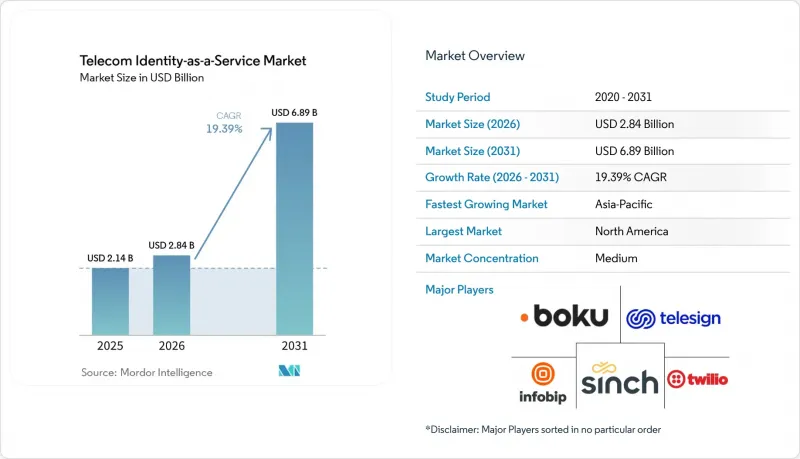
本報告按組件(解決方案和服務)、部署方式(雲端、本地部署、混合部署)、身份驗證方法(基於簡訊的臨時密碼、行動生物識別等)、最終用戶(行動網路營運商等)、行業領域(金融服務、電子商務和零售、醫療保健等)以及地區進行細分。市場預測以美元(USD)為單位。
電信業者身分即服務 (IDaaS) 市場的全球趨勢與洞察。
持續不斷的SIM卡交換和帳戶劫持詐騙
根據Cifas統計,2026年上半年詐欺性SIM卡交換案件數量較2025年同期增加402%。這一成長表明,有組織的自動化SIM卡傳輸技術正被廣泛使用,而非孤立的網路釣魚攻擊。簡訊動態密碼的前提是行動電話號碼始終與原始用戶綁定。然而,如果詐騙能夠控制已重新分配或號碼可攜性可攜的SIM卡,這一前提便不再成立。這種風險使得營運商所有權驗證對於銀行、零售商和營運商身分即服務(IDaaS)市場中的數位平台而言變得更加重要。對於仍使用簡訊作為主要身分驗證方式的機構而言,在帳戶恢復和高價值交易過程中驗證身分也變得至關重要。
強客戶認證和數位身分法規
法規的實施日益凸顯了對不完全依賴知識型憑證的身份驗證方式的需求。歐盟第2024/1183號條例規定,所有歐盟成員國必須在2026年12月6日前提供至少一個歐洲數位身分錢包。該框架還要求受監管的依賴方按照實施計劃接受此類錢包。這些規則為金融機構、電信業者和數位服務供應商提供了升級其身分流程的明確理由。電信業者的身份即服務(IDaaS)市場可以透過營運商訊號來補充基於錢包的身份驗證和其他強身份驗證方法,從而支持此轉型。此外,英國國家醫療服務體系(NHS England)的DAPB3051標準要求在2026年12月31日前完全符合數位健康身分標準,這進一步凸顯了檢驗的病患存取控制的重要性。
對集中式用戶資料的隱私限制
電信業者掌握著寶貴的用戶數據,但隱私法限制了這些數據的再利用。在2025年對歐洲資料保護委員會(EDPB)指導意見的回應中,Connect Europe指出,在目前的ePrivacy框架下,營運商無法依賴GDPR的兼容性條款來處理流量資料和位置資料。這限制了在集中式身分模型中使用行為資料和位置資料。因此,營運商需要更加重視預先定義的訊號,例如號碼匹配和SIM卡交換標誌。雖然這些訊號很有用,但與更廣泛的行為風險模型相比,它們缺乏上下文資訊。為了使電信業者的身份即服務(IDaaS)能夠更廣泛地利用網路訊息,需要擴大基於用戶同意和隱私保護方法的應用範圍。
細分市場分析
預計到 2025 年,解決方案將佔收入的 71.23%,成為營運商身分即服務 (IDaaS) 市場中最大的組成部分。此類別包括電話號碼檢驗API、SIM 卡交換偵測、數位身分 API 和靜默網路認證產品。企業通常選擇這些預先整合產品,因為它們允許企業在無需與營運商建立單獨關係的情況下實施基於營運商的檢查。打包解決方案結合了 API 存取和工作流程控制,可以部署在現有的詐欺防制和客戶存取系統中。隨著 GSMA 開放閘道器的標準化,基本 API 存取方面的差異正在縮小。因此,提供者越來越重視與網路訊號相關的編配、風險評分、授權管理和報告功能。
預計2026年至2031年間,服務市場將以21.61%的複合年成長率成長。這反映出市場對實施支援、營運商關係管理、監管諮詢和持續詐欺監控的需求日益成長。企業身分環境通常涉及多種身分驗證方法的組合,因此設計和配置工作的重要性日益凸顯。服務可以幫助企業將營運商訊號與內部詐欺預防、客戶體驗要求以及特定國家/地區的合規義務相協調。人工智慧代理的興起也催生了為非人類主體設計信任管理的需求。 2026年4月,Prove推出了一個身分平台,支援在統一環境中檢驗個人、企業和人工智慧代理的身份。隨著買家考慮如何檢驗和監控代理商權限,這項需求將推動對專業服務的需求。
預計到2025年,雲端部署將佔總營收的82.36%,並將在2031年之前以21.73%的複合年成長率成長。這一細分市場的規模表明,許多買家更傾向於基於軟體的身份服務,而不是專用基礎設施。雲端系統使企業能夠透過API利用檢驗和認證功能,而無需管理與本地運營商的連接。它們還可以處理跨多個國家和客戶管道的大量交易。雲端原生網路功能和數位化客戶旅程的日益普及正在推動營運商雲端交付的身份即服務(IDaaS)市場的成長。 ITU-T M.3411建議為通訊管理網路中的身分和存取管理提供了基於標準的指南,進一步強調了在分散式環境中進行集中管治的必要性。
本機部署和混合部署方案持續為對資料居住、安全性或基礎架構有嚴格要求的使用者提供服務。政府機構、部分金融機構和醫療機構可能需要對受監管資料保持本地控制。對於需要同時管理傳統虛擬網路功能和 5G 雲端原生功能的電信業者而言,混合設計也十分適用。採用通用身份策略使他們能夠在不立即替換舊有系統的情況下覆蓋兩種環境。雖然此類設計可以減輕現代化帶來的營運影響,但與雲端優先方法相比,它們可能需要更多的整合工作。由於不同行業的安全性和監管需求各不相同,電信業者的身份即服務 (IDaaS) 市場仍包含這些選項。因此,對於許多使用者而言,混合部署更像是一種遷移路徑,而非最終的通用方案。
區域分析
北美地區擁有大型企業買家、成熟的行動網路以及較高的詐騙風險,預計到2025年將佔全球收入的33.12%。美國消費者詐欺損失預計到2025年將達到159億美元,進一步凸顯了加強客戶驗證的必要性。該地區的電信營運商和聚合商正在建立可透過單一企業連接整合的網路API服務。這將使銀行、電子商務公司和數位平台更容易檢驗電話號碼並偵測SIM卡交換。北美地區在收入方面的領先地位也反映了其龐大的雲端軟體和電信服務供應商群體。在加拿大和墨西哥,金融服務機構和政府主導的數位身分舉措正在開發相關的應用案例。
數位身分和隱私相關法規的推出對歐洲產生了重大影響。歐洲數位身分框架要求成員國在2026年12月前至少提供一個電子錢包。這促使金融機構、電信業者和線上服務供應商使其身分驗證基礎設施與通用身分要求保持一致。英國電信業者於2025年9月開始在GSMA開放閘道架構下提供KYC年齡驗證和KYC使用期限驗證API。同年,Infobip的SIM卡交換和號碼檢驗API獲得了GSMA開放閘道器認證,從而支援電信運營商網路之間的互通性。由於該地區的隱私法規可能會限制集中式用戶資料的使用,因此,以使用者同意和合規性為核心的設計仍然是服務提供者策略的關鍵。
預計亞太地區在2026年至2031年間將以21.71%的複合年成長率成長,成為所有區域市場中成長最快的地區。這一成長主要得益於龐大的行動優先用戶群、日益普及的數位服務以及積極的監管發展。印度和阿拉伯聯合大公國推出的新規提高了金融服務領域對更強大身分驗證方法的需求。亞太地區電信業者的身份即服務(IDaaS)市場規模也得益於能夠處理高容量數位平台的網路API的普及。南美洲是一個新興的需求區域,尤其是在網路API已經能夠處理大量交易的地區。非洲和中東地區擁有巨大的長期發展潛力,這得益於其較高的行動普及率和國家數位身分認證計畫。這些地區的服務供應商可以根據當地電信業者的服務區域、使用者許可法規以及企業技術預算調整其身分認證服務,從而從中受益。
其他好處:
- Excel格式的市場預測(ME)表
- 3個月的分析師支持
目錄
第1章:引言
- 研究假設和市場定義
- 調查範圍
第2章:調查方法
第3章執行摘要
第4章 市場狀況
- 市場概覽
- 市場促進因素
- SIM卡交換和帳戶劫持詐騙增多
- 擴展行動網路營運商 ID 和網路 API
- 關於穩健的客戶身份驗證和數位身分的法規
- 整體電信業務的雲端遷移
- 基於同意的網路訊號實現無密碼身份驗證
- AI代理和物聯網身分的配置要求
- 市場限制因素
- 對集中式用戶資料的隱私限制
- 跨境KYC和身分驗證標準的差異
- 行動網路營運商和聚合商之間收入分成機制的複雜性
- SIM卡回收和用戶資料不完整
- 宏觀經濟因素對市場的影響
- 產業價值鏈分析
- 技術展望
- 監理情勢
- 波特五力分析
第5章 市場規模與成長預測
- 按組件
- 解決方案
- 服務
- 不同的發展
- 雲
- 現場
- 混合
- 身份驗證方法
- 基於簡訊的動態密碼
- 行動生物識別
- 多因素身份驗證令牌
- 數位身份驗證 API
- 號碼檢驗API
- 靜默網路認證
- 其他身份驗證方法
- 最終用戶
- 行動網路營運商
- 行動虛擬網路營運商
- Over-The-Top(OTT)服務供應商
- 公司
- 政府機構
- 按行業分類
- 金融服務
- 電子商務與零售
- 政府/公共部門
- 衛生保健
- 媒體與娛樂
- 旅遊與飯店
- 其他工業部門
- 按地區
- 北美洲
- 美國
- 加拿大
- 墨西哥
- 南美洲
- 巴西
- 阿根廷
- 智利
- 其他南美國家
- 歐洲
- 德國
- 英國
- 法國
- 義大利
- 西班牙
- 其他歐洲國家
- 亞太地區
- 中國
- 日本
- 印度
- 韓國
- 澳洲
- 其他亞太國家
- 中東
- 阿拉伯聯合大公國
- 沙烏地阿拉伯
- 卡達
- 其他中東國家
- 非洲
- 南非
- 埃及
- 奈及利亞
- 其他非洲國家
- 北美洲
第6章 競爭情勢
- 市場集中度
- 策略趨勢
- 市佔率分析
- 公司簡介
- Boku, Inc.
- Infobip Limited
- Telesign Corporation
- Sinch AB
- Twilio Inc.
- Mobileum Inc.
- Prove Identity, Inc.
- Callsign, Inc.
- 1Kosmos Inc.
- Trulioo Information Services Inc.
- Authlete, Inc.
- Tru.ID Limited
- IDEMIA France SAS
- Giesecke+Devrient Mobile Security GmbH
- Thales Digital Identity and Security France SAS
- Tyntec Group Limited
- Mitek Systems, Inc.
- Route Mobile Limited
- CM.com NV
- Syniverse Technologies, LLC
- GMS Global Mobile Solutions Inc.
- XConnect Global Networks Ltd
- Cloudcom Communications Corp.
- Vonage Holdings Corp.
第7章 市場機會與未來展望
According to Mordor Intelligence, the telecom identity-as-a-Service market size is projected to expand from USD 2.14 billion in 2025 and USD 2.84 billion in 2026 to USD 6.89 billion by 2031, registering a CAGR of 19.39% between 2026 to 2031.
This report is Segmented by Component (Solutions, and Services), Deployment (Cloud, On-Premise, and Hybrid), Authentication Type (SMS-Based One-Time Password, Mobile Biometrics, and More), End User (Mobile Network Operators, and More), Industry Vertical (Financial Services, E-Commerce and Retail, Healthcare, and More), and Geography. The Market Forecasts are Provided in Terms of Value (USD).
Global Telecom Identity-as-a-Service Market Trends and Insights
Rising SIM-Swap and Account-Takeover Fraud
Unauthorized SIM-swap cases rose 402% in the first half of 2026 compared with the same period in 2025, according to Cifas. The increase points to the wider use of organized, automated SIM-porting methods rather than isolated phishing attempts. SMS one-time passwords depend on the assumption that a mobile number remains tied to the intended user. That assumption weakens when a fraudster can obtain control of a reassigned or ported SIM. This exposure is making carrier-verified possession checks more relevant to banks, retailers, and digital platforms in the Telecom Identity-as-a-Service Market. It also makes verification at account recovery and high-value transactions more important for organizations that still use SMS as their primary authentication step.
Strong Customer Authentication and Digital-Identity Regulation
Regulation is increasing the need for authentication that does not rely solely on knowledge-based credentials. Regulation (EU) 2024/1183 required every EU member state to provide at least 1 European Digital Identity Wallet by December 6, 2026. The framework also establishes obligations for regulated relying parties to accept the wallet within its implementation timetable. These rules give financial institutions, telecommunications providers, and digital services a clearer reason to modernize identity flows. The Telecom Identity-as-a-Service Market can support this transition when carrier signals complement wallet-based or other strong authentication methods. NHS England's DAPB3051 standard also required full conformance with digital health identity standards by December 31, 2026, reinforcing the importance of verified patient access controls.
Privacy Restrictions on Centralized Subscriber Data
Telecom operators hold valuable subscriber data, but privacy law limits how that data can be reused. Connect Europe stated in its 2025 response to European Data Protection Board guidance that operators could not rely on the GDPR's compatibility provisions for traffic and location data under the current ePrivacy framework. This restricts the use of behavioral and location information in centralized identity models. Providers must therefore rely more heavily on defined signals such as a number match or a SIM-swap flag. Such signals can be useful, but they offer less context than a broader behavioral risk model. The Telecom Identity-as-a-Service Market must expand its use of consent-based and privacy-preserving approaches if it is to use network information more broadly.
Other drivers and restraints analyzed in the detailed report include:
- Expansion of MNO Identity and Network APIs
- Cloud Migration Across Telecom Operations
- Fragmented Cross-Border KYC and Identity Standards
For complete list of drivers and restraints, kindly check the Table Of Contents.
Segment Analysis
Solutions held 71.23% of revenue in 2025, making them the largest component of the Telecom Identity-as-a-Service Market. This category includes number-verification APIs, SIM-swap detection, digital-identity APIs, and silent network authentication products. Enterprises often choose these pre-integrated products because they can introduce carrier-based checks without building individual relationships with operators. A packaged solution also combines API access with workflow controls that can be deployed within existing fraud and customer-access systems. GSMA Open Gateway standardization is narrowing differences in basic API access. As a result, providers are placing greater value on orchestration, risk scoring, consent management, and reporting capabilities related to the network signal.
Services are projected to expand at a 21.61% CAGR from 2026 to 2031. This reflects growing demand for implementation support, carrier relationship management, regulatory advice, and continuous fraud monitoring. Enterprise identity environments often combine several authentication methods, which raises the importance of design and configuration work. Services can help organizations align carrier signals with internal fraud controls, customer-experience requirements, and country-specific compliance obligations. The rise of AI agents also creates a need to design trust controls for nonhuman actors. Prove launched its identity platform in April 2026 to support verification of people, businesses, and AI agents within a unified environment. This requirement can support professional services as buyers test how agent permissions should be verified and monitored.
Cloud deployment accounted for 82.36% of revenue in 2025 and is projected to expand at a 21.73% CAGR through 2031. The segment's scale indicates that many buyers prefer software-delivered identity services over dedicated infrastructure. Cloud systems allow enterprises to invoke verification and authentication functions via APIs without managing local carrier connections. They can also support high transaction volumes across several countries and customer channels. The wider adoption of cloud-native network functions and digital customer journeys drives the Telecom Identity-as-a-Service Market size for cloud delivery. ITU-T Recommendation M.3411 provides a standards-based reference for identity and access management in telecom management networks. This strengthens the case for centralized governance across distributed environments.
On-premise and hybrid deployments continue to serve users with strict data residency, security, or infrastructure requirements. Government agencies, certain financial institutions, and healthcare organizations may retain local controls for regulated data. Hybrid designs are also relevant to operators that manage older virtual network functions alongside 5G cloud-native functions. A common identity policy can cover both environments without requiring immediate replacement of legacy systems. These designs can reduce disruption during modernization, but they may require more integration work than a cloud-first approach. The Telecom Identity-as-a-Service Market continues to include these options because security and regulatory needs are not uniform across verticals. Hybrid deployment is therefore a transition path for many users rather than a universal end state.
Complete Report Scope:
- By Component
- Solutions
- Services
- By Deployment
- Cloud
- On-Premise
- Hybrid
- By Authentication Type
- SMS-Based One-Time Password
- Mobile Biometrics
- Multifactor Authentication Token
- Digital Identity Verification API
- Number Verification API
- Silent Network Authentication
- Other Authentication Types
- By End User
- Mobile Network Operators
- Mobile Virtual Network Operators
- Over-the-Top Service Providers
- Enterprises
- Government Agencies
- By Industry Vertical
- Financial Services
- E-Commerce and Retail
- Government and Public Sector
- Healthcare
- Media and Entertainment
- Travel and Hospitality
- Other Industry Verticals
- By Geography
- North America
- United States
- Canada
- Mexico
- South America
- Brazil
- Argentina
- Chile
- Rest of South America
- Europe
- Germany
- United Kingdom
- France
- Italy
- Spain
- Rest of Europe
- Asia-Pacific
- China
- Japan
- India
- South Korea
- Australia
- Rest of Asia-Pacific
- Middle East
- United Arab Emirates
- Saudi Arabia
- Qatar
- Rest of Middle East
- Africa
- South Africa
- Egypt
- Nigeria
- Rest of Africa
- North America
Geography Analysis
North America held 33.12% of revenue in 2025, supported by large enterprise buyers, mature mobile networks, and high fraud exposure. The United States recorded USD 15.9 billion in consumer fraud losses in 2025, which reinforced the need for stronger customer authentication. The region's operators and aggregators are establishing network API services that can be integrated through a single enterprise connection. This makes number verification and SIM-swap detection more accessible to banks, e-commerce firms, and digital platforms. North American revenue leadership also reflects a broad base of cloud software and communications providers. Canada and Mexico are developing related use cases through financial services and government digital identity initiatives.
The implementation of digital identity and privacy rules strongly influences Europe. The European Digital Identity framework requires member states to offer at least 1 wallet by December 2026. This encourages financial institutions, operators, and online services to align authentication infrastructure with common identity requirements. United Kingdom operators launched KYC age-verification and KYC tenure APIs under GSMA Open Gateway in September 2025. Infobip received GSMA Open Gateway certifications for SIM Swap and Number Verification APIs in 2025, supporting interoperability across operator networks. The region's privacy restrictions can limit the use of centralized subscriber data, so consent and compliance design remain central to provider strategy.
Asia-Pacific is projected to expand at a 21.71% CAGR from 2026 to 2031, the fastest rate across geographic segments. The region combines large mobile-first populations, rising use of digital services, and active regulatory development. India and the United Arab Emirates introduced requirements that increase the need for stronger forms of authentication in financial services. The Telecom Identity-as-a-Service Market size in Asia-Pacific is also supported by network API deployments that can serve high-volume digital platforms. South America is an emerging demand area, particularly where network APIs are already processing high transaction volumes. Africa and the Middle East have strong long-term potential because of high mobile usage and national digital identity programs. These regions can benefit when providers adapt identity services to local operator coverage, consent rules, and enterprise technology budgets.
- Boku, Inc.
- Infobip Limited
- Telesign Corporation
- Sinch AB
- Twilio Inc.
- Mobileum Inc.
- Prove Identity, Inc.
- Callsign, Inc.
- 1Kosmos Inc.
- Trulioo Information Services Inc.
- Authlete, Inc.
- Tru.ID Limited
- IDEMIA France SAS
- Giesecke+Devrient Mobile Security GmbH
- Thales Digital Identity and Security France SAS
- Tyntec Group Limited
- Mitek Systems, Inc.
- Route Mobile Limited
- CM.com N.V.
- Syniverse Technologies, LLC
- GMS Global Mobile Solutions Inc.
- XConnect Global Networks Ltd
- Cloudcom Communications Corp.
- Vonage Holdings Corp.
Additional Benefits:
- The market estimate (ME) sheet in Excel format
- 3 months of analyst support
TABLE OF CONTENTS
1 INTRODUCTION
- 1.1 Study Assumptions and Market Definition
- 1.2 Scope of the Study
2 RESEARCH METHODOLOGY
3 EXECUTIVE SUMMARY
4 MARKET LANDSCAPE
- 4.1 Market Overview
- 4.2 Market Drivers
- 4.2.1 Rising SIM-Swap and Account-Takeover Fraud
- 4.2.2 Expansion of MNO Identity and Network APIs
- 4.2.3 Strong Customer Authentication and Digital-Identity Regulation
- 4.2.4 Cloud Migration Across Telecom Operations
- 4.2.5 Consent-Based Network Signals for Passwordless Authentication
- 4.2.6 AI Agent and IoT Identity Provisioning Requirements
- 4.3 Market Restraints
- 4.3.1 Privacy Restrictions on Centralized Subscriber Data
- 4.3.2 Fragmented Cross-Border KYC and Identity Standards
- 4.3.3 MNO and Aggregator Revenue-Sharing Complexity
- 4.3.4 SIM Recycling and Incomplete Subscriber-Data Accuracy
- 4.4 Impact of Macroeconomic Factors on the Market
- 4.5 Industry Value-Chain Analysis
- 4.6 Technology Outlook
- 4.7 Regulatory Landscape
- 4.8 Porter's Five Forces Analysis
- 4.8.1 Threat of New Entrants
- 4.8.2 Bargaining Power of Suppliers
- 4.8.3 Bargaining Power of Buyers
- 4.8.4 Threat of Substitutes
- 4.8.5 Intensity of Competitive Rivalry
5 MARKET SIZE AND GROWTH FORECASTS (VALUE)
- 5.1 By Component
- 5.1.1 Solutions
- 5.1.2 Services
- 5.2 By Deployment
- 5.2.1 Cloud
- 5.2.2 On-Premise
- 5.2.3 Hybrid
- 5.3 By Authentication Type
- 5.3.1 SMS-Based One-Time Password
- 5.3.2 Mobile Biometrics
- 5.3.3 Multifactor Authentication Token
- 5.3.4 Digital Identity Verification API
- 5.3.5 Number Verification API
- 5.3.6 Silent Network Authentication
- 5.3.7 Other Authentication Types
- 5.4 By End User
- 5.4.1 Mobile Network Operators
- 5.4.2 Mobile Virtual Network Operators
- 5.4.3 Over-the-Top Service Providers
- 5.4.4 Enterprises
- 5.4.5 Government Agencies
- 5.5 By Industry Vertical
- 5.5.1 Financial Services
- 5.5.2 E-Commerce and Retail
- 5.5.3 Government and Public Sector
- 5.5.4 Healthcare
- 5.5.5 Media and Entertainment
- 5.5.6 Travel and Hospitality
- 5.5.7 Other Industry Verticals
- 5.6 By Geography
- 5.6.1 North America
- 5.6.1.1 United States
- 5.6.1.2 Canada
- 5.6.1.3 Mexico
- 5.6.2 South America
- 5.6.2.1 Brazil
- 5.6.2.2 Argentina
- 5.6.2.3 Chile
- 5.6.2.4 Rest of South America
- 5.6.3 Europe
- 5.6.3.1 Germany
- 5.6.3.2 United Kingdom
- 5.6.3.3 France
- 5.6.3.4 Italy
- 5.6.3.5 Spain
- 5.6.3.6 Rest of Europe
- 5.6.4 Asia-Pacific
- 5.6.4.1 China
- 5.6.4.2 Japan
- 5.6.4.3 India
- 5.6.4.4 South Korea
- 5.6.4.5 Australia
- 5.6.4.6 Rest of Asia-Pacific
- 5.6.5 Middle East
- 5.6.5.1 United Arab Emirates
- 5.6.5.2 Saudi Arabia
- 5.6.5.3 Qatar
- 5.6.5.4 Rest of Middle East
- 5.6.6 Africa
- 5.6.6.1 South Africa
- 5.6.6.2 Egypt
- 5.6.6.3 Nigeria
- 5.6.6.4 Rest of Africa
- 5.6.1 North America
6 COMPETITIVE LANDSCAPE
- 6.1 Market Concentration
- 6.2 Strategic Moves
- 6.3 Market Share Analysis
- 6.4 Company Profiles (includes Global Level Overview, Market Level Overview, Core Segments, Financials as available, Strategic Information, Market Rank/Share, Products and Services, Recent Developments)
- 6.4.1 Boku, Inc.
- 6.4.2 Infobip Limited
- 6.4.3 Telesign Corporation
- 6.4.4 Sinch AB
- 6.4.5 Twilio Inc.
- 6.4.6 Mobileum Inc.
- 6.4.7 Prove Identity, Inc.
- 6.4.8 Callsign, Inc.
- 6.4.9 1Kosmos Inc.
- 6.4.10 Trulioo Information Services Inc.
- 6.4.11 Authlete, Inc.
- 6.4.12 Tru.ID Limited
- 6.4.13 IDEMIA France SAS
- 6.4.14 Giesecke+Devrient Mobile Security GmbH
- 6.4.15 Thales Digital Identity and Security France SAS
- 6.4.16 Tyntec Group Limited
- 6.4.17 Mitek Systems, Inc.
- 6.4.18 Route Mobile Limited
- 6.4.19 CM.com N.V.
- 6.4.20 Syniverse Technologies, LLC
- 6.4.21 GMS Global Mobile Solutions Inc.
- 6.4.22 XConnect Global Networks Ltd
- 6.4.23 Cloudcom Communications Corp.
- 6.4.24 Vonage Holdings Corp.
7 MARKET OPPORTUNITIES AND FUTURE OUTLOOK
- 7.1 White-Space and Unmet-Need Assessment

 身分即服務 (IaaS):市場佔有率分析、產業趨勢與統計資料、成長預測 (2026-2031)
 身分即服務 (IDaaS) 市場:2026-2032 年全球市場預測(按組件、身分驗證類型、部署模式、組織和產業分類)
 身分即服務 (IDaaS) 市場:按組件、部署類型、企業規模、最終用戶、國家和地區分類-行業分析、市場規模、市場佔有率及 2026 年至 2033 年預測
 2026-2030年全球人工智慧紅隊解決方案市場
 醫療設備中的生物辨識即服務:全球市場
 身份即服務 (IDaaS) 市場規模、佔有率、成長率和全球行業分析:按類型、應用和地區分類的洞察,2026-2034 年預測
 2026年全球向量搜尋即服務(VSaaS)市場報告2026年全球人工智慧紅隊服務市場報告身份即服務全球市場報告(2026 年)
 身份即服務市場分析及至2035年預測:按類型、產品類型、服務、技術、組件、應用、部署類型、最終用戶和功能分類