


 |
市場調查報告書
商品編碼
2115019
身分即服務 (IaaS):市場佔有率分析、產業趨勢與統計資料、成長預測 (2026-2031)Identity As A Service - Market Share Analysis, Industry Trends & Statistics, Growth Forecasts (2026 - 2031) |
||||||

※ 本網頁內容可能與最新版本有所差異。詳細情況請與我們聯繫。
根據 Mordor Intelligence 預測,身分即服務 (IaaS) 市場規模將從 2025 年的 112.2 億美元成長到 2026 年的 134.8 億美元,然後在 2031 年達到 337.9 億美元,2026 年至 2031 年的複合年成長率為 20.18%。
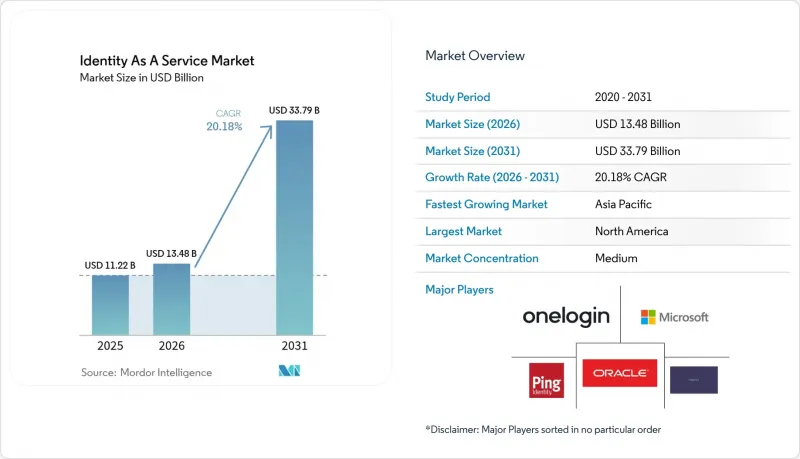
本報告按組件(配置、目錄服務等)、身份驗證類型(單因素身份驗證、多因素身份驗證等)、部署模式(公共雲端等)、用戶類型(員工 ID 等)、組織規模(大型企業等)、最終用戶行業(銀行、金融服務和保險 (BFSI)、電信和 IT 等)以及地區進行細分。市場預測以美元 (USD) 為單位。
全球身分即服務 (IaaS) 市場趨勢與洞察
美國受監理產業採用雲端原生零信任架構
14028號行政命令強制要求美國聯邦機構採用零信任架構,並將身分驗證作為第一道防線。美國國家標準與技術研究院 (NIST) 的實務指南草案提供了一個可互通的藍圖,旨在降低私營和公共相關人員的實施風險。醫院、保險公司和資本市場公司正在利用該指南,從邊界控制轉向持續身份驗證,並將身份即服務 (IaaS) 市場訂閱轉化為必要的營運支出。
基於 API 的微服務的激增,需要對 CI/CD 進行身分控制。
歐洲微服務的激增速度已經超過了傳統身分與存取管理 (IAM) 功能的能力。歐盟數位身分法規要求成員國在 2026 年前發行跨國數位錢包,並將建立統一的身份驗證 API。 DevOps 團隊現在需要一個平台,能夠在每次 CI/CD 運行時自動配置令牌,預計這將顯著推動專注於機器身分管治的身份即服務 (IaaS) 市場提供者的成長。
一級銀行保留傳統大型主機
一級金融機構面臨著龐大的技術債務,這些債務源於難以與現代身份即服務 (IDaaS) 平台整合的大型主機系統,其遷移進度也遠超典型的企業引進週期。 ING 遷移 150 萬行 COBOL 程式碼的案例生動地展現了將核心銀行系統中嵌入的身份與存取管理 (IAM) 邏輯解耦的複雜性 (softwaremining.com)。與大型主機的混合共存延長了測試週期,並減緩了身分即服務 (IaaS) 市場在全球銀行業的發展。
細分市場分析
到 2025 年,身分配置領域將佔身分認同即服務 (IaaS) 市場收入的 29.12%,這凸顯了在混合雲端環境中實現「入職、離職和終止」工作流程自動化的普遍需求。雖然目錄服務和單一登入仍然是必不可少的,但目前的應用重點在於編配人機身分生命週期控制的套件。
多因素身份驗證和無密碼身份驗證服務預計將以每年 21.96% 的速度成長,因為監管指南建議採用能夠抵禦網路釣魚攻擊的機制。像 CyberArk 這樣以 16.6 億美元收購 Venafi 的供應商正在整合生物識別密鑰編配功能,這表明整合套件將比獨立工具集更能吸引投資者的目光。
即使到了2025年,單因素身份驗證方法預計仍將佔據45.62%的收入佔有率,這主要是由於一些傳統工作負載仍然無法支援最新的協議。然而,隨著FIDO2身份驗證在受監管行業中成為強制性要求,無密碼身份驗證機制預計將以21.34%的複合年成長率成長,超過身份即服務(IaaS)市場。波士頓聯邦儲備銀行指出,合成身分將在2024年造成350億美元的詐欺損失,這項數據促使企業優先考慮持續的生物識別和行為身分驗證。
雖然多因素身份驗證工具可以作為過渡性安全措施,但董事會層級的風險委員會現在更傾向於使用完全消除共用金鑰的密碼金鑰。這種轉變正在推動身分驗證方式從間歇性轉變為持續性。
區域分析
到2025年,北美將佔身分即服務(IaaS)市場收入的38.35%。聯邦政府的零信任指令以及主要銀行早期採用無密碼系統,正推動市場支出持續成長。加拿大的「雲端優先」計畫和墨西哥的跨境貿易平台進一步刺激了需求,而所有這些都離不開成熟的超大規模資料中心業者基礎設施的支持。
亞太地區是成長最快的地區,複合年成長率高達23.02%。員工和公民應用場景的擴展得益於各國數位身分框架的完善,以及印尼、印度和越南等公共雲端的快速普及。企業正在利用政府頒發的憑證將員工和承包商關聯起來,從而縮短入職時間並降低KYC成本。
在歐洲,受歐盟數位身分法規的推動,市場呈現穩定成長態勢。該法規要求成員國在2026年前實現可互通的電子錢包。德國的EUDI試點計畫和法國的醫療保健資料在地化法規正在推動政府部門與企業之間的聯合採購模式。能夠整合跨境工作流程並保證資料駐留於區域內的服務提供者將鞏固其市場地位。
其他好處:
- Excel格式的市場預測(ME)表
- 3個月的分析師支持
目錄
第1章:引言
- 研究假設和市場定義
- 調查範圍
第2章:調查方法
第3章執行摘要
第4章 市場狀況
- 市場概覽
- 市場促進因素
- 在高度監管的產業(主要是美國)中採用雲端原生零信任。
- API 微服務的普及正在加速歐洲對 CI/CD 和 IDaaS 的需求。
- 亞洲數位公共產品(eKYC、Aadhaar、Singpass)正在推動各國勞動力採用身分即服務 (IDaaS)。
- 在金融服務業,無密碼 FIDO2先導計畫正在過渡到公司範圍內的許可證。
- 利用供應商提供的身份與存取管理 (IAM) 分析,透過新一代人工智慧實現即時風險評分。
- 超超大規模資料中心業者(Azure、AWS)透過併購創建橫向整合的套件,主導了整合式身分識別即服務 (IDaaS) 的普及。
- 市場限制因素
- 對傳統大型主機的依賴正在減緩一級銀行向身分即服務 (IDaaS) 的轉型。
- 中東地區關於資料儲存地點的法律法規不一致,導致合規成本上升。
- 工業物聯網用戶對基於雲端的身份驗證延遲表示擔憂
- 圍繞專有SSO協定擴展的廠商鎖定問題令人擔憂
- 價值供應鏈分析
- 監理情勢
- 技術展望
- 波特五力模型
第5章 市場規模與成長預測
- 按組件
- 供應
- 目錄服務
- 單一登入 (SSO)
- 密碼管理
- 進階身份驗證/多因素身份驗證
- 訪問管治和合規性
- 按身份驗證類型
- 單因素(基於密碼)
- 多因素認證(令牌、一次性密碼、行動推送)
- 無密碼認證(生物識別,FIDO2)
- 部署模式
- 公共雲端
- 私有雲端
- 混合雲端
- 依使用者類型
- 員工身分
- 客戶/消費者識別(CIAM)
- 按組織規模
- 大公司
- 中小企業
- 按最終用戶行業分類
- BFSI
- 通訊/IT
- 公共部門和政府
- 醫療保健和生命科學
- 能源公用事業
- 製造業
- 零售與電子商務
- 教育
- 其他
- 按地區
- 北美洲
- 美國
- 加拿大
- 墨西哥
- 南美洲
- 巴西
- 阿根廷
- 其他南美國家
- 歐洲
- 德國
- 英國
- 法國
- 北歐國家
- 其他歐洲國家
- 亞太地區
- 中國
- 印度
- 日本
- 韓國
- 澳洲
- 紐西蘭
- 其他亞太國家
- 中東和非洲
- 中東
- 非洲
- 北美洲
第6章 競爭情勢
- 市場集中度
- 策略性舉措(併購、合作、資金籌措)
- 市佔率分析
- 公司簡介
- Microsoft Corporation
- Okta Inc.
- Ping Identity Corporation
- IBM Corporation
- IDaptive LLC
- CyberArk Software Ltd.
- SailPoint Technologies
- ForgeRock Inc.
- One Identity LLC
- Oracle Corporation
- Amazon Web Services(AWS Cognito)
- Google LLC(Cloud Identity)
- Thales Group(Gemalto)
- SAP SE
- Cisco Systems Duo Security
- Auth0(now Okta)
- OneLogin Inc.
- Saviynt
- Simeio Solutions
- Entrust Corporation
- Transmit Security
第7章 市場機會與未來展望
According to Mordor Intelligence, the identity-as-a-Service market size is expected to grow from USD 11.22 billion in 2025 to USD 13.48 billion in 2026 and is forecast to reach USD 33.79 billion by 2031 at 20.18% CAGR over 2026-2031.
This report is Segmented by Component (Provisioning, Directory Services, and More), Authentication Type (Single-Factor, Multi-Factor, and More), Deployment Mode (Public Cloud, and More), User Type (Workforce Identity, and More), Organization Size (Large Enterprise, and More), End-User Vertical (BFSI, Telecom and IT, and More), and by Geography. The Market Forecasts are Provided in Terms of Value (USD).
Global Identity As A Service Market Trends and Insights
Cloud-native zero-trust adoption in regulated U.S. sectors
Executive Order 14028 requires U.S. federal agencies to implement zero-trust architectures, making identity verification the first line of defense. NIST's draft practice guide codifies an interoperable blueprint that cuts deployment risk for private and public stakeholders.Hospitals, insurers, and capital-markets firms are leveraging the guidance to shift from perimeter controls to continuous verification, turning Identity-as-a-Service market subscriptions into essential operating expenditure.
Proliferation of API-based micro-services requiring CI/CD identity controls
European adoption of micro-services has outpaced legacy IAM capabilities. The EU Digital Identity Regulation obliges Member States to issue cross-border digital wallets by 2026, creating uniform APIs for authentication. DevOps teams now require platforms that auto-provision tokens during each CI/CD run, positioning Identity-as-a-Service market providers that specialize in machine-identity governance for outsized growth.
Legacy mainframe entanglement in Tier-1 banks
Tier-1 financial institutions face significant technical debt from mainframe systems that resist integration with modern IDaaS platforms, creating migration timelines that extend beyond typical enterprise deployment cycles. ING's migration of 1.5 million COBOL lines illustrates the complexity of decoupling IAM logic trapped inside core banking systems softwaremining.com. Hybrid coexistence with mainframes prolongs testing cycles, tempering Identity-as-a-Service market acceleration among global banks.
Other drivers and restraints analyzed in the detailed report include:
- Asia-Pacific digital public-goods programs (eKYC, Aadhaar, Singpass)
- Enterprise-wide passwordless FIDO2 roll-outs in financial services
- Fragmented Middle-East data-residency statutes
For complete list of drivers and restraints, kindly check the Table Of Contents.
Segment Analysis
The provisioning segment generated 29.12% of Identity-as-a-Service market revenue in 2025, underlining the universal need for automated joiner-mover-leaver workflows across hybrid cloud estates. Directory services and single sign-on remain table stakes, yet adoption now concentrates on suites that orchestrate lifecycle controls for both human and machine principals.
Multi-factor and passwordless authentication services are forecast to grow 21.96% annually as regulatory guidance rewards phishing-resistant mechanisms. Vendors such as CyberArk are integrating biometric passkey orchestration following the USD 1.66 billion Venafi acquisition, signaling that unified suites will outpace isolated toolsets investors.
Single-factor methods retained 45.62% revenue share in 2025, largely due to legacy workloads that cannot yet support modern protocols. Passwordless mechanisms, however, are set to outgrow the Identity-as-a-Service market at a 21.34% CAGR as FIDO2 certification becomes table stakes for regulated industries. The Federal Reserve Bank of Boston attributes USD 35 billion in 2024 fraud losses to synthetic identities, a statistic that spurs enterprises to prioritize continuous biometric and behavioral authentication.
Multi-factor tools serve as transitional safeguards, but board-level risk committees now favor passkeys that eliminate shared secrets entirely. This pivot reinforces a structural shift from occasional to continuous identity assurance.
Complete Report Scope:
- By Component
- Provisioning
- Directory Services
- Single Sign-On (SSO)
- Password Management
- Advanced / Multi-factor Authentication
- Access Governance and Compliance
- By Authentication Type
- Single-Factor (Password-based)
- Multi-Factor (Token, OTP, Mobile Push)
- Passwordless (Biometric, FIDO2)
- By Deployment Mode
- Public Cloud
- Private Cloud
- Hybrid Cloud
- By User Type
- Workforce Identity
- Customer / Consumer Identity (CIAM)
- By Organization Size
- Large Enterprise
- Small and Medium Enterprise (SME)
- By End-User Vertical
- BFSI
- Telecom and IT
- Public Sector and Government
- Healthcare and Life-Sciences
- Energy and Utilities
- Manufacturing
- Retail and E-commerce
- Education
- Others
- By Geography
- North America
- United States
- Canada
- Mexico
- South America
- Brazil
- Argentina
- Rest of South America
- Europe
- Germany
- United Kingdom
- France
- Nordic Countries
- Rest of Europe
- Asia Pacific
- China
- India
- Japan
- South Korea
- Australia
- New Zealand
- Rest of Asia Pacific
- Middle East and Africa
- Middle East
- Africa
- North America
Geography Analysis
North America accounted for 38.35% of Identity-as-a-Service market revenue in 2025. Federal zero-trust edicts and early passwordless roll-outs among tier-one banks sustain spending momentum. Canada's cloud-first program and Mexico's cross-border trade platforms add incremental demand, all underpinned by mature hyperscaler infrastructure.
Asia-Pacific is the fastest-growing region at 23.02% CAGR. National digital ID frameworks, coupled with accelerated public-cloud adoption in Indonesia, India, and Vietnam, multiply workforce and citizen-access use cases. Enterprises leverage government-issued credentials to bind employees and contractors, compressing onboarding time and reducing KYC costs.
Europe exhibits steady expansion, catalyzed by the EU Digital Identity Regulation that obliges members to deploy interoperable wallets by 2026. Germany's EUDI pilot and France's health-data localization rules drive joint procurement models between ministries and enterprises. Providers able to guarantee regional data residency while integrating cross-border workflows will consolidate gains.
- Microsoft Corporation
- Okta Inc.
- Ping Identity Corporation
- IBM Corporation
- IDaptive LLC
- CyberArk Software Ltd.
- SailPoint Technologies
- ForgeRock Inc.
- One Identity LLC
- Oracle Corporation
- Amazon Web Services (AWS Cognito)
- Google LLC (Cloud Identity)
- Thales Group (Gemalto)
- SAP SE
- Cisco Systems Duo Security
- Auth0 (now Okta)
- OneLogin Inc.
- Saviynt
- Simeio Solutions
- Entrust Corporation
- Transmit Security
Additional Benefits:
- The market estimate (ME) sheet in Excel format
- 3 months of analyst support
TABLE OF CONTENTS
1 INTRODUCTION
- 1.1 Study Assumptions and Market Definition
- 1.2 Scope of the Study
2 RESEARCH METHODOLOGY
3 EXECUTIVE SUMMARY
4 MARKET LANDSCAPE
- 4.1 Market Overview
- 4.2 Market Drivers
- 4.2.1 Cloud-native Zero-Trust Adoption in U.S.-Centric Highly Regulated Sectors
- 4.2.2 Proliferation of API-based Micro-Services Accelerating CI/CD IDaaS Demand in Europe
- 4.2.3 Asia's Digital Public Goods (eKYC, Aadhaar, Singpass) Triggering Country-wide Workforce IDaaS Roll-outs
- 4.2.4 Passwordless FIDO2 Pilots Converting to Enterprise-wide Licences in Financial Services
- 4.2.5 Vendor-bundled IAM Analytics Using Generative-AI for Real-time Risk Scoring
- 4.2.6 MandA-Driven Horizontal Suite-Building by Hyperscalers (Azure, AWS) Boosting Integrated IDaaS Uptake
- 4.3 Market Restraints
- 4.3.1 Legacy Mainframe Entanglement Slowing IDaaS Migration in Tier-1 Banks
- 4.3.2 Fragmented Data-Residency Statutes in the Middle East Inflating Compliance Costs
- 4.3.3 High Latency Concerns Among IIoT Users for Cloud-hosted Authentication
- 4.3.4 Vendor-lock-in Fears around Proprietary SSO Protocol Extensions
- 4.4 Value / Supply-Chain Analysis
- 4.5 Regulatory Landscape
- 4.6 Technological Outlook
- 4.7 Porter's Five Forces
- 4.7.1 Threat of New Entrants
- 4.7.2 Bargaining Power of Buyers
- 4.7.3 Bargaining Power of Suppliers
- 4.7.4 Threat of Substitutes
- 4.7.5 Intensity of Competitive Rivalry
5 MARKET SIZE AND GROWTH FORECASTS (VALUE)
- 5.1 By Component
- 5.1.1 Provisioning
- 5.1.2 Directory Services
- 5.1.3 Single Sign-On (SSO)
- 5.1.4 Password Management
- 5.1.5 Advanced / Multi-factor Authentication
- 5.1.6 Access Governance and Compliance
- 5.2 By Authentication Type
- 5.2.1 Single-Factor (Password-based)
- 5.2.2 Multi-Factor (Token, OTP, Mobile Push)
- 5.2.3 Passwordless (Biometric, FIDO2)
- 5.3 By Deployment Mode
- 5.3.1 Public Cloud
- 5.3.2 Private Cloud
- 5.3.3 Hybrid Cloud
- 5.4 By User Type
- 5.4.1 Workforce Identity
- 5.4.2 Customer / Consumer Identity (CIAM)
- 5.5 By Organization Size
- 5.5.1 Large Enterprise
- 5.5.2 Small and Medium Enterprise (SME)
- 5.6 By End-User Vertical
- 5.6.1 BFSI
- 5.6.2 Telecom and IT
- 5.6.3 Public Sector and Government
- 5.6.4 Healthcare and Life-Sciences
- 5.6.5 Energy and Utilities
- 5.6.6 Manufacturing
- 5.6.7 Retail and E-commerce
- 5.6.8 Education
- 5.6.9 Others
- 5.7 By Geography
- 5.7.1 North America
- 5.7.1.1 United States
- 5.7.1.2 Canada
- 5.7.1.3 Mexico
- 5.7.2 South America
- 5.7.2.1 Brazil
- 5.7.2.2 Argentina
- 5.7.2.3 Rest of South America
- 5.7.3 Europe
- 5.7.3.1 Germany
- 5.7.3.2 United Kingdom
- 5.7.3.3 France
- 5.7.3.4 Nordic Countries
- 5.7.3.5 Rest of Europe
- 5.7.4 Asia Pacific
- 5.7.4.1 China
- 5.7.4.2 India
- 5.7.4.3 Japan
- 5.7.4.4 South Korea
- 5.7.4.5 Australia
- 5.7.4.6 New Zealand
- 5.7.4.7 Rest of Asia Pacific
- 5.7.5 Middle East and Africa
- 5.7.5.1 Middle East
- 5.7.5.2 Africa
- 5.7.1 North America
6 COMPETITIVE LANDSCAPE
- 6.1 Market Concentration
- 6.2 Strategic Moves (MandA, Alliances, Funding)
- 6.3 Market Share Analysis
- 6.4 Company Profiles {(includes Global level Overview, Market level overview, Core Segments, Financials as available, Strategic Information, Market Rank/Share for key companies, Products and Services, and Recent Developments)}
- 6.4.1 Microsoft Corporation
- 6.4.2 Okta Inc.
- 6.4.3 Ping Identity Corporation
- 6.4.4 IBM Corporation
- 6.4.5 IDaptive LLC
- 6.4.6 CyberArk Software Ltd.
- 6.4.7 SailPoint Technologies
- 6.4.8 ForgeRock Inc.
- 6.4.9 One Identity LLC
- 6.4.10 Oracle Corporation
- 6.4.11 Amazon Web Services (AWS Cognito)
- 6.4.12 Google LLC (Cloud Identity)
- 6.4.13 Thales Group (Gemalto)
- 6.4.14 SAP SE
- 6.4.15 Cisco Systems Duo Security
- 6.4.16 Auth0 (now Okta)
- 6.4.17 OneLogin Inc.
- 6.4.18 Saviynt
- 6.4.19 Simeio Solutions
- 6.4.20 Entrust Corporation
- 6.4.21 Transmit Security
7 MARKET OPPORTUNITIES AND FUTURE OUTLOOK
- 7.1 White-space and Unmet Need Analysis

 電信業者的身份即服務 (IDaaS):市場佔有率分析、產業趨勢與統計數據、成長預測 (2026-2031)
 身分即服務 (IDaaS) 市場:2026-2032 年全球市場預測(按組件、身分驗證類型、部署模式、組織和產業分類)
 身分即服務 (IDaaS) 市場:按組件、部署類型、企業規模、最終用戶、國家和地區分類-行業分析、市場規模、市場佔有率及 2026 年至 2033 年預測
 2026-2030年全球人工智慧紅隊解決方案市場
 醫療設備中的生物辨識即服務:全球市場
 身份即服務 (IDaaS) 市場規模、佔有率、成長率和全球行業分析:按類型、應用和地區分類的洞察,2026-2034 年預測
 2026年全球向量搜尋即服務(VSaaS)市場報告2026年全球人工智慧紅隊服務市場報告身份即服務全球市場報告(2026 年)
 身份即服務市場分析及至2035年預測:按類型、產品類型、服務、技術、組件、應用、部署類型、最終用戶和功能分類