


 |
市場調查報告書
商品編碼
2119260
推播通知行銷服務:市場佔有率分析、產業趨勢與統計資料、成長預測(2026-2031 年)Push Notification Marketing Services - Market Share Analysis, Industry Trends & Statistics, Growth Forecasts (2026 - 2031) |
||||||

※ 本網頁內容可能與最新版本有所差異。詳細情況請與我們聯繫。
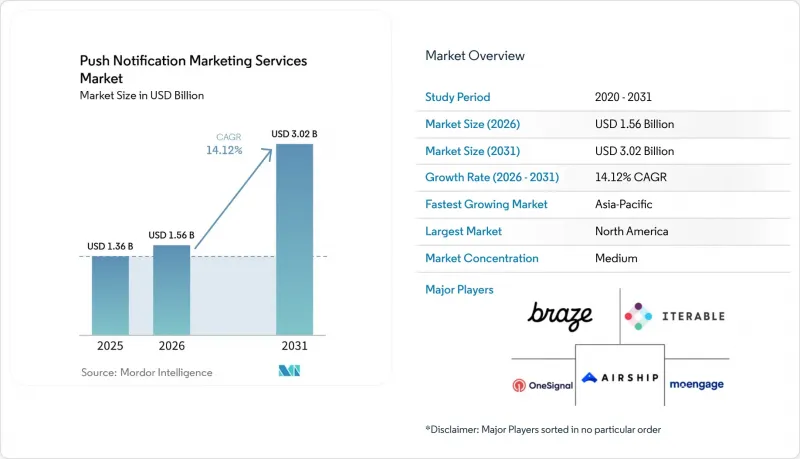
根據 Mordor Intelligence 預測,推播通知行銷服務的市場規模預計將從 2025 年的 13.6 億美元和 2026 年的 15.6 億美元成長到 2031 年的 30.2 億美元,2026 年至 2031 年的年複合成長率(CAGR)為 14.12%。
本報告按通知管道(網頁通知、應用程式通知)、服務類型(推播策略和宣傳活動設計等)、最終用戶行業(零售和電子商務、媒體和娛樂、醫療保健和生命科學、旅遊和酒店、消費品等)以及地區進行細分。市場預測以美元計價。
全球推播通知行銷服務市場趨勢及洞察
人工智慧驅動的個人化與旅程編配
人工智慧驅動的個人化正成為推播通知行銷服務市場的主要差異化因素。這是因為企業負責人現在評估平台時,不僅關注其發送功能,還關注其用戶旅程編配的品質。 MoEngage 對 2024 年 11 月至 2025 年 11 月期間發送的 400 億條訊息進行的一項基準研究顯示,行為觸發型宣傳活動的送達率高達 93.07%,而群發發送類型宣傳活動的送達率僅為 80.73%。學術研究也支持這一轉變;ACM 數位圖書館收錄的一項 2025 年研究報告稱,在電子商務領域,使用大規模語言模型 (LLM) 生成的推送通知文案的點擊率比使用模板的文案高出 12.5%,轉換率高出 8.3%。此外,Braze 於 2026 年 4 月發布了一項案例研究。據該公司稱,在 Cleo 部署 BrazeAI Operator 後,退訂率降低了 81%,推播通知互動率提高了 124%。這顯示人工智慧的應用已經開始對客戶維繫率產生影響。
瀏覽器推播通知在商業和出版業的普及。
在推播通知行銷服務市場中,基於瀏覽器的網頁推播正從一種小眾的發布工具轉變為更廣泛的客戶維繫管道。這一趨勢在希望直接觸達用戶而無需強制用戶下載應用程式的電商和媒體品牌中尤為明顯。 W3C 的「聲明式網頁推送」(Declarative Web Push)標準(蘋果將於 2026 年在 iOS 和 macOS 上原生支援)提升了蘋果設備上基於瀏覽器的通知的有效載荷處理能力和電池效率。這一點意義重大,因為 iOS 上的 Safari 瀏覽器長期以來限制了網頁推播通知的有效覆蓋範圍,將蘋果用戶排除在許多「瀏覽器優先」程式的主要目標受眾之外。同時,Shopify 引用的 Chrome 使用數據顯示,只有 17% 的用戶會在普通網站上授予通知權限。這表明,通知的推播時間和頁面上下文與平台選擇同樣重要。隨著蘋果擴大其覆蓋範圍,以及用戶許可設計日趨完善,對於那些希望在不投資原生應用程式的情況下擴大覆蓋範圍的品牌而言,網頁推送正成為更加可靠的管道。
隱私法規和同意管理的日益複雜化。
隱私法規使得跨國推廣推播通知行銷服務面臨許多挑戰。這是因為,使用者同意管理需要比設備級權限提示更加精細化。 Gibson Dunn LLP 於 2026 年 3 月發布的一份歐洲資料保護評估報告指出,根據 GDPR 第 6 條和第 7 條的規定,行銷推播通知需要獲得用戶單獨且針對特定目的的同意,而僅靠作業系統權限提示無法滿足這一標準。土耳其個人資料保護局在 2024 年也表達了類似的意願,要求行動應用程式中的商用推播通知和行銷推播通知必須採用不同的同意流程。對於供應商和企業買家而言,這意味著需要處理額外的同意記錄、策略邏輯以及涵蓋 GDPR、KVKK、LGPD 和 HIPAA 等醫療保健相關法規的特定司法管轄區工作流程。這些工作增加了法律和技術成本,對於進入推播通知行銷服務市場的中型企業而言,其負擔比擁有成熟合規團隊的大型企業更為沉重。
細分市場分析
到 2025 年,基於應用程式的通知將佔據推播通知行銷服務市場 77.63% 的佔有率,成為最大的管道。這是因為原生應用程式仍然是零售、金融服務和媒體產業與消費者接觸的主要管道。該管道利用了許多優勢,例如持久設備令牌、直接送達衡量、富媒體支援以及深度鏈接,可以將用戶引導至特定螢幕而非通用落地頁。根據 Airship 發布的 2026 年基準數據,基於向 15 個行業的 30 億多用戶發送的 6810 億條通知,Android 平台上的電子商務和零售應用程式的點擊率為 3.78%,而 iOS 平台為 3.05%。這一差異反映了 Android 平台歷來更勝一籌的許可式推播效果,在轉換漏斗因明確授權模式而收緊之前,基於應用程式的通訊在以轉換為中心的行銷活動中尤為有效。作為一種管道,基於 Web 的通知佔據了第二大的市場佔有率,並且隨著商業品牌利用它們直接觸達應用程式用戶以外的群體,其規模還在不斷擴大;與此同時,出版商和媒體集團在推送通知行銷服務市場中利用它們進行有時效性的提醒。
到2025年,網頁推播通知將佔剩餘的22.37%收入,隨著品牌尋求觸達應用程式安裝用戶以外的受眾,這一細分市場在推播通知行銷服務市場中的效用日益凸顯。對於那些需要留住回頭客,但無法在首次訪問時將所有用戶轉化為應用用戶的電商和出版企業而言,這項管道尤其重要。出版商的研究表明,實施推播通知可在三個月內將有效用戶提升高達60%,這凸顯了瀏覽器通訊在重複互動行銷活動中的重要作用。因此,推播通知行銷服務產業對能夠在與應用宣傳活動相同的環境中管理瀏覽器權限、受眾邏輯和內容分發順序的供應商的需求日益成長。未來,網頁推播將繼續在推播通知行銷服務市場中定位為一種補充管道,它能夠在不取代應用程式分發結構性優勢的前提下,拓展可觸及的受眾群體。
區域分析
2025年,北美持續維持領先地位,佔據推播通知行銷服務市場38.52%的佔有率。該地區受益於企業行銷技術的高滲透率和成熟的行動應用生態系統。此外,作為Braze、OneSignal和Airship的總部所在地,這些公司持續開發產品並進行B2B銷售活動,以緊密滿足推播通知行銷服務市場買家的需求。 Braze公佈截至2026年1月31日的會計年度營收為7.38億美元,反映出其持續加大對專注於該細分市場的企業平台的投入。加拿大電子商務和金融服務業的需求穩定,而墨西哥則隨著智慧型手機普及率的提高,應用用戶群不斷擴大,市場規模小規模,但正經歷著快速成長。
預計到2031年,亞太地區將以15.82%的複合年成長率成長,成為推播通知行銷服務市場成長最快的地區。這一成長主要得益於行動優先商務、不斷擴大的安卓用戶群體,以及印度、東南亞和韓國等地區對通訊主導日益成長的依賴。根據Infobip發布的《2026年通訊趨勢報告》,到2025年,印度將擁有5.5億RCS用戶,RCS互動將成長70%,行銷應用將成長2907%,這顯示更豐富的通訊格式正在迅速普及。在韓國和澳大利亞,遊戲、金融科技、媒體、零售和金融服務等行業的高消費應用場景得到了支持。同時,在日本,尋求更深入市場滲透的供應商需要更多在地化的產品設計和國內夥伴關係。
歐洲在推播通知行銷服務市場佔第二大佔有率,其中德國和英國是主要的企業基地。該地區的買家更加重視用戶許可獲取工具和管治支持,並且更傾向於能夠將宣傳活動功能與數據管理相結合的供應商。在法國、西班牙和義大利,隨著電子商務的普及,中端市場的需求也不斷成長。以巴西為首的南美洲,在金融科技、行動商務以及阿根廷和智利應用程式使用量的成長的推動下,正在不斷擴大其在推播通知行銷服務市場的佔有率。在中東,阿拉伯聯合大公國和沙烏地阿拉伯是主要市場,而非洲市場仍處於起步階段,但隨著金融科技和行動支付應用程式的普及,觸發式通訊的需求日益成長,其在奈及利亞、南非和埃及的重要性也日益凸顯。
其他好處:
- Excel格式的市場預測(ME)表
- 3個月的分析師支持
目錄
第1章:引言
- 研究假設和市場定義
- 調查範圍
第2章:調查方法
第3章執行摘要
第4章 市場狀況
- 市場概覽
- 市場促進因素
- 人工智慧驅動的客戶體驗個人化與最佳化
- 電子商務和出版業中基於瀏覽器的網路推播廣告的採用現狀
- 觸發式生命週期宣傳活動在挽回放棄購物車和客戶維繫的有效性。
- 企業支出正轉向透過自身管道與客戶參與。
- 在以安卓為主導的行動優先市場中,宣傳活動的成本效益正在提高。
- 利用 GenAI 進行低成本創新檢驗
- 市場限制因素
- 隱私法規的複雜性以及獲得同意的難度。
- 通知疲勞和選擇退出的壓力
- 與作業系統和瀏覽器權限相關的使用者體驗變化導致選擇加入轉換率下降。
- 整個行銷技術堆疊的即時資料整合存在延遲。
- 產業價值鏈分析
- 監理情勢
- 技術展望
- 宏觀經濟因素對市場的影響
- 波特五力分析
第5章 市場規模與成長預測
- 透過管道通知
- 網路為基礎的通知
- 基於應用程式的通知
- 按服務類型
- 推播策略和宣傳活動設計
- 執行和自動化推播通知
- 分析與效能最佳化
- 按最終用戶行業分類
- 零售與電子商務
- 媒體與娛樂
- 醫療保健和生命科學
- 旅遊與飯店
- 消費品
- 其他終端用戶產業
- 按地區
- 北美洲
- 美國
- 加拿大
- 墨西哥
- 南美洲
- 巴西
- 阿根廷
- 智利
- 其他南美國家
- 歐洲
- 德國
- 英國
- 法國
- 義大利
- 西班牙
- 其他歐洲國家
- 亞太地區
- 中國
- 日本
- 印度
- 韓國
- 澳洲
- 其他亞太國家
- 中東
- 阿拉伯聯合大公國
- 沙烏地阿拉伯
- 卡達
- 其他中東國家
- 非洲
- 南非
- 埃及
- 奈及利亞
- 其他非洲國家
- 北美洲
第6章 競爭情勢
- 市場集中度
- 策略趨勢
- 市佔率分析
- 公司簡介
- Braze, Inc.
- OneSignal, Inc.
- Airship Group, Inc.
- MoEngage Global Inc.
- Iterable, Inc.
- Pushwoosh Inc.
- Webklipper Technologies Private Limited
- Netcore Pvt. Ltd.
- Wingify Software Pvt. Ltd.
- SendPulse Inc.
- Push Engage LLC
- Datability Technologies Private Limited
- Sosyo Plus Bilgi Bilisim Tekn. Dan. Hiz. Tic. AS
- Brevo SAS
- Bloomreach, Inc.
- Salesforce, Inc.
- Oracle Corporation
- Adobe Inc.
- Amazon Web Services, Inc.
第7章 市場機會與未來展望
According to Mordor Intelligence, the push notification marketing services Market size is projected to expand from USD 1.36 billion in 2025 and USD 1.56 billion in 2026 to USD 3.02 billion by 2031, registering a CAGR of 14.12% between 2026 and 2031.
This report is Segmented by Notification Channel (Web-Based Notifications, and App-Based Notifications), Service Type (Push Strategy and Campaign Design, and More), End-User Industry (Retail and E-Commerce, Media and Entertainment, Healthcare and Life Sciences, Travel and Hospitality, Consumer Goods, and More), and Geography. The Market Forecasts are Provided in Terms of Value (USD).
Global Push Notification Marketing Services Market Trends and Insights
AI-Powered Personalization and Journey Orchestration
AI-powered personalization has become the main point of differentiation in the push notification marketing services market, as enterprise buyers now judge platforms on orchestration quality rather than raw send capacity. MoEngage's 2026 benchmark study across 40 billion messages sent between November 2024 and November 2025 found that behavior-triggered campaigns achieved a 93.07% delivery rate, compared with 80.73% for broadcast campaigns. Academic work also supports this shift, with a 2025 study indexed in the ACM Digital Library reporting 12.5% higher click-through rates and 8.3% higher conversion rates for LLM-generated push copies in e-commerce than templated alternatives. Braze added practical proof in April 2026, when it said that the BrazeAI Operator reduced unsubscribes by 81% and lifted push notification engagement by 124% for Cleo, showing that AI layers are already affecting retention outcomes.
Browser-Based Web Push Adoption Across Commerce and Publishing
Browser-based web push has moved from a niche publishing tool toward a broader retention channel in the push notification marketing services market, especially for commerce and media brands that want direct reach without forcing an app download. The W3C Declarative Web Push standard, which Apple began shipping natively across iOS and macOS in 2026, improved payload handling and battery efficiency for browser-delivered notifications on Apple devices. This matters because iOS Safari has long limited the effective reach of web push notifications, keeping Apple users outside the main addressable base for many browser-first programs. At the same time, Chrome usage data cited by Shopify showed that only 17% of users accept notification permission prompts on average websites, which means prompt timing and page context matter as much as platform choice. As Apple coverage improves and consent design becomes more deliberate, web push becomes a more credible owned channel for brands that want to expand reach without investing in a native app.
Privacy Regulation and Consent Enforcement Complexity
Privacy rules are making it harder to scale push notification marketing services across borders because consent now has to be managed at a more granular level than device-level permission prompts. Gibson Dunn's March 2026 Europe data protection review noted that marketing push notifications require separately obtained, purpose-specific consent under GDPR Articles 6 and 7, and that operating system permission prompts alone do not meet that standard. Turkey's Personal Data Protection Authority also signaled the same direction in 2024 by requiring separate consent paths for operational and marketing push notifications in mobile applications. For vendors and enterprise buyers, this creates extra work around consent records, policy logic, and jurisdiction-specific workflows across GDPR, KVKK, LGPD, and healthcare requirements such as HIPAA. These tasks add legal and technology costs, and they weigh more heavily on mid-market entrants than on large incumbents with established compliance teams in the push notification marketing services market.
Other drivers and restraints analyzed in the detailed report include:
- Triggered Lifecycle Campaign Performance in Cart Recovery and Retention
- Enterprise Spend Shift Toward Owned-Channel Customer Engagement
- Notification Fatigue and Opt-Out Pressure
For complete list of drivers and restraints, kindly check the Table Of Contents.
Segment Analysis
App-based notifications held 77.63% of the push notification marketing services market share in 2025, giving them the largest channel position because native apps remain the main consumer touchpoint in retail, financial services, and media. The channel benefits from persistent device tokens, direct delivery measurement, rich media support, and deep links that route users to specific screens instead of general landing pages. Airship's 2026 benchmarks, based on 681 billion notifications sent to more than 3 billion users across 15 verticals, showed that e-commerce and retail apps on Android posted a 3.78% click-through rate, compared with 3.05% on iOS. That gap reflects Android's historically stronger opt-in performance, which made app-based messaging especially effective for conversion-led programs before explicit permission models tightened the funnel. Web-based notifications held the second-largest channel position and continued to expand as commerce brands used them to add direct reach beyond app users, while publishers and media groups used them for time-sensitive alerts in the push notification marketing services market.
Web-based notifications accounted for the remaining 22.37% of revenue in 2025, and this segment of the push notification marketing services market is becoming increasingly useful as brands seek reach beyond app-installed audiences. The channel is particularly relevant for commerce and publishing businesses that attract repeat visitors but do not convert all of them into app users on the first visit. Publisher research showed that adopting push notifications can raise active users by up to 60% over 3 months, which supports the role of browser messaging in repeat engagement programs. The push notification marketing services industry is therefore seeing more need for vendors that can manage browser permissions, audience logic, and content sequencing in the same environment used for app campaigns. Over time, the push notification marketing services market should continue to treat web push as a complementary channel that expands reachable audiences without replacing the structural lead of app-based delivery.
Complete Report Scope:
- By Notification Channel
- Web-Based Notifications
- App-Based Notifications
- By Service Type
- Push Strategy and Campaign Design
- Push Notification Execution and Automation
- Analytics and Performance Optimization
- By End-user Industry
- Retail and E-commerce
- Media and Entertainment
- Healthcare and Life Sciences
- Travel and Hospitality
- Consumer Goods
- Other End-User Industries
- By Geography
- North America
- United States
- Canada
- Mexico
- South America
- Brazil
- Argentina
- Chile
- Rest of South America
- Europe
- Germany
- United Kingdom
- France
- Italy
- Spain
- Rest of Europe
- Asia-Pacific
- China
- Japan
- India
- South Korea
- Australia
- Rest of Asia-Pacific
- Middle East
- United Arab Emirates
- Saudi Arabia
- Qatar
- Rest of Middle East
- Africa
- South Africa
- Egypt
- Nigeria
- Rest of Africa
- North America
Geography Analysis
North America held 38.52% of the push notification marketing services market share in 2025, maintaining its lead. The region benefits from dense enterprise martech adoption and a mature mobile app ecosystem. It also remains the home base for Braze, OneSignal, and Airship, which keep product development and enterprise selling activity closely tied to buyer needs in the push notification marketing services market. Braze reported USD 738 million in revenue for the fiscal year ended January 31, 2026, reflecting continued enterprise platform spending concentrated in this market segment. Canada adds steady demand from e-commerce and financial services, while Mexico is expanding from a smaller base as smartphone use broadens the reachable app audience.
Asia-Pacific is projected to grow at a 15.82% CAGR through 2031, making it the fastest-expanding region in the push notification marketing services market. The region's growth stems from mobile-first commerce, larger Android user bases, and greater reliance on messaging-led engagement in India, Southeast Asia, and South Korea. Infobip's 2026 messaging trends report said India had 550 million RCS users in 2025, along with 70% growth in RCS interactions and a 2,907% increase in marketing use, which shows how quickly richer messaging formats are scaling. South Korea and Australia support higher-spend use cases in gaming, fintech, media, retail, and financial services, while Japan requires more localized product design and domestic partnerships for vendors that want deeper access.
Europe held the second-largest share of the push notification marketing services market, with Germany and the United Kingdom as the main enterprise hubs. Buyers in this region place greater weight on consent tooling and governance support, favoring vendors that can combine campaign functions with data control. France, Spain, and Italy are adding mid-market demand as e-commerce usage widens. South America is becoming a larger part of the push notification marketing services market, led by Brazil and supported by fintech, mobile commerce, and expanding app usage in Argentina and Chile. The Middle East shows concentrated activity in the UAE and Saudi Arabia, while Africa remains earlier stage but is gaining relevance in Nigeria, South Africa, and Egypt as fintech and mobile money apps create more trigger-based communication needs.
- Braze, Inc.
- OneSignal, Inc.
- Airship Group, Inc.
- MoEngage Global Inc.
- Iterable, Inc.
- Pushwoosh Inc.
- Webklipper Technologies Private Limited
- Netcore Pvt. Ltd.
- Wingify Software Pvt. Ltd.
- SendPulse Inc.
- Push Engage LLC
- Datability Technologies Private Limited
- Sosyo Plus Bilgi Bilisim Tekn. Dan. Hiz. Tic. A.S.
- Brevo SAS
- Bloomreach, Inc.
- Salesforce, Inc.
- Oracle Corporation
- Adobe Inc.
- Amazon Web Services, Inc.
Additional Benefits:
- The market estimate (ME) sheet in Excel format
- 3 months of analyst support
TABLE OF CONTENTS
1 INTRODUCTION
- 1.1 Study Assumptions and Market Definition
- 1.2 Scope of the Study
2 RESEARCH METHODOLOGY
3 EXECUTIVE SUMMARY
4 MARKET LANDSCAPE
- 4.1 Market Overview
- 4.2 Market Drivers
- 4.2.1 AI-Powered Personalization and Journey Orchestration
- 4.2.2 Browser-Based Web Push Adoption Across Commerce and Publishing
- 4.2.3 Triggered Lifecycle Campaign Performance in Cart Recovery and Retention
- 4.2.4 Enterprise Spend Shift Toward Owned-Channel Customer Engagement
- 4.2.5 Android-Weighted Mobile-First Markets Improving Campaign Economics
- 4.2.6 GenAI-Led Creative Testing at Lower Operating Cost
- 4.3 Market Restraints
- 4.3.1 Privacy Regulation and Consent Enforcement Complexity
- 4.3.2 Notification Fatigue and Opt-Out Pressure
- 4.3.3 OS and Browser Permission UX Changes Reducing Opt-In Conversion
- 4.3.4 Real-Time Data Integration Latency Across Martech Stacks
- 4.4 Industry Value Chain Analysis
- 4.5 Regulatory Landscape
- 4.6 Technological Outlook
- 4.7 Impact of Macroeconomic Factors on the Market
- 4.8 Porter's Five Forces Analysis
- 4.8.1 Threat of New Entrants
- 4.8.2 Bargaining Power of Buyers
- 4.8.3 Bargaining Power of Suppliers
- 4.8.4 Threat of Substitutes
- 4.8.5 Industry Rivalry
5 MARKET SIZE AND GROWTH FORECASTS (VALUE)
- 5.1 By Notification Channel
- 5.1.1 Web-Based Notifications
- 5.1.2 App-Based Notifications
- 5.2 By Service Type
- 5.2.1 Push Strategy and Campaign Design
- 5.2.2 Push Notification Execution and Automation
- 5.2.3 Analytics and Performance Optimization
- 5.3 By End-user Industry
- 5.3.1 Retail and E-commerce
- 5.3.2 Media and Entertainment
- 5.3.3 Healthcare and Life Sciences
- 5.3.4 Travel and Hospitality
- 5.3.5 Consumer Goods
- 5.3.6 Other End-User Industries
- 5.4 By Geography
- 5.4.1 North America
- 5.4.1.1 United States
- 5.4.1.2 Canada
- 5.4.1.3 Mexico
- 5.4.2 South America
- 5.4.2.1 Brazil
- 5.4.2.2 Argentina
- 5.4.2.3 Chile
- 5.4.2.4 Rest of South America
- 5.4.3 Europe
- 5.4.3.1 Germany
- 5.4.3.2 United Kingdom
- 5.4.3.3 France
- 5.4.3.4 Italy
- 5.4.3.5 Spain
- 5.4.3.6 Rest of Europe
- 5.4.4 Asia-Pacific
- 5.4.4.1 China
- 5.4.4.2 Japan
- 5.4.4.3 India
- 5.4.4.4 South Korea
- 5.4.4.5 Australia
- 5.4.4.6 Rest of Asia-Pacific
- 5.4.5 Middle East
- 5.4.5.1 United Arab Emirates
- 5.4.5.2 Saudi Arabia
- 5.4.5.3 Qatar
- 5.4.5.4 Rest of Middle East
- 5.4.6 Africa
- 5.4.6.1 South Africa
- 5.4.6.2 Egypt
- 5.4.6.3 Nigeria
- 5.4.6.4 Rest of Africa
- 5.4.1 North America
6 COMPETITIVE LANDSCAPE
- 6.1 Market Concentration
- 6.2 Strategic Moves
- 6.3 Market Share Analysis
- 6.4 Company Profiles (includes Global Level Overview, Market Level Overview, Core Segments, Financials as available, Strategic Information, Market Rank/Share, Products and Services, Recent Developments)
- 6.4.1 Braze, Inc.
- 6.4.2 OneSignal, Inc.
- 6.4.3 Airship Group, Inc.
- 6.4.4 MoEngage Global Inc.
- 6.4.5 Iterable, Inc.
- 6.4.6 Pushwoosh Inc.
- 6.4.7 Webklipper Technologies Private Limited
- 6.4.8 Netcore Pvt. Ltd.
- 6.4.9 Wingify Software Pvt. Ltd.
- 6.4.10 SendPulse Inc.
- 6.4.11 Push Engage LLC
- 6.4.12 Datability Technologies Private Limited
- 6.4.13 Sosyo Plus Bilgi Bilisim Tekn. Dan. Hiz. Tic. A.S.
- 6.4.14 Brevo SAS
- 6.4.15 Bloomreach, Inc.
- 6.4.16 Salesforce, Inc.
- 6.4.17 Oracle Corporation
- 6.4.18 Adobe Inc.
- 6.4.19 Amazon Web Services, Inc.
7 MARKET OPPORTUNITIES AND FUTURE OUTLOOK
- 7.1 White-Space and Unmet-Need Assessment

 行動推播通知技術市場規模、佔有率和成長分析:按組件、部署模式、應用、最終用戶和地區分類-2026-2033年產業預測
 推播通知軟體:市場佔有率分析、產業趨勢與統計、成長預測(2026-2031)
 2026年全球推播通知軟體市場報告