


 |
市場調查報告書
商品編碼
2117557
推播通知軟體:市場佔有率分析、產業趨勢與統計、成長預測(2026-2031)Push Notification Software - Market Share Analysis, Industry Trends & Statistics, Growth Forecasts (2026 - 2031) |
||||||

※ 本網頁內容可能與最新版本有所差異。詳細情況請與我們聯繫。
根據 Mordor Intelligence 預測,推播通知軟體市場規模將從 2025 年的 15.8 億美元和 2026 年的 18.3 億美元成長到 2031 年的 37.8 億美元,2026 年至 2031 年的年複合成長率(CAGR)為 15.61%。
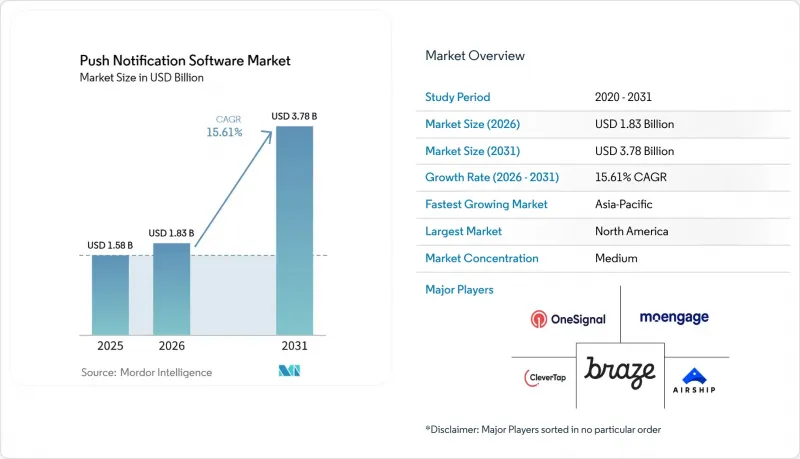
本報告按部署類型(雲端部署和本地部署)、企業規模(大型企業和中小企業)、通知管道(行動推播通知、網頁推播通知等)、最終用戶產業(零售和電子商務、銀行、金融服務和保險等)以及地區進行細分。市場預測以美元計價。
全球推播通知軟體市場趨勢及洞察
行動端和網路端對即時客戶參與的需求日益成長。
推播通知軟體市場正受益於行動應用程式和網站上對即時、相關客戶溝通日益成長的需求。品牌擴大使用事件觸發訊息來提醒用戶購物車遺棄、庫存狀態、價格變動、帳戶活動以及其他時效性操作。利用這些觸發機制的零售商報告稱,其訂單恢復率高於僅依賴定時宣傳活動活動的零售商。雖然印度和東南亞仍然擁有龐大的「行動優先」用戶群,他們能夠利用即時互動工具,但用戶數量本身並不能保證有效的溝通。由於透過付費管道重新獲取客戶的成本可能很高,企業越來越重視留住現有用戶。推播通知軟體市場的成熟用戶正在將通知推播整合到更廣泛的客戶維繫計畫中,使得與客戶資料和工作流程系統整合的平台一旦部署就難以取代。
第一方數據和基於許可的通訊的成長
隨著第三方追蹤方式的衰落,推播通知訂閱已成為獲得第一方客戶資訊的重要資訊來源。推送令牌提供了一種選擇加入的、與裝置綁定的通訊管道,即使在瀏覽器重新載入或應用程式更新後仍然可用。此功能使品牌能夠直接與已知用戶互動,而無需完全依賴分散的廣告受眾。 2026年7月,OneSignal發布了OneSignal AI和模型上下文協議伺服器的公開測試版,使其AI助理能夠利用行為數據來建立受眾群體並管理宣傳活動。歐洲資料保護委員會指出,在涉及個人資料處理時,根據適用的隱私框架,同意必須是自願的、具體的、知情的和明確的。因此,具備同意管理、用戶追蹤和選擇退出控制功能的供應商可以在企業採購決策中獲得優勢。
通知疲勞和使用者選擇退出的壓力
在推播通知軟體市場,通知疲勞仍然是阻礙因素。訊息不當或重複訊息會導致用戶停用通知。裝置層面的停用操作難以撤銷,通常需要品牌安裝新的應用程式或更新使用者權限。如果零售商、媒體公司和其他群發者沒有根據客戶行為和偏好最佳化訊息,他們將面臨更大的風險。 Batch 的 2025 年基準研究分析了來自 12 億用戶的 8,000 億則訊息,揭示了不同平台和產業類別之間權限模式的差異。如果企業不投資於管理相關性和推送頻率,用戶成長並不一定能轉化為長期的平台收入。透過利用預測性推送抑制工具,服務提供者可以識別高風險用戶,並在關係破裂之前降低聯繫頻率。
細分市場分析
到2025年,基於雲端的部署將佔據推播通知軟體市場72.63%的佔有率。這一細分市場受益於自動化軟體更新、靈活的容量以及降低初始部署成本的定價模式。雲端交付還支援基於Web的應用程式介面(API),這對於瀏覽器通知和更廣泛的數位互動專案至關重要。中小型企業往往更傾向於雲端工具,因為他們可以從有限的技術支援起步,並隨著用戶群的成長擴展使用規模。 Braze在2026年4月發布的版本中新增了多語言翻譯支援和基於工作區的訊息發送速率限制,展示了雲端平台如何為客戶帳戶提供新的功能。 SOC 2 Type II和ISO 27001等安全認證已成為雲端供應商的關鍵企業級要求,提高了小規模供應商的准入門檻。
預計到 2031 年,本地部署的複合年成長率將達到 15.96%,成為成長最快的部署方式。金融機構、政府承包商和醫療機構通常需要對資料儲存和處理的位置及方式進行更嚴格的控制。醫療保健和生命科學領域 18.37% 的複合年成長率部分與美國 HIPAA 法規要求下對私有雲端和本地環境的需求有關。 2026 年 4 月,Braze 在 Google Cloud 上為其 BrazeAI Decisioning Studio 新增了歐洲託管服務,以滿足其歐洲客戶的資料居住要求。此舉表明,將雲端交付與更強大的客戶管理能力相結合的託管私有環境的作用日益增強。能夠提供靈活部署且不影響核心功能的供應商可以同時服務雲端優先企業和受監管的組織。
到2025年,大型企業將佔推播通知軟體市場64.38%的佔有率。這些企業通常跨多個業務部門運營,並將通知工具與客戶關係管理(CRM)系統、客戶資料平台、分析產品和資料倉儲整合。此類整合可能會帶來營運轉換成本,因為更換供應商可能會擾亂既定的客戶旅程和報告流程。大型採購商還需要使用者授權管理、稽核記錄、基於角色的存取控制、專用基礎架構和服務等級協定(SLA)。醫療保健系統、零售連鎖店以及銀行、金融服務和保險機構尤其重視交付可靠性和資料安全處理。如果供應商不具備與Salesforce、Oracle、SAP等系統以及主流客戶資料平台進行認證整合的能力,則可能難以滿足企業採購需求。
預計到2031年,中小企業(SME)市場將以16.78%的複合年成長率成長。自助式註冊、免費增值計劃和按使用收費系統降低了中小企業實施的成本和複雜性。 OneSignal表示,其平台在全球擁有超過一百萬家用戶,支援推播通知、電子郵件、簡訊、RCS、應用程式內通訊和即時活動等多種通訊方式。該公司於2026年7月發布的AI功能旨在幫助小規模團隊創建用戶細分、撰寫宣傳活動內容、建立用戶旅程並安排溝通,最大限度地減少人工操作。 Pushwoosh、PushEngage和WebEngage等供應商採用按使用量收費系統,使小規模客戶能夠根據用戶群的成長調整支出。 AI驅動的自動化可以進一步彌合大型企業互動計畫與小規模團隊可用資源之間的差距。
區域分析
到2025年,北美將佔據全球推播通知軟體市場36.61%的佔有率。在該地區,零售、銀行、金融服務、保險、媒體和數位商務公司對軟體即服務(SaaS)的採用已趨於成熟。企業部署通常涉及與Salesforce、HubSpot和客戶資料平台(CDP)的緊密整合,通知系統已成為現有客戶參與營運不可或缺的一部分。這種整合增加了轉換成本,但也有助於與供應商維持長期合作關係。歐洲是第二大區域市場,德國、英國和法國是企業客戶的主要聚集地。歐洲客戶更重視同意管理、資料居住和審計基礎設施,因為隱私合規性會影響平台選擇。因此,歐洲的資料保護框架使得管治能力成為服務該地區的供應商的關鍵競爭優勢。
預計到2031年,亞太地區的複合年成長率將達到19.24%。印度、中國和東南亞的「行動優先」商務模式正在推動金融科技、快消、教育科技和數位醫療等領域的需求成長。 MoEngage、WebEngage和Netcore Cloud等區域供應商正利用其在印度客戶參與專案的經驗,拓展海外市場。 Aurora Mobile於2026年7月為寶寶金融部署的JPush系統,凸顯了中國金融通訊領域對高可用性交付系統的迫切需求。在日本和韓國,智慧型手機的高普及率也帶動了遊戲、零售、媒體和消費應用公司等企業的需求。
南美洲是推播通知軟體的新興市場,巴西和墨西哥金融科技及電子商務的蓬勃發展推動了該軟體的普及。行動優先的網路使用使得直接客戶參與對於尋求具成本效益客戶維繫方案的企業而言尤為重要。巴西大規模的數位商務環境正在推動對生命週期自動化和行為模式的通訊技術的投資。儘管中東和非洲仍處於應用初期,但沙烏地阿拉伯和阿拉伯聯合大公國金融服務的數位化正在創造銀行、金融科技供應商和電子商務公司的需求。奈及利亞和南非正成為非洲的關鍵市場,這得益於行動基礎設施的改善和數位商務活動的活性化。隨著這些地區數位基礎設施的發展,能夠與當地語言和區域支付系統整合的供應商可能擁有顯著優勢。
其他好處:
- Excel格式的市場預測(ME)表
- 3個月的分析師支持
目錄
第1章:引言
- 研究假設和市場定義
- 調查範圍
第2章:調查方法
第3章執行摘要
第4章 市場狀況
- 市場概覽
- 市場促進因素
- 對基於行動端和網路端的即時客戶參與。
- 擴展第一方資料和基於許可的通訊
- 擴展SaaS和電商工作流程中的生命週期自動化
- 全通路客戶維繫策略取代單通路宣傳活動
- 利用人工智慧技術控制訊息發送時間和訊息個人化。
- 在中型企業和自助式中小企業領域擴大採用率
- 市場限制因素
- 通知疲勞和使用者選擇退出的壓力
- 更嚴格的同意、隱私和設備級權限管理。
- 跨應用程式、Web 和 CRM 堆疊的跨平台整合非常複雜。
- 核心推送功能的商品化和低轉換成本
- 產業價值鏈分析
- 宏觀經濟因素對市場的影響
- 監理情勢
- 技術展望
- 價格分析
- 波特五力分析
第5章 市場規模與成長預測
- 按部署模式
- 基於雲端的
- 現場
- 按公司規模
- 大公司
- 小型企業
- 透過管道通知
- 行動推播通知
- 網路推播通知
- 桌面推播通知
- 按最終用戶行業分類
- 零售與電子商務
- 銀行、金融服務和保險(BFSI)
- IT/通訊
- 媒體與娛樂
- 旅遊與飯店
- 醫療保健和生命科學
- 教育
- 其他終端用戶產業
- 按地區
- 北美洲
- 美國
- 加拿大
- 墨西哥
- 南美洲
- 巴西
- 阿根廷
- 其他南美國家
- 歐洲
- 德國
- 英國
- 法國
- 義大利
- 西班牙
- 俄羅斯
- 其他歐洲國家
- 亞太地區
- 中國
- 日本
- 印度
- 韓國
- 澳洲
- 其他亞太國家
- 中東和非洲
- 中東
- 土耳其
- 沙烏地阿拉伯
- 阿拉伯聯合大公國
- 其他中東國家
- 非洲
- 南非
- 奈及利亞
- 其他非洲國家
- 中東
- 北美洲
第6章 競爭情勢
- 市場集中度
- 策略趨勢
- 市佔率分析
- 公司簡介
- OneSignal, Inc.
- Airship Group, Inc.
- Braze, Inc.
- CleverTap
- MoEngage, Inc.
- Iterable, Inc.
- Salesforce, Inc.
- Adobe Inc.
- Oracle Corporation
- Attentive Mobile, Inc.
- PushEngage
- Firebase, LLC
- WebEngage
- Customer.io, Inc.
- Insider.
- HubSpot, Inc.
- Netcore Cloud Pvt. Ltd.
- VWO Engage
- Pushwoosh Inc.
- Sendinblue SAS
- Catapush
第7章 市場機會與未來展望
According to Mordor Intelligence, the push notification software market size is projected to expand from USD 1.58 billion in 2025 and USD 1.83 billion in 2026 to USD 3.78 billion by 2031, registering a CAGR of 15.61% between 2026 to 2031.
This report is Segmented by Deployment Mode (Cloud-Based, and On-Premises), Enterprise Size (Large Enterprises, and Small and Medium Enterprises), Notification Channel (Mobile Push Notifications, Web Push Notifications, and More), End-User Industry (Retail and E-Commerce, Banking, Financial Services, and Insurance, and More), and Geography. The Market Forecasts are Provided in Terms of Value (USD).
Global Push Notification Software Market Trends and Insights
Rising Need For Real-Time Mobile and Web Customer Engagement
The push notification software market benefits from the growing need for immediate and relevant customer communication across mobile applications and websites. Brands increasingly use event-triggered messages for abandoned carts, inventory availability, price changes, account activity, and other time-sensitive actions. Retailers that use these triggers have reported stronger order recovery than businesses that depend only on scheduled campaign broadcasts. India and Southeast Asian countries continue to offer a wide mobile-first audience for real-time engagement tools, although subscriber scale alone does not guarantee effective communication. Businesses are focusing more closely on retaining existing users because customer reacquisition through paid channels can be expensive. Mature users of the push notification software market have embedded notification delivery into broader retention programs, which makes these platforms more difficult to replace once they are linked to customer data and workflow systems.
Growth of First-Party Data and Permission-Based Messaging
The reduction in third-party tracking options has made push subscriptions a more important source of first-party customer information. A push token can provide an opted-in, device-linked communication route that remains available when browsers refresh or applications update. This capability gives brands a direct way to engage known users without relying entirely on fragmented advertising audiences. OneSignal released OneSignal AI and its Model Context Protocol Server in open beta during July 2026, allowing AI assistants to use behavioral data for audience creation and campaign work. The European Data Protection Board stated that consent under the applicable privacy framework must be freely given, specific, informed, and unambiguous when personal data processing is involved. Providers with consent management, subscriber records, and opt-out controls can therefore have an advantage in enterprise purchasing decisions.
Notification Fatigue and User Opt-Out Pressure
Notification fatigue remains a constraint on the push notification software market because poorly timed or repetitive messages can lead users to disable communications. Device-level opt-outs can be difficult to reverse because brands often need a new application install or renewed permission from the user. Retail, media, and other high-volume senders face greater risk when messages are not tailored to customer behavior and preferences. Batch's 2025 benchmark reviewed 800 billion messages across 1.2 billion visitors and found different permission outcomes across platforms and industry categories. A growing subscriber list does not necessarily translate into long-term platform revenue if businesses do not invest in relevance and frequency management. Predictive suppression tools can help providers identify users with elevated opt-out risk and reduce contact volume before the relationship is lost.
Other drivers and restraints analyzed in the detailed report include:
- Expansion of Lifecycle Automation in SaaS and Commerce Workflows
- Omnichannel Retention Strategies Replacing Single-Channel Campaigns
- Tightening Consent, Privacy, and Device-Level Permission Controls
For complete list of drivers and restraints, kindly check the Table Of Contents.
Segment Analysis
Cloud-based deployment held 72.63% of the push notification software market share in 2025. The segment benefits from automatic software updates, flexible capacity, and pricing models that reduce up-front implementation costs. Cloud delivery also supports the web-based application programming interfaces that are necessary for browser notifications and broader digital engagement programs. Small and mid-sized buyers often favor cloud tools because they can begin with limited technical support and expand usage as their subscriber base grows. Braze added multilingual translation support and workspace-level messaging rate limits in its April 2026 release, showing how cloud platforms can deliver new capabilities across customer accounts. Security certifications such as SOC 2 Type II and ISO 27001 have become important enterprise requirements for cloud providers, raising the entry barrier for smaller vendors.
On-premises deployment is expected to record a 15.96% CAGR through 2031, making it the fastest-growing deployment approach. Financial institutions, government contractors, and healthcare organizations often require stronger control over data location and processing environments. The healthcare and life sciences segment's 18.37% CAGR is linked in part to demand for private cloud or on-premises environments that support HIPAA requirements in the United States. Braze added European hosting on Google Cloud for BrazeAI Decisioning Studio during April 2026 to address data-residency requirements among European clients. This development illustrates the growing role of hosted private environments that combine cloud delivery with stronger customer controls. Providers that offer flexible deployment without reducing core functionality can serve both cloud-first companies and regulated organizations.
Large enterprises accounted for 64.38% of the push notification software market share in 2025. These organizations often operate across several business units and connect notification tools with CRM systems, customer data platforms, analytics products, and data warehouses. Such integrations can create operational switching costs because replacing a provider may disrupt established customer journeys and reporting processes. Large buyers also require consent management, audit records, role-based access controls, dedicated infrastructure, and service-level agreements. Healthcare systems, retail chains, and banking, financial services, and insurance institutions place particular importance on delivery reliability and secure handling of data. Providers without certified integrations for systems such as Salesforce, Oracle, SAP, and major customer data platforms may struggle to meet enterprise procurement needs.
The SME segment is projected to grow at a 16.78% CAGR through 2031. Self-service onboarding, freemium plans, and consumption-based pricing have lowered the cost and complexity of adoption for smaller businesses. OneSignal stated that its platform had been adopted by more than 1 million businesses globally and supported messaging across push, email, SMS, RCS, in-app messaging, and Live Activities. The company's July 2026 AI release was designed to help lean teams create segments, write campaign content, build journeys, and schedule communications with less manual work. Providers such as Pushwoosh, PushEngage, and WebEngage use usage-based pricing that allows smaller customers to align spending with subscriber growth. AI-supported automation can further narrow the gap between large-company engagement programs and the resources available to smaller teams.
Complete Report Scope:
- By Deployment Model
- Cloud-Based
- On-Premises
- By Enterprise Size
- Large Enterprises
- Small and Medium Enterprises
- By Notification Channel
- Mobile Push Notifications
- Web Push Notifications
- Desktop Push Notifications
- By End User Industry
- Retail and E-Commerce
- Banking, Financial Services, and insurance (BFSI)
- IT and Telecommunication
- Media and Entertainment
- Travel and Hospitality
- Healthcare and Life Sciences
- Education
- Other End User Industries
- By Geography
- North America
- United States
- Canada
- Mexico
- South America
- Brazil
- Argentina
- Rest of South America
- Europe
- Germany
- United Kingdom
- France
- Italy
- Spain
- Russia
- Rest of Europe
- Asia-Pacific
- China
- Japan
- india
- South Korea
- Australia
- Rest of Asia-Pacific
- Middle East and Africa
- Middle East
- Turkey
- Saudi Arabia
- United Arab Emirates
- Rest of Middle East
- Africa
- South Africa
- Nigeria
- Rest of Africa
- Middle East
- North America
Geography Analysis
North America held 36.61% of the global push notification software market share in 2025. The region has mature software-as-a-service adoption among retail, banking, financial services, insurance, media, and digital commerce companies. Enterprise deployments often connect deeply with Salesforce, HubSpot, and customer data platforms, making notification systems part of established customer engagement operations. These integrations can increase switching costs and support longer vendor relationships. Europe represented the second-largest regional market, with Germany, the United Kingdom, and France serving as significant enterprise buyer locations. European customers place greater emphasis on consent management, data residency, and audit infrastructure because privacy compliance affects platform selection. The European data protection framework has therefore made governance features an important competitive differentiator for providers serving the region.
Asia-Pacific is expected to grow at a 19.24% CAGR through 2031. Mobile-first commerce in India, China, and Southeast Asia supports demand from fintech, quick commerce, education technology, and digital health applications. Regional providers such as MoEngage, WebEngage, and Netcore Cloud have used their experience in Indian customer engagement programs to expand outside their domestic markets. Aurora Mobile's JPush deployment with Pobo Financial in July 2026 demonstrated the need for high-availability delivery systems for financial communications in China. Japan and South Korea contribute enterprise demand from gaming, retail, media, and consumer application companies with high smartphone penetration.
South America is an emerging area for the push notification software market, with Brazil and Mexico supporting adoption through fintech and e-commerce growth. Mobile-first internet use makes direct customer engagement especially relevant for businesses seeking cost-effective retention programs. Brazil's large digital commerce environment is encouraging investment in lifecycle automation and behavior-based communications. The Middle East and Africa remains at an earlier stage of adoption, although financial services digitization in Saudi Arabia and the United Arab Emirates is creating demand among banks, fintech providers, and e-commerce businesses. Nigeria and South Africa are important African markets because improving mobile infrastructure and digital commerce activity are expanding the addressable user base. Providers that support local languages and regional payment integrations may be better positioned as digital infrastructure develops across these regions.
- OneSignal, Inc.
- Airship Group, Inc.
- Braze, Inc.
- CleverTap
- MoEngage, Inc.
- Iterable, Inc.
- Salesforce, Inc.
- Adobe Inc.
- Oracle Corporation
- Attentive Mobile, Inc.
- PushEngage
- Firebase, LLC
- WebEngage
- Customer.io, Inc.
- Insider.
- HubSpot, Inc.
- Netcore Cloud Pvt. Ltd.
- VWO Engage
- Pushwoosh Inc.
- Sendinblue SAS
- Catapush
Additional Benefits:
- The market estimate (ME) sheet in Excel format
- 3 months of analyst support
TABLE OF CONTENTS
1 INTRODUCTION
- 1.1 Study Assumptions and Market Definition
- 1.2 Scope of the Study
2 RESEARCH METHODOLOGY
3 EXECUTIVE SUMMARY
4 MARKET LANDSCAPE
- 4.1 Market Overview
- 4.2 Market Drivers
- 4.2.1 Rising Need for Real-Time Mobile and Web Customer Engagement
- 4.2.2 Growth of First-Party Data and Permission-Based Messaging
- 4.2.3 Expansion of Lifecycle Automation in SaaS and Commerce Workflows
- 4.2.4 Omnichannel Retention Strategies Replacing Single-Channel Campaigns
- 4.2.5 AI-Assisted Send-Time and Message Personalization
- 4.2.6 Rising Adoption in Mid-Market and Self-Service SMB Segments
- 4.3 Market Restraints
- 4.3.1 Notification Fatigue and User Opt-Out Pressure
- 4.3.2 Tightening Consent, Privacy, and Device-Level Permission Controls
- 4.3.3 Cross-Platform Integration Complexity Across Apps, Web, and CRM Stacks
- 4.3.4 Commoditization and Low Switching Costs in Core Push Functionality
- 4.4 Industry Value-Chain Analysis
- 4.5 Impact of Macroeconomic Factors on the Market
- 4.6 Regulatory Landscape
- 4.7 Technological Outlook
- 4.8 Pricing Analysis
- 4.9 Porter's Five Forces Analysis
- 4.9.1 Bargaining Power of Buyers
- 4.9.2 Bargaining Power of Suppliers
- 4.9.3 Threat of New Entrants
- 4.9.4 Threat of Substitutes
- 4.9.5 Intensity of Competitive Rivalry
5 MARKET SIZE AND GROWTH FORECASTS (VALUE)
- 5.1 By Deployment Model
- 5.1.1 Cloud-Based
- 5.1.2 On-Premises
- 5.2 By Enterprise Size
- 5.2.1 Large Enterprises
- 5.2.2 Small and Medium Enterprises
- 5.3 By Notification Channel
- 5.3.1 Mobile Push Notifications
- 5.3.2 Web Push Notifications
- 5.3.3 Desktop Push Notifications
- 5.4 By End User Industry
- 5.4.1 Retail and E-Commerce
- 5.4.2 Banking, Financial Services, and insurance (BFSI)
- 5.4.3 IT and Telecommunication
- 5.4.4 Media and Entertainment
- 5.4.5 Travel and Hospitality
- 5.4.6 Healthcare and Life Sciences
- 5.4.7 Education
- 5.4.8 Other End User Industries
- 5.5 By Geography
- 5.5.1 North America
- 5.5.1.1 United States
- 5.5.1.2 Canada
- 5.5.1.3 Mexico
- 5.5.2 South America
- 5.5.2.1 Brazil
- 5.5.2.2 Argentina
- 5.5.2.3 Rest of South America
- 5.5.3 Europe
- 5.5.3.1 Germany
- 5.5.3.2 United Kingdom
- 5.5.3.3 France
- 5.5.3.4 Italy
- 5.5.3.5 Spain
- 5.5.3.6 Russia
- 5.5.3.7 Rest of Europe
- 5.5.4 Asia-Pacific
- 5.5.4.1 China
- 5.5.4.2 Japan
- 5.5.4.3 india
- 5.5.4.4 South Korea
- 5.5.4.5 Australia
- 5.5.4.6 Rest of Asia-Pacific
- 5.5.5 Middle East and Africa
- 5.5.5.1 Middle East
- 5.5.5.1.1 Turkey
- 5.5.5.1.2 Saudi Arabia
- 5.5.5.1.3 United Arab Emirates
- 5.5.5.1.4 Rest of Middle East
- 5.5.5.2 Africa
- 5.5.5.2.1 South Africa
- 5.5.5.2.2 Nigeria
- 5.5.5.2.3 Rest of Africa
- 5.5.5.1 Middle East
- 5.5.1 North America
6 COMPETITIVE LANDSCAPE
- 6.1 Market Concentration
- 6.2 Strategic Moves
- 6.3 Market Share Analysis
- 6.4 Company Profiles (includes Global Level Overview, Market Level Overview, Core Segments, Financials as available, Strategic Information, Market Rank/Share, Products and Services, Recent Developments)
- 6.4.1 OneSignal, Inc.
- 6.4.2 Airship Group, Inc.
- 6.4.3 Braze, Inc.
- 6.4.4 CleverTap
- 6.4.5 MoEngage, Inc.
- 6.4.6 Iterable, Inc.
- 6.4.7 Salesforce, Inc.
- 6.4.8 Adobe Inc.
- 6.4.9 Oracle Corporation
- 6.4.10 Attentive Mobile, Inc.
- 6.4.11 PushEngage
- 6.4.12 Firebase, LLC
- 6.4.13 WebEngage
- 6.4.14 Customer.io, Inc.
- 6.4.15 Insider.
- 6.4.16 HubSpot, Inc.
- 6.4.17 Netcore Cloud Pvt. Ltd.
- 6.4.18 VWO Engage
- 6.4.19 Pushwoosh Inc.
- 6.4.20 Sendinblue SAS
- 6.4.21 Catapush
7 MARKET OPPORTUNITIES AND FUTURE OUTLOOK
- 7.1 White-Space and Unmet-Need Assessment

 行動推播通知技術市場規模、佔有率和成長分析:按組件、部署模式、應用、最終用戶和地區分類-2026-2033年產業預測
 推播通知行銷服務:市場佔有率分析、產業趨勢與統計資料、成長預測(2026-2031 年)
 2026年全球推播通知軟體市場報告