


 |
市場調查報告書
商品編碼
2119255
磷酸鋰鐵(LFP)電池材料:市場佔有率分析、行業趨勢和統計數據以及成長預測(2026-2031)Lithium Iron Phosphate (LFP) Battery Materials - Market Share Analysis, Industry Trends & Statistics, Growth Forecasts (2026 - 2031) |
||||||

※ 本網頁內容可能與最新版本有所差異。詳細情況請與我們聯繫。
根據 Mordor Intelligence 預測,磷酸鋰鐵(LFP) 電池材料市場規模預計在 2025 年達到 173.1 億美元,並將從 2026 年的 195 億美元成長到 2031 年的 361.2 億美元,2026 年至 2031 年的年複合成長率(CAGR)為 13.2%。
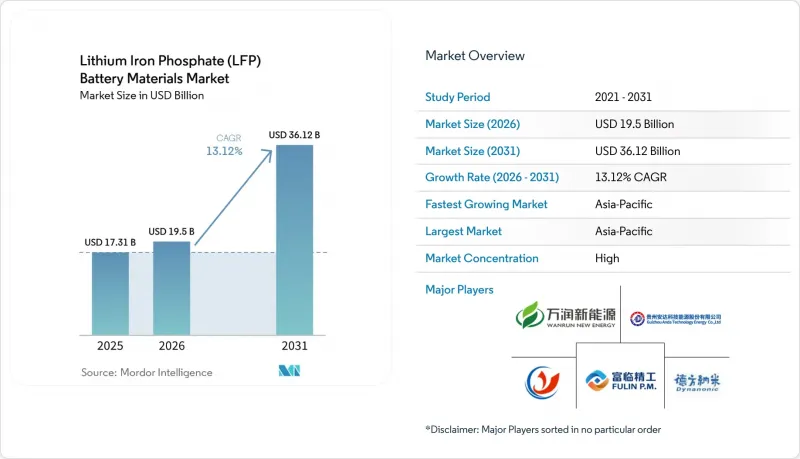
本報告按材料類型(例如,磷酸鋰電池正極材料)、電池形狀(例如,圓柱形電池)、應用(例如,電池能源儲存系統)和地區(亞太地區、北美地區、歐洲地區、南美地區以及中東和非洲地區)進行細分。市場預測以美元計價。
全球磷酸鋰鐵(LFP)電池材料市場趨勢及洞察
在電動車和固定式儲能領域的應用
電動車 (EV) 和固定式儲能系統是磷酸鋰鐵(LFP) 電池材料的兩大主要需求來源。 LFP 電池目前滿足了全球近一半的電動車電池需求,而 2020 年這一比例還不到 10%。這反映出 LFP 在標準續航里程車輛和儲能系統中的應用日益廣泛。其化學成分賦予了 LFP 優異的熱穩定性,並使其充放電循環壽命超過 3000 次,能夠滿足不同運行要求的交通運輸和固定式儲能應用的需求。這使得製造商能夠利用通用材料平台,滿足不同充電模式的應用需求。
這種組合擴大了磷酸鐵鋰電池材料在移動出行、電網穩定和備用電源等領域的需求基礎。製造商可以平衡其對汽車專案的依賴與來自固定式系統的需求,後者的採購決策通常受長期營運需求而非車輛續航里程驅動。由此產生的需求結構雖然並非完全不受經濟週期的影響,但為材料市場提供了多個可觀的成長途徑。此外,儘管汽車和儲能系統領域的投資趨勢可能會影響材料採購,但這兩個客戶群都對資金籌措條件、政策支援和可靠的生產能力較為敏感,從而降低了對單一終端應用週期的依賴。
低成本且不含鈷的化學成分
磷酸鐵鋰電池(LFP)化學成分中不含鈷和鎳,這仍然是其成本和採購的關鍵優勢。鐵和磷酸鹽比鎳錳鈷化學成分中使用的金屬更容易獲得。這種成分減少了對多條金屬供應鏈的依賴,並降低了鈷採購嚴格審查帶來的風險。對於評估原料供應情況以及成品電池技術特性的買家而言,這是一個重要的考量。當汽車製造商和儲能系統開發商尋求更簡單的原料採購方式時,磷酸鐵鋰電池材料市場將從中受益。
由於原料成本波動很大程度上取決於碳酸鋰和磷酸鹽的價格,這種化學成分並不能完全消除價格風險。對於正極材料加工商而言尤其如此,即使原物料價格飆升,他們也可能無法立即調整價格。然而,由於需要管理的金屬原料種類減少,下游買家在磷酸鐵鋰電池材料市場簽訂長期合約是可以簡化的。
高階出行方式中低質量能量密度
標準磷酸鐵鋰電池的單體能量密度為160–170 Wh/kg,而鎳錳鈷(NMC)電池由於鎳含量較高,能量密度可達250–280 Wh/kg。這種能量密度差異限制了NMC電池在需要長途駕駛的乘用車以及對每千瓦時重量要求極高的應用中的使用。這是因為能量密度較低的電池可能需要更大的電池組空間和更高的電池品質才能達到相同的續航里程。因此,NMC電池目前仍主要應用於歐洲和北美高階車型的高配版本。液態金屬磷酸鐵鋰電池(LMFP)可以透過替換錳元素將能量密度提升至200 Wh/kg,使其成為解決此難題的潛在方案。然而,LMFP電池的成本比標準LFP電池高出12–17%,阻礙了其廣泛應用。雖然 LMFP 作為高壓材料,提供了一種在不放棄已建立的磷酸鹽基化學成分的情況下提高性能的實用方法,但在 LMFP 達到更具競爭力的成本水平之前,LFP 電池材料市場進入豪華汽車領域可能會受到限制。
細分市場分析
到2025年,磷酸鐵鋰(LFP)正極材料將佔最大的銷售佔有率,達到53.82%。正極材料的需求與汽車和儲能電池產量的成長密切相關,因為每生產1吉瓦時LFP電池需要1600至1800噸LFP正極粉末。隨著LFP應用範圍的擴大,對粉末的需求直接成長,無需經過其他下游消費類別。電解液材料佔據第二大銷售佔有率,這得益於汽車和固定式儲能電池產量的同步成長,以及電解液在電池內部電荷轉移中的關鍵作用。隔膜、黏結劑、導電添加劑和集電器構成了剩餘的材料類別。雖然這些產品的銷售量隨著電池產量的成長而成長,但它們的利潤率往往低於正極材料和電解材料,而且其日益標準化意味著它們對銷售額的貢獻較少依賴於高價值的化學規格,而更多地與電池整體產量相關。
預計到2031年,負極材料市場將以14.42%的複合年成長率成長,成為所有材料類別中成長最快的市場。磷酸鐵鋰電池材料市場受益於對矽碳複合材料和高壓縮人造石墨的需求。這些材料支援第五代電池,旨在實現更高的能量密度和更快的充電速度。隨著電池製造商不斷追求更好的充電特性和更高的電池組利用率,由於高壓縮設計,負極材料的品質日益重要。 BTR新能源材料(BTR)於2026年3月發布了其超快充電石墨負極系列產品「T-Max」和「T-Pro 6C」。
區域分析
預計到2025年,亞太地區將佔全球銷售額的46.63%,並將以14.07%的複合年成長率成長至2031年。這一地位反映了材料生產、電池製造和電動車需求的區域一體化,使材料供應商能夠在服務國內大規模客戶的同時,並受益於成熟的上游和中游生產網路。中國在正負極材料生產方面的作用構成了亞太地區磷酸鐵鋰電池材料市場的基礎,預計到2025年,中國磷酸鐵鋰電池材料的產量將達到375萬噸。印度、日本、韓國和東南亞國協是其他需求中心,它們的角色受到國家電池製造計劃、汽車需求以及與更廣泛的區域供應鏈整合的影響。印度的製造計劃和韓國電池製造商的認證活動正在將區域供應商與北美和歐洲的客戶聯繫起來,建立一個採購網路,使亞太地區的角色從國內需求擴展到海外工廠供應鏈。
北美和歐洲合計約佔全球銷售額的三分之一。儘管美國的專案儲備正快速成長,但截至2025年,國內產能僅能滿足正極活性材料47%的需求和負極活性材料23%的需求。這一缺口表明,即使項目公告數量增加,在預測期內的大部分時間裡,對進口的依賴仍可能持續。這是因為替代現有進口需要建造新的材料生產能力、獲得認證以及供應可靠的上游原料。 LG能源解決方案公司已簽署契約,將從2027年起為特斯拉位於密西根州蘭辛的MegaPack 3專案供應棱柱形磷酸鐵鋰電池。在歐洲,更嚴格的電池監管要求使得擁有完善本地供應鏈的材料更加受到重視,即使進口材料在直接材料成本方面最初看起來更具競爭力,這些因素也會影響採購決策。因此,磷酸鐵鋰電池材料市場的重要性日益凸顯,不僅體現在電池成本方面,也體現在區域合規規劃方面。
南美洲、中東和非洲的銷售貢獻仍然相對較小。阿根廷和智利作為鋰鹵水生產國佔有重要地位,為磷酸鐵鋰(LFP)合成提供碳酸鋰。巴西正在崛起為儲能中心,尤其是在可再生能源系統與電池結合方面。摩洛哥致力於建立一體化電池製造能力,而沙烏地阿拉伯則透過其「2030願景」計畫為下游製造提供資金。儘管預計這些地區在預測期內不會改變全球市場佔有率格局,但它們有潛力成為未來的需求中心,支持現有亞洲生產商的本地化投資,尤其是在本地電池製造和可再生能源儲存系統系統發展取得進展,以及區域材料消費基礎日益清晰的情況下。
其他好處:
- Excel格式的市場預測(ME)表
- 3個月的分析師支持
目錄
第1章:引言
- 研究假設和市場定義
- 調查範圍
第2章:調查方法
第3章執行摘要
第4章 市場狀況
- 市場概覽
- 市場促進因素
- 電動車和固定式儲能系統的普及
- 低成本且不含鈷的化學成分
- 單體封裝和高壓縮設計正變得越來越普遍。
- 按地區分類的電池供應鏈本地化
- 長期採購合約和產能保障合約
- LFP 到 LMFP 升級路徑
- 市場限制因素
- 高階出行方式中重量能量密度降低
- 鋰化學品的價格和利潤率波動
- 接觸以中國為中心的加工與貿易政策
- 與認證週期和流程一致性相關的風險
- 價值鏈分析
- 波特五力分析
第5章 市場規模與成長預測
- 依材料類型
- LFP正極材質
- 陽極材料
- 電解質材料
- 其他(隔膜、黏合劑、導電添加劑、集電器)
- 按細胞形狀
- 圓柱形單元格
- 棱柱形細胞
- 袋式電池
- 透過使用
- 電動車
- 電池儲能系統
- 家用電子產品
- 其他(工業設備、通訊備份)
- 按地區
- 亞太地區
- 中國
- 印度
- 日本
- 韓國
- 東南亞國協
- 其他亞太國家
- 北美洲
- 美國
- 加拿大
- 墨西哥
- 歐洲
- 德國
- 英國
- 法國
- 義大利
- 北歐國家
- 其他歐洲國家
- 南美洲
- 巴西
- 阿根廷
- 其他南美國家
- 中東和非洲
- 沙烏地阿拉伯
- 南非
- 其他中東和非洲國家
- 亞太地區
第6章 競爭情勢
- 市場集中度
- 策略趨勢
- 市佔率和排名分析
- 公司簡介
- Aleees
- BTR New Material Group Co., Ltd.
- BYD Europe BV
- Changzhou Liyuan New Energy Technology Co., Ltd.
- Chongqing Terui Battery Materials Co., Ltd.
- Gotion
- Guizhou Anda Energy Technology Co., Ltd.
- Hubei Wanrun New Energy Technology Co., Ltd.
- Hunan Yuneng New Energy Battery Material Co., Ltd.
- Mianyang Fulin Precision Machining Co.,Ltd.
- Nano One Materials Corp.
- Pulead Technology Industry Co., Ltd.
- RT-Hitech Co., Ltd.
- Shenzhen Dynanonic Co., Ltd.
- Tianjin STL Energy Technology Co., Ltd.
- Yantai Zhuoneng Battery Materials Co., Ltd.
第7章 市場機會與未來展望
According to Mordor Intelligence, the lithium iron phosphate (LFP) battery materials market size was estimated at USD 17.31 billion in 2025 and is estimated to grow from USD 19.50 billion in 2026 to USD 36.12 billion by 2031, at a CAGR of 13.12% during the forecast period (2026-2031).
This report is Segmented by Material Type (LFP Cathode Materials and More), Cell Format (Cylindrical Cells, and More), Application (Battery Energy Storage Systems and More), and Geography (Asia-Pacific, North America, Europe, South America, and Middle-East and Africa). The Market Forecasts are Provided in Terms of Value (USD).
Global Lithium Iron Phosphate (LFP) Battery Materials Market Trends and Insights
EV and Stationary Storage Adoption
Electric vehicles and stationary storage represent the two main demand channels for the lithium iron phosphate (LFP) battery materials market. LFP supplied close to half of global electric-car battery demand, up from less than 10% in 2020, reflecting its wider use in standard-range vehicles and storage systems. The chemistry offers thermal stability and a cycle life exceeding 3,000 charge-discharge events, supporting both transport and stationary applications with different operating needs. This allows producers to serve applications with distinct charging patterns from a common material platform.
This combination broadens the demand base for LFP battery materials across mobility, grid balancing, and backup power. Producers can balance exposure to vehicle programs with demand from stationary systems, where purchasing decisions are often shaped by long-duration operating requirements rather than vehicle range. The resulting mix does not eliminate cyclicality, but it provides the materials base with more than one substantial route to growth. It also reduces reliance on a single end-use cycle, even though vehicle and storage investment patterns can influence material purchasing, as both customer groups remain sensitive to financing conditions, policy support, and the availability of reliable manufacturing capacity.
Lower Cost and Cobalt-Free Chemistry
The absence of cobalt and nickel remains a central cost and sourcing advantage for LFP chemistry. Iron and phosphate are more widely available feedstocks than the metals used in nickel-manganese-cobalt chemistries. This composition reduces exposure to several metal supply chains and the scrutiny associated with cobalt sourcing, a consideration for buyers that assess raw-material availability alongside the technical properties of the finished cell. The LFP battery materials market benefits when automakers and storage developers seek simpler raw-material procurement.
Material cost movements depend strongly on lithium carbonate and phosphate prices, so the chemistry does not eliminate price risk, particularly for cathode processors whose pricing arrangements may not adjust immediately when inputs become more expensive. It can, however, simplify long-term contracting in the LFP battery materials market for downstream buyers, as fewer metal inputs must be managed simultaneously.
Lower Gravimetric Energy Density in Premium Mobility
Standard LFP cells deliver 160-170 Wh/kg at the cell level, compared with 250-280 Wh/kg for nickel-rich Nickel Manganese Cobalt (NMC) alternatives. This difference limits use in long-range passenger vehicles and in applications where weight per kilowatt-hour is a critical design factor, as a lower-energy-density cell may require more pack space or additional cell mass to achieve the same vehicle range. Premium European and North American vehicle programs have therefore continued to use NMC for high-specification models. LMFP offers a possible response, as manganese substitution can increase energy density to 200 Wh/kg. However, LMFP carries a 12-17% cost premium over standard LFP, which delays wider adoption. The LFP battery materials market will remain less exposed to premium mobility until LMFP reaches more competitive cost levels, even as the higher-voltage material provides a practical route to improve performance without abandoning the established phosphate-based chemistry.
Other drivers and restraints analyzed in the detailed report include:
- Cell-to-Pack and High-Compaction Design Gains
- Regional Battery Supply-Chain Localization
- Lithium Chemical Price and Margin Volatility
For complete list of drivers and restraints, kindly check the Table Of Contents.
Segment Analysis
LFP cathode materials held the largest revenue share at 53.82% in 2025. Each gigawatt-hour of LFP cell production requires 1,600-1,800 tons of LFP cathode powder, keeping cathode material demand closely tied to growth in vehicle and storage cell output. Each increase in LFP deployment translates directly into powder demand, rather than flowing through a separate downstream consumption category. Electrolyte materials accounted for the second-largest revenue share, supported by simultaneous expansion in vehicle and stationary storage cell production and by their essential role in enabling charge transfer within the cell. Separators, binders, conductive additives, and current collectors comprised the remaining materials category. These products grow with cell output, although their margins are often lower and more standardized than those of cathode or electrolyte materials, making their revenue contribution less dependent on premium chemistry specifications and more closely tied to overall cell production output.
Anode materials are forecast to grow at a 14.42% CAGR through 2031, the highest rate among material types. The LFP battery materials market for anodes benefits from demand for silicon-carbon composite products and high-compaction artificial graphite. These materials support fifth-generation cells that target higher energy density and faster charging performance, while higher-compaction designs increase the value of anode quality as cell makers pursue improved charging behavior and more efficient pack use. BTR New Energy Materials Co., Ltd (BTR) introduced its T-Max and T-Pro 6C ultra-fast-charging graphite anode series in March 2026.
Complete Report Scope:
- By Material Type
- LFP Cathode Materials
- Anode Materials
- Electrolyte Materials
- Others (Separators, Binders, Conductive Additives, Current Collectors)
- By Cell Format
- Cylindrical Cells
- Prismatic Cells
- Pouch Cells
- By Application
- Electric Vehicles
- Battery Energy Storage Systems
- Consumer Electronics
- Others (Industrial Equipment, Telecom Backup)
- By Geography
- Asia-Pacific
- China
- India
- Japan
- South Korea
- ASEAN Countries
- Rest of Asia-Pacific
- North America
- United States
- Canada
- Mexico
- Europe
- Germany
- United Kingdom
- France
- Italy
- NORDIC Countries
- Rest of Europe
- South America
- Brazil
- Argentina
- Rest of South America
- Middle-East and Africa
- Saudi Arabia
- South Africa
- Rest of Middle-East and Africa
- Asia-Pacific
Geography Analysis
Asia-Pacific held 46.63% of global revenue in 2025 and is forecast to grow at a 14.07% CAGR through 2031. This position reflects the regional integration of materials production, cell manufacturing, and electric vehicle demand, enabling material suppliers to serve large domestic customers while benefiting from established upstream and midstream production networks. China's role in cathode and anode production anchors the Asia-Pacific LFP battery materials market, with the country producing 3.75 million tons of LFP material in 2025. India, Japan, South Korea, and ASEAN countries represent additional demand points, with their roles shaped by local cell manufacturing plans, vehicle demand, and links to broader regional supply chains. India's manufacturing plans and South Korean cell makers' qualification work connect regional suppliers with customers in North America and Europe, creating procurement links that extend Asia-Pacific's role beyond domestic demand into overseas factory supply chains.
North America and Europe together accounted for approximately one-third of global revenue. The US project pipeline has grown rapidly; however, domestic capacity covered only 47% of cathode active material demand and 23% of anode active material demand in 2025. This gap is likely to sustain import dependence for much of the forecast period, even as project announcements increase, because new materials capacity must be built, qualified, and supplied with reliable upstream inputs before it can displace established imports. LG Energy Solution entered an agreement with Tesla to supply prismatic LFP batteries for Megapack 3 from Lansing, Michigan, beginning in 2027. In Europe, battery regulation requirements are strengthening the case for materials with local supply chain documentation, which can influence sourcing decisions even when imports may initially appear more competitive on direct material costs. The LFP battery materials market has therefore become more relevant to regional compliance planning, not only to cell cost.
South America, the Middle-East, and Africa remain smaller revenue contributors. Argentina and Chile are important as lithium-brine suppliers of lithium carbonate used in LFP synthesis. Brazil is emerging as a storage deployment location, particularly for renewable energy systems paired with batteries. Morocco is seeking to develop integrated battery manufacturing capacity, while Saudi Arabia is funding downstream manufacturing through Vision 2030. These regions are not expected to alter global share patterns during the forecast period, but they may become future demand nodes that support localization investments by established Asian producers, particularly as local cell manufacturing and renewable storage development create a clearer basis for regional materials consumption.
- Aleees
- BTR New Material Group Co., Ltd.
- BYD Europe B.V.
- Changzhou Liyuan New Energy Technology Co., Ltd.
- Chongqing Terui Battery Materials Co., Ltd.
- Gotion
- Guizhou Anda Energy Technology Co., Ltd.
- Hubei Wanrun New Energy Technology Co., Ltd.
- Hunan Yuneng New Energy Battery Material Co., Ltd.
- Mianyang Fulin Precision Machining Co.,Ltd.
- Nano One Materials Corp.
- Pulead Technology Industry Co., Ltd.
- RT-Hitech Co., Ltd.
- Shenzhen Dynanonic Co., Ltd.
- Tianjin STL Energy Technology Co., Ltd.
- Yantai Zhuoneng Battery Materials Co., Ltd.
Additional Benefits:
- The market estimate (ME) sheet in Excel format
- 3 months of analyst support
TABLE OF CONTENTS
1 Introduction
- 1.1 Study Assumptions and Market Definition
- 1.2 Scope of the Study
2 Research Methodology
3 Executive Summary
4 Market Landscape
- 4.1 Market Overview
- 4.2 Market Drivers
- 4.2.1 EV and Stationary Storage Adoption
- 4.2.2 Lower Cost and Cobalt-Free Chemistry
- 4.2.3 Cell-to-Pack and High-Compaction Design Gains
- 4.2.4 Regional Battery Supply-Chain Localization
- 4.2.5 Long-Term Procurement and Capacity Reservation Agreements
- 4.2.6 LFP-to-LMFP Upgrade Path
- 4.3 Market Restraints
- 4.3.1 Lower Gravimetric Energy Density in Premium Mobility
- 4.3.2 Lithium Chemical Price and Margin Volatility
- 4.3.3 China-Centric Processing and Trade-Policy Exposure
- 4.3.4 Qualification Cycles and Process Consistency Risk
- 4.4 Value Chain Analysis
- 4.5 Porter's Five Forces Analysis
- 4.5.1 Threat of New Entrants
- 4.5.2 Bargaining Power of Suppliers
- 4.5.3 Bargaining Power of Buyers
- 4.5.4 Threat of Substitutes
- 4.5.5 Competitive Rivalry
5 Market Size and Growth Forecasts (Value)
- 5.1 By Material Type
- 5.1.1 LFP Cathode Materials
- 5.1.2 Anode Materials
- 5.1.3 Electrolyte Materials
- 5.1.4 Others (Separators, Binders, Conductive Additives, Current Collectors)
- 5.2 By Cell Format
- 5.2.1 Cylindrical Cells
- 5.2.2 Prismatic Cells
- 5.2.3 Pouch Cells
- 5.3 By Application
- 5.3.1 Electric Vehicles
- 5.3.2 Battery Energy Storage Systems
- 5.3.3 Consumer Electronics
- 5.3.4 Others (Industrial Equipment, Telecom Backup)
- 5.4 By Geography
- 5.4.1 Asia-Pacific
- 5.4.1.1 China
- 5.4.1.2 India
- 5.4.1.3 Japan
- 5.4.1.4 South Korea
- 5.4.1.5 ASEAN Countries
- 5.4.1.6 Rest of Asia-Pacific
- 5.4.2 North America
- 5.4.2.1 United States
- 5.4.2.2 Canada
- 5.4.2.3 Mexico
- 5.4.3 Europe
- 5.4.3.1 Germany
- 5.4.3.2 United Kingdom
- 5.4.3.3 France
- 5.4.3.4 Italy
- 5.4.3.5 NORDIC Countries
- 5.4.3.6 Rest of Europe
- 5.4.4 South America
- 5.4.4.1 Brazil
- 5.4.4.2 Argentina
- 5.4.4.3 Rest of South America
- 5.4.5 Middle-East and Africa
- 5.4.5.1 Saudi Arabia
- 5.4.5.2 South Africa
- 5.4.5.3 Rest of Middle-East and Africa
- 5.4.1 Asia-Pacific
6 Competitive Landscape
- 6.1 Market Concentration
- 6.2 Strategic Moves
- 6.3 Market Share (%)/Ranking Analysis
- 6.4 Company Profiles (includes Global Overview, Market Overview, Core Segments, Financials as available, Strategic Information, Products and Services, and Recent Developments)
- 6.4.1 Aleees
- 6.4.2 BTR New Material Group Co., Ltd.
- 6.4.3 BYD Europe B.V.
- 6.4.4 Changzhou Liyuan New Energy Technology Co., Ltd.
- 6.4.5 Chongqing Terui Battery Materials Co., Ltd.
- 6.4.6 Gotion
- 6.4.7 Guizhou Anda Energy Technology Co., Ltd.
- 6.4.8 Hubei Wanrun New Energy Technology Co., Ltd.
- 6.4.9 Hunan Yuneng New Energy Battery Material Co., Ltd.
- 6.4.10 Mianyang Fulin Precision Machining Co.,Ltd.
- 6.4.11 Nano One Materials Corp.
- 6.4.12 Pulead Technology Industry Co., Ltd.
- 6.4.13 RT-Hitech Co., Ltd.
- 6.4.14 Shenzhen Dynanonic Co., Ltd.
- 6.4.15 Tianjin STL Energy Technology Co., Ltd.
- 6.4.16 Yantai Zhuoneng Battery Materials Co., Ltd.
7 Market Opportunities and Future Outlook
- 7.1 White-Space and Unmet-Need Assessment

 磷酸鋰鐵電池:市佔率分析、產業趨勢與統計及成長預測(2026-2031)
 對堆疊式鋰電池市場到 2035 年的分析和預測:按類型、產品、技術、應用、材料類型、最終用戶、功能、安裝配置、設備和解決方案。石墨烯電池市場分析及預測(至2035年):類型、產品、技術、應用、形式、材料類型、裝置、製程、最終用戶、功能
 全球資料中心電池市場規模、佔有率、趨勢和成長分析報告(2026-2034年)先進電池技術市場分析及預測(至2035年):按類型、產品、技術、組件、應用、材料類型、最終用戶、安裝類型、解決方案、模式分類
 全球資料中心電池市場(截至 3032 年):UPS(100 kWh 以下、100-500 kWh、500 kWh-1 MWh、1 MWh 以上)、BESS(1 MWh 以下、1-30 MWh、30 MWh 以上)、電池類型(鋰離子電池、鉛酸Wh 以下、1-30 MWh、30 MWh 以上)、電池類型(鋰離子電池、鉛酸Wh 以下、離子和電池)液流式電池和電池(電池級)。
 先進電池市場:按產品類型、應用、電池類別、最終用途、國家和地區分類-全球產業分析、市場規模及佔有率和未來預測(2026-2033)
 固態固態電池市場:實用化(至2034年)-按電池類型、實用化階段、創新重點領域、應用和地區分類的全球分析電池先進材料市場預測至2034年—按材料類型、電池類型、應用、材料形狀、最終用戶和地區分類的全球分析
 先進電池市場:按化學成分、電芯形式、電池類型、應用和最終用戶分類-2026-2032年全球市場預測