


 |
市場調查報告書
商品編碼
2119218
磷酸鋰鐵電池:市佔率分析、產業趨勢與統計及成長預測(2026-2031)Lithium Iron Phosphate (LFP) Battery - Market Share Analysis, Industry Trends & Statistics, Growth Forecasts (2026 - 2031) |
||||||

※ 本網頁內容可能與最新版本有所差異。詳細情況請與我們聯繫。
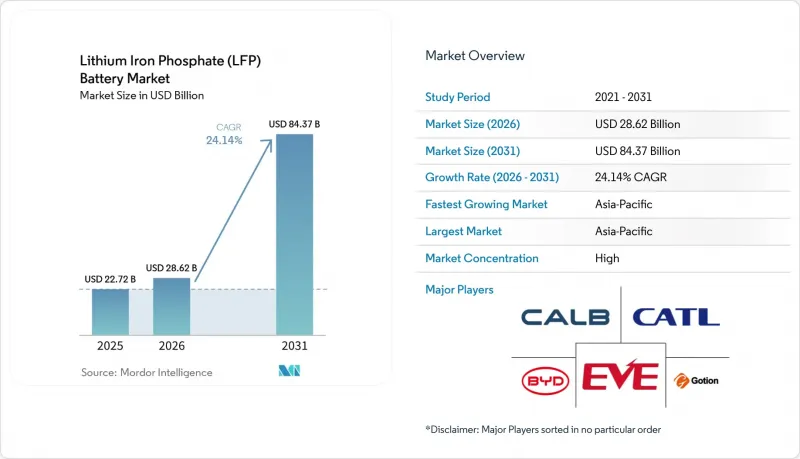
根據 Mordor Intelligence 預測,磷酸鋰鐵(LFP) 電池市場規模預計將在 2025 年達到 227.2 億美元,2026 年達到 286.2 億美元,到 2031 年達到 843.7 億美元,2026 年至 2031 年的複合年成長率為 24.14%。
本報告按電池形狀(圓柱形、棱柱形、軟包)、應用領域(可攜式、固定式、電動車、電網/可再生能源儲存)和地區(北美、歐洲、亞太、南美、中東和非洲)進行細分。市場預測以美元計價。
全球磷酸鋰鐵(LFP)電池市場趨勢及洞察
大眾市場電動車的成本競爭力
汽車製造商正擴大在注重成本的電動車車型中採用磷酸鋰鐵鋰電池(LFP),從而擴大了磷酸鐵鋰電池市場在乘用車、車隊車輛和低成本定價模式的應用。預計到2025年,LFP電池在全球電動車電池部署的比例將超過55%,高於2024年的約50%。與鎳基碳化物(NMC)電池相比,LFP電池組的平均每度電成本降低40%以上。在中國,預計到2025年,LFP電池將佔國內電動車電池部署的81.2%,這反映了其在續航里程為300-600公里的主流乘用車量產車型中的重要角色。這種化學成分的電池也獲得了開發中國家市場的認可。中國汽車製造商出口成長以及經濟型車型的廣泛普及,使得磷酸鐵鋰電池(LFP)在2025年之前將應用於三分之二的電動車。高壓縮性正極材料在中國車型重新設計中變得日益重要,因為與標準配方相比,它們可以在不改變化學成分基本成本結構的前提下,將電池的能量密度提高15-20%。這使得磷酸鋰鐵鋰電池市場對低成本標準電池和高性能電池的需求不再局限於單一的統一產品,而是同時滿足了中國國產車型的需求。此外,可靠的正極材料供應、製造品質以及新電池設計的快速認證對於汽車製造商也變得越來越重要,尤其是在汽車製造商努力縮短量產車型平台開發週期的情況下。
可再生能源併網及電網級儲能的引進
電網和可再生能源儲能是磷酸鋰鐵鋰電池市場成長最快的應用領域。這是因為電力公司需要能夠長期頻繁充放電的電池。 2025年,全球整體新增儲能容量達108吉瓦,較2024年成長40%,其中磷酸鐵鋰電池佔新增容量的90%。在美國,2025年新增儲能容量為57.6吉瓦時,年增30%。 2026年第一季又新增了9.7吉瓦時。在中國,由於循環壽命超過2萬次的磷酸鐵鋰電池以及可再生能源的快速發展,到2025年底,新增儲能容量累積達到144.7吉瓦。此外,中國大型資料中心園區對備用儲能的需求,以及可再生能源的併網,也催生了新的市場需求。對於需要 2-4 小時備用電源的業者而言,這一點尤其明顯。磷酸鐵鋰電池 (LFP) 適用於 2-4 小時的專案。此類應用場景優先考慮安全性、循環壽命和成本,而非能量密度。這種相容性使得開發人員能夠在公用事業、商業和特定備用電源專案中使用化學成分通用的電池,即使客戶的調度計劃和區域電網要求各不相同,也能滿足不同運作模式的需求。
低質量能量密度和寒冷氣候下的性能
在豪華車和長續航力電動車領域,磷酸鋰鐵鋰電池(LFP)在寒冷氣候下的能量密度和性能是限制其市場發展的因素。 LFP電池的能量密度為170–205 Wh/kg,而NMC電池的能量密度可達255 Wh/kg,這使得LFP在續航里程超過600公里的車輛中處於劣勢。儘管電池組設計將空間利用率提高到65–72%,但單顆電池的效能差異依然存在,在零度以下的低溫環境下更為顯著。鈉離子電池在短續航里程和寒冷氣候的應用領域具有競爭力,而LMFP的目標是提高400–600公里續航里程的能量密度,全固態電池則瞄準高階車型。歐洲豪華車製造商繼續在其旗艦車型中使用NMC電池,同時對入門級車型使用LFP電池的評估則更為謹慎。儘管高壓縮比設計提升了性能,但這仍然限制了LFP電池的技術應用。
細分市場分析
截至2025年,棱柱形電芯將佔據磷酸鋰鐵鋰電池市場61.2%的佔有率,預計2026年至2031年將以26.1%的複合年成長率成長。這一地位主要歸功於「電芯到電池組一體化」(cell-to-pack)設計的普及,而大尺寸棱柱形電芯透過減少中間模組的數量和簡化電池組結構,有效地支持了這種設計。比亞迪的「刀片電池」和寧德時代的電芯到電池組一體化平台推動了棱柱形磷酸鐵鋰電池在電動車電池組和公用事業級儲能容器中的應用。在這些應用中,標準化的電芯形狀適用於大規模系統佈局。更大的電芯可以簡化溫度控管,並降低兆瓦時系統的模組組裝成本,而兆瓦時系統目前是固定式儲能系統部署的核心。一項針對比亞迪4680型圓柱形磷酸鐵鋰電池的研究記錄了374.6 Wh/L的比能,顯示在某些設計中,圓柱形電芯仍具有技術競爭力。
2026年第一季,稜柱形電池在中國儲能電池出貨量中佔比超過97%。這反映出,隨著專案規模的擴大和開發商對可重複安裝設計的需求,公用事業級儲能系統更傾向於使用大尺寸電池。圓柱形電池在特斯拉的「4680」專案以及某些高性能應用中仍然發揮著重要作用,因為這種電池規格符合成熟的汽車工程方法。軟包電池在韓國主導的設計中仍然佔據重要地位,因為它們在電池組配置中具有更高的能量密度,並能有效利用車身下方的可用空間。雖然棱柱形電池設計在中國乃至全球儲能市場佔據主導地位,但圓柱形電池在北美市場和高性能應用領域仍然保持著領先地位,而軟包電池也正在歐洲的某些電動車平台上得到應用。
區域分析
預計到2025年,亞太地區將佔磷酸鋰鐵鋰電池市場規模的58.4%,並在2026年至2031年間以31.2%的複合年成長率成長。到2025年,中國將佔全球新增電池裝置量的60%,並擁有全球超過80%的鋰離子電池產能,這為區域供應商提供了一個將產能與本地客戶需求相結合的綜合基地。這些優勢鞏固了中國在生產、技術研發和消費方面的地位,其在正極材料領域的地位也正在塑造更廣泛的磷酸鋰鐵鋰電池市場。印度電動車的日益普及以及東南亞製造業投資的增加,正透過汽車組裝、國內電池計畫和新的可再生能源發電,在該地區創造對磷酸鐵鋰電池的需求。印尼正在建構一個規模超過日本和韓國的負極活性材料供應體系。
北美和歐洲是磷酸鋰鐵電池市場活動的下一個主要區域,但它們的供應鏈和政策環境與亞太地區有所不同。在美國,儘管由於2025年對「受關注的外國公司」實施更嚴格的監管,電動車中磷酸鐵鋰電池的使用量有所下降,但由於開發商繼續為大型項目購買磷酸鐵鋰電池系統,儲能容量成長了30%,達到57.6吉瓦時。 2026年第一季新增9.7吉瓦時,創下第一季歷史新高。這表明,固定需求可以消化部分電動車專案中不再使用的材料。在歐洲,磷酸鐵鋰電池在2025年電動車電池需求中的佔比超過10%,但供應仍有限,幾乎全部依賴從中國進口。目前,電池實質審查義務正在影響歐洲的採購決策,並可能促使對本地正極材料進行投資,儘管建立這種產能預計需要時間。
儘管南美洲、中東和非洲在磷酸鋰鐵鋰電池市場中所佔佔有率較小,但它們在本地化生產和與太陽能相關的儲能領域的重要性日益提升。巴西正在建造新的電池組組裝線和儲能電池生產線,以滿足國內採購需求並建立本地化生產系統。智利和阿根廷擁有鋰鹵水資源,如果對正極材料的投資跟進,將有助於上游製程的整合,儘管不太可能立即取代中國的加工能力。沙烏地阿拉伯和阿拉伯聯合大公國正透過可再生能源計畫支持磷酸鐵鋰電池的推廣,而摩洛哥計劃建造的磷酸鐵鋰電池超級工廠旨在支持非洲和歐洲的電動車組裝供應鏈。這些地區提供了新的需求和製造地,但它們的作用不僅取決於鋰資源,還取決於對加工、電芯和系統整合的投資。
其他好處
- Excel格式的市場預測(ME)表
- 3個月的分析師支持
目錄
第1章:引言
- 研究假設和市場定義
- 調查範圍
第2章:調查方法
第3章執行摘要
第4章 市場狀況
- 市場概覽
- 市場促進因素
- 大眾市場電動車的成本競爭力
- 可再生能源併網及電網級儲能的引進
- 電池製造在地化和供應鏈優惠待遇
- 在安全性、使用壽命和總擁有成本 (TCO) 方面具有優勢
- 電池到包裝的整體結構將磷酸鐵鋰電池擴展到 40-80kWh 平台
- 資料中心備份與分散式儲存採購
- 市場限制因素
- 低質量能量密度和寒冷氣候下的性能
- 使用鈉離子電池、液態金屬磷酸鹽電池、奈米金屬碳化物電池和全固態電池的替代方案
- 低殘餘材料價值導致磷酸鐵鋰回收的經濟可行性下降。
- 由於OEM專用超級工廠的出現,一般供應商數量減少。
- 供應鏈分析
- 技術展望
- 監理情勢
- 波特五力分析
第5章 市場規模與成長預測
- 按電池形狀
- 圓柱形
- 矩形的
- 袋式
- 透過使用
- 可攜式的
- 固定式
- 電動出行
- 電網和可再生能源存儲
- 按地區
- 北美洲
- 美國
- 加拿大
- 墨西哥
- 歐洲
- 德國
- 法國
- 義大利
- 西班牙
- 英國
- 波蘭
- 俄羅斯
- 其他歐洲國家
- 亞太地區
- 中國
- 印度
- 日本
- 韓國
- 澳洲
- 印尼
- 越南
- 泰國
- 其他亞太國家
- 南美洲
- 巴西
- 阿根廷
- 智利
- 其他南美國家
- 中東和非洲
- 沙烏地阿拉伯
- 阿拉伯聯合大公國
- 埃及
- 南非
- 摩洛哥
- 其他中東和非洲國家
- 北美洲
第6章 競爭情勢
- 市場集中度
- 策略趨勢
- 市佔率分析
- 公司簡介
- BYD Company Limited
- CALB Group Co., Ltd.
- Contemporary Amperex Technology Co., Limited
- Envision AESC Group Ltd.
- EVE Energy Co., Ltd.
- Farasis Energy(Ganzhou)Co., Ltd.
- Gotion High-Tech Co., Ltd.
- LG Energy Solution, Ltd.
- Lithium Werks BV
- Microvast Holdings, Inc.
- Narada Power Source Co., Ltd.
- Phylion Battery Co., Ltd.
- REPT Battero Energy Co., Ltd.
- Samsung SDI Co., Ltd.
- SVOLT Energy Technology Co., Ltd.
- Tianneng Battery Group Co., Ltd.
- Wanxiang A123 Systems Corp.
第7章 市場機會與未來展望
According to Mordor Intelligence, the lithium iron phosphate battery market size is projected to be USD 22.72 billion in 2025, USD 28.62 billion in 2026, and reach USD 84.37 billion by 2031, growing at a CAGR of 24.14% from 2026 to 2031.
This report is Segmented by Battery Form Factor (Cylindrical, Prismatic, Pouch), Application (Portable, Stationary, Electric Mobility, Grid and Renewable Energy Storage), and Geography (North America, Europe, Asia-Pacific, South America, and Middle East and Africa). The Market Forecasts are Provided in Terms of Value (USD).
Global Lithium Iron Phosphate (LFP) Battery Market Trends and Insights
EV Cost-Competitiveness in Mass-Market Vehicles
Automakers are using LFP more often in cost-sensitive EV models, which is expanding the lithium iron phosphate battery market across passenger cars, fleet vehicles, and lower-priced models. LFP captured more than 55% of global EV battery deployments in 2025, up from nearly 50% in 2024, and LFP packs cost more than 40% less per kilowatt-hour than NMC packs on average. In China, LFP reached 81.2% of domestic EV battery installations in 2025, reflecting its role in mainstream passenger vehicles with 300-600 km driving ranges and high-volume production schedules. Emerging market and developing economy sales also favored the chemistry, with LFP powering 2-thirds of electric car sales in 2025 as Chinese OEM exports widened affordable model availability. Higher-compaction cathode materials are becoming important for Chinese model refreshes because they improve cell energy density by 15-20% over standard formulations without changing the chemistry's basic cost position. This leaves the lithium iron phosphate battery market with demand for lower-cost standard cells and more capable cells for domestic Chinese models, rather than a single uniform product requirement, and it also increases the importance of reliable cathode supply, manufacturing quality, and rapid qualification of new cell designs by vehicle makers, particularly as manufacturers work to shorten development cycles for mass-market vehicle platforms.
Renewable Integration and Grid-Scale Energy Storage Deployment
Grid and renewable energy storage is the fastest-growing application in the lithium iron phosphate battery market because utilities need batteries that can be cycled regularly over long operating periods. The world added 108 GW of battery storage during 2025, an increase of 40% from 2024, and LFP accounted for 90% of new additions. The United States installed 57.6 GWh of energy storage in 2025, up 30%, and added 9.7 GWh in the first quarter of 2026. China reached 144.7 GW of cumulative new-type energy storage capacity at the end of 2025, supported by LFP cells with certified cycle life above 20,000 cycles and the rapid buildout of renewable power. Backup storage requirements for large Chinese data center campuses are creating another source of demand alongside renewable integration, especially where operators require 2-4 hours of reserve capacity. LFP remains suited to 2-4 hour projects because safety, cycle life, and cost carry more weight than energy density in this use case, and this fit helps developers use a common chemistry across utility, commercial, and selected backup-power projects with different operating profiles, even where customers have different dispatch schedules and local grid requirements.
Lower Gravimetric Energy Density and Cold-Weather Performance
Energy density and cold-weather performance constrain the lithium iron phosphate battery market in premium and long-range EVs. LFP cells deliver 170-205 Wh/kg, while NMC cells can reach 255 Wh/kg, placing LFP at a disadvantage where vehicle range exceeds 600 km. Cell-to-pack designs improve space utilization to 65-72%, but the cell-level difference persists and becomes more pronounced in sub-zero temperatures. Sodium-ion cells compete in shorter-range and cold-climate uses, while LMFP seeks to raise energy density in the 400-600 km range, and solid-state batteries target premium vehicles. Premium European manufacturers continue to specify NMC for their flagship models and assess LFP more selectively for entry-level vehicles. This creates a technology boundary for LFP even as higher-compaction designs improve its performance.
Other drivers and restraints analyzed in the detailed report include:
- Safety, Cycle Life and Total-Cost-of-Ownership Advantages
- Battery-Manufacturing Localization and Supply-Chain Incentives
- Low Residual Material Value Weakening LFP Recycling Economics
For complete list of drivers and restraints, kindly check the Table Of Contents.
Segment Analysis
Prismatic cells held 61.2% of the lithium iron phosphate battery market share in 2025 and are forecast to grow at a 26.1% CAGR from 2026 to 2031. Their position follows the wider use of cell-to-pack designs, which large-format prismatic cells support effectively by reducing the number of intermediate modules and simplifying the pack structure. BYD Blade Battery and CATL cell-to-pack platforms have helped establish prismatic LFP for EV packs and utility-scale storage containers, where the cell shape works with standardized large-scale system layouts. Larger cells can simplify thermal management and reduce module assembly costs in multi-megawatt-hour systems, which are now a central part of stationary storage deployment. A study of BYD's 4680-format LFP cylindrical cell recorded 374.6 Wh/L, showing that cylindrical cells remain technically competitive in selected designs.
Prismatic cells accounted for more than 97% of China's energy storage battery shipments in the first quarter of 2026. This reflects the preference for larger formats in utility-scale storage as projects increase in size and developers seek repeatable installation designs. Cylindrical cells retain a role through Tesla's 4680 program and select high-performance applications where the format supports established vehicle engineering approaches. Pouch cells remain relevant in Korean-led designs because their packaging can support higher gravimetric energy density in cell-to-pack configurations and can use available vehicle underbody space efficiently. Prismatic designs lead China and global energy storage, while cylindrical cells retain a North American and performance-focused position and pouch cells serve selected European EV platforms.
Complete Report Scope:
- By Battery Form Factor
- Cylindrical
- Prismatic
- Pouch
- By Application
- Portable
- Stationary
- Electric Mobility
- Grid and Renewable Energy Storage
- By Geography
- North America
- United States
- Canada
- Mexico
- Europe
- Germany
- France
- Italy
- Spain
- United Kingdom
- Poland
- Russia
- Rest of Europe
- Asia-Pacific
- China
- India
- Japan
- South Korea
- Australia
- Indonesia
- Vietnam
- Thailand
- Rest of Asia-Pacific
- South America
- Brazil
- Argentina
- Chile
- Rest of South America
- Middle East and Africa
- Saudi Arabia
- United Arab Emirates
- Egypt
- South Africa
- Morocco
- Rest of Middle East and Africa
- North America
Geography Analysis
Asia-Pacific held 58.4% of the lithium iron phosphate battery market size in 2025 and is forecast to grow at a 31.2% CAGR from 2026 to 2031. China contributed 60% of global new battery storage additions in 2025 and holds more than 80% of global lithium-ion battery manufacturing capacity, giving regional suppliers an integrated base that combines production volume with local customer demand. These advantages support China's role in production, technology development, and consumption, while its position in cathode materials also shapes the wider lithium iron phosphate battery market. India's EV expansion and Southeast Asian manufacturing investment are building regional LFP demand through vehicle assembly, domestic battery plans, and new renewable generation. Indonesia is developing an anode active-material pipeline that exceeds Japan's and South Korea's in scale.
North America and Europe form the next major block of the lithium iron phosphate battery market activity, but their supply chains and policy settings differ from those in the Asia-Pacific. In the United States, LFP use in EVs contracted in 2025 as foreign entity of concern restrictions tightened, while storage additions reached 57.6 GWh and grew 30% as developers continued to procure LFP systems for large projects. The first quarter of 2026 added 9.7 GWh, the strongest opening quarter on record, showing that stationary demand can absorb material no longer directed to some EV programs. In Europe, LFP exceeded 10% of EV battery demand in 2025, with nearly all supply imported from China and local supply still limited. Battery due-diligence obligations now affect European procurement decisions and could encourage local cathode investment, although developing this capability will take time.
South America and the Middle East and Africa hold smaller shares of the lithium iron phosphate battery market but are becoming more relevant for localized manufacturing and solar-linked storage. Brazil is adding battery pack assembly and energy storage battery lines to support domestic content requirements and establish a local production presence. Chile and Argentina have lithium brine resources that could support upstream integration if cathode investment follows, although this would not immediately replace Chinese processing capacity. Saudi Arabia and the United Arab Emirates are supporting LFP deployment through renewable-energy programs, while Morocco's planned LFP gigafactory is intended to support African EV assembly and European supply chains. These regions offer new demand and manufacturing locations, but their role depends on investment in processing, cells, and system integration rather than lithium resources alone.
- BYD Company Limited
- CALB Group Co., Ltd.
- Contemporary Amperex Technology Co., Limited
- Envision AESC Group Ltd.
- EVE Energy Co., Ltd.
- Farasis Energy (Ganzhou) Co., Ltd.
- Gotion High-Tech Co., Ltd.
- LG Energy Solution, Ltd.
- Lithium Werks B.V.
- Microvast Holdings, Inc.
- Narada Power Source Co., Ltd.
- Phylion Battery Co., Ltd.
- REPT Battero Energy Co., Ltd.
- Samsung SDI Co., Ltd.
- SVOLT Energy Technology Co., Ltd.
- Tianneng Battery Group Co., Ltd.
- Wanxiang A123 Systems Corp.
Additional Benefits:
- The market estimate (ME) sheet in Excel format
- 3 months of analyst support
TABLE OF CONTENTS
1 INTRODUCTION
- 1.1 Study Assumptions and Market Definition
- 1.2 Scope of the Study
2 RESEARCH METHODOLOGY
3 EXECUTIVE SUMMARY
4 MARKET LANDSCAPE
- 4.1 Market Overview
- 4.2 Market Drivers
- 4.2.1 EV Cost-Competitiveness in Mass-Market Vehicles
- 4.2.2 Renewable Integration and Grid-Scale Energy Storage Deployment
- 4.2.3 Battery-Manufacturing Localization and Supply-Chain Incentives
- 4.2.4 Safety, Cycle Life and Total-Cost-of-Ownership Advantages
- 4.2.5 Cell-to-Pack Architecture Expanding LFP into 40-80 kWh Platforms
- 4.2.6 Data-Center Backup and Distributed-Storage Procurement
- 4.3 Market Restraints
- 4.3.1 Lower Gravimetric Energy Density and Cold-Weather Performance
- 4.3.2 Substitution by Sodium-Ion, LMFP, NMC and Solid-State Chemistries
- 4.3.3 Low Residual Material Value Weakening LFP Recycling Economics
- 4.3.4 Captive OEM Gigafactories Shrinking the Merchant Supplier Pool
- 4.4 Supply-Chain Analysis
- 4.5 Technology Outlook
- 4.6 Regulatory Landscape
- 4.7 Porter's Five Forces Analysis
- 4.7.1 Bargaining Power of Suppliers
- 4.7.2 Bargaining Power of Buyers
- 4.7.3 Threat of New Entrants
- 4.7.4 Threat of Substitutes
- 4.7.5 Competitive Rivalry
5 MARKET SIZE AND GROWTH FORECASTS
- 5.1 By Battery Form Factor
- 5.1.1 Cylindrical
- 5.1.2 Prismatic
- 5.1.3 Pouch
- 5.2 By Application
- 5.2.1 Portable
- 5.2.2 Stationary
- 5.2.3 Electric Mobility
- 5.2.4 Grid and Renewable Energy Storage
- 5.3 By Geography
- 5.3.1 North America
- 5.3.1.1 United States
- 5.3.1.2 Canada
- 5.3.1.3 Mexico
- 5.3.2 Europe
- 5.3.2.1 Germany
- 5.3.2.2 France
- 5.3.2.3 Italy
- 5.3.2.4 Spain
- 5.3.2.5 United Kingdom
- 5.3.2.6 Poland
- 5.3.2.7 Russia
- 5.3.2.8 Rest of Europe
- 5.3.3 Asia-Pacific
- 5.3.3.1 China
- 5.3.3.2 India
- 5.3.3.3 Japan
- 5.3.3.4 South Korea
- 5.3.3.5 Australia
- 5.3.3.6 Indonesia
- 5.3.3.7 Vietnam
- 5.3.3.8 Thailand
- 5.3.3.9 Rest of Asia-Pacific
- 5.3.4 South America
- 5.3.4.1 Brazil
- 5.3.4.2 Argentina
- 5.3.4.3 Chile
- 5.3.4.4 Rest of South America
- 5.3.5 Middle East and Africa
- 5.3.5.1 Saudi Arabia
- 5.3.5.2 United Arab Emirates
- 5.3.5.3 Egypt
- 5.3.5.4 South Africa
- 5.3.5.5 Morocco
- 5.3.5.6 Rest of Middle East and Africa
- 5.3.1 North America
6 COMPETITIVE LANDSCAPE
- 6.1 Market Concentration
- 6.2 Strategic Moves
- 6.3 Market Share Analysis
- 6.4 Company Profiles (includes Global Level Overview, Market Level Overview, Core Segments, Financials as available, Strategic Information, Market Rank/Share, Products and Services, Recent Developments)
- 6.4.1 BYD Company Limited
- 6.4.2 CALB Group Co., Ltd.
- 6.4.3 Contemporary Amperex Technology Co., Limited
- 6.4.4 Envision AESC Group Ltd.
- 6.4.5 EVE Energy Co., Ltd.
- 6.4.6 Farasis Energy (Ganzhou) Co., Ltd.
- 6.4.7 Gotion High-Tech Co., Ltd.
- 6.4.8 LG Energy Solution, Ltd.
- 6.4.9 Lithium Werks B.V.
- 6.4.10 Microvast Holdings, Inc.
- 6.4.11 Narada Power Source Co., Ltd.
- 6.4.12 Phylion Battery Co., Ltd.
- 6.4.13 REPT Battero Energy Co., Ltd.
- 6.4.14 Samsung SDI Co., Ltd.
- 6.4.15 SVOLT Energy Technology Co., Ltd.
- 6.4.16 Tianneng Battery Group Co., Ltd.
- 6.4.17 Wanxiang A123 Systems Corp.
7 MARKET OPPORTUNITIES AND FUTURE OUTLOOK
- 7.1 White-Space and Unmet-Need Assessment

 磷酸鋰鐵(LFP)電池材料:市場佔有率分析、行業趨勢和統計數據以及成長預測(2026-2031)
 對堆疊式鋰電池市場到 2035 年的分析和預測:按類型、產品、技術、應用、材料類型、最終用戶、功能、安裝配置、設備和解決方案。石墨烯電池市場分析及預測(至2035年):類型、產品、技術、應用、形式、材料類型、裝置、製程、最終用戶、功能
 全球資料中心電池市場規模、佔有率、趨勢和成長分析報告(2026-2034年)先進電池技術市場分析及預測(至2035年):按類型、產品、技術、組件、應用、材料類型、最終用戶、安裝類型、解決方案、模式分類
 全球資料中心電池市場(截至 3032 年):UPS(100 kWh 以下、100-500 kWh、500 kWh-1 MWh、1 MWh 以上)、BESS(1 MWh 以下、1-30 MWh、30 MWh 以上)、電池類型(鋰離子電池、鉛酸Wh 以下、1-30 MWh、30 MWh 以上)、電池類型(鋰離子電池、鉛酸Wh 以下、離子和電池)液流式電池和電池(電池級)。
 先進電池市場:按產品類型、應用、電池類別、最終用途、國家和地區分類-全球產業分析、市場規模及佔有率和未來預測(2026-2033)
 固態固態電池市場:實用化(至2034年)-按電池類型、實用化階段、創新重點領域、應用和地區分類的全球分析電池先進材料市場預測至2034年—按材料類型、電池類型、應用、材料形狀、最終用戶和地區分類的全球分析
 先進電池市場:按化學成分、電芯形式、電池類型、應用和最終用戶分類-2026-2032年全球市場預測