


 |
市場調查報告書
商品編碼
2119244
智慧城市通訊服務:市場佔有率分析、產業趨勢與統計、成長預測(2026-2031)Smart City Communication Services - Market Share Analysis, Industry Trends & Statistics, Growth Forecasts (2026 - 2031) |
||||||

※ 本網頁內容可能與最新版本有所差異。詳細情況請與我們聯繫。
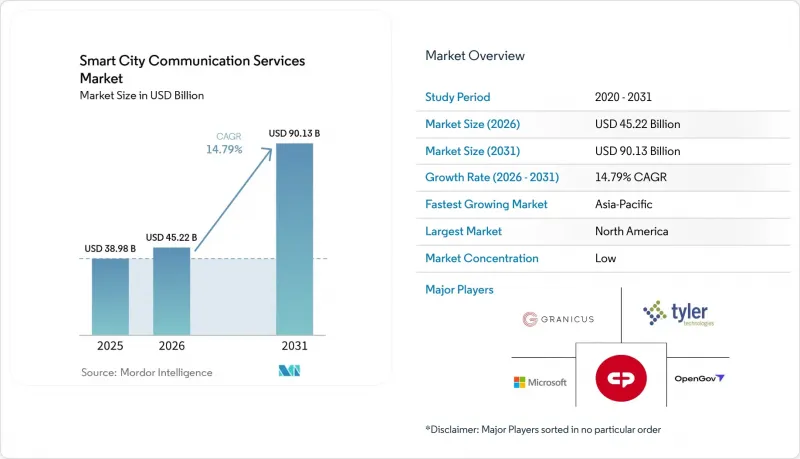
據 Mordor Intelligence 稱,2025 年智慧城市通訊服務市場價值為 389.8 億美元,預計到 2031 年將達到 901.3 億美元,而 2026 年為 452.2 億美元,預測期(2026-2031 年)的複合年成長率為 14.79%。
本報告按通訊技術(公共資訊、公民參與等)、應用(智慧管治、智慧運輸移動、永續性與環境、城市規劃與發展、公共產業)、最終用戶(地方政府、市政府、專門公共機構等)和地區進行細分。市場預測以美元計價。
全球智慧城市通訊服務市場趨勢及洞察
政府主導的數位管治和智慧城市項目
政府對城市數位基礎設施的投資持續推動智慧城市通訊服務市場的需求。西班牙於2025年12月啟動了「RedCyTI」計劃,撥款8,900萬歐元(約9,630萬美元)用於支持59個由歐洲區域發展基金資助的地方智慧城市數位化舉措。韓國正在實施“2026年人工智慧城市創新技術探索計畫”,投資300億韓元(約2174萬美元)用於人工智慧驅動的城市交通、環境和公共安全服務。在美國,HR 4649法案批准每年撥款1億美元用於智慧城市技術示範津貼,其中包括通訊服務。此類專案支援多年採購,並減少對年度地方預算決策的依賴。這種資金籌措結構為供應商提供了更清晰的續約機會,同時也使城市能夠規劃更廣泛的服務平台。
基於雲端原生、人工智慧的全通路公民溝通
從各自獨立的政府入口網站轉向互聯互通的通訊平台,正在重塑智慧城市通訊服務市場供應商的優先事項。 Granicus 在 2026 年 1 月的平台更新中發布了「政府體驗代理」功能,並計劃支援語音、簡訊和 WhatsApp,以及一個客戶資料平台,該平台可對電子郵件、服務請求和公共會議等資訊進行細分。作為其「CivicPlus Intelligence」舉措的一部分,CivicPlus 為美國和加拿大超過 12,000 個政府機構推出了六款人工智慧產品,這些機構服務於 3.4 億居民。 2026 年 5 月,英國(GDS)推出了“GOV.UK Chat”,在 GOV.UK 應用內提供了一個由政府控制的互動式管道。這些服務的推出凸顯了通路整合、居民偏好以及無縫過渡到公共服務工作流程的重要性。如果城市使用多個管道但缺乏資料共用,則面臨訊息重複和服務品質不一致的更高風險。
預算限制和較長的公共採購週期
預算壓力和冗長的採購流程將減緩智慧城市通訊服務在市場上的普及,尤其是在數位化專案尚未納入常規營運預算的情況下。德國資訊科技委員會(Bitkom)認為,專案週期之外的長期資金籌措以及能夠促進創新的採購體係是德國智慧城市的優先事項。專案津貼和續約資金之間的缺口會阻礙多年期平台合約的簽訂。在歐盟和北美,從需求定義到服務上線,採購週期可能需要18到36個月。這種延遲可能使供應商得以推進其產品計劃,而市政當局卻仍在使用過時的系統。旨在確保課責的法規也可能使那些在公共部門擁有良好業績記錄的成熟供應商受益。
細分市場分析
到2025年,公共資訊和宣傳服務將佔智慧城市通訊服務市場佔有率的35.45%,成為通訊技術領域最大的類別。法定緊急警報、官方資訊入口網站和政府通知網路正在推動對這些服務的穩定需求。區域廣播節點、通知中間件和群發通訊平台需要持續維護,因此這些合約通常為期多年。智慧城市通訊服務市場繼續依賴這些權威管道來進行緊急和日常公共關係宣傳活動。 GOV.UK Chat於2026年5月上線,在短短幾週內處理了超過15,000個問題,這表明官方資訊服務在保持政府控制的同時,正變得越來越互動式。
預計2026年至2031年間,公民參與和諮詢服務(CECS)的複合年成長率將達到16.36%。數位化參與工具支援就地方計畫、服務計畫和社區優先事項進行諮詢。根據德國《2025年智慧城市指數》,89%的受訪城市正在使用線上參與平台,45%的城市已部署聊天機器人回覆市民諮詢。 Go Vocal計畫已在14個國家開展,其在鹽湖城的實施在第一年就涵蓋了超過10%的人口,並支持了超過25個計畫。行為改變和在地推廣服務支持公共衛生、永續性和本地宣傳活動。這些領域的穩定發展反映出人們需要證據來證明,推廣的角色不僅僅是創造互動,而是真正帶來行為改變。
區域分析
到2025年,北美將佔據智慧城市通訊服務市場38.42%的佔有率。成熟的消費技術、智慧型手機的高普及率以及聯邦和州級的數位化要求正在推動該地區的需求。美國司法部於2024年最終確定了《美國殘疾人法案》(ADA)第2章關於網路無障礙的規定,並為人口超過5萬的城市設定了2027年4月26日的殘障人士期限。這項要求使得無障礙投資成為傳統的採購重點。同時,T-Mobile於2025年2月與紐約市簽署的合約為公共安全部門和緊急應變人員提供支援。此外,加州的AB-2474法案要求在2027年7月1日前簽訂一份全州範圍內的綜合契約,用於開發可互通的預警和早期預警軟體。
預計2026年至2031年,亞太地區智慧城市通訊服務市場將以16.05%的複合年成長率成長,在所有地區中成長最高。印度、日本和韓國政府主導的智慧城市計畫持續推動對數位化服務平台的需求。在印度,人工智慧語音聊天機器人「Samadhan Didi」於2026年5月推出,居民可以使用他們偏好的本地語言進行申訴。東京的“智慧城市2025計劃”旨在到2030年實現“市政廳全面數位化”,而韓國的“智慧城市資料中心2026”項目則支持政府數據共用,以服務於市民溝通平台。這些項目旨在滿足各個城市在語言、規模和訪問方面的不同需求。
在歐洲,受「數位十年」目標和「電子化政府基準」的推動,對數位化的需求仍然強勁。 「電子化政府基準」評估了到2025年100項關鍵公共服務的數位轉型情況。根據德國的“2025年智慧城市指數”,71%的市政服務已實現線上化,45%的城市已部署人工智慧聊天機器人。 2026年4月,斯圖加特推出了改版後的市民參與入口網站,該網站採用了SUMM AI的簡明語言翻譯功能,並利用DeepL提供12種語言支援。雖然南美洲、中東和非洲仍處於實施初期,但巴西的「2026年智慧城市」計畫和科威特的長期網路協議表明,公共部門對數位化的投入正在擴大。
其他好處:
- Excel格式的市場預測(ME)表
- 3個月的分析師支持
目錄
第1章:引言
- 研究假設和市場定義
- 調查範圍
第2章:調查方法
第3章執行摘要
第4章 市場狀況
- 市場概覽
- 宏觀經濟因素對市場的影響
- 市場促進因素
- 政府資助的數位管治和智慧城市項目
- 向雲端原生、人工智慧賦能的全通路公民溝通轉型
- 對緊急警報和即時公共安全資訊傳播的需求日益成長。
- 對可衡量的公民體驗和服務實施成果的需求
- 無障礙合規的最後期限將導致預算支出增加。
- 消除假訊息、恢復信任,提高了市政府官方資訊傳播管道的重要性。
- 市場限制因素
- 預算限制和漫長的公共採購
- 與網路安全、隱私和舊有系統整合相關的風險。
- 僅依靠數位推廣造成的疲勞和信任差距正在降低參與品質。
- 對多語言和包容性溝通的要求增加了分銷的複雜性。
- 產業價值鏈分析
- 監理情勢
- 技術展望
- 波特五力分析
第5章 市場規模與成長預測
- 透過通訊技術
- 公共關係和意識提升服務
- 公民參與和諮詢服務
- 行為支持和社區支持服務
- 透過使用
- 智慧管治
- 智慧運輸
- 永續性與環境
- 公共產業與資源管理
- 公安
- 都市計畫與發展
- 最終用戶
- 地方政府和市政廳
- 專門的公共機構
- 區域和國家政府機構
- 官民合作關係(PPP)和合資企業
- 其他最終用戶
- 按地區
- 北美洲
- 美國
- 加拿大
- 墨西哥
- 南美洲
- 巴西
- 阿根廷
- 其他南美國家
- 歐洲
- 德國
- 英國
- 法國
- 義大利
- 西班牙
- 其他歐洲國家
- 亞太地區
- 中國
- 日本
- 印度
- 韓國
- 其他亞太國家
- 中東和非洲
- 沙烏地阿拉伯
- 阿拉伯聯合大公國
- 南非
- 其他中東和非洲國家
- 北美洲
第6章 競爭情勢
- 市場集中度
- 策略趨勢
- 市佔率分析
- 公司簡介
- Granicus, LLC
- CivicPlus, LLC
- CitizenLab NV
- Bang the Table Pty Ltd
- Social Pinpoint Pty Ltd
- PublicInput, Inc.
- Nextdoor Holdings, Inc.
- Tyler Technologies, Inc.
- OpenGov, Inc.
- Microsoft Corporation
- International Business Machines Corporation
- Cisco Systems, Inc.
- NEC Corporation
- Siemens AG
- Huawei Technologies Co., Ltd.
- Oracle Corporation
- Amazon Web Services, Inc.
- SAP SE
- Schneider Electric SE
- Honeywell International Inc.
第7章 市場機會與未來展望
According to Mordor Intelligence, the smart city communication services market size was valued at USD 38.98 billion in 2025 and estimated to grow from USD 45.22 billion in 2026 to reach USD 90.13 billion by 2031, at a CAGR of 14.79% during the forecast period (2026-2031).
This report is Segmented by Communication Technology (Public Information, Citizen Engagement, and More), Application (Smart Governance, Smart Mobility, Sustainability and Environment, Urban Planning and Development, and Utilities), End User (Municipal and City Governments, Specialized Public Agencies, and More), and Geography. The Market Forecasts are Provided in Terms of Value (USD).
Global Smart City Communication Services Market Trends and Insights
Government-Funded Digital Governance and Smart City Programs
Government investment in urban digital infrastructure remains a durable source of demand for the Smart city communication services market. Spain launched the RedCyTI program in December 2025, providing EUR 89 million, USD 96.3 million, for 59 local smart city digitalization initiatives supported by the European Regional Development Fund. South Korea is running its 2026 AI City Innovation Technology Exploration Program with KRW 30 billion (USD 21.74 million) for AI-enabled urban transportation, environmental, and citizen safety services. In the United States, H.R. 4649 authorizes USD 100 million each year for smart city technology demonstration grants, including communication services. Such programs support multi-year procurement and reduce dependence on annual local budget decisions. This funding structure gives vendors clearer renewal opportunities while allowing cities to plan broader service platforms.
Cloud-Native, AI-Enabled, and Omnichannel Citizen Communication
The shift from separate government portals to connected communication platforms is reshaping supplier priorities in the Smart city communication services market. Granicus released its January 2026 platform update with Government Experience Agent capabilities and planned voice, SMS, and WhatsApp support, alongside a customer data platform for segmentation across email, service requests, and public meetings. CivicPlus launched 6 AI products under its CivicPlus Intelligence initiative for more than 12,000 government organizations that serve 340 million residents in the United States and Canada. The UK Government Digital Service launched GOV.UK Chat in May 2026, providing a government-controlled conversational channel within the GOV.UK app. These offerings shift attention toward channel coordination, resident preferences, and reliable handoffs to public service workflows. Cities that use several channels without shared data face a higher risk of duplicate messaging and uneven service quality.
Budget Constraints and Long Public Procurement Cycles
Budget pressure and prolonged procurement processes can slow deployment in the Smart city communication services market, especially where digital programs are not yet part of regular operating budgets. Bitkom identified permanent financing beyond project periods and innovation-friendly procurement as priority needs for smart cities in Germany. A gap between project grants and renewal funding can disrupt multi-year platform contracts. European Union and North American procurement cycles may take 18-36 months from defining requirements to launch. That timing can leave cities using older systems while vendor product plans move ahead. Rules intended to provide accountability can also favour established suppliers with prior public-sector references.
Other drivers and restraints analyzed in the detailed report include:
- Emergency Alerts and Real-Time Public Safety Messaging
- Measurable Citizen Experience and Service Adoption Outcomes
- Cybersecurity, Privacy, and Legacy Integration Risk
For complete list of drivers and restraints, kindly check the Table Of Contents.
Segment Analysis
Public Information and Awareness Services held 35.45% of Smart city communication services market share in 2025, making them the largest communication technology category. Legally required emergency alerts, official information portals, and government notification networks create stable demand for these services. Their contracts often run over multiple years because cell broadcast nodes, notification middleware, and mass messaging platforms require ongoing maintenance. The Smart city communication services market continues to rely on these authoritative channels during emergencies and routine public information campaigns. GOV.UK Chat handled more than 15,000 questions during its first weeks after the May 2026 launch, showing how official information services are becoming conversational while remaining government-controlled.
Citizen Engagement and Consultation Services (CECS) is projected to grow at a 16.36% CAGR from 2026 to 2031. Digital participation tools support consultation on local projects, service plans, and community priorities. Germany's Smart City Index 2025 found that 89% of surveyed cities used online participation platforms and 45% had deployed chatbots for citizen inquiries. Go Vocal operates across 14 countries, while Salt Lake City's deployment reached more than 10% of residents and supported more than 25 projects in its first year. Behavioural and Community Outreach Services support public health, sustainability, and neighbourhood campaigns. Their steadier development reflects demand for evidence that outreach changes behaviour rather than only generating interactions.
Complete Report Scope:
- By Communication Technology
- Public Information and Awareness Services
- Citizen Engagement and Consultation Services
- Behavioral and Community Outreach Services
- By Application
- Smart Governance
- Smart Mobility
- Sustainability and Environment
- Utilities and Resource Management
- Public Safety
- Urban Planning and Development
- By End User
- Municipal and City Governments
- Specialized Public Agencies
- Regional and National Government Bodies
- Public-Private Partnerships (PPPs) and Joint Ventures
- Other End Users
- By Geography
- North America
- United States
- Canada
- Mexico
- South America
- Brazil
- Argentina
- Rest of South America
- Europe
- Germany
- United Kingdom
- France
- Italy
- Spain
- Rest of Europe
- Asia-Pacific
- China
- Japan
- India
- South Korea
- Rest of Asia-Pacific
- Middle East and Africa
- Saudi Arabia
- United Arab Emirates
- South Africa
- Rest of Middle East and Africa
- North America
Geography Analysis
North America accounted for 38.42% of Smart city communication services market share in 2025. Mature civic technology procurement, high smartphone use, and federal and state digital requirements support regional demand. The U.S. Department of Justice finalized its ADA Title II web accessibility rule in 2024, with an April 26, 2027, deadline for local governments serving more than 50,000 people. This requirement makes accessibility spending a dated procurement priority, while T-Mobile's February 2025 New York City agreement supports public safety departments and first responders. California's AB-2474 also requires a statewide master contract for interoperable alert and early warning software by July 1, 2027.
Asia-Pacific is forecast to expand at a 16.05% CAGR from 2026 to 2031, the highest regional rate in the Smart city communication services market. Government-led smart city programs in India, Japan, and South Korea are creating repeated demand for digital service platforms. India launched the AI-powered Samadhan Didi voice chatbot in May 2026 so residents can register grievances in their preferred regional language. Tokyo's 2025 Smart City Plan aims for a Full Digital city hall by 2030, while South Korea's 2026 Smart City Data Hub project supports government data sharing for citizen communication platforms. These programs respond to language, scale, and access needs that differ across cities.
Europe maintains substantial demand through its Digital Decade goals and the eGovernment Benchmark, which assessed digital transformation across 100 key public services in 2025. Germany's Smart City Index 2025 found that 71% of municipal services were available online and 45% of cities used AI chatbots. Stuttgart launched its revised participation portal in April 2026 with SUMM AI plain-language translation and 12 language versions through DeepL. South America and the Middle East and Africa are earlier-stage regions, although Brazil's 2026 Cidades Mais Inteligentes call and Kuwait's long-term network agreement point to growing public commitment.
- Granicus, LLC
- CivicPlus, LLC
- CitizenLab NV
- Bang the Table Pty Ltd
- Social Pinpoint Pty Ltd
- PublicInput, Inc.
- Nextdoor Holdings, Inc.
- Tyler Technologies, Inc.
- OpenGov, Inc.
- Microsoft Corporation
- International Business Machines Corporation
- Cisco Systems, Inc.
- NEC Corporation
- Siemens AG
- Huawei Technologies Co., Ltd.
- Oracle Corporation
- Amazon Web Services, Inc.
- SAP SE
- Schneider Electric SE
- Honeywell International Inc.
Additional Benefits:
- The market estimate (ME) sheet in Excel format
- 3 months of analyst support
TABLE OF CONTENTS
1 INTRODUCTION
- 1.1 Study Assumptions and Market Definition
- 1.2 Scope of the Study
2 RESEARCH METHODOLOGY
3 EXECUTIVE SUMMARY
4 MARKET LANDSCAPE
- 4.1 Market Overview
- 4.2 Impact of Macroeconomic Factors on the Market
- 4.3 Market Drivers
- 4.3.1 Government-Funded Digital Governance and Smart City Programs
- 4.3.2 Shift to Cloud-Native, AI-Enabled, and Omnichannel Citizen Communication
- 4.3.3 Rising Need for Emergency Alerts and Real-Time Public Safety Messaging
- 4.3.4 Demand for Measurable Citizen Experience and Service Adoption Outcomes
- 4.3.5 Accessibility Compliance Deadlines Create Budgeted Spend
- 4.3.6 Misinformation Response and Trust Rebuilding Elevate Official City Channels
- 4.4 Market Restraints
- 4.4.1 Budget Constraints and Long Public Procurement Cycles
- 4.4.2 Cybersecurity, Privacy, and Legacy Integration Risk
- 4.4.3 Digital-Only Outreach Fatigue and Trust Gaps Reduce Participation Quality
- 4.4.4 Multilingual and Inclusive Communication Mandates Raise Delivery Complexity
- 4.5 Industry Value Chain Analysis
- 4.6 Regulatory Landscape
- 4.7 Technological Outlook
- 4.8 Porter's Five Forces Analysis
- 4.8.1 Threat of New Entrants
- 4.8.2 Bargaining Power of Buyers
- 4.8.3 Bargaining Power of Suppliers
- 4.8.4 Threat of Substitutes
- 4.8.5 Intensity of Competitive Rivalry
5 MARKET SIZE AND GROWTH FORECASTS (VALUE)
- 5.1 By Communication Technology
- 5.1.1 Public Information and Awareness Services
- 5.1.2 Citizen Engagement and Consultation Services
- 5.1.3 Behavioral and Community Outreach Services
- 5.2 By Application
- 5.2.1 Smart Governance
- 5.2.2 Smart Mobility
- 5.2.3 Sustainability and Environment
- 5.2.4 Utilities and Resource Management
- 5.2.5 Public Safety
- 5.2.6 Urban Planning and Development
- 5.3 By End User
- 5.3.1 Municipal and City Governments
- 5.3.2 Specialized Public Agencies
- 5.3.3 Regional and National Government Bodies
- 5.3.4 Public-Private Partnerships (PPPs) and Joint Ventures
- 5.3.5 Other End Users
- 5.4 By Geography
- 5.4.1 North America
- 5.4.1.1 United States
- 5.4.1.2 Canada
- 5.4.1.3 Mexico
- 5.4.2 South America
- 5.4.2.1 Brazil
- 5.4.2.2 Argentina
- 5.4.2.3 Rest of South America
- 5.4.3 Europe
- 5.4.3.1 Germany
- 5.4.3.2 United Kingdom
- 5.4.3.3 France
- 5.4.3.4 Italy
- 5.4.3.5 Spain
- 5.4.3.6 Rest of Europe
- 5.4.4 Asia-Pacific
- 5.4.4.1 China
- 5.4.4.2 Japan
- 5.4.4.3 India
- 5.4.4.4 South Korea
- 5.4.4.5 Rest of Asia-Pacific
- 5.4.5 Middle East and Africa
- 5.4.5.1 Saudi Arabia
- 5.4.5.2 United Arab Emirates
- 5.4.5.3 South Africa
- 5.4.5.4 Rest of Middle East and Africa
- 5.4.1 North America
6 COMPETITIVE LANDSCAPE
- 6.1 Market Concentration
- 6.2 Strategic Moves
- 6.3 Market Share Analysis
- 6.4 Company Profiles (includes Global Level Overview, Market Level Overview, Core Segments, Financials as available, Strategic Information, Market Rank/Share, Products and Services, Recent Developments)
- 6.4.1 Granicus, LLC
- 6.4.2 CivicPlus, LLC
- 6.4.3 CitizenLab NV
- 6.4.4 Bang the Table Pty Ltd
- 6.4.5 Social Pinpoint Pty Ltd
- 6.4.6 PublicInput, Inc.
- 6.4.7 Nextdoor Holdings, Inc.
- 6.4.8 Tyler Technologies, Inc.
- 6.4.9 OpenGov, Inc.
- 6.4.10 Microsoft Corporation
- 6.4.11 International Business Machines Corporation
- 6.4.12 Cisco Systems, Inc.
- 6.4.13 NEC Corporation
- 6.4.14 Siemens AG
- 6.4.15 Huawei Technologies Co., Ltd.
- 6.4.16 Oracle Corporation
- 6.4.17 Amazon Web Services, Inc.
- 6.4.18 SAP SE
- 6.4.19 Schneider Electric SE
- 6.4.20 Honeywell International Inc.
7 MARKET OPPORTUNITIES AND FUTURE OUTLOOK
- 7.1 White-Space and Unmet-Need Assessment

 永續海洋基礎設施市場分析及至2035年的預測:按類型、產品、服務、技術、組件、應用、材料類型、部署方式、最終用戶和安裝類型
 智慧城市基礎設施市場預測至2034年-按基礎設施領域、服務類型、技術、最終用戶和區域分類的分析智慧城市市場預測至2034年-按組件、技術、應用和區域分類的分析
 政策促進因素、技術發展以及在建築物中引入太陽能發電所面臨的挑戰。
 智慧公共安全舉措:全球,2026 年2035年前自給自足型都市公園市場分析和預測:按類型、產品、服務、技術、組件、應用、材料類型、最終用戶、安裝類型和解決方案。快速城市綠化系統市場分析及預測(至2035年):按類型、產品、服務、技術、組件、應用、材料類型、最終用戶、安裝模式和解決方案分類數位旅遊生態系統市場預測至2034年-按解決方案類型、整合類型、連接技術、交通方式、最終用戶和地區分類的全球分析
 智慧城市市場:全球市場預測,2026-2032年
 智慧城市:市場佔有率分析、產業趨勢與統計、成長預測(2026-2031)