


 |
市場調查報告書
商品編碼
2119243
創作者行銷服務:市場佔有率分析、產業趨勢與統計、成長預測(2026-2031)Creator Marketing Services - Market Share Analysis, Industry Trends & Statistics, Growth Forecasts (2026 - 2031) |
||||||

※ 本網頁內容可能與最新版本有所差異。詳細情況請與我們聯繫。
據 Mordor Intelligence 稱,2025 年創作者行銷服務市場價值 542.2 億美元,預計到 2031 年將達到 1925.5 億美元,而 2026 年為 675.2 億美元,預測期(2026-2031 年)複合年成長率為 23.32%。
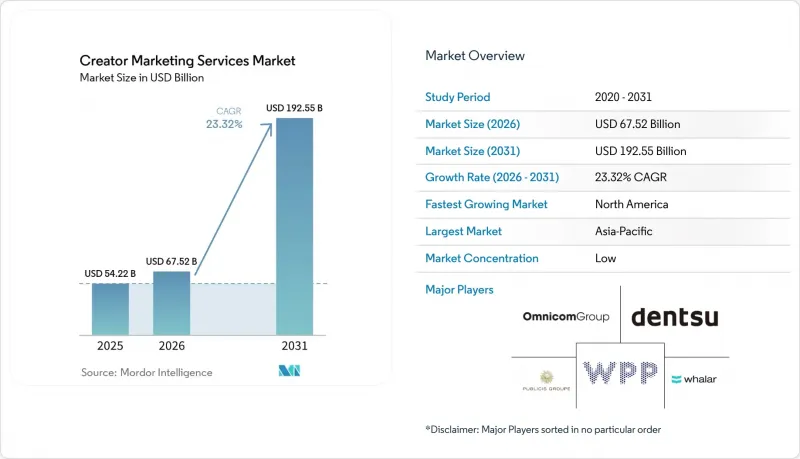
本報告按服務類型(創作者發現與甄選服務、宣傳活動管理服務、創作者關係管理服務等)、終端用戶行業(時尚美妝、消費品、食品飲料、科技電子、醫療保健、旅遊酒店等)和地區進行細分。市場預測以美元計價。
全球創作者行銷服務市場趨勢與洞察
數位廣告預算向創作者主導媒體的重新分配正在推進。
預算來源的轉變是創作者行銷服務市場的主要驅動力。預計到2025年,創作者經濟領域的廣告支出將達到370億美元,到2026年將達到439.1億美元。互動廣告局(IAB)將創作者廣告定位為核心媒體管道,使其更接近規劃週詳的媒體活動,而非只是試驗誤式的嘗試。廣告支出正擴大從傳統的數位和付費管道重新分配,而不再僅僅資金籌措新增的廣告預算。這一趨勢促使人們對彙報、歸因和基於效果的合約提出了更高的期望。同時,能夠運用成熟媒體管道的管理方法來運作創作者專案的服務供應商的需求也在不斷成長。品牌正從偶爾的宣傳活動轉向需要定期規劃和內容交付的持續性創作者專案。如果專案能夠展現出永續的商業性價值,這種轉變將提高創作者預算的穩定性。此外,服務提供者越來越需要將宣傳活動活動與業務指標(而不僅僅是互動率)掛鉤。創作者行銷服務市場正受益於這一轉變,因為廣告商需要支援來發現、簽約、製作、追蹤以及與創作者建立關係。隨著預算課責的加強,衡量能力有限的代理商可能難以證明其收費的合理性。能夠提供可靠數據的平台可以成為品牌營運模式的核心。
社群電商整合的擴展正在推動可購買的創作者內容的出現。
社群電商拓展了內容創作者的角色,使其不再局限於品牌推廣,而是延伸至交易支援。如今,創作者的內容能夠引導消費者在同一平台會話中完成從產品發現到購買的整個流程。在產品展示、評論和個人化推薦能夠有效影響轉換率的品類中,此過程尤其重要。隨著代理商管理與創作者的內容和電商關係,創作者行銷服務市場也從中受益。服務供應商需要協調連結、聯盟條款、產品庫存、創新核准和效果報告等工作。這些活動需要比傳統贊助貼文宣傳活動更有效率的工作流程。在中國和印度,社交和電商系統緊密融合,這種影響尤其顯著。在時尚、美容、消費品、食品飲料和旅遊等行業,創作者可以推廣產品並提供直接購買管道,這為社交電商提供了清晰的應用案例。品牌團隊可以利用聯盟行銷結構將獎勵與銷售績效掛鉤,為財務和市場團隊提供更明確的專案評估標準。此外,隨著創作者參與客戶獲取流程中,創作者的選擇也變得更加關鍵。因此,在創作者行銷服務市場中,擁有電商數據並與零售商和平台建立穩固聯繫的企業將更具優勢。
持續衡量和投資報酬率歸因的挑戰阻礙了人們對預算編制的信心。
分散化的衡量標準仍然是創作者行銷服務市場的一大限制。創作者的發現、簽約、付款和效果報告通常由不同的工具處理。此外,平台報告系統所採用的指標和歸因規則各不相同。這使得廣告主難以直接比較不同宣傳活動的效果。 IAB 已將衡量和歸因問題認定為阻礙對創作者進一步投資的核心障礙。因此,當品牌無法將創作者的活動與業務成果直接關聯時,可能被迫依賴替代指標。對於購買週期長或線下銷售的產品,這個問題尤其突出。在這些情況下,僅憑瀏覽量和點擊量可能不足以判斷創作者的內容是否影響了後續購買。行銷團隊需要在 TikTok、Meta、YouTube 和其他平台上採用一致的定義和報告方法。代理商也需要在宣傳活動啟動前協調商業性目標、內容和衡量方法。能夠提供透明報告的供應商更有可能獲得持續的預算支援。在通用衡量方法得到更廣泛應用之前,創作者行銷服務市場在中期內仍將面臨許多限制因素。
細分市場分析
到2025年,創作者發掘和甄選服務將佔據創作者行銷服務市場29.33%的佔有率。這個市場定位反映了將創作者與合適的受眾、品牌和宣傳活動目標聯繫起來的重要性。當品牌與創作者建立長期合作關係時,甄選不當可能會對多個宣傳活動產生負面影響。宣傳活動管理服務和創作者關係管理服務負責協調、核准和支付創作者團隊等工作。這些服務使品牌能夠在無需大幅增加內部人員的情況下擴展其專案規模。
內容創作和製作服務市場預計將在2026年至2031年間以24.66%的複合年成長率成長。這個創作者行銷服務市場的主要驅動力是對可在各種平台上分發的內容的需求,這些平台包括自然社交媒體貼文、付費夥伴關係廣告、零售媒體和連網電視。品牌越來越傾向於尋找可在多個媒體平台上重複使用的創作者內容。人工智慧驅動的製作工具有助於提高創作者的產出,同時確保內容針對每個平台進行客製化。 Agentio表示,與傳統代理商6-10週的製作週期相比,其基礎設施能夠幫助品牌在不到一周的時間內完成從創新構思到實際夥伴關係廣告發布的整個流程。
區域分析
到2025年,北美將佔創作者行銷服務市場36.52%的佔有率。美國在該地區佔據主導地位,這主要歸功於其集中了許多大型廣告商、平台、代理商和創作者網路。互動廣告協會(IAB)將創作者廣告指定為主要媒體管道,這促進了更規範的預算規劃的發展。聯邦貿易委員會(FTC)的指導方針制定了關於代言、影響者和評論的規則。 「消費者評論和推薦規則」進一步完善了針對虛假陳述和誤導性行為的合規框架。
加拿大正在培養能夠支持跨境宣傳活動的雙語創作人才。在墨西哥,隨著創作者生態系統和電子商務活動的蓬勃發展,其重要性日益凸顯。預計到2027年,美國廣告商將進一步加強創作者驅動的內容創作與付費推廣之間的合作。在歐洲,對資訊揭露、資料隱私要求以及人工智慧內容透明度義務的期望正在塑造市場格局。德國、英國、法國、義大利和西班牙已形成成熟的創作者行銷業務區域基礎。清晰的資訊揭露能夠透過建立透明的贊助活動規則來增強廣告商的信心。
亞太地區預計將成為成長最快的地區,到2031年複合年成長率將達到24.34%。中國的直播電商系統正在建造從內容到購買的直接路徑。印度的創作者經濟受益於行動裝置的廣泛使用以及與國內電商平台的緊密整合。韓國正將其K-beauty和K-pop創作者網路與全球文化影響力結合。日本的合規要求正在促進品牌和代理商之間正式的資訊揭露程序。南美、中東和非洲提供了進一步的成長機遇,得益於行動優先的使用者群體和創作者的信任,這些地區正推動商業活動突破傳統媒體的界限。
其他好處:
- Excel格式的市場預測(ME)表
- 3個月的分析師支持
目錄
第1章:引言
- 研究假設和市場定義
- 調查範圍
第2章:調查方法
第3章執行摘要
第4章 市場狀況
- 市場概覽
- 市場促進因素
- 將數位廣告預算重新分配給創作者主導媒體的趨勢正在擴大。
- 與社群電商的融合日益加深,推動了可購買的創作者內容的普及。
- 利用人工智慧進行創作者發現、匹配和宣傳活動最佳化。
- 全球品牌正在加速採用短視訊格式。
- B2B 企業透過內容創作者行銷來提升其在 LinkedIn 上的思想領袖和經營團隊地位。
- 將基於代理的人工智慧引入自主創作和宣傳活動管理:減少人工工作量
- 市場限制因素
- 衡量和投資報酬率歸因方面仍然存在挑戰,這削弱了人們對預算的信心。
- 網紅詐騙、虛假互動和品牌安全事件正在損害廣告商的信譽。
- 創作者倦怠和高離職率正在阻礙長期品牌夥伴關係的延續。
- 合規性問題很複雜,因為各國對揭露贊助內容的法規結構各不相同。
- 產業價值鏈分析
- 監理情勢
- 技術展望
- 波特五力分析
- 宏觀經濟因素對市場的影響
第5章 市場規模與成長預測
- 按服務類型
- 創作者發現並選擇服務
- 宣傳活動管理服務
- 創作者關係管理服務
- 內容創作與製作服務
- 績效追蹤與分析服務
- 其他服務類型
- 按最終用戶行業分類
- 時尚與美妝
- 消費品
- 食品/飲料
- 技術與電子
- 醫療保健與健康
- 旅遊與飯店
- 遊戲與娛樂
- 其他終端用戶產業
- 按地區
- 北美洲
- 美國
- 加拿大
- 墨西哥
- 南美洲
- 巴西
- 阿根廷
- 智利
- 其他南美國家
- 歐洲
- 德國
- 英國
- 法國
- 義大利
- 西班牙
- 其他歐洲國家
- 亞太地區
- 中國
- 日本
- 印度
- 韓國
- 澳洲
- 其他亞太國家
- 中東和非洲
- 沙烏地阿拉伯
- 阿拉伯聯合大公國
- 南非
- 其他中東和非洲國家
- 北美洲
第6章 競爭情勢
- 市場集中度
- 策略趨勢
- 市佔率分析
- 公司簡介
- Publicis Groupe SA
- WPP plc
- Interpublic Group of Companies, Inc.
- Omnicom Group Inc.
- Dentsu Inc.
- Daniel J. Edelman Holdings, Inc.
- Whalar Group Ltd.
- IZEA Worldwide, Inc.
- Viral Nation Inc.
- Billion Dollar Boy Ltd.
- Open Influence, Inc.
- Obviously Social LLC
- HireInfluence LLC
- Socially Powerful Ltd.
- The Influencer Marketing Factory LLC
- CreatorIQ Inc.
- Traackr, Inc.
- Upfluence SAS
- Onalytica Ltd.
- TopRank Marketing, Inc.
- NeoReach Inc.
- Linqia, Inc.
- LTK Co.
- AnyMind Group, Inc.
- Later, Inc.
- Meltwater NV
- Impact.com, Inc.
- Grin Technologies Inc.
第7章 市場機會與未來展望
According to Mordor Intelligence, the creator marketing services market size was valued at USD 54.22 billion in 2025 and is estimated to grow from USD 67.52 billion in 2026 to reach USD 192.55 billion by 2031, at a CAGR of 23.32% during the forecast period (2026-2031).
This report is Segmented by Service Type (Creator Discovery and Selection Services, Campaign Management Services, Creator Relationship Management Services, and More), End-User Industry (Fashion and Beauty, Consumer Goods, Food and Beverage, Technology and Electronics, Healthcare and Wellness, Travel and Hospitality, and More), and Geography. The Market Forecasts are Provided in Terms of Value (USD).
Global Creator Marketing Services Market Trends and Insights
Rising Reallocation of Digital Advertising Budgets Toward Creator-Led Media
The shift in budget source is a major force in the creator marketing services market. Creator-economy advertising spending reached USD 37 billion in 2025 and is expected to reach USD 43.91 billion in 2026. The IAB described creator advertising as a core media channel, which places it closer to planned media activity than discretionary experimentation. Spending is increasingly redirected from traditional digital and paid channels rather than funded only through new advertising budgets. That movement brings stronger expectations for reporting, attribution, and performance-based contracts. It also increases demand for service providers that can operate creator programs with the controls used in established media channels. Brands are moving from occasional activations to continuous creator programs that need regular planning and supply of content. This change can make creator budgets more durable when programs show consistent commercial value. It also puts pressure on providers to connect campaign activity with business measures rather than engagement alone. The creator marketing services market gains from this shift because advertisers need discovery, contract administration, production, tracking, and creator relationship support. Agencies with limited measurement capabilities may find it harder to defend their fees as budgets become more accountable. Platforms that provide reliable data can become central to a brand's operating model.
Expansion of Social Commerce Integrations Driving Shoppable Creator Content
Social commerce expands the role of creator activity from awareness building to transaction support. Creator content can now lead consumers from product discovery to a purchase within the same platform session. This process is especially relevant to categories where demonstrations, reviews, and personal recommendations influence conversion. The creator marketing services market benefits when agencies manage both content and commerce-linked creator relationships. Service providers must then coordinate links, affiliate terms, product availability, creative approvals, and performance reporting. These activities require a more connected workflow than a conventional sponsored post campaign. The effect is particularly important across China and India, where social and commerce systems are closely connected. Fashion, beauty, consumer goods, food and beverage, and travel have clear use cases because creators can showcase products and offer a direct purchase path. Brand teams can use affiliate structures to connect compensation with sales outcomes. This gives finance and marketing teams a clearer basis for assessing program results. It also makes creator selection more consequential because the creator becomes part of the customer acquisition process. The creator marketing services market can therefore reward operators with commerce data and established retailer or platform connections.
Persistent Measurement and ROI Attribution Challenges Limiting Budget Confidence
Measurement fragmentation remains a major restraint for the creator marketing services market. Discovery, contracting, payment, and performance reporting are often handled through separate tools. Platform reporting systems also use different measures and attribution rules. This makes direct comparisons between campaigns harder for advertisers. The IAB identified measurement and attribution as a central barrier to additional creator investment. Brands may therefore rely on proxy metrics when they cannot connect creator activity to a business outcome. The issue is more significant for products with long buying cycles or sales that occur offline. In these cases, a view or click alone may not show whether creator content influenced a later purchase. Marketing teams need consistent definitions and reporting methods across TikTok, Meta, YouTube, and other platforms. Agency operations must also align commercial objectives, content, and measurement before a campaign begins. Providers that can produce transparent reporting are better placed to retain recurring budgets. The creator marketing services market will continue to face a medium-term constraint until shared measurement practices become more widely adopted.
Other drivers and restraints analyzed in the detailed report include:
- AI-Enabled Creator Discovery, Matching, and Campaign Optimization
- Accelerating Adoption of Short-Form Video Formats by Brands Globally
- Influencer Fraud, Fake Engagement, and Brand Safety Incidents Eroding Advertiser Trust
For complete list of drivers and restraints, kindly check the Table Of Contents.
Segment Analysis
Creator Discovery and Selection Services held 29.33% of the creator marketing services market share in 2025. The position reflects the importance of matching a creator with the right audience, brand setting, and campaign objective. A poor selection can affect several campaigns when brands work with creators on an ongoing basis. Campaign Management Services and Creator Relationship Management Services address the operational work of coordinating creator groups, approvals, and payments. These services help brands scale programs without increasing internal staffing at the same pace.
Content Creation and Production Services is projected to record a 24.66% CAGR from 2026 to 2031. The creator marketing services market size for this service is supported by demand for content that can appear in organic social posts, paid partnership ads, retail media, and connected television. Brands increasingly seek creator material that can be adapted across several media placements. AI-assisted production tools can help creators increase output while keeping content suited to each platform. Agentio stated that its infrastructure allowed brands to move from creative insight to live partnership ads in less than 1 week. This compares with traditional agency production schedules of 6-10 weeks described in the supplied material.
Complete Report Scope:
- By Service Type
- Creator Discovery and Selection Services
- Campaign Management Services
- Creator Relationship Management Services
- Content Creation and Production Services
- Performance Tracking and Analytics Services
- Other Service Types
- By End-User Industry
- Fashion and Beauty
- Consumer Goods
- Food and Beverage
- Technology and Electronics
- Healthcare and Wellness
- Travel and Hospitality
- Gaming and Entertainment
- Other End-user Industries
- By Geography
- North America
- United States
- Canada
- Mexico
- South America
- Brazil
- Argentina
- Chile
- Rest of South America
- Europe
- Germany
- United Kingdom
- France
- Italy
- Spain
- Rest of Europe
- Asia-Pacific
- China
- Japan
- India
- South Korea
- Australia
- Rest of Asia-Pacific
- Middle East and Africa
- Saudi Arabia
- United Arab Emirates
- South Africa
- Rest of Middle East and Africa
- North America
Geography Analysis
North America accounted for 36.52% of the creator marketing services market size in 2025. The United States leads the region because large advertisers, platforms, agencies, and creator networks are concentrated there. The IAB's treatment of creator advertising as a core media channel supports more formal budget planning. Federal Trade Commission guidance provides rules for endorsements, influencers, and reviews. The Consumer Reviews and Testimonials Rule adds a further compliance framework for deceptive practices.
Canada contributes bilingual creator talent that can support cross-border campaigns. Mexico is becoming more important as its creator ecosystem and e-commerce activity develop. U.S. advertisers are expected to bring creator production and paid amplification closer together by 2027. Europe is shaped by disclosure expectations, data privacy requirements, and AI-content transparency obligations. Germany, the United Kingdom, France, Italy, and Spain form a developed regional base for creator marketing operations. Clear disclosure can support advertiser confidence by setting transparent rules for sponsored activity.
Asia-Pacific is expected to be the fastest-growing regional area at a 24.34% CAGR through 2031. China's live-commerce systems support direct paths from content to purchases. India's creator economy benefits from widespread mobile usage and closer links to domestic commerce platforms. South Korea combines K-beauty and K-pop creator networks with global cultural influence. Japan's compliance requirements have encouraged formal disclosure procedures among brands and agencies. South America and the Middle East and Africa provide additional growth paths where mobile-first audiences and creator trust can extend commerce activity beyond traditional media.
- Publicis Groupe S.A.
- WPP plc
- Interpublic Group of Companies, Inc.
- Omnicom Group Inc.
- Dentsu Inc.
- Daniel J. Edelman Holdings, Inc.
- Whalar Group Ltd.
- IZEA Worldwide, Inc.
- Viral Nation Inc.
- Billion Dollar Boy Ltd.
- Open Influence, Inc.
- Obviously Social LLC
- HireInfluence LLC
- Socially Powerful Ltd.
- The Influencer Marketing Factory LLC
- CreatorIQ Inc.
- Traackr, Inc.
- Upfluence SAS
- Onalytica Ltd.
- TopRank Marketing, Inc.
- NeoReach Inc.
- Linqia, Inc.
- LTK Co.
- AnyMind Group, Inc.
- Later, Inc.
- Meltwater NV
- Impact.com, Inc.
- Grin Technologies Inc.
Additional Benefits:
- The market estimate (ME) sheet in Excel format
- 3 months of analyst support
TABLE OF CONTENTS
1 INTRODUCTION
- 1.1 Study Assumptions and Market Definition
- 1.2 Scope of the Study
2 RESEARCH METHODOLOGY
3 EXECUTIVE SUMMARY
4 MARKET LANDSCAPE
- 4.1 Market Overview
- 4.2 Market Drivers
- 4.2.1 Rising Reallocation of Digital Advertising Budgets Toward Creator-Led Media
- 4.2.2 Expansion of Social Commerce Integrations Driving Shoppable Creator Content
- 4.2.3 AI-Enabled Creator Discovery, Matching, and Campaign Optimization
- 4.2.4 Accelerating Adoption of Short-Form Video Formats by Brands Globally
- 4.2.5 B2B Enterprise Adoption of Creator Marketing for Thought Leadership and Executive Positioning on LinkedIn
- 4.2.6 Agentic AI Deployment in Autonomous Creator Campaign Management Reducing Human Overhead
- 4.3 Market Restraints
- 4.3.1 Persistent Measurement and ROI Attribution Challenges Limiting Budget Confidence
- 4.3.2 Influencer Fraud, Fake Engagement, and Brand Safety Incidents Eroding Advertiser Trust
- 4.3.3 Creator Talent Burnout and High Attrition Rates Disrupting Long-Term Brand Partnership Continuity
- 4.3.4 Fragmented Global Regulatory Frameworks for Sponsored Content Disclosure Creating Compliance Complexity
- 4.4 Industry Value Chain Analysis
- 4.5 Regulatory Landscape
- 4.6 Technological Outlook
- 4.7 Porter's Five Forces Analysis
- 4.7.1 Threat of New Entrants
- 4.7.2 Bargaining Power of Buyers
- 4.7.3 Bargaining Power of Suppliers
- 4.7.4 Threat of Substitute Products and Services
- 4.7.5 Competitive Rivalry within the Industry
- 4.8 Impact of Macroeconomic Factors on the Market
5 MARKET SIZE AND GROWTH FORECASTS (VALUE)
- 5.1 By Service Type
- 5.1.1 Creator Discovery and Selection Services
- 5.1.2 Campaign Management Services
- 5.1.3 Creator Relationship Management Services
- 5.1.4 Content Creation and Production Services
- 5.1.5 Performance Tracking and Analytics Services
- 5.1.6 Other Service Types
- 5.2 By End-User Industry
- 5.2.1 Fashion and Beauty
- 5.2.2 Consumer Goods
- 5.2.3 Food and Beverage
- 5.2.4 Technology and Electronics
- 5.2.5 Healthcare and Wellness
- 5.2.6 Travel and Hospitality
- 5.2.7 Gaming and Entertainment
- 5.2.8 Other End-user Industries
- 5.3 By Geography
- 5.3.1 North America
- 5.3.1.1 United States
- 5.3.1.2 Canada
- 5.3.1.3 Mexico
- 5.3.2 South America
- 5.3.2.1 Brazil
- 5.3.2.2 Argentina
- 5.3.2.3 Chile
- 5.3.2.4 Rest of South America
- 5.3.3 Europe
- 5.3.3.1 Germany
- 5.3.3.2 United Kingdom
- 5.3.3.3 France
- 5.3.3.4 Italy
- 5.3.3.5 Spain
- 5.3.3.6 Rest of Europe
- 5.3.4 Asia-Pacific
- 5.3.4.1 China
- 5.3.4.2 Japan
- 5.3.4.3 India
- 5.3.4.4 South Korea
- 5.3.4.5 Australia
- 5.3.4.6 Rest of Asia-Pacific
- 5.3.5 Middle East and Africa
- 5.3.5.1 Saudi Arabia
- 5.3.5.2 United Arab Emirates
- 5.3.5.3 South Africa
- 5.3.5.4 Rest of Middle East and Africa
- 5.3.1 North America
6 COMPETITIVE LANDSCAPE
- 6.1 Market Concentration
- 6.2 Strategic Moves
- 6.3 Market Share Analysis
- 6.4 Company Profiles (includes Global Level Overview, Market Level Overview, Core Segments, Financials as available, Strategic Information, Market Rank/Share, Products and Services, Recent Developments)
- 6.4.1 Publicis Groupe S.A.
- 6.4.2 WPP plc
- 6.4.3 Interpublic Group of Companies, Inc.
- 6.4.4 Omnicom Group Inc.
- 6.4.5 Dentsu Inc.
- 6.4.6 Daniel J. Edelman Holdings, Inc.
- 6.4.7 Whalar Group Ltd.
- 6.4.8 IZEA Worldwide, Inc.
- 6.4.9 Viral Nation Inc.
- 6.4.10 Billion Dollar Boy Ltd.
- 6.4.11 Open Influence, Inc.
- 6.4.12 Obviously Social LLC
- 6.4.13 HireInfluence LLC
- 6.4.14 Socially Powerful Ltd.
- 6.4.15 The Influencer Marketing Factory LLC
- 6.4.16 CreatorIQ Inc.
- 6.4.17 Traackr, Inc.
- 6.4.18 Upfluence SAS
- 6.4.19 Onalytica Ltd.
- 6.4.20 TopRank Marketing, Inc.
- 6.4.21 NeoReach Inc.
- 6.4.22 Linqia, Inc.
- 6.4.23 LTK Co.
- 6.4.24 AnyMind Group, Inc.
- 6.4.25 Later, Inc.
- 6.4.26 Meltwater NV
- 6.4.27 Impact.com, Inc.
- 6.4.28 Grin Technologies Inc.
7 MARKET OPPORTUNITIES AND FUTURE OUTLOOK
- 7.1 White-Space and Unmet-Need Assessment

 創作者經濟市場:依平台類型、收入模式、應用程式、最終用戶、內容類型、創作者經濟相關企業和地區分類
 創作者經濟市場規模、佔有率和成長分析:按平台介面類型、變現管道模式、創作者專業水平和地區分類-2026-2033年產業預測
 創作者經濟市場規模、佔有率和趨勢分析報告:按最終用途、平台類型、創新服務、收入管道、地區和細分市場預測(2026-2033 年)
 2026年全球創作者經濟市場報告虛擬形象經濟市場:按類型、應用程式、最終用戶和地區分類
 2026-2030年全球創作者經濟市場
 2032 年創作者經濟市場預測:按平台類型、創作者類型、收益模式、內容類別、最終用戶和地區進行的全球分析
 全球創作者經濟市場