


 |
市場調查報告書
商品編碼
2119239
用於直接鋰提取的功能性材料:市場佔有率分析、行業趨勢和統計數據以及成長預測(2026-2031 年)Direct Lithium Extraction Functional Materials - Market Share Analysis, Industry Trends & Statistics, Growth Forecasts (2026 - 2031) |
||||||

※ 本網頁內容可能與最新版本有所差異。詳細情況請與我們聯繫。
根據 Mordor Intelligence 預測,用於直接鋰提取的功能性材料市場規模預計將在 2025 年達到 3.1456 億美元,從 2026 年的 3.7008 億美元成長到 2031 年的 8.4881 億美元,在預測期(2026-2031 年)內複合成長率為 18.06%。
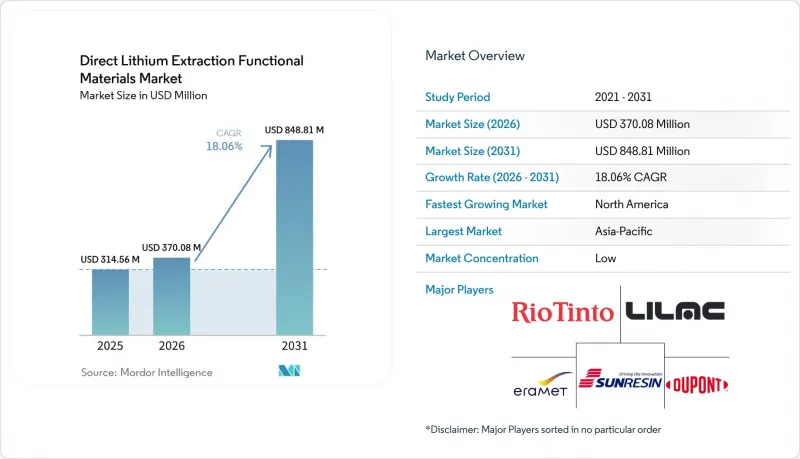
本報告材料類型(鋰選擇性吸附劑、離子交換樹脂及其他)、DLE技術(吸附式DLE、離子交換式DLE及其他)、鹽水來源(鹽湖鹽水及其他)、應用(鋰回收和濃縮及其他)以及地區(亞太地區、北美地區、歐洲地區及其他)進行細分。市場預測以美元計價。
用於直接鋰提取的功能材料的全球市場趨勢和見解。
供不應求
根據長期合約向汽車製造商供應電池正極材料的生產商對電池級氯化鋰和氫氧化鋰水合物的需求日益成長。這種需求推動了商業規模高選擇性功能材料的發展。直接鋰萃取功能材料的市場受到直接影響,因為這些材料決定了下游製程轉換前的回收率和雜質控制。國際能源總署 (IEA) 預測鋰供不應求將持續到 2035 年,這為持續投資改進提取材料提供了理由。哥倫比亞大學的一項分析表明,直接鋰萃取 (DLE) 的回收率超過 90%,而蒸發池的回收率僅為 40% 至 60%。此外,計畫中的正極材料產能僅為預計鋰礦開採產能的三分之一左右,增加了加工技術和產品品質改進的壓力。能夠在商業規模的鹽水條件下可靠地實現 99.9% 或更高雜質去除率的供應商,可以提供區別於通用材料的產品。
國內重要礦產政策及專案資金籌措
2026年4月7日,美國能源局宣佈為關鍵礦物和材料加速器計畫提供高達6,900萬美元的資金。第三主題領域直接針對具有成本競爭力的直接鋰提取(DLE)分離和加工技術。這筆資金是2025年8月宣布的10億美元關鍵礦物支持計畫的一部分,該計畫包括5億美元用於商業設施開發。這些措施有利於直接鋰提取(DLE)功能性材料的市場,因為資金降低了材料認證和商業採購的門檻。根據美國《通貨膨脹削減法案》,45倍稅額扣抵為國內礦物開採和加工提供10%的獎勵,促使採購重點轉向北美材料。加拿大的乾淨科技投資稅額扣抵為礦物開採和加工提供30%的稅額扣抵,E3鋰清水計畫也獲得了聯邦政府的支持。在歐洲,鋰被指定為戰略原料,以及歐盟電池法規的可追溯性要求,正在推動採購經過認證的低碳材料。
鹽水成分的變化和特定部位的設計
沒有一種用於直接鋰萃取 (DLE) 的功能性材料能夠在所有鹽水成分中都表現最佳。這項限制增加了工程工作量,並導致每個新計畫場地的合格耗時過長。因此,直接鋰提取 (DLE) 功能性材料市場需要適應特定場地的材料選擇,而不是標準化採購。歐洲地球科學與工程師協會 (EAGE) 的一項調查顯示,不同 DLE 供應商在最低鋰濃度、回收率、純度、化學品用量、用水量以及資本和營運成本的估算方面存在顯著差異。南美鹽湖的鹽水可能有較高的鎂鋰比,而中國柴達木盆地油田的鹽水則有較高的鈉鋰比,需要針對性的預處理。材料供應商可能需要 6 至 18 個月的認證期才能獲得大額訂單的承諾。阿根廷的授權差異以及智利鹽水回注法規的不確定性可能會進一步延遲最終的投資決策。
細分市場分析
截至2025年,鋰選擇性吸附劑佔材料類型細分市場的26.86%。這一佔有率反映了其在鹽湖、地熱和油田鹽水項目中的商業應用。吸附劑仍然是市場上用於直接提取鋰的功能材料中最成熟的材料類別。吸附型吸附劑,包括錳酸鋰和鈦基離子篩,在鋰濃度50-2000 mg/L時,回收率可達80%至98%。目前,中國、阿根廷和美國均有此類吸附劑的商業應用案例。離子交換樹脂在需要對低濃度鋰進行高選擇性萃取的場合中發揮重要作用。 Lilac Solutions公司報告稱,2025年,該公司使用其第五代離子交換技術,從濃度為70 mg/L的大鹽湖鹽水中實現了87%的鋰回收率。
預計到2031年,薄膜技術將以20.26%的複合年成長率成長。發表在《自然通訊》上的一項研究報告了一種薄膜奈米複合陽離子交換膜,其Li+/Na+選擇性為13.58,每回收1公斤鋰的能耗為34.83千瓦時。發表在《自然·水》上的一項研究報告稱,在電滲析過程中,Li+/Mg2+選擇性高達485,並且從189平方厘米的電堆中獲得了純度為99.6%的碳酸鋰。溶劑萃取方法雖然目標市場規模較小,但在一些特殊的高純度應用領域仍佔有重要地位。國內生產激勵措施可能促使部分吸附劑採購轉向北美。此外,功能性材料產業在直接鋰萃取方面也取得了薄膜製造技術的進步,這可能會在預測期內縮小與吸附劑的規模差距。
截至2025年,吸附式直接鋰萃取(DLE)佔了38.35%的市佔率。其技術成熟度達到9級(TRL 9),且能夠處理多種類型的鹽水,這為其優勢提供了支撐。吸附法已有的商業成功案例,為直接鋰萃取功能性材料的市場提供了支撐。中信國安科技於2026年1月運作了一條年產2萬噸的海水淡化鹽水吸附式鋰提取生產線。據該公司稱,該工廠的鋰回收率從75.38%提高到90.41%。 Eramet公司位於阿根廷的Centenario Latones計畫於2025年底實現穩定商業化生產,年產2.4萬噸鋰當量(LCE)。離子交換式直接鋰萃取技術在美國和加拿大也正透過同步商業化推廣而發展。
基於薄膜技術的直接鋰萃取(DLE)預計到2031年將以20.74%的複合年成長率成長。哥倫比亞大學的一項分析表明,膜分離技術目前處於技術成熟度(TRL)4-5級,預計回收率將超過99.9%。美國能源局曾報告過一種兩性離子層析法法,此方法無需使用試劑即可達到79.2%的鋰鈣產率。減少化學品的使用有助於加快專案在環境評估過程中的進展。 LiTHOS集團在從萃取到純化的薄膜技術製程的專利活動也表明,整合平台的競爭將日益激烈。用於直接鋰萃取的功能性材料的市場前景取決於這些技術進步能否從試驗規模轉化為可重複的工業規模性能。
區域分析
2025年,亞太地區將佔直接鋰萃取功能性材料市場44.49%的佔有率。中國鹽湖地區的直接鋰提取(DLE)活動以及一體化電池製造地的建設,直接催生了對上游材料的需求。因此,亞太地區材料的引進和下游電池生產支撐著直接鋰萃取功能性材料市場的發展。根據哥倫比亞大學分析,青海省的鋰儲量約佔中國蘊藏量的50%。中信國安科技於2026年1月在青海省運作的一條生產線,產能達2萬噸,全廠回收率達90.41%。由於青海省的許可證核准週期短,最短僅需40天,因此短期引進主要集中在青海省。日本和韓國則透過技術研發和海外專案投資參與其中。 Hydro Lithium於2026年7月簽署了一份為期10年的具有約束力的銷售協議,將獲得薩斯喀徹爾Prairie Lithium計畫一期100%的產量。這顯示韓國對上游DLE供應感興趣。
預計到2031年,北美市場將以20.43%的複合年成長率成長。聯邦政府的資金支持、生產計畫以及大鹽湖的開發都為此前景提供了支撐。直接鋰提取(DLE)功能性材料市場正受益於該地區政策獎勵和新興商業項目的協同效應。美國能源局提供的6,900萬美元加速器資金尤其用於支持具有成本競爭力的DLE分離和加工技術。 Lilac Solutions公司於2026年1月在內華達州弗恩利建造了一條商業規模的離子交換介質生產線。其初始年產能為200噸,旨在支援全球高達10萬噸的鋰離子交換膜(LCE)產量。 E3 Lithium公司的Clearwater計畫已獲得高達3,650萬加元的聯邦政府資金。同時,Prairie Lithium 計劃於 2026 年第四季開始投產。猶他州 2024 年的 HB 453 法案取消了從大鹽湖鹽水中提取礦物用水的障礙,為 Lilac Solutions 的年產 5000 噸(LCE)的工廠提供了支持。
用於直接鋰提取 (DLE) 的功能性材料市場在歐洲、南美洲以及中東和非洲地區存在差異。在歐洲,《基本原料法》規定的 27 個月許可期限以及歐洲投資銀行向 VULCAN ENERGY RESOURCES 提供的 5 億歐元貸款正在推動地熱 DLE 的發展。到 2025 年,智利、阿根廷和玻利維亞將佔全球鋰產量的 25%,國際能源總署 (IEA) 預測,到 2030 年,產量將增加近 50%。因此,擁有豐富鹽湖資源的南美地區極易受到該地區計畫進展的影響。在智利,力拓集團的 Marikunga 和 Salares Altoandinos 計畫正在推進中,分別投資 9 億美元和 4.25 億美元。智利缺乏針對 DLE 回注的具體法規,而阿根廷各省的規定不盡相同,這造成了短期實施風險。中東和非洲仍處於早期階段,但沙烏地阿拉伯的石油相關鹽水在可行性研究層面引起了人們的興趣。
其他好處
- Excel格式的市場預測(ME)表
- 3個月的分析師支持
目錄
第1章:引言
- 研究假設和市場定義
- 調查範圍
第2章:調查方法
第3章執行摘要
第4章 市場狀況
- 市場概覽
- 市場促進因素
- 供不應求
- 國內重要礦產政策及專案資金籌措
- 低品位和非常規鹽水的商業化
- 生產週期比蒸發池短
- 吸附劑耐久性和再生技術的創新
- 從鹽水到成品的一體化流程圖
- 市場限制因素
- 鹽水成分的變化和特定部位的設計
- 長期材料劣化與更換成本
- 與前所未有的規模擴張和資金籌措可能性相關的風險
- 鋰價波動和專案獲利能力變化
- 價值鍊和供應鏈分析
- 波特五力分析
第5章 市場規模與成長預測
- 依材料類型
- 鋰選擇性吸附劑
- 離子交換樹脂
- 電影
- 溶劑抽取劑
- 其他材料類型
- 透過DLE技術
- 吸附型DLE
- 離子交換型DLE
- 膜類型 DLE
- 溶劑萃取類型 DLE
- 其他DLE技術
- 源自海水
- 鹽湖鹹水
- 地熱鹽水
- 生產
- 海水/工業鹽水
- 其他海水來源
- 透過使用
- 鋰的回收和濃縮
- 碳酸鋰生產
- 氫氧化鋰的生產
- 雜質去除和最終精煉
- 其他用途
- 按地區
- 亞太地區
- 中國
- 印度
- 日本
- 韓國
- 東南亞國協
- 其他亞太國家
- 北美洲
- 美國
- 加拿大
- 墨西哥
- 歐洲
- 德國
- 英國
- 法國
- 義大利
- 北歐國家
- 其他歐洲國家
- 南美洲
- 巴西
- 阿根廷
- 其他南美國家
- 中東和非洲
- 沙烏地阿拉伯
- 南非
- 其他中東和非洲國家
- 亞太地區
第6章 競爭情勢
- 市場集中度
- 策略趨勢
- 市佔率和排名分析
- 公司簡介
- Adionics
- Albemarle Corporation
- Aquatech
- DuPont
- Energy Exploration Technologies
- Eramet
- Evonik Industries AG
- Ganfeng Lithium Group Co., Ltd.
- Geolith
- INTERNATIONAL BATTERY METALS
- Lilac Solutions
- Rio Tinto
- Standard Lithium Ltd.
- Sunresin New Materials Co.Ltd.
- XtraLit Ltd.
第7章 市場機會與未來展望
According to Mordor Intelligence, the direct Lithium Extraction Functional Materials Market was valued at USD 314.56 million in 2025 and is estimated to grow from USD 370.08 million in 2026 to reach USD 848.81 million by 2031, at a CAGR of 18.06% during the forecast period (2026-2031).
This report is Segmented by Material Type (Lithium-Selective Sorbents, Ion-Exchange Resins, and More), DLE Technology (Adsorption-Based DLE, Ion-Exchange DLE, and More), Brine Source (Salar Brines, and More), Application (Lithium Capture and Enrichment, and More), and Geography (Asia-Pacific, North America, Europe, and More). The Market Forecasts are Provided in Terms of Value (USD).
Global Direct Lithium Extraction Functional Materials Market Trends and Insights
Battery-Grade Lithium Supply Deficit
Battery cathode manufacturers serving automotive companies under long-term agreements are increasingly requiring battery-grade lithium chloride and lithium hydroxide monohydrate. This requirement supports the demand for functional materials with high selectivity at a commercial scale. The direct lithium extraction functional materials market is affected directly because these materials determine recovery and impurity control before downstream conversion. The International Energy Agency (IEA) projected that lithium supply deficits would continue through 2035, which provides a continuing basis for investment in improved extraction materials. DLE recovery rates exceeded 90% in the Columbia analysis, compared with 40% to 60% for evaporation ponds. Planned cathode production capacity was also near one-third of projected lithium mining capacity, adding pressure to improve processing and product quality. Suppliers that can show reliable 99.9%+ impurity rejection across commercial brine conditions can differentiate their offerings from generic materials.
Domestic Critical-Mineral Policy and Project Financing
On April 7, 2026, the U.S. Department of Energy announced up to USD 69 million in Critical Minerals and Materials Accelerator funding. Topic Area 3 directly targets cost-competitive DLE separation and processing. This funding formed part of a USD 1 billion critical minerals package announced in August 2025, including USD 500 million for commercial facility development. The direct lithium extraction functional materials market gains from these measures because funding reduces barriers to material qualification and commercial procurement. The U.S. Inflation Reduction Act 45X tax credit provides a 10% incentive for domestic mineral extraction and processing, which is shifting procurement interest toward North American materials. Canada's Clean Technology Investment Tax Credit offers a 30% write-off for mineral extraction and processing, while E3 Lithium's Clearwater Project received federal support. In Europe, lithium's designation as a strategic raw material and the EU Battery Regulation's traceability requirements support procurement of certified, low-carbon materials.
Brine-Chemistry Variability and Site-Specific Design
No single DLE functional material performs best across every brine chemistry. This limitation adds engineering work and extends qualification at each new project site. The direct lithium extraction functional materials market must therefore accommodate site-specific material selection rather than standard procurement. European Association of Geoscientists and Engineers (EAGE) found substantial variation among DLE providers in minimum lithium concentration, recovery, purity, chemical use, water use, and capital and operating cost estimates. South American salar brines can have high magnesium-to-lithium ratios, while oilfield brines in China's Tsaidam Basin need targeted pre-treatment because of high sodium-to-lithium ratios. Material suppliers can face qualification periods of 6 to 18 months before receiving volume commitments. Permitting differences in Argentina and uncertainty around Chilean brine reinjection rules can further delay final investment decisions.
Other drivers and restraints analyzed in the detailed report include:
- Low-Grade and Non-Traditional Brine Monetization
- Faster Production Cycles Than Evaporation Ponds
- Long-Cycle Material Degradation and Replacement Cost
For complete list of drivers and restraints, kindly check the Table Of Contents.
Segment Analysis
Lithium-selective sorbents held 26.86% of the material type segment in 2025. This position reflected their commercial use across salar, geothermal, and oilfield brine projects. The direct lithium extraction functional materials market retains sorbents as its most established material class. Adsorption-based sorbents, including lithium manganese oxide and titanium-based ion sieves, achieved recovery rates of 80% to 98% across lithium concentrations of 50 to 2,000 mg/L. Existing commercial references span China, Argentina, and the United States. Ion-exchange resins hold a related role in settings that need high selectivity at low lithium concentrations. Lilac Solutions reported 87% lithium recovery from a 70 mg/L Great Salt Lake brine with its Gen 5 ion-exchange technology in 2025.
Membranes are projected to grow at a 20.26% CAGR through 2031. Research published in Nature Communications reported a thin-film nanocomposite cation-exchange membrane with Li+/Na+ selectivity of 13.58 and energy consumption of 34.83 kWh per kg of lithium recovered. A Nature Water study reported Li+/Mg2+ selectivity up to 485 in electrodialysis and 99.6% purity lithium carbonate from a 189 cm2 stack. Solvent extractants remain relevant for specialized high-purity applications, although their addressable base is narrower. Domestic production incentives may shift some procurement toward North American sorbents. The direct lithium extraction functional materials industry is also seeing membrane manufacturing methods improve, which may narrow the scale gap with sorbents over the forecast period.
Adsorption-based DLE held 38.35% of the market share in 2025. Its Technology Readiness Level 9 status and ability to process a broad range of brines supported this lead. The direct lithium extraction functional materials market is supported by adsorption's established commercial reference base. Qinghai CITIC Guoan Technology commissioned a 20,000 metric ton desalinated-brine adsorption lithium extraction line in January 2026. The company reported that overall plant lithium recovery increased from 75.38% to 90.41%. Eramet's Centenario-Ratones project in Argentina reached steady-state commercial production in late 2025 with a target of 24,000 metric tons LCE per year. Ion-exchange DLE is being advanced through parallel commercialization efforts in the United States and Canada.
Membrane-based DLE is projected to grow at a CAGR of 20.74% through 2031. The Columbia analysis placed membrane separation at Technology Readiness Level 4 to 5, with potential recovery above 99.9%. The U.S. Department of Energy described a zwitterionic chromatography method that achieved 79.2% lithium-calcium yield without reagent chemicals. Lower chemical use can help projects during environmental review. LiTHOS Group's patent activity on a membrane-based process spanning extraction and refining also points to increasing competition around integrated platforms. The direct lithium extraction functional materials market will depend on whether these technical advances can move from pilot-scale results to repeatable industrial performance.
Complete Report Scope:
- By Material Type
- Lithium-Selective Sorbents
- Ion-Exchange Resins
- Membranes
- Solvent Extractants
- Other Material Types
- By DLE Technology
- Adsorption-Based DLE
- Ion-Exchange DLE
- Membrane-Based DLE
- Solvent Extraction DLE
- Other DLE Technologies
- By Brine Source
- Salar Brines
- Geothermal Brines
- Oilfield Produced Water
- Seawater and Industrial Brines
- Other Brine Sources
- By Application
- Lithium Capture and Enrichment
- Lithium Carbonate Production
- Lithium Hydroxide Production
- Impurity Removal and Polishing
- Other Applications
- By Geography
- Asia-Pacific
- China
- India
- Japan
- South Korea
- ASEAN Countries
- Rest of Asia-Pacific
- North America
- United States
- Canada
- Mexico
- Europe
- Germany
- United Kingdom
- France
- Italy
- NORDIC Countries
- Rest of Europe
- South America
- Brazil
- Argentina
- Rest of South America
- Middle-East and Africa
- Saudi Arabia
- South Africa
- Rest of Middle-East and Africa
- Asia-Pacific
Geography Analysis
Asia-Pacific held 44.49% of the direct lithium extraction functional materials market in 2025. China's Salt Lake DLE activity and integrated battery manufacturing base created direct demand for upstream materials. The direct lithium extraction functional materials market is, therefore, anchored by regional material deployment and downstream battery production. Qinghai province held an estimated 50% of China's lithium reserves, according to the Columbia analysis. CITIC Guoan Technology's January 2026 line in Qinghai reached 90.41% plant-wide recovery at a 20,000-metric-ton scale. Permitting timelines as short as 40 days in Qinghai concentrate near-term deployment in the region. Japan and South Korea participate through technology development and offshore project financing. Hydro Lithium secured a binding 10-year offtake agreement for 100% of Prairie Lithium's Saskatchewan Phase 1 production in July 2026, showing South Korea's interest in upstream DLE supply.
North America is forecast to grow at a CAGR of 20.43% through 2031. Federal funding, oilfield produced-water projects, and Great Salt Lake development support this outlook. The direct lithium extraction functional materials market is benefiting from the region's combination of policy incentives and emerging commercial projects. The U.S. Department of Energy's USD 69 million accelerator funding specifically includes cost-competitive DLE separation and processing. Lilac Solutions completed a commercial-scale ion-exchange media manufacturing line in Fernley, Nevada, in January 2026. Its initial capacity of 200 metric tons per year was designed to support up to 100,000 metric tons LCE of global production. E3 Lithium's Clearwater project received up to CAD 36.5 million in federal support, while Prairie Lithium targeted first production in the fourth quarter of 2026. Utah's 2024 HB 453 removed a water-use barrier for Great Salt Lake brine mineral extraction and supported the advancement of Lilac's 5,000-metric tons-LCE-per-year facility.
Europe, South America, and Middle-East and Africa have distinct conditions in the direct lithium extraction functional materials market. Europe's 27-month permitting mandate under the Critical Raw Materials Act and the EUR 500 million European Investment Bank loan for VULCAN ENERGY RESOURCES support geothermal DLE development. Chile, Argentina, and Bolivia produced 25% of global lithium in 2025, and IEA projections indicated nearly 50% output growth by 2030. The direct lithium extraction functional materials market is exposed to South American project timing because the region has a large salar resource base. Rio Tinto's Maricunga and Salares Altoandinos projects are advancing in Chile, with investments of USD 900 million and USD 425 million, respectively. Chile's lack of DLE-specific reinjection provisions and provincial differences in Argentina add near-term adoption risk. The Middle-East and Africa remain at an early stage, although Saudi oil-associated brines are attracting feasibility-level interest.
- Adionics
- Albemarle Corporation
- Aquatech
- DuPont
- Energy Exploration Technologies
- Eramet
- Evonik Industries AG
- Ganfeng Lithium Group Co., Ltd.
- Geolith
- INTERNATIONAL BATTERY METALS
- Lilac Solutions
- Rio Tinto
- Standard Lithium Ltd.
- Sunresin New Materials Co.Ltd.
- XtraLit Ltd.
Additional Benefits:
- The market estimate (ME) sheet in Excel format
- 3 months of analyst support
TABLE OF CONTENTS
1 Introduction
- 1.1 Study Assumptions and Market Definition
- 1.2 Scope of the Study
2 Research Methodology
3 Executive Summary
4 Market Landscape
- 4.1 Market Overview
- 4.2 Market Drivers
- 4.2.1 Battery-Grade Lithium Supply Deficit
- 4.2.2 Domestic Critical-Mineral Policy and Project Financing
- 4.2.3 Low-Grade and Non-Traditional Brine Monetization
- 4.2.4 Faster Production Cycles Than Evaporation Ponds
- 4.2.5 Sorbent Durability and Regeneration Innovation
- 4.2.6 Integrated Brine-to-Product Flowsheets
- 4.3 Market Restraints
- 4.3.1 Brine-Chemistry Variability and Site-Specific Design
- 4.3.2 Long-Cycle Material Degradation and Replacement Cost
- 4.3.3 First-of-a-Kind Scale-Up and Bankability Risk
- 4.3.4 Lithium-Price Volatility and Uneven Project Economics
- 4.4 Value and Supply-Chain Analysis
- 4.5 Porter's Five Forces Analysis
- 4.5.1 Threat of New Entrants
- 4.5.2 Bargaining Power of Suppliers
- 4.5.3 Bargaining Power of Buyers
- 4.5.4 Threat of Substitutes
- 4.5.5 Competitive Rivalry
5 Market Size and Growth Forecasts (Value)
- 5.1 By Material Type
- 5.1.1 Lithium-Selective Sorbents
- 5.1.2 Ion-Exchange Resins
- 5.1.3 Membranes
- 5.1.4 Solvent Extractants
- 5.1.5 Other Material Types
- 5.2 By DLE Technology
- 5.2.1 Adsorption-Based DLE
- 5.2.2 Ion-Exchange DLE
- 5.2.3 Membrane-Based DLE
- 5.2.4 Solvent Extraction DLE
- 5.2.5 Other DLE Technologies
- 5.3 By Brine Source
- 5.3.1 Salar Brines
- 5.3.2 Geothermal Brines
- 5.3.3 Oilfield Produced Water
- 5.3.4 Seawater and Industrial Brines
- 5.3.5 Other Brine Sources
- 5.4 By Application
- 5.4.1 Lithium Capture and Enrichment
- 5.4.2 Lithium Carbonate Production
- 5.4.3 Lithium Hydroxide Production
- 5.4.4 Impurity Removal and Polishing
- 5.4.5 Other Applications
- 5.5 By Geography
- 5.5.1 Asia-Pacific
- 5.5.1.1 China
- 5.5.1.2 India
- 5.5.1.3 Japan
- 5.5.1.4 South Korea
- 5.5.1.5 ASEAN Countries
- 5.5.1.6 Rest of Asia-Pacific
- 5.5.2 North America
- 5.5.2.1 United States
- 5.5.2.2 Canada
- 5.5.2.3 Mexico
- 5.5.3 Europe
- 5.5.3.1 Germany
- 5.5.3.2 United Kingdom
- 5.5.3.3 France
- 5.5.3.4 Italy
- 5.5.3.5 NORDIC Countries
- 5.5.3.6 Rest of Europe
- 5.5.4 South America
- 5.5.4.1 Brazil
- 5.5.4.2 Argentina
- 5.5.4.3 Rest of South America
- 5.5.5 Middle-East and Africa
- 5.5.5.1 Saudi Arabia
- 5.5.5.2 South Africa
- 5.5.5.3 Rest of Middle-East and Africa
- 5.5.1 Asia-Pacific
6 Competitive Landscape
- 6.1 Market Concentration
- 6.2 Strategic Moves
- 6.3 Market Share (%)/Ranking Analysis
- 6.4 Company Profiles (includes Global Overview, Market Overview, Core Segments, Financials as available, Strategic Information, Products and Services, and Recent Developments)
- 6.4.1 Adionics
- 6.4.2 Albemarle Corporation
- 6.4.3 Aquatech
- 6.4.4 DuPont
- 6.4.5 Energy Exploration Technologies
- 6.4.6 Eramet
- 6.4.7 Evonik Industries AG
- 6.4.8 Ganfeng Lithium Group Co., Ltd.
- 6.4.9 Geolith
- 6.4.10 INTERNATIONAL BATTERY METALS
- 6.4.11 Lilac Solutions
- 6.4.12 Rio Tinto
- 6.4.13 Standard Lithium Ltd.
- 6.4.14 Sunresin New Materials Co.Ltd.
- 6.4.15 XtraLit Ltd.
7 Market Opportunities and Future Outlook
- 7.1 White-Space and Unmet-Need Assessment

 直接鋰提取市場規模、佔有率和成長分析:按技術、原料、應用、最終用戶、工廠類型和地區分類-2026-2033年產業預測
 磷酸釩鋰市場規模、佔有率和成長分析:按產品類型、應用、等級、最終用戶、形態和地區分類-2026-2033年產業預測
 鋰市場:依形態、等級、產品類型、應用和最終用戶分類-2026-2032年全球市場預測
 直接鋰提取 (DLE) 市場預測至 2034 年——按技術、鋰源、最終用戶和地區分類的全球分析
 鋰萃取膜市場分析及預測(至2035年):類型、技術、應用、材料類型、製程、最終用戶、功能、安裝配置
 鋰提取市場規模、佔有率和趨勢分析報告:按資源類型、地區和細分市場預測(2026-2033 年)
 2026-2034年全球鋰市場規模、佔有率、趨勢和成長分析報告
 2026年全球鋰市場報告全球直接鋰萃取 (DLE) 市場 (2026-2036)鋰離子電池電解液(LiFSI)市場規模、佔有率、成長及全球產業分析:依類型、應用和地區劃分的洞察與預測(2026–2034)