


 |
市場調查報告書
商品編碼
2119223
VR行銷服務:市場佔有率分析、產業趨勢與統計、成長預測(2026-2031年)VR Marketing Services - Market Share Analysis, Industry Trends & Statistics, Growth Forecasts (2026 - 2031) |
||||||

※ 本網頁內容可能與最新版本有所差異。詳細情況請與我們聯繫。
據 Mordor Intelligence 稱,2025 年 VR 行銷服務市值為 26.6 億美元,預計到 2031 年將從 2026 年的 30.1 億美元成長至 68.6 億美元,預測期(2026-2031 年)的複合年成長率為 17.91%。
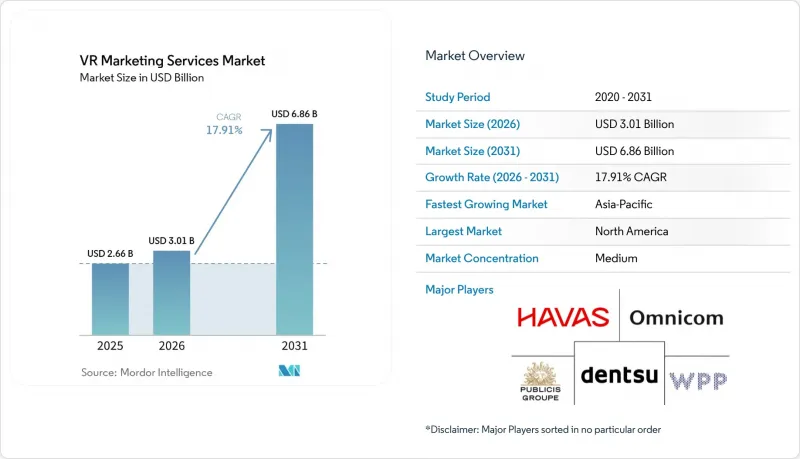
本報告按服務類型(身臨其境型內容創作和世界構建、宣傳活動管理、最佳化和分析等)、平台和交付方式(WebXR/基於瀏覽器的體驗、基於頭戴式設備的身臨其境型體驗等)、終端用戶行業(家用電子電器、汽車等)以及地區進行細分。市場預測以價值(美元)表示。
全球虛擬實境行銷服務市場趨勢與洞察
對身臨其境型品牌互動體驗的需求
品牌正投入專案預算打造虛擬環境,讓消費者自主探索產品、參與新品發表會並進行忠誠度提升活動。這種模式正引領虛擬實境行銷服務市場從單純的數位曝光轉向與消費者建立更長期的互動。博報堂DY控股公司的報告顯示,37.5%的日本用戶在虛擬環境中接觸到某個品牌後記住了該品牌名稱,其中21.5%的用戶隨後搜尋了該公司。 Snap的齋戒月AR商城在2025年涵蓋了中東和北非超過1,680萬用戶,品牌商店的平均互動量較2024年增加了30.25%。使用者在每個虛擬品牌商店停留的時間超過26秒,這表明,當內容反映本地需求時,季節性的空間宣傳活動可以非常有效。用戶停留時間和會後搜尋是廣告公司用來支持高階負責人評估宣傳活動成效的績效指標。
針對購買考慮期較長的產品,提供虛擬產品展示。
當買家面臨複雜的選擇、高昂的價格或難以親自到展示室時,虛擬產品展示最為實用。因此,汽車、房地產和奢侈時尚是虛擬實境行銷服務市場中需求最為旺盛的領域。汽車製造商正在利用基於瀏覽器的3D配置器和虛擬展示室,讓買家在前往經銷商之前即可查看內裝規格、客製化車輛並檢驗試駕。海灣合作理事會(GCC)地區的房地產開發商正在使用虛擬導覽來展示尚未完成的房產。這些應用將客戶的需求從簡單的品牌推廣活動轉變為銷售支持,通常需要與客戶關係管理(CRM)系統和銷售代理的工作流程進行整合。這類工作不僅需要安排宣傳活動活動,還需要與客戶的銷售流程和體驗保持一致,為服務供應商帶來更長期的合作關係。
創建和整合體驗的成本很高
要實現高清體驗,需要3D藝術家、空間使用者體驗設計師、即時渲染工程師和品質保證負責人。這些要求使得VR項目比傳統的數位創新工作成本更高,限制了中型品牌採用VR技術。 2024年6月,WPP與Hogarth合作推出了由人工智慧驅動的“製作工作室”,並採用了NVIDIA Omniverse和OpenUSD,這是其每年在人工智慧、數據和技術方面3.2億美元投資的一部分。在VR行銷服務市場,當宣傳活動需要連結電子商務系統、客戶關係管理(CRM)工具、行銷自動化平台和分析堆疊時,就會產生整合成本。大規模控股公司可以將這些成本分攤到多個專案中,而小規模品牌則必須權衡客製化開發與現有效果行銷模式之間的優缺點。雖然製作自動化未來可能會降低內容成本,但並非所有客戶都能以相同的速度享受到成本節約帶來的益處。
細分市場分析
到2025年,「身臨其境型內容創作與世界建構」將佔據VR行銷服務市場42.30%的佔有率,成為最大的服務類別。這一佔有率反映了品牌在建立客製化空間環境方面進行投資的早期發展階段。汽車、時尚和零售業的客戶持續委託創建此類環境,將其作為身臨其境型專案的核心資產。 「策略與體驗設計」為那些需要在全面投入製作之前定義空間規劃和使用者旅程的客戶提供了一個切入點。它還有助於客戶進行早期規劃,包括體驗的創新架構、內容流程和業務目標。 「宣傳活動管理、最佳化與分析」預計將在2026年至2031年間以18.44%的複合年成長率成長。這一成長率反映了將身臨其境型互動與後續轉化活動聯繫起來的歸因分析需求的不斷成長。隨著行銷團隊開始將身臨其境型體驗視為可衡量的媒體單元而非一次性活動,此服務類別的重要性可能會進一步提升。
在虛擬實境行銷服務產業,代理商正從以企劃為基礎的製作收入模式轉向透過長期合作協議提供的分析和最佳化服務。這種轉變可能會導致一次性製作項目的收入減少,但有可能提高客戶留存率和合約期限。 WPP 的《2024 年製作工作室》報告顯示,領先的代理商正在實現高清 3D 內容製作部分流程的自動化。據英偉達 (NVIDIA) 稱,可口可樂、酩悅軒尼詩和雀巢已利用基於 Omniverse 的工具製作大規模、區域特定的 3D 內容變體。製作這些變體需要了解不同創新交付物在何時何地有效。製作負擔的減輕和衡量需求的增加正在縮小內容創作和宣傳活動分析之間的差距。因此,代理商不僅要在視覺製作品質上競爭,還要在將創新作品與效果資訊關聯起來的能力上競爭。
區域分析
北美引領VR行銷服務市場,預計到2025年將佔全球營收的41.63%。該地區受益於集中的企業行銷預算、成熟的全方位服務和專業代理機構,以及企業對空間運算硬體的早期採用。美國仍然是VR宣傳活動訂單最活躍的國家,WPP、宏盟集團和陽獅集團都在為大型企業客戶投資身臨其境型製作基礎設施。 WPP旗下的HEX Studios匯集了來自建築、遊戲、機器人及相關領域的50位創新技術專家,體現了其對先進體驗製作的持續投入。儘管隨著市場成熟,北美地區的成長速度有所放緩,但由於其龐大的品牌行銷預算,預計北美的收入基礎仍將保持最大。
亞太地區的虛擬實境(VR)行銷服務市場預計將在2026年至2031年間以18.96%的複合年成長率成長,成為所有地區中成長最快的地區。在中國,一個龐大的虛擬實境和元宇宙行銷生態系統正在構建,並被眾多奢侈品牌和汽車製造商所利用。日本一項2025年的消費者調查顯示,670萬元元宇宙用戶在接觸虛擬品牌後表現出可衡量的品牌認知。該調查還顯示,37.5%的用戶能夠識別品牌名稱,其中21.5%的用戶隨後進行了網路搜尋。在韓國和東南亞,智慧型手機的高普及率、熱衷遊戲的年輕消費群體以及對互動品牌娛樂的濃厚興趣進一步推動了區域需求的成長。
在歐洲,德國、英國和法國是主要的收入來源,奢侈品牌、汽車集團和零售商都是積極的買家。英國的創新機構和製作工作室為體驗設計專案提供了支持,而德國汽車產業則推動了對配置器和虛擬展示室的需求。歐洲的隱私法規規範了身臨其境型分析中的用戶許可獲取和資料保存,而阿拉伯聯合大公國和沙烏地阿拉伯正在崛起為高度活躍的市場。沙烏地阿拉伯參與Snap的2025年齋戒月AR商城,充分體現了這種高度的參與。南美洲和非洲仍然是發展中市場,但巴西和南非在行動原生格式的應用方面處於領先,這些格式甚至可以在中階智慧型手機上運作。
其他好處:
- Excel格式的市場預測(ME)表
- 3個月的分析師支持
目錄
第1章:引言
- 研究假設和市場定義
- 調查範圍
第2章:調查方法
第3章執行摘要
第4章 市場狀況
- 市場概覽
- 宏觀經濟因素對市場的影響
- 市場促進因素
- 對身臨其境型品牌體驗的需求
- 在考慮期較長的採購過程中,擴大虛擬產品展示的使用。
- 混合式和虛擬活動的預算增加
- 透過電子商務促進 3D 產品發現,提高轉換率。
- 基於瀏覽器的空間傳輸降低了實施門檻。
- 企業空間運算的試點部署正在擴大高階品牌體驗的影響範圍。
- 市場限制因素
- 高昂的開發和整合成本
- 耳機在大眾市場宣傳活動中的局限性
- 與生物識別數據和推斷數據相關的合規風險
- GPU串流處理能力與成本限制
- 產業價值與價值鏈分析
- 監理情勢
- 技術展望
- 波特五力分析
第5章 市場規模與成長預測
- 按服務類型
- 戰略與體驗設計
- 身臨其境型內容創作與世界構建
- 宣傳活動管理、最佳化與分析
- 按平台和交付方式
- WebXR/基於瀏覽器的體驗
- 行動和基於應用程式的虛擬實境體驗
- 基於頭戴裝置的身臨其境型體驗
- 混合全通路VR宣傳活動
- 按最終用途行業分類
- 零售與電子商務
- 車
- 房地產
- 時尚與美妝
- 旅遊與飯店
- 家用電子產品
- 醫療保健和生命科學
- 媒體與娛樂
- 按地區
- 北美洲
- 美國
- 加拿大
- 墨西哥
- 南美洲
- 巴西
- 阿根廷
- 智利
- 其他南美國家
- 歐洲
- 德國
- 英國
- 法國
- 義大利
- 西班牙
- 俄羅斯
- 其他歐洲國家
- 亞太地區
- 中國
- 印度
- 日本
- 韓國
- 澳洲
- 東南亞
- 其他亞太國家
- 中東
- 阿拉伯聯合大公國
- 沙烏地阿拉伯
- 土耳其
- 其他中東國家
- 非洲
- 南非
- 埃及
- 奈及利亞
- 其他非洲國家
- 北美洲
第6章 競爭情勢
- 市場集中度
- 策略趨勢
- 市佔率分析
- 公司簡介
- WPP plc
- Omnicom Group Inc.
- Publicis Groupe SA
- Dentsu Group Inc.
- Havas NV
- Jack Morton Worldwide, Inc.
- GMR Marketing, LLC
- Sector 5 Digital, LLC
- Groove Jones, Inc.
- The Glimpse Group, Inc.
- Matterport, Inc.
- Marxent Labs, LLC
- vFairs LLC
- ENGAGE XR Holdings plc
第7章 市場機會與未來展望
According to Mordor Intelligence, the VR marketing services market size was valued at USD 2.66 billion in 2025 and estimated to grow from USD 3.01 billion in 2026 to reach USD 6.86 billion by 2031, at a CAGR of 17.91% during the forecast period (2026-2031).
This report is Segmented by Service Type (Immersive Content Production and Worldbuilding, and Campaign Management, Optimization and Analytics, and More), Platform and Delivery Mode (WebXR / Browser-Based Experiences, Headset-Based Immersive Experiences, and More), End-Use Industry (Consumer Electronics, Automotive, and More), and Geography. The Market Forecasts are Provided in Terms of Value (USD).
Global VR Marketing Services Market Trends and Insights
Demand for Immersive Brand Engagement
Brands are assigning dedicated budgets to virtual environments where consumers can explore products, attend launches, and participate in loyalty activities at their own pace. This approach gives the VR marketing services market a way to move beyond flat digital impressions and toward longer consumer interactions. Hakuhodo DY Holdings reported that 37.5% of Japanese users who encountered a brand in a virtual environment learned its name, while 21.5% searched for the company afterward. Snap's Ramadan AR Mall reached more than 16.8 million users across the Middle East and North Africa in 2025, and average brand-store engagement rose 30.25% from 2024. Users spent more than 26 seconds in each virtual brand store, showing that seasonal spatial campaigns can achieve scale when the content reflects local demand. Dwell time and searches after a session give agencies performance measures that can support campaign reviews with senior marketers.
Virtual Product Demonstrations for High-Consideration Purchases
Virtual product demonstrations are most useful when buyers face complex choices, high prices, or difficult showroom visits. Automotive, real estate, and premium fashion are therefore relevant demand areas for the VR marketing services market. Automotive companies use browser-based 3D configurators and virtual showrooms so buyers can review interior trims, customize vehicles, and examine driving scenarios before visiting a dealer. Real estate developers in the Gulf Cooperation Council use guided virtual walkthroughs to present off-plan properties before construction is complete. These uses change the client brief from a brand-awareness exercise to sales support, which may require links to customer relationship management systems and dealer workflows. Such work can create longer engagements for service providers because the experience must align with the client's sales process, not just a campaign calendar.
High Experience Production and Integration Costs
High-fidelity experiences require 3D artists, spatial user experience designers, real-time rendering engineers, and quality assurance. These requirements make a VR project more costly than conventional digital creative work and limit adoption among mid-market brands. WPP launched its AI-powered Production Studio with Hogarth in June 2024, using NVIDIA Omniverse and OpenUSD as part of an annual USD 320 million investment in AI, data, and technology. The VR marketing services market also faces integration costs when campaigns must connect e-commerce systems, customer relationship management tools, marketing automation platforms, and analytics stacks. Larger holding companies can spread these costs across accounts, while smaller brands may compare a bespoke build against established performance marketing formats. Production automation may lower content costs over time, but savings do not necessarily reach every client at the same pace.
Other drivers and restraints analyzed in the detailed report include:
- E-commerce Demand for 3D Product Discovery and Conversion
- Browser-Based Spatial Delivery Reduces Activation Friction
- Biometric and Inferred-Data Compliance Exposure
For complete list of drivers and restraints, kindly check the Table Of Contents.
Segment Analysis
Immersive Content Production and Worldbuilding held 42.30% of the VR marketing services market share in 2025, making it the largest service category. The share reflects a stage of development in which brands first pay to build a custom spatial environment. Automotive, fashion, and retail clients continue to commission these environments as the core assets in immersive programs. Strategy and Experience Design provides an entry point for clients who need to define a spatial brief and user journey before funding full production. It also supports early planning for the creative architecture, content flow, and business objective of an experience. Campaign Management, Optimization, and Analytics is projected to grow at a CAGR of 18.44% from 2026 to 2031. This rate reflects the growing demand for attribution linking immersive engagement to downstream conversion activity. The service category can become more important as marketing teams treat immersive sessions as measurable media units instead of one-time activations.
The VR marketing services industry is seeing agencies shift from project-based production revenue toward analytics and optimization work delivered through retainers. This change can reduce revenue from a single build while increasing client retention and contract duration. WPP's 2024 production studio showed how large agencies are seeking to automate parts of high-fidelity 3D content creation. NVIDIA stated that Coca-Cola, Moet Hennessy, and Nestle used Omniverse-based tools to create localized 3D content variations at scale. These variations require data on where and when different creative output performs. The combination of lower production effort and higher measurement needs can narrow the gap between content production and campaign analytics. Agencies must therefore compete on their ability to connect creative work with performance information as well as on visual production quality.
Complete Report Scope:
- By Service Type
- Strategy and Experience Design
- Immersive Content Production and Worldbuilding
- Campaign Management, Optimization and Analytics
- By Platform and Delivery Mode
- WebXR / Browser-Based Experiences
- Mobile and Application-Based VR Experiences
- Headset-Based Immersive Experiences
- Hybrid Omnichannel VR Campaigns
- By End-use Industry
- Retail and E-commerce
- Automotive
- Real Estate
- Fashion and Beauty
- Travel and Hospitality
- Consumer Electronics
- Healthcare and Life Sciences
- Media and Entertainment
- By Geography
- North America
- United States
- Canada
- Mexico
- South America
- Brazil
- Argentina
- Chile
- Rest of South America
- Europe
- Germany
- United Kingdom
- France
- Italy
- Spain
- Russia
- Rest of Europe
- Asia-Pacific
- China
- India
- Japan
- South Korea
- Australia
- Southeast Asia
- Rest of Asia-Pacific
- Middle East
- United Arab Emirates
- Saudi Arabia
- Turkey
- Rest of Middle East
- Africa
- South Africa
- Egypt
- Nigeria
- Rest of Africa
- North America
Geography Analysis
North America led the VR marketing services market, accounting for 41.63% of global revenue in 2025. The region benefits from concentrated enterprise marketing budgets, established full-service and specialist agencies, and early corporate use of spatial computing hardware. The United States remains the most active country for VR campaign commissioning, and WPP, Omnicom, and Publicis Groupe are investing in immersive production infrastructure for large enterprise clients. WPP's HEX studio brought together 50 creative technologists from architecture, gaming, robotics, and related fields, showing continued investment in advanced experience production. North America's revenue base is expected to remain the largest because of the scale of brand marketing budgets, even as regional growth moderates with maturity.
The VR marketing services market in Asia-Pacific is projected to grow at a CAGR of 18.96% from 2026 to 2031, the highest rate among the regions. China has developed a broad virtual reality and metaverse marketing ecosystem that is used by luxury brands and automotive manufacturers. Japan's 2025 consumer survey identified 6.7 million metaverse users with measurable brand awareness after virtual brand contact. In that survey, 37.5% of users learned the brand name and 21.5% conducted a later web search. South Korea and Southeast Asia add to regional demand through high smartphone use, younger gaming-oriented consumers, and interest in interactive brand entertainment.
Europe has an important revenue base through Germany, the United Kingdom, and France, where luxury brands, automotive groups, and retail companies are active buyers. The United Kingdom's creative-agency and production-studio base supports experience design work, while Germany's automotive sector creates demand for configurators and virtual showrooms. European privacy rules shape immersive analytics consent and data retention, while the United Arab Emirates and Saudi Arabia are emerging as high-engagement markets. Saudi Arabia's participation in Snap's 2025 Ramadan AR Mall illustrates this engagement. South America and Africa remain earlier-stage markets, with Brazil and South Africa leading adoption through mobile-native formats that can run on mid-range smartphones.
- WPP plc
- Omnicom Group Inc.
- Publicis Groupe S.A.
- Dentsu Group Inc.
- Havas N.V.
- Jack Morton Worldwide, Inc.
- GMR Marketing, LLC
- Sector 5 Digital, LLC
- Groove Jones, Inc.
- The Glimpse Group, Inc.
- Matterport, Inc.
- Marxent Labs, LLC
- vFairs LLC
- ENGAGE XR Holdings plc
Additional Benefits:
- The market estimate (ME) sheet in Excel format
- 3 months of analyst support
TABLE OF CONTENTS
1 INTRODUCTION
- 1.1 Study Assumptions and Market Definition
- 1.2 Scope of the Study
2 RESEARCH METHODOLOGY
3 EXECUTIVE SUMMARY
4 MARKET LANDSCAPE
- 4.1 Market Overview
- 4.2 Impact of Macroeconomic Factors on the Market
- 4.3 Market Drivers
- 4.3.1 Demand for Immersive Brand Engagement
- 4.3.2 Rising Use of Virtual Product Demonstrations in High-Consideration Purchases
- 4.3.3 Expansion of Hybrid and Virtual Event Budgets
- 4.3.4 E-commerce Push for 3D Product Discovery and Conversion Uplift
- 4.3.5 Browser-Based Spatial Delivery Lowers Activation Friction
- 4.3.6 Enterprise Spatial Computing Pilots Expand Premium Brand Experience Inventory
- 4.4 Market Restraints
- 4.4.1 High Experience Production and Integration Costs
- 4.4.2 Limited Headset Reach for Mass-Market Campaigns
- 4.4.3 Biometric and Inferred-Data Compliance Exposure
- 4.4.4 GPU Streaming Capacity and Cost Constraints
- 4.5 Industry Value and Supply-Chain Analysis
- 4.6 Regulatory Landscape
- 4.7 Technological Outlook
- 4.8 Porter's Five Forces Analysis
- 4.8.1 Threat of New Entrants
- 4.8.2 Bargaining Power of Suppliers
- 4.8.3 Bargaining Power of Buyers
- 4.8.4 Threat of Substitutes
- 4.8.5 Competitive Rivalry
5 MARKET SIZE AND GROWTH FORECASTS (VALUE)
- 5.1 By Service Type
- 5.1.1 Strategy and Experience Design
- 5.1.2 Immersive Content Production and Worldbuilding
- 5.1.3 Campaign Management, Optimization and Analytics
- 5.2 By Platform and Delivery Mode
- 5.2.1 WebXR / Browser-Based Experiences
- 5.2.2 Mobile and Application-Based VR Experiences
- 5.2.3 Headset-Based Immersive Experiences
- 5.2.4 Hybrid Omnichannel VR Campaigns
- 5.3 By End-use Industry
- 5.3.1 Retail and E-commerce
- 5.3.2 Automotive
- 5.3.3 Real Estate
- 5.3.4 Fashion and Beauty
- 5.3.5 Travel and Hospitality
- 5.3.6 Consumer Electronics
- 5.3.7 Healthcare and Life Sciences
- 5.3.8 Media and Entertainment
- 5.4 By Geography
- 5.4.1 North America
- 5.4.1.1 United States
- 5.4.1.2 Canada
- 5.4.1.3 Mexico
- 5.4.2 South America
- 5.4.2.1 Brazil
- 5.4.2.2 Argentina
- 5.4.2.3 Chile
- 5.4.2.4 Rest of South America
- 5.4.3 Europe
- 5.4.3.1 Germany
- 5.4.3.2 United Kingdom
- 5.4.3.3 France
- 5.4.3.4 Italy
- 5.4.3.5 Spain
- 5.4.3.6 Russia
- 5.4.3.7 Rest of Europe
- 5.4.4 Asia-Pacific
- 5.4.4.1 China
- 5.4.4.2 India
- 5.4.4.3 Japan
- 5.4.4.4 South Korea
- 5.4.4.5 Australia
- 5.4.4.6 Southeast Asia
- 5.4.4.7 Rest of Asia-Pacific
- 5.4.5 Middle East
- 5.4.5.1 United Arab Emirates
- 5.4.5.2 Saudi Arabia
- 5.4.5.3 Turkey
- 5.4.5.4 Rest of Middle East
- 5.4.6 Africa
- 5.4.6.1 South Africa
- 5.4.6.2 Egypt
- 5.4.6.3 Nigeria
- 5.4.6.4 Rest of Africa
- 5.4.1 North America
6 COMPETITIVE LANDSCAPE
- 6.1 Market Concentration
- 6.2 Strategic Moves
- 6.3 Market Share Analysis
- 6.4 Company Profiles (includes Global Level Overview, Market Level Overview, Core Segments, Financials as available, Strategic Information, Market Rank/Share, Products and Services, Recent Developments)
- 6.4.1 WPP plc
- 6.4.2 Omnicom Group Inc.
- 6.4.3 Publicis Groupe S.A.
- 6.4.4 Dentsu Group Inc.
- 6.4.5 Havas N.V.
- 6.4.6 Jack Morton Worldwide, Inc.
- 6.4.7 GMR Marketing, LLC
- 6.4.8 Sector 5 Digital, LLC
- 6.4.9 Groove Jones, Inc.
- 6.4.10 The Glimpse Group, Inc.
- 6.4.11 Matterport, Inc.
- 6.4.12 Marxent Labs, LLC
- 6.4.13 vFairs LLC
- 6.4.14 ENGAGE XR Holdings plc
7 MARKET OPPORTUNITIES AND FUTURE OUTLOOK
- 7.1 White-space and Unmet-Need Assessment

 VR內容製作服務:市佔率分析、產業趨勢與統計、成長預測(2026-2031年)VR串流媒體:市佔率分析、產業趨勢與統計、成長預測(2026-2031年)
 虛擬實境(VR)內容市場:2026-2032年全球市場預測(按內容類型、設備類型、收入模式、分發平台和最終用戶分類)
 虛擬實境(VR)內容製作市場規模、佔有率和成長分析:按內容類型、技術、應用、最終用戶和地區分類-2026-2033年產業預測
 虛擬實境(VR)內容製作市場:按內容類型、組件、最終用戶和地區分類
 2026年全球虛擬內容製作市場報告VR內容製作市場:按組件、授權模式、最終用戶、部署方法和發行管道分類-2026年至2032年全球預測
 虛擬實境(VR)內容製作市場報告:按內容類型、組件、最終用戶和地區分類(2026-2034 年)
 虛擬偶像市場規模、佔有率和成長分析:按類型、技術、內容形式、獲利模式、目標受眾和地區分類——2026-2033年產業預測
 虛擬內容創作市場分析與預測(至2035年):類型、產品類型、服務、技術、組件、應用、設備、流程、最終用戶