


 |
市場調查報告書
商品編碼
2119205
硫酸鎂:市場佔有率分析、產業趨勢與統計、成長預測(2026-2031)Magnesium Sulfate - Market Share Analysis, Industry Trends & Statistics, Growth Forecasts (2026 - 2031) |
||||||

※ 本網頁內容可能與最新版本有所差異。詳細情況請與我們聯繫。
據 Mordor Intelligence 稱,2025 年硫酸鎂市場價值為 8.1 億美元,預計到 2031 年將從 2026 年的 8.5 億美元成長至 11.2 億美元,預測期(2026-2031 年)的複合年成長率為 5.76%。
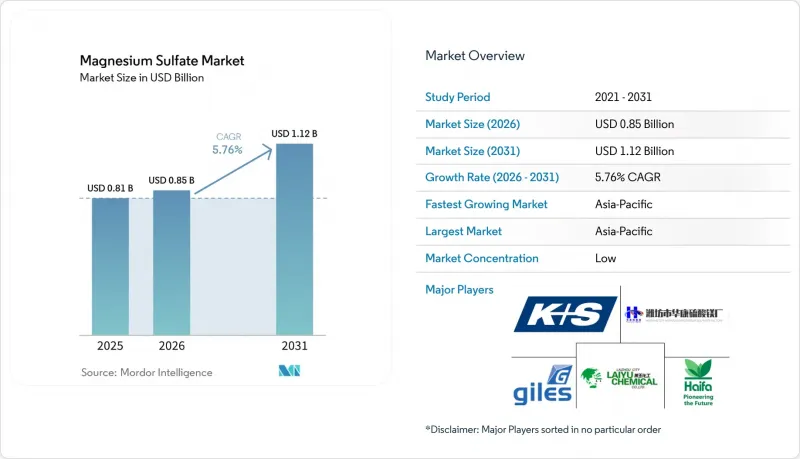
本報告按產品類型(七水合硫酸鎂、一水合硫酸鎂、無水硫酸鎂)、物理形態(晶體、粉末、顆粒、液體溶液)、等級(農業級、醫藥級、食品級、其他)、終端用戶產業(農業、化學、其他)和地區(亞太地區、北美、其他)進行細分。市場預測以美元計價。
全球硫酸鎂市場趨勢及洞察
土壤中鎂和硫的消耗
在許多生產系統中,集約化作物生產導致鎂和硫的流失速度超過了自然循環的補充速度。 2025年的一篇綜述報告指出,在撒哈拉以南非洲的試驗田中施用硫肥後,玉米產量提高了20%至260%,顯示基準硫的基線缺乏程度十分嚴重。此外,長期施用鉀肥會降低根系對鎂的吸收,導致結構性營養缺乏,而目前的化肥投入只能部分彌補此不足。酸性土壤影響40%至50%的耕地,並會加速熱帶和亞熱帶生產系統中鎂的流失。在水果、蔬菜和甘蔗生產中,由於反覆收穫,這些營養素的流失更為嚴重。硫酸鎂市場有利於那些需要同時補充鎂和硫的生產者,他們可以使用一種水溶性產品,而不是使用不同的產品。
擴大藥用級硫酸鎂在婦幼保健的應用。
硫酸鎂在母嬰保健中的應用範圍正在擴大,不再局限於治療子癇,而是擴展到增加每位患者的用藥劑量。 2026年的一篇綜述指出,對於懷孕30週前即將早產的孕婦,建議在懷孕期間使用硫酸鎂進行胎兒神經保護。這篇綜述顯示,這種方法可使腦性麻痹的發生率降低近三分之一。正如該綜述所引述的,英國國家早產兒預防計劃(National PreCePT Programme)推廣在有早產風險的孕婦中使用硫酸鎂,並證實了其良好的成本效益。為了滿足東非的需求,Piston Medical於2026年7月在烏干達推出了全國首個本地生產的硫酸鎂注射劑。在地化生產將使先前完全依賴進口的地區能夠增加藥品消費量。
嚴格的藥典和污染物標準
由於需要符合多部藥典的要求,能夠向受監管藥品採購商供貨的供應商數量有限。美國藥典 (USP) 標準規定,注射劑的純度(以無水計)為 98.0% 至 102.0%,氯化物含量低於 0.014%,並且對鐵、硒和細菌內毒素的含量有嚴格的限制。要達到這些標準,需要專用的生產線、經過驗證的清洗流程以及與農業等級生產不同的作業流程。此外,USP 和歐洲藥典 (EP) 對鐵的允許限量也不同,因此需要單獨的庫存管理、分析證書和特定用途的標籤。 USP 於 2024 年 5 月發布了標準修訂通知,這些變更於 2025 年 5 月正式生效。隨著需求的成長,生產商不得不更新驗證文件和分析參考物質。對於新興市場中那些旨在從農用級產品過渡到藥用級產品的生產商而言,這種成本負擔尤其沉重。
細分市場分析
2025年,七水硫酸鎂(瀉鹽)佔了硫酸鎂市場56.78%的佔有率。由於在室溫下穩定、完全溶於水,並廣泛應用於農業、製藥和個人護理領域,因此至今仍被廣泛使用。七水硫酸鎂含有七個結晶水分子,是規格、定價和貿易報告中的標準產品。一水硫酸鎂(水鎂礬)是K+S Aktiengesellschaft公司以「ESTA Kieserit」品牌供應的另一種產品,以乾式靜電分離法從德國地下礦床開採。該公司將其定位為一種pH值中性的肥料,施用於土壤後可立即被植物吸收。
預計到2031年,無水硫酸鎂的年複合成長率將達到6.36%。它可用作工業乾燥劑、濕度可控藥物固態製劑的配製劑以及電解質療法的活性成分。 2025年,中國從日本和德國進口了1.8萬噸高純度無水硫酸鎂,價格是國內價格的2.3倍,因為供應商具備精密結晶和重金屬去除能力。 2025年,全球與硫酸鎂(MgSO4)生產製程技術相關的專利申請數量達247件,較去年同期成長9%。這些專利申請主要集中在晶體尺寸控制、重金屬去除和可溶性鎂鹽的製備方面。這些技術能力可以支持硫酸鎂產業在更高規格的製藥和園藝應用領域取得成功。
2025年,粉狀硫酸鎂佔硫酸鎂市場38.35%的市佔率。其市場領先地位主要得益於其在肥料濃縮物製備、藥物配製和工業生產的應用。此外,粉狀硫酸鎂與機械噴霧器的兼容性以及其與複合肥料的混合性也促進了其應用。結晶型硫酸鎂主要用於個人護理、沐浴添加劑和食品級應用,其較大的粒徑和較高的透明度使其在零售市場中佔據了一席之地。
預計到2031年,液態溶液的複合年成長率將達到6.62%,在所有物理形態中成長最高。市場需求主要來自歐洲、韓國和中國的商業封閉回路型園藝產業,這些系統需要預先溶解的鎂離子和硫酸根離子,以便植物能夠快速吸收利用。液態產品透過專用注入通道輸送,並在流動路徑中稀釋,從而降低了製備高濃度粉末時常見的沉澱風險。已發表的測試結果表明,與傳統的開放式系統相比,採用離子選擇性電極進行監測的封閉回路型系統在用水效率方面提高了46%。這項性能優勢正日益體現在一些商業溫室設施的硫酸鎂採購規範中。
區域分析
預計到2025年,亞太地區將佔硫酸鎂市場41.78%的佔有率,並在2031年之前以6.87%的複合年成長率成長。在中國,福建省的一項土壤調查顯示,81.5%的受測地塊鎂含量低於120毫克/公斤的適宜閾值。調查也發現,中國南方55%的耕地有鎂缺乏問題。中國的土壤檢測和複合肥料項目覆蓋超過10億畝(約6670萬公頃)的耕地,硫酸鎂已被納入各省推薦的輔助養分標準。
北美和歐洲是市場上優質硫酸鎂的主要需求中心,但兩地的供應情況有差異。 2021年至2024年間,中國供應了美國53%的硫酸鎂進口量,其次是德國(12%)、印度(11%)和墨西哥(7%)。到2026年4月,北美的基準價格將達到每公斤0.41美元,比東北亞和歐洲的每公斤0.30美元高出37%。歐洲幾乎可以自給自足地供應特種級硫酸鎂,K+S Aktiengesellschaft公司表示,其「Werra 2060」計畫旨在確保其能夠繼續從德國滿足歐盟100%的硫酸鎂需求。
南美洲的需求主要集中在巴西和阿根廷,熱帶土壤中大豆、玉米和甘蔗的生產支撐著對鎂和硫的持續需求。 K+S Aktiengesellschaft 預計,在整個規劃期間內,巴西仍將是鉀肥和鎂肥的成長區域。在中東和非洲,對孕產婦健康的投資正在推動藥品需求的成長。 Piston Medical 於 2026 年 7 月在烏干達、肯亞、坦尚尼亞、南蘇丹和剛果民主共和國推出本地生產的注射劑,顯示該地區供應鏈的發展取得了進展。波灣合作理事會(GCC) 成員國在糧食安全計畫下,也形成了可控環境農業和精準灌溉園藝的獨特需求區域。
其他好處
- Excel格式的市場預測(ME)表
- 3個月的分析師支持
目錄
第1章:引言
- 研究假設和市場定義
- 調查範圍
第2章:調查方法
第3章執行摘要
第4章 市場狀況
- 市場概覽
- 市場促進因素
- 土壤中鎂和硫的消耗
- 對糧食安全和提高作物產量的需求。
- 擴大藥用級硫酸鎂在婦幼保健的應用。
- 針對特定作物的封閉回路型鎂硫組合藥物
- 實現藥用級急救藥品的本地化供應。
- 市場限制因素
- 嚴格的藥典和污染物標準
- 不同礦床中天然礦物的品質有差異。
- 多罐施肥灌溉系統的適用性和沈澱風險
- 價值鏈分析
- 波特五力分析
第5章 市場規模與成長預測
- 依產品類型
- 七水硫酸鎂(瀉鹽)
- 一水合物(水合矽酸鉀)
- 無水硫酸鎂
- 依實體形態
- 水晶
- 粉末
- 顆粒
- 液體溶液
- 按年級
- 農業級
- 醫藥級
- 食品級
- 飼料級
- 工業級
- 一般消費級
- 按最終用戶行業分類
- 農業
- 藥品和醫療保健
- 飲食
- 個人護理和化妝品
- 動物飼料
- 紙漿和造紙
- 紡織品和皮革
- 水處理
- 化學品
- 其他終端用戶產業
- 按地區
- 亞太地區
- 中國
- 印度
- 日本
- 韓國
- 東南亞國協
- 其他亞太國家
- 北美洲
- 美國
- 加拿大
- 墨西哥
- 歐洲
- 德國
- 英國
- 法國
- 義大利
- 北歐國家
- 俄羅斯
- 其他歐洲國家
- 南美洲
- 巴西
- 阿根廷
- 其他南美國家
- 中東和非洲
- 沙烏地阿拉伯
- 南非
- 其他中東和非洲國家
- 亞太地區
第6章 競爭情勢
- 市場集中度
- 策略趨勢
- 市佔率和排名分析
- 公司簡介
- ACURO ORGANICS LIMITED
- China Nafine Group International Co., Ltd.
- Haifa Negev technologies LTD
- ICL
- Industrias Penoles
- Jost Chemical Co.
- K+S Aktiengesellschaft
- Laizhou City Laiyu Chemical CO.,Ltd
- Laizhou Guangcheng Chemical Co., Ltd.
- SML Limited
- Tianjin Xingyu Fertilizer Industry Co., Ltd.
- UMAI CHEMICAL CO., LTD.
- Weifang City Huakang Magnesium Sulphate Factory
- Yingkou Magnesite Chemical Ind. Group Co., Ltd.
第7章 市場機會與未來展望
According to Mordor Intelligence, the magnesium sulfate market was valued at USD 0.81 billion in 2025 and is estimated to grow from USD 0.85 billion in 2026 to reach USD 1.12 billion by 2031, at a CAGR of 5.76% during the forecast period (2026-2031).
This report is Segmented by Product Type (Heptahydrate, Monohydrate, and Anhydrous Magnesium Sulfate), Physical Form (Crystals, Powder, Granules, and Liquid Solution), Grade (Agriculture Grade, Pharmaceutical Grade, Food Grade, and More), End-User Industry (Agriculture, Chemical, and More), and Geography (Asia-Pacific, North America, and More). The Market Forecasts are Provided in Terms of Value (USD).
Global Magnesium Sulfate Market Trends and Insights
Soil Magnesium and Sulfur Depletion
Intensive crop production removes magnesium and sulfur faster than natural cycles can restore them in many production systems. A 2025 review reported maize yield responses of 20% to 260% after sulfur application across Sub-Saharan African test sites, showing the severity of baseline sulfur deficiencies. Long-term potassium fertilizer use has also reduced root uptake of magnesium, creating a structural nutrient gap that current fertilizer spending only partly addresses. Acidic soils affect 40% to 50% of potentially cultivable land and can accelerate magnesium leaching in tropical and subtropical systems. Fruit, vegetable, and sugarcane production can intensify these nutrient losses because of repeated harvest cycles. The magnesium sulfate market benefits where growers need both nutrients in one soluble application rather than separate products.
Expansion of Pharmaceutical Magnesium Sulfate Use in Maternal Healthcare
Magnesium sulfate use in maternal medicine is expanding beyond established eclampsia treatment into protocols that increase dosage volumes per patient. A 2026 review stated that antenatal MgSO4 is recommended for fetal neuroprotection when preterm birth is imminent before 30 weeks of gestation. The review linked this use to a reduction in cerebral palsy incidence of nearly one-third. The National PreCePT Programme in England increased MgSO4 uptake for threatened preterm births and showed favorable cost-effectiveness, as cited in the same review. Piston Medical Limited launched Uganda's first locally manufactured magnesium sulfate injection in July 2026 for an East African demand pool. Local production can increase pharmaceutical consumption in places that previously relied fully on imports.
Stringent Pharmacopeial and Contaminant Specifications
Multi-pharmacopeia compliance limits the number of suppliers that can serve regulated pharmaceutical buyers. The United States Pharmacopeia (USP) monograph specifies 98.0% to 102.0% assay purity on an anhydrous basis, chloride below 0.014%, and strict limits for iron, selenium, and bacterial endotoxin in parenteral forms. These specifications require dedicated manufacturing lines, validated cleaning, and procedures that differ from agricultural grade production. Iron limits also differ between the USP and European Pharmacopoeia, requiring separate inventory, certificates of analysis, and use-specific labeling. The USP posted a notice to revise the monograph in May 2024, and the change became official in May 2025. Producers had to update validation documentation and analytical standards during a period of growing demand. The costs are especially difficult for emerging-market producers that want to move from agricultural to pharmaceutical grade.
Other drivers and restraints analyzed in the detailed report include:
- Crop-Specific Magnesium-Sulfur Formulation for Closed-Loop Horticulture
- Pharmaceutical Grade Supply Localization for Emergency-Care Formulations
- Compatibility and Precipitation Risk in Multi-Tank Fertigation Systems
For complete list of drivers and restraints, kindly check the Table Of Contents.
Segment Analysis
Heptahydrate (Epsom salt) accounted for 56.78% of the magnesium sulfate market in 2025. The form remains widely used because it is stable under ambient conditions, dissolves fully in water, and serves agricultural, pharmaceutical, and personal care uses. Its 7 molecules of crystallization make it the reference product for specifications, pricing, and trade reporting. Monohydrate (Kieserite) is another product type supplied by K+S Aktiengesellschaft under the ESTA Kieserit brand from German underground deposits using dry electrostatic separation. The company positions it as a pH-neutral and immediately plant-available input for soil application.
Anhydrous magnesium sulfate is forecast to grow at a 6.36% CAGR through 2031. It is used as an industrial desiccant, a compounding ingredient for moisture-controlled pharmaceutical solid-dose formulations, and an active ingredient in electrolyte therapies. China imported 18,000 metric tons of high-purity anhydrous magnesium sulfate from Japan and Germany in 2025 and paid 2.3 times its domestic price because the suppliers offer precision crystallization and heavy-metal-removal capabilities. Global filings in MgSO4 process technology reached 247 in 2025, up 9% from the prior year, with activity in crystal-size control, heavy-metal removal, and soluble magnesium-salt preparation. These technical capabilities can support the magnesium sulfate industry in higher-specification pharmaceutical and horticulture applications.
Powder accounted for 38.35% of the magnesium sulfate market in 2025. It leads because it can be used in fertigation stock preparation, pharmaceutical compounding, and industrial processes. Its use is supported by compatibility with mechanized spreaders and compound-fertilizer blending. Crystals are used mainly in personal care, bath products, and food grade applications, where larger particle size and visual clarity support retail positioning.
Liquid solution is forecast to grow at a 6.62% CAGR through 2031, the fastest rate among physical forms. Demand comes mainly from commercial closed-loop horticulture in Europe, South Korea, and China, where systems need pre-dissolved magnesium and sulfate ions that are immediately available to plants. A liquid product can be delivered through a dedicated injector channel and diluted in-stream, reducing the precipitation risk associated with concentrated powder stock preparation. In published trials, closed-loop systems with ion-selective electrode monitoring achieved 46% higher water productivity than conventional open systems. This performance is being incorporated into procurement specifications at some commercial greenhouse operations in the magnesium sulfate market.
Complete Report Scope:
- By Product Type
- Heptahydrate (Epsom Salt)
- Monohydrate (Kieserite)
- Anhydrous Magnesium Sulfate
- By Physical Form
- Crystals
- Powder
- Granules
- Liquid Solution
- By Grade
- Agriculture Grade
- Pharmaceutical Grade
- Food Grade
- Feed Grade
- Industrial Grade
- Consumer Grade
- By End-User Industry
- Agriculture
- Pharmaceutical and Healthcare
- Food and Beverage
- Personal Care and Cosmetics
- Animal Feed
- Pulp and Paper
- Textile and Leather
- Water Treatment
- Chemical
- Other End-User Industries
- By Geography
- Asia-Pacific
- China
- India
- Japan
- South Korea
- ASEAN Countries
- Rest of Asia-Pacific
- North America
- United States
- Canada
- Mexico
- Europe
- Germany
- United Kingdom
- France
- Italy
- NORDIC Countries
- Russia
- Rest of Europe
- South America
- Brazil
- Argentina
- Rest of South America
- Middle-East and Africa
- Saudi Arabia
- South Africa
- Rest of Middle-East and Africa
- Asia-Pacific
Geography Analysis
Asia-Pacific held 41.78% of the magnesium sulfate market share in 2025 and is forecast to grow at a 6.87% CAGR through 2031. In China, a soil assessment in Fujian Province found that 81.5% of tested plots were below the magnesium-sufficiency threshold of 120 mg/kg. Research also found magnesium deficiency across 55% of arable land in southern China. China's soil-testing and formula-fertilization program has covered more than 1 billion mu (approximately 66.7 million hectares) of cultivated land and has incorporated magnesium sulfate into provincial secondary-nutrient recommendations.
North America and Europe represent the main premium grade demand centers for the magnesium sulfate market, although their supply positions differ. China supplied 53% of U.S. magnesium sulfate imports from 2021 to 2024, followed by Germany at 12%, India at 11%, and Mexico at 7%. North American benchmark prices reached USD 0.41 per kg in April 2026, 37% above Northeast Asian and European levels of USD 0.30 per kg. Europe is largely self-sufficient in specialty grades, and K+S Aktiengesellschaft states that its Werra 2060 project is designed to maintain the capacity to supply 100% of EU magnesium sulfate demand from Germany.
South American demand is concentrated in Brazil and Argentina, where soybean, corn, and sugarcane production on tropical soils supports ongoing magnesium and sulfur demand, and K+S Aktiengesellschaft expects Brazil to remain a growth area for potassium and magnesium fertilizers during its planning period. In the Middle-East and Africa, pharmaceutical demand is growing because of maternal health investment. Piston Medical Limited's July 2026 launch of a locally manufactured injection for Uganda, Kenya, Tanzania, South Sudan, and the Democratic Republic of Congo shows the development of regional supply. Gulf Cooperation Council countries also form a distinct demand area for controlled-environment agriculture and precision-irrigated horticulture under food-security programs.
- ACURO ORGANICS LIMITED
- China Nafine Group International Co., Ltd.
- Haifa Negev technologies LTD
- ICL
- Industrias Penoles
- Jost Chemical Co.
- K+S Aktiengesellschaft
- Laizhou City Laiyu Chemical CO.,Ltd
- Laizhou Guangcheng Chemical Co., Ltd.
- SML Limited
- Tianjin Xingyu Fertilizer Industry Co., Ltd.
- UMAI CHEMICAL CO., LTD.
- Weifang City Huakang Magnesium Sulphate Factory
- Yingkou Magnesite Chemical Ind. Group Co., Ltd.
Additional Benefits:
- The market estimate (ME) sheet in Excel format
- 3 months of analyst support
TABLE OF CONTENTS
1 Introduction
- 1.1 Study Assumptions and Market Definition
- 1.2 Scope of the Study
2 Research Methodology
3 Executive Summary
4 Market Landscape
- 4.1 Market Overview
- 4.2 Market Drivers
- 4.2.1 Soil Magnesium and Sulfur Depletion
- 4.2.2 Food Security and Higher Crop Productivity Requirements
- 4.2.3 Expansion of Pharmaceutical Magnesium Sulfate Use in Maternal Healthcare
- 4.2.4 Crop-Specific Magnesium-Sulfur Formulation for Closed-Loop Horticulture
- 4.2.5 Pharmaceutical Grade Supply Localization for Emergency-Care Formulations
- 4.3 Market Restraints
- 4.3.1 Stringent Pharmacopeial and Contaminant Specifications
- 4.3.2 Natural Mineral Quality Variability Across Deposits
- 4.3.3 Compatibility and Precipitation Risk in Multi-Tank Fertigation Systems
- 4.4 Value Chain Analysis
- 4.5 Porter's Five Forces Analysis
- 4.5.1 Threat of New Entrants
- 4.5.2 Bargaining Power of Suppliers
- 4.5.3 Bargaining Power of Buyers
- 4.5.4 Threat of Substitutes
- 4.5.5 Competitive Rivalry
5 Market Size and Growth Forecasts (Value)
- 5.1 By Product Type
- 5.1.1 Heptahydrate (Epsom Salt)
- 5.1.2 Monohydrate (Kieserite)
- 5.1.3 Anhydrous Magnesium Sulfate
- 5.2 By Physical Form
- 5.2.1 Crystals
- 5.2.2 Powder
- 5.2.3 Granules
- 5.2.4 Liquid Solution
- 5.3 By Grade
- 5.3.1 Agriculture Grade
- 5.3.2 Pharmaceutical Grade
- 5.3.3 Food Grade
- 5.3.4 Feed Grade
- 5.3.5 Industrial Grade
- 5.3.6 Consumer Grade
- 5.4 By End-User Industry
- 5.4.1 Agriculture
- 5.4.2 Pharmaceutical and Healthcare
- 5.4.3 Food and Beverage
- 5.4.4 Personal Care and Cosmetics
- 5.4.5 Animal Feed
- 5.4.6 Pulp and Paper
- 5.4.7 Textile and Leather
- 5.4.8 Water Treatment
- 5.4.9 Chemical
- 5.4.10 Other End-User Industries
- 5.5 By Geography
- 5.5.1 Asia-Pacific
- 5.5.1.1 China
- 5.5.1.2 India
- 5.5.1.3 Japan
- 5.5.1.4 South Korea
- 5.5.1.5 ASEAN Countries
- 5.5.1.6 Rest of Asia-Pacific
- 5.5.2 North America
- 5.5.2.1 United States
- 5.5.2.2 Canada
- 5.5.2.3 Mexico
- 5.5.3 Europe
- 5.5.3.1 Germany
- 5.5.3.2 United Kingdom
- 5.5.3.3 France
- 5.5.3.4 Italy
- 5.5.3.5 NORDIC Countries
- 5.5.3.6 Russia
- 5.5.3.7 Rest of Europe
- 5.5.4 South America
- 5.5.4.1 Brazil
- 5.5.4.2 Argentina
- 5.5.4.3 Rest of South America
- 5.5.5 Middle-East and Africa
- 5.5.5.1 Saudi Arabia
- 5.5.5.2 South Africa
- 5.5.5.3 Rest of Middle-East and Africa
- 5.5.1 Asia-Pacific
6 Competitive Landscape
- 6.1 Market Concentration
- 6.2 Strategic Moves
- 6.3 Market Share (%)/Ranking Analysis
- 6.4 Company Profiles (includes Global Overview, Market Overview, Core Segments, Financials as available, Strategic Information, Products and Services, and Recent Developments)
- 6.4.1 ACURO ORGANICS LIMITED
- 6.4.2 China Nafine Group International Co., Ltd.
- 6.4.3 Haifa Negev technologies LTD
- 6.4.4 ICL
- 6.4.5 Industrias Penoles
- 6.4.6 Jost Chemical Co.
- 6.4.7 K+S Aktiengesellschaft
- 6.4.8 Laizhou City Laiyu Chemical CO.,Ltd
- 6.4.9 Laizhou Guangcheng Chemical Co., Ltd.
- 6.4.10 SML Limited
- 6.4.11 Tianjin Xingyu Fertilizer Industry Co., Ltd.
- 6.4.12 UMAI CHEMICAL CO., LTD.
- 6.4.13 Weifang City Huakang Magnesium Sulphate Factory
- 6.4.14 Yingkou Magnesite Chemical Ind. Group Co., Ltd.
7 Market Opportunities and Future Outlook
- 7.1 White-Space and Unmet-Need Assessment
- 7.2 Low-Carbon Magnesium Sulfate with Verified Product Footprints


