

 |
市場調查報告書
商品編碼
2119197
改質醇酸樹脂:市場佔有率分析、產業趨勢與統計、成長預測(2026-2031)Modified Alkyd Resin - Market Share Analysis, Industry Trends & Statistics, Growth Forecasts (2026 - 2031) |
||||||

※ 本網頁內容可能與最新版本有所差異。詳細情況請與我們聯繫。
據 Mordor Intelligence 稱,2025 年改性醇酸樹脂的市場規模估計為 31.1 億美元,預計在預測期(2026-2031 年)內將以 4.08% 的複合年成長率成長,從 2026 年的 32.1 億美元成長到 2031 億美元的 39.92 億美元。
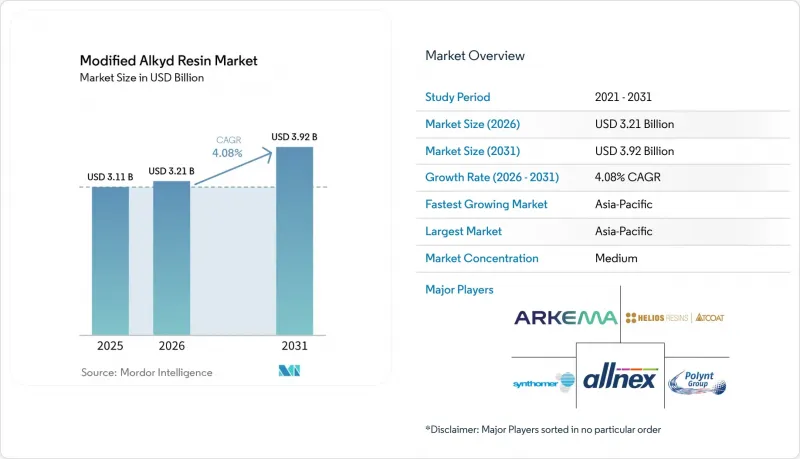
本報告按類型(丙烯酸、矽酮及其他)、技術(溶劑型、水性及其他)、應用(塗料、黏合劑和密封劑及其他)、終端用戶產業(建築、汽車及其他)和地區(亞太地區、北美、歐洲、南美、中東和非洲)進行細分。市場預測以美元計價。
全球改質醇酸樹脂市場趨勢及洞察
擴大低VOC和水性塗料配方
隨著塗料生產商應對日益嚴格的產品要求,改質醇酸樹脂市場正向水性及低VOC塗料轉型。這項轉變意義重大,因為隨著低排放在塗料規格中變得越來越重要,傳統溶劑型產品的客戶群可能會萎縮。水性醇酸分散體具有更高的光澤度、附著力和耐腐蝕性,解決了專業使用者長期以來關注的表現難題。美國塗料協會(ACA)指出,近零VOC的水性醇酸分散體旨在達到與溶劑型醇酸塗料相當的性能。改進的催化劑選擇和樹脂設計使塗料製造商能夠更好地平衡乾燥性能和環保目標之間的矛盾。阿科瑪公司將其水性醇酸乳液SYNAQUA 4804定位為需要生物基成分和低排放性能的塗料。
建築和基礎設施塗料市場的成長
建築和基礎設施維護支撐著對改性醇酸樹脂的穩定需求,因為鋼材、混凝土、木材和覆材都需要防護塗層。在承包商優先考慮易於施工、附著力可靠和成熟塗層系統的專案中,醇酸配方繼續發揮至關重要的作用。在新建專案帶來需求的同時,成熟經濟體的維修專案也推動了塗料產品的持續採購。在維修工程中,室內空氣品質和工作環境會影響產品選擇,因此低氣味和水性醇酸系統尤其重要。改質醇酸樹脂市場既供應裝飾塗料,也供應防護/維護產品,從而降低了其對特定建設活動的依賴性。基礎設施開發項目的需求也支撐著交通基礎設施、公共建築和工業設施的底漆和維護塗料市場。
石油化學產品和植物油原料價格的波動
由於植物油和石油化學中間體是許多樹脂配方中的關鍵成分,原料價格波動對改質醇酸樹脂市場構成限制。農業供應、生質燃料需求和石油化學生產活動的變化使得原料採購難以預測。對於沒有長期供應合約或後向整合的小型生產商而言,這種風險更大。化合物生產商可以透過確保多種植物油來源或引入可再生原料來應對這一問題。廢棄食用油、回收油脂和妥爾油衍生物都是很有前景的選擇,但所有這些都需要可靠的品管。對廢棄食用油衍生醇酸樹脂的研究清楚地表明了這種方法為何備受關注。
細分市場分析
2025年,丙烯酸改質樹脂佔據了改質醇酸樹脂市場佔有率的28.71%。其優異的抗紫外線性能、保色性和優異的成膜性能使其廣泛應用於建築外牆塗料和工業維護領域。這些特性在南亞和東南亞地區尤其重要,因為這些地區的塗料經常暴露在濕度波動和強烈的陽光照射下。混合乳化技術提高了水性醇酸塗料的穩定性和成膜一致性。丙烯酸改質為配方研發人員提供了一種成熟的方法來提高塗料的耐候性,而無需完全放棄醇酸樹脂的化學特性。這種市場定位確保了丙烯酸改質樹脂在對外觀和保色性要求極高的表面保護應用中繼續發揮關鍵作用。此外,該細分市場在塗料配方研發人員和承包商中享有廣泛的認可,這也是其另一個優勢。
預計到2031年,胺甲酸乙酯改質樹脂的複合年成長率將達到4.92%。這些樹脂無需雙組分混合即可快速固化、耐磨損且柔軟性。這些特性使其適用於基礎設施維護、汽車噴漆和設備塗層等需要實用施工方法的場合。矽改質樹脂在引擎機殼和排氣系統等高溫應用中仍然非常有用。酚醛樹脂在乾燥和耐化學性方面具有優勢,適用於金屬包裝和某些OEM塗料。乙烯基和聚醯胺改質產品適用於印刷油墨和對附著力要求極高的應用。對生物可再生氟代甲酸羧酸(FDCA)基醇酸樹脂的研究表明,提高不飽和度可以改善無黏性和交聯性,從而推動了對生物基混合高性能材料的持續研究。
預計到2025年,溶劑型系統將佔改質醇酸樹脂市場的54.33%。這一市場佔有率反映了溶劑型系統在戶外塗料、船舶產品和工業配方等領域的穩固地位,在這些領域,附著力和耐腐蝕性至關重要。許多承包商都熟悉這些系統在常見基材和施工條件下的性能。這種熟悉度在維護工作中仍然至關重要,因為維護工作需要可靠的施工結果,並且必須盡可能減少對現有製程的改變。在濕度較高、水性塗料乾燥不穩定的環境中,溶劑型產品仍然非常實用。相容施工方法的廣泛應用將支撐整個預測期內的持續需求。另一方面,該領域也面臨越來越大的壓力,需要減少排放並提高產品管理水準。
預計到2031年,水性塗料技術將以5.39%的複合年成長率成長,成為各技術領域中成長最快的。催化劑系統的改進和樹脂設計的進步,使得塗料生產商能夠縮小水性塗料與溶劑型產品之間的性能差距。博徹斯有限公司(Borchers GmbH)推出了名為「OXY-Coat 1101」的觸媒技術,旨在改善水性醇酸塗料的乾燥性能和耐洗性。高固態含量醇酸樹脂是另一種在保持單層塗層厚度的同時減少溶劑用量的方法。紫外線(UV)固化系統適用於快速固化要求較高的特殊木材和工業應用。混合醇酸-聚氨酯和醇酸-丙烯酸系統則滿足了需要單一成分便捷性和更高性能的專案需求。這些替代技術正在拓展改質醇酸樹脂市場的可用技術範圍。
區域分析
預計到2025年,亞太地區將佔據改性醇酸樹脂市場43.88%的佔有率,並在2031年之前以4.77%的複合年成長率成長。該地區受益於活躍的建設活動、大規模的製造業產能、對交通運輸設備維修和工業維護的需求。中國是該地區最大的消費中心,建築和工業塗料的需求為其提供了強大的支撐。印度和東南亞國家正透過基礎建設和工業擴張推動市場需求。日本和韓國是較成熟的市場,主要基於傳統需求,但特殊改質等級和水性系統為提升價值提供了機會。在整個全部區域,供應商必須平衡日益嚴格的排放法規與客戶對快速乾燥和穩定施工性能的期望。
北美和歐洲是改質醇酸樹脂市場下一個主要需求區域。北美的需求主要由維修塗料、汽車噴漆以及消費者對低揮發性有機化合物 (VOC) 含量產品的持續需求所驅動。歐洲客戶高度重視產品責任、低排放系統和檢驗的永續性聲明,該地區在水性、高固態和生物基產品的開發方面佔據重要地位。在成熟市場,維修和維護應用往往比新建專案更為重要。能夠提供技術指導和可靠文件的供應商可以增強其在專業塗料客戶中的地位。這兩個地區也是新樹脂配方廣泛商業化之前的重要試驗場。
南美洲、中東和非洲雖然目前市場規模較小,但在改質醇酸樹脂市場仍佔有重要地位。在巴西,住宅和建設活動支撐著對建築塗料的需求,但當地原料的供應可能會影響配方的經濟可行性。在中東,大規模建設項目和工業資產需要用於保護鋼材和混凝土表面的塗料。在非洲部分地區,用於基礎設施更新和工業設備維護的高耐久性產品需求也在增加。強烈的紫外線輻射、高溫、鹽霧和高濕度等環境因素使得耐腐蝕性和應用可靠性成為產品選擇的關鍵考慮因素。鑑於這些條件,預計兼具實用性和經濟性防護性能的改質醇酸樹脂的需求將持續成長。
其他好處
- Excel格式的市場預測(ME)表
- 3個月的分析師支持
目錄
第1章:引言
- 研究假設和市場定義
- 調查範圍
第2章:調查方法
第3章執行摘要
第4章 市場狀況
- 市場概覽
- 市場促進因素
- 擴大低VOC和水性塗料配方
- 建築和基礎設施塗料市場的成長
- 汽車噴漆和運輸塗料的需求
- 對耐腐蝕工業和船舶塗料的需求
- 在醇酸樹脂配方中採用生物基原料
- 市場限制因素
- 石油化學產品和植物油原料價格的波動
- 與揮發性有機化合物和有害物質相關的合規成本
- 水性體系中乾燥時間和配方變化之間的權衡
- 價值鏈分析
- 波特五力分析
第5章 市場規模與成長預測
- 按類型
- 丙烯酸纖維
- 矽
- 胺甲酸乙酯
- 乙烯基塑膠
- 苯酚
- 聚醯胺
- 其他類型
- 透過技術
- 溶劑型
- 水溶液
- 高固態含量
- 紫外線/輻射固化型
- 混合樹脂體系
- 透過使用
- 畫
- 黏合劑和密封劑
- 印刷油墨
- 複合材料
- 電氣絕緣漆
- 複合材料
- 其他用途
- 按最終用戶行業分類
- 建築/施工
- 車
- 工業設備
- 船
- 家具及木製品
- 電氣和電子設備
- 消費品
- 其他終端用戶產業
- 按地區
- 亞太地區
- 中國
- 印度
- 日本
- 韓國
- 其他亞太國家
- 北美洲
- 美國
- 加拿大
- 墨西哥
- 歐洲
- 德國
- 英國
- 法國
- 義大利
- 俄羅斯
- 其他歐洲國家
- 南美洲
- 巴西
- 阿根廷
- 其他南美國家
- 中東和非洲
- 沙烏地阿拉伯
- 南非
- 其他中東和非洲國家
- 亞太地區
第6章 競爭情勢
- 市場集中度
- 策略趨勢
- 市佔率和排名分析
- 公司簡介
- Allnex GMBH
- Arakawa Chemical Industries, Ltd.
- Arkema
- Ciech Sarzyna SA
- Covestro AG
- DSV Chemicals
- Deltech Corporation
- DIC Corporation
- Eternal Materials Co., Ltd.
- HELIOS RESINS
- Macro Polymers
- Polynt SpA
- Spolchemie as
- Synpol Products Private Limited
- Synthomer plc
- Uniform Synthetics
第7章 市場機會與未來展望
According to Mordor Intelligence, the modified alkyd resin market size was estimated at USD 3.11 billion in 2025 and is estimated to grow from USD 3.21 billion in 2026 to USD 3.92 billion by 2031, at a CAGR of 4.08% during the forecast period (2026-2031).
This report is Segmented by Type (Acrylic, Silicone, and More), Technology (Solvent-Based, Water-Based, and More), Application (Coatings, Adhesives and Sealants, and More), End-User Industry (Building and Construction, Automotive, and More), and Geography (Asia-Pacific, North America, Europe, South America, and Middle-East and Africa). The Market Forecasts are Provided in Terms of Value (USD).
Global Modified Alkyd Resin Market Trends and Insights
Expansion of Low-VOC and Waterborne Coating Formulations
The modified alkyd resin market is shifting toward waterborne and low-VOC coatings as formulators respond to stricter product requirements. This transition is significant because traditional solvent-based products may face a smaller addressable customer base as coating specifications increasingly prioritize lower emissions. Waterborne alkyd dispersions have improved in gloss, adhesion, and corrosion resistance, addressing a long-standing performance concern among professional users. The American Coatings Association has described near-zero-VOC waterborne alkyd dispersions designed to deliver performance comparable to solventborne alkyds. Improved catalyst selection and resin design are helping coatings producers reduce the trade-off between drying performance and environmental objectives. Arkema positions its SYNAQUA 4804 waterborne alkyd emulsion for paints requiring bio-based content and lower-emission characteristics.
Growth of Construction and Infrastructure Coatings
Construction and infrastructure maintenance support steady consumption in the modified alkyd resin market, as steel, concrete, wood, and exterior trim require protective coatings. Alkyd-based formulations remain relevant where applicators value straightforward application, reliable adhesion, and established coating systems. New construction generates demand, while renovation activity also supports recurring coating purchases in mature economies. Low-odor and waterborne alkyd systems are relevant in renovation projects where indoor air quality and workplace conditions influence product selection. The modified alkyd resin market serves both decorative coatings and protective maintenance products, reducing reliance on any single construction activity. Demand from infrastructure programs also supports primers and maintenance coatings for transport assets, public buildings, and industrial facilities.
Volatility in Petrochemical and Vegetable-Oil Feedstock Prices
Feedstock price volatility constrains the modified alkyd resin market, as vegetable oils and petrochemical intermediates are essential components of many resin formulations. Changes in agricultural supply, biofuel demand, and petrochemical operating conditions make material purchasing less predictable. This exposure is greater for producers that lack scale, long-term supply arrangements, or backward integration. Formulators can respond by qualifying more than one source of vegetable oil or by introducing alternative renewable inputs. Waste cooking oil, recycled fats, and tall oil derivatives are potential options, although each requires reliable quality control. Research on waste cooking oil-derived alkyds illustrates why these pathways are receiving increased research attention.
Other drivers and restraints analyzed in the detailed report include:
- Automotive Refinishing and Transportation Coating Demand
- Demand for Corrosion-Resistant Industrial and Marine Coatings
- VOC and Hazardous-Substance Compliance Costs
For complete list of drivers and restraints, kindly check the Table Of Contents.
Segment Analysis
Acrylic-modified grades held 28.71% of the modified alkyd resin market share in 2025. Their UV durability, color retention, and hard-film properties support use in exterior architectural coatings and industrial maintenance applications. These attributes are relevant in South and Southeast Asia, where coatings face frequent humidity fluctuations and strong sunlight. Hybrid emulsification approaches have improved stability and film formation consistency in waterborne alkyd systems. Acrylic modification provides formulators with an established route to improve weathering performance without fully abandoning alkyd chemistry. This positioning keeps acrylic grades relevant for surface protection applications where appearance and retention matter. The segment also benefits from broad familiarity among coatings formulators and applicators.
Urethane-modified grades are forecast to grow at a CAGR of 4.92% through 2031. They offer faster hardness development, abrasion resistance, and flexibility without requiring two-component mixing. These characteristics support infrastructure maintenance, automotive refinishing, and equipment coatings that require practical application methods. Silicone-modified grades remain useful in high-temperature applications such as engine casings and exhaust systems. Phenolic grades provide drying and chemical-resistance benefits for metal packaging and selected original-equipment finishes. Vinyl and polyamide modifications address printing inks and adhesion-focused uses. A study of bio-renewable furandicarboxylic acid (FDCA)-based alkyds found that greater unsaturation improved tack-free time and cross-linking, supporting continued work on bio-based performance hybrids.
Solvent-based systems held 54.33% of the modified alkyd resin market share in 2025. Their position reflects established use in exterior coatings, marine products, and industrial formulations where adhesion and corrosion resistance are important. Many applicators are familiar with how these systems behave across common substrates and site conditions. This familiarity remains valuable in maintenance work that requires dependable results and minimal changes to existing processes. Solvent-based products can also remain relevant in environments where humidity makes waterborne drying less consistent. The large installed base of compatible application practices supports continued demand during the forecast period. At the same time, the segment faces increasing pressure to reduce emissions and improve product stewardship.
Water-based technology is forecast to grow at a CAGR of 5.39% through 2031, the fastest pace among technology categories. Improved catalyst systems and resin design are helping formulators narrow the performance gap with solvent-based products. Borchers GmbH presents OXY-Coat 1101 as a catalyst technology intended to improve drying behavior and cleanability in waterborne alkyd coatings. High-solids alkyds provide another route for reducing solvent use while maintaining a thicker coating film per coat. Ultraviolet (UV)-curable systems serve specialty wood and industrial uses where fast cure is essential. Hybrid alkyd-polyurethane and alkyd-acrylic systems address projects that require single-component convenience with higher-performance properties. These alternatives expand the technology choices available in the modified alkyd resin market.
Complete Report Scope:
- By Type
- Acrylic
- Silicone
- Urethane
- Vinyl
- Phenolic
- Polyamide
- Other Types
- By Technology
- Solvent-Based
- Water-Based
- High-Solids
- UV/Radiation-Curable
- Hybrid Resin Systems
- By Application
- Coatings
- Adhesives and Sealants
- Printing Inks
- Composites
- Electrical Insulating Coatings
- Composites
- Other Applications
- By End-User Industry
- Building and Construction
- Automotive
- Industrial Equipment
- Marine
- Furniture and Wood Finishing
- Electrical and Electronics
- Consumer Goods
- Other End-User Industries
- By Geography
- Asia-Pacific
- China
- India
- Japan
- South Korea
- Rest of Asia-Pacific
- North America
- United States
- Canada
- Mexico
- Europe
- Germany
- United Kingdom
- France
- Italy
- Russia
- Rest of Europe
- South America
- Brazil
- Argentina
- Rest of South America
- Middle-East and Africa
- Saudi Arabia
- South Africa
- Rest of Middle-East and Africa
- Asia-Pacific
Geography Analysis
Asia-Pacific held 43.88% of the modified alkyd resin market share in 2025 and grew at a CAGR of 4.77% through 2031. The region benefits from high construction activity, significant manufacturing capacity, demand for transportation repairs, and industrial maintenance needs. China is the largest regional consumption center, supported by architectural and industrial coating activity. India and Southeast Asian economies contribute demand from infrastructure development and industrial expansion. Japan and South Korea represent more mature markets with conventional demand, though specialty modified grades and waterborne systems offer opportunities for value growth. Across the region, suppliers must balance lower emission requirements with customer expectations for fast drying and consistent application.
North America and Europe represent the next major demand block for the modified alkyd resin market. North American demand is supported by renovation-related coatings, automotive refinish work, and a continued shift toward lower volatile organic compound (VOC) products. European customers place strong emphasis on product stewardship, lower-emission systems, and verified sustainability claims, making the region important for the development of waterborne, high-solids, and bio-based products. In mature markets, renovation and maintenance applications tend to take precedence over new construction. Suppliers that provide technical guidance and reliable documentation can strengthen their position with professional coatings customers. Both regions also serve as important testing grounds for new resin formulations before wider commercialization.
South America, the Middle-East, and Africa are smaller in current value but remain relevant to the modified alkyd resin market. Brazil supports demand for architectural coatings through housing and construction activity, while local feedstock conditions can influence formulation economics. In the Middle-East, large construction projects and industrial assets require coatings that protect steel and concrete surfaces. Parts of Africa also generate demand for durable products used in infrastructure renewal and industrial maintenance. High ultraviolet exposure, heat, salt, and humidity make corrosion protection and application reliability central to product selection. These conditions support continued demand for modified alkyds that offer practical application and cost-effective protection.
- Allnex GMBH
- Arakawa Chemical Industries,Ltd.
- Arkema
- Ciech Sarzyna S.A.
- Covestro AG
- D.S.V. Chemicals
- Deltech Corporation
- DIC Corporation
- Eternal Materials Co., Ltd.
- HELIOS RESINS
- Macro Polymers
- Polynt S.p.A.
- Spolchemie a.s.
- Synpol Products Private Limited
- Synthomer plc
- Uniform Synthetics
Additional Benefits:
- The market estimate (ME) sheet in Excel format
- 3 months of analyst support
TABLE OF CONTENTS
1 Introduction
- 1.1 Study Assumptions and Market Definition
- 1.2 Scope of the Study
2 Research Methodology
3 Executive Summary
4 Market Landscape
- 4.1 Market Overview
- 4.2 Market Drivers
- 4.2.1 Expansion of Low-VOC and Waterborne Coating Formulations
- 4.2.2 Growth of Construction and Infrastructure Coatings
- 4.2.3 Automotive Refinishing and Transportation Coating Demand
- 4.2.4 Demand for Corrosion-Resistant Industrial and Marine Coatings
- 4.2.5 Bio-Based Feedstock Adoption in Alkyd Resin Formulation
- 4.3 Market Restraints
- 4.3.1 Volatility in Petrochemical and Vegetable-Oil Feedstock Prices
- 4.3.2 VOC and Hazardous-Substance Compliance Costs
- 4.3.3 Drying-Time and Reformulation Trade-Offs in Waterborne Systems
- 4.4 Value Chain Analysis
- 4.5 Porter's Five Forces Analysis
- 4.5.1 Threat of New Entrants
- 4.5.2 Bargaining Power of Suppliers
- 4.5.3 Bargaining Power of Buyers
- 4.5.4 Threat of Substitutes
- 4.5.5 Competitive Rivalry
5 Market Size and Growth Forecasts (Value)
- 5.1 By Type
- 5.1.1 Acrylic
- 5.1.2 Silicone
- 5.1.3 Urethane
- 5.1.4 Vinyl
- 5.1.5 Phenolic
- 5.1.6 Polyamide
- 5.1.7 Other Types
- 5.2 By Technology
- 5.2.1 Solvent-Based
- 5.2.2 Water-Based
- 5.2.3 High-Solids
- 5.2.4 UV/Radiation-Curable
- 5.2.5 Hybrid Resin Systems
- 5.3 By Application
- 5.3.1 Coatings
- 5.3.2 Adhesives and Sealants
- 5.3.3 Printing Inks
- 5.3.4 Composites
- 5.3.5 Electrical Insulating Coatings
- 5.3.6 Composites
- 5.3.7 Other Applications
- 5.4 By End-User Industry
- 5.4.1 Building and Construction
- 5.4.2 Automotive
- 5.4.3 Industrial Equipment
- 5.4.4 Marine
- 5.4.5 Furniture and Wood Finishing
- 5.4.6 Electrical and Electronics
- 5.4.7 Consumer Goods
- 5.4.8 Other End-User Industries
- 5.5 By Geography
- 5.5.1 Asia-Pacific
- 5.5.1.1 China
- 5.5.1.2 India
- 5.5.1.3 Japan
- 5.5.1.4 South Korea
- 5.5.1.5 Rest of Asia-Pacific
- 5.5.2 North America
- 5.5.2.1 United States
- 5.5.2.2 Canada
- 5.5.2.3 Mexico
- 5.5.3 Europe
- 5.5.3.1 Germany
- 5.5.3.2 United Kingdom
- 5.5.3.3 France
- 5.5.3.4 Italy
- 5.5.3.5 Russia
- 5.5.3.6 Rest of Europe
- 5.5.4 South America
- 5.5.4.1 Brazil
- 5.5.4.2 Argentina
- 5.5.4.3 Rest of South America
- 5.5.5 Middle-East and Africa
- 5.5.5.1 Saudi Arabia
- 5.5.5.2 South Africa
- 5.5.5.3 Rest of Middle-East and Africa
- 5.5.1 Asia-Pacific
6 Competitive Landscape
- 6.1 Market Concentration
- 6.2 Strategic Moves
- 6.3 Market Share (%)/Ranking Analysis
- 6.4 Company Profiles (includes Global Overview, Market Overview, Core Segments, Financials as available, Strategic Information, Products and Services, and Recent Developments)
- 6.4.1 Allnex GMBH
- 6.4.2 Arakawa Chemical Industries,Ltd.
- 6.4.3 Arkema
- 6.4.4 Ciech Sarzyna S.A.
- 6.4.5 Covestro AG
- 6.4.6 D.S.V. Chemicals
- 6.4.7 Deltech Corporation
- 6.4.8 DIC Corporation
- 6.4.9 Eternal Materials Co., Ltd.
- 6.4.10 HELIOS RESINS
- 6.4.11 Macro Polymers
- 6.4.12 Polynt S.p.A.
- 6.4.13 Spolchemie a.s.
- 6.4.14 Synpol Products Private Limited
- 6.4.15 Synthomer plc
- 6.4.16 Uniform Synthetics
7 Market Opportunities and Future Outlook
- 7.1 White-Space and Unmet-Need Assessment

 醇酸樹脂市場:依原料、技術、應用和最終用途分類-2026-2032年全球市場預測
 改質醇酸樹脂市場規模、佔有率和成長分析:按樹脂類型、應用和地區分類-2026-2033年產業預測
 水性醇酸塗料:市場佔有率分析、產業趨勢與統計、成長預測(2026-2031)
 2026年全球醇酸塗料市場報告2026年全球醇酸樹脂市場報告環氧改質丙烯酸酯市場按類型、等級和應用分類,全球預測(2026-2032年)矽基改質樹脂冷媒市場(依產品種類、等級、最終用途產業及銷售管道),全球預測(2026-2032年)
 改質環氧樹脂市場規模、佔有率和成長分析(依改質劑類型、應用、終端用戶產業、銷售管道和地區分類)-2026-2033年產業預測
 全球醇酸樹脂市場
 改質諾伏勒克環氧樹脂市場報告:趨勢、預測和競爭分析(至 2031 年)