


 |
市場調查報告書
商品編碼
2119189
量子通訊:市場佔有率分析、產業趨勢與統計、成長預測(2026-2031)Quantum Communication - Market Share Analysis, Industry Trends & Statistics, Growth Forecasts (2026 - 2031) |
||||||

※ 本網頁內容可能與最新版本有所差異。詳細情況請與我們聯繫。
根據 Mordor Intelligence 預測,量子通訊市場規模將從 2025 年的 14.1 億美元和 2026 年的 18 億美元成長到 2031 年的 63.7 億美元,2026 年至 2031 年的年複合成長率(CAGR)為 28.76%。
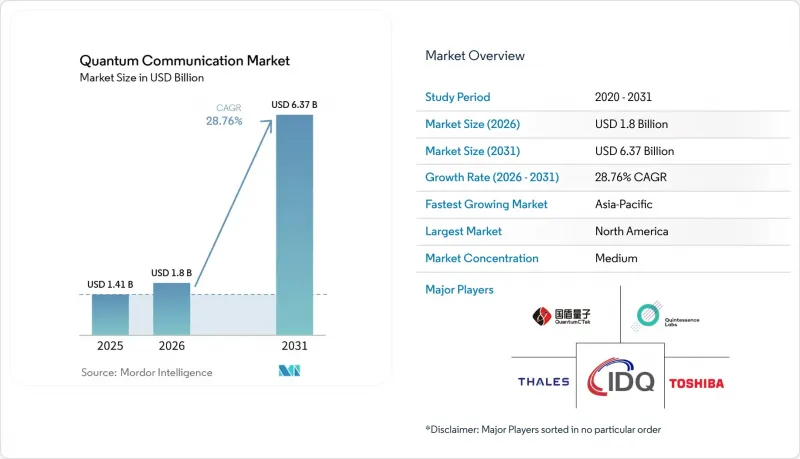
本報告按產品/服務(解決方案和服務)、部署模式(本地部署和雲端部署)、組織規模(大型企業和中小企業)、產業(銀行、金融服務和保險 (BFSI)、政府和國防、醫療保健、航太、IT 和電信、能源和公共產業、學術和研究等)以及地區進行細分。市場預測以美元 (USD) 為單位。
全球量子通訊市場趨勢與洞察
由於「先收集後解密」的風險,向量子安全過渡的壓力越來越大。
量子通訊市場正受益於一種威脅模型,對於需要長期保密的數據而言已變得尤為迫切。美國國家標準與技術研究院 (NIST) 於 2024 年最終確定了後量子密碼學的核心標準,並於 2025 年採納了 HQC 作為備用密鑰封裝機制。這為買家提供了更清晰的長期規劃過渡路徑。隨後,白宮於 2026 年 6 月設定了明確的聯邦期限,要求在 2030 年 12 月 31 日前完成後量子金鑰的建立,並在 2031 年 12 月 31 日前完成向數位簽章的過渡。 NIST 也將後量子過渡定位為“當前風險管理挑戰”,而不僅僅是“未來的擔憂”。這對那些需要儲存數十年記錄的行業具有重大意義。這些壓力正在推動量子通訊市場加快預算核准,尤其是在那些延誤可能危及高度敏感檔案、簽名系統和長期加密記錄的領域。因此,量子通訊市場的發展不僅受技術成熟度的驅動,也受合規時間表的限制。
國防和國家安全採購,用於主權安全鏈接
量子通訊市場的發展也受到國防領域買家的推動,他們優先考慮主權控制,並且能夠承受更高的部署成本。 2026年6月,白宮的一項指令擴大了聯邦政府向量子安全過渡的力度,使得這個問題對於所有支持敏感系統的機構和承包商都至關重要。根據《國家安全局網路與安全2.0》(CNSA 2.0)的規定,美國國家安全局(NSA)要求自2027年1月1日起,新採購的國家安全系統必須符合後量子演算法的要求,這為未來的採購設定了明確的截止日期。歐洲政府網路的發展也表明,主權安全通訊正從概念階段邁向實際運作階段。例如,丹麥將於2025年運作一個涵蓋10個政府部門的量子安全網路。這些項目對量子通訊市場至關重要,因為國防層面的採購通常會制定技術標準,而這些標準又會影響金融、通訊和基礎設施領域的部署。此外,這些項目往往優先考慮能夠滿足嚴格的認證、控制和整合要求的供應商,而不是僅僅銷售獨立硬體的供應商。
量子級硬體和網路整合的高資本密集度
量子通訊市場仍面臨著巨大的成本壁壘,尤其是在部署需要專用硬體、精確的光學設計和網路適配的情況下。對於需要專用光纖環境、嚴格的實體管理以及與現有安全環境深度整合的專案而言,這項挑戰尤其突出。供應商正致力於減少重新設計的需求。例如,ID Quantique 和 IonQ 預計將於 2025 年部署“Clavis XG Multiplex”,這將使量子流量和傳統流量能夠在現有的城域光纖基礎設施上共存。營運商主導的模式也在推動這項轉型。 Orange Business 計劃於 2025 年與東芝合作推出“Quantum Defender”,該服務不僅銷售設備,而且是一項商業服務。 Quantropi 預計將於 2026 年進一步加速這項轉型,屆時其與諾基亞整合的 D-QKD 平台將全面開放,為營運商和企業提供與硬體無關的部署方案。儘管取得了這些進展,但在低成本方案得到更廣泛的應用之前,量子通訊市場可能仍然更適合大型買家而非中型組織。
細分市場分析
預計到2025年,「解決方案」細分市場將佔量子通訊市場總收入的58.97%,並預計到2031年將以30.34%的複合年成長率成長,這主要得益於企業和政府機構傾向於直接擁有加密硬體。這一趨勢反映了在關鍵基礎設施環境中保持密鑰產生控制權的需求。在「解決方案」細分市場中,量子金鑰傳輸(QKD)系統預計仍將是主要的收入來源。 2025年6月,Orange Business和東芝計劃在整個巴黎大都會圈推出法國首個商用量子安全網路服務,該服務結合了量子金鑰傳輸和後量子密碼技術。預計量子隨機數產生器(QRNG)的應用範圍也將超越專業安全應用領域,並得到更廣泛的應用。 Palo Alto Networks 計畫於 2025 年 1 月推出 QRNG Open API 框架,以支援供應商之間的互通性;而 OVHcloud 預計將利用 QRNG 產生的熵,在 2025 年 9 月之前為大約 500 萬個託管網站提供 SSL 憑證保護。
單光子檢測器、量子記憶體和光子積體電路等量子通訊組件預計將保持高供應量和高利潤率。這些專業供應商的集中度支撐了其定價優勢。此外,隨著企業尋求管理混合量子-經典環境的工具,預計採購重點將轉向後量子金鑰管理軟體和加密敏捷中介軟體等解決方案。儘管預計到2025年,服務業在量子通訊市場中的佔有率將有所下降,但部署和整合預計將帶來可觀的商機。預計在2026年5月,Terra Quantum和Merqury Cybersecurity將在馬耳他梅利塔的運作中電信光纖網路上部署量子金鑰傳輸(QKD)鏈路,並透過符合ETSI標準的REST API處理數萬個金鑰請求。隨著銀行、金融服務和保險 (BFSI) 以及國防機構應對加密敏捷性要求、專業知識缺乏以及本地基礎設施營運成本等挑戰,專業服務、培訓、支援和託管金鑰供應預計將會擴大。
預計到2025年,本地部署將佔總收入的67.32%,這表明量子通訊市場仍然偏好物理可控環境。這一趨勢在國防、政府和金融結算網路中尤為顯著,因為儲存、可見性和運行隔離仍然是這些領域的核心需求。在許多此類環境中,量子金鑰分發(QKD)的安全優勢依賴於對金鑰分發環境的嚴格控制,這使得共用基礎架構的部署變得困難。因此,量子通訊市場的大部分部署都圍繞著本地環境構建,運營商可以在其中直接管理網路狀態。預計在整個預測期內,這種部署模式仍將保持重要性,因為在許多受監管的系統中,信任邊界無法快速變更。
預計2026年至2031年間,雲端部署的量子通訊市場將以29.21%的複合年成長率成長,成為成長最快的部署模式。這一成長反映了市場對軟體定義和訂閱模式的需求日益成長,這些模式降低了光電領域小規模買家的複雜性門檻。 Quantropi的D-QKD平台預計將於2026年正式發布,並透過與諾基亞安全管理伺服器的整合,為營運商和企業部署提供硬體無關的解決方案。此外,Orange Business與東芝合作,將於2025年在巴黎大都會圈推出「Quantum Defender」商業化產品,顯示營運商可以將量子安全網路作為託管服務提供。因此,量子通訊市場正在湧現第二個部署管道,該管道無需所有客戶進行大量的前期資本投資。
區域分析
預計到2025年,北美將佔據量子通訊市場23.98%的佔有率,成為最大的貢獻地區。美國在該地區處於領先地位,聯邦政府和承包商的強制性要求正在加速公共和國防相關供應鏈的轉型規劃。預計白宮將於2026年6月發布一項行政命令,為後量子時代轉型設定明確的聯邦期限,並加強早期採用決策的合規性基礎。加拿大也在支持該地區,預計聯邦政府的規劃要求將於2026年4月最終確定,並規定在2025年向選定的量子相關企業提供3.34億加元(2.43億美元)的資金。
預計亞太地區2026年至2031年將以29.11%的複合年成長率成長,成為量子通訊市場成長最快的地區。 2025年,中國的營運商級網路預計將超過1萬公里,透過結合地面光纖和衛星地面站,為該地區提供國家級部署的參考模型。印度在其「國家量子任務」框架下,將於2026年4月實現1,000公里量子金鑰分發(QKD)的里程碑,並計畫在2031年建成2,000公里整合衛星骨幹網路。日本、韓國和新加坡也透過其面向政府和金融領域的安全通訊項目,全部區域的需求提供支援。歐洲透過歐洲量子通訊計劃(EuroQCI)及相關國家計畫保持競爭力。丹麥預計於2025年運作涵蓋10個政府部門的量子安全網路,而歐洲電信標準化協會(ETSI)預計將於2026年繼續加強其區域標準基礎設施建設。
南美洲、中東和非洲的量子通訊市場仍處於早期階段,目前主要活動集中在政策制定、試點計畫和關鍵基礎設施規劃。在南美洲,巴西是目前最活躍的早期市場,對安全的銀行間通訊以及金融領域的應用案例表現出濃厚的興趣。在中東,量子安全專案正與主權雲端概念和關鍵基礎設施保護相結合,隨著營運需求的成熟,預計這將促進未來的採購。非洲目前仍處於認知初期,但參與更廣泛的標準化框架將有助於區域計畫與當前量子通訊市場正在形成的互通性方向保持一致。
其他好處
- Excel格式的市場預測(ME)表
- 3個月的分析師支持
目錄
第1章:引言
- 研究假設和市場定義
- 調查範圍
第2章:調查方法
第3章執行摘要
第4章 市場狀況
- 市場概覽
- 市場促進因素
- 由於「先收集後解密」的風險,向量子安全過渡的壓力越來越大。
- 國防和國家安全採購,用於主權安全鏈接
- 透過光纖和衛星的混合應用,拓展可部署的應用場景
- 企業加密敏捷性和零信任計畫的整合
- 多廠商量子安全協定棧互通性的必要性
- 來自關鍵基礎設施和高價值貿易網路的特殊需求
- 市場限制因素
- 量子級硬體和網路整合的高資本密集度
- 協議、測試方法和認證缺乏標準化
- 量子光學和光電領域的人才短缺
- 跨境業務受出口管制和主權規則的約束
- 產業價值鏈分析
- 監理情勢
- 技術展望
- 價格分析
- 波特五力分析
第5章 市場規模與成長預測
- 透過提供
- 解決方案
- 量子通訊組件
- 量子金鑰傳輸解決方案
- 量子隨機數產生器
- 其他解決方案
- 服務
- 專業服務
- 培訓和諮詢
- 實施與整合
- 支援與維護
- 其他服務
- 解決方案
- 部署模式
- 現場
- 雲
- 按組織規模
- 大公司
- 小型企業
- 按行業
- BFSI
- 政府/國防
- 衛生保健
- 航太
- 資訊科技/通訊
- 能源與公共產業
- 學術與研究
- 其他行業
- 按地區
- 北美洲
- 美國
- 加拿大
- 墨西哥
- 南美洲
- 巴西
- 阿根廷
- 其他南美國家
- 歐洲
- 德國
- 英國
- 法國
- 其他歐洲國家
- 亞太地區
- 中國
- 日本
- 印度
- 韓國
- 其他亞太國家
- 中東
- 沙烏地阿拉伯
- 阿拉伯聯合大公國
- 其他中東國家
- 非洲
- 南非
- 奈及利亞
- 其他非洲國家
- 北美洲
第6章 競爭情勢
- 市場集中度
- 策略趨勢
- 市佔率分析
- 公司簡介
- Toshiba Corporation
- Thales SA
- ID Quantique SA
- QuintessenceLabs Pty Ltd
- QuantumCTek Co., Ltd.
- Qubitekk, Inc.
- Quantum Xchange, Inc.
- MagiQ Technologies, Inc.
- Arqit Quantum Inc.
- Aliro Quantum, Inc.
- HEQA Security BV
- Crypta Labs Limited
- SpeQtral Pte. Ltd.
- QNu Labs Private Limited
- QphoX BV
- Qunnect, Inc.
- LuxQuanta Technologies SL
- Quantropi Inc.
第7章 市場機會與未來展望
According to Mordor Intelligence, the quantum communication market size is projected to expand from USD 1.41 billion in 2025 and USD 1.80 billion in 2026 to USD 6.37 billion by 2031, registering a CAGR of 28.76% between 2026 to 2031.
This report is Segmented by Offering (Solutions, and Services), Deployment Mode (On-Premises, and Cloud), Organization Size (Large Enterprises, and Small and Medium Enterprises), Vertical (BFSI, Government and Defense, Healthcare, Aerospace, IT and Telecommunications, Energy and Utilities, Academia and Research, and More), and Geography. The Market Forecasts are Provided in Terms of Value (USD).
Global Quantum Communication Market Trends and Insights
Rising Quantum-Safe Migration Pressure from Harvest-Now, Decrypt-Later Risk
The quantum communication market is benefiting from a threat model that has become urgent for data with long confidentiality lives. NIST finalized core post-quantum standards in 2024 and selected HQC as a backup key encapsulation mechanism in 2025, providing buyers with a clearer migration path for long-term planning. The White House then set firm federal deadlines in June 2026 for post-quantum key establishment by December 31, 2030, and digital signature migration by December 31, 2031. NIST also framed post-quantum migration as a current risk-management issue rather than a future-only concern, which matters for sectors that retain records for decades. That pressure supports earlier budget approvals in the quantum communication market, especially where delayed action could expose sensitive archives, signing systems, and long-life encrypted records. The result is that the quantum communication market is being pulled forward by compliance calendars as much as by technology readiness.
Defense And National Security Procurement for Sovereign Secure Links
The quantum communication market is also being driven by defense buyers who value sovereign control and can absorb higher deployment costs. The White House order in June 2026 widened the federal push for quantum-safe migration and made the issue relevant across agencies and contractors that support sensitive systems. NSA guidance under CNSA 2.0 requires new national security system acquisitions to support post-quantum algorithms starting January 1, 2027, creating a clear procurement cutoff for future buys. Government network activity in Europe also shows that sovereign secure communications are moving from concept work into operational environments, as Denmark activated a quantum-secure network across 10 ministry sites in 2025. These programs matter for the quantum communication market because defense-grade procurement often sets technical standards that later influence financial, telecom, and infrastructure deployments. They also favor vendors that can meet strict certification, control, and integration requirements rather than selling stand-alone hardware.
High Capital Intensity for Quantum-Grade Hardware and Network Integration
The quantum communication market continues to face a significant cost barrier, particularly when deployments require specialized hardware, precise optical design, and network adaptation. This challenge is most evident in projects that require dedicated fiber conditions, strict physical control, and deep integration with legacy security environments. Vendors are working to reduce redesign requirements. For instance, ID Quantique and IonQ are expected to introduce Clavis XG Multiplex in 2025, enabling quantum and classical traffic to coexist on existing metropolitan fiber infrastructure. Carrier-led models are also supporting this transition. Orange Business is expected to launch Quantum Defender with Toshiba in 2025 as a commercial service rather than a pure equipment sale. Quantropi is expected to further advance this shift in 2026 by making its D-QKD platform generally available with Nokia integration, supporting hardware-agnostic deployment paths for carriers and enterprises. Despite these developments, the quantum communication market is likely to remain more accessible to large buyers than to mid-sized organizations until lower-cost packaging becomes more widely available.
Other drivers and restraints analyzed in the detailed report include:
- Fiber And Satellite Hybridization Expanding Deployable Use Cases
- Enterprise Crypto-Agility and Zero-Trust Program Alignment
- Limited Standardization Across Protocols, Test Methods, And Certification
For complete list of drivers and restraints, kindly check the Table Of Contents.
Segment Analysis
The Solutions segment is expected to account for 58.97% of the quantum communication market revenue in 2025, and it is projected to expand at a 30.34% CAGR through 2031, as enterprises and government agencies favor direct ownership of cryptographic hardware. This preference reflects the need to retain control over key generation in critical infrastructure settings. Quantum Key Distribution systems are expected to remain the primary revenue contributor within solutions. In June 2025, Orange Business and Toshiba are expected to launch France's first commercial quantum-safe network service, combining Quantum Key Distribution and post-quantum cryptography across the greater Paris area. Quantum Random Number Generators are also expected to move beyond specialized security applications. Palo Alto Networks is expected to introduce its QRNG Open API framework in January 2025 to support interoperability across vendors, while OVHcloud is expected to use QRNG-generated entropy to secure SSL certificates for nearly 5 million hosted websites by September 2025.
Quantum communication components, including single-photon detectors, quantum memories, and photonic integrated circuits, are expected to remain supply-constrained and command high margins. This concentration of specialist suppliers supports their pricing position. Other solutions, including post-quantum key management software and crypto-agile middleware, are expected to receive greater procurement attention as enterprises seek tools to manage hybrid quantum-classical environments. The Services segment is expected to represent a smaller share of the quantum communication market in 2025, although deployment and integration are likely to generate substantial billing opportunities. In May 2026, Terra Quantum and Merqury Cybersecurity are expected to deploy a Quantum Key Distribution link on Melita's active telecom fiber network in Malta, processing tens of thousands of key requests through an ETSI-aligned REST API. Professional services, training, support, and managed key provisioning are expected to expand as BFSI and defense organizations address crypto-agility requirements, limited specialist skills, and the cost of operating on-premises infrastructure.
On-premises deployment is expected to account for 67.32% of revenue in 2025, showing that the quantum communication market still leans toward physically controlled environments. This pattern is strongest in defense, government, and financial clearing networks, where custody, visibility, and operational isolation remain central requirements. In many of these settings, QKD's security promise depends on tight control over the key distribution environment, making shared infrastructure a difficult fit. The quantum communication market has therefore built much of its installed base around on-premises models, where operators can directly manage network conditions. This installed base is expected to remain important through the forecast period because many regulated systems cannot shift their trust boundaries quickly.
The quantum communication market size for cloud deployment is projected to expand at a 29.21% CAGR from 2026 to 2031, making it the fastest-growing deployment mode. This growth reflects rising demand for software-defined and subscription-based models that reduce the complexity barrier for smaller buyers in photonics. Quantropi's D-QKD platform is expected to reach general availability in 2026 with integration into Nokia's Security Management Server, supporting a hardware-agnostic approach for carrier and enterprise deployments. Orange Business also commercialized Quantum Defender in the greater Paris area in 2025 with Toshiba, showing how telecom operators can package quantum-safe networking as a managed service. As a result, the quantum communication market is creating a second adoption path that does not require every customer to begin with heavy capital spending.
Complete Report Scope:
- By Offering
- Solutions
- Quantum Communication Components
- Quantum Key Distribution Solutions
- Quantum Random Number Generator
- Other Solutions
- Services
- Professional Services
- Training and Consulting
- Deployment and Integration
- Support and Maintenance
- Other Services
- Solutions
- By Deployment Mode
- On-Premises
- Cloud
- By Organization Size
- Large Enterprises
- Small and Medium Enterprises
- By Vertical
- BFSI
- Government and Defense
- Healthcare
- Aerospace
- IT and Telecommunications
- Energy and Utilities
- Academia and Research
- Other Verticals
- By Geography
- North America
- United States
- Canada
- Mexico
- South America
- Brazil
- Argentina
- Rest of South America
- Europe
- Germany
- United Kingdom
- France
- Rest of Europe
- Asia-Pacific
- China
- Japan
- India
- South Korea
- Rest of Asia-Pacific
- Middle East
- Saudi Arabia
- United Arab Emirates
- Rest of the Middle East
- Africa
- South Africa
- Nigeria
- Rest of Africa
- North America
Geography Analysis
North America is expected to hold 23.98% of the quantum communication market share in 2025, making it the largest regional contributor. The United States leads the region, as federal mandates and contractor obligations are accelerating migration planning across public agencies and defense-linked supply chains. The White House order issued in June 2026 is expected to set firm federal deadlines for post-quantum migration, strengthening the compliance case for earlier deployment decisions. Canada also supports the region's position, with federal planning requirements expected by April 2026 and CAD 334 million (USD 243 million) directed to selected quantum companies in 2025.
Asia-Pacific is projected to expand at a CAGR of 29.11% from 2026 to 2031, making it the fastest-growing region in the quantum communication market. China's carrier-grade network is expected to exceed 10,000 km by 2025 and to combine terrestrial fiber with satellite ground stations, providing the region with a deployed national-scale reference model. India is expected to reach a 1,000-km QKD milestone in April 2026 under the National Quantum Mission and target a 2,000-km backbone with satellite integration by 2031. Japan, South Korea, and Singapore are also advancing secure communications programs for government and financial applications, supporting broader regional demand. Europe remains competitive through EuroQCI and related national programs. Denmark is expected to activate a quantum-secure network across 10 ministry sites in 2025, while ETSI is expected to continue strengthening the regional standards base in 2026.
South America, the Middle East, and Africa remain earlier-stage parts of the quantum communication market, with activity focused on policy work, selective pilots, and critical infrastructure planning. Brazil is the most active early market in South America, with interest focused on secure interbank communication and financial-sector use cases. The Middle East is linking quantum-safe programs to sovereign cloud agendas and critical infrastructure protection, which should support future procurement as operational requirements mature. Africa remains at an earlier awareness stage, but participation in broader standards frameworks should help regional programs align with the interoperability direction now forming across the quantum communication market.
- Toshiba Corporation
- Thales S.A.
- ID Quantique SA
- QuintessenceLabs Pty Ltd
- QuantumCTek Co., Ltd.
- Qubitekk, Inc.
- Quantum Xchange, Inc.
- MagiQ Technologies, Inc.
- Arqit Quantum Inc.
- Aliro Quantum, Inc.
- HEQA Security B.V.
- Crypta Labs Limited
- SpeQtral Pte. Ltd.
- QNu Labs Private Limited
- QphoX B.V.
- Qunnect, Inc.
- LuxQuanta Technologies S.L.
- Quantropi Inc.
Additional Benefits:
- The market estimate (ME) sheet in Excel format
- 3 months of analyst support
TABLE OF CONTENTS
1 INTRODUCTION
- 1.1 Study Assumptions and Market Definition
- 1.2 Scope of the Study
2 RESEARCH METHODOLOGY
3 EXECUTIVE SUMMARY
4 MARKET LANDSCAPE
- 4.1 Market Overview
- 4.2 Market Drivers
- 4.2.1 Rising Quantum-Safe Migration Pressure From Harvest-Now, Decrypt-Later Risk
- 4.2.2 Defense And National Security Procurement For Sovereign Secure Links
- 4.2.3 Fiber And Satellite Hybridization Expanding Deployable Use Cases
- 4.2.4 Enterprise Crypto-Agility And Zero-Trust Program Alignment
- 4.2.5 Interoperability Demand Across Multi-Vendor Quantum Security Stacks
- 4.2.6 Specialized Demand From Critical Infrastructure And High-Value Transaction Networks
- 4.3 Market Restraints
- 4.3.1 High Capital Intensity For Quantum-Grade Hardware And Network Integration
- 4.3.2 Limited Standardization Across Protocols, Test Methods, And Certification
- 4.3.3 Shortage Of Quantum Optics And Photonics Deployment Talent
- 4.3.4 Export Controls And Sovereignty Rules Fragment Cross-Border Rollouts
- 4.4 Industry Value Chain Analysis
- 4.5 Regulatory Landscape
- 4.6 Technological Outlook
- 4.7 Pricing Analysis
- 4.8 Porter's Five Forces Analysis
- 4.8.1 Bargaining Power Of Suppliers
- 4.8.2 Bargaining Power Of Buyers
- 4.8.3 Threat Of New Entrants
- 4.8.4 Threat Of Substitutes
- 4.8.5 Industry Rivalry Analysis
5 MARKET SIZE AND GROWTH FORECASTS (VALUE)
- 5.1 By Offering
- 5.1.1 Solutions
- 5.1.1.1 Quantum Communication Components
- 5.1.1.2 Quantum Key Distribution Solutions
- 5.1.1.3 Quantum Random Number Generator
- 5.1.1.4 Other Solutions
- 5.1.2 Services
- 5.1.2.1 Professional Services
- 5.1.2.2 Training and Consulting
- 5.1.2.3 Deployment and Integration
- 5.1.2.4 Support and Maintenance
- 5.1.2.5 Other Services
- 5.1.1 Solutions
- 5.2 By Deployment Mode
- 5.2.1 On-Premises
- 5.2.2 Cloud
- 5.3 By Organization Size
- 5.3.1 Large Enterprises
- 5.3.2 Small and Medium Enterprises
- 5.4 By Vertical
- 5.4.1 BFSI
- 5.4.2 Government and Defense
- 5.4.3 Healthcare
- 5.4.4 Aerospace
- 5.4.5 IT and Telecommunications
- 5.4.6 Energy and Utilities
- 5.4.7 Academia and Research
- 5.4.8 Other Verticals
- 5.5 By Geography
- 5.5.1 North America
- 5.5.1.1 United States
- 5.5.1.2 Canada
- 5.5.1.3 Mexico
- 5.5.2 South America
- 5.5.2.1 Brazil
- 5.5.2.2 Argentina
- 5.5.2.3 Rest of South America
- 5.5.3 Europe
- 5.5.3.1 Germany
- 5.5.3.2 United Kingdom
- 5.5.3.3 France
- 5.5.3.4 Rest of Europe
- 5.5.4 Asia-Pacific
- 5.5.4.1 China
- 5.5.4.2 Japan
- 5.5.4.3 India
- 5.5.4.4 South Korea
- 5.5.4.5 Rest of Asia-Pacific
- 5.5.5 Middle East
- 5.5.5.1 Saudi Arabia
- 5.5.5.2 United Arab Emirates
- 5.5.5.3 Rest of the Middle East
- 5.5.6 Africa
- 5.5.6.1 South Africa
- 5.5.6.2 Nigeria
- 5.5.6.3 Rest of Africa
- 5.5.1 North America
6 COMPETITIVE LANDSCAPE
- 6.1 Market Concentration
- 6.2 Strategic Moves
- 6.3 Market Share Analysis
- 6.4 Company Profiles (includes Global Level Overview, Market Level Overview, Core Segments, Financials as available, Strategic Information, Market Rank/Share, Products and Services, Recent Developments)
- 6.4.1 Toshiba Corporation
- 6.4.2 Thales S.A.
- 6.4.3 ID Quantique SA
- 6.4.4 QuintessenceLabs Pty Ltd
- 6.4.5 QuantumCTek Co., Ltd.
- 6.4.6 Qubitekk, Inc.
- 6.4.7 Quantum Xchange, Inc.
- 6.4.8 MagiQ Technologies, Inc.
- 6.4.9 Arqit Quantum Inc.
- 6.4.10 Aliro Quantum, Inc.
- 6.4.11 HEQA Security B.V.
- 6.4.12 Crypta Labs Limited
- 6.4.13 SpeQtral Pte. Ltd.
- 6.4.14 QNu Labs Private Limited
- 6.4.15 QphoX B.V.
- 6.4.16 Qunnect, Inc.
- 6.4.17 LuxQuanta Technologies S.L.
- 6.4.18 Quantropi Inc.
7 MARKET OPPORTUNITIES AND FUTURE OUTLOOK
- 7.1 White-Space And Unmet-Need Assessment
- 7.2 Roadmap For Quantum Network Commercialization
- 7.3 Ecosystem Analysis

 量子通訊市場預測至2034年:按組件、部署模式、應用、最終用戶和地區分類的全球分析
 2026年全球量子通訊市場報告
 量子通訊市場:依產品類型、技術(量子金鑰分發、量子隨機數產生器、抗量子密碼學)、傳輸介質、產業垂直領域和地區劃分-全球預測至2036年
 量子通訊市場-全球產業規模、佔有率、趨勢、機會和預測:按產品類型、應用、地區和競爭格局分類,2021-2031年
 量子通訊市場規模、佔有率和成長分析(按服務、傳輸介質、部署方式、組織規模、產業和地區分類):產業預測(2026-2033 年)
 量子通訊:全球市場佔有率和排名、總收入和需求預測(2025-2031年)
 量子通訊市場規模、佔有率、趨勢分析報告:按產品、傳輸介質、公司規模、產業、地區和細分趨勢:2025-2030 年
 量子通訊的全球市場