


 |
市場調查報告書
商品編碼
2119150
清潔劑用酒精:市場佔有率分析、產業趨勢與統計、成長預測(2026-2031)Detergent Alcohols - Market Share Analysis, Industry Trends & Statistics, Growth Forecasts (2026 - 2031) |
||||||

※ 本網頁內容可能與最新版本有所差異。詳細情況請與我們聯繫。
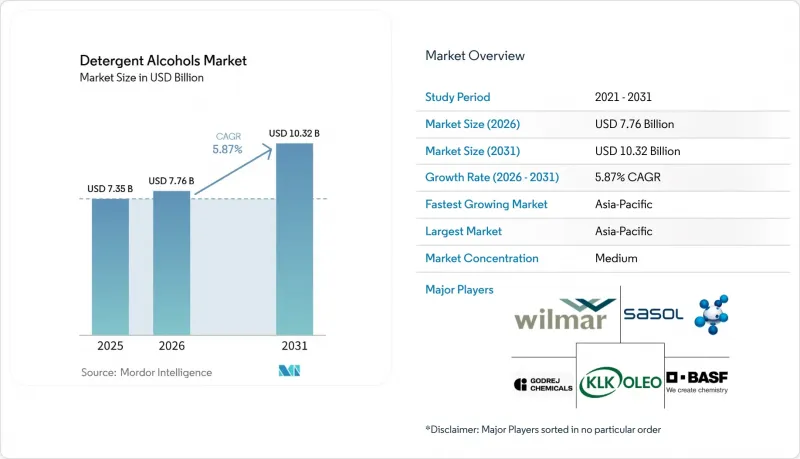
據 Mordor Intelligence 稱,2025 年清潔劑用酒精市場價值將達到 73.5 億美元,預計到 2031 年將達到 103.2 億美元,而 2026 年為 77.6 億美元,預測期內(2026-2031 年)的複合年成長率為 5.87%。
本報告按配方類型(液體和粉末)、原料(天然系和合成清潔劑清潔劑)、應用領域(家庭清潔、工業和設施清潔等)、最終用戶行業(家居護理、個人護理、紡織品加工等)以及地區(亞太地區、北美地區等)進行細分。市場預測以美元計價。
全球清潔劑。
家庭和工業清潔應用中對高性能表面活性劑的需求不斷成長。
由C12-C18醇衍生的醇乙氧基化物和醇醚硫酸酯廣泛用於液體洗衣精、清潔劑和商用清潔劑的配方中。這些化合物具有高度生物分解性,即使在低溫下也能保持良好的清潔性能,因此適用於需要可靠清潔效果的產品,尤其適用於消費者期望即使在低溫洗滌循環中也能有效清潔的情況。食品服務、醫療和旅館業日益嚴格的衛生標準,為商用清潔界面活性劑創造了持續穩定的需求基礎。與同類粉末產品相比,濃縮液體清潔劑單位體積的脂醇類含量更高,即使在消費品包裝和用水量減少的情況下,也能使成品清潔劑的單位體積醇值密度更高。 2026年7月,黑田公司報告稱,其EBC Crosolv產品在預處理噴霧中將油漬去除效果提高了高達27%,這表明生物衍生成分也有助於提高配方性能。隨著洗滌劑配方技術的不斷進步,清潔劑類洗滌劑市場可能會轉向更強大的天然來源產品。
在個人護理和化妝品配方中擴大使用清潔劑酒精
鯨蠟醇、硬脂醇和鯨蠟硬脂醇在沖洗型和免沖洗型個人保健產品中用作乳化劑、潤膚劑和質地改良劑。這些成分具有獨特的感官和配方特性,因此在某些化妝品應用中難以取代。脂醇類類非離子界面活性劑也用於護髮和其他個人護理配方中,買家正在尋找植物來源的潤膚劑和穩定的感官特性,而石油化學替代品在不改變配方的情況下可能無法複製這些特性。 2025年3月,花王與Future Origins公司簽訂了一份多年採購協議,採購NALO,這是一種透過生物發酵生產的不含棕櫚油的C12/C14脂醇類。該協議表明,買家正在積極制定籌資策略,而不是等待發酵衍生的供應達到更大的商業規模。隨著個人保健產品買家更願意為經過認證和差異化的原料支付更高的價格,清潔劑醇市場將從中受益。
棕櫚仁油、椰子油及其他油脂作為化學原料的價格波動。
受天氣、出口限制和物流瓶頸導致的產量下降影響,馬來西亞精煉、漂白和脫臭(RBD)棕櫚仁油在2025年9月的離岸價(FOB)達到每噸2035美元。椰子油價格在2025年也大幅上漲,給依賴椰子衍生原料的月桂醇生產商帶來了更大的壓力。這些價格上漲擠壓了沒有長期原料供應合約的生產商的利潤空間,一些月桂醇生產商加快了向棕櫚仁油的轉型。 2026年初,隨著供需平衡開始恢復,壓力有所緩解,但由於種植限制和乾旱週期,棕櫚仁油的產量仍然有限。中型生產商可能會因為利潤空間縮小而推遲維護成本。即使原料價格開始回落,這也可能會延長供應限制,因為恢復生產可靠性和重啟維護計畫所需的時間比短期商品價格調整要長。個人保健產品製造商的柔軟性不如家用產品製造商,因為更改配方可能需要昂貴的重新註冊。
細分市場分析
至2025年,液體配方將佔洗滌劑中清潔劑產品市場佔有率的63.22%,預計到2031年將以6.22%的複合年成長率成長。這一市場規模和成長速度反映了液體型洗衣精、清潔劑和個人保健產品的持續使用。醇醚和醇醚硫酸酯能有效溶於水性基質,因此是已開發市場和新興市場(包括洗衣精和洗碗精)許多液體配方產品的核心活性成分。濃縮型產品單位體積內脂醇類的含量高於標準粉狀產品。
在印度農村、撒哈拉以南非洲和拉丁美洲部分地區等對價格敏感的地區,粉狀洗滌劑仍具有重要的商業性價值。在這些地區,人們習慣用冷水洗滌衣物,且產品價格低廉,這些因素共同支撐了對粉狀清潔劑的需求。 2025年7月,BASF擴展了其液體酶產品線,新增了可生物分解的脂肪酶“Lavergy L Pace”和纖維素酶“C Care”,並充分考慮了它們與液體清潔劑的兼容性。因此,巴斯夫的原料研發重點在於提升主流液體洗滌劑配方的性能。
預計到2025年,天然來源的清潔劑醇將佔據清潔劑醇市場68.41%的佔有率,並將在2031年之前以6.38%的複合年成長率成長。這一成長得益於永續性計劃、消費者對潔淨標示的需求以及印尼產能的提升。源自棕櫚仁油的月桂醇和肉荳蔻醇廣泛用於家用清潔劑和工業界面活性劑。鯨蠟醇和硬脂醇在個人保健產品中尤其重要,因為它們的碳鍊長度分佈有助於乳化和質地形成。尤其是在個人保健產品的配方中,由於對原料來源有明確的要求,擁有可追溯原料的天然成分供應商更有可能在與高階客戶的合約中脫穎而出。
齊格勒法和Oxo法生產的合成醇在北美和歐洲的工業應用中仍佔有重要地位。具有奇數碳原子和支鏈的合成醇能夠提供天然醇難以實現的特性。 EcoGreen Oleochemicals公司榮獲BP Batam頒發的“2025年投資獎”,成為在巴淡島自由貿易區投資額最高的印尼本土私營企業。此舉顯示印尼將繼續加大對天然醇基礎設施的投資。此外,RSPO認證標準的修訂也提高了整個供應鏈合規性記錄的重要性。
區域分析
預計到2025年,亞太地區將佔據清潔劑醇市場45.38%的佔有率,並將在2031年之前以6.41%的複合年成長率成長。印尼和馬來西亞位置完善的油脂化學品綜合體,將油棕櫚原料與C12-C18醇的生產聯繫起來。在中國和印度,由於個人護理和家居護理需求的成長,消費量正在擴大,該地區的生產基地正成為許多買家熟悉的供應來源。在日本,化妝品配方中使用的高純度醇支撐了市場需求。在高階護髮和美容產品中,成分純度、清晰的性能和供應鏈文件比一般家用清潔產品更為重要。 EcoGreen計劃於2025年企業發展巴淡島市場,也顯示該公司將繼續在印尼進行資本投資。
北美和歐洲是較成熟的地區,在這些地區,監管和產品附加價值更為重要。歐盟第2026/405號法規將於2029年9月生效,該法規要求更嚴格的生物分解性和可追溯性措施。BASF報告稱,到2026年,其採購的RSPO認證棕櫚油和棕櫚仁油比例將達到79.2%,並實現了98%的可追溯性,直至煉油廠層面。北美嚴重依賴沙索和殼牌的合成醇產能。隨著消費品公司尋求不涉及森林砍伐的原料以及具有更強可追溯性的原料,生物基產品的進口可能會變得越來越重要。
南美洲、中東和非洲是具有巨大成長潛力的地區。在巴西,消費者和機構的清潔活動是推動需求的主要因素。在南美洲,Indorama Ventures 的子公司 Oxyteno 對可再生脂醇類的加工,反映了下游對生物基材料的需求。在中東和非洲,Sasol 在南非的合成醇生產以及沙烏地阿拉伯的石化原料供應支撐著市場。外匯波動和物流成本可能會限制棕櫚油衍生油脂化學品產品的進口,從而導致基於人口結構的潛在需求與實際購買量之間出現週期性差異。這些因素可能會限制人口成長和都市化轉化為清潔劑醇需求成長的程度。
其他好處:
- Excel格式的市場預測(ME)表
- 3個月的分析師支持
目錄
第1章:引言
- 研究假設和市場定義
- 調查範圍
第2章:調查方法
第3章執行摘要
第4章 市場狀況
- 市場概覽
- 市場促進因素
- 家庭和工業清潔應用中對高性能表面活性劑的需求不斷成長。
- 在個人護理和化妝品配方中擴大使用清潔劑酒精
- 擴大生物基和可再生油脂化學品原料的使用。
- 新興國家對經濟實惠的清潔劑成分的需求日益成長
- 有利於可生物分解和環境友善表面活性劑成分的監管政策轉變
- 市場限制因素
- 棕櫚仁油、椰子油及其他油脂化學原料的價格波動
- 與棕櫚油供應鏈相關的永續性和環境問題
- 生產和精煉設施需要大量資本投資。
- 價值鏈分析
- 波特五力分析
第5章 市場規模與成長預測
- 依配方類型
- 液體
- 粉末
- 按原料
- 用於天然清潔劑的酒精
- 月桂醇(十二醇)
- 肉荳蔻醇(十四烷醇)
- 鯨蠟醇(十六醇)
- 硬脂醇(十八醇)
- 油醇(十八烯醇)
- 鯨蠟硬脂醇混合物
- 其他天然系清潔酒精
- 合成清潔劑酒精
- 線性合成醇
- 支鏈合成醇
- 其他合成清潔劑和酒精
- 用於天然清潔劑的酒精
- 透過使用
- 家務清潔
- 工業和設施清潔
- 個人護理化妝品
- 紡織加工
- 潤滑油和化學中間體
- 其他用途
- 按最終用途行業分類
- 居家照護
- 個人護理
- 工業和公共機構
- 化學品
- 按地區
- 亞太地區
- 中國
- 印度
- 日本
- 韓國
- 其他亞太國家
- 北美洲
- 美國
- 加拿大
- 墨西哥
- 歐洲
- 德國
- 英國
- 法國
- 義大利
- 俄羅斯
- 其他歐洲國家
- 南美洲
- 巴西
- 阿根廷
- 其他南美國家
- 中東和非洲
- 沙烏地阿拉伯
- 南非
- 其他中東和非洲國家
- 亞太地區
第6章 競爭情勢
- 市場集中度
- 策略趨勢
- 市佔率和排名分析
- 公司簡介
- BASF
- Cargill, Incorporated
- Croda International Plc
- Ecogreen Oleochemicals
- Emery Oleochemicals
- Godrej Chemicals
- Kao Corporation
- KLK OLEO
- Musim Mas Group
- OLEOCHEMICAL INDUSTRIES BERHAD
- Procter & Gamble
- Sasol Limited
- Shell
- VVF Ltd.
- Wilmar International Ltd
第7章 市場機會與未來展望
According to Mordor Intelligence, the detergent alcohols market was valued at USD 7.35 billion in 2025 and is estimated to grow from USD 7.76 billion in 2026 to reach USD 10.32 billion by 2031, at a CAGR of 5.87% during the forecast period (2026-2031).
This report is Segmented by Formulation Type (Liquid and Powder), Source (Natural Detergent Alcohols and Synthetic Detergent Alcohols), Application (Household Cleaning, Industrial and Institutional Cleaning, and More), End-Use Industry (Home Care, Personal Care, Textile Processing, and More), Geography (Asia-Pacific, North America, and More). The Market Forecasts are Provided in Terms of Value (USD).
Global Detergent Alcohols Market Trends and Insights
Rising Demand for High-Performance Surfactants in Household and Industrial Cleaning
Alcohol ethoxylates and alcohol ether sulfates derived from C12 to C18 alcohols are widely used in liquid laundry, dishwashing, and institutional cleaning formulations. Their biodegradability and cold-temperature performance support their use in products that need dependable cleaning performance, especially where consumers expect results in lower-temperature wash cycles. Higher hygiene requirements in food service, health care, and hospitality have sustained demand for industrial cleaning surfactants, adding a durable layer of demand. Concentrated liquid detergents require greater fatty alcohol loading per unit volume than comparable powder products, raising alcohol value density for each unit of finished detergent even when the consumer product itself uses less packaging and water. Croda reported in July 2026 that its EBC Crosolv products delivered up to 27% better greasy stain removal in pre-treatment sprays, showing how bio-based ingredients can also address formulation performance. The detergent alcohols market is likely to favor natural grades with stronger functional properties as cleaning formulations continue to develop.
Expanding Use of Detergent Alcohols in Personal Care and Cosmetics Formulations
Cetyl, stearyl, and cetearyl alcohols are used as emulsifiers, emollients, and texture agents in rinse-off and leave-on personal care products. Their defined sensory and formulation properties make substitution difficult in some cosmetic applications. Fatty alcohol-based non-ionic surfactants are also used in hair care and other personal care formulations, where buyers seek plant-derived emollients and consistent sensory properties that petrochemical alternatives may not reproduce without formulation changes. Kao entered a multiyear purchase agreement with Future Origins in March 2025 for NALO, a palm-free C12/C14 fatty alcohol made through biofermentation. This agreement shows that buyers are preparing their sourcing strategies before fermentation-derived supply reaches broader commercial volumes, rather than waiting for large-scale production to become available. The detergent alcohols market benefits when personal care buyers accept higher costs for certified and differentiated materials.
Volatility in Prices of Palm Kernel Oil, Coconut Oil, and Other Oleochemical Feedstocks
Refined, Bleached, and Deodorized (RBD) palm kernel oil in Malaysia reached USD 2,035 per metric ton FOB in September 2025, following weather-related yield disruption, export restrictions, and logistics constraints. Coconut oil prices also rose sharply in 2025, increasing pressure on lauryl alcohol producers that rely on coconut-derived feedstock. These increases reduced margins for producers without long-term feedstock agreements and encouraged some lauryl alcohol producers to accelerate palm-kernel-oil-based substitution. Early 2026 conditions indicated easing pressure as supply and demand started to rebalance, although planting constraints and drought cycles continued to limit palm kernel oil output. Mid-tier producers may defer maintenance spending when margins narrow, which can prolong supply constraints even after feedstock prices begin to correct, because restoring production reliability and maintenance schedules takes longer than a short-term commodity price adjustment. Personal care producers have less flexibility than household product makers because formulation changes can require costly re-registration.
Other drivers and restraints analyzed in the detailed report include:
- Growing Adoption of Bio-Based and Renewable Oleochemical Feedstocks
- Favorable Regulatory Shift Toward Biodegradable and Environmentally Friendly Surfactant Ingredients
- Sustainability and Environmental Concerns Related to Palm Oil-Based Supply Chains
For complete list of drivers and restraints, kindly check the Table Of Contents.
Segment Analysis
Liquid formulation held 63.22% of the detergent alcohols market share in 2025 and is projected to grow at a 6.22% CAGR through 2031. This combined scale and growth position reflects continued use of liquid laundry, dishwashing, and personal care products. Alcohol ethoxylates and alcohol ether sulfates dissolve effectively in water-based matrices. They are therefore core active ingredients in many liquid formulations used in developed and emerging markets, including laundry and dishwashing products. Concentrated formats use more fatty alcohol per unit volume than standard powder products.
Powder formulation remains commercially important in price-sensitive areas, including rural India, Sub-Saharan Africa, and parts of Latin America. Cold-water washing habits and lower product costs support powder demand in these locations. BASF expanded its liquid enzyme portfolio in July 2025 with biodegradable Lavergy L Pace lipase and C Care cellulase for liquid detergent compatibility. Ingredient development is therefore concentrating on performance within the leading liquid format.
Natural detergent alcohols held 68.41% of the detergent alcohols market share in 2025 and are projected to grow at a 6.38% CAGR through 2031. Sustainability commitments, clean-label demand, and Indonesian capacity additions support this position. Lauryl and myristyl alcohols from palm kernel oil streams are widely used in household cleaning and industrial surfactants. Cetyl and stearyl alcohols are especially relevant to personal care products because their chain distribution supports emulsification and texture. Natural suppliers with traceable feedstock documentation can be preferred in premium customer agreements, particularly for personal care formulations with defined sourcing requirements.
Synthetic alcohols made through Ziegler and oxo processes remain relevant in North American and European industrial applications. Odd-carbon and branched-chain variants can provide properties that natural alcohols cannot readily match. Ecogreen Oleochemicals received BP Batam's 2025 Investment Award as the domestic private national company with the largest investment realization in the Batam Free Trade Zone. This development points to continued investment in Indonesia's natural alcohol infrastructure. Updated RSPO requirements also raise the importance of documented compliance across the supply chain.
Complete Report Scope:
- By Formulation Type
- Liquid
- Powder
- By Source
- Natural Detergent Alcohols
- Lauryl Alcohol (Dodecanol)
- Myristyl Alcohol (Tetradecanol)
- Cetyl Alcohol (Hexadecanol)
- Stearyl Alcohol (Octadecanol)
- Oleyl Alcohol (Octadecenol)
- Cetyl-Stearyl Alcohol Blends
- Other Natural Detergent Alcohols
- Synthetic Detergent Alcohols
- Linear Synthetic Alcohols
- Branched Synthetic Alcohols
- Other Synthetic Detergent Alcohols
- Natural Detergent Alcohols
- By Application
- Household Cleaning
- Industrial and Institutional Cleaning
- Personal Care and Cosmetics
- Textile Processing
- Lubricants and Chemical Intermediates
- Other Applications
- By End-Use Industry
- Home Care
- Personal Care
- Industrial and Institutional
- Chemical
- By Geography
- Asia-Pacific
- China
- India
- Japan
- South Korea
- Rest of Asia-Pacific
- North America
- United States
- Canada
- Mexico
- Europe
- Germany
- United Kingdom
- France
- Italy
- Russia
- Rest of Europe
- South America
- Brazil
- Argentina
- Rest of South America
- Middle-East and Africa
- Saudi Arabia
- South Africa
- Rest of Middle-East and Africa
- Asia-Pacific
Geography Analysis
Asia-Pacific held 45.38% of the detergent alcohols market share in 2025 and is forecast to grow at a 6.41% CAGR through 2031. Indonesia and Malaysia host integrated oleochemical complexes that connect oil palm feedstock with C12 to C18 alcohol production. China and India add consumption growth through personal care and home care demand, while the regional production base provides a close supply source for many buyers. Japan supports demand for high-purity alcohols used in cosmetic formulations, where premium hair care and beauty products place greater weight on ingredient purity, defined performance, and supply-chain documentation than commodity household cleaning products. Ecogreen's 2025 recognition in Batam also indicates continued capital deployment in Indonesia.
North America and Europe are mature regions where regulation and product value are more important. Regulation (EU) 2026/405 will apply from September 2029 and will require stronger biodegradability and traceability practices. BASF reported 79.2% RSPO-certified palm and palm kernel oil sourcing and 98% traceability to the oil mill level in 2026. North America relies substantially on synthetic alcohol capacity from Sasol and Shell. Bio-based imports can gain relevance as consumer goods companies pursue deforestation-free sourcing and seek materials supported by stronger traceability records.
South America, and the Middle-East and Africa are regions with growth potential. Brazil supports demand through consumer goods and institutional cleaning activity. In South America, renewable fatty alcohol processing by Indorama Ventures' Oxiteno division shows downstream demand for bio-based materials. The Middle-East and Africa have supply support from Sasol's South African synthetic alcohol production and Saudi petrochemical feedstock. Currency volatility and logistics costs can constrain imports of palm-derived oleochemicals, creating periodic gaps between demographic demand potential and realized purchasing. These factors can limit the extent to which the underlying population and urbanization growth convert into detergent alcohol demand.
- BASF
- Cargill, Incorporated
- Croda International Plc
- Ecogreen Oleochemicals
- Emery Oleochemicals
- Godrej Chemicals
- Kao Corporation
- KLK OLEO
- Musim Mas Group
- OLEOCHEMICAL INDUSTRIES BERHAD
- Procter & Gamble
- Sasol Limited
- Shell
- VVF Ltd.
- Wilmar International Ltd
Additional Benefits:
- The market estimate (ME) sheet in Excel format
- 3 months of analyst support
TABLE OF CONTENTS
1 Introduction
- 1.1 Study Assumptions and Market Definition
- 1.2 Scope of the Study
2 Research Methodology
3 Executive Summary
4 Market Landscape
- 4.1 Market Overview
- 4.2 Market Drivers
- 4.2.1 Rising Demand for High-Performance Surfactants in Household and Industrial Cleaning
- 4.2.2 Expanding Use of Detergent Alcohols in Personal Care and Cosmetics Formulations
- 4.2.3 Growing Adoption of Bio-Based and Renewable Oleochemical Feedstocks
- 4.2.4 Increasing Demand for Cost-Effective Detergent Raw Materials in Emerging Economies
- 4.2.5 Favorable Regulatory Shift Toward Biodegradable and Environmentally Friendly Surfactant Ingredients
- 4.3 Market Restraints
- 4.3.1 Volatility in Prices of Palm Kernel Oil, Coconut Oil, and Other Oleochemical Feedstocks
- 4.3.2 Sustainability and Environmental Concerns Related to Palm Oil-Based Supply Chains
- 4.3.3 High Capital Investment Requirements for Production and Refining Facilities
- 4.4 Value Chain Analysis
- 4.5 Porter's Five Forces Analysis
- 4.5.1 Threat of New Entrants
- 4.5.2 Bargaining Power of Suppliers
- 4.5.3 Bargaining Power of Buyers
- 4.5.4 Threat of Substitutes
- 4.5.5 Competitive Rivalry
5 Market Size and Growth Forecasts (Value)
- 5.1 By Formulation Type
- 5.1.1 Liquid
- 5.1.2 Powder
- 5.2 By Source
- 5.2.1 Natural Detergent Alcohols
- 5.2.1.1 Lauryl Alcohol (Dodecanol)
- 5.2.1.2 Myristyl Alcohol (Tetradecanol)
- 5.2.1.3 Cetyl Alcohol (Hexadecanol)
- 5.2.1.4 Stearyl Alcohol (Octadecanol)
- 5.2.1.5 Oleyl Alcohol (Octadecenol)
- 5.2.1.6 Cetyl-Stearyl Alcohol Blends
- 5.2.1.7 Other Natural Detergent Alcohols
- 5.2.2 Synthetic Detergent Alcohols
- 5.2.2.1 Linear Synthetic Alcohols
- 5.2.2.2 Branched Synthetic Alcohols
- 5.2.2.3 Other Synthetic Detergent Alcohols
- 5.2.1 Natural Detergent Alcohols
- 5.3 By Application
- 5.3.1 Household Cleaning
- 5.3.2 Industrial and Institutional Cleaning
- 5.3.3 Personal Care and Cosmetics
- 5.3.4 Textile Processing
- 5.3.5 Lubricants and Chemical Intermediates
- 5.3.6 Other Applications
- 5.4 By End-Use Industry
- 5.4.1 Home Care
- 5.4.2 Personal Care
- 5.4.3 Industrial and Institutional
- 5.4.4 Chemical
- 5.5 By Geography
- 5.5.1 Asia-Pacific
- 5.5.1.1 China
- 5.5.1.2 India
- 5.5.1.3 Japan
- 5.5.1.4 South Korea
- 5.5.1.5 Rest of Asia-Pacific
- 5.5.2 North America
- 5.5.2.1 United States
- 5.5.2.2 Canada
- 5.5.2.3 Mexico
- 5.5.3 Europe
- 5.5.3.1 Germany
- 5.5.3.2 United Kingdom
- 5.5.3.3 France
- 5.5.3.4 Italy
- 5.5.3.5 Russia
- 5.5.3.6 Rest of Europe
- 5.5.4 South America
- 5.5.4.1 Brazil
- 5.5.4.2 Argentina
- 5.5.4.3 Rest of South America
- 5.5.5 Middle-East and Africa
- 5.5.5.1 Saudi Arabia
- 5.5.5.2 South Africa
- 5.5.5.3 Rest of Middle-East and Africa
- 5.5.1 Asia-Pacific
6 Competitive Landscape
- 6.1 Market Concentration
- 6.2 Strategic Moves
- 6.3 Market Share (%)/Ranking Analysis
- 6.4 Company Profiles (includes Global Overview, Market Overview, Core Segments, Financials as available, Strategic Information, Products and Services, and Recent Developments)
- 6.4.1 BASF
- 6.4.2 Cargill, Incorporated
- 6.4.3 Croda International Plc
- 6.4.4 Ecogreen Oleochemicals
- 6.4.5 Emery Oleochemicals
- 6.4.6 Godrej Chemicals
- 6.4.7 Kao Corporation
- 6.4.8 KLK OLEO
- 6.4.9 Musim Mas Group
- 6.4.10 OLEOCHEMICAL INDUSTRIES BERHAD
- 6.4.11 Procter & Gamble
- 6.4.12 Sasol Limited
- 6.4.13 Shell
- 6.4.14 VVF Ltd.
- 6.4.15 Wilmar International Ltd
7 Market Opportunities and Future Outlook
- 7.1 White-Space and Unmet-Need Assessment

 乙二胺四乙酸市場:全球市場預測,2026-2032年
 清潔劑:市場佔有率分析、產業趨勢與統計、成長預測(2026-2031)清潔劑市場-2026-2032年全球市場預測
 2026 年至 2035 年清潔劑洗滌劑市場的商業機會、成長要素、產業趨勢分析與預測。清潔劑化學品市場:按技術、產品類型、劑型、最終用戶、分銷管道和應用分類-2026-2032年全球市場預測
 2026年全球可生物分解清潔劑市場報告2026年全球天然葉醇市場報告
 清潔劑化學品市場分析及預測(至2035年):依類型、產品類型、應用、劑型、材料類型、製程、最終用戶、功能及技術分類清潔劑酒精市場分析及預測(至2035年):類型、產品類型、應用、劑型、材料類型、製程、技術、最終用戶、功能、解決方案
 全球清潔劑市場規模、佔有率、趨勢和成長分析報告(2026-2034年)