


 |
市場調查報告書
商品編碼
2119081
聚氯乙烯糊狀樹脂:市場佔有率分析、行業趨勢和統計數據、成長預測(2026-2031)Paste PVC Resin - Market Share Analysis, Industry Trends & Statistics, Growth Forecasts (2026 - 2031) |
||||||

※ 本網頁內容可能與最新版本有所差異。詳細情況請與我們聯繫。
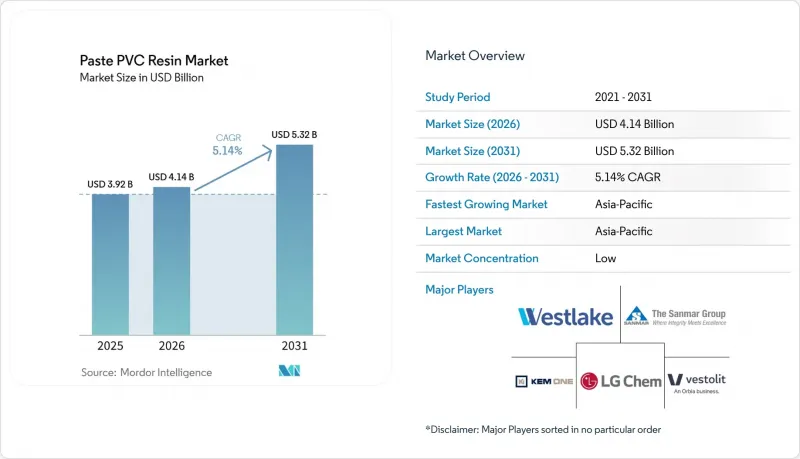
根據 Mordor Intelligence 預測,聚氯乙烯糊狀樹脂市場規模預計將在 2025 年達到 39.2 億美元,2026 年達到 41.4 億美元,到 2031 年達到 53.2 億美元,在預測期(2026-2031 年)內複合年成長率為 5.14%。
本報告按生產流程(乳液法和微懸浮法)、等級(K級、低K級等)、應用領域(合成革、PVC地板等)、終端用戶產業(建築、汽車、包裝等)以及地區(亞太、北美、歐洲、南美、中東和非洲)進行細分。市場預測以美元計價。
全球聚氯乙烯糊狀樹脂市場趨勢及洞察
建設產業對彈性地板材料和牆壁材料材料的需求不斷成長
建設產業仍然是糊狀PVC樹脂市場最大的終端用戶產業。這主要歸功於彈性地板材料和壁材系統功能層中對塑溶膠的應用。高檔乙烯基地磚和類石材塑膠複合材料則依賴精心配製的發泡層和背襯層。因此,糊狀樹脂不僅是可互換的通用產品,更是滿足各種應用特定需求的原料。用於商業和醫療設施的乙烯基壁材是顆粒乳液級PVC樹脂的第二大需求來源。樹脂供應商和混煉商之間較長的認證週期,鞏固了聚氯乙烯糊狀樹脂市場現有的採購關係。
對合成皮革、手套和特殊塗料的需求不斷成長。
合成皮革是汽車、鞋類、家具及相關塗層織物應用領域中糊狀樹脂的關鍵市場。工業和醫用手套也為糊狀PVC樹脂提供了另一個主要需求基礎,尤其是在亞洲的生產基地。 LG化學的HRTP4000聚合度超過4000,而傳統PVC的聚合度僅為1000,HRTP4000耐熱溫度高達125 度C,且無需材料分離即可回收。
對聚氯乙烯和塑化劑的使用有嚴格的環境法規。
REACH法規中關於鄰苯二甲酸酯的規定提高了歐盟市場PVC糊狀物配方生產商的合規要求。自2026年5月起,歐盟委員會將鄰苯二甲酸二異丁酯(DIBP)、鄰苯二甲酸二正戊酯(DPENP)和鄰苯二甲酸二(2-己基)酯(DHEXP)列入REACH法規附件XVII,濃度閾值為0.1%。該規定適用於歐盟市場的PVC地板材料、牆板、汽車密封劑和包裝塗料。從亞洲出口的生產商必須提供其配方供應鏈的證明文件,包括塑化劑供應商的資訊。二異壬基環己烷-1,2-二羧酸(DINCH)和對苯二甲酸二辛酯(DOTP)的替代品比受監管的等級貴15%至25%,從而增加了塑溶膠配方的成本。 Kem One 位於福斯濱海的 ELYSE 膜電解廠於 2025 年 3 月開始運作,透過減少每年 50,000 公噸的二氧化碳排放量,為減少環境影響的良好記錄做出了貢獻,這是注重合規性的買家的要求。
細分市場分析
到2025年,乳液法將佔據聚氯乙烯糊狀樹脂市場82.16%的佔有率。其市場地位得益於此方法能夠生產粒徑分佈窄(0.1–2 μm)的顆粒。這些特性使其能夠在合成革面漆和高檔乙烯基瓷磚的發泡層等應用中實現平滑熔合。客戶通常透過持續6至18個月的測試週期來驗證特定等級產品的合格。這種專業設備和資格確認流程的結合增加了供應商和加工商的轉換成本。
預計到2031年,微懸浮製程將以6.17%的複合年成長率成長。其準牛頓流體特性使其適用於連續浸漬式手套生產線和旋轉成型應用,在這些應用中,黏度穩定性至關重要。韓華的KH-31G牌號專為薄壁PVC手套設計,在低剪切速率下具有低黏度,並能抑制黏度隨時間的變化。這項技術特性使其區別於通用乳液混合物。因此,生產流程會影響加工性能以及供應商滿足高附加價值應用需求的能力。
2025年,中等介電常數(中K)等級的聚氯乙烯糊狀樹脂佔市佔率的36.84%。此等級的聚氯乙烯廣泛用於合成皮革,因為其分子量平衡有利於提高機械強度、延伸率和熱老化性能。汽車和家具行業的複合材料製造商利用這些特性來確保成品的品質。低介電常數(低K)等級的聚氯乙烯用於塗料和印刷油墨等對熔點和表面光潔度要求較高的應用領域。高介電常數(高K)等級的聚氯乙烯則用於輸送機襯裡和篷布等高要求應用。
預計到2031年,醋酸乙烯酯共聚物的年複合成長率將達到6.54%。與均聚物相比,其低熔點可降低轉換器的能源成本。此外,這些產品可使用較少的塑化劑,使其在歐洲日益嚴格的鄰苯二甲酸酯類塑化劑法規下更具優勢。 LG化學的HRTP4000是一款高性能產品,聚合度超過4000,耐熱溫度達125 度C。據該公司稱,該產品無需分離處理即可回收。
區域分析
預計到2025年,亞太地區將佔據糊狀PVC樹脂市場58.92%的佔有率,並在2031年之前以5.93%的複合年成長率成長。在中國,據報道,年產能12萬噸的天津糊狀PVC廠已於2026年第一季運作。這種情況正在推動標準乳液級PVC的進口替代。印度鞋類、服裝、醫療保健和建築業的活躍發展支撐了該地區需求基礎的擴大。日本和韓國為高規格電子和醫療應用領域提供產品。韓國生產商在2025年面臨供應過剩和VCM成本上漲的雙重挑戰,韓華解決方案公司已於2025年4月起降低了其麗水工廠的運轉率。
北美和歐洲是聚氯乙烯糊狀樹脂市場高階規格細分市場的核心。 Syntec的Pracumin擴建計畫預計將使乙烯年產量增加62.5萬噸,氯乙烯年產量增加50萬噸,苛性鈉年產量增加31萬噸,第一階段預計2030年運作。
歐洲的品質和可追溯性要求可能更有利於本地生產且有據可查的產品等級,但不斷上漲的能源成本和來自中國的進口仍然是重要的阻礙因素。 Westlake於2026年6月完成了對其位於威廉港的PVC和VCM製造地的收購,新增了一座年PVC產能為38萬噸的工廠。 Chem-One也在2026年6月獲得了1億歐元的資本重組。南美洲、中東和非洲仍然供應不足,嚴重依賴亞洲和歐洲的進口。
其他好處:
- Excel格式的市場預測(ME)表
- 3個月的分析師支持
目錄
第1章:引言
- 研究假設和市場定義
- 調查範圍
第2章:調查方法
第3章執行摘要
第4章 市場狀況
- 市場概覽
- 市場促進因素
- 建設產業對彈性地板材料和牆壁材料的需求不斷成長
- 聚氯乙烯糊狀樹脂在汽車內裝件、密封劑和塗料的應用日益廣泛
- 對合成皮革、手套和特殊塗料的需求不斷成長。
- 低黏度糊狀PVC材料在高速塑溶膠加工的應用日益廣泛。
- 生物循環和再生PVC樹脂解決方案的開發正在取得進展。
- 市場限制因素
- 對聚氯乙烯和塑化劑的使用有嚴格的環境法規。
- 乙烯、氯氣和能源價格的波動
- 對產品品質、顆粒形態和製程合格有嚴格的要求。
- 價值鏈分析
- 波特五力分析
第5章 市場規模與成長預測
- 透過製造程序
- 乳液法
- 微懸浮法
- 按年級
- 幼稚園
- 低K值等級
- 中等K值等級
- 高K值等級
- 醋酸乙烯酯共聚物的等級
- 混合樹脂級
- 透過使用
- 合成皮革
- PVC地板
- 手套(工業和醫療用途)
- 黏合劑和密封劑
- 印刷油墨
- 油漆和塗料
- 電氣和電子元件
- 包裝和罐頭塗層
- 消費品
- 其他用途
- 按最終用途行業分類
- 建造
- 車
- 電氣和電子設備
- 醫療保健
- 包裝
- 消費品和鞋類
- 產業
- 按地區
- 亞太地區
- 中國
- 印度
- 日本
- 韓國
- 其他亞太國家
- 北美洲
- 美國
- 加拿大
- 墨西哥
- 歐洲
- 德國
- 英國
- 法國
- 義大利
- 俄羅斯
- 其他歐洲國家
- 南美洲
- 巴西
- 阿根廷
- 其他南美國家
- 中東和非洲
- 沙烏地阿拉伯
- 南非
- 其他中東和非洲國家
- 亞太地區
第6章 競爭情勢
- 市場集中度
- 策略趨勢
- 市佔率和排名分析
- 公司簡介
- Anhui Tianchen Chemical Co., Ltd.
- Formosa Plastics Corporation
- Hanwha Solutions Corporation
- INEOS
- Kaneka Corporation
- Kem One
- LG Chem
- Orbia(Vestolit)
- Reliance Industries Limited
- SCG Chemicals Public Company Limited
- Shandong Xinfa Chemical Group
- Shin-Etsu Chemical Co., Ltd.
- The Sanmar Group
- Tosoh Corporation
- Westlake Corporation
第7章 市場機會與未來展望
According to Mordor Intelligence, the paste PVC resin market was valued at USD 3.92 billion in 2025 and is estimated to grow from USD 4.14 billion in 2026 to reach USD 5.32 billion by 2031, at a CAGR of 5.14% during the forecast period (2026-2031).
This report is Segmented by Manufacturing Process (Emulsion Process and Micro-Suspension Process), Grade (K Grade, Low K-Value Grade, and More), Application (Synthetic Leather, PVC Flooring, and More), End-Use Industry (Construction, Automotive, Packaging, and More), and Geography (Asia-Pacific, North America, Europe, South America, Middle-East and Africa). The Market Forecasts are Provided in Terms of Value (USD).
Global Paste PVC Resin Market Trends and Insights
Growing Demand from the Construction Industry for Resilient Flooring and Wall Covering Applications
Construction remains the largest end-use area for the paste PVC resin market because resilient flooring and wall-covering systems use plastisols in functional layers. Luxury vinyl tile and stone plastic composite products rely on carefully formulated foam and backing layers. Paste resin, therefore, serves as a material input with application-specific requirements rather than a simple interchangeable commodity. Vinyl wall coverings used in commercial and healthcare facilities provide a second source of demand for fine-particle emulsion grades. Long qualification cycles between resin suppliers and formulators can reinforce established sourcing relationships in the paste PVC resin market.
Expanding Demand for Synthetic Leather, Gloves, and Specialty Coating Applications
Synthetic leather is an important outlet for paste resin in automotive, footwear, furniture, and related coated-fabric applications. Industrial and medical gloves add another demand base for the paste PVC resin market, especially in Asian production centers. LG Chem's HRTP4000 has a polymerization degree above 4,000, compared with 1,000 for conventional PVC, and supports 125 °C thermal resistance and recyclability without material separation.
Stringent Environmental Regulations on PVC and Plasticizer Usage
REACH-related phthalate restrictions raise compliance demands for paste PVC formulators serving the European Union. The European Commission added diisobutyl phthalate (DIBP), di-n-pentyl phthalate (DPENP), and di-2-hexyl phthalate (DHEXP) to REACH Annex XVII at a 0.1% concentration threshold in May 2026. The restriction applies to PVC flooring, wall panels, automotive sealing compounds, and packaging coatings placed on the EU market. Producers exporting from Asia must document the formulation supply chain, including information from plasticizer suppliers. The diisononyl cyclohexane-1,2-dicarboxylate (DINCH) and dioctyl terephthalate (DOTP) alternatives carry 15-25% premiums over restricted grades, raising formulated plastisol costs. Kem One's ELYSE membrane electrolysis unit at Fos-sur-Mer became operational in March 2025 and reduces annual CO2 emissions by 50,000 metric tons, supporting the lower-footprint credentials sought by compliance-sensitive buyers.
Other drivers and restraints analyzed in the detailed report include:
- Increasing Use of Paste PVC Resin in Automotive Interior Components, Sealants, and Coatings
- Rising Adoption of Low-Viscosity Paste PVC Grades for High-Speed Plastisol Processing
- Volatility in Ethylene, Chlorine, and Energy Prices
For complete list of drivers and restraints, kindly check the Table Of Contents.
Segment Analysis
The emulsion process held 82.16% of the paste PVC resin market share in 2025. Its position rests on the ability to make particles in the 0.1-2 μm range with narrow size distributions. These characteristics support smooth fusion in synthetic leather topcoats and luxury vinyl tile foam layers. Customers commonly qualify specific grades through testing cycles that last 6-18 months. This combination of specialized assets and qualification work raises switching costs for both suppliers and converters.
The micro-suspension process is forecast to grow at a 6.17% CAGR through 2031. Its quasi-Newtonian flow behavior suits continuous-immersion glove-dipping lines and rotational molding uses where viscosity stability is important. Hanwha's KH-31G grade is designed for thin-wall PVC gloves and offers low viscosity at low shear rates with limited viscosity aging. This technical profile distinguishes it from commodity emulsion blends. The manufacturing route, therefore, affects both processing performance and the supplier's ability to serve higher-value applications.
Medium K-value grade accounted for 36.84% of the paste PVC resin market size in 2025. It is widely used in synthetic leather because balanced molecular weight supports mechanical strength, elongation, and heat-aging performance. Automotive and furniture compounders rely on these properties for their finished products. Low K-value grades are used in coatings and printing inks where lower fusion temperature and surface finish are priorities. High K-value grades address heavy-duty uses such as conveyor belt backings and tarpaulins.
Vinyl acetate copolymer grade is projected to grow at a 6.54% CAGR through 2031. Its lower fusion temperature can reduce converter energy costs compared with homopolymer alternatives. The same grades can also operate at lower plasticizer loadings, which is useful as restrictions on orthophthalate plasticizers expand in Europe. LG Chem's HRTP4000 demonstrates a high-performance category with a polymerization degree above 4,000 and 125 °C heat resistance. It can be recycled without separation, according to the company.
Complete Report Scope:
- By Manufacturing Process
- Emulsion Process
- Micro-Suspension Process
- By Grade
- K Grade
- Low K-Value Grade
- Medium K-Value Grade
- High K-Value Grade
- Vinyl Acetate Copolymer Grade
- Blend Resin Grade
- By Application
- Synthetic Leather
- PVC Flooring
- Gloves (Industrial and Medical)
- Adhesives and Sealants
- Printing Inks
- Paints and Coatings
- Electrical and Electronic Components
- Packaging and Can Coatings
- Consumer Goods
- Other Applications
- By End-Use Industry
- Construction
- Automotive
- Electrical and Electronics
- Medical and Healthcare
- Packaging
- Consumer Goods and Footwear
- Industrial
- By Geography
- Asia-Pacific
- China
- India
- Japan
- South Korea
- Rest of Asia-Pacific
- North America
- United States
- Canada
- Mexico
- Europe
- Germany
- United Kingdom
- France
- Italy
- Russia
- Rest of Europe
- South America
- Brazil
- Argentina
- Rest of South America
- Middle-East and Africa
- Saudi Arabia
- South Africa
- Rest of Middle-East and Africa
- Asia-Pacific
Geography Analysis
Asia-Pacific held 58.92% of the paste PVC resin market share in 2025 and is forecast to grow at a 5.93% CAGR through 2031. China reported that a 120,000 metric tons per year Tianjin paste PVC plant was commissioned in the first quarter of 2026. These conditions support import substitution for standard emulsion grades. India's footwear, apparel, healthcare, and construction activity supports the region's expanding demand base. Japan and South Korea serve high-specification electronics and medical applications. South Korean producers faced both oversupply and higher VCM costs in 2025, and Hanwha Solutions reduced operating rates at Yeosu from April 2025.
North America and Europe anchor the premium-specification tier of the paste PVC resin market. Shintech's Plaquemine expansion is planned to add 625,000 metric tons per year of ethylene, 500,000 metric tons per year of VCM, and 310,000 metric tons per year of caustic soda, with the first phase expected in 2030.
Europe's quality and traceability requirements can favor locally produced and documented grades, although higher energy costs and Chinese imports remain important constraints. Westlake completed its acquisition of the Wilhelmshaven PVC and VCM site in June 2026, adding a facility with 380,000 metric tons per year of PVC capacity. Kem One also secured a EUR 100 million recapitalization in June 2026. South America, and the Middle-East and Africa remain underserved and depend largely on Asian and European imports.
- Anhui Tianchen Chemical Co., Ltd.
- Formosa Plastics Corporation
- Hanwha Solutions Corporation
- INEOS
- Kaneka Corporation
- Kem One
- LG Chem
- Orbia (Vestolit)
- Reliance Industries Limited
- SCG Chemicals Public Company Limited
- Shandong Xinfa Chemical Group
- Shin-Etsu Chemical Co., Ltd.
- The Sanmar Group
- Tosoh Corporation
- Westlake Corporation
Additional Benefits:
- The market estimate (ME) sheet in Excel format
- 3 months of analyst support
TABLE OF CONTENTS
1 Introduction
- 1.1 Study Assumptions and Market Definition
- 1.2 Scope of the Study
2 Research Methodology
3 Executive Summary
4 Market Landscape
- 4.1 Market Overview
- 4.2 Market Drivers
- 4.2.1 Growing Demand from the Construction Industry for Resilient Flooring and Wall Covering Applications
- 4.2.2 Increasing Use of Paste PVC Resin in Automotive Interior Components, Sealants, and Coatings
- 4.2.3 Expanding Demand for Synthetic Leather, Gloves, and Specialty Coating Applications
- 4.2.4 Rising Adoption of Low-Viscosity Paste PVC Grades for High-Speed Plastisol Processing
- 4.2.5 Growing Development of Bio-Circular and Recycled-Content PVC Resin Solutions
- 4.3 Market Restraints
- 4.3.1 Stringent Environmental Regulations on PVC and Plasticizer Usage
- 4.3.2 Volatility in Ethylene, Chlorine, and Energy Prices
- 4.3.3 Stringent Product Quality, Particle Morphology, and Process Qualification Requirements
- 4.4 Value Chain Analysis
- 4.5 Porter's Five Forces Analysis
- 4.5.1 Threat of New Entrants
- 4.5.2 Bargaining Power of Suppliers
- 4.5.3 Bargaining Power of Buyers
- 4.5.4 Threat of Substitutes
- 4.5.5 Competitive Rivalry
5 Market Size and Growth Forecasts (Value)
- 5.1 By Manufacturing Process
- 5.1.1 Emulsion Process
- 5.1.2 Micro-Suspension Process
- 5.2 By Grade
- 5.2.1 K Grade
- 5.2.2 Low K-Value Grade
- 5.2.3 Medium K-Value Grade
- 5.2.4 High K-Value Grade
- 5.2.5 Vinyl Acetate Copolymer Grade
- 5.2.6 Blend Resin Grade
- 5.3 By Application
- 5.3.1 Synthetic Leather
- 5.3.2 PVC Flooring
- 5.3.3 Gloves (Industrial and Medical)
- 5.3.4 Adhesives and Sealants
- 5.3.5 Printing Inks
- 5.3.6 Paints and Coatings
- 5.3.7 Electrical and Electronic Components
- 5.3.8 Packaging and Can Coatings
- 5.3.9 Consumer Goods
- 5.3.10 Other Applications
- 5.4 By End-Use Industry
- 5.4.1 Construction
- 5.4.2 Automotive
- 5.4.3 Electrical and Electronics
- 5.4.4 Medical and Healthcare
- 5.4.5 Packaging
- 5.4.6 Consumer Goods and Footwear
- 5.4.7 Industrial
- 5.5 By Geography
- 5.5.1 Asia-Pacific
- 5.5.1.1 China
- 5.5.1.2 India
- 5.5.1.3 Japan
- 5.5.1.4 South Korea
- 5.5.1.5 Rest of Asia-Pacific
- 5.5.2 North America
- 5.5.2.1 United States
- 5.5.2.2 Canada
- 5.5.2.3 Mexico
- 5.5.3 Europe
- 5.5.3.1 Germany
- 5.5.3.2 United Kingdom
- 5.5.3.3 France
- 5.5.3.4 Italy
- 5.5.3.5 Russia
- 5.5.3.6 Rest of Europe
- 5.5.4 South America
- 5.5.4.1 Brazil
- 5.5.4.2 Argentina
- 5.5.4.3 Rest of South America
- 5.5.5 Middle-East and Africa
- 5.5.5.1 Saudi Arabia
- 5.5.5.2 South Africa
- 5.5.5.3 Rest of Middle-East and Africa
- 5.5.1 Asia-Pacific
6 Competitive Landscape
- 6.1 Market Concentration
- 6.2 Strategic Moves
- 6.3 Market Share (%)/Ranking Analysis
- 6.4 Company Profiles (includes Global Overview, Market Overview, Core Segments, Financials as available, Strategic Information, Products and Services, and Recent Developments)
- 6.4.1 Anhui Tianchen Chemical Co., Ltd.
- 6.4.2 Formosa Plastics Corporation
- 6.4.3 Hanwha Solutions Corporation
- 6.4.4 INEOS
- 6.4.5 Kaneka Corporation
- 6.4.6 Kem One
- 6.4.7 LG Chem
- 6.4.8 Orbia (Vestolit)
- 6.4.9 Reliance Industries Limited
- 6.4.10 SCG Chemicals Public Company Limited
- 6.4.11 Shandong Xinfa Chemical Group
- 6.4.12 Shin-Etsu Chemical Co., Ltd.
- 6.4.13 The Sanmar Group
- 6.4.14 Tosoh Corporation
- 6.4.15 Westlake Corporation
7 Market Opportunities and Future Outlook
- 7.1 White-Space and Unmet-Need Assessment
- 7.2 Non-Phthalate and Bio-Based Formulations

 低介電常數樹脂市場報告:趨勢、預測及競爭分析(至2035年)
 壓延樹脂市場:全球市場預測,2026-2032年
 2026年全球酚醛環氧樹脂市場研究報告
 水性樹脂:市場佔有率分析、產業趨勢與統計、成長預測(2026-2031)
 2026年全球樹脂市場報告
 工程樹脂、聚合物合金和混合物:全球市場樹脂砂回收生產線市場:依回收製程、設備類型、樹脂類型、產能和最終用途產業分類-全球預測,2026-2032年全球合成皮革聚氨酯樹脂市場(按技術、類型、形式、應用和最終用途分類)預測(2026-2032年)冷凝油精煉裝置市場(依最終用途產業、技術、樹脂類型、產能和應用分類)-全球預測,2026-2032年聚合松香樹脂市場:依樹脂類型、應用、最終用戶和通路分類,全球預測(2026-2032年)