


 |
市場調查報告書
商品編碼
2114004
水性樹脂:市場佔有率分析、產業趨勢與統計、成長預測(2026-2031)Water-based Resin - Market Share Analysis, Industry Trends & Statistics, Growth Forecasts (2026 - 2031) |
||||||

※ 本網頁內容可能與最新版本有所差異。詳細情況請與我們聯繫。
據 Mordor Intelligence 稱,2026 年水性樹脂市場規模估計為 487.6 億美元,高於 2025 年的 472.2 億美元,預計到 2031 年將達到 572.7 億美元。
預計從 2026 年到 2031 年,其複合年成長率將達到 3.27%。
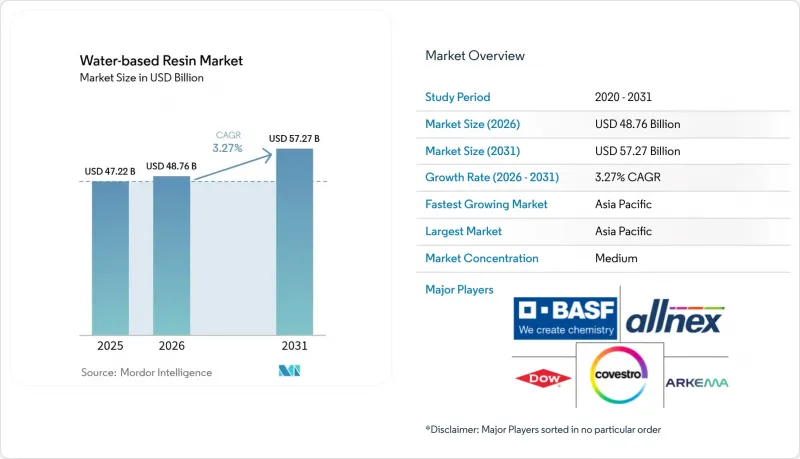
本報告按類型(丙烯酸樹脂、聚氨酯樹脂、環氧樹脂、聚酯樹脂、醇酸樹脂及其他樹脂)、應用領域(油漆和塗料、黏合劑和密封劑、油墨及其他應用)以及地區(亞太地區、北美地區、歐洲地區、南美地區以及中東和非洲地區)進行細分。市場預測以美元計價。
全球水性樹脂市場趨勢及洞察
VOC 和 EHS 法規正在加速從溶劑型技術轉向水性技術的轉變。
中國GB 18581-2020標準將建築塗料的VOC含量限制在每公升80-120克,比歐盟的規定更為嚴格。此外,各省的審核頻率由每年一次提高到每月一次,這促使塗料行業迅速轉向水性分散體。南海岸空氣品質管理區(AQMD)第1151號規則於2024年1月生效,取消了汽車噴漆的溶劑豁免,迫使加州汽車修理廠採用符合規定的底塗層。儘管東南亞擁有經認證的閒置產能的樹脂生產商在此過渡時期獲得了高額利潤,但由於新型分散反應器的批准需要12-18個月的時間,供應短缺問題仍然存在。
亞太地區的建築熱潮帶動了對裝飾性和保護性塗料的需求激增。
2025年上半年,中國塗料生產新增就業機會中超過70%集中在水性產品領域,較往年成長。同時,在印度,班加羅爾、清奈和海得拉巴等城市地鐵隧道採用低VOC防護塗料,推動了建築化學品市場的成長。預計這一趨勢將持續到2030年。此外,承包商擴大選擇水性塗料系統,以避免因維修通風系統以控制溶劑排放而產生的成本。這種轉變正在加速水性塗料的普及,即使在一些以往對變革反應遲緩的行業也是如此。
在高濕度和惡劣氣候條件下,戶外使用性能存在差異。
當濕度超過一定閾值時,未經處理的鋼材會迅速出現閃鏽。這種緊迫性迫使承包商對鋼材進行磷酸鹽預處理,從而導致人事費用增加。在寒冷氣候下,反覆的凍融循環會降低水性壓克力顏料的抗張強度。然而,在熱帶氣候下,濕度增加會延長這些材料的無黏性時間,導致污垢更容易積聚。因此,儘管面臨監管壓力,相當一部分海上平台和橋樑仍然依賴溶劑型塗料。
細分市場分析
2025年,丙烯酸分散體佔總銷售額的41.82%,在樹脂化學品中佔比最高,並在水性樹脂市場佔據領先地位。這一領先地位體現了建築和工業塗料領域對成本和性能平衡的重視。聚氨酯分散體預計到2031年將以4.02%的年均成長率成長,成為所有樹脂化學品中成長最快的,這主要得益於汽車OEM(目的地設備製造商)採用低溫固化透明塗層,從而降低了烘乾爐的能耗。BASF湛江丙烯酸單體聯合裝置計劃於2025年竣工,此前惠州分散體生產設施的擴建將確保丙烯酸樹脂原料的充足供應;而萬華煙台工廠計劃於2024年竣工,則充分展現了中國企業對上游一體化的投入。
聚氨酯憑藉其在汽車修補和電子組裝的卓越耐化學性,正在挑戰丙烯酸樹脂的主導地位。環氧樹脂分散體仍主要應用於基礎設施建設等特殊領域,在這些領域,鋼材的附著力比成本更為重要,但其極易發生閃銹,限制了其戶外應用。聚酯分散體的成長較為緩慢,家具製造商開始採用低溫燒結的粉末漿料。醇酸改質混合產品,將丙烯酸乳液與四分之一醇酸樹脂混合,既能提供專業油漆工所熟悉的流動性,又能降低揮發性有機化合物(VOC)的排放。另一類產品,即矽酮和氟聚合物分散體,則面向離型紙和防塗鴉等細分市場,在這些領域,性能比價格更為重要。
區域分析
預計到2025年,亞太地區將佔全球銷售額的47.10%,佔據水性樹脂市場最大佔有率,並維持4.12%的複合年成長率直至2031年。中國嚴格的每月VOC(揮發性有機化合物)審核正在推動裝飾和防護塗料領域向水性解決方案的快速轉型。同時,印度的城市軌道運輸計畫也推動了基礎設施領域的成長。在日本和韓國,水性樹脂在汽車和電子行業的應用已趨於成熟,這限制了替代需求的顯著成長。東南亞地區落後於區域平均水平,許多二線塗料製造商面臨資金限制,尤其是在固化爐升級方面。這一差距為願意提供技術信貸和延期付款方案的供應商提供了機會。
北美地區呈現出兩極化的局面。在加州,1151號規則的實施正在加速汽車噴漆行業向水性解決方案的轉變。相較之下,墨西哥灣沿岸各州仍依賴溶劑型系統來滿足工業維修需求。原物料價格的波動正在拖累2024年加工商的利潤率。然而,路博潤公司在北卡羅來納州擴建其丙烯酸乳液生產設施,為DIY和建築業帶來了樂觀的前景。在加拿大,聯邦VOC法規以及對生物基成分的獎勵,為阿科瑪的生物基丙烯酸乙酯創造了獨特的市場機遇,儘管供應有限。
在歐洲,水性塗料在裝飾塗料行業中佔據主導地位,這主要歸功於《建築塗料指令》,該指令對揮發性有機化合物(VOC)的含量設定了限制。雖然裝飾塗料已基本完成轉型,但離岸風力發電電場和海洋設施的防護塗料仍然嚴重依賴溶劑型塗料。這是因為水性環氧樹脂目前在確保其在嚴苛的鹽鹼環境中具有足夠的耐腐蝕性方面有其限制。北歐國家正透過碳關稅來推廣生物基樹脂的使用,而受持續進口限制影響的俄羅斯仍傾向於使用溶劑型塗料。在南美洲、中東和非洲,向水性塗料的轉型步伐緩慢。巴西的法規專注於工業領域,而沙烏地阿拉伯則優先考慮按時完成基礎設施建設,即使這意味著犧牲VOC合規性。
其他好處:
- Excel格式的市場預測(ME)表
- 3個月的分析師支持
目錄
第1章:引言
- 研究假設和市場定義
- 調查範圍
第2章:調查方法
第3章執行摘要
第4章 市場狀況
- 市場概覽
- 市場促進因素
- VOC 和 EHS 法規正在加速從溶劑型技術轉向水性技術的轉變。
- 亞太地區的建築熱潮帶動了對裝飾性和保護性塗料的需求激增。
- 家用電器行業原始設備製造商 (OEM) 致力於使用低揮發性有機化合物 (VOC)黏合劑和密封劑
- 品牌擁有者的 ESG 目標正在推動生物基水性樹脂的採用。
- 數位配色和線上固化技術的進步使得水性塗料生產線能夠更快地運作。
- 市場限制因素
- 在高濕度和極端氣候條件下戶外使用時的表現差異
- 丙烯酸和聚氨酯原料價格的波動
- 新興市場缺乏季度專業知識
- 價值鏈分析
- 波特五力模型
第5章 市場規模與成長預測
- 按類型
- 丙烯酸纖維
- 聚氨酯
- 環氧樹脂
- 聚酯纖維
- 阿爾基多
- 其他
- 透過使用
- 油漆和塗料
- 黏合劑和密封劑
- 墨水
- 其他用途
- 地區
- 亞太地區
- 中國
- 印度
- 日本
- 韓國
- 東南亞國協
- 其他亞太國家
- 北美洲
- 美國
- 加拿大
- 墨西哥
- 歐洲
- 德國
- 英國
- 法國
- 義大利
- 西班牙
- 俄羅斯
- 北歐國家
- 其他歐洲國家
- 南美洲
- 巴西
- 阿根廷
- 其他南美國家
- 中東和非洲
- 沙烏地阿拉伯
- 南非
- 其他中東和非洲國家
- 亞太地區
第6章 競爭情勢
- 市場集中度
- 策略趨勢
- 市佔率和排名分析
- 公司簡介
- Allnex Netherlands BV
- Arkema
- BASF
- Celanese Corporation
- Covestro AG
- DIC CORPORATION
- Dow
- DSM
- Eastman Chemical Company
- Evonik
- HB Fuller Company
- Huntsman International LLC
- Lubrizol Corporation
- Momentive
- Nan Ya Plastics Corporation
- Solvay
- Synthomer plc
- Wanhua
第7章 市場機會與未來展望
According to Mordor Intelligence, water-based resin market size in 2026 is estimated at USD 48.76 billion, growing from 2025 value of USD 47.22 billion with 2031 projections showing USD 57.27 billion, growing at 3.27% CAGR over 2026-2031.
This report is Segmented by Type (Acrylic, Polyurethane, Epoxy, Polyester, Alkyd, and Others), Application (Paints and Coatings, Adhesives and Sealants, Ink, and Other Applications), and Geography (Asia-Pacific, North America, Europe, South America, and Middle-East and Africa). The Market Forecasts are Provided in Terms of Value (USD).
Global Water-based Resin Market Trends and Insights
VOC And EHS Regulations Accelerating Solvent-To-Water Technology Shift
China's GB 18581-2020 caps architectural coatings at 80-120 g VOC per liter, stricter than the EU limits, while provincial audits now occur monthly rather than annually, forcing rapid reformulations into waterborne dispersions. South Coast AQMD Rule 1151, which has been in effect since January 2024, removes exempt solvents for automotive refinish, compelling California body shops to adopt compliant basecoats. Resin producers with certified idle capacity in Southeast Asia are earning premium margins during the transition; however, a 12-18-month lag in new dispersion reactor approvals continues to pinch supply.
Surge In Decorative And Protective Coatings Demand In Asia-Pacific Construction Boom
In the first half of 2025, China produced coatings, with over 70% of new jobs now focusing on waterborne products, a rise from previous years. Meanwhile, in India, the adoption of low-VOC protective coatings for metro rail tunnels in cities such as Bangalore, Chennai, and Hyderabad is driving growth in construction chemicals, a trend projected to continue until 2030. Additionally, contractors are increasingly opting for waterborne systems, sidestepping the costs associated with ventilation upgrades needed for solvent controls. This shift is accelerating the adoption in segments that were previously slow to adopt change.
Performance Gap In High-Humidity/Extreme-Climate Exterior Uses
When humidity surpasses a certain threshold, untreated steel can develop flash rust quickly. This urgency compels contractors to resort to phosphate pretreatments, inflating labor costs. In colder regions, freeze-thaw cycles diminish the tensile strength of waterborne acrylics. Meanwhile, in tropical climates, heightened humidity extends the tack-free time of these materials, leading to increased dirt accumulation. As a result, despite regulatory pressures, a significant portion of offshore platforms and bridges continue to rely on solventborne treatments.
Other drivers and restraints analyzed in the detailed report include:
- OEM Push For Low-VOC Adhesives And Sealants In Consumer Electronics
- Digital Colour-Matching / Inline Curing Advances Enabling Faster Water-Borne Lines
- Acrylic And Polyurethane Feedstock Price Volatility
For complete list of drivers and restraints, kindly check the Table Of Contents.
Segment Analysis
Acrylic dispersions accounted for 41.82% of 2025 revenue, the highest among resin chemistries, thereby securing the leading water-based resin market share. The top positions reflect a cost-to-performance balance valued in architectural and industrial coatings. Polyurethane dispersions are projected to grow at a 4.02% annual rate to 2031, the fastest pace among chemistries, as automotive original equipment manufacturers (OEMs) adopt low-temperature curing clear coats that reduce oven energy consumption. BASF's 2025 Zhanjiang acrylic monomer complex and its earlier Huizhou dispersion expansion secure raw materials at scale for acrylics, whereas Wanhua's 2024 Yantai facility demonstrates Chinese entrants' push toward upstream integration.
Polyurethane momentum challenges acrylic dominance by offering greater chemical resistance for automotive refinishing and electronics assembly. Epoxy dispersions remain a specialty for infrastructure where adhesion to steel outranks cost, though flash-rust sensitivity limits their outdoor appeal. Polyester dispersions are growing modestly, with furniture players adopting low-bake powder slurries. Alkyd-modified hybrids, which blend one-quarter alkyd into acrylic emulsions, provide professional painters with a familiar flow while still reducing VOCs. The other category, covering silicone and fluoropolymer dispersions, serves release liners and anti-graffiti niches where performance supersedes price.
Complete Report Scope:
- By Type
- Acrylic
- Polyurethane
- Epoxy
- Polyester
- Alkyd
- Others
- By Application
- Paints and Coatings
- Adhesives and Sealants
- Ink
- Other Applications
- Geography
- Asia-Pacific
- China
- India
- Japan
- South Korea
- ASEAN Countries
- Rest of Asia-Pacific
- North America
- United States
- Canada
- Mexico
- Europe
- Germany
- United Kingdom
- France
- Italy
- Spain
- Russia
- NORDIC Countries
- Rest of Europe
- South America
- Brazil
- Argentina
- Rest of South America
- Middle-East and Africa
- Saudi Arabia
- South Africa
- Rest of Middle-East and Africa
- Asia-Pacific
Geography Analysis
Asia-Pacific generated 47.10% of global revenue in 2025, the largest slice of the water-based resin market, and is projected to post a 4.12% CAGR to 2031. China's stringent monthly VOC audits are catalyzing a swift shift towards water-based solutions in decorative and protective coatings. Meanwhile, India's metro projects are bolstering the momentum in infrastructure. Both Japan and South Korea have achieved mature penetration of water-based resins in the automotive and electronics sectors, which curtails any significant growth in replacement demand. Southeast Asia lags the regional average; many tier-2 coating companies are constrained by capital limitations, particularly in upgrading to curing ovens. This gap presents an opportunity for suppliers willing to offer technical credit and deferred payment options.
North America showcases a dichotomous landscape. In California, the enforcement of Rule 1151 is propelling the shift towards waterborne solutions in automotive refinishing. In contrast, states along the Gulf Coast continue to depend on solvent-based systems for their industrial maintenance needs. Volatility in feedstock prices has dampened converter margins for 2024. Yet, the recent expansion of Lubrizol's acrylic emulsion facility in North Carolina underscores a bullish outlook on the DIY and architectural segments. In Canada, federal VOC regulations are supplemented by bio-content incentives, creating a unique market space for Arkema's bio-ethyl acrylate, despite its limited supply.
Europe boasts a dominant presence of waterborne solutions in the decorative paints industry. This is largely driven by the Architectural Coatings Directive, which imposes a VOC cap. While decorative paints have largely transitioned, protective coatings for offshore wind and marine assets still rely significantly on solvent-based solutions. This is due to the current limitations of waterborne epoxies in providing adequate corrosion resistance in challenging saline conditions. Nordic nations are leveraging carbon-border levies to promote bio-based resins, but Russia remains steadfast in its preference for solvent systems, a stance influenced by ongoing import restrictions. In South America, the Middle-East, and Africa, the transition rates to water-based solutions are sluggish. Brazil's regulatory focus is on industrial sources, while in Saudi Arabia, the emphasis is on meeting infrastructure delivery timelines, even at the expense of VOC compliance.
- Allnex Netherlands BV
- Arkema
- BASF
- Celanese Corporation
- Covestro AG
- DIC CORPORATION
- Dow
- DSM
- Eastman Chemical Company
- Evonik
- H.B. Fuller Company
- Huntsman International LLC
- Lubrizol Corporation
- Momentive
- Nan Ya Plastics Corporation
- Solvay
- Synthomer plc
- Wanhua
Additional Benefits:
- The market estimate (ME) sheet in Excel format
- 3 months of analyst support
TABLE OF CONTENTS
1 Introduction
- 1.1 Study Assumptions and Market Definition
- 1.2 Scope of the Study
2 Research Methodology
3 Executive Summary
4 Market Landscape
- 4.1 Market Overview
- 4.2 Market Drivers
- 4.2.1 VOC and EHS regulations accelerating solvent-to-water technology shift
- 4.2.2 Surge in decorative and protective coatings demand in Asia-Pacific construction boom
- 4.2.3 OEM push for low-VOC adhesives and sealants in consumer electronics
- 4.2.4 Brand owner ESG targets driving bio-based water-borne resin adoption
- 4.2.5 Digital colour-matching/inline curing advances enabling faster water-borne lines
- 4.3 Market Restraints
- 4.3.1 Performance gap in high-humidity/extreme-climate exterior uses
- 4.3.2 Acrylic and polyurethane feed-stock price volatility
- 4.3.3 Limited coater-level expertise in emerging markets
- 4.4 Value Chain Analysis
- 4.5 Porter's Five Forces
- 4.5.1 Bargaining Power of Suppliers
- 4.5.2 Bargaining Power of Buyers
- 4.5.3 Threat of New Entrants
- 4.5.4 Threat of Substitute Products and Services
- 4.5.5 Degree of Competition
5 Market Size and Growth Forecasts (Value)
- 5.1 By Type
- 5.1.1 Acrylic
- 5.1.2 Polyurethane
- 5.1.3 Epoxy
- 5.1.4 Polyester
- 5.1.5 Alkyd
- 5.1.6 Others
- 5.2 By Application
- 5.2.1 Paints and Coatings
- 5.2.2 Adhesives and Sealants
- 5.2.3 Ink
- 5.2.4 Other Applications
- 5.3 Geography
- 5.3.1 Asia-Pacific
- 5.3.1.1 China
- 5.3.1.2 India
- 5.3.1.3 Japan
- 5.3.1.4 South Korea
- 5.3.1.5 ASEAN Countries
- 5.3.1.6 Rest of Asia-Pacific
- 5.3.2 North America
- 5.3.2.1 United States
- 5.3.2.2 Canada
- 5.3.2.3 Mexico
- 5.3.3 Europe
- 5.3.3.1 Germany
- 5.3.3.2 United Kingdom
- 5.3.3.3 France
- 5.3.3.4 Italy
- 5.3.3.5 Spain
- 5.3.3.6 Russia
- 5.3.3.7 NORDIC Countries
- 5.3.3.8 Rest of Europe
- 5.3.4 South America
- 5.3.4.1 Brazil
- 5.3.4.2 Argentina
- 5.3.4.3 Rest of South America
- 5.3.5 Middle-East and Africa
- 5.3.5.1 Saudi Arabia
- 5.3.5.2 South Africa
- 5.3.5.3 Rest of Middle-East and Africa
- 5.3.1 Asia-Pacific
6 Competitive Landscape
- 6.1 Market Concentration
- 6.2 Strategic Moves
- 6.3 Market Share (%)/Ranking Analysis
- 6.4 Company Profiles (includes Global level Overview, Market level overview, Core Segments, Financials as available, Strategic Information, Market Rank/Share, Products and Services, Recent Developments)
- 6.4.1 Allnex Netherlands BV
- 6.4.2 Arkema
- 6.4.3 BASF
- 6.4.4 Celanese Corporation
- 6.4.5 Covestro AG
- 6.4.6 DIC CORPORATION
- 6.4.7 Dow
- 6.4.8 DSM
- 6.4.9 Eastman Chemical Company
- 6.4.10 Evonik
- 6.4.11 H.B. Fuller Company
- 6.4.12 Huntsman International LLC
- 6.4.13 Lubrizol Corporation
- 6.4.14 Momentive
- 6.4.15 Nan Ya Plastics Corporation
- 6.4.16 Solvay
- 6.4.17 Synthomer plc
- 6.4.18 Wanhua
7 Market Opportunities and Future Outlook
- 7.1 White-space and Unmet-need Assessment

 低介電常數樹脂市場報告:趨勢、預測及競爭分析(至2035年)
 聚氯乙烯糊狀樹脂:市場佔有率分析、行業趨勢和統計數據、成長預測(2026-2031)
 壓延樹脂市場:全球市場預測,2026-2032年
 2026年全球酚醛環氧樹脂市場研究報告
 2026年全球樹脂市場報告
 工程樹脂、聚合物合金和混合物:全球市場樹脂砂回收生產線市場:依回收製程、設備類型、樹脂類型、產能和最終用途產業分類-全球預測,2026-2032年全球合成皮革聚氨酯樹脂市場(按技術、類型、形式、應用和最終用途分類)預測(2026-2032年)冷凝油精煉裝置市場(依最終用途產業、技術、樹脂類型、產能和應用分類)-全球預測,2026-2032年聚合松香樹脂市場:依樹脂類型、應用、最終用戶和通路分類,全球預測(2026-2032年)