


 |
市場調查報告書
商品編碼
2119078
脂肪酸:市佔率分析、產業趨勢及統計、成長預測(2026-2031)Fatty Acids - Market Share Analysis, Industry Trends & Statistics, Growth Forecasts (2026 - 2031) |
||||||

※ 本網頁內容可能與最新版本有所差異。詳細情況請與我們聯繫。
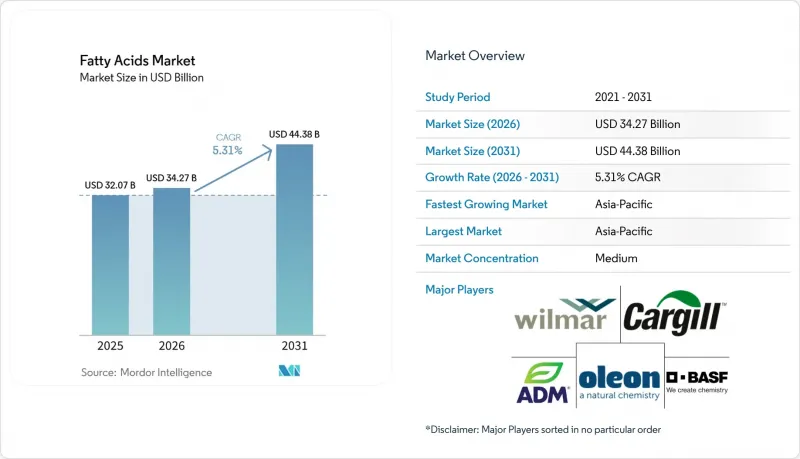
據 Mordor Intelligence 稱,2025 年脂肪酸市值為 320.7 億美元,預計到 2031 年將達到 443.8 億美元,而 2026 年為 342.7 億美元,預測期(2026-2031 年)的複合年成長率為 5.31%。
本報告按原料(植物油、動物脂肪等)、產品類型(飽和脂肪酸、不飽和脂肪酸、特殊脂肪酸)、應用領域(肥皂和清潔劑、藥品等)、終端用戶產業(家用和工業清潔劑、食品和飲料等)以及地區(亞太地區、北美地區等)進行細分。市場預測以美元計價。
全球脂肪酸市場趨勢及洞察
消費者對歐米伽脂肪酸和健康營養產品的需求日益成長
2025年,全球整體ω-3原料供應量達13.6萬噸,較2024年成長2.60%。總價值為25.3億美元,受厄爾尼諾現象後價格正常化的影響,較去年同期下降4.30%。全球二十碳五烯酸(EPA)和二十二碳六烯酸(DHA)ω-3組織(GOED)預測,到2028年,原料出貨量將以每年3-4%的速度成長。膳食補充劑和藥用級EPA產品正在透過成熟的消費者保健管道滿足這一需求。隨著純度標準日益嚴格,分子蒸餾和分餾對供應商而言變得越來越重要的。因此,在脂肪酸市場,優質產品比大批量交易通用產品更具戰略意義,這可能有助於與供應商建立更緊密的合作關係。
擴大脂肪酸在肥皂、清潔劑和工業清洗應用的使用。
由於棕櫚酸和月桂酸是皂化反應和表面活性劑生產所必需的原料,因此肥皂和清潔劑仍然是重要的市場。歐洲清潔劑生產商正在改進產品配方,以降低反應溫度並減少能耗。這些產品使用甲基酯磺酸鹽和烷基聚葡萄糖苷等原料。印尼和馬來西亞的供應商正在調整純度和認證標準,以滿足歐洲市場客戶的需求。對天然成分日益成長的需求也推動了脂醇類基烷基聚葡萄糖苷在高階個人保健產品配方中的應用。這種廣泛的清潔需求確保了脂肪酸市場即使在醫療保健和個人護理領域的特殊應用不斷擴展的情況下,也能保持穩定的基礎。
植物油、動物脂肪和海洋衍生原料的價格波動
植物油價格仍然對天氣、生質燃料政策和全球庫存水準波動十分敏感。 2026年5月,聯合國糧農組織植物油物價指數較上季下降4.60%。厄爾尼諾-南方濤動(ENSO)週期及其週期性模式可能會擾亂東南亞的棕櫚油供應。強制性生質燃料也對動物脂肪供應構成壓力,因為適宜等級的原料正被轉移到氫化植物油的生產路線。秘魯鳀魚捕撈配額的波動也對海洋脂肪酸的供應構成類似的風險。這些因素可能會增加加工商、經銷商和買家的營運資金需求,使整個脂肪酸市場的合約定價更加複雜。
細分市場分析
到2025年,植物油將佔脂肪酸市場佔有率的65.72%。棕櫚油和大豆油具備全球清潔和工業供應鏈大規模生產所需的規模。一體化生產商可直接進入油脂加工和下游油脂化學品業務領域,從中受益。這種結構支援向肥皂、清潔劑、工業應用以及眾多配方客戶供應產品。動物脂肪作為原料來源位居第二,並在動物脂肪衍生硬脂酸的生產中繼續發揮重要作用。
預計到2031年,微生物和發酵衍生原料將以8.06%的複合年成長率成長。這些生產商瞄準的是需要定製成分、保證純度和明確性能的特種脂質應用領域。一項2025年的研究表明,基因改造桑生原絲菌(Prototheca moriformis)可在1公升生物反應器中生產出脂質濃度為48.00克/公升的高油酸棕櫚油替代品。透過利用發酵技術,可以緩解土地限制和棕櫚油價格波動對優質產品的影響。因此,預計脂肪酸產業在保持傳統原料用於大規模生產的同時,將利用發酵技術開發脂肪酸市場的差異化產品。
到2025年,飽和脂肪酸將佔脂肪酸市場總規模的52.16%。棕櫚酸和硬脂酸廣泛應用於肥皂、塑膠添加劑、橡膠加工和其他成熟領域。它們在許多大規模生產的配方中難以替代,從而支撐了整個工業價值鏈的穩定需求。不飽和脂肪酸包括油酸、亞麻油酸和亞麻油酸。這些物質用於個人保健產品、食品乳化劑、工業潤滑劑等領域。
預計到2031年,特種脂肪酸的複合年成長率將達到6.93%。市場需求包括用於脂質奈米顆粒遞送和藥物輔料的高純度中鏈脂肪酸,以及具有獨特性能特徵的精密化妝品成分。 IOI Oleo GmbH公司開發了用於脂質奈米顆粒藥物遞送的「LipoGalen」聚甘油酯系列產品。這些產品線表明,在脂肪酸市場中,特定等級的脂肪酸正從通用成分轉向面向受監管客戶的功能性成分。
區域分析
預計到2025年,亞太地區將佔據全球脂肪酸市場45.67%的佔有率,並在2031年之前以6.27%的複合年成長率成長。印尼和馬來西亞透過一體化油脂化學聯合企業供應全球大部分棕櫚油衍生脂肪酸。由於原料接近性,該地區的生產商擁有顯著的成本和供應優勢。此外,該地區也是洗滌劑、個人保健產品、食品和保健品等消費品的龐大且持續成長的消費中心。這種既是供應商又是消費者的雙重角色,促使下游產業持續投資於產能建設。
北美地區對脂肪酸市場的技術要求極高。特種產品、醫藥級產品、生物基潤滑劑和ω-3補充劑是該地區的主要需求促進因素。 2026年3月,嘉吉公司擴建了位於Port Klan的工廠,新增了一條面向全球食品配料客戶的特殊油脂生產線。此次投資為其產品線增加了可可脂替代品、低反式脂肪酸替代品和高性能油脂。嘉吉公司在亞洲的綜合業務基地能夠滿足北美脂肪酸市場的特定需求。
在主要地區中,歐洲的監管要求最為嚴格。由於歐盟《森林砍伐條例》(EUDR) 的要求,棕櫚油供應鏈正朝著可追溯性和無森林砍伐的採購方向發展。 2026年3月,黑田公司在印度達赫傑開設了一家生產工廠,該工廠採用RSPO認證的油脂化學品、可再生能源和零液體排放系統。南美洲擁有豐富的豆類加工能力,這為穩定的原料供應提供了保障。豐益國際擴大了其在越南的豆類壓榨合資企業規模,並在南非啟動了一家精煉廠的運作。
其他好處:
- Excel格式的市場預測(ME)表
- 3個月的分析師支持
目錄
第1章:引言
- 市場分析與定義的前提條件
- 分析範圍
第2章 分析方法
第3章執行摘要
第4章 市場狀況
- 市場概覽
- 市場促進因素
- 消費者對歐米伽脂肪酸和健康營養產品的需求日益成長
- 擴大脂肪酸在肥皂、清潔劑和工業清洗應用的使用。
- 擴大生物基潤滑劑、界面活性劑和可再生化學產品的應用。
- 人們越來越偏好選擇天然來源、植物來源和永續來源的脂肪酸。
- 利用酵素、發酵和藻類生產脂肪酸技術的進步
- 市場限制因素
- 植物油、動物脂肪和海洋衍生原料的價格波動
- 人們對棕櫚油生產的永續性以及海洋資源的利用表示擔憂
- 涵蓋食品、藥品和工業應用領域的複雜監管要求。
- 價值鏈分析
- 波特五力分析
第5章:預測市場規模與成長率
- 按原料
- 植物油
- 動物脂肪
- 海洋油脂
- 微生物和發酵衍生的
- 依產品類型
- 飽和脂肪酸
- 不飽和脂肪酸
- 特殊脂肪酸
- 透過使用
- 肥皂和清潔劑
- 食品/飲料
- 營養保健品(膳食補充品)
- 個人護理和化妝品
- 製藥
- 工業化學品
- 潤滑劑
- 塑膠和橡膠
- 生質燃料
- 動物飼料
- 其他用途
- 按最終用途行業分類
- 家用和工業清潔劑
- 食品/飲料
- 個人護理和化妝品
- 藥品和營養保健品
- 化工
- 汽車和運輸機械行業
- 能源與生質燃料
- 農業、動物營養
- 按地區
- 亞太地區
- 中國
- 印度
- 日本
- 韓國
- 其他亞太國家
- 北美洲
- 美國
- 加拿大
- 墨西哥
- 歐洲
- 德國
- 英國
- 法國
- 義大利
- 俄羅斯
- 其他歐洲國家
- 南美洲
- 巴西
- 阿根廷
- 其他南美國家
- 中東和非洲
- 沙烏地阿拉伯
- 南非
- 其他中東和非洲國家
- 亞太地區
第6章 競爭情勢
- 市場集中度
- 策略趨勢
- 市佔率和排名分析
- 公司簡介
- AAK AB
- ADM
- Ashland
- BASF
- Cargill, Incorporated
- Croda International Plc
- Eastman Chemical Company
- Ecogreen Oleochemicals
- Godrej Chemicals
- IOI Corporation Berhad
- KLK OLEO
- Mitsubishi Chemical Corporation
- Oleon NV
- Permata Group
- Stepan Company
- Wilmar International Ltd
第7章 市場機會與未來展望
According to Mordor Intelligence, the fatty acids market was valued at USD 32.07 billion in 2025 and is estimated to grow from USD 34.27 billion in 2026 to reach USD 44.38 billion by 2031, at a CAGR of 5.31% during the forecast period (2026-2031).
This report is Segmented by Source (Vegetable Oils, Animal Fats, and More), Product Type (Saturated Fatty Acids Unsaturated Fatty Acids, and Specialty Fatty Acids), Application (Soaps and Detergents, Pharmaceuticals, and More), End-Use Industry (Household and Industrial Cleaning, Food and Beverage, and More), and Geography (Asia-Pacific, North America, and More). The Market Forecasts are Provided in Terms of Value (USD).
Global Fatty Acids Market Trends and Insights
Growing Consumer Demand for Omega Fatty Acids and Health-Oriented Nutritional Products
Omega-3 ingredient volume reached 136,000 metric tons globally in 2025, increasing 2.60% from 2024. Total value declined 4.30% to USD 2.53 billion after post-El Nino price normalization. The Global Organization for eicosapentaenoic acid (EPA) and docosahexaenoic acid (DHA) Omega-3s (GOED) expects ingredient volumes to grow 3% to 4% annually through 2028. Dietary supplements and pharmaceutical-grade EPA products support this demand across established consumer health channels. Tighter purity specifications make molecular distillation and fractionation more important for suppliers. In the fatty acids market, premium grades can therefore carry more strategic importance than commodity volume and support closer supplier relationships.
Expanding Use of Fatty Acids in Soaps, Detergents, and Industrial Cleaning Applications
Soaps and detergents remain a large outlet because palmitic and lauric acids are central to saponification and surfactant production. European detergent makers are reformulating products for colder washing and lower energy use. These products use inputs such as methyl ester sulfonates and alkyl polyglucosides. Suppliers in Indonesia and Malaysia are adapting purity and certification practices for customers serving European markets. Natural ingredient targets also support fatty alcohol-based alkyl polyglucosides in premium personal care formulations. This broad cleaning demand gives the fatty acids market a stable base even as specialty uses expand across health and personal care applications.
Volatility in Vegetable Oil, Animal Fat, and Marine Feedstock Prices
Vegetable oil prices remain sensitive to weather, biofuel policy, and changes in global inventory levels. The FAO Vegetable Oil Price Index fell 4.60% in May 2026 from the previous month. El Nino-Southern Oscillation (ENSO) cycles can disrupt Southeast Asian palm supply on recurring patterns. Animal fat availability also faces pressure as biofuel mandates divert suitable grades toward hydrotreated vegetable oil pathways. Peruvian anchovy quota variability creates a parallel risk for marine fatty acid inputs. These factors can raise working capital needs and complicate contract pricing across the fatty acids market for processors, distributors, and buyers.
Other drivers and restraints analyzed in the detailed report include:
- Rising Adoption of Bio-Based Lubricants, Surfactants, and Renewable Chemical Products
- Advancements in Enzymatic, Fermentation, and Algae-Based Fatty Acid Production Technologies
- Sustainability Concerns Related to Palm Oil Production and Marine Resource Utilization
For complete list of drivers and restraints, kindly check the Table Of Contents.
Segment Analysis
Vegetable oils held 65.72% of the fatty acids market share in 2025. Palm and soybean oils provide the scale required for high-volume fatty acid production across global cleaning and industrial supply chains. Integrated producers benefit from direct access to oil processing and downstream oleochemical operations. This structure supports supply to soaps, detergents, industrial applications, and a wide range of formulation customers. Animal fats held the second source position and remain important for tallow-based stearic acid production.
Microbial and fermentation sources are forecast to grow at an 8.06% CAGR through 2031. These producers target specialty lipid applications that need customized compositions, assured purity, and defined performance. A 2025 study showed engineered Prototheca moriformis producing a high-oleic palm oil alternative at a lipid titer of 48.00 g/L in a 1-liter bioreactor. Fermentation can reduce exposure to land constraints and palm-price changes in premium grades. The fatty acids industry is therefore likely to retain conventional feedstocks for quantity while using fermentation for differentiated products in the fatty acids market.
Saturated fatty acids accounted for 52.16% of the fatty acids market size in 2025. Palmitic and stearic acids are used in soaps, plastic additives, rubber processing, and other established applications. Their roles are difficult to replace in many high-volume formulations, supporting steady demand across industrial value chains. Unsaturated fatty acids include oleic, linoleic, and linolenic acids. These materials support personal care, food emulsification, and industrial lubricants.
Specialty fatty acids are forecast to grow at a 6.93% CAGR through 2031. Demand includes high-purity medium-chain grades for lipid nanoparticle delivery and pharmaceutical excipients. It also includes precision cosmetic ingredients with defined performance characteristics. IOI Oleo GmbH developed the LipoGalen polyglycerol ester family for lipid nanoparticle drug delivery applications. These offerings show how the fatty acids market is shifting selected grades from commodity inputs toward functional ingredients for regulated customers.
Complete Report Scope:
- By Source
- Vegetable Oils
- Animal Fats
- Marine Oils
- Microbial and Fermentation
- By Product Type
- Saturated Fatty Acids
- Unsaturated Fatty Acids
- Specialty Fatty Acids
- By Application
- Soaps and Detergents
- Food and Beverages
- Dietary Supplements and Nutraceuticals
- Personal Care and Cosmetics
- Pharmaceuticals
- Industrial Chemicals
- Lubricants
- Plastics and Rubber
- Biofuels
- Animal Feed
- Other Applications
- By End-Use Industry
- Household and Industrial Cleaning
- Food and Beverage
- Personal Care and Cosmetics
- Pharmaceuticals and Nutraceuticals
- Chemical Industry
- Automotive and Transportation
- Energy and Biofuels
- Agriculture and Animal Nutrition
- By Geography
- Asia-Pacific
- China
- India
- Japan
- South Korea
- Rest of Asia-Pacific
- North America
- United States
- Canada
- Mexico
- Europe
- Germany
- United Kingdom
- France
- Italy
- Russia
- Rest of Europe
- South America
- Brazil
- Argentina
- Rest of South America
- Middle-East and Africa
- Saudi Arabia
- South Africa
- Rest of Middle-East and Africa
- Asia-Pacific
Geography Analysis
Asia-Pacific held 45.67% of the fatty acids market share in 2025 and is forecast to grow at a 6.27% CAGR through 2031. Indonesia and Malaysia together supply the majority of global palm-derived fatty acids through integrated oleochemical complexes. Feedstock proximity gives regional producers a strong cost and supply advantage. The region is also a large and expanding consumption base for cleaning, personal care, food, and health products. Its dual role as supplier and customer supports continued investment in downstream capacity.
North America is a technically demanding region for the fatty acids market. Specialty and pharmaceutical-grade products, bio-based lubricants, and omega-3 supplements shape regional demand. Cargill expanded its Port Klang facility in March 2026 with a specialty fats line that serves global food ingredient customers. The investment added cocoa butter equivalents, low-trans fatty acid replacers, and performance fats. Supply from integrated Asian operations can support specialized North American requirements in the fatty acids market.
Europe has the most demanding regulatory conditions among the major regions. EU Deforestation Regulation (EUDR) requirements are moving palm-derived supply chains toward traceable and deforestation-free sourcing. Croda opened a manufacturing facility in Dahej, India, in March 2026 using RSPO-certified oleochemicals, renewable energy, and zero liquid discharge systems. South America benefits from soybean processing capacity, which supports feedstock availability. Wilmar expanded a soybean crushing joint venture in Vietnam and commissioned refining capacity in South Africa.
- AAK AB
- ADM
- Ashland
- BASF
- Cargill, Incorporated
- Croda International Plc
- Eastman Chemical Company
- Ecogreen Oleochemicals
- Godrej Chemicals
- IOI Corporation Berhad
- KLK OLEO
- Mitsubishi Chemical Corporation
- Oleon NV
- Permata Group
- Stepan Company
- Wilmar International Ltd
Additional Benefits:
- The market estimate (ME) sheet in Excel format
- 3 months of analyst support
TABLE OF CONTENTS
1 Introduction
- 1.1 Study Assumptions and Market Definition
- 1.2 Scope of the Study
2 Research Methodology
3 Executive Summary
4 Market Landscape
- 4.1 Market Overview
- 4.2 Market Drivers
- 4.2.1 Growing Consumer Demand for Omega Fatty Acids and Health-Oriented Nutritional Products
- 4.2.2 Expanding Use of Fatty Acids in Soaps, Detergents, and Industrial Cleaning Applications
- 4.2.3 Rising Adoption of Bio-Based Lubricants, Surfactants, and Renewable Chemical Products
- 4.2.4 Increasing Preference for Natural, Plant-Based, and Sustainably Sourced Fatty Acids
- 4.2.5 Advancements in Enzymatic, Fermentation, and Algae-Based Fatty Acid Production Technologies
- 4.3 Market Restraints
- 4.3.1 Volatility in Vegetable Oil, Animal Fat, and Marine Feedstock Prices
- 4.3.2 Sustainability Concerns Related to Palm Oil Production and Marine Resource Utilization
- 4.3.3 Complex Regulatory Requirements Across Food, Pharmaceutical, and Industrial Applications
- 4.4 Value Chain Analysis
- 4.5 Porter's Five Forces Analysis
- 4.5.1 Threat of New Entrants
- 4.5.2 Bargaining Power of Suppliers
- 4.5.3 Bargaining Power of Buyers
- 4.5.4 Threat of Substitutes
- 4.5.5 Competitive Rivalry
5 Market Size and Growth Forecasts (Value)
- 5.1 By Source
- 5.1.1 Vegetable Oils
- 5.1.2 Animal Fats
- 5.1.3 Marine Oils
- 5.1.4 Microbial and Fermentation
- 5.2 By Product Type
- 5.2.1 Saturated Fatty Acids
- 5.2.2 Unsaturated Fatty Acids
- 5.2.3 Specialty Fatty Acids
- 5.3 By Application
- 5.3.1 Soaps and Detergents
- 5.3.2 Food and Beverages
- 5.3.3 Dietary Supplements and Nutraceuticals
- 5.3.4 Personal Care and Cosmetics
- 5.3.5 Pharmaceuticals
- 5.3.6 Industrial Chemicals
- 5.3.7 Lubricants
- 5.3.8 Plastics and Rubber
- 5.3.9 Biofuels
- 5.3.10 Animal Feed
- 5.3.11 Other Applications
- 5.4 By End-Use Industry
- 5.4.1 Household and Industrial Cleaning
- 5.4.2 Food and Beverage
- 5.4.3 Personal Care and Cosmetics
- 5.4.4 Pharmaceuticals and Nutraceuticals
- 5.4.5 Chemical Industry
- 5.4.6 Automotive and Transportation
- 5.4.7 Energy and Biofuels
- 5.4.8 Agriculture and Animal Nutrition
- 5.5 By Geography
- 5.5.1 Asia-Pacific
- 5.5.1.1 China
- 5.5.1.2 India
- 5.5.1.3 Japan
- 5.5.1.4 South Korea
- 5.5.1.5 Rest of Asia-Pacific
- 5.5.2 North America
- 5.5.2.1 United States
- 5.5.2.2 Canada
- 5.5.2.3 Mexico
- 5.5.3 Europe
- 5.5.3.1 Germany
- 5.5.3.2 United Kingdom
- 5.5.3.3 France
- 5.5.3.4 Italy
- 5.5.3.5 Russia
- 5.5.3.6 Rest of Europe
- 5.5.4 South America
- 5.5.4.1 Brazil
- 5.5.4.2 Argentina
- 5.5.4.3 Rest of South America
- 5.5.5 Middle-East and Africa
- 5.5.5.1 Saudi Arabia
- 5.5.5.2 South Africa
- 5.5.5.3 Rest of Middle-East and Africa
- 5.5.1 Asia-Pacific
6 Competitive Landscape
- 6.1 Market Concentration
- 6.2 Strategic Moves
- 6.3 Market Share (%)/Ranking Analysis
- 6.4 Company Profiles (includes Global Overview, Market Overview, Core Segments, Financials as available, Strategic Information, Products and Services, and Recent Developments)
- 6.4.1 AAK AB
- 6.4.2 ADM
- 6.4.3 Ashland
- 6.4.4 BASF
- 6.4.5 Cargill, Incorporated
- 6.4.6 Croda International Plc
- 6.4.7 Eastman Chemical Company
- 6.4.8 Ecogreen Oleochemicals
- 6.4.9 Godrej Chemicals
- 6.4.10 IOI Corporation Berhad
- 6.4.11 KLK OLEO
- 6.4.12 Mitsubishi Chemical Corporation
- 6.4.13 Oleon NV
- 6.4.14 Permata Group
- 6.4.15 Stepan Company
- 6.4.16 Wilmar International Ltd
7 Market Opportunities and Future Outlook
- 7.1 White-Space and Unmet-Need Assessment

 脂肪酸氯化物:全球市場佔有率和排名、總收入和需求預測(2026-2032年)
 食用動物脂肪市場規模、佔有率和趨勢分析報告:按類型、應用、地區和細分市場預測(2026-2033 年)
 食用動物奶油市場規模、佔有率和成長分析:按原料、脂肪含量、應用、分銷管道、包裝類型和地區分類-2026-2033年產業預測
 牛油脂肪酸市場:按類型、等級、製程、應用和銷售管道分類-2026-2032年全球市場預測飽和脂肪酸市場:按類型、形態、原料、生產流程、應用和分銷管道分類-2026-2032年全球市場預測脂肪酸市場:依類型、原料、形態、應用、最終用戶和通路分類-2026-2032年全球市場預測
 食用動物脂肪:市場佔有率分析、產業趨勢與統計、成長預測(2026-2031)椰子脂肪酸市場:全球市場依產品類型、形態、通路和最終用途產業分類的預測-2026-2032年
 全球脂肪酸市場:市場規模、佔有率、趨勢和成長分析(2026-2034)
 十一烯酸市場規模、佔有率和成長分析:按等級、應用、最終用途、通路和地區分類-2026-2033年產業預測