


 |
市場調查報告書
商品編碼
2097293
食用動物脂肪:市場佔有率分析、產業趨勢與統計、成長預測(2026-2031)Edible Animal Fat - Market Share Analysis, Industry Trends & Statistics, Growth Forecasts (2026 - 2031) |
||||||

※ 本網頁內容可能與最新版本有所差異。詳細情況請與我們聯繫。
根據 Mordor Intelligence 預測,食用動物脂肪的市場規模預計將從 2025 年的 569.2 億美元成長到 2026 年的 584.2 億美元,然後在 2031 年達到 691.1 億美元,2026 年至 2031 年的複合年成長率為 3.42%。
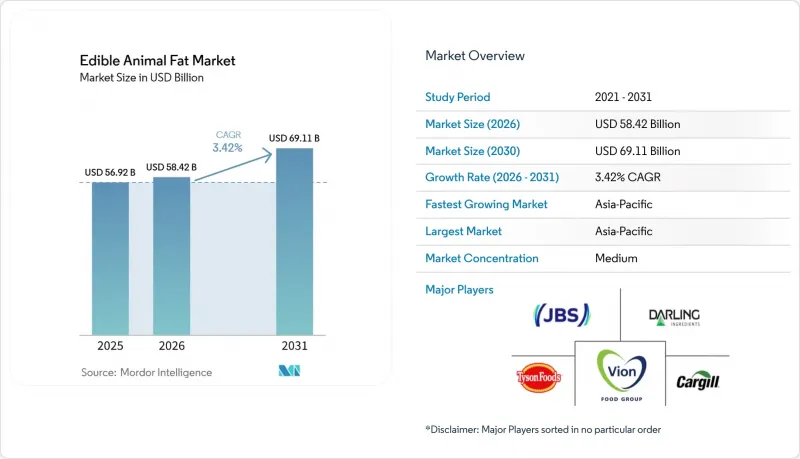
本報告按原料類型(奶油、動物脂肪、豬油、液態黃金及其他)、形態(固體/膏狀、液態)、類別(傳統、有機)、最終用戶(食品加工業、餐飲服務業、零售業)和地區(北美、歐洲、亞太、南美、中東和非洲)進行細分。市場預測以美元計價。
全球食用動物脂肪市場趨勢與洞察
烘焙和糕點產品的功能優勢
食用動物脂肪在烘焙和糕點產品中的廣泛應用,因其在改善質地、風味和產品品質方面的卓越表現,正推動著市場成長。奶油、豬油和動物脂肪等原料具有極佳的可塑性,能夠使糕點形成層次分明的組織,蛋糕口感鬆軟,烘焙點心入口即化。豬油尤其因其能夠製作酥脆的派麵團和層次豐富的麵團而備受推崇,而奶油憑藉其濃郁的風味和香氣,仍然是高檔麵包、餅乾、可頌麵包和糖果甜點的首選原料。食品生產商和手工烘焙坊持續依賴動物脂肪來確保產品品質的穩定性和加工效率。消費者對高檔烘焙點心和傳統配方的日益青睞,也進一步推高了對傳統油脂的需求。
食譜改進項目中對潔淨標示食用油的需求不斷成長
隨著人們對潔淨標示食品的關注度日益提高,製造商被鼓勵使用易於識別、加工最少的原料來重新調整配方,這進一步推高了食用動物脂肪的需求。奶油、豬油和牛油等傳統脂肪正擴大被納入配方改進項目中,作為人工添加劑和高度加工脂肪成分的替代品。這種轉變源自於消費者對成分更簡單、更透明的產品的偏好。例如,美國烘焙協會承諾在2025年11月停止在烘焙點心中使用FD&C認證的色素,這反映了整個行業向更清潔配方發展的趨勢。此外,根據化學商業研究所(CBI)的一項調查,潔淨標示產品的產品系列佔有率預計將從2021年的52%成長到2025年和2026年的70%以上。隨著食品製造商在烘焙、加工食品和乳製品等領域擴大潔淨標示的投入,天然來源的食用動物脂肪的使用量預計將會增加。
人們對飽和脂肪酸和膽固醇的認知仍然阻礙著需求。
消費者對飽和脂肪酸和膽固醇健康影響的擔憂持續限制食用動物脂肪的普及。人們對心血管健康和文明病的認知不斷提高,促使許多消費者減少攝取被認為飽和脂肪酸含量高的食物。因此,食品生產商正不斷調整產品配方,添加植物油和其他通常被視為更健康的替代品。此外,許多國家的公共衛生建議和營養指南都提倡適量攝取飽和脂肪酸,這影響消費者的購買決策。這種意識尤其影響注重健康的消費者對低脂和有益心臟健康的食品的需求。此外,消費者對動物脂肪的負面態度也給那些希望在健康食品領域擴大市場佔有率的生產商帶來了挑戰。
細分市場分析
到2025年,奶油將佔食用動物脂肪市場銷售額的47.11%,成為最大的原料,這主要歸功於其在食品加工和餐飲服務業的廣泛應用。烘焙、糖果、乳製品和即食食品行業對奶油的強勁需求支撐了其市場主導地位,因為奶油能夠提升食品的風味、質地和品質。與合成脂肪和高度加工的替代品相比,奶油因其天然風味和「潔淨標示」的吸引力而廣受消費者青睞。高階烘焙點心、糕點、甜點和高檔乳製品的消費量不斷成長,進一步鞏固了奶油在市場上的主導地位。
預計到2031年,豬油將以4.93%的複合年成長率高速成長,這主要得益於其在食品製造和特色烹飪領域的應用日益廣泛。消費者對傳統烹飪方法和道地地方美食的興趣日益濃厚,推動了烘焙、肉類加工和油炸等領域對豬油需求的復甦。食品製造商也利用豬油來改善糕點、派餅、餅乾和加工肉品肉製品的質地、層次感和風味。生酮飲食、原始人飲食和高脂肪飲食在多個市場的流行,進一步促進了包括豬油在內的動物脂肪的使用。
固體/膏狀油脂市場取得了雙重成功,預計到2025年將佔據63.21%的市場佔有率,並以4.93%的複合年成長率保持領先地位直至2031年,這清晰地表明食品行業對結構性油脂在質地和功能性方面的持續依賴。這種主導地位體現了食品科學的基本原理,因為固體油脂為烘焙點心、糖果甜點和加工肉品提供了液態替代品無法取代的重要結構特性。製造商對能夠不受溫度變化或儲存條件影響而保持穩定的油脂的需求日益成長,這進一步推動了對具有可預測性能特徵的固體和膏狀油脂的需求。
同時,液態動物脂肪已被用於油炸、生物柴油生產和工業流程等特殊應用,在這些應用中,流動性和傳熱性能比結構功能更為重要。整個動物油脂加工產業的脂肪回收和精煉技術的進步提高了液態脂肪的品質,拓展了其在可再生燃料生產中的應用前景。 2025年2月,Coast Packing公司位於德克薩斯德克薩斯州阿馬裡洛市的新工廠投資6000萬美元,旨在擴大面向家庭和商用市場的動物油脂起酥油的生產,這表明市場對固體油脂的需求持續存在。市場區隔越來越反映出對最終用途的最佳化,製造商現在根據特定的功能需求而非傳統偏好來選擇產品形態。
區域分析
預計到2025年,亞太地區將佔據動物脂肪市場40.22%的佔有率,並在2031年之前保持5.67%的複合年成長率。這將使該地區擁有最大的市場規模和最快的區域擴張速度。中國、東南亞和日本在烹飪和食品生產中大量使用豬油和其他動物脂肪,支撐著該地區的動物脂肪市場。在日本,由於煉製廠原料持續短缺,預計2025年初豬油的供應將最為緊張,批發價格將達到每15公斤5765日圓(約每15公斤38美元)。在印度,收入水準的提高推動了烘焙和高階包裝食品產業的擴張,為進一步成長提供了途徑。在香港,廚師們正在積極推廣豬油在廚房中的復興,這增加了對高階產品的需求,並確立了豬油在高價值食品和飲料管道中的應用。
歐洲仍然是動物脂肪市場的成熟地區,法國、德國、義大利、西班牙和荷蘭是奶油、牛油和豬油的主要生產國和消費國。香腸製作、糕點和加工肉品等傳統用途繼續支撐著該地區的需求。更嚴格的法規也在改變供應格局。歐盟法規 (EC) 1069/2009 的 2026 年修訂版將要求動物脂肪加工廠持續保存關鍵控制點 (CCP) 數據的數位化記錄,並建立更嚴格的可追溯性文件。雖然這項要求會增加小規模加工商的合規成本,但它也將提高高階食品買家和出口客戶日益重視的檢驗記錄品質。在南美洲,巴西和阿根廷是中心,其大規模的牛肉和豬肉生產系統提供了大量的動物脂肪供應。 Minerva Foods 透過整合以 57 億巴西幣(約 10 億美元)收購的 13 家 Marfrig 工廠,大幅擴大了這項供應基礎。因此,七個國家 46 個工業設施的每日總合加工能力增加到 41,789牛和 25,716 隻羊。
中東和非洲仍然是動物油脂市場中規模最小的區域市場,但其清真認證奶油和奶油的供應鏈仍蘊藏著巨大的商機。沙烏地阿拉伯、阿拉伯聯合大公國和南非是重要的需求中心,這得益於餐飲服務業的成長、加工食品消費量的增加以及消費者對清真高階食品日益成長的興趣。 JBS 已抓住這一機遇,在中東投資 1.5 億美元建立了一個多蛋白產業中心,其中包括牛肉和羊肉加工。出口商還需要滿足海灣標準化組織 (GSO) 和 SANHA 等機構制定的清真要求,因此認證在採購中日益成為一項重要的選擇標準。這些要求有利於那些擁有規模、合規能力和穩定區域分銷網路的供應商。
其他好處:
- Excel格式的市場預測(ME)表
- 3個月的分析師支持
目錄
第1章:引言
- 研究假設和市場定義
- 調查範圍
第2章:調查方法
第3章執行摘要
第4章 市場狀況
- 市場概覽
- 市場促進因素
- 適用於烘焙和糕點店的功能優勢
- 產品精煉專案中對潔淨標示油脂的需求不斷成長。
- 零浪費渲染和產品有效利用
- 擴大耐熱油脂在食品服務業的使用
- 傳統和古代食品的優質化和定位
- 更嚴格的可追溯性要求使精煞車物脂肪比混合產品更具優勢。
- 市場限制因素
- 人們對飽和脂肪酸和膽固醇的認知仍然限制了市場需求。
- 使用植物油和酯交換油的替代壓力
- 牲畜和加工原料的供應情況波動很大。
- 由於香氣和風味的差異,混合受到限制。
- 供應鏈分析
- 監理情勢
- 技術展望
- 波特五力模型
第5章 市場規模與成長預測
- 依原料類型
- 奶油
- 脂
- 豬油
- 液態黃金
- 其他成分類型
- 按形式
- 固態/膏狀
- 液體
- 按類別
- 傳統的
- 有機的
- 最終用戶
- 食品加工業
- 麵包店
- 糖果糕餅
- 鹹味零食
- 其他
- 食品服務業
- 零售
- 食品加工業
- 按地區
- 北美洲
- 美國
- 加拿大
- 墨西哥
- 其他北美國家
- 歐洲
- 德國
- 英國
- 義大利
- 法國
- 西班牙
- 荷蘭
- 其他歐洲國家
- 亞太地區
- 中國
- 印度
- 日本
- 澳洲
- 其他亞太國家
- 南美洲
- 巴西
- 阿根廷
- 其他南美國家
- 中東和非洲
- 南非
- 沙烏地阿拉伯
- 阿拉伯聯合大公國
- 其他中東和非洲國家
- 北美洲
第6章 競爭情勢
- 市場集中度
- 策略趨勢
- 市佔率分析
- 公司簡介
- Darling Ingredients
- Tyson Foods, Inc.
- Cargill, Incorporated
- JBS SA
- Vion Food Group
- West Coast Reduction
- Saria Group
- Bunge Limited
- Minerva Foods
- Cooperl Arc Atlantique
- NH Foods
- Marfrig
- Smithfield Foods
- Los Angeles Rendering
- Colyer Fehr
- MOPAC
- Coast Packing
- AAK AB
- Veos Group
- Innova Flavors(Griffith Foods)
第7章 市場機會與未來展望
According to Mordor Intelligence, the edible animal fat market size is expected to grow from USD 56.92 billion in 2025 to USD 58.42 billion in 2026 and is forecast to reach USD 69.11 billion by 2031 at 3.42% CAGR over 2026-2031.
This report is Segmented by Ingredient Type (Butter, Tallow, Lard, Liquid Gold, Others), Form (Solid and Paste, Liquid), Category (Conventional and Organic), End-User (Food Processing Industry, Foodservice, Retail), and Geography (North America, Europe, Asia-Pacific, South America, Middle East and Africa). The Market Forecasts are Provided in Terms of Value (USD).
Global Edible Animal Fat Market Trends and Insights
Functional superiority in bakery and pastry applications
The widespread use of edible animal fats in bakery and pastry products is supporting market growth due to their superior performance in enhancing texture, flavor, and product quality. Ingredients such as butter, lard, and tallow provide excellent plasticity, creating flaky layers in pastries, tender crumbs in cakes, and improved mouthfeel in baked goods. Lard, in particular, is valued for producing crisp pie crusts and laminated doughs, while butter remains a preferred ingredient in premium breads, cookies, croissants, and confectionery products because of its rich flavor and aroma. Food manufacturers and artisan bakeries continue to rely on animal fats to achieve consistent product quality and processing efficiency. The growing consumer preference for premium baked goods and authentic recipes has further increased demand for traditional fat ingredients.
Rising demand for clean-label fats in reformulation projects
The increasing focus on clean-label food products is encouraging manufacturers to reformulate recipes using recognizable and minimally processed ingredients, creating greater demand for edible animal fats. Traditional fats such as butter, lard, and tallow are increasingly being incorporated into reformulation projects as alternatives to artificial additives and highly processed fat ingredients. This shift is supported by changing consumer preferences for products with shorter and more transparent ingredient lists. For instance, the American Baking Association's November 2025 pledge to remove certified FD&C colors from baked goods reflects the broader industry movement toward cleaner formulations. Furthermore, according to research by the CBI Ministry of Foreign Affairs, clean-label products are projected to account for more than 70% of product portfolios during 2025 and 2026, up from 52% in 2021. As food manufacturers expand clean-label initiatives across bakery, processed foods, and dairy applications, the use of naturally derived edible animal fats is expected to increase.
Saturated fat and cholesterol perception remains a demand ceiling
Consumer concerns regarding the health effects of saturated fat and cholesterol continue to limit the widespread adoption of edible animal fats. Growing awareness of cardiovascular health and lifestyle-related diseases has encouraged many consumers to reduce the consumption of foods perceived to be high in saturated fats. As a result, food manufacturers are increasingly reformulating products with vegetable oils and other alternatives that are often viewed as healthier options. Public health recommendations and nutritional guidelines in many countries also advocate moderation in the intake of saturated fats, influencing purchasing decisions. This perception has particularly affected demand among health-conscious consumers seeking low-fat or heart-friendly food products. In addition, negative consumer attitudes toward animal-based fats create challenges for manufacturers attempting to expand their presence in wellness-focused food categories.
Other drivers and restraints analyzed in the detailed report include:
- Zero-waste rendering and byproduct valorization
- Expanding foodservice use of high-heat stable fats
- Substitution pressure from vegetable oils and interesterified fats
For complete list of drivers and restraints, kindly check the Table Of Contents.
Segment Analysis
Butter accounted for 47.11% of the edible animal fat market revenue in 2025, making it the largest ingredient type due to its widespread use across food processing and foodservice applications. Its dominant position is supported by strong demand from the bakery, confectionery, dairy, and ready-to-eat food industries, where it enhances flavor, texture, and product quality. Butter is also widely preferred by consumers for its natural taste and clean-label appeal compared to synthetic or highly processed fat alternatives. Growing consumption of premium baked goods, pastries, desserts, and gourmet dairy products continues to reinforce its market leadership.
Lard is projected to register the fastest CAGR of 4.93% through 2031, driven by its expanding use in food manufacturing and specialty culinary applications. Increasing consumer interest in traditional cooking methods and authentic regional cuisines is contributing to renewed demand for lard in bakery, meat processing, and frying applications. Food manufacturers are also utilizing lard to improve texture, flakiness, and flavor in products such as pastries, pies, biscuits, and processed meat items. The growing popularity of ketogenic, paleo, and high-fat dietary patterns in several markets has further encouraged the use of animal-based fats, including lard.
The solid/paste segment's dual achievement of 63.21% market share in 2025 and 4.93% CAGR leadership through 2031 underscores the food industry's continued reliance on structured fats for texture and functionality. This format's dominance reflected core food science principles, as solid fats provided essential structural properties in baked goods, confectionery, and processed meats that liquid alternatives could not replicate. Manufacturers increasingly required fats that remained stable across temperature variations and storage conditions, supporting demand for solid/paste formats with predictable performance characteristics.
Liquid animal fats served specialized applications in frying operations, biodiesel production, and industrial processes where flowability and heat transfer properties took priority over structural functionality. Technological advances in fat recovery and purification across the rendering industry improved liquid fat quality and expanded application opportunities in renewable fuel production. In February 2025, Coast Packing's new USD 60 million facility in Amarillo, Texas, was expected to target increased production of animal fat shortenings for both home and commercial channels, indicating sustained demand for solid formats. Form segmentation increasingly reflected end-use optimization, with manufacturers selecting formats based on specific functional requirements rather than traditional preferences.
Complete Report Scope:
- By Ingredient Type
- Butter
- Tallow
- Lard
- Liquid Gold
- Other Ingredient Types
- By Form
- Solid and Paste
- Liquid
- By Category
- Conventional
- Organic
- 5.4 By End-User
- Food Processing Industry
- Bakery
- Confectionery
- Savory Snacks
- Others
- Foodserivce
- Retail
- Food Processing Industry
- By Geography
- North America
- United States
- Canada
- Mexico
- Rest of North America
- Europe
- Germany
- United Kingdom
- Italy
- France
- Spain
- Netherlands
- Rest of Europe
- Asia-Pacific
- China
- India
- Japan
- Australia
- Rest of Asia-Pacific
- South America
- Brazil
- Argentina
- Rest of South America
- Middle East and Africa
- South Africa
- Saudi Arabia
- United Arab Emirates
- Rest of Middle East and Africa
- North America
Geography Analysis
Asia-Pacific accounted for 40.22% of the animal edible fat market share in 2025 and is projected to register a CAGR of 5.67% through 2031, giving it the largest base and the fastest regional expansion. Heavy use of pork and other animal fats in Chinese, Southeast Asian, and Japanese cooking and food manufacturing supports the animal edible fat market in the region. Japan is expected to show the tightest supply conditions, with wholesale lard prices reaching JPY 5,765 per 15 kg can, or USD 38 per 15 kg, in early 2025 as raw material shortages continue at rendering facilities. India adds another growth avenue as its bakery and premium packaged food sectors expand amid improving income levels. In Hong Kong, chefs have actively supported a culinary return to rendered pork fat, strengthening premium demand and helping normalize lard use in higher-value dining channels.
Europe remains a mature part of the animal edible fat market, with France, Germany, Italy, Spain, and the Netherlands serving as major producing and consuming countries for butter, tallow, and lard. Traditional use in sausage making, pastry, and prepared meats continues to support regional demand. Regulatory tightening is also changing the supply landscape, as the 2026 amendment to EU Regulation (EC) 1069/2009 will require continuous digital CCP data logging and stronger traceability documentation at rendering facilities. This requirement raises compliance costs for smaller processors, but it also improves the verification record that premium food buyers and export customers increasingly require. South America centers on Brazil and Argentina, where large beef and pork systems create substantial rendered fat supply. Minerva Foods materially expanded this base after integrating 13 Marfrig plants acquired for BRL 5.7 billion, or USD 1.0 billion, increasing combined daily processing capacity to 41,789 cattle and 25,716 sheep across 46 industrial units in 7 countries.
The Middle East and Africa remain the smallest regional segment in the animal edible fat market, but they continue to offer opportunities in halal-certified tallow and butter supply chains. Saudi Arabia, the United Arab Emirates, and South Africa are the key demand centers, supported by foodservice growth, rising processed food use, and broader interest in halal premium foods. JBS supported this opportunity with a USD 150 million investment in a multiprotein hub in the Middle East that includes beef and lamb processing. Exporters also need to meet halal requirements from bodies such as the Gulf Standards Organization and SANHA, making certification an increasingly important procurement filter. These requirements favor suppliers that can combine scale, compliance discipline, and steady regional distribution.
- Darling Ingredients
- Tyson Foods, Inc.
- Cargill, Incorporated
- JBS S.A.
- Vion Food Group
- West Coast Reduction
- Saria Group
- Bunge Limited
- Minerva Foods
- Cooperl Arc Atlantique
- NH Foods
- Marfrig
- Smithfield Foods
- Los Angeles Rendering
- Colyer Fehr
- MOPAC
- Coast Packing
- AAK AB
- Veos Group
- Innova Flavors (Griffith Foods)
Additional Benefits:
- The market estimate (ME) sheet in Excel format
- 3 months of analyst support
TABLE OF CONTENTS
1 INTRODUCTION
- 1.1 Study Assumptions and Market Definition
- 1.2 Scope of the Study
2 RESEARCH METHODOLOGY
3 EXECUTIVE SUMMARY
4 MARKET LANDSCAPE
- 4.1 Market Overview
- 4.2 Market Drivers
- 4.2.1 Functional superiority in bakery and pastry applications
- 4.2.2 Rising demand for clean-label fats in reformulation projects
- 4.2.3 Zero-waste rendering and byproduct valorization
- 4.2.4 Expanding foodservice use of high-heat stable fats
- 4.2.5 Premiumization of heritage and traditional food positioning
- 4.2.6 Tightening traceability requirements favors rendered animal fats over blends
- 4.3 Market Restraints
- 4.3.1 Saturated fat and cholesterol perception remains a demand ceiling
- 4.3.2 Substitution pressure from vegetable oils and interesterified fats
- 4.3.3 Volatile livestock and rendering input supply
- 4.3.4 Formulation constraints from odor and flavor drift
- 4.4 Supply Chain Analysis
- 4.5 Regulatory Landscape
- 4.6 Technological Outlook
- 4.7 Porter's Five Forces
- 4.7.1 Threat of New Entrants
- 4.7.2 Bargaining Power of Suppliers
- 4.7.3 Bargaining Power of Buyers
- 4.7.4 Threat of Substitutes
- 4.7.5 Intensity of Competitive Rivalry
5 MARKET SIZE AND GROWTH FORECASTS (VALUE)
- 5.1 By Ingredient Type
- 5.1.1 Butter
- 5.1.2 Tallow
- 5.1.3 Lard
- 5.1.4 Liquid Gold
- 5.1.5 Other Ingredient Types
- 5.2 By Form
- 5.2.1 Solid and Paste
- 5.2.2 Liquid
- 5.3 By Category
- 5.3.1 Conventional
- 5.3.2 Organic
- 5.4 5.4 By End-User
- 5.4.1 Food Processing Industry
- 5.4.1.1 Bakery
- 5.4.1.2 Confectionery
- 5.4.1.3 Savory Snacks
- 5.4.1.4 Others
- 5.4.2 Foodserivce
- 5.4.3 Retail
- 5.4.1 Food Processing Industry
- 5.5 By Geography
- 5.5.1 North America
- 5.5.1.1 United States
- 5.5.1.2 Canada
- 5.5.1.3 Mexico
- 5.5.1.4 Rest of North America
- 5.5.2 Europe
- 5.5.2.1 Germany
- 5.5.2.2 United Kingdom
- 5.5.2.3 Italy
- 5.5.2.4 France
- 5.5.2.5 Spain
- 5.5.2.6 Netherlands
- 5.5.2.7 Rest of Europe
- 5.5.3 Asia-Pacific
- 5.5.3.1 China
- 5.5.3.2 India
- 5.5.3.3 Japan
- 5.5.3.4 Australia
- 5.5.3.5 Rest of Asia-Pacific
- 5.5.4 South America
- 5.5.4.1 Brazil
- 5.5.4.2 Argentina
- 5.5.4.3 Rest of South America
- 5.5.5 Middle East and Africa
- 5.5.5.1 South Africa
- 5.5.5.2 Saudi Arabia
- 5.5.5.3 United Arab Emirates
- 5.5.5.4 Rest of Middle East and Africa
- 5.5.1 North America
6 COMPETITIVE LANDSCAPE
- 6.1 Market Concentration
- 6.2 Strategic Moves
- 6.3 Market Share Analysis
- 6.4 Company Profiles (includes Global level Overview, Market level overview, Core Segments, Financials as available, Strategic Information, Market Rank/Share for key companies, Products and Services, and Recent Developments)
- 6.4.1 Darling Ingredients
- 6.4.2 Tyson Foods, Inc.
- 6.4.3 Cargill, Incorporated
- 6.4.4 JBS S.A.
- 6.4.5 Vion Food Group
- 6.4.6 West Coast Reduction
- 6.4.7 Saria Group
- 6.4.8 Bunge Limited
- 6.4.9 Minerva Foods
- 6.4.10 Cooperl Arc Atlantique
- 6.4.11 NH Foods
- 6.4.12 Marfrig
- 6.4.13 Smithfield Foods
- 6.4.14 Los Angeles Rendering
- 6.4.15 Colyer Fehr
- 6.4.16 MOPAC
- 6.4.17 Coast Packing
- 6.4.18 AAK AB
- 6.4.19 Veos Group
- 6.4.20 Innova Flavors (Griffith Foods)
7 MARKET OPPORTUNITIES AND FUTURE OUTLOOK

 脂肪酸氯化物:全球市場佔有率和排名、總收入和需求預測(2026-2032年)
 食用動物脂肪市場規模、佔有率和趨勢分析報告:按類型、應用、地區和細分市場預測(2026-2033 年)
 脂肪酸:市佔率分析、產業趨勢及統計、成長預測(2026-2031)
 食用動物奶油市場規模、佔有率和成長分析:按原料、脂肪含量、應用、分銷管道、包裝類型和地區分類-2026-2033年產業預測
 牛油脂肪酸市場:按類型、等級、製程、應用和銷售管道分類-2026-2032年全球市場預測飽和脂肪酸市場:按類型、形態、原料、生產流程、應用和分銷管道分類-2026-2032年全球市場預測脂肪酸市場:依類型、原料、形態、應用、最終用戶和通路分類-2026-2032年全球市場預測椰子脂肪酸市場:全球市場依產品類型、形態、通路和最終用途產業分類的預測-2026-2032年
 全球脂肪酸市場:市場規模、佔有率、趨勢和成長分析(2026-2034)
 十一烯酸市場規模、佔有率和成長分析:按等級、應用、最終用途、通路和地區分類-2026-2033年產業預測